

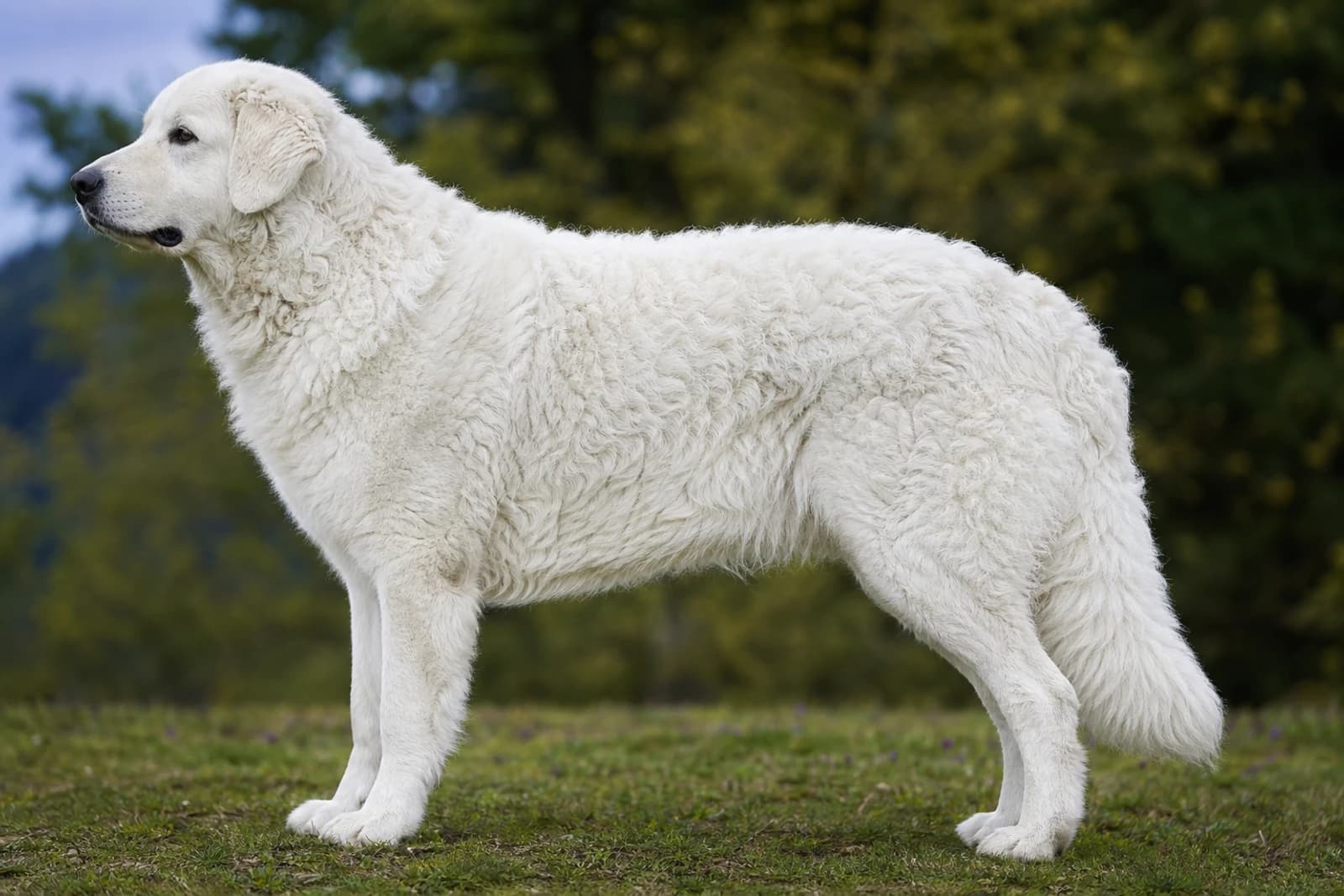
The Kuvasz is a majestic, giant-sized guardian dog from Hungary, instantly recognizable by its gleaming white coat. Bred to protect livestock and estates, this breed is fiercely loyal, courageous, and protective, forming deep bonds with its family. Gentle and patient with children they are raised with, the Kuvasz thrives with an experienced owner who can provide firm, consistent training and early socialization. Not for novice dog owners, this independent breed requires plenty of space, regular exercise, and a job to do. With the right guidance, the Kuvasz is a devoted and reliable companion.
At a glance
- Size
- Giant
- Height
- 26–30 in
- Weight
- 71–115 lb
- Life span
- 10–12 years
- Coat colors
- white
- Coat type
- Double, medium-length, straight to wavy
- Group
- Working
- Origin
- Hungary
How much does a Kuvasz cost?
Adopt / rescue
$75–$400
Usually includes spay/neuter, first shots, and a microchip.
Buy from a breeder
$700–$2,000
From a reputable, health-testing breeder.
Approximate USD. Prices vary widely by region, breeder, pedigree, age, and coat colour — adopting is the lower-cost and recommended route. Avoid suspiciously cheap “breeders”; they’re often puppy mills.
Estimate the full cost of a Kuvasz →Kuvasz photos
Views
Front, side, rear and top — the full silhouette.Poses
How the breed sits, lies, moves and plays.Puppy to senior
The breed across its whole life.Expressions
The breed’s range of moods.Close-up details
Eyes, ears, nose, paws, tail and coat.Coat colors
The breed’s recognized colors.Click any photo to enlarge. We show the Kuvasz from every angle — three views, poses, life stages, expressions, close-ups, coat and colors.
Appearance & size
The first thing you notice about a Kuvasz is the sheer scale. Males hit 28 to 30 inches at the shoulder and tip the scales at 100 to 115 pounds; females run 26 to 28 inches and 70 to 90 pounds. That weight sits on a frame that’s slightly longer than tall—more rectangular than square—giving the dog a ground-covering stride without any trace of bulkiness. The bone is substantial but clean, and the muscles lie flat and hard, especially in the shoulder and thigh.
That white coat is the breed’s signature. It’s a full double coat: a dense, woolly undercoat beneath a coarser outer coat that falls straight or with a subtle wave. Run your hand through it and the texture feels crisp, never silky or soft. A heavy mane frames the neck and chest, especially pronounced in males, while feathering brushes the backs of the forelegs, the thighs, and the tail. The only allowable color is white, though you might see ivory or pale cream shading on the ears, and that’s fine. Underneath it all, the skin is dark slate gray—pigment you can spot through thinner areas like the belly and inside the thighs.
The head is wedge-shaped and lean, dry without excess skin. The eyes are dark brown, almond-shaped, and set just slightly oblique; black rims make them pop against the white face. The ears are V-shaped with softly rounded tips, set high and hanging close to the head. A black nose, black lips, and black eye rims complete the crisp, high-contrast look—on a solid white dog, that dark pigment is a defining feature and a sign of good pigment health.
From the front, the chest appears broad and deep, with straight, well-boned forelegs and tight, round paws that have webbed toes. From the side, you see a level topline, a brisket that drops to the elbows, and a moderate tuck-up in the belly—athletic, not wasp-waisted. The neck rises muscular and slightly arched from well-laid-back shoulders. Move to the rear and the thighs are well-developed, the stifles moderately angulated, and the rear pasterns vertical. The tail hangs down to at least the hock at rest, carried low with a slight upward flick at the tip. When the dog is alert, the tail lifts but never curls over the back. The whole animal reads as a big, white, weatherproof guardian built to cover rough ground all day, rain and snow beading off that dense coat.
History & origin
The Kuvasz has been watching over flocks on the Hungarian plains for well over a thousand years. When the Magyar tribes swept into the Carpathian Basin around the 9th century, they brought with them large, white guardian dogs — likely descendants of the same Tibetan mastiff-type stock that gave us the Great Pyrenees and Akbash. Those dogs became the foundation of the breed you see today.
For centuries, the Kuvasz was the shepherds’ first line of defense. On the open puszta, a dog that blended in with the sheep held a massive advantage: a white coat made it hard for wolves and bears to single out the guardian until it was already on top of them. And at 71 to 115 pounds, standing as tall as 30 inches, a Kuvasz could back up that surprise with real force. The dogs worked independently, often ranging miles from the shepherd, making life-or-death decisions about what was a threat and what was just bad weather. That ancient wiring — cool judgment, unflinching courage, and a deep suspicion of anything unusual — is still fully intact in the breed.
By the 15th century, the Kuvasz had caught the attention of Hungarian nobility. King Matthias Corvinus kept a whole kennel of them and famously trusted his dogs more than his palace guards. For a few hundred years, the breed straddled two worlds: a no-nonsense livestock protector by day and a companion to royalty. That almost proved its undoing. Both World Wars decimated the breed. The dogs were shot on sight by invading troops who knew a 100-pound guardian dog could and would challenge armed soldiers. After World War II, only a handful of Kuvasz remained in Hungary. Dedicated breeders painstakingly rebuilt the population from fewer than 30 surviving individuals.
Even today, the Kuvasz is not a dog you’ll meet at every dog park. The same independence and territorial instinct that kept flocks alive for a millennium makes the breed a challenging fit for casual pet homes — and responsible breeders still screen for those working traits.
Temperament & personality
A Kuvasz is a big, clear-thinking dog that doesn’t hand out trust like candy. He was bred to guard livestock and property without a human telling him what to do every second, so he sizes up people and situations on his own. With his immediate family, he’s laid-back and surprisingly gentle—often leaning into your leg or resting his head in your lap. With strangers, he’s reserved and watchful, not hostile without reason, but absolutely ready to step between you and anything he sees as a threat. That independence makes him a terrible choice for a first-time dog owner or a home that expects blind, biddable obedience. You earn his cooperation with calm, consistent leadership; punishment or heavy-handed corrections just turn him stubborn or defensive.
Inside the house, expect a quiet, watchful presence. He’s not a hyper dog, but he’s got real stamina when he’s on patrol, so a daily hour of running or long, hilly walks—plus a securely fenced yard to roam—keeps his body and brain satisfied. Without that outlet, boredom can slide into anxious habits like nonstop barking or destructive chewing. Puppies chew to ease teething pain, and adults gnaw hard objects to keep their jaws strong; a homemade citrus spray or a vinegar-water mix can save your furniture, but it’s no substitute for enough exercise and tough, safe chews.
This breed’s territorial nature means scent marking often shows up indoors if you don’t stay ahead of it. A male might urinate on a spot that smells like a previous accident or a less-frequented room that doesn’t carry the family’s scent strongly enough. Enzymatic cleaners that obliterate the odor, not just mask it, are your first line of defense. And reward him immediately after he goes outside—not punishment—so he connects the outdoors with a good payoff. Quirks like rolling in dead things or particularly ripe dirt probably trace back to his scavenger roots; some dogs just seem to enjoy the stink like a person enjoys perfume. Accept it or keep a long line handy during walks in smelly areas.
With children, a well-socialized Kuvasz is patient and protective, but his size alone (71–115 pounds) means a young child can get bowled over by a happy turn. He also has a dose of food-guarding instinct that shows up early. Never let anyone interrupt him while he’s eating, and teach kids that his mealtime is hands-off. That one habit prevents more tension than months of correction later. Read his body language—a forward lean and a stiff stare aren’t confidence, they’re a warning, while a loose body and soft eyes tell you he’s truly at ease. If you can provide clear rules, real work to do, and the respect he gives right back, you’ll have a steady, devoted dog who doesn’t need to be told you’re his whole world.
Good with kids, dogs & other pets
Kids
A well-socialized Kuvasz brings serious patience to the kid table — these are dogs with a naturally non-aggressive, steady temperament. You aren’t getting a pushover, but you are getting a 71–115-pound animal, so supervision around toddlers and small children isn’t a suggestion; it’s a safety requirement. A happy wag of the tail can knock over a two-year-old, and a young Kuvasz’s playful zoomies in the living room don’t mix with a child crawling on the floor.
Teach your kids the ground rules early: no climbing on the dog, no grabbing at the face, and leave the dog alone while it’s eating or resting. In return, you’ll see a dog that instinctively keeps an eye on its little humans and settles into a calm, protective presence. The Kuvasz’s strong bond with family means he isn’t a backyard-only pet. When shut away from the household for long stretches, he can become stressed and vocal, which directly affects his behavior around kids.
Other dogs
The Kuvasz was bred to work independently and make quick decisions about threats, so expecting him to be a dog-park social butterfly usually backfires. Instead, focus on careful, early introductions. The most critical window slams shut around 12–16 weeks, but the groundwork gets laid from 3 weeks onward. Expose your puppy gradually to a handful of neutral, calm adult dogs in controlled settings. Let him learn that not every dog is a problem to be managed.
Even with stellar socialization, many Kuvaszok — especially males — grow up selective about other dogs, particularly same-sex ones. Forced greetings with strange dogs at a park can trigger defensive posturing rather than play. You’re better off with structured walks and one-on-one playdates. If you already have another dog, raising a Kuvasz puppy alongside a stable adult often works well, but bringing a new adult dog into a home with a mature Kuvasz demands a slow, supervised integration over weeks, not days.
Cats and small pets
A Kuvasz puppy raised with a house cat or pocket pet usually learns to accept that animal as part of the flock. But don’t mistake tolerance for a free pass — this is a giant working breed, and a squirrel dashes across the yard differently than a cat he’s known since he was 8 weeks old. Indoor cats and the Kuvasz can coexist peacefully if you never leave them unsupervised in tight quarters and you reward calm, disengaged behavior around the cat from day one.
Smaller outdoor pets like chickens or rabbits need secure, separate housing. Some Kuvaszok do mature into trustworthy farm guardians, but that depends heavily on puppyhood exposure and the individual dog’s temperament. Relying on instinct without months of supervised, positive repetitions is asking for a dead animal and a confused dog that was just doing what his job title suggests.
Trainability & intelligence
A Kuvasz doesn’t train like a Labrador. This is a quick-witted, deliberate guardian bred to work alone and make decisions without a human giving orders. He learns new behaviors fast — sometimes startlingly fast — but obedience is never automatic. He’ll weigh a command against his own judgment before deciding whether to comply. If you treat that as stubbornness and reach for a firm hand, you’ll wreck the trust that makes him safe to live with.
The only approach that works is reward-based and relationship-first. Praise, a tug session, or a slice of hot dog at the right instant reinforces the behavior you want — and preserves the bond. Punishment, corrections, or intimidation backfire badly. A Kuvasz doesn’t forget rough treatment; he may shut down or respond with avoidance, and an anxious 100-pound dog with stranger-wariness is a serious liability. You need a dog who trusts you, not one who fears you, because you can’t physically force a giant who decides he’s done listening.
- Start young, stay consistent. Begin simple cue work and handling exercises the week the pup comes home. Keep sessions short and end on a win.
- Socialization before 16 weeks is non-negotiable. Expose the puppy gently to different people, sounds, surfaces, and calm new dogs. Don’t flood him — one positive experience at a time builds a confident adult who doesn’t default to suspicion.
- Expect a dance around recall. Off-leash reliability takes months of layered rewards in low-distraction areas before you even think about testing it near a strange dog or a fence line. His instinct is to patrol and problem-solve, not to check in like a retriever. Many owners keep a long line on for years.
Because the Kuvasz is sensitive, training pressure looks different than with a high-drive herder. Raise your voice and you’ll see him disengage. Instead, let him figure out what earns the reward — he’s smart enough to offer behaviors if you set up clear, predictable patterns. When he blows you off, ask yourself whether the environment was too much, not whether he’s being hard-headed. Back up, lower the difficulty, and pay him well for getting it right.
Raising a Kuvasz out of sheer frustration is how these dogs end up surrendered. Raised with patience, clear communication, and a mountain of positive reinforcement, you get a steady partner who watches your face before making a move — and that’s a dog you can trust with your family and your property.
Exercise & energy needs
A Kuvasz isn’t wired for a leisurely stroll around the neighborhood. This is a giant, free-thinking guardian bred to move across open land all night, watching for any threat. You’re looking at 60 to 90 minutes of true physical work every day, split into at least two sessions. One long ramble won’t do it—he needs that split to burn off steady, not frantic, energy and to keep his mind from inventing his own security patrols.
- Morning: 30–45 minutes of off-leash running (in a securely fenced area) or a long, snappy hike with plenty of sniffing.
- Evening: another brisk 30–40 minutes—a power walk pulling a cart, an advanced obedience session on a long line, or dragging a weighted sled on grass.
Walking politely on a short leash past mailboxes isn’t exercise for a Kuvasz. He’ll tolerate it, but he won’t be tired. The real sweet spot is purpose-driven activity where he’s using his brain and his brawn together: mushing or carting over varied terrain, tracking scents across a field, or protecting livestock if you have them. A bored Kuvasz left with just a backyard and a couple of tennis balls is the dog who’ll start barking at every leaf that moves and taking his guarding job far too seriously.
Mind work, not just muscle
Physical exhaustion alone isn’t the goal. Kuvaszok are independent problem-solvers, and mental exercise is just as critical. A 20-minute session of nose work (hiding a favorite toy or treat in the woods for him to find) can drain a surprising amount of energy. Puzzle toys with hidden kibble, pattern games, and short, reward-heavy training sessions that ask him to think—these sessions should be woven into the day. They also deepen your bond without direct confrontation, which matters for a breed that doesn’t respond well to heavy-handed repetition.
Guard those growing joints
With a giant deep-chested dog topping 100 pounds, respect the skeleton. No forced running on pavement, no high-impact jumping, and no repetitive pounding until growth plates close—typically around 18 to 24 months. Puppies get their movement through free play on grass and short, exploratory walks, not structured miles. Even with an adult, stick to soft surfaces when you can: trails, dirt, sand. Responsible breeders screen for hip and elbow dysplasia, and a sensible exercise plan you start now can help keep those joints sound into his double-digit years. Watch for overheating in summer; that thick white coat reflects sun but also holds heat, so shift exertion to cooler parts of the day.
If you’re skipping the morning hike or letting him “run it off” in the yard, you’ll pay the price in shredded patio furniture and a dog who decides the neighbor’s pickup truck is a threat at 2 a.m. Give a Kuvasz a genuine job—a weighted cart pull, a long tracking line through the pines, a purpose—and you’ll have a calm, watchful companion who’s ready to settle at your feet, not pace the fence.
Grooming & coat care
That gleaming white coat is a double-layer dirt-shedding machine — until the undercoat decides to let go. The Kuvasz has a medium-length, dense, slightly wavy outer coat and a softer underlayer that blows heavily a couple of times a year. Day to day, loose hair tends to tangle in the furnishings rather than fly everywhere, but ignoring it leads to mats along the chest, behind the ears, and in the feathering on the legs and tail.
Brushing
Grab a slicker brush and a wide-toothed steel comb or undercoat rake. Two to three sessions a week handles normal shedding. During spring and fall blowouts, plan on a quick daily comb-out to keep the hair tumbleweeds manageable and prevent painful mats from tightening against the skin. Pay careful attention to the thick ruff and the backs of the thighs, where tangles start easily. A slicker with rounded pins gets through the topcoat without scratching, and the comb checks your work. No scissoring or professional clipping needed — the breed’s coat is meant to stay natural — though you can trim the fur between the paw pads for better traction on slick floors.
Bathing
That white hair resists dirt surprisingly well, so you won’t be bathing constantly. Every 6–8 weeks, or when your dog has rolled in something unforgivable, is plenty. Over-bathing strips the coat’s natural oils and can turn it dull. Use a mild dog shampoo or a whitening formula; rinse thoroughly — soap residue trapped in the dense undercoat invites hot spots. Towel-dry vigorously and then let the dog air-dry in a warm, draft-free spot. Never leave the coat damp against the skin.
Nails, ears & teeth
Giant-breed nails grow fast. If you hear clicking on hard floors, break out a heavy-duty nail clipper or a grinder. Check the drop ears every week for wax buildup or redness — a quick wipe with a damp cotton ball is usually enough. Daily tooth brushing with a dog-safe paste keeps that big mouth healthy.
After any romp through brush or woods, run your hands over the coat to feel for ticks, burrs, or hidden cuts. A quick towel-off and a slicker once-over will restore that ivory gleam faster than you’d think.
Shedding & allergies
The Kuvasz sheds a steady stream of white hair year-round, and twice a year it really lets loose. You’ll find that fine, downy undercoat woven into furniture, dark clothing, and drifting into every corner of the house. This is a giant double-coated breed built for guarding sheep in the Hungarian mountains, not for keeping a clean house. The outer coat is coarse and straight, but the thick, soft undercoat is the main culprit. Daily brushing with a pin rake or slicker brush during spring and fall blowouts is non-negotiable—skip a few days and you'll have tumbleweeds of fur. Outside those peak shedding seasons, plan on a thorough brushing two or three times a week to stay ahead of the mess.
If anyone in the home has allergies, this is not the breed for you. No dog is truly hypoallergenic, and the Kuvasz is far from it. The sheer volume of shed hair, combined with the dander and protein-laden saliva, means a potential allergy trifecta. This breed also drools. Expect wet spots on your pants after a greeting, heavy slingers after drinking, and occasional strings of slobber hanging from those jowls. Regular grooming, a good vacuum, and keeping an off-limits bedroom might help slightly, but you'll be fighting a losing battle against that coat and the allergens that come with it.
Diet & nutrition
A Kuvasz stays sound longest when you keep him lean — extra pounds hammer those big joints and can set the stage for a lifetime of pain. Every meal is a chance to protect his hips and elbows.
From puppy chow to adult meals
Kuvasz puppies grow at an astonishing rate, so what you feed and how much matter enormously. A large-breed puppy formula keeps the pace slow and steady, which helps prevent the orthopedic problems this breed can be prone to. Until four months old, divide the daily portion into four evenly spaced meals; from four to six months, drop to three; after six months, two meals a day works for life. Around twelve weeks, raw chicken wings (supervised) offer a satisfying chew that supports dental health, but any new food should be introduced gradually — mix a little into the current diet over a week or two.
Real-world portions for a giant
An adult Kuvasz typically weighs anywhere from 71 to 115 pounds, and a moderately active dog often lands in the 4–6 cup range of high-quality dry food daily, split between morning and evening. That’s a starting point, not a rule. A dog who runs beside a tractor for hours obviously needs more fuel than a companion who patrols the yard a few times a day. The best gauge is hands-on: you should feel the ribs easily with a thin layer of flesh, and from above there should be a visible waist tuck. If the ribs disappear, cut back. If they’re stark, add a bit.
Because some Kuvaszok will inhale dinner in seconds, a food puzzle bowl is a cheap investment — it slows them down and gives that clever brain something to do. Avoid feeding from the table or handing out rich, fatty scraps; a single holiday binge can trigger pancreatitis in a large breed.
Home-prepared and senior adjustments
If you cook for your dog, aim for roughly 60% meat (raw or cooked), 20–30% fruits and vegetables, and 10% extras like eggs, pearl barley, or plain yogurt. Don’t be tempted by a vegetarian or vegan plan — a Kuvasz’s entire digestive system is built around meat, and skipping it robs him of nutrients he can’t synthesize on his own. Puréeing or blending the mix aids nutrient absorption, a handy trick for older dogs with tender gums. Canned fish (in water), cooked eggs, and batch-cooked grains keep weeknight meals simple.
As your Kuvasz moves into senior territory, his metabolism will likely slow. Rather than one big meal that sits heavy, try three smaller feedings. Keep a hard eye on the scale; even a few extra pounds on an aging frame accelerates arthritis. No drastic protein restriction is needed — just sensible, measured portions and a daily walk. When teeth go missing, blitzing the meal in a blender ensures every calorie counts.
Health & lifespan
A healthy Kuvasz typically lives 10 to 12 years, which is solid for a giant breed. You don’t get a decade-plus with a dog this size without paying close attention to a handful of well-known trouble spots. The big three are hips, elbows, and stomach.
Hip and elbow dysplasia are common in large, fast-growing dogs. You won’t see it in a puppy, but the wear-and-tear shows up as stiffness, trouble rising, or a wonky gait later on. Bloat (gastric dilatation-volvulus, or GDV) is the one that scares experienced owners. A deep chest like the Kuvasz’s makes the stomach vulnerable to twisting. If your dog retches without producing anything, paces restlessly, or goes stiff in the belly, get to a vet immediately—this can kill within hours.
Beyond joint and gut issues, the breed can be prone to hypothyroidism, progressive retinal atrophy (PRA), and cataracts. Osteosarcoma (bone cancer) also shows up more often in giant breeds, so limping that doesn’t improve with rest deserves a prompt X-ray. Skin allergies are not the first thing people mention, but a few lines do carry sensitive skin, so don’t ignore persistent itching or hotspots—diet and environment can play a real role.
Responsible breeders stack the deck in your favor. They screen breeding dogs with OFA or PennHIP radiographs for hips and elbows, eye exams by a board-certified veterinary ophthalmologist, and thyroid panels. They’ll happily show you the paperwork. No test erases risk entirely, but it pushes the odds toward a sounder dog.
Weight management is make-or-break. A lean frame takes pressure off growing joints and aging bones. You should feel ribs under a thin layer of flesh, not a layer of padding. Split meals into two feedings and avoid heavy exercise for an hour after eating to reduce bloat risk. Heartworm prevention is non-negotiable during mosquito season, and the rabies vaccine is a legal must that also protects you from an untreatable disease. Twice-yearly senior checkups catch subtle shifts—slower appetite, lagging on walks, a little more water consumption—before they turn into crises. With a giant breed, you don’t wait for a limp to become dramatic; you investigate early.
Living environment
If you live in an apartment or share a wall with neighbors, the Kuvasz is a terrible match. These giant, territorial guardians were bred to patrol open land and make independent decisions — not to lounge on a couch while you’re at work. A house with a large, securely fenced yard is non-negotiable. The fence needs to be at least 6 feet high and dig-proof. A Kuvasz will test boundaries, and an insecure yard turns into an escape hatch.
The breed’s thick white double coat handles snow and freezing temperatures beautifully. Many Kuvaszok genuinely enjoy sleeping outside on a chilly night. Hot, humid summers are a different story. In warm climates, expect to shift walks to early morning or late evening and provide constant shade, cool water, and air-conditioned indoor space. Overheating hits them hard.
Prepare for noise. A deep, booming bark comes standard — it’s how a Kuvasz announces its presence to everything from a delivery truck to a stray cat. Two or three alarm barks an hour might be the norm. That makes them a tough fit for close-in suburban lots or anywhere with noise restrictions, unless you’re committed to training calm settles and “enough” cues from day one.
When it comes to being left alone, this is not a breed you can shut in a room for ten hours and expect to come home to an intact sofa. They bond tightly to their people and need a job, even if that job is simply watching over the property. A lonely Kuvasz can channel boredom into nonstop barking, digging, or dismantling fences. A household where at least one person works from home or is around most of the day works best. If you have to leave for a few hours, build up alone time gradually and leave a frozen puzzle toy or a scent game to engage that big brain.
Exercise is what holds the whole picture together. Plan on splitting 60–90 minutes of daily activity into two sessions — not a single lap around the block. A brisk walk paired with off-leash exploration (in a safe, contained area) meets their physical needs, but add scent work, hide-and-seek, or obedience drills to satisfy their mind. Puppies and adolescents are still growing those giant joints, so skip high-impact jumping and long forced runs until growth plates close.
Who this breed suits
A Kuvasz isn’t a dog for everyone — he’s a serious livestock guardian in a gleaming white coat, and he needs an owner who respects what that means. If you’ve never owned a dog before, or if your experience stops at eager-to-please retrievers, this is not your breed. He’s for someone who understands independent thinking, is calm under pressure, and won’t take his protective instincts personally.
Best fits
- Experienced owners with guardian-breed background — people who have worked with dogs that make their own decisions and don’t live for a treat or a game of fetch.
- Active families on rural or large suburban properties — a securely fenced yard (minimum 6‑foot, dig-proof) is non‑negotiable. Bred to patrol vast pastures, a Kuvasz needs room to move and a job that satisfies his watchful nature. He often bonds deeply with respectful children he’s raised alongside, but supervision is a must because of his size (71–115 lb) and low tolerance for roughhousing from visiting kids.
- Singles or couples who want a devoted, all‑weather companion and can provide at least an hour of purposeful exercise daily — think long, sniffy walks, hikes on private land, or pulling a cart, not just a lap around the block. This is a thinking dog who thrives on problem‑solving and learning boundaries, not mindless repetition.
- People comfortable with reserve and a loud bark — a Kuvasz is aloof with strangers and announces everything. He’s not a deterrent you can switch off; he’ll assess every guest, delivery driver, and squirrel as a potential threat.
Think twice (or skip entirely)
- First‑time dog owners or anyone looking for an eager‑to‑please pup — this breed challenges authority and bores easily. Inconsistent training or heavy‑handed corrections will backfire.
- Apartment dwellers or suburban homes with tiny lots — without a real territory to monitor, anxiety and destructive behavior quickly surface. The thick white double coat sheds heavily year‑round and becomes a snowstorm twice a year; keeping a pristine house is a full‑time job.
- Families with a revolving door of strangers or frequent rough‑and‑tumble playdates — a Kuvasz distinguishes between “his” kids and neighborhood friends, and his guarding instinct can escalate from a warning bark to physical intervention without a lifelong commitment to careful socialization and management.
- Anyone unwilling to be the calm, consistent leader — this is a 115‑pound dog who will walk all over a timid person. He doesn’t respond to pleading; he respects fair boundaries, early training, and an owner who never panics.
A well‑bred Kuvasz bonds fiercely with his people and makes a formidable, gentle guardian for the right home. But he’s not a pet you can leave to figure out society on his own — every day, you need to be the person he trusts to handle the things he’s hardwired to worry about.
Cost of ownership
Getting a Kuvasz isn’t an impulse buy. Expect to pay $1,500–$3,000 from a responsible breeder who screens for hips, elbows, thyroid, and eye disorders. Well-bred puppies from working or show lines on the East or West Coast can push toward $3,500. Avoid the low-end “farm puppy” deals; they almost always skip health clearances, and a giant breed with bad hips becomes a financial nightmare fast. Budget another $300–$500 for the first round of supplies — a crate rated for a 100-lb adult, heavy-duty bowls, a stout leash, and a properly fitted harness.
Monthly costs stack up because size dictates everything. Plan on $80–$120 a month for high-quality kibble. A 100-pound guardian eats 4–5 cups a day, and cheap fillers just create expensive vet visits later.
Grooming isn’t a monthly line item for most owners, but it’s steady work. The dense white double coat sheds moderately most of the year and blows coat like a snowstorm twice annually. You’ll wear out a slicker brush and an undercoat rake, but you can do it yourself. A professional deshedding bath two or three times a year runs $75–$100 a visit. Count on nail trims every 4–6 weeks ($15–$25) if you don’t teach yourself to do them.
Veterinary and insurance are where the Kuvasz budget gets real. Routine wellness, flea/tick/heartworm prevention, and yearly bloodwork average $60–$90 a month. Giant breeds are prone to bloat (GDV), cruciate tears, and hip dysplasia — a single emergency surgery can top $5,000. Pet insurance for a Kuvasz typically lands between $65 and $110 a month, depending on your deductible and coverage level. Skip it only if you have a dedicated six-figure emergency fund.
Add $50–$75 monthly for treats, periodic replacement of chews that get destroyed in twenty minutes, and a training class or two. Even an independent guardian needs early socialization classes, because fixing an unsocialized 110-lb dog later costs thousands in private behavior work.
Choosing a Kuvasz
You’re not just picking a dog; you’re picking a 100-pound guardian whose decisions can keep your family safe — or land you in a world of liability. That reality should shape every choice you make about where your Kuvasz comes from.
Starting with a breeder
A well-bred Kuvasz puppy costs real money, takes time to find, and likely comes with a waitlist. That’s a feature, not a bug. Good breeders breed rarely, and they breed to preserve rock-solid temperaments and sound bodies, not to cash in on a litter. Expect to answer a lot of questions before you ask your own. The breeder should be just as interested in how you’ll contain, train, and live with a dog of this size and instinct as you are in the puppy’s pedigree.
Health clearances to verify
Giant breeds come with a stack of potential problems, and the Kuvasz is no exception. Don’t settle for a vet check or a “clean bill of health.” Demand to see the parents’ official clearance results you can independently confirm on the OFA database:
- Hips: OFA evaluation rated Fair, Good, or Excellent — no “borderline” passes.
- Elbows: OFA evaluation; dysplasia can sideline a working dog early.
- Thyroid: A full panel from an approved lab, not just an in-house T4 test. Autoimmune thyroiditis is a known issue in the breed.
- Eyes: A CAER exam from a board-certified veterinary ophthalmologist screening for PRA and other inherited conditions.
- Cardiac: An echocardiogram by a veterinary cardiologist to rule out congenital heart defects.
Ask bluntly about bloat (GDV) history in the line. There’s no genetic test, but a breeder who tracks their dogs’ causes of death can tell you whether stomach torsion has claimed relatives — and what steps they take to minimize risk.
Red flags that should make you walk away
- No health clearances, or excuses like “the vet said they look healthy.”
- Puppies raised in a kennel run or barn with little daily human handling — you’ll get a fearful, reactive dog who defaults to suspicion under pressure.
- Multiple litters on the ground at once, or the same female bred back-to-back.
- A breeder who ships a puppy to anyone with a credit card, without ever talking to you on the phone or video call.
- You can’t meet the mother (at minimum) on-site in a clean, home-like environment. The mother’s temperament tells you a lot about what the pup may carry.
Picking the right puppy
A good breeder will have been doing early neurological stimulation and exposing the litter to everyday sights, sounds, and strangers from the first weeks. Watch how puppies recover from a startle: you want the one that notices a loud noise, investigates, and then checks back in with you — not the one that slinks away or never stops barking. That bounce-back ability is gold in a guardian breed that needs to assess threats without losing its head.
Going the rescue route
Kuvasz-specific rescues exist, and sometimes you’ll find a dog whose owner simply underestimated the breed’s needs. The upside is an adult dog with known house manners and a foster-tested temperament. The catch: many rescue Kuvaszok come with guarding behaviors that require an experienced owner who can read canine body language and manage a 110-pound dog around visitors, delivery people, and kids’ friends. A responsible rescue will give you the unvarnished truth. If you’re a first-time guardian-dog owner, be honest about your limits — a project dog with a bite history is not your starter Kuvasz.
Pros & cons
Pros
- Deeply loyal family guardian that thrives on protecting its people — a well-raised Kuvasz forms a fierce bond and is typically gentle and patient with children in its own household.
- Intelligent and level-headed when socialized early; they file away what’s normal and don’t startle without reason, making them a dependable presence on a large property.
- The white double coat is surprisingly practical. It resists dirt, stays fairly clean, and while the dense undercoat blows seasonally, the dog doesn’t coat your house in hair year-round.
- Simply being there is a deterrent. A 71–115 pound, 26–30 inch solid-white dog with a deep bark makes most ill-intentioned visitors think twice.
- Respects fair, consistent leadership and remembers training cues for years. They prefer independent work — guarding a flock or a fenceline — over repetitive drills, but they’re not stubborn just for the sake of it.
Cons
- An independent mind that sizes up a command before deciding whether to obey. Training takes patience, mutual respect, and a handler who won’t be outmaneuvered — force backfires badly.
- Hardwired to assess strangers with suspicion. You’ll need daily, proactive socialization from puppyhood through adulthood, or the dog defaults to treating every guest as a potential threat.
- Wrong fit for a novice home. This is a giant, strong-willed guardian that can top 100 pounds; managing a Kuvasz through adolescence without experience is a recipe for frustration.
- Same-sex aggression is real in the breed, and many adults are simply intolerant of strange dogs. Off-leash dog parks or casual playdates are often not safe options.
- Health risks that come with size and a deep chest: hip and elbow dysplasia, OCD, and gastric dilatation-volvulus (bloat). Reputable breeders screen with OFA or PennHIP, but owners must still learn bloat prevention steps.
- When the undercoat goes, it really goes. Twice a year you’ll battle clouds of white fluff that weave into carpets, furniture, and dark clothing — a heavy-duty vacuum is non-negotiable.
Similar breeds & alternatives
If your heart is set on a white livestock guardian but you’re cross-shopping, a few breeds look similar on the surface yet deliver very different day-to-day experiences.
Great Pyrenees is the most common comparison. Expect a bigger, heavier dog — often 85–160 pounds — with a dense double coat that sheds in clouds year-round. A Pyr is typically more patient and gentle with kids, but also less sharp about territory. The Kuvasz runs leaner (71–115 pounds), moves with more agility, and takes suspicious-to-a-fault guarding more personally. He bonds hard to one person instead of spreading affection evenly.
Maremma Sheepdog sits in the same 70–100 pound range and comes in solid white, but the coat is thick and weather-resistant, which means heavier shedding. Maremmas are usually a notch softer in their guarding intensity; a Kuvasz often won’t back down until a stranger is truly accepted.
If you want to stay inside Hungarian lines but dread the corded coat, the Komondor is the Kuvasz’s cousin in a different wrapper. Those cords require serious maintenance, and the Komondor is even more independent and slower to warm up. The Kuvasz’s medium, wavy single coat is far simpler to care for by comparison.
Anatolian Shepherd functions as a livestock guardian across many ranch setups, but the breed comes in multiple colors, sports a short dense coat, and tends to be a nocturnal, standoffish patroller. An Anatolian may prefer sleeping outside with the flock, while a Kuvasz wants to finish the night inside with his people. For an athletic, white guardian that’s slightly more trainable than other LGDs and lives for one family instead of a flock, the Kuvasz lands in a middle ground that’s hard to match.
Fun facts
- King Matthias I of Hungary trusted his Kuvasz dogs more than his courtiers, using them for personal protection.
- The breed nearly went extinct after World War II, but was revived by dedicated breeders in Hungary.
- Their white coat helped shepherds distinguish the Kuvasz from wolves at night while guarding flocks.
Frequently asked questions
- Are Kuvasz good with children?
- A well-socialized Kuvasz can be gentle and protective with family children, but due to their large size and guarding instincts, interactions should always be supervised. Early training and socialization help them learn to be patient, but they may be reserved with unfamiliar kids.
- How much do Kuvasz shed?
- Kuvasz have a thick double coat that sheds moderately throughout the year, with heavier shedding during seasonal changes. Weekly brushing helps manage loose hair, but expect regular vacuuming, especially in spring and fall.
- How much exercise does a Kuvasz need?
- As a working breed, the Kuvasz requires daily vigorous exercise, such as long walks, jogging, or play in a securely fenced area. Without enough physical and mental stimulation, they can become bored and develop unwanted behaviors.
- Are Kuvasz suitable for apartment living?
- Generally, Kuvasz are not well-suited for apartments due to their large size and high exercise needs. They thrive in homes with a spacious, securely fenced yard where they can move freely and perform their natural guarding duties.
- Does the Kuvasz bark a lot?
- Kuvasz are naturally watchful and tend to bark to alert their family of anything unusual. This barking can be frequent, but consistent training can help manage excessive vocalization while preserving their protective nature.
- Is the Kuvasz a good choice for first-time dog owners?
- The Kuvasz is not typically recommended for first-time owners due to their independent, strong-willed temperament and need for experienced handling. Early and ongoing training is crucial, but their size and guarding drive can be challenging without prior dog experience.
Tools & calculators for Kuvasz owners
Quick estimates tailored to Kuvaszs — pre-filled with this breed’s size where it matters.
Articles & stories about the Kuvasz
Sources & standards
This profile follows recognized breed standards from the American Kennel Club (AKC) and the Fédération Cynologique Internationale (FCI), along with established veterinary and breed-club guidance. These describe general breed tendencies — every dog is an individual.
Owner stories
Have a Kuvasz? Share your experience — grooming tips, personality quirks, anything goes.