

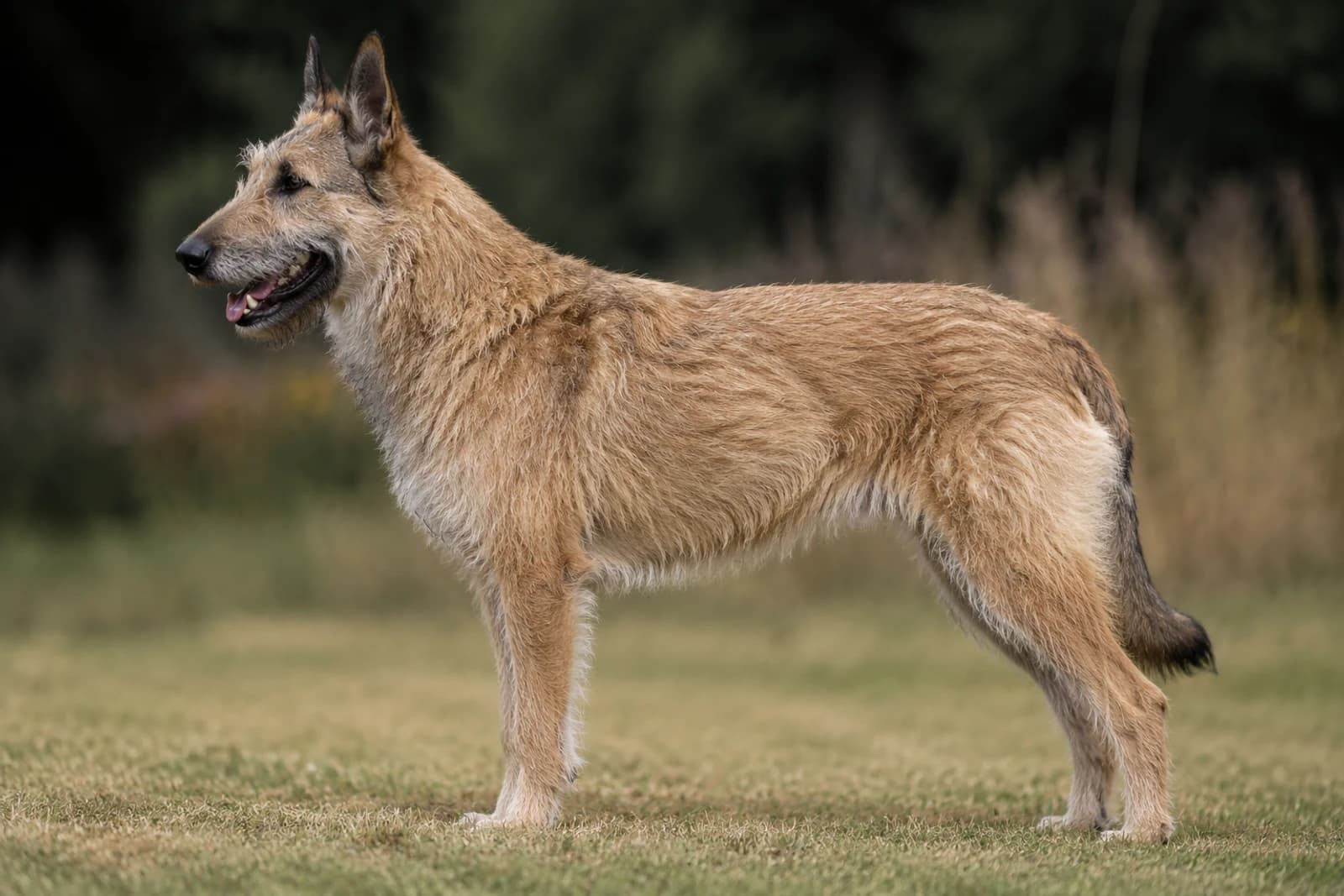
The Belgian Laekenois is a rare, medium-large herding dog prized for its sharp intelligence, unwavering loyalty, and distinctively rough, wiry coat. Originally bred to guard linen fields, this alert breed thrives in active, experienced homes that offer ample exercise and mental challenges. Deeply devoted to family, the Laekenois makes an excellent watchdog but may be reserved with strangers. Not ideal for novices or apartment life, it excels in dog sports, herding trials, and obedience work when given consistent training and early socialization. Its weather-resistant coat and tireless work ethic suit rural or suburban settings.
At a glance
- Size
- Giant
- Height
- 22–26 in
- Weight
- 55–65 lb
- Life span
- 10 years
- Coat colors
- Fawn
- Coat type
- rough, wiry double coat
How much does a Laekenois cost?
Adopt / rescue
$75–$400
Usually includes spay/neuter, first shots, and a microchip.
Buy from a breeder
$700–$2,000
From a reputable, health-testing breeder.
Approximate USD. Prices vary widely by region, breeder, pedigree, age, and coat colour — adopting is the lower-cost and recommended route. Avoid suspiciously cheap “breeders”; they’re often puppy mills.
Estimate the full cost of a Laekenois →Laekenois photos
Views
Front, side, rear and top — the full silhouette.Poses
How the breed sits, lies, moves and plays.Puppy to senior
The breed across its whole life.Expressions
The breed’s range of moods.Close-up details
Eyes, ears, nose, paws, tail and coat.Coat colors
The breed’s recognized colors.Click any photo to enlarge. We show the Laekenois from every angle — three views, poses, life stages, expressions, close-ups, coat and colors.
Appearance & size
You see the coat first. The Laekenois wears a rough, tousled double coat unlike any other Belgian shepherd’s — wiry, dry, and completely unkempt by design. This is no sleek show coat. It’s meant to turn brambles and weather, and it gives the dog a slightly gruff, rustic look that still reads as alert and capable.
The breed falls into the giant category, though the frame is lean and athletic rather than massive. Males stand 24–26 inches at the shoulder, females 22–24 inches, and both typically weigh between 55 and 65 pounds. The dog is solid under the tousled hair, with a square silhouette: the distance from the point of shoulder to the point of buttock equals the height at the withers. Bone is substantial but never clunky; you see smooth muscle under the shaggy coat, not bulk.
The head is carried proudly and gives a sharp, intelligent expression. Dark brown, slightly almond-shaped eyes peer out from under shaggy, overhanging brows. The erect, triangular ears are well cupped and never droop, adding to the watchfulness. A moderately pointed muzzle finishes in a black nose, and a crisp black mask covers the muzzle, eye rims, and often the lower jaw, contrasting with the fawn body. The beard on the chin and the wiry eyebrows are signature details — they make a Laekenois look pleasantly disheveled, even when the dog is standing still.
The coat itself is harsh and dry to the touch, about 2½ inches long all over, with a soft, dense undercoat for insulation. It never lies flat or glossy. Instead, it stands off the body in a rumpled, tousled fashion, never woolly or curly. There is no feathering on the legs or tail, just the same rough texture. Color is shades of fawn with a pronounced black overlay — often called a “sooty” effect — that shades the back, sides, tail, and shoulders. The underparts, chest, and legs show the clearer fawn underneath. You might occasionally spot a small white patch on the chest or chin, but it’s not preferred.
- From the front: The dog looks squarely balanced, with the black-masked face framed by prick ears and heavy brows. Forelegs are straight and parallel, and the deep chest reaches the elbow but stays moderate in width — no slab-sided bulk here.
- From the side: The square proportions jump out. The topline slopes very slightly from the withers toward the croup, the ribs are well sprung, and there’s a moderate tuck-up behind the ribs. The tail — bone-thick and reaching to the hock — hangs down at rest with a slight curve at the tip; when the dog is keyed up, it lifts proudly but never curls over the back.
- From the rear: Strong, well-muscled thighs stand parallel, and the coarse coat over the rump adds a bit of untamed silhouette. The hocks are neither turned in nor out, giving a clean driving line.
The overall picture is of a sturdy, athletic animal whose shaggy exterior doesn’t hide the sharp angles and ready movement underneath. Run your hand over that coat and you’ll feel the dry, springy texture that sheds mud and rain better than any shampooed fluff — a no-fuss coat on a dog that looks like it just stepped off a farm in the Ardennes.
History & origin
The Laekenois wasn’t just another farm dog — it was the rough-coated shepherd of the royal kennels, forged to work flax fields and guard the chateau grounds. This is the rarest and most rugged of the four Belgian Shepherd varieties, and its story starts in the town of Laeken, now part of Brussels, in the late 1800s.
Belgian breeders weren’t originally concerned with coat type. They wanted a lithe, intelligent, tireless herding and guarding dog that could handle the harsh, damp climate of the Low Countries. The Laekenois simply emerged as the wire-haired variant, its tousled, weatherproof coat setting it apart from the sleek Groenendael, the mahogany Tervuren, and the smooth Malinois. The name stuck after Queen Marie Henriette of Belgium took a particular shine to the shaggy fawn-colored dogs at the Château de Laeken, where they watched over her sheep flocks and the royal residence itself.
By the 1890s, the Club du Chien de Berger Belge was formalizing the breed, recognizing the Laekenois as one distinct variety. From the start, these dogs were bred for practical work, not the show ring. Their job was to move livestock all day, patrol boundaries, and alert to strangers — tasks that called for a quick, springy dog with a big dog’s presence packed onto a 55- to 65-pound frame.
World War I and World War II nearly erased the breed. The Laekenois served as messenger dogs and ambulance scouts, crashing through barbed wire and artillery smoke with messages strapped to their collars. That fierce loyalty and work ethic came at a staggering cost: wartime deaths, combined with the breed’s already small numbers, left the Laekenois teetering on the edge. After the wars, dedicated breeders in Belgium and the Netherlands carefully rebuilt the population, often crossing back to Malinois and other Belgian shepherds for genetic health while saving the signature wiry coat.
Today, the Laekenois remains the needle-in-a-haystack variety. In the United States, it didn’t even enter the AKC’s Herding Group until 2021, though the breed had been working in police K-9 units, search and rescue, and competitive dog sports for years. Even now, you’re far more likely to spot one working livestock in rural Belgium or the Netherlands than trotting down a suburban sidewalk. That scarcity means most breeders keep a sharp focus on preserving temperament and working ability — exactly what the old Flemish shepherds would have wanted.
Temperament & personality
The Laekenois isn’t a dog that lounges while you binge a season. This is a keen, driven partner who reads your mood, scans the perimeter, and waits for the next cue. You’ll get a dog that works as hard as you do, maybe harder. If you expect a couch potato, the Laekenois will turn your upholstery into a puzzle toy.
Alertness borders on obsession. They notice the FedEx truck from the window, the neighbor’s cat two fences over, the faintest change in household routine. They bark to tell you about all of it—a trait that makes them superb watchdogs and lousy apartment neighbors unless you channel it early. Expect a dog that’s on duty, often staring toward the door, head cocked, reading the air.
With family, they’re tender but not gooey. A Laekenois will lean against your leg, follow you without being called, and accept a belly rub on their terms. They bond tightly to one or two people, often the ones who do the training and provide structure. That intensity can morph into separation anxiety if you leave them in a crate for ten hours; their world revolves around the shared work. Left too long, they may mark territory inside—urine scent cues are their way of saying “I was here, and I was stressed.” (A vinegar spray cleanup removes the odor so they won’t keep revisiting that spot.)
This breed’s strong will is a feature, not a bug, but it demands respectful handling. You can’t bully a Laekenois into submission. A stiff, direct stare or heavy-handed correction will trigger resistance—often a forward-leaning posture, tail rigid, indicating they’re not giving ground. Instead, you’ll get miles further with a calm, consistent ask and immediate reward for the right choice. They learn fast, including what they can get away with, so consistency matters. You’ll see appeasement signals—lip licks, head turns, yawns—when they’re unsure; back off and reinforce instead of pushing.
Energy is substantial for a 55–65 lb dog. A brisk 30-minute walk won’t touch it. They need an hour or more of running, herding ball, or farm chores, plus brain games that stump them. Without that, they’ll chew to keep their jaws strong—puppies teething on anything within reach, adults destroying baseboards if bored. A homemade citrus spray on forbidden items can turn them off, while a meaty bone satisfies the gnawing instinct.
Around children, they can be gentle if raised together, but their herding heritage means they may nip at heels when kids run shrieking. Teach children to let the dog eat in peace—never interrupt a mealtime—because food guarding builds fast in smart, possessive dogs. With other pets, the Laekenois can be pushy or reactive, especially same-sex dogs. Early socialization can blunt the edge, but don’t expect a dog-park social butterfly.
You’ll laugh at their quirks. They might roll in something foul to “perfume” themselves or brag about a find—a holdover from scavenging ancestors. After a good session, they’ll shake off stress with a full-body wiggle and settle into a relaxed, loose-limbed sprawl, eyes soft, finally content. That’s when you know you’ve earned your partner for the day.
Good with kids, dogs & other pets
A well-socialized Laekenois is patient and reliable around kids, but don’t let that lull you into laxity. At 55–65 pounds and up to 26 inches tall, this is a powerful, agile herding dog, and an excited lean or a playful body-check can level a toddler. Good kid interactions happen when adults stay close, especially with crawlers and early walkers. Teach children to be gentle—no tugging ears or crowding the dog’s space—and give the dog a quiet spot to retreat to. This breed thrives on constant companionship; long stretches alone in the yard or a crate can breed anxiety and destructive behavior. A Laekenois does best in a busy household where someone is usually around, making it a natural fit for families who aren’t gone 9-to-5.
With other dogs, the story hinges on early socialization. Puppies need controlled, positive exposure to friendly dogs and new settings during the 12-to-16-week window, when their brains are soaking up what “normal” looks like. Miss that, and you’ll spend far more work building confidence later. Even a Laekenois raised right can be a pushy playmate—herding breeds often nip heels and chest-bump to control movement, which some dogs tolerate poorly. Monitor group play, especially with smaller or older dogs. Same-sex aggression isn’t a given, but it surfaces in some Belgian lines; scout your breeder’s dogs for easygoing adult temperaments. Never force a reserved adult Laekenois to meet new dogs at the park. Forced interactions spike stress and can lead to fights. Take introductions at the dog’s pace.
Around cats and small pets, prey drive is real. A Laekenois may live peacefully with the cat it was raised alongside, but a fleeing cat, rabbit, or guinea pig often triggers the chase—and a herding dog’s “catch” can end badly. Use baby gates and separate living areas, especially when you’re not supervising. Even with months of calm coexistence, a sudden dash can flip that switch. If you already have pocket pets or free-roaming cats, think hard about whether you’re ready to manage spaces permanently. For families with little kids, the mix of speed, size, and herding instinct means direct supervision isn’t optional—not because the dog intends harm, but because a 60-pound bundle of enthusiasm can accidentally knock a small child flat in half a second.
Trainability & intelligence
A Laekenois is sharp, observant, and so quick to connect cause and effect that he’ll sometimes figure out what you meant to teach before you do. That raw intelligence, combined with a deeply ingrained work ethic, makes him intensely trainable — and, frankly, a little humbling to work with. He isn’t a dog who responds well to rote drilling or a heavy hand. He needs a thinking partner, not a dictator.
What “smart” actually means with this breed He learns new cues in just a few repetitions and genuinely wants a job. The catch: he’s also an independent problem-solver who will offer his own variations if your communication is sloppy. Expect him to test whether “down” always means belly-on-the-floor or if an elbow hover is good enough. Bribery won’t fly here, either. A Laekenois wants to know why he should do something, and a relationship built on mutual trust is the only currency that pays out long-term.
Training approach that works Reward-based methods — praise, a quick game of tug, a well-timed treat — tap directly into his motivation. Start hard-wiring desired behaviors the day the puppy comes home, and be meticulous about consistency. If you count to three before he sits, don’t be surprised when he starts ignoring the first two requests. Keep sessions short, varied, and mentally taxing; this is a dog who gets bored with simple repetition and will start making up his own entertainment.
Recall demands special attention. With a sighthound-adjacent prey drive and a mind that weighs options quickly, a Laekenois off leash can blow you off in an instant if a squirrel tears across the field. Build a rock-solid recall using the highest-value rewards you have and proof it relentlessly around distractions before you ever trust it in an unfenced area. Even then, manage the environment realistically — many owners find a long line is a smarter safety net than ego.
Early socialization is non-negotiable Puppy brains are spongiest between 3 and 14 weeks, and this window matters more for a Laekenois than for many other breeds. Without a deliberate, positive introduction to a wide variety of people, sounds, surfaces, and other animals, his natural reserve can curdle into fear-based reactivity. Expose him gradually and generously. Never flood him; set him up to succeed so that novelty becomes ho-hum background noise, not a threat. A Laekenois who missed that foundation can be a project dog for years — and a heartbreak — so get this right from day one.
Where people go wrong Punishment-based techniques, even mild-looking scolding or leash pops, often backfire hard. This breed doesn’t shrug things off. He’ll remember the correction and, more importantly, the person who delivered it. Trust erodes quickly, and anxiety replaces engagement. You’ll get far more reliability from a dog who sees you as a source of clarity and good things than from one who operates under pressure. That’s not sentiment; it’s the reality of working with a sensitive, high-octane mind.
The actual challenge Honestly, the biggest hurdle isn’t his IQ — it’s our patience. A Laekenois will make mistakes, sell you a clever evasion, or briefly lose his mind when a delivery truck backfires. Breathe through it, stay calm, and redirect him to something you can pay. Consistency over time, not a perfect session, is what shapes the adult dog you’ll live with for a decade. Done right, you end up with a partner who reads your body language from across the room and acts on a whisper — exactly what he was bred to do.
Exercise & energy needs
A Laekenois doesn’t just want a workout — they need one that tests both body and brain, every single day. Plan on at least 90 minutes of real activity, split across two sessions. A 20-minute stroll on leash won’t cut it. They were built to move livestock all day, and that drive sticks.
What “real activity” looks like
- Morning: 45–60 minutes of off-leash running, a long hike with elevation, or a hard game of fetch combined with obedience drills. This is a dog that runs, turns on a dime, and thinks while in motion.
- Afternoon/evening: Another 30–45 minutes — maybe a bike ride beside you (once joints are mature), a focused agility or herding session, or a vigorous flirt-pole workout with impulse-control commands woven in.
If you skip a day or shortchange a session, you’ll know. Bored Laekenois become destructive, reactive, or anxious. They’ll find a job — re-landscaping the yard, chewing baseboards, or barking at every passing car.
Mental exercise counts just as much as the physical side. Work scent games, puzzle toys, and trick training into the daily mix. This breed thrives when you combine movement with thinking: hide a toy, then send them to find it; practice a new trick sequence before mealtime; set up a backyard obstacle course. Dog sports like herding, agility, and treibball are fantastic outlets, but even a 15-minute session of nosework in the living room burns a surprising amount of energy.
Watch the giant-frame joints. Until growth plates close (around 18–24 months), avoid repetitive high-impact stuff like jumping for Frisbees or pounding pavement on long runs. Stick to softer surfaces — grass, dirt trails — and build intensity gradually. Even as adults, warm them up before hard exercise and cool them down after to protect hips and elbows. A tired Laekenois is a pleasure to live with; a sore one is a long-term worry. Match the workload to the individual dog’s age and physical soundness, and you’ll have a partner ready for anything.
Grooming & coat care
The Laekenois wears a rough, tousled double coat that looks almost unkempt but actually needs a consistent, no-fuss routine to stay in working shape. That wiry outer layer and dense undercoat are built to shed dirt and weather, not to be fluffed into a silky show gloss. A good pin brush or slicker brush used 2–3 times a week catches loose undercoat before it mats, especially behind the ears, inside the thighs, and along the beard where tangles form fast. During the two heavy seasonal sheds each year, step that up to a quick daily pass—this is when you'll really see how much hair a 55–65 lb double-coated dog can release.
Bathing is a low-frequency job. Too much soap strips the coat’s natural oils and softens the rough texture that defines the breed. Aim for a bath every 3–4 months or when the dog rolls in something truly offensive. Always brush out any mats before getting the coat wet, because water tightens tangles into felt-like knots that are a nightmare to remove. Between baths, a wipe-down with a damp cloth and a spritz of diluted coat conditioner can knock off dust and keep the beard from getting crusty.
Trimming is minimal and purpose-driven. Most owners clean up the hair between the paw pads to prevent sliding on hard floors and clip the flyaway hairs around the eyes if they start to obscure vision. Some also neaten the edges of the ears. Avoid clipping the body—the coat insulates against both heat and cold, and shaving can permanently wreck the harsh texture. Instead, breeders often hand-strip dead outer hairs twice a year to encourage new, harsh growth and maintain the proper wire feel.
Nail, ear, and tooth care follow the same cadence as any large, active dog. Check nails every 2–3 weeks; if you hear clicking on the floor, they’re too long. Clean the ears weekly with a vet-approved cleaner, especially after outdoor romps where foxtails or debris might sneak in. A quick brush of the teeth 2–3 times a week—or daily if you can—keeps tartar down and extends that 10-year lifespan in a breed that loves to use its mouth.
Shedding & allergies
Plan on hair tumbleweeds. The Laekenois has a dense double coat — a soft undercoat and a rough, wiry outer layer — that sheds moderately all year but goes into overdrive twice a year when the seasons shift. During those spring and fall blowouts, you’ll pull enough loose undercoat off a brush to knit a sweater, and dust bunnies will multiply overnight. Daily brushing with a slicker brush or undercoat rake during peak shedding keeps the worst of it off your furniture; once or twice a week is fine the rest of the year. You’ll still find stray hairs woven into couch cushions, but it’s manageable if you stay ahead of it.
Drool is a non-issue. You might see a drip or two after a big drink of water, but these dogs aren’t heavy jowlers, so your pants won’t end up soaked with slobber.
Let’s clear up the hypoallergenic myth: no dog is, and the Laekenois is especially not. The same thick coat that blows out seasonally spreads plenty of dander and allergen-coated hair around your home. If you or a family member sneezes around dogs, do a real-world test before bringing one home — spend time in a home with an adult Laekenois, not just a quick meet-and-greet. Any breeder who claims their Laekenois puppies are hypoallergenic is selling you a line, not the truth.
Diet & nutrition
A Laekenois will happily work for food, and that drive can turn into a weight problem fast if you free-feed or guess at portions. A 55–65 lb frame puts real stress on joints, and even a few extra pounds can shorten an already modest 10-year lifespan.
How much and how often
- Puppies under 4 months: four evenly spaced meals a day.
- 4–6 months: three meals a day.
- Adults and dogs over 6 months: two meals a day, morning and evening.
Don’t leave food down all day. Measure every meal using the bag’s guidelines for a 60-pound dog, but treat that number as a starting point. After two weeks, run your hands along the ribs. If you have to press through a layer of padding, cut back by a quarter-cup at a time until you feel ribs with just a light fat cover. From above, you should always see a visible waist tuck behind the ribcage.
What to put in the bowl
A high-quality commercial food that lists a named meat first works well. If you go the home-prepared route, aim for roughly 60% raw or cooked meat, 20–30% fruits and vegetables, and 10% extras like eggs, plain yogurt, or digestible grains such as pearl barley or white rice. Blend or process the mix — dogs lack salivary enzymes and their jaws only move vertically, so puréeing improves nutrient absorption. Canned fish (in water, no salt), cooked veggies, and extra batches of grains keep meal prep quick during busy weeks.
Slow things down. Many Laekenois inhale their food. A puzzle bowl or a frozen Kong stuffed with part of the meal turns a 30-second gulp into 15 minutes of mental work and protects against bloat, a real giant-breed risk.
Age-specific tweaks
- Puppies transition best onto lightly cooked, puréed meats, fish, fruits, and vegetables, or a premium puppy kibble. Raw chicken wings can be introduced around 12 weeks, always under your direct watch.
- Seniors often slow down but still eat with gusto. Switch to three smaller meals a day, keep protein levels normal (there’s no solid proof that lowering protein helps), and weigh your dog monthly. As exercise tapers, you’ll need to trim calories before the scale moves.
Skip the holiday leftovers and any rich, fatty scraps — a single high-fat meal can trigger pancreatitis. Serve every meal in your dog’s own bowl, away from the table, to avoid begging that’s nearly impossible to undo.
Health & lifespan
A Laekenois typically lives about 10 years. That’s on the shorter side for a 55–65 pound dog, so every year needs to count.
Because this breed is rare, there’s no massive database of inherited conditions, but responsible breeders screen for what they can. The big ones are hip and elbow dysplasia — joints that can wear down early if the parents weren’t cleared. Good breeders also test eyes for progressive retinal atrophy (PRA) and check thyroid function. A breeder who skips these screenings isn’t doing you any favors.
His rough, double coat can be a weak spot. Moisture trapped against the skin makes hot spots and allergic dermatitis more likely, especially in humid weather. You’re not guaranteed to deal with it, but you’ll want to dry him thoroughly after rain or a bath and watch for obsessive licking.
Weight sneaks up on a food-motivated dog, and even five extra pounds grind on those joints. Keep him lean — you should feel ribs without digging — and you’ll delay arthritis and keep him moving well into his senior years.
Preventive care here isn’t optional:
- Heartworm prevention needs to be given monthly during mosquito season, and for one month after it ends. Treatment for an infected dog is rough, so don’t skip it.
- Rabies vaccination is legally required. There’s no effective treatment once symptoms appear.
- Annual vet exams catch subtle shifts — a slight limp, a change in appetite, or reduced activity — before they become emergencies. Once he’s past 7, twice-yearly checkups make sense.
You know your dog better than anyone. If he’s suddenly less excited about his morning run or starts favoring a leg after a frisbee session, act on it. Catching a torn cruciate ligament early or catching a skin infection before it spreads saves you both months of trouble.
Living environment
A Laekenois belongs in a house with a seriously secure yard — an apartment or townhome with shared walls sets everyone up for frustration. These are 55–65-pound herding dogs with a true working drive that can’t be satisfied by a quick stroll. A 6-foot fence is non-negotiable; they patrol their territory and will bark at anything that wanders too close.
That barking is part of the package. Laekenois are alert, vocal guardians. They’ll sound off at delivery trucks, squirrels, neighbors walking by the window. Noise-sensitive households or tight city lots will find the constant commentary exhausting.
A double, rough coat handles cold and damp well, but heat demands common sense. On scorching days, shift intense exercise to dawn or dusk and provide plenty of shade and water. They’ll still need that outlet — a solid 60 minutes of hard running or herding-style play twice a day, not just a leashed walk. Without it, boredom excavates your garden and remodels your baseboards.
Separation anxiety is real. These dogs bond fiercely to their people and don’t tolerate long hours alone. You’ll see it in destruction, nonstop barking, or escape attempts. Puzzle toys, scent games, and gradual desensitization help, but if your household is gone 8-to-10 hours daily, a Laekenois will broadcast its distress loudly enough for the whole neighborhood to hear.
Who this breed suits
A Laekenois rarely lands in a casual home by accident, and that’s a good thing. This is a full-throttle working dog in a medium-large frame — intensely smart, wired to guard, and built to move. You don’t just “have” a Laekenois; you partner with one.
Best fits are owners who genuinely want a dog that runs hot. Think distance runners, hikers on aggressive terrain, or people into advanced dog sports like protection work, herding, or high-level agility. A tired Laekenois is a reasonable Laekenois, and they demand a solid hour or more of hard, focused exercise daily — not a leashed stroll, but off-leash running, tug, and problem-solving. If your weekends already revolve around trail miles or training sessions, you’ll be on the right track.
Experience matters a lot. This breed is whip-smart and reads every flicker of your mood, which can make them manipulative if you’re soft on boundaries. They need a handler who is confident, consistent, and calm — not someone who’ll nag or escalate into a battle of wills. First-time owners will likely feel outmatched. A Laekenois doesn’t respond well to heavy-handed corrections either; they’ll shutdown or sharpen their own edge. Positive, firm, and fair training gets the best out of their serious work ethic.
Household dynamics need a reality check. With their own family, they’re fiercely loyal and often surprisingly goofy behind closed doors, but they are watchdogs to the bone. Expect aloofness with strangers and a low tolerance for unannounced guests. Early and relentless socialization is non-negotiable. They can live with respectful older kids who won’t test the dog’s space, but the breed’s herding instinct (nipping, circling) and general intensity make them a poor match for homes with toddlers or chaotic, high-foot-traffic environments. They are typically fine with other dogs when raised together, but same-sex aggression can surface, and they’ll chase small fleeing animals — that rusty old prey drive never sleeps.
Who should pass? Sedentary owners, apartment dwellers without a fenced yard and a serious exercise plan, and anyone who works long hours away from home. A Laekenois left alone in a crate all day will dismantle your baseboards and your sanity. Seniors might work if they are extremely active and have years of working-dog savvy, but the physical demands and sharp reflexes required make this a tough fit for most. Singles and couples with a canine-centered lifestyle, a sense of humor for the breed’s opinionated nature, and a high tolerance for shedding (that wiry coat is a mess factory) will find a fiercely devoted shadow. Just know: you’ll earn every ounce of that devotion.
Cost of ownership
Finding a Laekenois puppy often takes patience and a solid budget. This is the rarest of the four Belgian shepherd varieties, and U.S. litters are scarce. A typical purchase price from a responsible breeder who screens for hip dysplasia, epilepsy, and eye issues falls between $2,000 and $4,000. Show- or working-line pups can push past $5,000. Rescue is uncommon; when a Laekenois does land in breed-specific rescue, adoption fees usually run $300–$800.
Once your dog is home, plan on a monthly outlay that clusters around $200–$350. Here’s how it breaks down:
- Food: $60–$90 for high-quality kibble sized for a 55–65 lb, high-energy dog. Raw or fresh diets can double that figure.
- Grooming: The harsh, wiry coat needs weekly brushing and occasional hand-stripping. Many owners learn to do it themselves, but if you outsource, a professional groomer visit every 6–8 weeks adds $70–$100 per session — budget $30–$70 monthly.
- Routine vet and preventives: $50–$70 a month for annual exams, vaccinations, and flea/tick/heartworm preventives. Because hip dysplasia and epilepsy appear in the breed, it’s smart to set aside extra for periodic bloodwork or imaging.
- Pet insurance: $40–$80 a month for a comprehensive policy that covers orthopedic and neurological conditions.
- Extras: $20–$40 on training treats, poop bags, and the occasional replacement of well-chewed toys — this is a busy working mind that doesn’t idle.
First-year costs run higher. With a crate, bed, leash, collar, initial training classes, and spay/neuter if you go that route, expect a first-year total (including the puppy price) of $5,500–$9,000. After that, annual maintenance typically lands in the $2,500–$4,200 range, not counting emergencies.
Choosing a Laekenois
If you’re set on a Laekenois, be ready to wait. Litters are scarce, and good breeders don’t breed often. You’ll likely end up on a waiting list, and that’s actually a good sign — it means the breeder cares more about placing dogs in the right homes than making a quick sale.
Rescue is rare for this breed, but not impossible. Check with Belgian Shepherd–specific rescues, or contact the breed parent club for rehome referrals. An adult rescue can skip the puppy chaos, but you may miss early socialization windows; ask about any known history of reactivity or resource guarding.
Health Clearances to Demand
Laekenoises can be prone to hip and elbow dysplasia, so insist on OFA or PennHIP scores for both parents — fair, good, or excellent hips are non-negotiable. Eye exams registered with the Canine Eye Registration Foundation (CERF) or OFA Eye Certification should be current within the last year. Responsible breeders also screen for thyroid disease; ask for a recent thyroid panel, not just a general blood test. Epilepsy exists in the breed and has no DNA test yet, so the breeder should be open about any seizure history in the lines.
Breeder Red Flags
Walk away if the breeder won’t show you the dam on-site, or makes excuses about the sire. You want to see where the pups are raised — a clean, home environment, not a kennel run. Price shouldn’t hinge on coat color or markings; that’s a huge warning sign. No written contract, no health guarantee, no take-back clause for the life of the dog? Keep looking. And no puppy leaves before 8 weeks — 10 is better for this thoughtful, high-drive breed.
Picking Your Puppy
A Laekenois pup should be alert and nosy, not cowering in a corner or clinging. Watch the litter interact: you want the one that’s curious, recovers quickly after a loud noise, and nibbles your shoelace without going over the top. Don’t fall for the calm puppy hiding under a chair; you’re not doing it a favor by bringing it into a busy home. The breeder should also match temperaments based on the lifestyle info you’ve shared — trust that more than your gut feeling during a 20-minute visit. You’re choosing a partner for hard work and real intensity, so a clear-eyed, confident pup that engages with you is worth its weight in gold.
Pros & cons
Pros
- Top-tier intelligence and trainability. For an owner who puts in the work, a Laekenois picks up commands almost before you finish giving them. They shine in advanced obedience, agility, herding, and scent work.
- Deeply bonded and protective. Once you earn their trust, this dog is fiercely loyal to their people. They don’t need extra guard training — just having them around is a natural deterrent.
- Striking, wash-and-wear coat. The rough, tousled wire coat looks rugged with almost no grooming hassle. A quick weekly brush and an occasional hand-strip keeps the shedding manageable.
- Built for real adventure. An athletic 55–65 lb frame and tireless drive make them an ideal partner for trail runs, long hikes, or bike rides, not just a loop around the block.
Cons
- Demands a huge daily outlet. A quick walk won’t touch it. Plan on 90+ minutes of hard running, plus mental games or training sessions, unless you enjoy the sight of your drywall being remodeled by a bored Laekenois.
- Herding engine never idles. The instinct to chase and control movement runs deep. Without early, consistent training, they’ll nip at running kids, go after bikes, or turn a passing jogger into a herding project.
- Not an easy first dog. They are sensitive yet bullheaded, and they’ll read every inconsistency in your leadership like a book. They need a calm, experienced handler to channel their intensity.
- Wary of strangers and some dogs. A Laekenois isn’t a tail-wagging greeter with everyone. Careful, lifelong socialization is required to prevent over-guarding and dog selectivity from taking root.
- Short time with you, hard time finding one. A 10-year lifespan stings for a dog that becomes such a central part of your life. As a rare breed, a well-bred puppy means a long wait from a responsible breeder who screens for common health issues.
Similar breeds & alternatives
If the Laekenois’s wire coat and intense, watchful nature caught your eye, you’re essentially looking at the roughest-cut gem of the Belgian Shepherd family. The three other varieties are genetically the same stock in different coats, so start there when you want a similar brain and engine without the bristly hair:
- Belgian Malinois – Same 55–65 lb frame, short, flat fawn-to-mahogany coat with black mask. Even sharper drive and more wired for non-stop action. Malinois are everywhere in police and protection work for good reason; they’re generally less reserved with strangers than the more aloof Laekenois. Expect to burn off a solid 90+ minutes of hard running daily, not just a jog.
- Belgian Tervuren – Long, glossy sable coat with a dark overlay and an elegant ruff. Tends to be slightly softer with their people but still high-energy and sensitive. Grooming jumps to daily brushing and heavy shedding seasons.
- Belgian Groenendael – Solid black long coat. Same alert, owner-focused mind. Often described as a touch more biddable in the home, but don’t mistake that for low maintenance; they’ll still dismantle your routine if bored.
Outside the four-pack, consider the Dutch Shepherd – 50–70 lb, brindle coat that can come in a rough, wire version almost identical to the Laekenois’s. Dutchies are near-equivalent in working drive, with a harder, less handler-sensitive edge. If you like the rustic look but want a slightly larger and more stubborn guardian, a Bouvier des Flandres (70–110 lb, rough coat, dark fawn to black) is mellower indoors but still needs a serious job. Just remember: a Laekenois’s wire coat is the rarest flavor; finding a litter from responsible health-testing breeders will take patience you don’t need for a Malinois or a Terv.
Fun facts
- The Laekenois is the rarest of the four Belgian Shepherd varieties.
- They were originally bred to guard linen fields in the town of Laeken.
- Their rough, wire coat is weather-resistant and gives them a distinctive unkempt look.
- They excel in search and rescue, agility, and obedience competitions.
Frequently asked questions
- Is the Laekenois good with children?
- The Laekenois can be good with children if properly socialized from a young age, but due to its large size and high energy, supervision is recommended around young kids to prevent accidental knocks. They tend to be protective and loyal, forming strong bonds with all family members.
- How much does the Laekenois shed?
- The Laekenois sheds a moderate amount year-round, with increased shedding during seasonal changes. Regular brushing helps control loose hair and keeps the wiry coat in good condition.
- How much exercise does a Laekenois need?
- This active herding breed requires at least an hour of vigorous daily exercise, such as long walks, runs, or play sessions. Without enough physical and mental stimulation, they may become restless or develop undesirable behaviors.
- What are the grooming requirements for a Laekenois?
- The rough, tousled coat needs weekly brushing to prevent mats and remove debris, with occasional trimming around the face and paws. Bathing is only necessary when the dog gets very dirty, as the coat tends to resist soiling.
- Can a Laekenois live in an apartment?
- A Laekenois is generally not suited for apartment living because of its high energy level and need for space to move. They thrive best in a home with a securely fenced yard where they can explore and expend energy safely.
- Is the Laekenois a good choice for first-time dog owners?
- The Laekenois can be a challenge for inexperienced owners due to its intelligence, strong will, and need for consistent, firm training. Early socialization and structured routines are essential, so first-time owners may find success with commitment to professional guidance.
Tools & calculators for Laekenois owners
Quick estimates tailored to Laekenoiss — pre-filled with this breed’s size where it matters.
Articles & stories about the Laekenois
Sources & standards
This profile follows recognized breed standards from the American Kennel Club (AKC) and the Fédération Cynologique Internationale (FCI), along with established veterinary and breed-club guidance. These describe general breed tendencies — every dog is an individual.
Owner stories
Have a Laekenois? Share your experience — grooming tips, personality quirks, anything goes.