

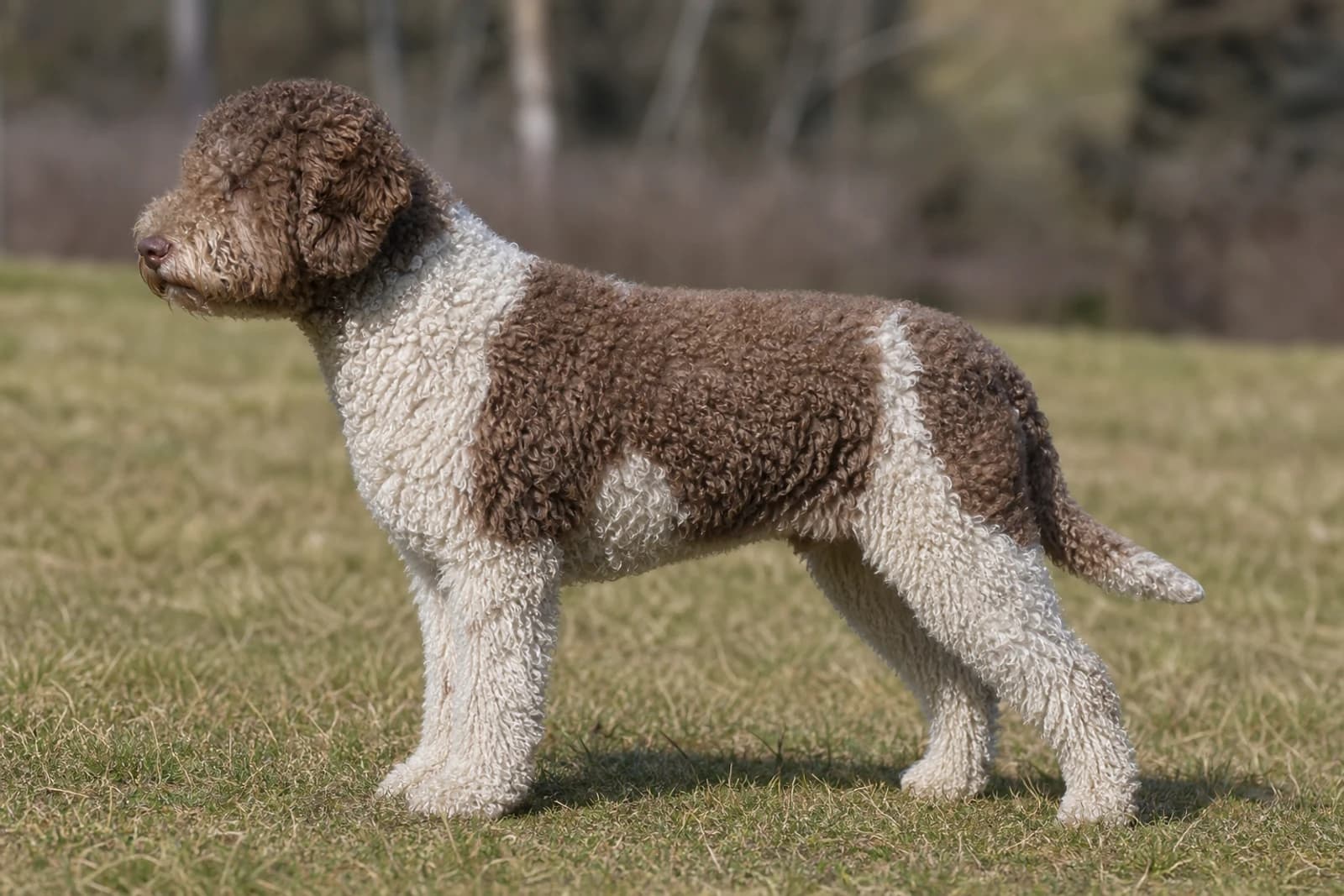
The Lagotto Romagnolo is a lively, affectionate companion ideal for active families or individuals seeking a devoted, hypoallergenic dog. Bred originally as a water retriever and later fine-tuned for truffle hunting, this curly-coated Italian breed thrives on mental and physical stimulation. They are exceptionally trainable and form strong bonds, making them excellent for dog sports or scent work. While they adapt well to various homes, their moderate barking and high grooming needs require dedicated owners. Best suited for those who appreciate an energetic, loving, and sharply intelligent canine partner.
At a glance
- Size
- Medium
- Height
- 16–19 in
- Weight
- 24–35 lb
- Life span
- 12–14 years
- Coat colors
- White, White with brown patches, White with orange patches, Brown roan, Orange roan, Brown, Orange
- Coat type
- Thick, curly, woolly coat
How much does a Lagotto Romagnolo cost?
Adopt / rescue
$75–$400
Usually includes spay/neuter, first shots, and a microchip.
Buy from a breeder
$700–$2,000
From a reputable, health-testing breeder.
Approximate USD. Prices vary widely by region, breeder, pedigree, age, and coat colour — adopting is the lower-cost and recommended route. Avoid suspiciously cheap “breeders”; they’re often puppy mills.
Estimate the full cost of a Lagotto Romagnolo →Lagotto Romagnolo photos
Views
Front, side, rear and top — the full silhouette.Poses
How the breed sits, lies, moves and plays.Puppy to senior
The breed across its whole life.Expressions
The breed’s range of moods.Close-up details
Eyes, ears, nose, paws, tail and coat.Coat colors
The breed’s recognized colors.Click any photo to enlarge. We show the Lagotto Romagnolo from every angle — three views, poses, life stages, expressions, close-ups, coat and colors.
Appearance & size
The first thing you’ll notice about a Lagotto Romagnolo is that coat—it’s not fur in the usual dog-park sense. Think dense, woolly, and packed into tight, springy curls that cover the body from head to tail. The texture is more like a rustic teddy bear than a polished poodle, and it feels coarse rather than silky. That coat is the breed’s calling card: water-resistant, low-shedding, and designed to keep the dog comfortable in cold marsh water while hunting truffles or retrieving. Color-wise, you’ll see solid off-white, shades of brown from pale to deep chocolate, orange, or brown roan. Some dogs have a white patch on the chest, a white-tipped tail, or a white muzzle, but large white markings are a fault. The curls often give the coat a matte, dusty look, especially in lighter shades.
For a dog that packs so much energy and drive, the Lagotto is surprisingly compact. A male stands 17 to 19 inches at the shoulder; a female, 16 to 18 inches. Weight runs 24 to 35 pounds—solid, never fragile, but not bulky. The overall silhouette is rustic and square: from the side, the body is as long as the dog is tall at the withers. The chest is deep and reaches to the elbows, the ribs are well sprung, and the back is straight and strong. The neck is muscular and slightly arched, blending smoothly into laid-back shoulders. At the rear, the thighs are developed and the angulation matches the front, giving the dog a balanced, tireless stride. The tail is carried scimitar-like when the dog is alert and hangs down at rest.
From the front, the head commands attention. It’s broad between the ears, with a forehead that’s flat or very slightly dished, and a muzzle that’s strong and wedge-shaped—roughly equal in length to the backskull. The stop is noticeable but not sharp. Large, round eyes are set wide apart. They come in shades of ochre, hazel, or dark brown, depending on the coat color; the expression is alert and almost human, gauging your next move. Ears are triangular with rounded tips, set just above eye level, and drop close to the cheeks. The overall effect is a dog that looks like it’s wearing a curly, rumpled jacket, ready to get its paws muddy at a moment’s notice. When it moves, the Lagotto covers ground with a bounce and a grin—compact, curly, and built for a long day’s work.
History & origin
You’re looking at one of the oldest retriever breeds on the planet, and it didn’t come from the British Isles. The Lagotto Romagnolo took shape in the marshy lowlands of Italy’s Romagna sub-region, probably as early as the 1400s. If you squint at Andrea Mantegna’s 15th-century fresco “The Meeting” in Mantua, you’ll spot a curly-coated dog under a table that looks an awful lot like today’s Lagotto. The name gives away the original job: Lago means lake in Italian, and Lagotto means water dog. These compact, waterproof dogs retrieved downed waterfowl from the cold, reed-choked marsh ponds of the Po Delta, working from traditional flat-bottomed boats called puntane.
For centuries that’s what they did. Then, starting in the late 1800s, large-scale drainage projects turned vast wetlands into farmland. The waterfowling gig dried up almost literally, and the Lagotto population collapsed. A few sharp-eyed Romagnoli noticed something else: the same persistent nose that marked a fallen duck could pinpoint a ripe truffle buried under oak roots. The breed swapped one job for another, becoming the only purebred dog on earth specialized for truffle hunting. Unlike other breeds pressed into truffle work, the Lagotto had a soft mouth that wouldn’t crush the delicate fungus, a tight curly coat that shed burrs and brambles easily, and a tireless, methodical search style.
Even that near-perfect pivot wasn’t enough to save the breed from near-extinction by the mid-20th century. A handful of dedicated Italian fanciers—most notably the breed historian and breeder Gianni Bellingeri—scoured the Romagna countryside in the 1970s, found remnant dogs still working truffle patches, and pooled them into a formal recovery program. Their effort rebuilt the gene pool and drafted the modern breed standard. The Ente Nazionale della Cinofilia Italiana (ENCI) had originally recognized the Lagotto in 1949, but this revival cemented its future. The Fédération Cynologique Internationale (FCI) granted full recognition in 1995.
The first Lagotti arrived in the United States in the 1990s, and the American Kennel Club welcomed the breed into its Sporting Group in 2015. That gap of a few decades means you won’t stumble across dozens of 15-year-old American Lagotti yet, but you will see their numbers growing fast in scent-work competitions and active homes that value a working dog who’s just as serious about finding a truffle as he is about a tennis ball in the yard.
Temperament & personality
The first thing you notice about a Lagotto Romagnolo isn’t his woolly, teddy-bear coat — it’s his nose. This dog inhales the world. Bred to sniff out truffles in dense, wet Italian undergrowth, he’s wired for obsessive, joyful scent-work. Lay a trail of treats through your living room and watch him transform into a focused, tail-pumping detective. Ignore that drive, and he’ll build his own jobs: excavating your flower beds, emptying the trash, or shadowing scent trails from room to room.
His loyalty runs just as deep. A Lagotto bonds like Velcro and prefers to be underfoot whether you’re cooking, working, or hiking. He’s naturally watchful. A stranger at the door won’t get an instant wiggle — he’ll hang back, give a low buff, and assess things before deciding you’re safe. Once you’re in the circle, though, affection is full-on. Expect a bearded chin on your knee, a solid lean against your calf, and a quiet but persistent presence in every room.
That shadow-tendency cuts both ways. A Lagotto left alone for long stretches often unravels into barking, digging, or chewing. He was bred to work beside you, and isolation strikes him as deeply wrong. If your schedule keeps you gone all day, he’s a poor fit. Puppies gnaw everything to soothe teething gums, and even adults keep their jaws strong by chomping on hard stuff. Load the house with tough chew toys — a frozen rag soaked in broth can be a lifesaver — or your furniture will pay the tax.
He’s no pushover. This is a thinking breed that thrives on calm, consistent engagement. You earn his cooperation with reward-based games, not force. Jerk the leash or raise your voice and you’ll get a stubborn, sulky dog. Play “find the treat,” and you’ve got a partner for life.
House quirks come with the package. He loves water — a puddle isn’t an obstacle, it’s an open bar. And like many scent-drunk dogs, he may roll in something unbelievably foul: maybe to show off the “treasure,” maybe to mask his own smell, or maybe just because he likes eau de dead thing. A fenced yard is nonnegotiable, because his nose can vaporize a recall command in two seconds.
With his own family, he’s gentle, but every dog appreciates a peaceful dinner. Teach kids never to interrupt him while he’s eating — a stiff body, hard stare, or forward lean means back away. A soft, wiggly body and blinking eyes say he’s content. If an indoor accident happens, soak it with an enzymatic cleaner. His nose files away even a ghost of urine scent, and that spot can become a repeat target. In the end, you’re living with a bright, busy, deeply affectionate partner who operates best when you treat his nose — and his heart — as a full-time commitment.
Good with kids, dogs & other pets
With Kids
A Lagotto Romagnolo’s patient, non-aggressive nature makes him a natural around children — but this isn’t a hands-off, bombproof dog like a Labrador. He’s sensitive and forms tight bonds with his family, so rough handling or chaotic play can shut him down. Always supervise interactions, especially with toddlers, and teach kids not to grab ears, tail, or paws. At 24–35 pounds, a Lagotto is sturdy enough to keep up with a 6-year-old’s tag game in the yard, yet small enough that he won’t accidentally flatten a baby. The real key is early, consistent exposure to well-behaved children before 16 weeks of age. Puppies raised without that can grow into jittery adults who bark or retreat when a child gets loud.
With Other Dogs
Most Lagotti get along well with other dogs, provided they were properly socialized during the critical 3- to 14-week window. A Lagotto who missed that window may be timid or over-excitable around unfamiliar dogs, turning a simple greeting into a tense standoff. Group walks and puppy classes with positive reinforcement help build a relaxed, confident dog. In multi-dog homes, they generally slot in without much fuss — they’re not resource-guarders or status-seekers. Still, a bored Lagotto left alone too long can redirect his energy into pestering a housemate, so plenty of exercise and mental work keeps household peace. If you have an adult rescue who’s indifferent to other dogs, don’t force socializing; a dog that prefers his owner’s company and a few familiar buddies doesn’t need a crowded dog park.
With Cats & Small Pets
This is where the Lagotto’s working background deserves a second look. He was bred to search for truffles using a powerful nose and persistent pawing behavior — and before that, to retrieve from water. That drive translates into a strong interest in moving targets. A cat who holds still is often ignored, but a sprinting kitten can trigger a chase. Introduce them slowly, using a leash and high-value distractions, until the dog learns to settle around the cat. Caged small pets like hamsters or rabbits? Don’t leave them unattended together. A Lagotto’s pawing instinct and quick reflexes can spell disaster for a pocket pet. With patient, reward-based training from puppyhood, many Lagotti live peacefully with cats, but you’ll always need to manage the environment — baby gates and separate spaces are your friends.
The common thread across all these relationships is time spent. This is a breed that craves human companionship; left isolated in the backyard or a crate for 10-hour days, a Lagotto can develop anxiety that spills into every interaction, including those with kids and other animals. So plan on early socialization, daily exercise (think 45-60 minutes of active engagement), and a household where someone’s around most of the day.
Trainability & intelligence
Your Lagotto learns new cues almost faster than you can teach them—this is a breed that was built to solve problems in the field, not just follow a routine. Their intelligence is paired with a deep-seated desire to work alongside people, so a Lagotto will dive into training sessions with genuine enthusiasm, especially if there’s something in it for them. The catch? That same quick mind also gets bored by repetition and can decide you’re the one who needs more schooling. When a scent distracts them—and their nose is always on the clock—your recall request may get an “in a minute” look unless you’ve made coming back to you more rewarding than sniffing out a hidden treasure.
Train them like you’d persuade a clever, slightly sensitive friend. Reward-based methods (high-value treats, a tug toy, or just an excited “yes!”) build the trust that makes a Lagotto want to work with you. Harsh corrections are a dealbreaker; a raised voice can cause this dog to shut down or get anxious, so you’ll lose the eager learner you started with. Instead, keep sessions short, game-like, and upbeat. Clicker training often shines here because it marks the exact moment of success without any emotional static.
Start early. From puppyhood, consistency and clear rules keep the Lagotto’s independent streak from turning into selective hearing. Pair that with intensive socialization—expose them gradually to new people, kids, city noises, and weird surfaces well before the 4-month mark. Without it, a Lagotto can trend toward aloof or jumpy around strangers, not out of malice but out of a natural caution. With enough positive experiences, you’ll have a confident, focused dog who can settle in a café and still be ready to learn the next trick on cue. The real work is building the relationship, not just drilling commands. Once that’s solid, this little truffle hound will surprise you with how fast they connect the dots and how badly they want to get it right.
Exercise & energy needs
A Lagotto Romagnolo doesn’t just want to run — he needs to sniff, solve, and search. Bred for centuries to hunt truffles in the Italian marshlands, this dog’s brain is as high-octane as his legs. If you only provide physical exercise, you’ll end up with a fit, frustrated dog digging up the yard.
Plan on 60 to 90 minutes of daily activity, split into at least two sessions. A couple of strolls around the block won’t touch his energy. You need off-leash running, vigorous fetch, or a long hike with plenty of sniff breaks. Swimming is a natural outlet — these are water retrievers at heart, and a pond or pool session burns energy without stressing joints.
But the real key is mental work. A 15-minute scent game can wipe out a Lagotto more completely than a half-hour run. Hide treats around the house or yard and tell him to “find it.” Feed meals in puzzle toys or snuffle mats. If you’re up for it, formal nose work or barn hunt classes turn his instinct into a sport you’ll both love. They also thrive in agility, dock diving, and rally — anything that asks them to think while they move.
Skip the mental challenge, and you’ll see the fallout. A bored Lagotto becomes an inventive nuisance: counter-surfing, barking at nothing, or redecorating your garden one hole at a time. Exhaust that nose, and you get an affectionate, calm companion who’s happy to curl up at your feet — after he’s made sure there are no truffles under the sofa.
Grooming & coat care
That dense, rustic coat looks rugged, but it’s a grooming commitment. A Lagotto’s woolly, single-layer curls grow nonstop and trap dead hair instead of shedding it onto your couch. Without consistent care, that hair quickly turns into tight, hard mats against the skin.
Brushing
Get your hands on a metal slicker brush with rounded pins — it grabs loose hair and breaks up small tangles before they become trouble. Follow up with a greyhound comb (wide on one end, fine on the other) to check that every curl is mat-free right down to the skin. Work in small sections, lifting the hair to brush the roots — that’s “line brushing.” Skip the bristle brush; it’s worthless in this coat. Aim to brush at least every other day, more if your dog spends time in damp grass or mud. This routine also spreads natural oils and lets you catch burrs, ticks, or the beginnings of a hot spot early.
Bathing
Bathe your Lagotto every 4–6 weeks, or whenever he comes home smelling like a swamp. Use a moisturizing, sulfate-free shampoo and always follow with conditioner — this coat has a tendency to dry out. Rinse thoroughly; leftover product will make the curls gummy and attract dirt. Don’t overdo it: bathing too often strips the coat’s protective oils and can lead to flaky skin.
Trimming & clipping
Because the hair keeps growing, a Lagotto needs a full clip roughly every 6–8 weeks. You can learn to do it yourself with a quality clipper and a #4 or #5 blade (leaving about ½ inch of length), or leave it to a groomer who knows the breed’s traditional retriever clip or an easy “teddy” trim. Neglect this schedule and the coat will mat regardless of how much you brush. Between full clips, trim the hair around the eyes, mouth, and paw pads to keep those areas clean and comfortable.
Ears, nails & teeth
Those drop ears are a perfect breeding ground for yeast and bacteria, especially in a water-loving breed. Dry the ears thoroughly after any swim or bath, and clean weekly with a vet-approved ear cleaner. Never use a cotton swab deep in the canal.
Nails — if you hear them clicking on the floor, break out the clippers. For a dog this active, monthly trims are usually enough. Teeth need brushing 3–4 times a week; a small, soft-bristled brush and dog toothpaste will keep tartar and bad breath in check.
Seasonal coat care
You won’t get a heavy seasonal shed, but the coat does react to moisture. In wet, muddy seasons, curls can mat faster even with regular brushing. If your Lagotto is a dedicated water retriever, consider keeping the coat clipped shorter year-round and rinse him with plain water after every swim to cut down on tangles and irritants.
Shedding & allergies
The Lagotto’s coat behaves a lot like a Poodle’s—dense, tightly curled, and constantly growing instead of cycling through heavy shedding seasons. In your house, that translates to practically zero hair on the sofa or your clothes. Loose hairs get caught in the curls and stay there until a brush or comb pulls them out. You’ll see a small handful in the slicker brush during a grooming session, not tumbleweeds rolling across the kitchen floor. There’s no seasonal “blowout” to dread, because the coat doesn’t ramp up and shed a winter undercoat all at once.
Drool is just as minimal. This is a naturally dry-mouthed breed. You won’t find wet streaks on your pant leg or slobber spots on the furniture after a visit from a Lagotto.
The hypoallergenic claim gets thrown around a lot. Here’s what that actually means with this breed. Most allergic reactions are triggered by proteins in dander, saliva, and urine that hitch a ride on shed fur. Since the Lagotto sheds so little, those particles don’t become airborne or settle on surfaces nearly as much as they do with a heavy-shedding dog. Plenty of people with mild to moderate allergies live comfortably with one. But no dog is allergen-free. The proteins still exist, and some individuals react strongly to them in any amount. If someone in your home has serious allergies, arrange a long visit with adult Lagotti before committing. Regular brushing and the occasional bath help wash away dander and dried saliva, keeping the environmental load even lower.
Diet & nutrition
The Lagotto’s legendary food drive is a training superpower – and a fast track to obesity if you aren’t measuring every scoop. These 24–35 lb dogs pack on weight easily, and even a few extra pounds strain their joints over a long, active life. Don’t free-feed. Use a kitchen scale or a proper measuring cup, split the daily ration into two meals, and adjust based on how your dog actually looks and feels – you want to feel ribs with a light fat cover, not see them, and spot a visible waist from above.
- Puppy schedule: From weaning to four months, feed four small meals a day. At four months, drop to three meals until six months, then move to the adult pattern of two meals a day. Transition a new puppy’s diet gradually over a week or so by mixing old and new food. By about twelve weeks, you can introduce raw meaty bones like chicken wings under close supervision, but start with lightly cooked, puréed meats, fish, fruits, and vegetables if you’re going homemade.
- Adult portions: Most Lagotti thrive on a high-quality commercial diet at roughly 1–1½ cups of dry kibble a day (split into two feedings), but that varies widely with brand and activity. A dog that trains hard or works in water often needs more. The goal is a body condition score of 4–5 out of 9. Treats count – keep them under 10% of daily calories and break tiny training bits, since a Lagotto would happily eat a brick if you called it a cookie. Use a puzzle bowl or scatter the kibble across a snuffle mat to slow down a gulper and give that busy nose something to do.
- Homemade and blended meals: If you cook from scratch, build meals around roughly 60% raw or cooked meat, 20–30% fruits and vegetables, and the remaining 10% from eggs, grains, and plain yogurt. Dogs lack salivary amylase and their jaws move vertically, so blending or puréeing a homemade mix noticeably improves nutrient absorption. Pearl barley and white rice are gentle, digestible grains to add fiber and carbs, especially for a sensitive stomach. Save the unsalted water from steaming veggies to moisten dry food or cook grains.
- Senior shifts: As your Lagotto slows down sometime after age 7 or 8, keep the protein quality high – there’s no good evidence older dogs need less. Instead, trim total calories and feed three smaller meals if a twice-daily schedule becomes harder to manage. Weigh your dog every few weeks and reduce food by 10% at a time if the numbers creep up. Missing teeth or a tender mouth make puréed food a solid option.
- What to avoid: Rich holiday scraps, greasy trimmings, and high-fat table foods can trigger pancreatitis, especially in a breed that’s already primed to overeat. Never hand food from your plate; once a Lagotto learns that begging works, unlearning it is brutal. Serve any leftovers – plain cooked veggies, a spoon of canned fish, extra grains – in his own bowl after you’re done eating.
A lean Lagotto stays healthier, stays sharper, and works by your side a whole lot longer. Measure the meals, protect the waistline, and you’ll keep that eager spirit going strong.
Health & lifespan
A healthy Lagotto Romagnolo typically lives 12 to 14 years. That longevity hinges on tackling a handful of inherited conditions head-on, and on the kind of preventive care that starts with the breeder.
Responsible breeders don’t guess. They screen for hip and elbow dysplasia (look for OFA or PennHIP clearances), get yearly eye exams certified by a veterinary ophthalmologist (CERF or CAER), and run DNA tests for neurological disorders that show up in the breed — cerebellar abiotrophy, benign familial juvenile epilepsy, and progressive rod-cone degeneration (prcd-PRA). Ask to see the results for both parents. Clearances won’t erase all risk, but they dramatically stack the odds in your favor.
Ears are a constant battleground because that dense, curly coat traps moisture like a sponge. Without weekly drying and cleaning, yeast and bacteria move in fast — chronic ear infections are a leading reason Lagotti land at the vet. Their coat also makes them prone to hot spots and skin allergies if they’re left damp or fed a diet that triggers inflammation.
Weight management is not a footnote here. A Lagotto clocks in at 24 to 35 pounds; packing on an extra 5 pounds adds stress to hip and elbow joints that already have a genetic vulnerability. Given how food-driven this breed can be, portion control and daily exercise are non-negotiable. A solid hour of off-leash running or scent work keeps muscles strong, joints stable, and the brain satisfied — which also lowers the odds of stress-related behaviors like obsessive barking.
Monthly heartworm prevention through mosquito season (and one month past it) shouldn’t be skipped, and the rabies vaccine is a legal must. Because that thick coat insulates — and overheats — quickly, avoid hard exercise during peak summer heat. Plan water work or shady sessions instead.
Annual wellness exams catch subtle shifts in vision, hearing, and mobility before they become crises. As a Lagotto ages past 10, biannual bloodwork helps spot changes in liver and kidney function early, giving you the best shot at a comfortable, active last chapter.
Living environment
A Lagotto can manage apartment living, but only if you treat his brain and body like the working dog he is. Without that, a small space becomes a pressure cooker for barking, chewing, and excavation projects that your landlord will not appreciate.
A house with a securely fenced yard is a better fit, but don’t expect the yard to do the work for you. Left to his own devices, a bored Lagotto often reverts to his truffle-hunting roots and starts digging up flowerbeds or tunneling along fence lines. He wants to be where you are, so plan to spend that yard time together—throwing bumpers, hiding scent articles, or letting him splash in a kiddie pool.
That dense, curly coat gives him decent insulation in cool, wet weather (he was originally a water retriever in the Italian marshes), but it also means he can overheat fast in high humidity or blazing sun. In warm climates, schedule exercise for early morning or late evening and always provide shade and water.
Noise-wise, he’s an alert watchdog with a ready bark when someone approaches the door. With consistent training, you can teach a quiet settle, but a Lagotto who isn’t mentally and physically satisfied will bark at every leaf that moves out of sheer frustration.
Separation anxiety is the real non-negotiable here. These dogs bond hard with their families and fall apart if routinely left alone for 8‑hour workdays. Gradual alone-time training, crate comfort, and puzzle toys stuffed with treats help, but this is not a breed that thrives in a silent, empty house. If your schedule can’t accommodate mid-day breaks or doggy daycare, plan on at least 60 to 90 minutes of focused activity every day, broken into two or three sessions that work his nose as much as his legs. Think scent games, hide-and-seek, or a long, sniffy walk—not just a quick lap around the block.
Who this breed suits
The Lagotto Romagnolo is a muddy, merry, mentally-driven dog built for people who want a full-contact hobby, not a low-maintenance pet. If you’re home a lot, love training, and believe a tired dog is a happy dog, this breed will fit like a well-worn hiking boot.
Great fit if you…
- Can give a real hour-plus of action daily. A couple of quick leash walks won’t come close. These dogs need to run, swim, dig, and hunt. An ideal day includes off-leash trails, vigorous fetch in a pond, or a long session of nose work. They’ll go from zero to zoomies in seconds, then ask for more.
- Enjoy a dog that wants to work with you. Lagotti are famously tuned into their person. They excel at trick training, scent detection (truffle hunting is their original job), agility, and anything that makes them think. Hide a toy, teach a new command — they live for the collaboration.
- Embrace the grooming commitment. The dense, curly coat hardly sheds, which is a big draw for allergy sufferers. The trade-off? You’ll comb out tangles a few times a week and plan for a full body clip every 6–8 weeks. Mud, burrs, and water come with the territory, so you’ll get practiced at rinsing off a 24–35 pound woolly bear.
- Have an active family with older kids. Lagotti are sturdy little tanks that adore roughhousing, chasing, and joining every backyard adventure. They generally do best with children who understand dog boundaries — smaller kids can get knocked over by a joyful, spring-loaded 30-pound dog. Early socialization turns their natural reserve with strangers into polite acceptance instead of suspicion.
- Are retired, fit, and want a devoted shadow. Seniors who hike, swim, or have access to safe open space will find a Lagotto to be a lively companion with a tender side. They’ll settle on your feet after a big day out, but they won’t settle for a sedentary life.
Think twice if…
- You’re gone 8+ hours a day. This is a velcro breed. Left alone and under-exercised, a Lagotto can spiral into barking, chewing, and house-soiling anxiety. Separation distress is not uncommon.
- You prefer a dog that’s easygoing with every stranger. Most Lagotti are affectionate with their own pack but aloof or watchful around new people. That’s a feature for a truffle dog — it’s not hostility, but it’s also not a golden retriever’s goofy greeting.
- You don’t want to manage a coat. If the thought of regular combing, clipping, and dealing with wet-dog smell after a spontaneous lake plunge makes you cringe, this is the wrong breed.
- You’re a first-time owner who isn’t excited about training. Lagotti are whip-smart but can be stubborn and easily bored. They’ll outthink a novice who’s inconsistent, and they’ll make their own fun — usually involving a hole in your garden. With a committed handler, they shine; without one, they become a handful in a curly package.
A Lagotto’s ideal person is home a lot, loves the outdoors, finds real joy in teaching a dog new tricks, and doesn’t mind a little (or a lot) of dirt tracked through the kitchen. If your weekends are built around long woodland walks, swimming holes, and hiding truffle-scented targets behind the sofa, you’ll probably find your best friend — 12 to 14 years of one.
Cost of ownership
You’re not buying a generic doodle; you’re buying a rare working water dog. A Lagotto puppy from health-tested parents typically costs $3,000 to $5,000 in the U.S., sometimes higher for show-prospect pups or European imports. That price should include early scenting instincts, BAER hearing tests, and screening for hip dysplasia, elbow dysplasia, and inherited eye disorders like juvenile cataracts. If the number is below $2,500, ask hard questions about what testing got skipped.
Monthly costs land higher than you might expect for a 30-pound dog because of the coat. Here’s a realistic breakdown:
- Food: A high-quality, protein-forward kibble runs $50–$70 a month. Lagottos do well on fish-based formulas, but they aren’t big eaters; measure carefully—they gain weight fast.
- Grooming: The dense, woolly coat mats fiercely and doesn’t shed. You’ll need a professional groom every 5–7 weeks at $90–$130 a visit, depending on your area and whether the groomer hand-strips or clips. Budget $60–$110 monthly. You’ll also go through a good amount of detangler and a sturdy metal comb at home between appointments.
- Veterinary and prevention: Annual exams, vaccinations, heartworm/flea/tick preventives, and routine bloodwork average $50–$80 a month if you spread the cost. Dental cleanings every year or two add $500–$1,000 a pop, so set aside an extra $20–$40 monthly for that. Lagottos can be stoic; don’t skip the dental care.
- Pet insurance: Accidents happen, and the breed is prone to epilepsy and occasional orthopedic quirks. A solid accident-illness plan with a low deductible runs $40–$65 a month.
One-time startup costs (crate, bed, bowls, harness, leash, a couple of waterproof blankets for a dog who loves mud) clock in around $400–$600. Factor in puppy classes, too—this is a sensitive, smart breed that needs early socialization, not just trick training. Plan on $200–$350 for a good group class.
All in, a healthy Lagotto realistically costs $200–$350 a month, and a year with an unexpected ACL tear or epilepsy workup can bump that sharply. The biggest wildcard is grooming. If you let that coat go untended between appointments, you’ll face a full shave-down and a higher bill, plus a very unhappy dog.
Choosing a Lagotto Romagnolo
Your first decision — breeder or rescue — is also the most honest. Lagotto Romagnolo dogs rarely end up in shelters, and when they do, they’re often mislabeled as a Poodle mix. A breed-specific rescue is a good place to look, but the wait can be long. Most people go straight to a breeder, and that’s where the homework really starts.
Health Clearances You Need to See
Responsible breeders don’t just say a puppy is healthy; they hand you proof. For a Lagotto, ask to see both parents’ OFA hip scores (fair or better; good and excellent are ideal) and an OFA elbow clearance. Eye exams should be current — a CAER (Companion Animal Eye Registry) certification from a veterinary ophthalmologist. Lagottos can be prone to a severe neurological condition called Lagotto Storage Disease (LSD), so the sire and dam must have a clear DNA test for the LSD gene. Some breeders also screen for juvenile epilepsy and NAD (neuroaxonal dystrophy); ask if those tests were done and what the results were.
Red Flags That Should Send You Elsewhere
A breeder who shrugs off those health tests or says “my vet says they’re fine” isn’t doing enough. Other warning signs: multiple litters available at once, pressure to pay a deposit immediately, no questions about your lifestyle, or a puppy price that’s suspiciously low (a well-bred Lagotto from health-tested parents usually costs $3,000–$4,500). If they won’t show you the mother or the area where puppies are raised, walk away. Breeders who market the dogs mainly as truffle-hunting novelties without discussing the breed’s high energy and coat care are also missing the mark.
Picking Your Puppy
Visit if you can. The puppies should be curious, bouncy, and happy to approach you — not cowering or glued to a corner. Watch how they interact with littermates and with people. The mother’s temperament tells you a lot; a nervous or snappy dam can pass those tendencies on. A good breeder will talk openly about which pup in the litter matches your activity level and experience. Go home with a written contract that includes a health guarantee (typically two years against genetic defects) and a return-to-breeder clause — someone who insists on taking the dog back at any age isn’t just selling puppies; they’re standing behind them.
Pros & cons
Pros
- Low-shedding curly coat traps dander and hair, often making the Lagotto a workable choice for allergy sufferers.
- Extremely trainable and food-motivated — they pick up new cues fast and genuinely enjoy working with you.
- Affectionate, people-oriented personality; they form tight bonds with every family member, not just one person.
- Moderate 24–35 pound size that’s easy to travel with, manage on leash, and fit into most homes without knocking over the coffee table.
- A nose built for truffle hunting gives you a built-in outlet for their brain; they light up when you turn a walk into a sniffari.
Cons
- Coat is high-maintenance: those tight curls mat down to the skin without daily combing and a professional trim every 6–8 weeks.
- The nose drives the dog — expect digging, distracted recall, and counter-surfing when mental exercise falls short.
- Can be prone to separation anxiety; this isn’t a breed that happily skips human contact for a full workday.
- Needs a solid hour of off-leash running, swimming, or scent work daily — a stroll around the block isn’t nearly enough to prevent barking and chewing.
- Health risks include hip dysplasia, epilepsy, and juvenile cataracts; responsible breeders screen for these, but the potential is real.
Similar breeds & alternatives
The Lagotto sits in a unique spot among the curly-coated water dogs—smaller than most, with a nose bred for scent work rather than just retrieving. If you need a non-shedding, medium-sized dog that thrives on mental challenges, here’s how a few close cousins compare.
-
Miniature or Moyen Poodle (10–15 lb / 20–35 lb): A Mini Poodle is smaller and more delicate than the 24–35 lb Lagotto; a Moyen (medium) Poodle falls right in the same weight bracket. Poodles share the curly, non-shedding coat and high intelligence, but were refined for companionship and performance, not for rooting out truffles. They tend to be a bit more reserved with strangers and need just as much mental stimulation—though their drive usually leans toward learning tricks and agility rather than all-day scent quests. Grooming demands are similar, but Poodle clips usually require more frequent shaping.
-
Portuguese Water Dog (35–60 lb, 17–23 in): Significantly larger and sturdier, the Portie is a robust working retriever bred for all-day water tasks. Its coat can be curly or wavy and is also non-shedding, but the dog comes with a higher-octane engine. Where a Lagotto is content with a long sniffy walk and a hide-and-seek game, a Portie may need a solid hour of hard running or swimming. Temperament is bolder and more outgoing, but the breed can be pushier than the typically biddable Lagotto.
-
Spanish Water Dog (30–50 lb, 15–20 in): Closer in weight but often taller and rangier, this rustic Spanish herder and retriever sports a coat that naturally cords if left unclipped. The SWD is a driven, versatile worker with a strong guarding instinct; it can be more aloof with strangers and a bit more intense to manage day-to-day than the Lagotto. Both need a job, but the Lagotto’s job is usually a nose-focused game, while the SWD may herd everything that moves.
-
Barbet (35–65 lb, 19–24 in): A rare French water dog with a thick, woolly coat and a calm, affable nature. Barbets tend to be lower-key than a typical Lagotto—less combustible energy, though still active. They’re often more accepting of strangers and less driven by scent alone. If you love the scruffy, non-shedding look but want a slightly softer character, a Barbet might appeal, though finding a responsible breeder can take time.
All these breeds need regular grooming to prevent mats, and none are a good fit for a sedentary home. The Lagotto’s big distinction is that relentless truffle-hunting nose — a trait you’ll either learn to channel with scent games or find yourself constantly managing if all you want is a quiet walk. If you live on the water and want a larger, powerful swim partner, a Portuguese Water Dog is a natural step up. For a smaller, highly trainable dog that still demands plenty of brain work, a Miniature Poodle can fill a similar niche, just without the same muddy-paw scent obsession.
Fun facts
- Renowned as the world's only purebred truffle-hunting dog.
- Their name 'Lagotto' means 'water dog' in Italian dialect.
- They have a hypoallergenic, tightly curled coat that feels like human hair.
- This ancient breed dates back to the Middle Ages in Italy's Romagna region.
Frequently asked questions
- Does the Lagotto Romagnolo shed a lot?
- The Lagotto Romagnolo has a wooly, curly coat that sheds minimally, making it a good choice for many allergy sufferers. Regular grooming is essential to prevent mats and keep the coat in good condition.
- How much exercise does a Lagotto Romagnolo need?
- This breed is energetic and thrives on daily exercise, typically needing 45–60 minutes of activity such as walks, play, or mental stimulation. Without enough exercise, they can become bored and potentially destructive.
- Are Lagotto Romagnolos good with children?
- Lagotto Romagnolos can be affectionate and gentle with children, especially when raised together. As with any dog, interactions should be supervised, and early socialization helps ensure a positive relationship.
- Can a Lagotto Romagnolo live comfortably in an apartment?
- They can adapt to apartment living if their exercise needs are met and they get plenty of mental engagement. However, their active nature and tendency to bark at noises may make a house with a yard a better fit.
- Are Lagotto Romagnolos suitable for first-time dog owners?
- Their intelligence and eagerness to please make them trainable, but they can also be independent and require consistent, positive training. First-time owners who are committed to providing structure and mental stimulation can successfully raise a Lagotto.
Tools & calculators for Lagotto Romagnolo owners
Quick estimates tailored to Lagotto Romagnolos — pre-filled with this breed’s size where it matters.
Articles & stories about the Lagotto Romagnolo
Sources & standards
This profile follows recognized breed standards from the American Kennel Club (AKC) and the Fédération Cynologique Internationale (FCI), along with established veterinary and breed-club guidance. These describe general breed tendencies — every dog is an individual.
Owner stories
Have a Lagotto Romagnolo? Share your experience — grooming tips, personality quirks, anything goes.