

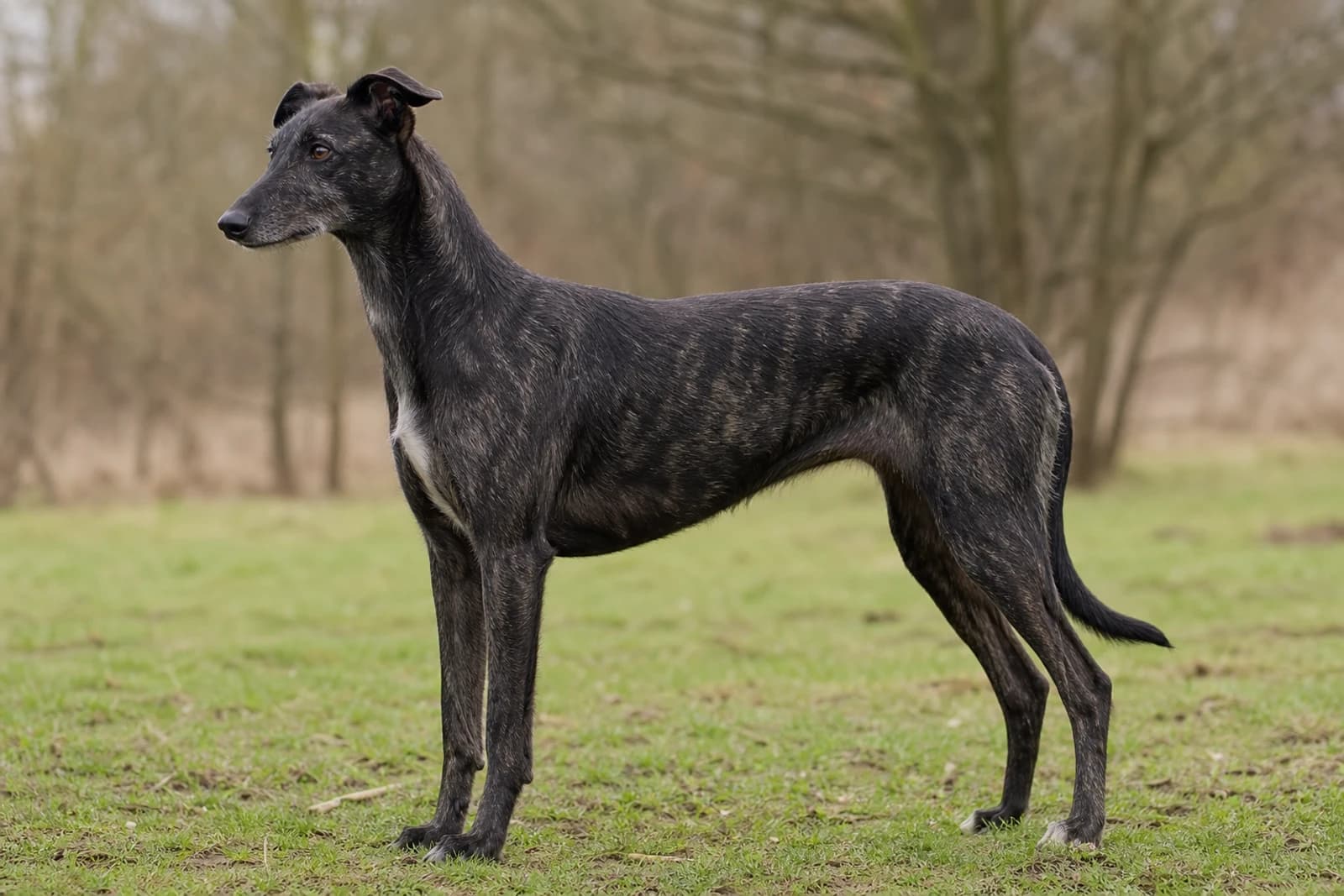
The Lurcher is a versatile and loyal crossbreed, typically a mix of a sighthound (like Greyhound) and a herding or terrier breed. Originally bred for speed and stealth in hunting, these dogs are known for their gentle, affectionate nature at home paired with high prey drive outdoors. They suit active individuals or families with older children who can provide daily exercise and secure spaces. Lurchers are intelligent but independent, requiring patient training. Their short coats need minimal grooming, making them low-maintenance companions for those who appreciate a blend of grace and vigor.
At a glance
- Size
- Giant
- Height
- 22–28 in
- Weight
- 60–71 lb
- Life span
- 13–14 years
- Coat colors
- Black, White, Brindle, Fawn, Red
- Coat type
- short to medium, smooth or rough
- Group
- Crossbreeds
How much does a Lurcher cost?
Adopt / rescue
$75–$400
Usually includes spay/neuter, first shots, and a microchip.
Buy from a breeder
$700–$2,000
From a reputable, health-testing breeder.
Approximate USD. Prices vary widely by region, breeder, pedigree, age, and coat colour — adopting is the lower-cost and recommended route. Avoid suspiciously cheap “breeders”; they’re often puppy mills.
Estimate the full cost of a Lurcher →Lurcher photos
Views
Front, side, rear and top — the full silhouette.Poses
How the breed sits, lies, moves and plays.Puppy to senior
The breed across its whole life.Expressions
The breed’s range of moods.Close-up details
Eyes, ears, nose, paws, tail and coat.Coat colors
The breed’s recognized colors.Click any photo to enlarge. We show the Lurcher from every angle — three views, poses, life stages, expressions, close-ups, coat and colors.
Appearance & size
Lurchers don’t come off an assembly line. Because every one is a deliberate cross — most often a sighthound like a Greyhound or Whippet bred to a working or herding dog — appearance varies, but the classic Lurcher silhouette is unmistakably built for speed and efficiency. Think of a tall, lean athlete with a deep chest and impossibly long legs, and you’re close.
Height at the shoulder runs 22 to 28 inches, and a mature dog typically weighs between 60 and 71 pounds. That puts most Lurchers firmly in the Giant size category, but the overall shape is more streamlined than bulky. The frame is light and racy, with a prominent breastbone, a noticeably arched loin, and a waist that tucks up sharply from the ribcage to the hindquarters. You shouldn’t see a soft, slab-sided dog here — the ribcage is deep but laterally narrow, engineered for large lung capacity and minimal wind resistance.
From the front, the chest forms a deep, inverted V between straight, fine-boned forelegs. The neck is long and gracefully arched, flowing into well-laid-back shoulders. Move to the side view, and you’ll catch that elegant S-curve: a smooth slope from the withers into a slightly roached back, then the steep tuck that makes the dog look almost underfed to someone unfamiliar with the type. The tail hangs low in a gentle curve, never curled over the back, and the overall impression is one of coiled energy.
From behind, the hindquarters show real power. Muscles are long and defined — not as heavily double-muscled as a pure Greyhound, perhaps, but still capable of sudden, explosive bursts. The hind legs stand wide apart at the stifles, which lets them drive forward without wasting motion.
Coat is where you see the working-dog mix come through. A smooth-coated Lurcher will have short, dense fur that’s sleek to the touch. A rough or broken coat brings in terrier or Collie influence: wiry, longer, often with a beard or facial furnishings. Colors run the entire dog rainbow — solid black, fawn, brindle, blue, red, white, or any party-color combination. You’ll spot dogs with white chest blazes, dark masks, or speckled ticking.
The head is long and tapered, with a flat skull and a slight stop. Eyes are dark, bright, and set obliquely, giving that soft, alert expression. Ears vary the most: small rose ears that fold back like a Greyhound’s, semi-prick ears that tip forward, or even upright terrier-style ears. It’s part of what makes each Lurcher look one of a kind. Instead of trying to match a written standard, you really need to see the individual dog and appreciate the blend — any good Lurcher should look like it was built for a purpose, not a show ring.
History & origin
A Lurcher isn’t a breed in the pedigree sense — it’s a deliberate cross, a type, with roots sunk deep into the hedgerows and moonlit fields of the British Isles. For at least 700 years, these dogs were the silent partner of the poacher, the commoner’s answer to forest laws that made owning a purebred sighthound a hanging offence. If you weren’t landed gentry, you couldn’t legally keep a Greyhound, Deerhound, or Wolfhound. So you made your own dog — one that could do the same job, then fade into the night.
The earliest written record of the word “Lurcher” shows up around the 14th century, likely borrowed from the Romani lur (thief) or the Middle English lurken (to lurk). That tells you exactly what these dogs were bred for: silent, fast, and furtive. A typical cross paired a sighthound — usually a Greyhound, sometimes a Whippet — with a herding or terrier breed. Collie blood added brains, stamina, and a rock-solid recall; terrier threw in grit, weatherproofness, and a smaller frame for squeezing through brambles. The recipe was never one-size-fits-all. A night hunter working open fields might want more Greyhound for flat-out speed; someone working dense cover might lean harder on the terrier side for a dog that could dig and dispatch.
Because Lurchers were owned by folks who didn’t write things down, no single origin story survives. What’s clear is that the type spread across England, Ireland, Scotland, and Wales as long as hare, rabbit, and the odd deer were worth the risk. The dog had to be quiet (no baying at the scent), sharp-eyed, and fast enough to course and catch game before it vanished. Equally important, the dog had to be unobtrusive — a good Lurcher could fold itself into a ditch at a whistle, avoid drawing a gamekeeper’s eye, and melt back into the shadows once the job was done.
Today, that working heritage still hums under the surface. Lurchers remain hugely popular in the UK and Ireland, both as working companions and as household pets. You’ll see them at lurcher shows, lure-coursing events, and on every other village green, stretched out in a sunbeam. In North America they’re less common but steadily gaining a following among people who want a big, lanky dog with a built-in off-switch. The modern Lurcher is still not a standardised breed — some are rough-coated, some smooth; some top 70 pounds, others barely nudge 50 — and that variety is exactly the point. For centuries, they were built to suit the land and the job, and that practical, unsentimental adaptability still defines them.
Temperament & personality
A Lurcher is a purpose-bred cross, usually a sighthound mixed with a working breed, so you’re not getting a single personality template. What you are getting is a dog with a distinct split: indoors, a quiet, couch-loving shadow; outdoors, a high-speed hunter with razor focus. Managing that dual nature is the key to living happily with one.
The indoor couch potato and the yard rocket
Lurchers often spend 90% of their time doing an excellent impression of a rug. They love soft surfaces, will follow you from room to room just to lie down nearby, and can be surprisingly gentle giants for a dog that stands up to 28 inches and weighs 60–71 pounds. That gentleness, however, doesn’t mean low energy. A fenced area where they can hit full stride is non-negotiable. Most need a hard sprint session — not a leisurely walk — at least once a day. Without it, that peaceful indoor dog can turn destructive or start barking out of sheer pent-up frustration.
Affection and wariness
With their own people, Lurchers are often velcro dogs, leaning into legs and resting their heads on laps. They bond deeply and can become anxious if left isolated for long stretches. Neglect or long periods alone may trigger anxiety-driven behaviors like destructive chewing or excessive barking. With strangers, many are watchful but reserved; a stiff body and direct stare from a dog that’s unsure means back off and give space. They’re not typically bark-on-sight watchdogs, but they notice everything and will alert you if something feels off.
Prey drive and multi-pet homes
The sighthound half brings a chase instinct that doesn’t negotiate. Small furry animals — cats, rabbits, even small dogs running — can flick a switch. A relaxed, loose body and soft eyes can become a forward-leaning, rigid stare in a heartbeat. If you have cats or pocket pets, you need a Lurcher with a proven track record or a management plan that assumes the dog will hunt. This isn’t aggression; it’s hardwired drive. Food guarding can also surface, so teach children to leave the dog in peace during meals.
Quirks you’ll just have to accept
- Rolling in filth. Lurchers frequently roll in dead things, fox scat, or anything truly foul. Some do it to mask their scent; others just seem to enjoy the perfume. A homemade citrus or vinegar spray can help protect your belongings from post-roll damage, but for the dog itself, you’ll be reaching for the shampoo.
- Scent marking. They can be enthusiastic urine markers, especially intact males, using scent as a spatial memory aid. That means cleaning indoor accidents with an enzyme cleaner (or a vinegar solution to neutralize odor) is critical. Otherwise, that spot still smells like a bathroom and will be targeted again.
- Chewing as a lifelong hobby. Puppies chew to explore and soothe teething pain; adults keep at it to maintain jaw strength and clean teeth. Provide approved chew items and leave nothing valuable at Lurcher height.
Training mindset
This is not a breed you bully into compliance. Strong-willed Lurchers respond to respectful, consistent engagement — never force. Lip licking, yawning, or turning the head away are calming signals that tell you to dial back pressure. Always reward outdoor elimination immediately with a treat; that one positive link does more than a dozen corrections. And because dogs often define their territory by family scent clusters, a Lurcher who soils a guest room isn’t being spiteful — that room just doesn’t smell like home yet. More supervised time there usually sorts it.
Good with kids, dogs & other pets
A Lurcher who grows up with children usually turns into a patient, affectionate shadow, but those early weeks matter more than the dog’s natural disposition. These are big, leggy dogs — 60 to 71 pounds and up to 28 inches at the shoulder — and a happy tail wag or a full-speed zoomie can floor a toddler before either of them knows what happened. Adult supervision is non-negotiable, and kids need clear rules: no climbing on the dog, no grabbing a running Lurcher’s collar, no disturbing one that’s resting. Teach them to read a stiffened body or a whale eye, because even the sweetest dog has limits.
With other dogs, a well-socialized Lurcher is rarely the one starting trouble. They often welcome a canine playmate who can match their sprint-and-chase style — other sighthounds or leggy mixed breeds tend to be the best fit. The catch comes with dogs they didn’t meet during the 3–14 week socialization window. A Lurcher who missed that exposure can be aloof, nervous, or reactive, especially around pushy dogs that crowd their space. If you’re adopting an adult, pay attention to what they already know. Forcing meet-and-greets on a fearful Lurcher doesn’t build confidence; it just adds stress, and two tense dogs going muzzle-to-muzzle can spark a fight.
Cats, rabbits, ferrets, and even small fluffy dogs live in a different category. Every Lurcher carries sighthound ancestry — Greyhound, Whippet, Deerhound — crossed with a working breed. That mix creates a high-speed hunter whose instinct to chase small, darting creatures rarely goes fully dormant. Some individuals raised from puppyhood alongside a house cat learn to draw an uneasy truce, but you can’t treat that as a given. A cat that bolts across the room can flip a switch in a dog who was napping two seconds before. When you leave the house, separate them. Outdoors, keep a Lurcher leashed or muzzled unless the area is securely fenced and free of temptations. Early, positive exposure between 3 and 16 weeks gives you the best shot at household harmony, but even then, prey drive won’t necessarily disappear — it’s just better managed.
Trainability & intelligence
A Lurcher’s intelligence is the independent, problem-solving kind — not the biddable “what’s next?” eagerness of a retriever. These are sight hound crosses, often with collie or terrier influence, and they quickly figure out what you want. The real question is whether they see a reason to do it right now. Motivation matters enormously, and it usually comes in the form of high-value treats, a squeaky toy, or a chance to sprint. Without that, you can expect a blank stare from a dog that’s already decided the squirrel in the yard is a better deal.
Training has to start early, but more importantly, it has to be a relationship, not a transaction. Puppy socialization between 3 and 14 weeks is non-negotiable — expose them gradually to different people, kids, traffic sounds, and strange surfaces. A Lurcher that misses this window can become spooky or reactive, and at 60–71 lb of lean muscle, a fearful burst of speed is the last thing you want. Use reward-based methods exclusively. A piece of chicken or a game of tug for a desired behavior builds trust; a harsh correction can shut them down or spike anxiety, and a dog that doesn’t trust you simply won’t listen.
Recall is the big test. A Lurcher’s prey drive is hardwired, and once they lock onto a moving target — a cat, a rabbit, a plastic bag blowing across a field — their ears switch off. Short, upbeat training sessions work best. Start “come” in a distraction-free hallway, then a fenced yard, then on a long line in a quiet park, always rewarding like you’ve won the lottery. Never call them to you and then do something they dislike (like ending a walk or clipping nails). The moment the recall becomes optional in their head, you’ll spend years trying to fix it.
Common challenges include selective hearing and a stubborn streak that can look like laziness. A Lurcher doesn’t need hours of drilling; five minutes of focused work, three or four times a day, beats a 20-minute slog. End each session on a high with a treat toss or a short play session. If you run into a wall, step back and ask whether the reward is exciting enough, not whether the dog is being “bad.” Patience and consistency pay off, but you’re building a partnership with a sensitive, fast-thinking athlete — not programming a robot.
Exercise & energy needs
A Lurcher’s exercise sweet spot is one or two full-tilt sprints each day, not hours of plodding leash walks. These leggy 60–71 lb crossbreeds are built for explosive speed followed by serious couch time, so a quick trot around the block barely scratches the surface. Plan on 60 to 90 minutes of daily activity, split into at least two sessions. The highlight should be off-leash running in a securely fenced area—Lurchers have a hair-trigger prey drive and can vanish after a squirrel in seconds. If a safe field isn’t an option, a long line used for sprint-and-recall games is the next best thing.
You don’t get a pass on mental exercise. A bored Lurcher will redecorate your home, howl, or fixate on the window in a way that frays everyone’s nerves. Feed that busy brain with puzzle toys, scent games, or scatter feeding—anything that lets the Collie or Terrier smarts in the mix work a problem. Lure coursing, amateur straight racing, and fast flirt-pole sessions lean into their sighthound heritage and drain energy in a fraction of the time a long hike takes.
Protect those long legs and deep chest. Avoid repetitive pounding on pavement, heavy jumping, or hard running right after a meal (bloat is a real risk). Puppies and adolescents need even more caution—hold off on forced road running and full-height jumps until growth plates close, usually between 12 and 18 months. Nail the blend of sprint and brainwork, and you’ll get a dog who spends the rest of the day upside-down on the sofa, dead to the world.
Grooming & coat care
Your Lurcher’s grooming routine hinges entirely on which coat type came through the genetic lottery. This crossbreed can inherit anything from a Greyhound’s slick, close-lying coat to a Saluki’s long, silky feathers or a terrier’s wiry scruff. Pay attention to what’s actually on your dog, because advice meant for a smooth coat won’t work on a heavily feathered one.
Know your Lurcher’s coat and the right brush for it
- Smooth, short coat (typical of a Whippet or Greyhound parent): A 5–10 minute weekly session with a pig-bristle brush is all you need most of the year. The bristles pull away loose hair and spread natural oils, leaving a glossy shine. During spring and fall when shedding kicks up, swap in a rubber grooming mitt every other day to grab handfuls of dead coat before it blankets your sofa.
- Rough or broken coat (wiry, medium length, often from a Collie or terrier cross): You’re going in with a slicker brush — the kind with rounded pins — to work through the topcoat and clear out any trapped undercoat. Follow immediately with a metal greyhound comb to snag tangles before they harden into mats. Three times a week keeps this coat manageable. Let it slide for two weeks and you’ll be cutting out felted knots behind the ears and deep in the flank.
- Long, soft, or feathered coat (Saluki, Deerhound, or setter influence): Brush every single day, no exceptions. Use a pin brush or slicker to gently work through the long hair on the tail, chest, and backs of the legs, then go back with the comb right down to the skin. The spots behind the ears and under the collar mat up ridiculously fast, so give those extra attention.
Bathing, nails, ears, and teeth
Bathe when your dog smells bad or rolls in something unspeakable — no fixed schedule. For a smooth-coated Lurcher, that might mean two or three baths a year. Use a mild, dog-specific shampoo so you don’t strip the coat’s protective oils. Rough- and long-coated dogs benefit from a conditioner spray afterward to stop the comb from tugging dry hair.
Clicking nails on the floor mean it’s time for a trim, usually every 3–4 weeks. Use a guillotine or scissor-style clipper and keep some styptic powder handy if you nick the quick. Ear care depends on ear set: sighthound-type rose ears tend to stay drier and cleaner, but floppy ears from a Collie line need weekly checks and a quick wipe with a damp cotton ball. Brush teeth at least three times a week with an enzymatic dog toothpaste; tartar buildup becomes a bigger deal as these large dogs age.
Seasonal shedding and the exercise bonus
Lurchers with an insulating undercoat — common in rough and some long coats — blow coat heavily twice a year. You’ll ramp up to daily brushing during those periods and still find tumbleweeds drifting across the kitchen. A 15-minute session with a high-velocity dryer at a self-serve dog wash during peak molt can blow out a startling volume of dead hair in one go.
A final practical point: hard running through fields is a legitimate grooming hack. A Lurcher that gets a solid off-leash hour every day shakes out dead hair, stimulates healthy coat turnover, and sheds less from stress. The exercise you’re already giving them pulls double duty for skin and coat.
Shedding & allergies
Shedding with a Lurcher is a mixed bag — literally. Because these dogs are sighthound crosses, a lot depends on which breeds went into the recipe. The Greyhound half usually brings a slick, short coat that barely sheds; throw in a rough Collie or terrier parent, and you might get a denser, wiry coat that drops more hair.
Coat types and shedding
- Smooth-coated Lurchers (the most common) have a short, close-lying coat that needs a quick wipe-down. You’ll notice some light shedding year-round, but it’s nothing like a Lab’s constant fuzz.
- Broken-coated Lurchers carry a wiry, slightly longer topcoat over a soft undercoat. These tend to shed a bit more, especially during seasonal transitions. A weekly brush with a hound glove or rubber curry comb catches the loose stuff before it lands on the couch.
- Long-coated Lurchers are rarer, but when they pop up, expect more hair tumbleweeds. Still, even the heaviest-shedding Lurcher is nowhere near a true double-coated breed. Seasonal blowouts are mild; you won’t be vacuuming mountains of fluff twice a year.
Drool factor
You won’t be carrying a drool rag. Lurchers rarely slobber. If you see a puddle, it’s usually a stolen sandwich or an iffy stomach, not an everyday event.
The allergy reality
No dog is truly hypoallergenic, and a Lurcher’s mixed coat genetics make it impossible to guarantee an allergy-safe pet. Many people with mild allergies do react less to short, single-coated dogs like the smooth Lurcher, because they produce less dander than oilier, heavily shedding breeds. If allergies are a big concern, spend time with the individual dog you’re considering — littermates can wind up with completely different coat types. A responsible breeder won’t promise a particular shed level, but they can walk you through the parents’ coats and grooming habits.
Diet & nutrition
Measure every meal. A Lurcher’s long, lean build hides weight creep better than almost any breed—until ribs vanish and the dog is carrying five or ten extra pounds that strain long legs and a deep chest. If your dog works hard off lead, a 65-pounder may burn through 1,800 calories a day. The same dog hitting middle age on short leash walks might do fine on 1,200. Keep him trim enough that you can feel each rib with a light touch, not see them standing out.
Adult Lurchers do best on two meals a day. If yours inhales food in seconds, use a puzzle bowl to slow eating and add a little mental work to mealtime. Puppies need four evenly spaced meals until four months, three meals until six months, then the adult schedule. Transition a puppy gradually onto lightly cooked, puréed meats, fish, fruits, and vegetables, or a large-breed commercial puppy food. Raw chicken wings can be introduced around twelve weeks, always under supervision.
Once your Lurcher gets older and the sprint turns to a stroll, don’t cut protein—just shrink the portions if the waistline softens. Three smaller meals often suit seniors better than two large ones, and puréeing food helps dogs with worn or missing teeth absorb more nutrients.
Lean heavily on animal protein. A good foundation is roughly 60% muscle meat and organs, 20–30% fruits and vegetables, and the remaining 10% from eggs, plain yogurt, or digestible grains like pearl barley and white rice. If you home-cook, blending the mix aids dogs’ vertical jaw motion and the lack of salivary enzymes. Canned fish, cooked veg, and batch-cooked grains make quick, healthy bases, and unsalted vegetable cooking water works as a moisture-rich pour-over. Avoid vegetarian or vegan diets—your Lurcher’s gut is built for meat. Keep fatty holiday scraps out of the bowl entirely; even one rich meal can trigger pancreatitis. And serve everything in the dog’s own dish, nowhere near the table. Once begging takes hold, it’s a hard habit to break.
Health & lifespan
A well-cared-for Lurcher typically lives 13 to 14 years — a solid stretch for a giant-sized dog. As a crossbreed, health isn't a single checklist; it's a blend of what both parent lines bring. Many enjoy hybrid vigor and never run into the concentrated genetic troubles some purebreds face, but they can still inherit vulnerabilities, especially when sighthound influence runs deep.
Deep chests from Greyhound or Deerhound ancestry make bloat (gastric dilatation-volvulus) a real emergency to watch for. Feed two or three smaller meals a day and avoid hard exercise right before and after eating. Large, lean frames also mean osteosarcoma (bone cancer) crops up more often than in smaller dogs — any limp that doesn't resolve in a day or two deserves a prompt vet check.
That paper-thin skin is tough enough for a sprint but fragile in brush or roughhousing. Cuts, scrapes, and skin allergies trigger plenty of vet visits. A dull, shredding coat or constant licking often points to a food or environmental trigger. Combined with almost no body fat, it also makes Lurchers temperature-sensitive. They need a coat in freezing weather and can overheat fast in summer; never leave one outside without shade and water when it's hot.
When you buy from a breeder, ask how they screen breeding stock. For sighthound-heavy lines, eye exams clear of progressive retinal atrophy and cardiac checks for dilated cardiomyopathy are smart. If Collie or working-dog lines appear, hip scores and a MDR1 drug-sensitivity test become relevant.
Preventive care is straightforward. Monthly heartworm prevention during mosquito season (and for one month after) is essential. Rabies vaccination is mandatory. After age seven, annual bloodwork and a thorough physical help catch arthritis, thyroid shifts, or early kidney changes. And because all that weight rides on long limbs, keeping your dog lean — ribs easily felt under a thin coat — protects joints and may tack extra healthy years onto that 13–14 range.
- Sudden appetite loss, a pot-bellied look, or unproductive retching? Get to a vet immediately — bloat can kill in hours.
- Any recurring skin trouble warrants a dietary audit and a chat about environmental allergies, not just another cream.
Living environment
A Lurcher is a study in contradictions that suits more living situations than you’d expect from a 60–71 lb, 22–28 inch tall dog. They typically inherit the sighthound’s famous “40-mph couch potato” rhythm: explosive sprints followed by deep, unmoving sleep. That means a spacious apartment can work perfectly well as long as you commit to daily, high-speed off-lead runs. The ideal setup is a house with a large, securely fenced yard—6-foot fencing is non-negotiable, because many Lurchers clear a lower barrier in a single bound if a squirrel streaks past. Even with a yard, they still need those dedicated sprints; pacing the fence line won’t burn the energy that settles them indoors.
Climate tolerance is lopsided. A Lurcher runs low on body fat and coat, so they feel the cold keenly. Once the temperature dips below about 50°F, they’ll need a well-fitted coat for walks and a warm bed away from drafts. Heat is a mixed picture—they’ll happily sunbathe for hours, but hard running in high humidity or over 80°F can tip a deep-chested dog into overheating fast. Early morning or evening exercise solves that neatly.
Noise-wise, these are remarkably quiet housemates. Barking is rarely their default; you’re more likely to hear a dramatic groan of contentment or a roo-roo greeting when you walk in the door. That low-volume habit makes them a friendlier fit for attached housing than many other large breeds.
Tolerance for being alone depends heavily on the individual and your training, but the blueprint matters. Many Lurchers bond tightly to their people and, if left for long hours without preparation, can slide into howling, chewing, or destructive anxiety. Stack the deck by providing a solid off-lead run before you leave, a food puzzle, and gradual desensitization from day one. A second calm dog often does more to keep a lonely Lurcher settled than any toy, but even a solo Lurcher can manage a sensible workday once they trust the routine. Just don’t expect them to be a hands-off backyard ornament—they want the sofa, and they want you on it.
Who this breed suits
If your idea of the perfect dog day involves a flat-out sprint in a safe field, followed by collapsing onto the couch for hours, you’re already thinking like a Lurcher. These 60–71 lb giants are bred from sighthound lines—usually Greyhound crossed with a Collie, Terrier, or other working breed—which means they pack explosive speed into a surprisingly lazy body. A solid 20–30 minutes of off-leash tearing around (securely fenced, always) satisfies them far more than a three-mile jog. After that, they’ll curl their 22–28 inch frame into the smallest possible ball and ignore you till dinner.
Active singles or couples with a yard often hit the sweet spot. You get a dog who’s up for country walks, beach dashes, or lure coursing, but won’t demand constant entertainment inside. Families with older kids do well, too—Lurchers are typically gentle and patient, though that whippy tail at coffee-table height clears surfaces effortlessly. Knock-overs happen, so toddlers can be a mismatch unless you’re prepared to manage the dog’s space. Seniors who still enjoy daily walks and can handle a strong pull if a squirrel appears can make excellent owners, provided the dog gets its sprint fix without relying on the owner’s own pace.
First-timers can succeed here if they go in eyes open. You’ll need to embrace two non-negotiables: rock-solid recall training (their chase instinct flips on like a switch, and a running Lurcher hears nothing) and a home where small furries aren’t cohabitating. Cats, rabbits, and even tiny dogs often flick that prey drive switch, and management is lifelong, not a training phase.
Think twice if you live in an apartment without easy access to a private, enclosed run. These dogs don’t exercise themselves on a leash. Walks alone won’t drain the tank—an under-exercised Lurcher turns anxious, destructive, or finds his own “games” by shredding cushions. They’re also sensitive souls; a loud, chaotic household or harsh training shuts them down fast. If you can’t give a secure sprint space and a quiet spot to decompress, a Lurcher will struggle to feel like himself.
Cost of ownership
A healthy Lurcher rarely comes with a steep upfront price tag, which is part of their appeal. Many end up in sighthound rescues or shelters, where adoption fees typically run $200–$500 and usually include spay/neuter, microchipping, and initial vaccinations. If you go through a dedicated breeder who health-tests parent stock for conditions like osteosarcoma or bloat susceptibility, expect to pay $800–$1,500+. Either route, the real spend is the long game.
Monthly costs settle around $150–$300, skewed by a Lurcher’s size and surprising food bill. These are leggy, deep-chested dogs often weighing 60–71 lb, and an active one eats 4–5 cups of high-quality kibble a day. Budget $70–$100 per month for a brand that supports joint and heart health, more if you mix in fresh protein. Treats for training add another $15–$20.
Grooming is refreshingly minimal. A Lurcher’s short coat needs only a weekly once-over with a hound glove and the occasional bath. Nail trims and ear cleaning cost $15–$25 a month if you outsource, or a one-time kit purchase of $30 if you DIY.
Vet and insurance costs ask for a hard look. Routine preventive care—annual exams, vaccines, heartworm and flea prevention—averages $40–$60 monthly. Then there’s the sighthound reality: thin skin that tears, a proclivity for dental disease, and the risk of gastric dilatation-volvulus (bloat) that demands emergency surgery. A solid pet insurance plan for a giant crossbreed can run $50–$75 a month. Sock away $30–$50 a month in a pet emergency fund if you skip insurance.
Don’t overlook start-up and lifestyle extras. A crate ($100–$200), extra-large orthopedic bed ($80–$150), martingale collar and long line ($40–$60), and a few sturdy chew toys cover the first week. If you hire a sitter or walker for a high prey-drive dog prone to bolting, those pop-up costs easily outstrip the grocery bill.
Choosing a Lurcher
Most Lurchers don’t come from a breeder with a glossy website—they’re the accidental, often brilliant result of a sighthound mixed with a working terrier, collie, or bull breed. That means your first stop should be a rescue. Organizations specializing in sighthounds are overflowing with lanky all-rounders whose adult size, temperament, and any health quirks are already known. If you do pursue a puppy from a home or breeder, go in with your eyes wide open.
Rescue or breeder?
Rescues routinely have young Lurchers under a year old, and you’ll skip the guesswork on adult size (though the 60–71 lb, 22–28 in range is a good average). A reputable rescue will have spayed or neutered, done a basic behavioral assessment, and treated any immediate medical issues. With a breeder, you’re betting on how two different breeds will combine—something even experienced breeders can’t fully predict.
Health clearances to ask for
There’s no single health panel for a crossbreed, so you’re looking at the parent breeds. A serious breeder will have screened both parents for issues that show up in their respective lines. For the sighthound side, ask for:
- Hip scores (Greyhounds, Deerhounds, etc.)
- Ophthalmologist eye exams (PRA, cataracts)
- DNA tests relevant to the breed (e.g., Greyhound polyneuropathy, Whippet/Parson Russell terrier late-onset ataxia)
For the other parent—often a Border Collie, Bedlington, or Staffordshire Bull Terrier—expect elbow scores, patella checks, and breed-specific DNA screens. If they can’t name the exact mix or produce paperwork, walk away.
Red flags
- Multiple litters of different crosses always available
- Puppies leaving before eight weeks
- No vaccination or worming records, or reluctance to let you see the mother and the environment
- Claims like “crossbreeds are healthier, so no testing needed”
Picking a puppy
Watch the mother first. A Lurcher puppy takes after her in early confidence. You want a pup who investigates new people, not one who cowers behind a chair. Reputable raisers will have exposed the litter to household sounds, gentle handling, and short car trips. At pickup, each puppy should be microchipped and have at least a first vet exam. A 13–14-year commitment starts with steady nerves, so if the whole setup feels off, trust your gut and check local rescues instead.
Pros & cons
-
A couch potato with a turbo button. At home, most Lurches melt into furniture, content to lounge for hours. But once outside, that sighthound engine kicks in — expect a dog that can hit 35 mph in a sprint and then nap for the rest of the afternoon.
-
Gentle family companion. When properly socialized, they’re famously soft-mouthed and patient, often forming strong bonds with children. A 60–71 lb dog that leans rather than bowls you over is a real asset in a busy household.
-
Low-maintenance coat care. Short, sleek fur means mud brushes off easily. A quick wipe-down and the occasional bath handle shedding and dirt — no professional grooming bills needed.
-
Quiet housemates. Unlike many high-energy breeds, Lurches rarely bark without a reason. You get the alertness of a sighthound without the nonstop commentary.
-
Long, sturdy lifespan. With 13–14 years typical, you’re signing up for a long-term partnership, and their crossbreed vigor often means fewer inherited health quirks than their purebred cousins.
-
Prey drive on a hair trigger. A squirrel, a cat, a small fluffy dog — the chase instinct overrides recall. Off-leash freedom requires either a fenced field or impeccable training, and even then, no guarantees.
-
Escape artists with a vertical leap. A 22–28 inch Lurcher can clear a four-foot fence from a standstill. Secure, high fencing (think 6 ft+) is non-negotiable unless you enjoy searching the neighborhood at dusk.
-
Can shred a sofa when bored. Leave one alone without enough physical or mental work, and those needle-sharp sighthound teeth will remodel your upholstery. A solid hour of off-leash running daily is the baseline, not a bonus.
-
Velcro dogs with a sensitive streak. They often pick one person and stick like glue, which can slide into separation anxiety if not managed from day one. Expect a dog that supervises every bathroom trip.
-
Not a small-pet household default. Many adult rescue Lurches were originally bred for hunting, and their reaction to pet rabbits, guinea pigs, or even small dogs can be instinctive and terminal. Management, not trust, is the rule.
Similar breeds & alternatives
If you like the idea of a leggy, fast dog with a strong chase instinct but you’re weighing other routes, a few specific breeds give you different trade-offs.
Greyhound is the obvious comparison, because most Lurchers carry a heavy dose of Greyhound blood. A purebred Greyhound stands 27–30 inches and weighs 60–70 lb, right in the same ballpark. The biggest difference is predictability. A Greyhound from a responsible program comes with known, consistent traits: extreme sprint speed followed by serious couch time, a fairly low-key indoor presence, and a prey drive that’s high but often manageable with training. A Lurcher, by contrast, is a mixed bag. You might get more biddability and off-leash recall from a collie cross, or more tenacity and stock-sense from a terrier cross, but you also lose the guarantee of that Greyhound “40-mph potato” package. If you want a quieter, softer-natured dog and you’re okay with a hound who may never be reliable off leash in an open field, a retired racing Greyhound is often a simpler, calmer fit.
Whippet gives you the same sighthound silhouette in a smaller, more apartment-friendly package—18–22 inches, 25–40 lb. Whippets tend to be a bit more playful and people-oriented indoors than a typical Greyhound, and they’re still capable of explosive speed. A Lurcher is double the weight and far more powerful, which matters if you need a dog that can safely knock around with larger kids or cover serious ground on long runs. If you want a quieter, lower-impact sighthound that’s easier to curl up with on the sofa, a Whippet is a solid alternative; if you need the size and stamina for full-day hikes or working scenarios, a Lurcher makes more sense.
Scottish Deerhound sits at the giant end—28–32 inches and 75–110 lb. Deerhounds share the lurcher’s rugged, chase-hardy build, but they’re substantially heavier-boned and bred to course large game. They’re typically more docile in the house than a flighty Greyhound and can be gentle giants, but their sheer size, shorter typical lifespan (8–11 years), and higher feeding cost are real commitments. A 60–71 lb Lurcher splits the difference: tall and athletic but without the Deerhound’s bulk and maintenance.
People sometimes consider a purpose-bred collie cross or terrier cross directly, instead of a Lurcher. A working-line Border Collie will give you off-the-charts trainability and stamina, while a Bedlington Terrier cross often adds a woolly coat and a sharper vermin-killing drive. The catch is that a pure collie or terrier doesn’t bring the sighthound’s visual chase mechanics—that intense fixation on movement and sudden explosive launch. A Lurcher is that specific hybrid: a dog who hunts with its eyes and can switch on when something moves, but may also inherit some work ethic or resilience from the other side. If the visual-chase thrill is what you’re after, stick with a sighthound cross or a pure sighthound; if you prize trainability above all, a straight herding breed will run circles around any Lurcher in an obedience ring.
Fun facts
- Lurchers originated from crosses between sighthounds and working breeds, often used for poaching game.
- They can reach speeds of up to 40 mph, thanks to their sighthound heritage.
- Despite their athleticism, many Lurchers are content to lounge indoors after a good run.
- Their keen eyesight and strong prey drive make them excellent at lure coursing.
Frequently asked questions
- Are Lurchers good with children?
- Lurchers can be gentle and affectionate with children, especially when properly socialized from a young age. Their sighthound background often gives them a calm indoor demeanor, though they may be sensitive to rough handling. Supervision is recommended around very young kids due to their size and occasional chase instincts.
- Do Lurchers shed a lot?
- Shedding in Lurchers varies by coat type; smooth-coated individuals tend to shed moderately year-round, while rough-coated ones may shed less. Weekly brushing usually helps manage loose hair. They are not considered heavy shedders compared to many other breeds.
- How much exercise does a Lurcher need?
- Lurchers typically need at least an hour of daily exercise, combining walks, free running in a secure area, and mental stimulation. They have bursts of high energy but also enjoy lounging indoors. Regular exercise prevents boredom and destructive behaviors.
- What are the grooming requirements for a Lurcher?
- Grooming needs depend on the coat type; short-haired Lurchers require minimal maintenance, just occasional brushing, while longer-haired types may need more frequent brushing to prevent tangles. Routine nail trims, ear cleaning, and dental care are important for overall health.
- Can a Lurcher live in an apartment?
- A Lurcher can adapt to apartment living if given sufficient daily exercise and mental engagement. Their generally quiet nature indoors is a plus, but their large size and need for sprinting opportunities mean a home with access to a yard or nearby open space is more ideal.
- Are Lurchers easy to train for first-time owners?
- Lurchers are intelligent but can be independent, so training may require patience and positive reinforcement. They can be suitable for first-time owners who are consistent and use reward-based methods, though their sighthound traits sometimes lead to stubbornness. Early socialization is highly beneficial.
Tools & calculators for Lurcher owners
Quick estimates tailored to Lurchers — pre-filled with this breed’s size where it matters.
Articles & stories about the Lurcher
Sources & standards
This profile follows recognized breed standards from the American Kennel Club (AKC) and the Fédération Cynologique Internationale (FCI), along with established veterinary and breed-club guidance. These describe general breed tendencies — every dog is an individual.
Owner stories
Have a Lurcher? Share your experience — grooming tips, personality quirks, anything goes.