

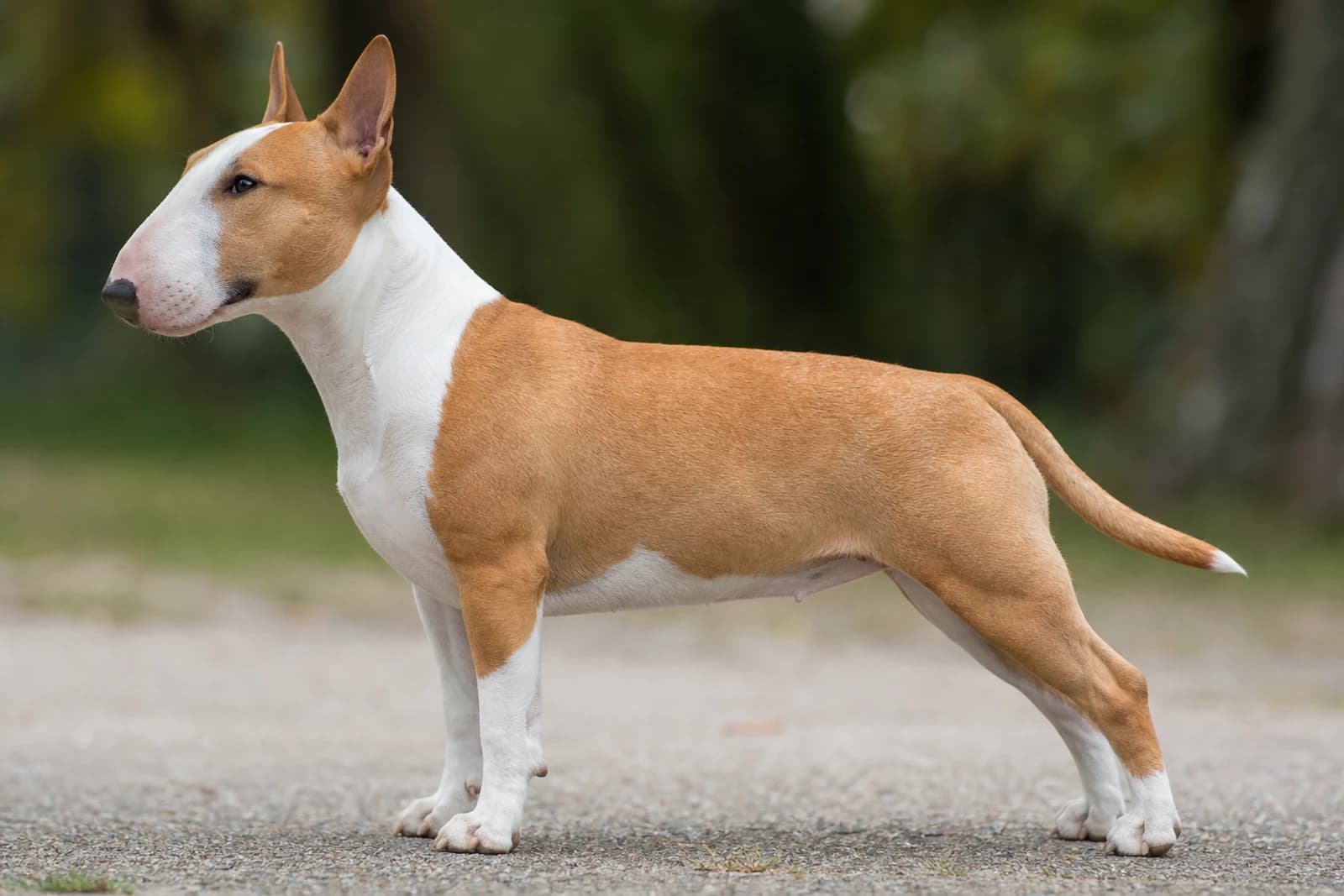
The Miniature Bull Terrier is a compact, muscular dog standing 14 inches tall and weighing 24-33 pounds, with a mischievous and affectionate nature. These terriers are known for their egg-shaped head and expressive eyes. They thrive in homes with experienced owners who appreciate their clownish antics and stubborn streak. While they love human companionship, their high energy and independent spirit require patient training and daily exercise. Suited for active singles or families without small pets, this loyal and entertaining breed is not recommended for first-time dog owners.
At a glance
- Size
- Medium
- Height
- 14 in
- Weight
- 24–33 lb
- Life span
- 10–12 years
- Coat colors
- White, White & Brindle, White & Fawn, White & Red, Brindle, Fawn, Red
- Coat type
- Short, flat, harsh coat
- Origin
- United Kingdom
How much does a Miniature Bull Terrier cost?
Adopt / rescue
$75–$400
Usually includes spay/neuter, first shots, and a microchip.
Buy from a breeder
$700–$2,000
From a reputable, health-testing breeder.
Approximate USD. Prices vary widely by region, breeder, pedigree, age, and coat colour — adopting is the lower-cost and recommended route. Avoid suspiciously cheap “breeders”; they’re often puppy mills.
Estimate the full cost of a Miniature Bull Terrier →Miniature Bull Terrier photos
Views
Front, side, rear and top — the full silhouette.Poses
How the breed sits, lies, moves and plays.Puppy to senior
The breed across its whole life.Expressions
The breed’s range of moods.Close-up details
Eyes, ears, nose, paws, tail and coat.Coat colors
The breed’s recognized colors.Click any photo to enlarge. We show the Miniature Bull Terrier from every angle — three views, poses, life stages, expressions, close-ups, coat and colors.
Appearance & size
When you first see a Miniature Bull Terrier, your eye goes straight to the head. It’s a smooth, egg-shaped curve with no stop — the skull and muzzle form one continuous arch from the top of the skull to the tip of the nose. The profile drops in a gentle Roman finish, and the whole head is long, deep, and filled with no hollows. The eyes are small, dark, and triangular, set close together and slightly slanted. The ears are thin, naturally erect, and point straight up. Together, that face gives the dog an expression that’s equal parts mischief and iron determination.
The body backs up the attitude. A Mini stands about 14 inches at the shoulder and settles onto a scale between 24 and 33 pounds. Despite the compact size, this is a square, densely muscled animal — you can see the power even at a standstill. The skin fits tight, and the short back, deep chest, and well-sprung ribs make the dog look like a little gladiator. From the side, the chest drops to the elbows, and the belly tucks up sharply behind it. From the rear, the hindquarters are heavily muscled, with angulation that hints at genuine driving power when the dog moves. The tail is set low, thick at the root, and tapers to a fine point; a happy Mini carries it straight out horizontally, like a rudder.
Coat is utterly no-fuss: short, flat, and harsh to the touch, with a crisp gloss when the dog is in good health. You won’t find any wispy feathering or curls. The standard allows two color routes. White dogs are solid white, though they may have colored markings restricted to the head. Colored dogs come in brindle, fawn, red, black, or tricolor; any color other than white must have white markings on the body, often in a flashy pattern of a white chest, white feet, and a white blaze. In either case, the close-lying coat shows off every muscle ripple and contributes to the trademark silhouette: the unmistakable curved head on a clean, arched neck, the barrel chest, and the compact, brawny frame that looks ready to explode. You’ll spot that outline from a block away.
History & origin
You can trace the Miniature Bull Terrier straight back to the smoke-and-ale grime of 19th-century England. The breed didn’t pop out of nowhere — it started as a downsized version of the full-size Bull Terrier, itself a mash-up of bulldog tenacity and terrier speed. In the 1860s, a Birmingham breeder named James Hinks set out to create a cleaner, all-white fighting dog by crossing the old bulldog with White English Terriers and possibly Dalmatians. His “Hinks breed” was the Bull Terrier, and it wasn’t long before smaller specimens began turning up in litters.
Those runts were exactly what ratting enthusiasts wanted. When bull-baiting and dog fighting were outlawed, rat pits filled the gambling gap — and a small, whip-fast terrier that could kill a hundred rats in minutes was worth its weight in shillings. Urban stables, warehouses, and riverfronts also teemed with vermin, so a compact ratter that didn’t eat much and could slip into tight spaces was a practical asset. The earliest Miniatures often weighed as little as 9 pounds. They had the same egg-shaped head, fiery eye, and scrappy attitude as their larger cousins but in a body smaller than a cat.
By the early 20th century, breeders were deliberately selecting for that pocket-rocket size. They wanted a dog that looked and acted like a Bull Terrier but fit into a city flat or a small yard. The Kennel Club in the UK recognized the Miniature Bull Terrier as a distinct variety in 1939, just as the world was about to descend into war. The breed nearly vanished during and after WWII, but a handful of dedicated fanciers pulled it back from the edge. The American Kennel Club welcomed the Mini Bull into its Terrier Group in 1991, and today’s standard is a sturdy 24–33 pounds, with a 14-inch height cap.
Despite the show-ring polish, the dog hasn’t forgotten its job. A Miniature Bull Terrier on a walk will still pivot and freeze at the faint skitter of a mouse in the grass. The breed was built to dispatch vermin on the fly — and that marrow-deep instinct didn’t get bred out just because the rat pits closed down.
Temperament & personality
This is not a dog for the faint of heart. A Miniature Bull Terrier packs more personality per pound than almost any breed — equal parts comedian, athlete, and stubborn negotiator. You’re signing up for a dog who believes he’s the center of the universe and will argue his case daily, often while plastering a grin across that egg-shaped head.
Expect a lively, self-confident firecracker who sees every day as a mission. He’ll greet you with full-body wiggles, then literally climb into your lap because personal space was never part of the deal. That same intensity makes him a sharp watchdog; nothing gets past a Mini Bull without a pointed, ear-splitting alert. With family, he’s a devoted shadow — Velcro-like, often to the point of tripping you. On the flip side, he’s naturally suspicious of strangers and can be prickly with unfamiliar dogs, especially those of the same sex. This is not a breed that automatically charms your dinner guests. Early, relentless socialization is not optional.
Stubbornness here isn’t a flaw — it’s the factory setting. A Mini Bull will tune out a command if you sound uncertain or boring. Hands-on, respectful consistency wins his cooperation; force or harsh corrections backfire spectacularly. He thrives on engagement and withers under neglect. Left alone with nothing to do, those anxiety-driven behaviors surface fast: shrieking barks, obsessive chewing, or redecorating your couch cushion by cushion. In fact, chewing is a serious avocation. Puppies explore the world with their teeth, and adults stay motivated — they’ll annihilate flimsy toys in seconds to keep jaws strong. Supply a rotation of near-indestructible chews unless you have a sentimental attachment to your baseboards.
You’re going to learn canine body language the hard way. A forward lean paired with a stiff, direct stare signals real trouble, not curiosity. A loose, wiggly body and soft eyes mean your clown is on deck. Lip-licking, yawning, or a sudden head-turn often mean “I’m uncomfortable,” and pushing past those signs can trigger a snap. Minis don’t bluff much. That same intensity extends to urine marking, especially in intact males. Their scent memory is excellent; a single missed spot indoors becomes an engraved invitation to re-offend. An enzyme cleaner — plain white vinegar works wonders — is your best defense.
This dog can soak up affection and give it right back, but he’s a full-contact project, not a quiet lap accessory. A Mini Bull’s loyalty is absolute, but so is his ability to turn a lazy afternoon into a wrestling match or a comedic disaster. If you want a peaceful, predictable companion, walk away. If you’re up for a ten-year commitment to a whip-smart, wildly entertaining house tyrant who will never let you take life too seriously, you’ve found your breed.
Good with kids, dogs & other pets
A Miniature Bull Terrier can be a loyal, playful companion for a family with kids — but this is not a hands-off, “easy” breed. Their patience and non-aggressive nature are real assets around children, yet you’re still managing 24–33 pounds of solid, bouncy muscle. A happy Bull Terrier’s helicopter-tail spins and full‑tilt zoomies can flatten a toddler by accident. Supervision is non‑negotiable, especially with children under about six. They tend to do best with older, dog‑savvy kids who understand when to back off and how to play without winding the dog into overdrive.
Early and ongoing socialization is what makes politeness possible. The prime window slams shut around 12–16 weeks — that’s when a puppy needs gentle, positive exposure to calm children, different handling styles, and the everyday chaos of family life. Without it, you’re likely to end up with a dog who is fearful, reactive, or overly excitable around visiting kids. Even with a solid foundation, this breed’s high companionship drive means they shouldn’t be left alone in the yard or ignored for long stretches. A Mini Bull who feels cut off from the household can develop real distress.
With other dogs, the picture gets sharper. Miniature Bull Terriers carry a low sociability score — they aren’t wired to be casual playmates with every dog they meet. Same‑sex aggression isn’t unusual, and forcing interaction can trigger fights rather than friendship. Some adults live perfectly content as the only dog in the home and simply don’t need dog‑park buddies. If you do add a second dog, opposite‑sex pairings and careful, gradual introductions from puppyhood give you the best shot at peace. Once the socialization window closes, dragging a reluctant adult to meet new dogs only piles on stress.
Cats, rabbits, and other small pets are a hard “it depends” that leans toward “don’t.” Terrier instincts run deep, and that chase-and-grab impulse can surface even in a dog raised around the family cat. Controlled introductions and constant management may work in rare cases, but never leave them unsupervised together. This is a breed that does best with an experienced owner who reads body language fast and doesn’t expect a social butterfly — just a stable, well‑loved dog who knows his people.
Trainability & intelligence
Miniature Bull Terriers are sharp little problem-solvers — rated a solid 4 out of 5 for trainability — but that number hides a catch. They’re smart enough to learn quickly and stubborn enough to decide when they’d rather not. If you approach training as a negotiation rather than a command, you’ll get somewhere. If you try to bully them, you’ll lose their trust and likely the behavior you wanted.
Reward-based training is your only real path. These dogs work for what pays: a crinkly treat bag, a squeaky toy, or a few seconds of wild, happy praise. Punishment, yelling, or intimidation don’t just fail — they can damage the relationship and spark the exact headstrong resistance you’re trying to avoid. Firmness matters, but firm means crystal-clear rules, consistently enforced, not a heavy hand. Teach a “sit” and pay it every time. Ask for a “down” before dinner and make the payoff immediate.
Start the day your puppy comes home. A Miniature Bull Terrier’s curiosity and physicality make waiting until six months a self-inflicted headache — by then you’ll be trying to reshape full-contact greetings and countertop prowling. Short, upbeat sessions (3–5 minutes, several times a day) work better than long drills. They’ll nail basic commands fast when the reward is right, but recall is another story. A squirrel will beat your voice nine times out of ten unless you’ve proofed “come” so heavily that returning to you is the obvious jackpot. Practice in boring rooms first, then the yard, then the park — always with a reward that tops whatever distraction is calling.
Socialization isn’t optional; it’s a safety net. Expose your puppy gently to different people, dogs, surfaces, and sounds between 3 and 14 weeks — and keep those positive experiences rolling through adulthood. Without that foundation, a Mini Bull can tip into suspicion or over-the-top excitement around new things. Go at his pace, pair each new situation with a treat or play, and you’ll build a confident dog who doesn’t default to barking or bolting.
A word on trust: this breed thinks for itself, and you can’t grind that out of it. When you show that cooperation leads to good things, you earn a dog who’ll offer you laser focus one minute and make you laugh with a stubborn head-tilt the next. Just know that even a well-trained Miniature Bull Terrier will occasionally weigh your request and counter with a look that says, “maybe in a minute.”
Exercise & energy needs
Plan on giving a Miniature Bull Terrier 45 to 60 minutes of purposeful activity each day, broken into at least two sessions. This isn’t a breed you can wear out with a single marathon walk—their energy comes in short, fiery bursts. One solid morning walk on a leash paired with a late-afternoon play session or training sprint works far better. Think of it as daily maintenance for a compact, muscular dog who will absolutely create his own entertainment if you don’t provide any.
His terrier brain needs to be tired out just as much as his legs. Mental stimulation is not a bonus here; it’s what keeps your baseboards intact. A bored Mini Bull will dig, chew, and bark with impressive focus. Build 10- to 15-minute brain games into the routine: a puzzle feeder for breakfast, a round of hide-and-seek with a tug toy, or a snuffle mat with scattered kibble. Scent work and barn hunt are natural outlets for a dog bred to dispatch vermin, and they’ll leave him happily drained.
- Flirt pole: A lure on a line satisfies his chase-grab-shake instinct in a controlled space. Five minutes of sprinting after the lure equals a much longer walk.
- Tug games: Most Mini Bulls live for a good game of tug. It burns energy and reinforces impulse control when you teach a solid “drop it.”
- Short fetch sessions: Throw a ball or a soft frisbee on grass, but keep reps limited and low to the ground to protect his joints. Don’t expect him to bring it back neatly without practice.
- Agility (after maturity): Low-impact jumps and tunnels are a blast, but wait until his growth plates close around 12–14 months to avoid stressing developing bones.
A few cautions are non-negotiable. Do not trust a Mini Bull Terrier off-leash in an unfenced area—his prey drive wipes out recall training in a heartbeat when a squirrel darts by. On warm days, exercise him in the morning or evening; that solid muscle can overheat faster than you think. And for puppies, trade long walks for multiple brief, playful sessions on soft surfaces. High-impact leaps and hard stops on slippery floors can set the stage for joint trouble down the road. When his body and brain get the right kind of daily workout, he’ll settle into the house as a calm, comical companion instead of a demolition crew.
Grooming & coat care
You won’t spend your weekends buried in fur with this breed. The Miniature Bull Terrier wears a short, flat single coat that’s genuinely easy to live with — harsh to the touch, sleek, and practically dirt-repellent. Most weeks, a five-minute once-over with a pig-bristle brush or a rubber curry mitt is all it takes to sweep away loose hair and bring up a glossy shine. The bristle brush does double duty: it distributes natural skin oils and gives a light massage, which these dogs lean into like a spa treatment.
Brushing once a week keeps shedding under control, but when the seasons shift you’ll notice a brief heavier shed. During spring and fall, bump it to two or three times weekly with the same tools — a metal slicker is overkill here and can irritate that close-lying coat. Nothing about this dog’s hair mats or tangles, so you skip detangling sprays and dematting combs entirely.
Baths are a rarity. A Mini Bull Terrier with a healthy coat rarely stinks, and you can go months between baths — just hose off muddy paws or wipe the dog down with a damp cloth if they’ve rolled in something. Use a mild dog shampoo when you do bathe, and rinse thoroughly; any residue can dull that coat’s natural patina. White and light-colored dogs show dirt faster, but a quick wipe-down usually handles it.
Don’t let the wash-and-go coat distract from other routine care. Nails grow fast on these active little terriers. If you hear clicking on hard floors, it’s past time for a trim. Ears should be checked weekly — the upright ear carriage gives good airflow, but they can still trap moisture or grime, so a gentle swipe with a vet-approved ear cleaner keeps things clear. Teeth need brushing several times a week; this breed can be prone to dental issues, and staying ahead of tartar saves bigger vet bills later.
Regular grooming also serves as a quick skin check. All-over white dogs can be more reactive to sun or allergens, so while you brush, look for any redness, bumps, or hot spots. Catching that early is a hundred times easier than treating a full-blown skin infection, and the dog gets a bonding session out of the deal.
Shedding & allergies
The short, harsh coat of a Miniature Bull Terrier doesn’t leave tumbleweeds of fluff behind, but don’t mistake that for no-shed. You’ll live with a low-to-moderate, year-round sprinkle of fine, needle-sharp hairs that work their way into upholstery and clothing. Twice a year—typically spring and fall—expect a noticeable blowout where the shedding ramps up for a few weeks. During those stretches, a rubber curry brush or shedding mitt used daily will capture most of the loose coat before it spreads.
Drool is a non-issue here. The breed’s tight, dry mouth means you won’t be wiping slobber off walls or your pants.
If you’re allergy-prone, take the “hypoallergenic” label with serious skepticism. No dog is truly allergen-free. Miniature Bull Terriers produce dander and the proteins in saliva and urine that trigger reactions. Some people with mild allergies report less trouble simply because there’s no dense undercoat trapping dander, but that’s individual chemistry—not a breed guarantee. The only reliable test is to spend time inside a home with an adult Mini Bull Terrier before committing. Weekly brushing and keeping a vacuum with a HEPA filter handy will handle the hair; they won’t make the allergy risk disappear.
Diet & nutrition
Miniature Bull Terriers rarely say no to a meal, and that food motivation makes them easy to train — but it also makes them prime candidates for packing on extra pounds. A lean Mini Bull is a healthier Mini Bull. Extra weight stresses joints that can already be vulnerable in the breed, so portion control isn’t optional; it’s the foundation of every meal.
How much to feed depends on the individual dog’s weight, activity level, and the calorie density of the food you choose. An adult typically lands between 24 and 33 pounds. Start with the manufacturer’s guidelines for that weight range, then adjust by feel: you should be able to feel ribs without pressing hard, and there should be a visible waist tuck from above. A moderately active adult usually does well on two meals a day. If your dog turns into a couch potato or gets less exercise during a busy week, cut back slightly before you notice the scale climbing.
Puppies
Puppies burn energy fast but have tiny stomachs. Feed four evenly spaced meals daily until four months old, then drop to three meals until six months, when you can switch to the adult two-meal schedule. Transition from the breeder’s diet gradually using lightly cooked, puréed meats, fish, fruits, and vegetables, or a high-quality commercial puppy formula. You can introduce raw chicken wings around twelve weeks — always supervised — to help them learn to chew and work for their food.
Seniors
As your Mini Bull Terrier slows down, weight gain creeps in easily. Monitor their body condition every few weeks and reduce portions gradually as activity declines. There’s no solid evidence that older dogs need less protein, so you don’t have to ditch quality meat. If missing teeth or a sensitive mouth make crunching uncomfortable, puréeing meals aids nutrient absorption and makes eating painless.
What goes in the bowl matters as much as how much. A practical ratio to aim for is roughly 60% meat (raw or cooked), 20–30% fruits and vegetables, and 10% other whole foods like eggs, plain yogurt, or cooked grains such as pearl barley or white rice. Pearl barley adds digestible fiber; white rice works as a bland carb if your dog’s stomach is upset. You don’t need exotic recipes — canned fish, cooked vegetables, and scrambled eggs can be combined quickly for a healthy meal. Blending or processing food even partly mimics the tearing action dogs lack, since their jaws move vertically and they don’t produce salivary enzymes to break down starches. This small step can improve nutrient uptake.
Weight management traps to watch for:
- Mini Bulls are terriers — persistent, and often obsessed with food. They’ll convince you they’re starving minutes after a full meal. Stick to measured portions.
- Use a puzzle bowl or slow feeder to prevent gulping and provide a mental workout.
- Never feed rich, fatty holiday scraps; a surge of fat can trigger pancreatitis, a painful and dangerous condition.
- Leftovers that are dog-safe should go into their bowl, not handed from the table, so you don’t accidentally train professional begging.
- This is not a breed that can thrive on a vegetarian or vegan diet. Their teeth and digestive system evolved around meat; a meat-free diet denies them essential nutrients.
When you batch-cook grains, vegetables, or proteins for the family, set aside a plain, unsalted portion for the dog. Even the water from boiling vegetables can serve as a light broth base. It’s an easy way to keep meals nutritious without extra work, and it helps you control exactly what’s in that bowl.
Health & lifespan
Miniature Bull Terriers typically live 10 to 12 years. That’s a decent stretch for a medium terrier, but those years aren’t guaranteed — they lean heavily on the preventive care you put in and a breeder’s willingness to screen for known trouble spots.
Skin — the thing you’ll deal with most
Ask any Mini Bull owner and they’ll mention skin. These dogs can be prone to atopic dermatitis, contact allergies, and recurrent hot spots. You might see itchy paws, gunky ears, or a dull, flaky coat. Often it’s environmental — pollen, dust mites, even certain grasses — or tied to food. Many owners get relief with a limited-ingredient diet and a fatty-acid supplement, but you’ll still want to stay on top of weekly ear checks and wipe-downs. Left unchecked, a minor flare turns into a staph infection fast.
Weight hits them hard
24–33 lb is the breed’s working weight, and even a couple extra pounds stress joints and organs. These are muscular, food-obsessed dogs that will vacuum meals and train you for seconds. Use a measuring cup, not a scoop by eye, and skip free-feeding. Treats need to come out of the daily calorie budget, not on top of it. A lean Mini Bull Terrier at 8 is a different dog than a pudgy one at the same age.
Inherited issues worth asking about
Responsible breeders screen for a short list of inherited conditions. Deafness tops it — especially in white dogs. Puppies should have BAER hearing test results before they go home. Primary lens luxation (where the lens slips out of position) and mitral valve disease are also in the breed’s background. Every yearly exam should include a thorough eye check and a listen to the heart. Don’t wait for symptoms; by the time a dog squints or gets lethargic, the damage is often advanced.
Short coat, zero weatherproofing
That tight, flat coat offers almost no insulation. In freezing temps they need a jacket; in blazing sun, white or light-pigmented dogs burn on their ears and nose. Dog-formulated sunscreen is a cheap, smart habit. On the flip side, humidity can make their skin wetter and more vulnerable to yeast, so dry them off properly after rain or a bath.
Routine care that does the heavy lifting
- Heartworm prevention: A monthly chew during mosquito season — and a month past it — is non-negotiable. Treatment is brutal and expensive.
- Rabies vaccination: Legally required, and once symptoms show, there’s no effective treatment.
- Bloodwork: Starting around age 7, twice-yearly panels can catch kidney decline or thyroid sluggishness before you see obvious signs like weight gain or excessive thirst.
Anxiety lands in the body
A neglected or isolated Mini Bull Terrier often scratches, licks, or barks in ways that create physical problems — hot spots, gut upset, weight loss. The reverse is also true: a dog raised with early socialization, clear boundaries, and calm daily handling tends to stay more physically resilient. Small behavioral shifts — less appetite, hiding, a sudden spike in reactivity — are just as important as a limp or a cough.
Living environment
A Miniature Bull Terrier can be perfectly happy in an apartment — as long as you’re not fooled by the name “mini.” At 24–33 pounds and 14 inches tall, this is a compact but muscular terrier that brings big-dog energy indoors. The real question isn’t square footage; it’s whether you can commit to a solid hour of daily exercise, broken into at least two sessions. Without it, even a house with a yard won’t prevent the digging, pacing, and volley of barking that boredom triggers.
A securely fenced yard is a bonus, not a substitute. Use it for off-leash zoomies and scent games, but never skip the walks and mental work. The fence must be escape-proof and dig-down sturdy — these dogs have a high prey drive and a stubborn streak that makes them surprisingly creative when a squirrel appears.
-
Climate needs attention. The short, flat coat and minimal body fat offer almost no insulation against cold. A sweater or coat is essential once temperatures drop. In heat, the breed’s short muzzle raises the risk of overheating. Move walks to early mornings or evenings, provide shade and water, and watch for heavy panting.
-
Barking is part of the package. Expect an alert watchdog who announces visitors, stray cats, and questionable leaf blowers. Early training and steady mental outlets — puzzle toys, short training bursts, scent work — squeeze the excessive edge out of the noise. In close-quarters living, that matters for neighborly peace.
-
Left alone? Not for long. Miniature Bull Terriers bond hard and fast. Left solo for full workdays, they can slide into separation anxiety, expressed as destructive chewing or nonstop vocalizing. Gradual desensitization, crate training, and frozen food puzzles help, but realistically, this isn’t a breed for a household where everyone is gone eight-plus hours daily. If you can bring them along, hire a midday walker, or work from home, you’ll avoid a lot of heartbreak — and torn couch cushions.
Who this breed suits
You either get the Miniature Bull Terrier and laugh, or you don’t — and this dog knows the difference. At 14 inches tall and a dense 24 to 33 pounds, he’s a muscular clown with an egg-shaped head and a stubborn streak that would humble a pack mule. The right owner treats him like a thinking athlete who moonlights as a court jester; the wrong one will wonder why the sofa got un-stuffed by 10 a.m.
Active singles and couples who already speak Terrier are the strongest fit. You need at least 60 to 90 minutes of honest exercise — running, flirt-pole sessions, or a hard game of fetch — not a leisurely walk around the block. A fenced yard buys you sanity, because off-leash recall remains optional whenever a squirrel appears. Apartment life can work, but only if you’re ruthless about meeting those daily energy demands and your neighbors tolerate occasional full-throated opinions.
Families with sturdy, dog-savvy kids (roughly 8 and up) often find a perfect playmate. This dog wrestles, tugs, and body-checks like a terrier halfback. He’s affectionate and adores being the household hub, but his lack of spatial awareness and his full-contact playing style can accidentally flatten a toddler. Older children who can enforce rules and handle a high-energy wrecking ball get a fiercely loyal shadow.
Who should think twice.
- First-time dog owners. There is no easy button. Mini Bull Terriers test rules daily, out-think you, and will run the house if they sense a leadership gap. They demand a confident handler who can stay calm, consistent, and genuinely amused when the boundary test fails.
- Couch potatoes and the time-starved. Leave this dog alone for nine hours with nothing to do, and you’ll come back to a redecorated home and a howling, anxious mess. Separation anxiety isn’t guaranteed, but it’s common enough to take seriously. This breed needs a job and near-constant company.
- Households with small pets or same-sex dogs. Prey drive runs deep; cats, rabbits, and rodents are generally not safe. Many Minis are dog-selective, especially with dogs of the same sex. Multi-dog homes require slow, supervised introductions and a backup plan if personalities clash.
- Look-before-you-leap adopters. The 10-to-12-year commitment isn’t just “funny online videos.” High shedding, a stubborn digestive system, and the athletic ability to scale furniture and counter-surf mean your daily rhythm has to accommodate a full-time comedian with a demolition habit. Spend time around adult Minis in real homes — the breed’s sparkle is real, but so is the workload.
Cost of ownership
Expect to pay $1,800–$3,500 for a well-bred Miniature Bull Terrier puppy from a responsible breeder. Show-prospect dogs or pups from sought-after health-tested lines can push the price closer to $4,000. Rescue adoption fees typically run $200–$500 if you go that route.
Beyond the purchase price, budget for a few upfront essentials: a crate, sturdy chew-proof bed, bowls, leash, and collar — around $200–$400. Spay/neuter and microchipping usually add $300–$600 in the first year.
Monthly costs break down like this:
- Food: A 24–33 lb adult with a fast metabolism eats about 2 cups of high-quality kibble a day. Expect $45–$70 per month.
- Grooming: Their short, harsh coat needs little more than a weekly rubber curry brush and the occasional bath. A professional nail trim once a month runs $15–$25. DIY grooming near zero.
- Vet & prevention: An annual check-up with core vaccines and year-round flea/tick/heartworm meds averages $50–$80 a month. Dental cleanings, when needed, add a lump-sum cost every couple of years.
- Pet insurance: For a breed that can be prone to patellar luxation, heart issues, and primary lens luxation, insurance is worth considering. Premiums for a medium-sized terrier typically land between $35 and $60 a month, depending on coverage and deductible.
Altogether, plan on $130–$235 in routine monthly expenses. That doesn’t include training classes, dog walkers, or the occasional emergency vet visit. A good emergency fund or a solid insurance policy is not a luxury here — it’s a practical piece of the budget for this tenacious, high-pain-threshold breed whose antics can sometimes result in unplanned trips to the clinic.
Choosing a Miniature Bull Terrier
You can bring a Mini Bull into your life through a breed-specific rescue or a careful breeder. Either path takes work, and that work pays off.
Rescue or breeder?
Rescue is a solid bet if you’re open to an adult dog with a known personality. Miniature Bull Terriers often land in rescue because someone underestimated their exercise needs and iron will — not because the dog is broken. A reputable rescue will test for deafness and kidney health where possible and will speak plainly about how the dog behaves around kids, cats, and other dogs. Ask about a trial period; it’s a common safety net that lets you see if the fit is real.
If you go the breeder route, expect a waitlist. That’s a good sign. Use the time to ask tough questions. A responsible breeder wants you to succeed and will grill you just as hard.
Health clearances that matter
Ask to see the paperwork — not a verbal “they’re healthy.” For this breed, you want four things:
- BAER hearing test on both parents and the puppy. Unilateral or bilateral deafness is a real risk, especially in white dogs, and a puppy with normal hearing shouldn’t be a guessing game.
- OFA patellar luxation evaluation — slipping kneecaps can hobble a small, active terrier.
- Eye exam by a board-certified veterinary ophthalmologist within the last year, looking for lens luxation and other inherited eye problems.
- DNA test for hereditary nephritis, a kidney disease that can cut a dog’s life short. Responsible breeders will show you a certificate from a recognized lab.
Some also run a cardiac exam. If a breeder waves off any of these clearances, walk.
Red flags that should make you pause
Avoid anyone selling puppies earlier than 10 weeks — BAER testing alone pushes the timeline later. Run from terms like “teacup” or “micro”; chasing extreme small size invites structural problems. A breeder with multiple litters always on the ground, or who can’t show you where the dogs sleep, eat, and play, is a risk. You should meet the mother, and if the father isn’t on-site, expect video and honest answers.
Be wary of glossy health guarantees that don’t mention deafness, kidneys, or kneecaps. And if the breeder tells you Mini Bulls are easygoing or “just like a small Staffie,” they’re not being straight with you.
Picking your puppy
When you visit, watch the whole litter. You want a puppy who trots over to investigate without steamrolling siblings — curiosity beats fear, but a bully who never lets up is a red flag. A healthy Mini Bull pup at 10–14 inches and a few pounds over 10 feels stocky and solid, with clear eyes, a cool nose, and a clean rear. The signature egg-shaped head is there early, but a good breeder won’t push the profile to an extreme that compromises breathing.
Ask how the puppies have been handled. They should have felt crates, household clatter, and gentle restraint at least daily. A well-bred Miniature Bull Terrier puppy is a busy, comic, stubborn bundle — not a trembling wallflower or a frantic mouth on legs. Trust that picture, and you’re off to a right start.
Pros & cons
Pros
- A clownish, big-personality dog in a sturdy 24–33 lb package — you get the full Bull Terrier goofiness without the standard-size bulk. At roughly 14 inches tall, they fit apartments and smaller homes yet aren’t fragile lapdogs.
- Intensely devoted; once you’re their person, they’ll shadow you from room to room and greet you with full-body wiggles and comedic antics.
- The short, flat coat is about as low-maintenance as it gets — a quick weekly once-over with a rubber curry brush takes care of shedding and keeps the coat glossy.
- Built for action, these medium-stamina terriers thrive with active owners who want a hiking buddy, fetch fanatic, or playmate that stays game well into their senior years.
Cons
- A walk around the block is a warm-up, not real exercise. Plan on at least 60 minutes of hard running, off-leash sprinting, or vigorous play daily, plus challenging puzzle toys. Without it, bored Miniature Bull Terriers quickly redecorate your home with chewed baseboards and shredded cushions.
- Independent thinking is baked in. They’re not push-button dogs — training demands patience, creativity, and a sense of humor. First-time owners often underestimate how quickly the breed will out-stubborn them.
- A sky-high prey drive and classic terrier scrappiness make off-leash reliability around cats, squirrels, or unfamiliar dogs a constant project. Same-sex dog aggression can surface at maturity, so early, structured socialization is non-negotiable.
- Health baggage is real. White-coated dogs have a high rate of congenital deafness; across all colors, skin allergies, luxating patellas, heart conditions, and primary lens luxation pop up. Responsible breeders screen for what they can, but a 10–12 year lifespan is modest, and ongoing skin and orthopedic care can get expensive. Obsessive-compulsive behaviors like tail chasing also appear in the breed and are tough to extinguish.
Similar breeds & alternatives
If the Miniature Bull Terrier’s egg-shaped head and clownish swagger have your attention, a few other terriers might also fit the bill—each with their own trade-offs.
Standard Bull Terrier
The most direct comparison. Standards run 50–70 pounds and stand 21–22 inches tall, roughly double the Mini’s 14-inch, 24–33-pound frame. You get the same stubborn, goofy, full-throttle personality in a much stronger package. If you have older kids or simply want a dog that feels more substantial under the leash, the upgrade makes sense. The trade-off: Standards need even more physical exercise (often 90+ minutes of hard running) and can accidentally topple a small child with a happy body-slam. Both sizes are prone to obsessive tail chasing and can be dog-selective; neither is a casual walk-around-the-block dog.
Staffordshire Bull Terrier
At 14–16 inches and 24–38 pounds, the Staffy hits nearly the same size range. The build is stockier, the head a broad wedge instead of a Roman-nose oval. Temperament-wise, Staffies are famously people-soft and eager to please, but they’re still scrappy with other dogs if not managed. They tend to be a little less independent-minded than the Mini Bull Terrier, which means training may go faster—especially recall. A Staffy’s exercise needs run similar: a solid hour of romping, plus mental work. If you love the idea of a muscular, comedic companion but want slightly lower odds of a daily debate over commands, this breed often fits.
Jack Russell Terrier
Smaller (13–17 pounds, 10–12 inches) and lighter, the JRT packs a ferocious terrier work ethic. They share the Mini Bull Terrier’s prey drive, cleverness, and refusal to be ignored, but they deliver it in a more portable, high-energy package. Expect even more leaping, digging, and escape artistry. JRTs can be more vocal and reactive, while the Mini Bull Terrier’s stubborn streak often expresses as quiet determination. Lifespan runs longer—commonly 13–16 years—so you’re making a longer commitment. If you want a similar tough-it-out attitude in a truly compact body ready for advanced trick training or dog sports, the JRT is a contender.
When the Mini Bull Terrier’s size hits your sweet spot, you’re choosing a dog that splits the difference between the Standard’s power and the JRT’s firecracker intensity, with a unique look few other breeds replicate.
Fun facts
- The Miniature Bull Terrier's distinctive egg-shaped head is its most recognizable feature.
- They have a clownish personality, earning them the nickname 'the kid in a dog suit'.
- Though small, they are fearless and were historically used for ratting.
- They are known for 'hucklebutting' – an excited spinning and tucking-in of the rear end.
Frequently asked questions
- Are Miniature Bull Terriers good with children?
- Miniature Bull Terriers can be affectionate and playful with children, but their energetic and sometimes rambunctious nature means supervision is important, especially with younger kids. They tend to form strong bonds with family members and can be gentle if properly socialized. However, teaching children how to interact respectfully is key.
- Do Miniature Bull Terriers shed a lot?
- The Miniature Bull Terrier has a short, flat coat that sheds moderately year-round. Regular brushing once or twice a week helps manage loose hair and keep the coat healthy. They are not considered a heavy-shedding breed but do require some maintenance.
- How much exercise does a Miniature Bull Terrier need?
- This breed needs daily exercise and mental stimulation to stay happy and well-behaved. A brisk walk or active play session of 30 to 60 minutes, along with puzzle toys or training, tends to suffice. Without enough activity, they can become destructive or develop nuisance behaviors.
- Can Miniature Bull Terriers live in apartments?
- Miniature Bull Terriers can adapt to apartment living if their exercise needs are met. They are relatively compact and indoor-active, but they can be prone to barking and require consistent training to manage noise. Access to daily walks and playtime is essential to curb restlessness.
- Do Miniature Bull Terriers bark a lot?
- Miniature Bull Terriers are not excessive barkers but will alert to unusual sounds or visitors. They tend to be vocal when bored or seeking attention, so a stable routine and mental engagement can reduce nuisance barking. Early training helps establish appropriate barking habits.
Tools & calculators for Miniature Bull Terrier owners
Quick estimates tailored to Miniature Bull Terriers — pre-filled with this breed’s size where it matters.
Articles & stories about the Miniature Bull Terrier
Sources & standards
This profile follows recognized breed standards from the American Kennel Club (AKC) and the Fédération Cynologique Internationale (FCI), along with established veterinary and breed-club guidance. These describe general breed tendencies — every dog is an individual.
Owner stories
Have a Miniature Bull Terrier? Share your experience — grooming tips, personality quirks, anything goes.