

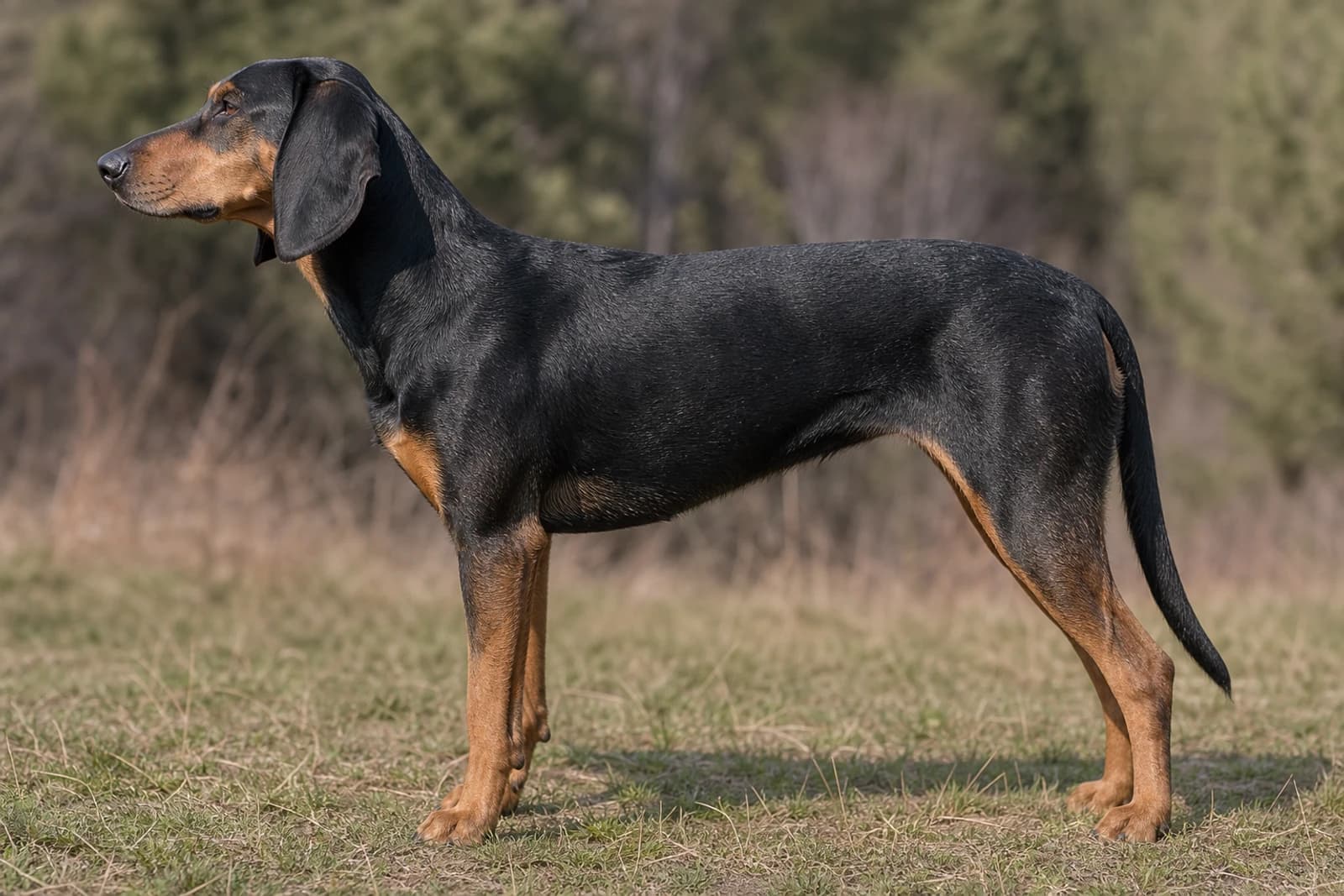
The Montenegrin Mountain Hound is a large, agile hunting dog developed in Montenegro for tracking and chasing large game over rugged terrain. This rare breed is best suited for active, experienced owners with a spacious, fenced yard. They are loyal and protective of their family but can be independent and strong-willed. Their intense prey drive makes them poor companions for small pets, and they require plenty of exercise and mental stimulation. Not ideal for apartment living, this hound thrives in rural settings where it can run and explore.
At a glance
- Size
- Large
- Height
- 17–21 in
- Weight
- 44–55 lb
- Life span
- 12 years
- Coat colors
- Black and tan, Fawn
- Coat type
- Short, dense double coat
How much does a Montenegrin Mountain Hound cost?
Adopt / rescue
$75–$400
Usually includes spay/neuter, first shots, and a microchip.
Buy from a breeder
$700–$2,000
From a reputable, health-testing breeder.
Approximate USD. Prices vary widely by region, breeder, pedigree, age, and coat colour — adopting is the lower-cost and recommended route. Avoid suspiciously cheap “breeders”; they’re often puppy mills.
Estimate the full cost of a Montenegrin Mountain Hound →Montenegrin Mountain Hound photos
Views
Front, side, rear and top — the full silhouette.Poses
How the breed sits, lies, moves and plays.Puppy to senior
The breed across its whole life.Expressions
The breed’s range of moods.Close-up details
Eyes, ears, nose, paws, tail and coat.Coat colors
The breed’s recognized colors.Click any photo to enlarge. We show the Montenegrin Mountain Hound from every angle — three views, poses, life stages, expressions, close-ups, coat and colors.
Appearance & size
The Montenegrin Mountain Hound is a lean, rectangular hound built to thread through Balkan brush and rocky slopes all day without flagging. Everything about the frame says “endurance,” not bulk. Height runs 17 to 21 inches at the shoulder, and a fit working dog weighs between 44 and 55 pounds. Length from point of shoulder to point of buttock clearly exceeds the height at the withers, giving the dog that ground-covering reach in a trot. The chest is deep — it drops to the elbows — but fairly narrow, so the forelegs can swing straight forward without brushing. The back is firm and level, the loin short and well-muscled, and the croup slopes gently toward the tail.
The coat is a short, dense, smooth jacket that lies flat and feels hard to the touch. It handles wet brush and light rain but offers no frills. The classic color is a crisp black with rich tan markings:
- tan points over each eye
- on the muzzle and cheeks
- a clean bib on the chest
- on the lower legs and inside the thighs
- under the tail
You’ll also see red or fawn dogs with a black saddle, and some individuals carry a small white spot on the chest. The pigment on the nose, eye rims, and pads is black regardless of coat color.
The head is hound-typical but with a look of its own. The skull is long and slightly domed, never coarse. The muzzle is long, strong, and blunt at the tip, with a moderate stop. Ears are set fairly high, thin, and hang flat against the cheeks in a round-ended drop. Eyes are dark brown, almond-shaped, and notably calm — they give the dog a quiet, steady expression even when it’s keyed up on a scent line.
Front view: The forelegs stand straight and parallel, with good bone for their size but no hint of heaviness. Elbows are tight against the chest wall, and the feet are round, tight, with strong nails and tough pads. Side view: The dog’s balance is most obvious here — the deep chest meets a well-sprung ribcage, the underline tucks up moderately, and the hindquarters are powerfully angulated at the stifle. The tail, a natural extension of the croup, is usually carried low and only lifts slightly when the dog is moving, never curling over the back. Rear view: The hind legs are straight from hock to ground when the dog is standing square. The thighs are broad and muscular; cow hocks or weak pasterns are serious faults in a breed that must power up rocky terrain hour after hour.
History & origin
This is a dog that grew straight out of the limestone karst and oak forests of the Western Balkans — a hunter’s answer to tough terrain and crafty game. The Montenegrin Mountain Hound (Crnogorski planinski gonič) was shaped in the Dinaric Alps of present-day Montenegro over centuries, though written records only start to firm up in the 20th century. Locals simply called it the “black hound” or “mountain hound” and bred it for one job: drive hare, fox, and sometimes larger quarry like wild boar toward the gun, using voice and nose across steep, rocky ground that would break a less agile dog.
Most historians agree the breed traces back to old Balkan scent hounds that traders, shepherds, and hunters moved through the region for hundreds of years. The type solidified in the mountainous villages around the Bay of Kotor and the Durmitor massif, where isolation acted like a sieve — only dogs with the right mix of endurance, scenting power, and free-hunting independence survived. By the mid-1900s, enthusiasts began deliberately breeding and cataloging the population, and in 1969 the Yugoslav Canine Federation registered the breed under its current name. The Fédération Cynologique Internationale (FCI) gave full international recognition in 2002, placing it in Group 6 (Scenthounds).
Despite that official nod, the Montenegrin Mountain Hound remains a rarity outside its homeland. Most breeding stock still lives with hunters in Montenegro and neighboring Serbia, Bosnia, and Croatia. Efforts to promote it as a family companion in Europe and North America are slow and small-scale, partly because this is a dog still hardwired for the hunt — loud on track, tireless in the field, and built for a working life that doesn’t easily translate to a quiet backyard.
Temperament & personality
Expect a dog with the kind of quiet confidence that doesn’t need to make a scene. The Montenegrin Mountain Hound is even-tempered inside the home—often content to sprawl near the wood stove after a long day—but transforms outdoors where scent trails snap that calm into laser focus. A 44–55 lb frame and 17–21 inch shoulder height make it substantial enough for rough terrain, yet not so big it can’t curl up on a rug. With a typical lifespan around 12 years, you’re signing up for a durable companion that bonds closely to its family but isn’t clingy. Independence runs deep: this hound thinks for itself on the trail and may decide your recall cue is optional when a fresh rabbit scent is involved.
His watchfulness is more functional than theatrical. He won’t bark at every leaf, but he’ll alert you when something’s genuinely out of place—a delivery truck, a stranger approaching the gate. That reserved streak with unfamiliar people isn’t aggression; it’s assessment. Pay attention to body language. A relaxed, loose body and soft eyes mean he’s at ease. A forward-leaning stance with stiff posture and a direct stare? That’s the hound saying, “I’m not convinced yet.” Lip licking or a head turn are his way of dialing tension down. Learn those signals and you’ll preempt most problems.
Training needs a respectful touch. This is a dog that can be strong-willed; you’ll get farther with consistency and a sense of humor than with a heavy hand. The nose rules. Moving through the house, he may pause to sniff and re-sniff the same corner—scent-based spatial memory is his normal, not an oddity. If you don’t manage it, he’ll mark territory with urine to make himself at home. Neutering and a vinegar-based odor neutralizer go a long way toward preventing indoor accidents, because the smell cue itself invites a repeat. Puppies chew hard to navigate teething, and adults chew to keep jaws strong and teeth clean. A homemade citrus spray on chair legs can save your furniture, but make sure he’s got raw bones or sturdy chews to satisfy that deep-rooted behavior. Set a rule early: never interrupt him while eating. Respect around the bowl prevents food guarding down the line.
With his own family, he’s gentle and steady—not a dog that thrives in isolation. Left alone too long, that calm can tip into anxiety-driven barking. Real exercise matters. A walk around the block won’t do it; he needs a solid hour of trotting or free-running where he can sort through the morning’s scent news. If you value a dog that brings the mountain’s patience and grit into your daily life, you’ll find a quiet, honest partnership here.
Good with kids, dogs & other pets
Montenegrin Mountain Hounds come with a steady, patient temperament that slots naturally into family life — provided you actually make them part of the family. This is not a breed that does well parked in a backyard or left alone for eight-hour workdays. They bond hard and need close companionship; loneliness can turn into nonstop barking, digging, or destructiveness. If your household can offer real togetherness, they’re a solid match.
Around kids, they’re generally gentle and forgiving. At 44–55 pounds and 17–21 inches tall, they’re sturdy enough for older children but still built in a way that an accidental hip-check can topple a toddler. Always supervise play, and teach kids not to crowd the dog’s food bowl or wake them suddenly. Because this hound craves connection, they often shadow their people and tolerate a lot of clumsy handling, but they still appreciate a quiet retreat space when they need it.
With other dogs, early and ongoing socialization makes all the difference. Pups exposed to friendly, balanced adult dogs between 3 and 14 weeks typically grow into adults who enjoy canine company. Adult dogs introduced later can still do well with slow, calm introductions. Be aware that some individuals develop a defensive edge with same-sex dogs; you’ll need to read your dog’s comfort level, not force dog-park friendships.
Cats and small pets demand caution. This is a scent hound with a deep chase instinct. A cat that bolts or a pet rabbit in a hutch can trigger a full-speed pursuit in an instant. Some Montenegrin Mountain Hounds learn to live peacefully with an indoor cat they were raised alongside — especially if you reinforce calm behavior from day one — but the instinct never fully goes away. Never leave them unsupervised with small animals, and secure outdoor spaces well.
Socialization isn’t just one puppy class. Introduce your pup to a wide variety of people, dogs, sounds, and surfaces before that critical window closes around 16 weeks. After that, consistent positive experiences keep them from turning skittish or reactive as adults. If you’re adopting an older dog who missed that early exposure, respect their boundaries. A dog who’s content just being a homebody with their people doesn’t need to meet every stranger, and forced interactions spike stress rather than build confidence.
Trainability & intelligence
You’re not training a push-button obedience champ here — you’re negotiating with a smart, self-employed hunting partner. The Montenegrin Mountain Hound learns quickly when the lesson makes sense to her, not just to you. She’s an independent problem solver, bred to work ahead of the hunter, making judgment calls on scent trails without looking back for direction. That intelligence shines when you give her a reason to collaborate; it curdles into stubbornness if you rely on drill or correction.
- Use what motivates her. Food rewards help, but the real jackpot for this nose-driven breed is often a chance to sniff, track, or chase. Turn training into a game of “find it” or use a long-line recall where coming back means you release her to follow a fresh scent trail. Praise and play work better than a treat pouch alone.
- Recall is the make-or-break skill. When a Montenegrin Mountain Hound locks onto a scent, her ears genuinely shut off. Start recall training the day she comes home. Pair a unique whistle or word with over-the-top rewards — think roasted chicken, not a dry biscuit — and practice in fenced areas. Never punish a slow return; you’re competing with the most fascinating smell she’s encountered all week, and you need to be more valuable than that rabbit trail. A well-proofed recall here takes months, not weeks.
- Build trust before you demand reliability. Punishment-based methods backfire fast. Even a sharp tone can make her shut down or get sneaky. She’s sensitive in a way many large hounds are: she’ll remember the unfair correction and may dodge you next time. Instead, catch her doing something right and mark it immediately. If she’s amped up, walk away and reset rather than escalate.
- Early socialization is non-negotiable. Between 3 and 14 weeks, expose her gently to different people, surfaces, sounds, and friendly dogs. Don’t flood her — let her approach at her own pace. A hound who hasn’t met the mail carrier or learned that the garbage truck isn’t a monster can develop fear-based reactivity that’s tough to unwind later. Keep new experiences positive and brief; pair them with cheese or a tug session.
Common challenges include leash pulling toward every interesting smell and a tendency to “check out” when overstimulated. Manage those with short, upbeat sessions in low-distraction environments at first. She won’t rehearse a sit-stay for the sake of pleasing you, but she’ll move mountains if she believes the two of you are on the same team. Patience and a sense of humor matter more than a perfect heel.
Exercise & energy needs
The short answer
Think athlete, not couch potato. This hound needs a substantial daily workout.
A Montenegrin Mountain Hound is a working scenthound bred to cover rough mountain miles while tracking game. Satisfying that drive means 60 to 90 minutes of purposeful exercise every day, split into at least two sessions. A single long walk won’t cut it. You’ll get far better results with a hard morning outing and a separate afternoon session that weaves in brain work.
What counts as good exercise
- Off-leash running in a securely fenced area. These dogs follow their nose first and your recall second. An unfenced field is a gamble.
- Hiking on trails lets them inhale the scent landscape and works their mind as much as their legs.
- Canicross, bikejoring, or running beside you on a harness taps their stamina and gives them a clear job.
- Scent games and tracking are the real off-switch. Hide a treated Kong in the yard, lay a short track, or join a nosework class. Even swapping the food bowl for a puzzle feeder makes a dent.
Puppies and young dogs need protection. Avoid repetitive pounding on pavement and hard-impact jumps until growth plates close. Keep runs on grass or dirt, and let natural movement dictate pace. Responsible breeders screen hips and elbows, but you manage the daily environment.
Why it matters beyond a tired dog
A bored Montenegrin Mountain Hound rarely sits quietly — you’re more likely to get howling, digging, or fence-pacing. Two solid daily sessions with genuine sniff-work produce a calm dog who flops on the rug, content that the world has been properly investigated. Without that, you haven’t met the needs of a hound designed to hunt all day in the mountains.
Grooming & coat care
This hound’s coat is a low-maintenance asset — until shedding season kicks in. A short, dense double coat that’s built for harsh Balkan mountains needs little more than a weekly once-over with the right brush. Grab a bristle brush (natural boar bristles are ideal) to pull out loose hair, spread skin oils, and bring up a glossy shine. During spring and fall blowouts, bump that to two or three times a week; you’ll be surprised how much undercoat a 44–55 lb dog can release.
Bathing and trimming
Bathe only when the dog rolls in something truly foul — maybe two or three times a year. Over-washing strips the coat’s natural weatherproofing, and this breed’s close-lying hair sheds dirt quickly once dry. Trimming is purely optional. You won’t need clippers or scissors for the coat itself, but a quick wipe-down with a damp cloth after a muddy run works wonders.
Ears, nails, and teeth
Those drop ears are an invitation for trapped moisture, so check them weekly. A gentle wipe with a dog-formulated ear cleaner and a cotton pad keeps things fresh and lets you catch any redness or odor early. Nails grow fast on an active dog, but if you hear clicking on hard floors, it’s time for a trim — every 3–4 weeks as a rough guide. Brush teeth several times a week with a dog-safe toothpaste. It’s simple prevention that pays off in a breed that can live a solid 12 years.
What to watch for
A double coat that doesn’t shed can hide skin trouble underneath. While you brush, run your hands over the body to feel for bumps, flaking, or hot spots. The outdoor exercise that keeps this hound happy also contributes to healthy coat turnover — less stress, less shedding indoors, and a dog that always looks like it just came off a mountain trail.
Shedding & allergies
A short, dense coat doesn’t mean low shed — and the Montenegrin Mountain Hound is proof. These dogs drop a steady drizzle of stiff, needle-sharp hairs year-round. You’ll find them embedded in couch cushions, car seats, and the cuffs of your pants after a few minutes of roughhousing.
Twice a year, usually in spring and fall, that drizzle becomes a downpour. Expect tufts of dead undercoat to loosen and drift into every corner of the house. Daily brushing with a rubber curry comb or a hound glove during these blowouts keeps the tumbleweeds manageable; outside of peak season, a once-over twice a week handles most of it.
Drool isn’t a constant accessory the way it is with some jowly hounds, but it’s not zero, either. After a long drink of water or when a particularly enticing smell hits the kitchen, a long string of slobber isn’t unusual. Keep a dedicated drool rag handy near the water bowl.
If you have allergies, move slowly. The Montenegrin Mountain Hound sheds enough to spread dander throughout a home, and no amount of grooming suddenly makes it hypoallergenic. The dense coat also traps pollen and outdoor dust, which can hitch a ride indoors and add to the sneeze factor. Spending time around a few adults before committing gives you a clear picture of how your sinuses will hold up.
Diet & nutrition
Give your Montenegrin Mountain Hound every chance to stay lean and active from day one—this is an athletic scenthound whose frame won’t forgive extra pounds. At 44–55 pounds, an adult who hunts or runs hard for an hour or more daily will burn through a lot more fuel than a weekend wanderer. Use his ribs as your gauge: you want to feel them easily under a thin layer of fat, not see them poking out. If you can’t find his ribs without pressing, cut back portions. If they’re visible, add a little more.
-
Puppies do best on four evenly spaced meals until about 4 months, then three meals until 6 months, then two meals for life. A large-breed puppy formula helps control growth and protect developing joints. Transition to adult food around 12–18 months. When switching any diet, go gradually—start with lightly cooked, puréed meats and veggies, or a high-quality commercial food. Raw chicken wings can be introduced around 12 weeks under supervision, but always watch how he chews.
-
Adults thrive on two meals a day. The exact amount depends on his real output, not the bag chart. A moderately active 50-pound hound might need around 1,200–1,600 calories, but you’ll dial it in by feel. If you choose a raw or home-prepared route, aim for roughly 60% muscle meat and raw meaty bones, 20–30% fruits and vegetables, and 10% other items like eggs, organ meats, or a little barley. A quick, balanced meal: canned fish (rinsed if brined), a scrambled egg, and steamed green beans over a scoop of cooked pearl barley. Use the unsalted water from steamed veggies as a light broth when stock isn’t on hand.
Obesity is the real enemy here. Montenegrin Mountain Hounds were built to move, and a sedentary, overfed hound can pack on weight fast, stressing joints and sapping stamina. If yours wolfs food, a puzzle bowl turns mealtime into a 10-minute brain game and prevents gulping. Never feed from the table or slip him rich holiday scraps—that’s a fast track to pancreatitis. When he has an upset stomach, plain white rice and a little poached chicken can settle things, but go back to his normal food once he’s steady.
- Seniors often need smaller, more frequent meals as their activity level drops. Keep weighing him every few weeks and trim portions before the scale creeps up. There’s no need to cut protein drastically; just keep him lean. Measure every meal, and always serve leftovers in his own bowl so he never learns to beg at yours.
Health & lifespan
Twelve years is a solid, expected run for a working hound of this size — but the number on paper only tells half the story. Many Montenegrin Mountain Hounds stay sharp and mobile well into their second decade when weight stays in check and preventive care isn't an afterthought. That means keeping a 44–55 lb dog lean, not just “not fat.” Ribs you can feel without a deep press are a good sign.
Like any deep-chested, active breed, this dog can be prone to bloat. Feed two smaller meals instead of one large one, and don't let him gulp water right before a hard run. Responsible breeders screen hips and elbows for dysplasia, even though the breed isn't notoriously crippled by it. If you’re buying a puppy, ask to see the parents’ hip scores and any eye exam results; honest breeders won't flinch at the question.
Those drop ears that frame his face are perfect for trapping moisture and debris. A quick sniff and wipe once a week cuts way down on ear infections — especially if he's been crashing through wet brush. Skin issues, too, can crop up in any hound. A diet with solid omega-3s and attention to environmental allergens often nips flaky, itchy skin before it becomes a problem. If you notice him licking his paws raw or losing hair, don't wait it out; early vet intervention saves months of frustration.
Monthly heartworm prevention during mosquito season (plus one extra month after it ends) is non-negotiable for a dog who lives to be outdoors. Rabies vaccination stays current because it's the law and there's no cure once symptoms hit. Annual wellness exams — or twice-yearly once he's a senior — catch the quiet things: a slight heart murmur, early kidney changes, a tooth wearing toward an abscess.
Early socialization does more than build a steady temperament. A dog that's handled often and exposed to new people, sounds, and routines early on tends to carry less chronic stress, which directly supports immune function. A calm, well-adjusted hound is just plain healthier.
Watch for subtle shifts: if a dog who normally demolishes his breakfast starts walking away, or the hound who would happily run a ridgeline for an hour now lags behind on a short walk, listen to that. Pain hides well in stoic breeds. The earlier you catch an issue, the simpler the fix usually is. Keep him lean, keep his ears dry, and keep those vet appointments boring — that’s the real goal.
Living environment
A Montenegrin Mountain Hound in an apartment is like trying to keep a foghorn quiet. This is a big, driven scenthound built to cover miles of rough terrain—not a dog that will be content with a couple of leash loops around the block. A house with a securely fenced yard is the realistic baseline. Even then, the yard is a bonus, not a substitute for intentional exercise. A bored hound left in a yard will invent his own job: digging craters, scaling fences, or serenading the neighbors.
Noise and barking come with the package. He doesn’t just bark; he bays—a deep, carrying sound that travels through walls. If you have close neighbors or noise restrictions, this breed will strain that relationship fast. Early training can take the edge off, but you won’t silence the instinct to announce interesting smells.
Climate tolerance tilts toward the cold. His dense coat and mountain heritage handle snow and chilly mornings without complaint. Hot, humid weather is riskier. Plan walks for early morning or late evening in summer, always provide shade and water, and watch for overheating during intense sniff sessions.
Yard requirements go beyond size. A standard 4-foot fence is a suggestion, not a barrier. Go taller and reinforce the bottom if he’s a digger. Better yet, treat the yard as a safe zone for off-leash sniffing and short training bursts—never as the main event.
Being left alone is manageable but not a given. These hounds bond strongly with their people but have an independent streak from generations of working at a distance from the hunter. Still, isolation without preparation breeds trouble. You’ll see frustration barking, destructive chewing, or escape attempts. Gradual desensitization to alone time and a heavy dose of mental work before you leave (scent games, puzzle toys, a long, rambling walk) take the edge off. Two solid exercise sessions daily—each at least 45–60 minutes where he’s trotting, tracking, and problem-solving—keep the indoor hours calm. Shortchange that, and you’ll come home to a hound who’s redesigned your couch cushions.
Who this breed suits
This is a serious, hardwired scenthound, not a casual companion. The Montenegrin Mountain Hound suits someone who already understands independent hounds and has the space, schedule, and patience to let a dog do what it was built for—tracking game through rough country for hours on end.
You’ll fit right in if you live on acreage or have access to vast, safely fenced land where a dog can run full-tilt, follow its nose, and bay without neighbors complaining. Active singles and outdoorsy families who hike, trail-run, or hunt regularly will find a willing, tireless partner. This breed bonds hard with its own people but isn’t needy; it’s equally content after a two-hour mountain scramble to curl up nearby and watch the evening. Families with older, dog-savvy kids work well, because the breed’s size (44–55 lb, 17–21 inches at the shoulder) is manageable but it’s not a rough-and-tumble playmate for toddlers. Retired hunters or rural couples who want a keen-nosed yard guardian and weekend tracking companion are a natural match.
Experience matters more than activity level alone. You’ll need to train with calm, consistent follow-through—this hound isn’t biddable in the Border Collie sense, and harsh methods shut it down. Scent work, mantrailing, or long off-leash rambles (in safe areas) keep a quick mind engaged and prevent baying marathons born of boredom.
Think twice if you’re a first-time dog owner, live in an apartment or a dense suburb with tiny yards, or prize a quiet, always-under-control dog. The voice is deep, carrying, and used with conviction—few things will make you more popular with close-set neighbors. A strong prey drive means cats, rabbits, and free-roaming chickens look like quarry, and even solid recall training can crumble when the nose locks on. If your idea of exercise is a stroll around the block or a quick game of fetch, this hound will go stir-crazy and get destructive. The breed also does poorly left alone for long workdays; it thrives on having its humans around to roam with. Finally, availability is a real hurdle. With very few responsible breeders outside the Balkans, you might wait years for a well-bred puppy—so casual ownership just isn’t practical.
Cost of ownership
Purchase Price
The Montenegrin Mountain Hound is virtually unknown outside the Balkans, so finding a puppy in the US takes time and serious cash. Responsible breeders who health-test and work to preserve the breed charge $2,000–$3,000. Importing a pup from Montenegro adds $500–$1,000 for flights, crates, and import fees. Waitlists are common, and many breeders will only place dogs with experienced scent-hound homes.
Ongoing Monthly Costs
Plan on $150–$250 per month for a healthy adult dog, though your first year will run higher due to supplies, spay/neuter, and training.
- Food: A 50-lb active hound eats about 2½ cups of quality kibble daily. A 30-lb bag costs $55–$70 and lasts roughly a month.
- Vet & preventives: Annual checkups, vaccines, heartworm test, and year-round heartworm/flea/tick prevention average $500–$700 per year (about $40–$60/month). Spay or neuter surgery adds a one-time $300–$800.
- Grooming: The short, dense coat needs only a weekly once-over with a rubber curry and occasional bath. Supplies run $10/month, or budget $25–$40 monthly if you use a groomer for nail trims and ear cleaning.
- Insurance: Large breeds can develop hip dysplasia and bloat. A solid accident-and-illness policy for a young dog typically costs $45–$65 per month.
- Training & gear: Group obedience classes ($150–$250 for a 6-week session) are a smart investment. A crate, leash, bowls, and bed add $200–$400 upfront.
One often-overlooked expense: a secure, tall fence. This hound lives to follow its nose and will bolt after a scent. Installing or reinforcing a fence can easily exceed $1,500—budget for it before the puppy arrives.
Choosing a Montenegrin Mountain Hound
Breeder or rescue?
This isn’t a breed you’ll stumble across at the local shelter. You’re dealing with a rare dog inside the U.S., so your first route is almost always a responsible breeder — and that means waiting. Expect a waiting list. A good breeder plans maybe one or two litters a year, if that, and they’ll grill you as hard as you grill them. Rescues do occasionally pick up a hound of this type through international rehoming networks or Balkan breed rescues, but those dogs often come with gaps in their history. If you go the rescue route, be honest about what you can handle: a dog who might need house-training from scratch, who may never have lived indoors, or who views small pets as quarry. Either path, you want a dog whose drives and energy level fit your actual daily life — not a romanticized version of it.
Health clearances that matter
These dogs run 44–55 pounds on a 17–21 inch frame — compact power. They were built to hunt rough terrain all day, so treat their joints like you’d treat a performance athlete’s. Ask for hip and elbow scores from the Orthopedic Foundation for Animals (OFA) or a PennHIP report on both parents. A vet saying “hips look good” doesn’t count. You want the numbers. Also ask for a current eye exam (CAER) from a veterinary ophthalmologist — hounds can inherit progressive retinal atrophy and other eye issues that creep up later. A cardiac exam from a board-certified cardiologist is smart; this is an endurance breed, and you don’t want to discover a congenital heart problem at two years old. Many breeders also screen for autoimmune thyroiditis. If you’re looking at a puppy, the parents should have these clearances done and posted publicly or provided without hesitation. A breeder who assures you the line is “perfectly healthy” without paperwork isn’t doing the work.
Red flags when you’re contacting breeders
Even rare breeds attract people who cut corners. Watch for these:
- No health testing on the sire and dam. This is the dealbreaker. If the answers are vague, walk away.
- Won’t let you visit. You should be able to meet the mother and see where the puppies are raised. A video call works long-distance, but you should see that space.
- Multiple litters always available. A breeder who always has puppies ready hasn’t built a waiting list for a reason.
- Pressures you to buy now. A responsible breeder wants the right home, not the fastest sale.
- Releasing puppies before 8 weeks. Hound pups need that extra time with littermates for bite inhibition and social skills. Earlier is trouble.
- Sells two puppies at once. Littermate syndrome is real, and no decent breeder knowingly sets a family up for that.
- Doesn’t ask you questions. If they don’t care about your yard, your schedule, your experience with high-drive dogs, they don’t care where that puppy lands.
Picking your puppy
The boldest pup that barrels toward you isn’t automatically “the one.” Spend at least an hour with the litter if you can. You’re looking for a puppy with a middle-of-the-road temperament — curious but not frantic, willing to investigate a new noise but able to settle. A pup that startles, recovers quickly, and then comes to check you out is a good sign. Avoid the puppy hiding in the corner unless you have a lot of rehabilitation experience, and be cautious of the relentless bully who picks on siblings. A reputable breeder will already have notes on each puppy’s emerging personality and will help match you based on whether you plan to hunt, hike, or do nose work versus keep a house companion. Let that insight carry real weight.
When the day comes to bring a puppy home, you should leave with a written contract, a health guarantee that spells out what’s covered, vaccination records, microchip info, and the breeder’s phone number for the next 12 years. Anything less, and you’re not working with someone who stands behind their dogs.
Pros & cons
Pros
- Deeply bonded with their people — calm and affectionate at home, forming a tight-knit family unit rather than a casual roommate.
- Low-maintenance coat — a short, dense double coat that needs only a weekly rubber curry to handle moderate shedding; no professional grooming required.
- Natural watchdog with a voice — a resonant, deep bay alerts you to strangers or unusual activity without veering into neurotic barking.
- Built for durability — a robust 44–55 lb frame, 17–21 inches at the shoulder, handles rough Balkan terrain and typically enjoys a healthy 12‑year lifespan with few inherited conditions.
- Trail machine — runs a scent line with breathtaking determination, making them a top hiking or jogging partner when you can keep them engaged.
Cons
- Prey drive that overrides everything — once a scent trail grabs them, off-leash recall evaporates; a fenced yard or long line is non‑negotiable in open areas.
- Not a quiet housemate — that magnificent bay can carry through walls, which quickly creates friction in apartments or close‑set neighborhoods if they’re bored or under‑exercised.
- Willful and independent — training is a negotiation, not a command; they need a handler who stays patient, consistent, and never mistakes stubbornness for stupidity.
- Serious exercise demand — a hard hour of running, structured tracking, or off‑leash sprinting daily; a couple of short walks triggers destructive restlessness and nonstop howling.
- Hard to find responsibly — rare outside Montenegro means long waitlists, few breeders, and a shallow gene pool; impulsive purchases often land you with dogs of unknown temperament or health background.
Similar breeds & alternatives
Several Balkan scenthounds fill a similar niche to the Montenegrin Mountain Hound—sturdy, deep-voiced, and relentless on a blood trail. The right alternative often comes down to coat, availability, and the size of the game you plan to hunt.
-
Serbian Hound: Nearly identical in height (17–21 in) and just as lean (44–48 lb), with a short, glossy red or black-and-tan coat. It’s a close cousin in temperament—pack-driven, strong-willed, and tireless on a cold track. The key difference is the shorter, less weather-resistant coat, so if your hunts involve heavy mountain snow or biting wind, the Montenegrin’s dense double coat has a clear edge. Serbian Hounds are also a bit more common, making a well-bred puppy easier to locate.
-
Bosnian Coarse-haired Hound (Barak): At 18–22 in and 42–55 lb, the Barak overlaps in weight but stands slightly taller. Its wiry, shaggy coat sheds dirt and turns brambles better than the Montenegrin’s smooth, plush coat, though it does need more brushing to prevent mats. Both breeds share a fearless, tenacious style on boar, but the Barak tends to be a little more reserved with strangers off the hunting grounds.
-
Istrian Shorthaired Hound: If you want a lighter-framed hound that still bays with the same musical voice, this is worth a look. Smaller (16–20 in, 26–40 lb) and mostly white with orange markings, the Istrian is nimble in dense underbrush but lacks the sheer bone and mass to hold large, aggressive game. It’s a smart choice for hunters focused on hare or fox rather than boar.
All three breeds demand serious off-leash running, a securely fenced yard, and an owner who understands that a scenthound’s nose overrides any recall command once it locks onto a scent. Because the Montenegrin Mountain Hound is quite rare, the Serbian Hound and Bosnian Barak are often more practical to source from breeders who actively hunt their dogs.
Fun facts
- Bred to hunt wild boar and hare in the Dinaric Alps
- Also known as the Crnogorski Planinski Gonič
- Known for incredible stamina and a deep, resonant bay
- Extremely rare outside its homeland of Montenegro
Frequently asked questions
- Is the Montenegrin Mountain Hound good with children?
- With proper socialization, the Montenegrin Mountain Hound can be good with children, especially older kids who respect its space. Its large size and high energy mean interactions should be supervised to prevent accidental knocks. It tends to be loyal and protective of its family.
- How much does the Montenegrin Mountain Hound shed?
- The Montenegrin Mountain Hound has a short, dense double coat that sheds moderately year-round, with heavier shedding during seasonal changes. Weekly brushing can help manage loose hair and keep the coat healthy. Overall, it is not considered a heavy shedder compared to some breeds.
- What are the exercise requirements for a Montenegrin Mountain Hound?
- This breed is an active hunting hound that needs a significant amount of daily exercise — at least an hour of vigorous activity, such as long walks, jogging, or hiking. Without enough physical and mental stimulation, it can become bored and potentially destructive. It thrives in an active home with a securely fenced yard.
- How much grooming does a Montenegrin Mountain Hound need?
- Grooming needs are relatively low: a weekly brushing is usually enough to keep the short coat in good condition and minimize shedding. Baths are only needed occasionally, when the dog gets dirty. Regular nail trimming and ear checks are also important.
- Can a Montenegrin Mountain Hound live in an apartment?
- Apartment living is generally not recommended for this breed; it is a large, energetic dog that does best in a home with outdoor space. If given enough exercise and mental stimulation, it might adapt, but its tendency to bark and need for room to roam make it less suited for close-quarter living.
- Is the Montenegrin Mountain Hound suitable for first-time dog owners?
- This breed can be challenging for first-time owners due to its independent nature and high exercise needs. It benefits from an experienced handler who can provide consistent training and plenty of physical activity. Without proper guidance, it may develop stubborn behaviors.
Tools & calculators for Montenegrin Mountain Hound owners
Quick estimates tailored to Montenegrin Mountain Hounds — pre-filled with this breed’s size where it matters.
Articles & stories about the Montenegrin Mountain Hound
Sources & standards
This profile follows recognized breed standards from the American Kennel Club (AKC) and the Fédération Cynologique Internationale (FCI), along with established veterinary and breed-club guidance. These describe general breed tendencies — every dog is an individual.
Owner stories
Have a Montenegrin Mountain Hound? Share your experience — grooming tips, personality quirks, anything goes.