

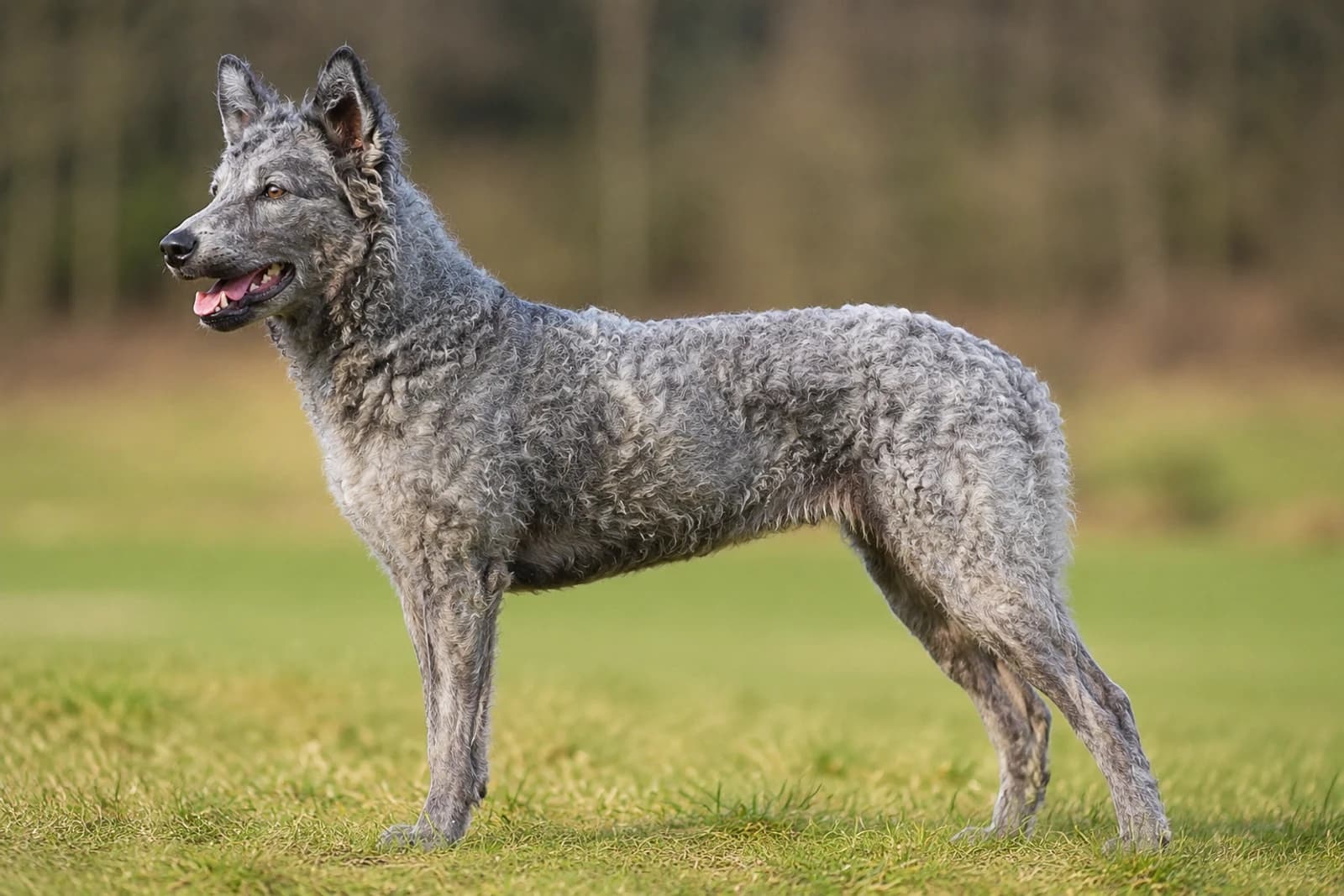
The Mudi is a rare Hungarian herding breed known for its versatile working ability and lively personality. This medium-sized dog excels in dog sports and makes a devoted companion for active families. With a curly or wavy coat and alert expression, the Mudi is highly intelligent and trainable but requires ample physical and mental exercise to prevent boredom. Best suited for experienced owners who can provide structure and a job to do, this breed thrives in rural or suburban homes with space to run. Early socialization is key to managing their strong herding instincts.
At a glance
- Size
- Medium
- Height
- 15–19 in
- Weight
- 18–29 lb
- Life span
- 13–14 years
- Coat colors
- black, white, fawn, brown, gray, blue merle
- Coat type
- Dense, wavy to curly medium-length double coat
How much does a Mudi cost?
Adopt / rescue
$75–$400
Usually includes spay/neuter, first shots, and a microchip.
Buy from a breeder
$700–$2,000
From a reputable, health-testing breeder.
Approximate USD. Prices vary widely by region, breeder, pedigree, age, and coat colour — adopting is the lower-cost and recommended route. Avoid suspiciously cheap “breeders”; they’re often puppy mills.
Estimate the full cost of a Mudi →Mudi photos
Views
Front, side, rear and top — the full silhouette.Poses
How the breed sits, lies, moves and plays.Puppy to senior
The breed across its whole life.Expressions
The breed’s range of moods.Close-up details
Eyes, ears, nose, paws, tail and coat.Coat colors
The breed’s recognized colors.Click any photo to enlarge. We show the Mudi from every angle — three views, poses, life stages, expressions, close-ups, coat and colors.
Appearance & size
A Mudi is a lean, square-built herding dog that lands squarely in the medium range — 15 to 19 inches at the shoulder and 18 to 29 pounds, with males typically a touch taller and heavier than females. You get a dog who feels compact and athletic, never bulky, but with enough bone to handle a day’s work on rough terrain. From the side, the outline is balanced: the topline stays level and firm from withers to croup, the chest reaches to the elbows without being barrel-shaped, and there’s a visible tuck-up behind the ribs that adds a leggy, agile look.
Coat and color are the first things that catch your eye up close. The coat is medium length, dense, and glossy, forming all-over waves and tight curls — roughly 3 to 7 cm long — with longer, more pronounced waves on the chest, the back of the forelegs, and the tail. It’s a true wash-and-wear coat; it sheds minimally but mats if ignored after a muddy hike. Colors you’ll see: solid black, white, fawn (sometimes called yellow), rich brown, and blue merle. The merle pattern gives a speckled, marbled look on a gray-blue base, often with tan points. A small white chest mark shows up in some dogs, but the breed doesn’t carry large white patches except in the white-coated dogs themselves.
Distinctive features start with the head and ears. The Mudi has a wedge-shaped head with a moderate stop, a straight or slightly convex muzzle that tapers without being pointy, and dark, almond-shaped eyes that look straight at you with a lively, questioning expression. The ears are what people remember: set high, held erect, but the upper third of each ear bends forward into a soft drop — think alert but not rigid, almost like a shepherd who’s always listening for the next command. Many Mudis are born with a natural bobtail, and that stump or shortened tail is a hallmark of the breed. When the tail is full-length, it’s carried low when relaxed and lifted in a slight saber curve when the dog moves.
From the front, you see straight forelegs, moderate angulation at the shoulder, and that slightly arched neck flowing into a chest deep enough for lung capacity but narrow enough to let the legs swing cleanly. From the rear, the hindquarters are well-muscled with a moderate bend of stifle, and you’ll notice the rear pasterns are short and upright — a build that makes the Mudi a quick, agile mover who can turn on a dime. The feet are round, tight, and cat-like, and the dog should look like it can cover rough ground without missing a beat. All these details add up to a dog that looks capable, expressive, and just a little mischievous — which is exactly how they’ll act once you bring one home.
History & origin
The Mudi isn’t a breed someone sat down and invented. It’s a dog that Hungarian shepherds shaped over centuries by keeping the smartest, most tireless workers from each litter and letting the rest go. By the early 1800s, a lean, upright-eared, wavy-coated herder was a common sight on farms across the Hungarian plains, though nobody called it a “Mudi” yet.
The dogs traced back to local shepherd stock that eventually split into the corded Puli, the smaller Pumi, and the smooth-faced Mudi. Crosses with German spitz-type dogs — the same nimble, barky dogs German traders brought along — contributed the sharp prick ears and alert expression. What emerged was a medium-sized, 18–29 lb dog that could do just about anything a farm needed: drive cattle and sheep, root out wild boar, eliminate rats, and guard the homestead with a piercing bark. That versatility became the breed’s signature.
In 1936, museum director and cynologist Dr. Dezso Fenyes separated the Mudi from the Pumi and Puli for good. He established the first breed standard, gave it the name Mudi (pronounced “moo-dee”), and began a registry. Two things nearly wiped out his work: World War II, which decimated breeding stock, and the Soviet-era collectivization of farms that made independent sheepdogs obsolete. By the 1960s, the Mudi was on the brink.
A handful of dedicated Hungarian breeders tracked down the last remaining farm dogs and painstakingly rebuilt the gene pool from scratch. They focused on preserving the original working temperament — a Mudi that wouldn’t herd, hunt, and think for itself wasn’t worth saving. Even today, the breed remains rare, with only a few thousand registered worldwide. In Hungary, you still see them moving flocks of sheep or competing in high-level agility, while in the United States, the Mudi waited until 2022 for full AKC recognition in the Herding Group. The standard hasn’t changed much from those early farm dogs: quick, sharp, and built for a full day’s work.
Temperament & personality
A Mudi is a medium-sized powder keg of brains and drive wrapped in an easy-to-live-with package — for the right owner. These dogs are sharp, alert, and always ready to go. Bred for herding, they see the world in terms of motion, so a jogging child or a darting cat can flip their working switch in a heartbeat. That instinct doesn’t come with a mean bone; it’s just an intense desire to control movement. You’ll see it in the nudge, the stare, the occasional heel nip, and you’ll need to redirect it with training, not hollering. Strong-willed and independent, a Mudi learns fast but doesn’t tolerate heavy-handed corrections. Respect and consistency win every time.
Energy pours out of this breed. A couple of 20-minute strolls won’t cut it — plan on a solid hour of running, fetching, or a herding lesson daily, plus mental challenges. Puzzle toys, trick training, and scent work keep that busy mind from inventing its own entertainment. And “inventing its own entertainment” often translates to chewing. Puppies explore the world with their mouths, and adult Mudis keep jaws in shape by gnawing on anything they can find if you don’t supply the right outlets. Give them thick ropes, durable rubber chews, and frozen treats. For off-limits items, a homemade citrus spray (boil peels in water) or a simple vinegar mist makes furniture far less appealing.
Left alone with nothing to do, a Mudi may invent a full-time job: barking at every leaf that falls. They’re naturally watchful and quick to sound the alarm. You’ll get a heads-up when the delivery truck arrives, but unchecked, it turns into a neighborhood nuisance. Early socialization softens their reserve with strangers and keeps that vigilance at a manageable volume.
Inside the home, they’re clean and usually easy to housetrain — provided you understand how a dog’s nose works. An accident in a quiet corner leaves a scent cue that invites a repeat performance. Soak the spot with an enzymatic cleaner, not just soap, and praise the moment they go outside, treat ready. Neutered males and spayed females rarely urine-mark indoors, but if it happens, the same deep-cleaning rule applies. Some Mudis carry a quirkier scent habit: they’ll roll in something dead or foul, likely for the sheer joy of it or to bring a stinky “trophy” back to you. It’s harmless and decidedly Mudi.
With their own family, these dogs are affectionate and loyal without being clingy. They read body language like a book — a stiff posture and hard stare precede a nip, while a loose, wiggly body and soft eyes mean a happy dog. Teach kids to give the dog space during meals and to recognize those calm signals, and you’ll have a resilient, playful companion that keeps everybody laughing.
Good with kids, dogs & other pets
Good with kids, dogs & other pets
Patient and steady, a Mudi can be a wonderful family dog — but his herding brain will still try to steer running children with a nip. Supervise all play involving kids under six, and teach older children to freeze when the dog starts bossing. With early, clear rules, Mudis rarely show aggression and form tight, affectionate bonds.
Dog friends depend on early social work. Between 3 and 14 weeks, gradually introduce your puppy to vaccinated adult dogs, varied people, and everyday household sounds. A well-socialized Mudi is often relaxed around other dogs. Without that foundation, the adult dog may bark, cower, or snap at unfamiliar dogs. Forcing a fearful older dog into a dog park just piles on stress.
Cats and small mammals live under ceiling-high guard. Raised with a cat, many Mudis coexist without drama, but a fuzzy escape artist that bolts will almost certainly trigger a chase. Always separate when you can’t supervise. Last piece: Mudis are sensitive companion dogs; they don’t do well when the whole family leaves for an eight-hour day. Budget for a midday walker or daycare.
Trainability & intelligence
Training a Mudi is a lot like working with a whip-smart teammate who figures things out faster than you can say “treat.” These dogs soak up new skills almost instantly, but they won’t be fooled by repetition for repetition’s sake. They need to see the point. If you’re just drilling sits without a reason, you’ll lose them to some other self-appointed job — like rearranging the throw pillows or herding the cat.
What works. Reward-based training is the only sensible approach. A Mudi will work hard for a mix of high-value treats, a favorite tug toy, and your genuine, excited praise. Because they’re so sensitive, even a sharp tone can set the relationship back. Keep sessions short, upbeat, and mentally challenging. Weave in quick problem-solving games — hiding a toy, sequencing two new cues — to tap into their natural drive to figure things out. That mental burn tires them out more than just physical exercise.
Recall and reliability. With consistent positive practice, you can build a stellar recall. Tap into the breed’s herding instinct: call them and then move away quickly, rewarding them with a game of tug when they catch you. The catch? Their chase drive is strong. A squirrel or a moving car can short-circuit recall, so proof it relentlessly in different environments before you trust it off-leash anywhere unfenced.
Where people get stuck. This is not a breed you can drill like a robot. Mudis will creatively reinterpret a command if the original task bores them. They can become noisy when frustrated or overstimulated, so teaching a solid “quiet” cue early is a lifesaver. Because they can be reserved with strangers, lack of socialization turns natural caution into fear-based reactivity. Get your puppy out between 3 and 14 weeks of age to experience different people, surfaces, sounds, and other well-adjusted dogs. Keep those experiences positive and let your Mudi set the pace — forcing them into scary situations backfires spectacularly.
The big picture. Training succeeds when you treat it as relationship-building, not a checklist of commands. Once your Mudi trusts that you’re fair, consistent, and more interesting than whatever else is going on, their responsiveness becomes almost intuitive. Skip punishment-based methods entirely; they damage trust and often cause a formerly eager dog to shut down. Instead, channel their sharp mind into daily learning moments. A job well done — whether a recall through a distraction or a new trick — is what makes a Mudi’s day.
Exercise & energy needs
A Mudi doesn’t just need a walk — they need a daily workout for both body and brain. Plan on 60–90 minutes of vigorous movement each day, split into at least two sessions. A casual 20-minute stroll barely scratches the surface for this herding dog. You’ll get better results with off-leash running, long hikes, a fast bike ride, or a chaotic game of fetch that ends only when you quit.
Because a Mudi’s drive comes from a working heritage, mental fatigue matters as much as physical. Forget just throwing a ball; make them work for it. Weave in quick obedience drills, hide-and-seek with a favorite toy, or scattering kibble in the yard so they can sniff it out. Puzzle feeders, scent work, and clicker shaping sessions will quiet that busy mind faster than an extra mile of running.
These dogs were born for speed and agility, and they shine in sports. Agility, flyball, disc dog, treibball (urban herding), and canine freestyle all play to their lightning-quick responses and desire to collaborate. If you can access herding lessons or set up home exercises with a Jolly Ball or a flirt pole, even better — it feeds the instinct without needing sheep.
- Stick to two sessions daily — one longer blast of movement and a later mix of training and free play works well.
- Watch the intensity for youngsters. Avoid repetitive high-impact jumping on hard surfaces until growth plates close around 12–14 months.
A Mudi who runs on empty doesn’t nap — they invent their own job. And that usually means barking, digging, fence-running, or dismantling your couch cushion by cushion. Hit their physical and mental quota, though, and you’ll have a calm, focused companion who crashes happily at your feet.
Grooming & coat care
Brushing & Detangling
The Mudi’s wavy-to-curly coat is a single layer—no dense, blowing undercoat—so you won’t be vacuuming tumbleweeds of fur every day. Still, those cute ringlets will turn into tight mats behind the ears, under the legs, and along the tail if left unattended. A metal slicker brush with rounded pins is your go-to tool for working through the curls and lifting out dead hair. Follow up with a metal comb to double-check trouble spots; if the comb snags, you’ve found early matting that a slicker can usually break up.
Brush once or twice a week for most of the year. During the lighter spring and fall shedding pushes, a quick daily pass keeps loose hair off the furniture and stimulates healthy skin.
Bathing & Trimming
Bathe every 6–8 weeks—or when your Mudi rolls in something truly foul. Use a gentle dog shampoo that won’t strip the coat’s natural oils. Don’t overdo it; frequent bathing can dry out the skin and make the curls frizzy.
Mudis don’t need haircuts. The coat stays its natural medium length, and clipping can ruin the texture. If you want a neater look, just trim the wispy hair between the paw pads and tidy up the sanitary area with blunt-tipped shears.
Paws, Ears & Teeth
Nail trims every 3–4 weeks keep those quick-moving feet comfortable—if you hear clicks on hard floors, you’ve waited too long. Check ears weekly for wax or debris (those drop ears can trap moisture), and wipe them with a dog-safe cleaner. Daily tooth brushing with a canine toothpaste fights tartar on a breed that can live 13–14 years; start young so it feels routine.
Seasonal Notes
Your Mudi’s coat thrives on outdoor exercise—running through fields and woods naturally buffs away dead hair. After a swim or a muddy romp, a quick rinse and a brush-out while the coat dries prevents knots from setting. You’ll quickly spot a developing mat by running a comb through the longer hair behind the ears and at the backs of the legs. Catch it early and a slicker brush makes short work of it.
Shedding & allergies
Coat & shedding
The Mudi’s wavy or curly coat is a single-layer affair—no fluffy undercoat waiting to explode. That doesn’t translate to a hair-free home, though. You’ll deal with a steady, moderate sprinkle of dark or fawn-colored hairs on your floors and furniture all year. Twice a year, as daylight hours shift, a heavier seasonal blowout kicks in. For a few weeks each spring and fall, you’ll notice tufts collecting under chairs and along baseboards. A weekly once-over with a slicker brush or pin brush won’t cut it during those windows; two or three sessions a week will keep the worst of it off your clothes and out of the air. The coat itself repels dirt pretty well and doesn’t mat easily, so grooming stays simple but not negligible.
The allergy reality
No dog is hypoallergenic, and the Mudi isn’t a magic loophole. Allergic reactions are triggered by proteins in dander (dead skin flakes) and saliva—not just shed hair volume. The breed’s single coat does trap some dander, and Mudis drool very little, which can mean fewer airborne allergens than a heavy-shedding, slobbery breed. Some allergy sufferers live comfortably with a Mudi; others don’t. A puppy meet-up won’t give you the real answer, because puppy coats and dander levels change with maturity. If allergies run deep in your household, spend unhurried time around a few adult Mudis before committing. Pay attention to how you feel after sitting in a closed room with them, not after a quick outdoor hello.
Drool
Drool is almost a non-issue. Mudis have tight, dry lips, so you won’t find gooey threads draped across your knee or flung onto walls. A small drip right after a long drink of water is as dramatic as it gets. For anyone who steers clear of mastiff-level slobber, this breed fits the tidy end of the spectrum. The real mess you’ll manage is that low-grade, everyday shed—worth it if you don’t mind running a lint roller before company comes.
Diet & nutrition
Because Mudis are high-drive herding dogs, they run lean and fast—so the biggest nutritional mistake is assuming they need extra calories just because they’re active. An adult Mudi weighing 20 to 28 pounds typically does well on 700–900 kcal per day, split into two meals. If your dog is a picky grazer, that’s fine; if he’d eat until he burst, measure every meal precisely. Even small weight gains on a medium frame add unnecessary stress to joints, especially over a 13–14 year life.
For puppies, the rhythm is more important than the math. Feed four small meals a day until four months, then three until six months, then drop to the adult two-meal schedule. Transition new foods gradually by mixing in lightly cooked, puréed meats, fish, and vegetables, or a high-quality commercial puppy formula. Around twelve weeks, raw meaty bones like chicken wings can be introduced under close supervision to build jaw strength and mental engagement.
Most Mudis thrive on a diet built around roughly 60% muscle meat and raw meaty bones, 20–30% dog-safe fruits and vegetables, and 10% extras like eggs, grains, or plain yogurt. That ratio works whether you’re cooking, feeding raw, or topping high-quality kibble with fresh food. If your Mudi inhales his food, dump it into a food puzzle bowl—it forces slower eating and gives that quick brain something real to solve.
Senior Mudis lose some edge but rarely need less protein. Instead, switch to smaller, more frequent meals and keep a hard eye on the scale; cut back calories as exercise tapers. A simple rib test never lies: you should feel each rib with a thin layer of padding, not see them, and never have to dig through a blanket of fat. If you keep that shape, your Mudi stays a step ahead of joint trouble and pancreatitis risks that come with rich, fatty scraps or sudden feast days.
Health & lifespan
Most Mudis live 13 to 14 years, and many stay active and sharp well into old age. This is a generally sound, medium‑sized herding dog without the extreme structure that saddles some breeds with chronic trouble — but no dog is bulletproof.
Hips, eyes, and kneecaps are the main areas responsible breeders watch. You’ll want to see that both parents have been screened through the Orthopedic Foundation for Animals (OFA) or a comparable registry for hip dysplasia, patellar luxation, and inherited eye disease. Progressive retinal atrophy (PRA) can pop up, and a yearly eye exam catches changes before they steal vision. Epilepsy also appears in some lines, so a breeder who tracks seizure history and is upfront about it is one you can trust.
Because Mudis are lean, quick, and often food‑driven, weight management directly affects longevity. An extra 3 pounds on a 25‑pound dog is a big deal — it accelerates joint wear and can set the stage for arthritis. Keep your dog at a “hands‑on” weight where you feel ribs without pressing, and adjust portions if that waistline starts to blur.
Routine preventive care is straightforward but non‑negotiable.
- Heartworm prevention every month during mosquito season (and one month after) protects a disease that’s miserable to treat and easy to prevent.
- Rabies vaccination isn’t optional — it’s legally required and has no effective treatment once clinical signs emerge.
- A dental care routine (daily brushing plus occasional scaling under anesthesia) matters, even in a medium dog; neglected teeth fuel kidney, heart, and liver problems over time.
Mudis are sensitive dogs that read your mood in a heartbeat. Early, positive socialization isn’t just a training checkbox — it lowers the chronic stress that can trigger digestive upsets, skin flare‑ups, and anxiety‑driven behaviors like non‑stop barking. A Mudi who lives in a calm, predictable world with plenty of mental exercise is simply healthier.
Schedule a wellness exam twice a year, not just when shots are due. Your vet will check for things you might miss — a subtle limp, a heart murmur, a change in the retina. Little caught early stays little.
Living environment
A Mudi is a tightly wound herding dog in a medium-sized package, and your living setup needs to match that energy. A house with a securely fenced yard is the most natural fit — not just a patch of grass, but a contained space where the dog can sprint, cut, and chase a ball hard. These dogs jump and climb with ease, so a 5- or 6-foot fence matters.
Apartment living isn’t impossible, but it’s a heavy lift. Mudis are vocal by nature: they bark at delivery trucks, squirrels, and odd noises down the hall. In shared walls, that can become a problem fast. You’ll need to teach a solid “quiet” cue and provide enough physical exhaustion to take the edge off — and even then, watchfulness runs deep.
- Exercise: Count on a minimum of 60–90 minutes of real movement daily, split into at least two sessions. This isn’t a leisurely stroll; it’s off-leash running, herding-ball games, or a long hike. Without it, a Mudi gets restless, pushy, and finds destructive ways to occupy itself. Mental work is equally important — food puzzles, scent games, and trick training all burn the brain fuel that a simple walk can’t touch.
- Yard: A fenced yard provides an outlet, but a Mudi won’t self-entertain. You still need to actively engage with the dog. The yard’s main value is a safe place for high-speed zoomies and training reps without a leash.
- Climate tolerance: The breed’s double coat handles cold and damp better than blazing heat. Mudis worked Hungarian fields in varied weather, so they’re comfortable in snow or a crisp fall day. In hot summers, shift exercise to early morning or late evening and watch for overheating — this is a hard-charging dog that may not know when to quit.
- Noise and barking: Expect alert barking. This is a feature, not a bug, of a vigilant farm dog. You can moderate it with training, but you’ll never erase it. If close neighbors or a noise-sensitive lease are dealbreakers, think carefully.
- Being left alone: Mudis bond tightly with their people and don’t do well with long, lonely stretches. Hours of isolation can trigger anxiety, howling, or frantic attempts to escape. Crate training, puzzle toys, and gradual alone-time desensitization help, but this breed really needs a schedule where someone is home much of the day — a single owner working long hours away is a mismatch without serious support from a dog walker or daycare.
Who this breed suits
If your ideal day doesn't break a sweat, the Mudi isn’t your dog. These 18–29 lb bundles of Hungarian herding instinct were built to work from dawn to dusk, and they bring that same intensity into home life. You’ll click with a Mudi if you’re an active single, a couple, or a family with older kids (think 10 and up) who genuinely enjoys putting in at least 60–90 minutes of hard, focused exercise daily—not a stroll around the block, but an off-leash hike, a bike ride, or serious fetch. They’re a natural for dog sports: agility, flyball, herding, and advanced obedience all channel that quick, biddable brain. A securely fenced yard is a major bonus, but Mudis bond tightly with their people and need to be right beside you, not left alone for long hours.
First-time owners should think twice. A Mudi is forgiving of training mistakes only if you’re game to learn fast—they’re smart, sensitive, and can outmaneuver you if you’re inconsistent. Seniors who are still highly active and experienced with driven dogs can make it work, but a low-key retirement companion this is not. Families with toddlers or small children need caution: the Mudi’s herding style includes nipping and circling, which can frighten a small child even if it’s play. That same vigilance makes them exceptional watchdogs, but it also means a tendency to bark at every leaf that falls; apartment living rarely ends well unless you’re home all day and can give the dog a literal job.
If you want a compact, portable dog that will hike 10 miles, learn any trick you teach, and stick like Velcro, the Mudi is a hidden gem. If “couch potato” sounds like a compliment, or your schedule can’t carve out two solid blocks of action every day, look elsewhere—a bored Mudi will redesign your baseboards and test every nerve you’ve got.
Cost of ownership
Purchase price
A well-bred Mudi is rare in the United States, and that scarcity shows in the numbers. From a responsible breeder who health-tests for hips, elbows, patellas, and eyes, expect to pay $1,800 to $2,500. Working-line puppies with proven herding parents sometimes command a bit more. Because the gene pool is small, you may need to join a waiting list months—or even a year—in advance. The cost of transporting a puppy from a distant breeder (often by air or a long drive) can tack on another $300 to $600. Mudi rescue is virtually nonexistent, though you might luck into a young adult through a breed-specific network; adoption fees there usually run $300 to $500.
First-year setup
Before you bring the dog home, budget roughly $200 to $400 for the basics: a 30-inch crate, a sturdy leash and flat collar, stainless bowls, a few high-value toys, and a good slicker brush. Spay or neuter (often done around 12–18 months) adds $200 to $500 depending on your clinic.
Monthly food and supplies
Mudis stay lean at 18–29 pounds and eat far less than you’d guess for a tireless herding dog. Count on 1 ½ to 2 cups of high-quality kibble a day, which means a 30-pound bag ($55–$70) lasts about two months. That puts your monthly food cost around $25 to $35; toss in another $10 to $15 for training treats and a chew or two.
Grooming
Their wavy-to-curly coat doesn’t shed heavily, but it mats if left alone. At home, plan to brush 2–3 times a week with a pin brush and a comb, and trim fur between the paw pads every few weeks. If you prefer a pro, a full groom every 6–8 weeks runs $50 to $70. Amortized monthly, that’s about $25 to $35, though many owners learn the simple maintenance and keep grooming costs under $10 a month for shampoo and a bottle of detangler.
Veterinary care and insurance
Routine annual care (exam, core vaccines, heartworm test, and a year of heartworm and flea/tick prevention) averages $350 to $500 a year — set aside roughly $30 to $40 per month. Mudis can be prone to hip dysplasia, epilepsy, and certain eye disorders, so a solid insurance policy matters. For a medium mixed-breed-like dog, comprehensive coverage with a reasonable deductible runs $30 to $50 per month. Without insurance, a single orthopedic surgery or a seizure workup can blow past $3,000 in a hurry.
Everything added up, a healthy Mudi typically costs $100 to $180 a month for the basics, with insurance included. If you skip the grooming salon and do your own nail trims, you’ll stay closer to the low end; if you opt for a wellness plan that bundles preventives, you might land in the middle. The real peace-of-mind expense is the insurance premium—it turns a scary surprise into a bill you can handle.
Choosing a Mudi
Mudis aren’t a breed you stumble across on a casual search. With a small gene pool in the U.S., finding a sound puppy usually means waiting — and that’s your first honest sign of a responsible breeder. They’ll have a list, not a litter ready to go today.
Responsible breeder vs. the rest
A dedicated Mudi breeder sees these dogs as more than a novelty. They’ll prove their stock’s health with verifiable clearances and will be just as interested in screening you as you are in screening them. Expect a conversation about your activity level, yard setup, and herding-breed experience. A Mudit that ends up bored and untrained is a disaster for everyone. If you can’t visit in person, a good breeder will do video tours and introduce you to the dam via call.
Health clearances you should ask to see
Mudis can be prone to a few heritable conditions. No test guarantees perfection, but responsible breeders screen for the big ones. Ask for written proof (not just a verbal “they’re healthy”) of:
- Hip dysplasia — OFA or PennHIP evaluation, rating fair or better
- Elbow dysplasia — OFA evaluation
- Eye exam — current clearance from a veterinary ophthalmologist (CAER exam)
- MDR1 drug sensitivity — a DNA test that identifies dogs at risk for severe reactions to common medications
- Patellar luxation — some breeders also screen for this trick knee
Some will go further with additional DNA panels for degenerative myelopathy, progressive retinal atrophy, or other concerns that pop up in the breed. Never feel shy about asking; if a breeder balks, walk away.
Red flags that scream “keep looking”
- No health clearances you can verify online or in person
- Puppies available under 8 weeks of age
- Multiple litters on the ground at once or a website that always shows available pups
- Breeder won’t let you meet the dam (some Mudis are reserved, but the mother should still be accessibly housed and introduced)
- Selling through a pet store, a third party, or shipping a puppy sight unseen without any real interview process
- No contract or a contract that doesn’t include a return-to-breeder clause if you can’t keep the dog
Rescue and breed club rehoming
Mudi rescue is a slim pipeline, but it exists through the Mudi Club of America and a few dedicated volunteers. You’ll typically wait for an adult dog, often one surrendered because someone underestimated the breed’s drive and energy. An adult Mudi from rescue can be a phenomenal fit if you want to skip puppy chaos and see exactly what you’re getting — provided the dog’s history and temperament are openly shared.
Picking the actual puppy
If you’re on a breeder’s list and the day comes, watch the litter interact. A solid Mudi puppy is curious, scrappy in play, and recovers fast from a mild startle. Avoid the one hiding in the corner; this breed’s natural caution with strangers can slide into real fearfulness if the nerve isn’t there. The litter should be raised underfoot — kitchen, living room, not a kennel run — so they’ve heard vacuums, tumbling pots, and kids. Ask the breeder what deliberate early socialization they did. At 8–10 weeks, the puppy should approach you willingly, not cower.
A well-chosen Mudi from a rigorous source sets you up with 13 to 14 years of sharp, eager partnership. Rushing this step is the one shortcut you can’t afford.
Pros & cons
Pros
- Mudi dogs pack real working-dog brains into a compact, 18–29 lb body that stands just 15–19 inches tall — easy to load into a car and built to go all day.
- They thrive on advanced training, trick work, and dog sports like agility, flyball, and herding trials; a Mudi will learn a new command in a handful of repetitions when you keep sessions short and upbeat.
- This is a wash-and-wear coat: a quick weekly brush handles the wavy or curly, medium-length hair, and the breed’s natural coat repels dirt fairly well. No salon appointments required.
- Mudis are famously alert and watchful, making them sharp little watchdogs that announce anyone approaching the door, then typically settle once you give the all-clear.
- With consistent socialization from puppyhood, they get along well with respectful children and can co-exist with other dogs, especially when raised together. Their 13–14 year lifespan gives you a long stretch of partnership.
Cons
- A Mudi’s herding motor never idles: they nip at heels, circle, and try to control movement, which can startle kids, joggers, and visiting friends unless you channel it early into structured games.
- You can’t just turn them out in the yard. This dog needs a solid 60–90 minutes of running, fetching, or off-leash exploration daily, plus mental puzzles — a bored Mudi invents his own job, often involving barking, digging, or redecorating your home.
- Sensitivity is real. They shut down under harsh corrections or chaotic households; training has to be fair, calm, and reward-based to bring out their best.
- The breed tends to be standoffish with strangers and can tip into fear-based reactivity if not thoroughly and positively socialized as a pup. Expect to manage greetings and skip crowded dog parks.
- That alertness cuts both ways: Mudis are quick to bark at every squirrel, delivery truck, and odd sound, so apartment living or noise-sensitive neighbors can be a challenge.
Similar breeds & alternatives
If the Mudi’s blazing speed and 24/7 job-readiness make you blink, the Pumi is its closest cousin with a slightly different engine. Standing about the same height (15–18.5 inches) and weighing 22–29 pounds, the Pumi is another Hungarian herder built for tight turns and quick decisions. The coat is the giveaway: curly and terrier-like instead of wavy. Pumis are just as alert and vocal, with ears that prick and tip forward with comic expressiveness. They lean a bit harder into suspicion of strangers and can be quicker to bark at a squirrel, so you trade the Mudi’s watch-everything coolness for a louder, bouncier housemate. Both need a solid hour of hard exercise, not a leash stroll; both excel at agility and flyball.
Another rare relative, the Croatian Sheepdog, offers a similar black-coat look and medium frame (16–21 inches, 29–44 pounds). They’re intense, velcro herders with a lower-key off-switch indoors than a Mudi—once they’ve had their work. You’ll wait longer for a puppy, but if the Mudi’s heat-seeking energy bothers you, this dog settles a bit more readily while still being a capable farmhand.
For a breed you can actually find, a Shetland Sheepdog sits in the same weight class (15–25 pounds, 13–16 inches) but steers into sensitivity rather than steeliness. Shelties want to please, not just out-strategize you, and their lush double coat blows heavily twice a year. They’re a gentler entry into the herding group if you love the Mudi’s size but can’t provide a daily sprint-and-train ritual. In contrast, the Mudi remains the lighter, wash-and-wear, thinking-on-its-feet outlier—a dog that expects you to keep up, not the other way around.
Fun facts
- Mudis are one of the few herding breeds that naturally work both sheep and cattle, adapting their driving style accordingly.
- The breed was recognized as distinct from the Puli and Pumi in the 1930s by Hungarian museum director Dr. Dezső Fényes.
- Mudis are known for their distinctive 'cifra' coat pattern, which is a marbled merle effect unique to the breed.
- Despite their rarity, Mudis excel in canine sports like agility, flyball, and obedience.
Frequently asked questions
- Are Mudis good with children?
- Mudis can be good with children when properly socialized, as they are loyal and playful. Their herding instincts may lead to nipping if not managed, so supervision and training are recommended. They generally do best in homes with older, respectful kids.
- Do Mudis shed a lot?
- Mudis are moderate shedders with a wavy to curly coat that requires regular brushing to manage loose hair. Shedding tends to increase during seasonal changes, but consistent grooming can help keep it under control.
- How much exercise does a Mudi need?
- A Mudi needs plenty of daily exercise, ideally an hour or more of vigorous activity. They thrive with mental challenges like agility or advanced obedience, as they are highly intelligent and have a strong work drive.
- Are Mudis easy to groom?
- Mudis are relatively easy to groom due to their medium-length, low-maintenance coat that requires brushing once or twice a week. They don’t typically need frequent baths, but regular ear checks and nail trims are important.
- Can a Mudi live in an apartment?
- A Mudi can adapt to apartment living if given sufficient daily exercise and mental stimulation, but their high energy and alert barking might not suit close quarters. Without enough activity, they can become restless and vocal.
- Are Mudis suitable for first-time dog owners?
- Mudis are often better suited for experienced owners because they are highly intelligent and need consistent training and a job to do. Their sensitivity and quick learning can be challenging for novices who may not provide enough structure.
Tools & calculators for Mudi owners
Quick estimates tailored to Mudis — pre-filled with this breed’s size where it matters.
Articles & stories about the Mudi
Sources & standards
This profile follows recognized breed standards from the American Kennel Club (AKC) and the Fédération Cynologique Internationale (FCI), along with established veterinary and breed-club guidance. These describe general breed tendencies — every dog is an individual.
Owner stories
Have a Mudi? Share your experience — grooming tips, personality quirks, anything goes.