

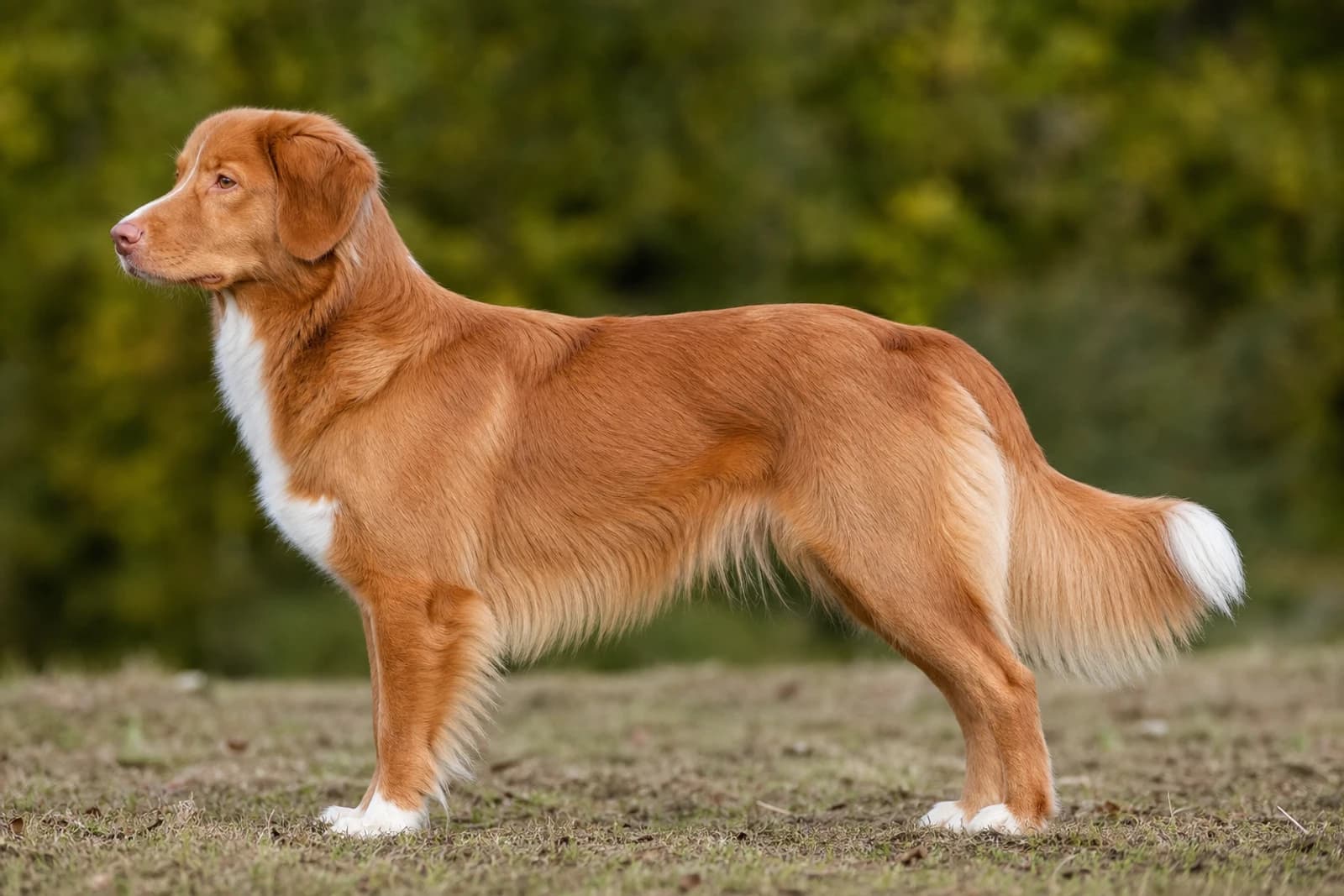
The Nova Scotia Duck Tolling Retriever, or Toller, is an energetic and intelligent gun dog best suited for active families or individuals who enjoy outdoor adventures. Bred to lure and retrieve waterfowl, these medium-sized retrievers are playful, affectionate, and thrive on mental and physical stimulation. They excel in dog sports like agility, obedience, and of course, hunting. Tollers are loyal companions but require consistent training and exercise; they may not be ideal for first-time owners due to their high drive and occasional stubbornness.
At a glance
- Size
- Large
- Height
- 18–21 in
- Weight
- 37–51 lb
- Life span
- 12–13 years
- Coat colors
- Red, Orange, Cream
- Coat type
- medium-length double coat, water-repellent
- Group
- Gun
- Origin
- Canada
How much does a Nova Scotia Duck Tolling Retriever cost?
Adopt / rescue
$75–$400
Usually includes spay/neuter, first shots, and a microchip.
Buy from a breeder
$700–$2,000
From a reputable, health-testing breeder.
Approximate USD. Prices vary widely by region, breeder, pedigree, age, and coat colour — adopting is the lower-cost and recommended route. Avoid suspiciously cheap “breeders”; they’re often puppy mills.
Estimate the full cost of a Nova Scotia Duck Tolling Retriever →Nova Scotia Duck Tolling Retriever photos
Views
Front, side, rear and top — the full silhouette.Poses
How the breed sits, lies, moves and plays.Puppy to senior
The breed across its whole life.Expressions
The breed’s range of moods.Close-up details
Eyes, ears, nose, paws, tail and coat.Coat colors
The breed’s recognized colors.Click any photo to enlarge. We show the Nova Scotia Duck Tolling Retriever from every angle — three views, poses, life stages, expressions, close-ups, coat and colors.
Appearance & size
A Nova Scotia Duck Tolling Retriever is compact but powerful—the smallest of the standard retriever family, but built to work rough water and marshy shorelines all day. The numbers tell you a lot: 18 to 21 inches at the shoulder and 37 to 51 pounds, with males usually at the upper end. Don’t expect a delicate dog. A Toller carries surprising substance for its size, with a deep chest, well-sprung ribs, and a muscular, medium-boned frame that feels both agile and solid.
From the side, the body is slightly longer than tall, giving it that balanced, ground-covering stride. The topline stays level, the back is strong, and the loin is short and muscular. The chest reaches at least to the elbows. There’s a visible but moderate tuck-up—this isn’t a lanky dog, but neither is it slab-sided. The tail, a real hallmark of the breed, is thick at the base set on as a natural extension of the croup, and tapers to a point. It’s carried at or just below the level of the back, with a jaunty, sweeping curve rather than a tight curl or high flag.
From the front, the legs are straight and parallel, set well under the body with strong, sloping shoulders. The deep chest between the forelegs shows the heart-room you’d expect in a water retriever. The head is clean-cut, wedge-shaped when viewed from above, with a broad skull that tapers to a moderately pointed muzzle. Eyes are almond-shaped, medium-sized, and range from amber to brown—always alert and with a lively, almost mischievous expression. Ears are triangular, set high, and hang close to the head, framing the face.
From behind, the rear legs are muscular and straight, with moderate angulation that balances the front. When the dog moves, there’s no wasted motion—legs track true, driving forward, not paddling out to the sides.
The coat is a double coat built for cold water: a dense, soft undercoat and a medium-length, water-repellent outer coat that can be straight or slightly wavy. It’s never harsh or too soft. Around the neck and shoulders, the coat forms a distinct ruff, longer in winter, and the back of the legs and tail have moderate feathering. The tail itself is heavily plumed, especially when the dog is excited.
Color is one of the Toller’s most recognizable features—any shade of red, from golden-red to deep coppery red. You’ll often see white markings on the tail tip, feet, and chest, and sometimes a small blaze on the head. No black, no liver. That rich red coat against the water is exactly what early hunters needed to mimic a fox’s playful shoreline antics—and it’s still the breed’s signature look.
History & origin
The Tolling Retriever sprang up in a very specific corner of Canada — the rocky coves and inlets around Yarmouth County, Nova Scotia, especially along the Little River. That’s why the earliest dogs were simply called the Little River Duck Dog. By the early 1800s, local waterfowlers needed a dog with a peculiar talent: the ability to lure curious ducks within gunshot range by racing, splashing, and fetching sticks along the shoreline. This playful “dance” exploits the way wild ducks are drawn to the antics of a fox-like animal moving near the water’s edge. Once the birds paddled close enough and the hunters fired, the same dog slipped into the cold Atlantic to retrieve downed ducks.
For generations, the exact recipe for the breed was a well-kept secret among a handful of families in the Acadian region. Diaries and local accounts suggest the dogs were built from a mix of working retrievers, spaniels, and farm collies, with a heavy dose of the now-extinct “red decoy dogs” that European settlers had brought to North America for tolling in duck decoy ponds. The result was a compact, fox-red dog with a powerful tail that never stopped wagging — an irresistible beacon to waterfowl.
Formal recognition came slowly. In 1945 the Canadian Kennel Club accepted the breed under the name we use today: Nova Scotia Duck Tolling Retriever. The American Kennel Club followed in 1995, placing the Toller in the Sporting Group. Even after official recognition, numbers stayed small. Dedicated breeders guarded against the kind of hype that can dilute working ability, and they still emphasize dual-purpose talent: a dog that lives for the retrieve but maintains the quirky, coy tolling instinct. You won’t find Tollers in every suburban park, but along the Maritime coasts and in serious waterfowling circles, they remain a symbol of practical ingenuity — a dog invented by hunters who simply watched what worked on the water and bred for it, generation after generation.
Temperament & personality
The Toller is a high-octane retriever in a deceptive package—18 to 21 inches tall and 37 to 51 pounds of coiled muscle with a brain that never downshifts. Expect a dog who watches you read a book, opens cabinets if they’re not latched, and invents her own games the moment you look away. That famous “tolling” scream-yodel isn’t just a party trick; it’s a window into how she thinks: manipulate the environment, get the prize, repeat. You’re not just an owner, you’re a teammate—and she’ll outwork you if you let her.
Fuel to burn, a nose that leads
Plan on at least an hour of off-leash running, swimming, and retrieving every day. This is not a breed that thrives on leashed strolls. A tired Toller is a happy one, but mental exhaustion matters just as much—scent games, puzzle feeders, and trick training keep the destruction at bay. Without them, boredom becomes your sofa’s enemy. Puppies chew to explore and ease teething; adults gnaw hard objects to keep jaws strong. If chewing shifts to chair legs or shoes, a homemade citrus-peel spray or a vinegar blend can redirect the habit while you offer a bully stick or frozen Kong. And because a Toller’s nose is always cataloging scents, indoor accidents leave an invisible cue that invites repeat marking—enzyme cleaners aren’t optional here.
Affection, wariness, and body language
With her own people, a Toller is famously silly and snuggly—she’ll retrieve a tennis ball until your arm gives out, then lean against your legs for a recharge. She tends to be reserved with strangers, which makes her a sharp watchdog. True aggression is rare, but any dog that locks a stiff posture and hard stare onto someone is broadcasting discomfort. Learn the early cut-off signals: lip licks, yawns, a turned head. Respect them, and you preserve trust. A loose, wiggly body and soft eyes mean you’ve got a content dog ready for a belly rub.
Living with a shrewd house-sport partner
Tollers can thrive in families with kids and other dogs when socialized early, but their retrieving drive and herding instincts often mean chasing small pets or nipping at moving ankles. Redirect that energy into fetch or hide-and-seek from day one. Consistent rewards for outdoor potty breaks build a reliable routine—just know that a rarely used guest room might confuse the dog whose “house” map is built on your family’s scent rather than walls and doors. Never disturb a dog mid-meal, and teach children to let eating time be peaceful; food guarding is far easier to prevent than to fix.
True to their scavenger ancestry, Tollers frequently find eau de dead fish or mystery marsh muck irresistible. If yours trots back from a hike plastered in something foul, blame a leftover instinct to “perfume” himself with notable finds. A hose, some suds, and a sense of humor are the only cures.
Good with kids, dogs & other pets
Tollers are patient, non-aggressive dogs who often form deep bonds with the kids in their household. Their playful, people-oriented nature makes them a natural fit for active families, but at 37–51 pounds and full of bounding energy, they can accidentally knock a toddler over in the middle of a game. Teach children not to grab the dog’s face, pull his ears, or swarm him when he’s resting. Even a good-natured Toller can get overwhelmed — this is a sensitive breed that remembers rough handling.
With other dogs
Bred to work alongside people and other canines, most Tollers genuinely enjoy the company of other dogs. That easygoing attitude depends heavily on early socialization. From 3 weeks to about 16 weeks old, a puppy needs plenty of positive, controlled encounters with friendly, vaccinated dogs. Puppy classes and supervised playdates go a long way. Without that exposure, a Toller can tip toward over-excitement or, in some lines, cautious aloofness with unfamiliar dogs. A well-socialized adult typically greets other dogs with a wagging tail, though you’ll still want to supervise initial meetings. Same-sex aggression isn’t a hallmark of the breed, but individual personalities always matter more than averages.
With cats and small pets
This is where the retriever heritage demands an honest look. Tollers were developed to lure, flush, and retrieve waterfowl, so they come with a built-in chase instinct. A Toller raised alongside a cat from puppyhood may learn to coexist, especially indoors. But that thin truce often evaporates the moment a cat darts across the yard — movement ignites the drive. For rabbits, guinea pigs, hamsters, or pet birds, the risk is high. Even a Toller that appears indifferent indoors should never be left unsupervised with small animals. Early, consistent exposure and a rock-solid “leave it” cue can improve the odds, but some dogs will never see a fleeing creature as anything but prey. If small pets are already part of your home, ask the breeder about litters raised around cats and start slow, thoughtful introductions from day one.
The socialization window that matters most
A Toller puppy’s world expands fast between 3 and 16 weeks. That short stretch is when gentle, gradual exposure to children, other dogs, household cats, and everyday noises lays the foundation for a confident adult. A pup raised in a kennel, a garage, or a puppy mill with minimal human contact often carries that deprivation into adulthood as timidity, noise phobias, or barking meltdowns around other dogs. After the window closes, you can still improve a dog’s comfort level with careful training, but forcing a fearful adult to meet new people or dogs only adds stress and can backfire badly. If your Toller ends up relaxed just with your immediate family and a handful of familiar dogs, that’s a win — he doesn’t need to be the life of every dog park party. Manage his world so he feels safe, and you’ll have a dog who is genuinely good to live with.
Trainability & intelligence
A Toller learns commands lightning-fast when training feels like a game—but that speed can backfire if you get sloppy. These are problem-solvers, bred to think independently while luring ducks closer. Drill the same “sit” thirty times in a row and you’ll watch his brain check out. He’d rather invent his own job, like pulling every Kleenex out of the box one by one.
Your relationship sets the ceiling. Tollers thrive on positive, reward-based methods—a thrown bumper, a squeaky toy, a quick game of tug, or a few high-value treats. They’re sensitive enough that harsh corrections or intimidation will shut them down entirely. Break that trust and even a simple recall becomes a standoff. What works is treating training like a collaboration: you pay attention to what he loves, he pays attention to you.
Recall and the prey-drive puzzle
Recall is where many owners hit a wall. With a 37–51 lb dog wired to zero in on fast-moving critters, a fleeing squirrel easily overrides your voice. Start building a recall foundation well before the 16-week socialization window closes, and proof it around real distractions—not just a quiet backyard. Practice calling him, reward like you just won the lottery, then immediately release him back to play. Coming to you must never signal the end of the fun.
Where people stumble
A Toller’s cleverness can look like stubbornness. If you’re inconsistent, he’ll “edit” the behavior—offering a half-hearted spin instead of a full one, just to see if it still pays. You have to be equally sharp, or he’ll train you instead. Keep sessions under 10 minutes and stop while he’s still eager. Mental work—scent games, hide-and-seek, simple agility foundations—counts as much as physical exercise. And don’t skip early, ongoing socialization. Expose a puppy gradually to different surfaces, sounds, people, and other dogs. A Toller who misses that calm, positive exposure often becomes noise-reactive or aloof as an adult.
Grab a treat pouch and a retrieving dummy, and turn every command into a two-way conversation. Reward what you want the instant it happens, using whatever makes your dog light up. A Toller without a job puts that quick mind to use anyway—and you probably won’t love his choice.
Exercise & energy needs
A Toller who only gets a calm walk around the block is a dog who hasn't broken a sweat yet. This breed was designed to lure and retrieve ducks from icy water—all day, with eager intensity. In a family home, that translates to a solid 60 to 90 minutes of real exercise every day, split into at least two sessions. One outing might be an off-leash run or a vigorous game of fetch where he sprints flat-out after a bumper. Another could be a swim—Tollers are practically part duck and will plunge into a pond or pool even when the temperature drops.
Leisurely sniff-and-stroll walks don't cut it. You need to get his heart pumping and let him use his retrieving drive. A flirt pole, long-distance tennis ball throws, or hiking with a pack all work. And because this is a thinking breed, mental work isn't a bonus—it's part of the energy equation. Puzzle toys, scent work, and training sessions of 10–15 minutes scattered through the day burn the mind-fuel that a purely physical workout might miss. A Toller without a mental job quickly invents his own, and that often involves creative destruction or nonstop barking.
He'll shine in dog sports that marry speed and smarts: dock diving, agility, flyball, rally, and especially field work that mimics his original tolling and retrieving role. These are dogs who love having a task to nail, and they'll thrive on the partnership.
Be mindful of growing bodies. Stick to soft surfaces like grass or sand for high-impact running until growth plates close around 12–14 months. Forced roadwork or repetitive jumping on pavement before that can stress developing joints. Even as an adult, watch for overheating in humid weather—that thick double coat puts him at risk during hot-weather sprints. Cold water? He'll keep going long after you've lost feeling in your fingers. Skip the intense exercise, and you'll see the fallout quickly: restlessness, reactivity, and a dog who can't settle indoors. Give him daily off-leash movement, a chance to swim, and a reason to think, and you get a calm, focused companion inside.
Grooming & coat care
That rusty-red coat is glorious — and surprisingly low maintenance most of the year. Tollers have a medium-length, water-repellent double coat: a soft, dense undercoat for insulation and a slightly wavy outer coat that sheds dirt and dries fast. Feathering on the chest, backs of the legs, and tail gives them a finished look without fussy trimming.
Brushing
Once a week with a slicker brush or pin brush keeps things tidy and distributes natural oils. Twice a year, though, they blow that undercoat entirely. During those 2–3 week stretches in spring and fall, you’ll want to brush daily — a metal comb or an undercoat rake gets down to the skin and pulls out loose fur faster than any slicker alone. It’s the difference between finding hair tumbleweeds in every corner and staying ahead of the mess.
Bathing
Bathe only when your dog is truly grimy or has rolled in something foul. Overbathing strips the coat’s natural water resistance, so stick to a gentle dog shampoo and rinse thoroughly. After a swim in a lake or salt water, a quick hose-down with plain water removes grit and algae without soap.
Trimming
No haircuts needed. The only scissor work you might do is a light trim around the feet to keep mud from collecting between the pads, and perhaps neatening the edges of the ears if the feathering gets tangled easily.
Nails, ears & teeth
Floppy, furry ears trap moisture, so check weekly for redness or a yeasty smell, especially if your Toller swims a lot. Wipe the outer ear flap with a damp cloth or a vet-approved ear cleaner — never dig into the canal. Nails that click on the floor need a trim, usually every 3–4 weeks. Brush teeth at least a few times a week with dog-safe toothpaste to keep that muzzle fresh and gums healthy.
Between seasonal sheds, this is a wash-and-wear dog that thrives on outdoor life. All that running and swimming naturally polishes the coat — you’re just the cleanup crew for the big blowouts.
Shedding & allergies
If you’re hoping for a dog that barely sheds, the Toller will disappoint. This is a double-coated retriever that drops fur every day of the year and unleashes a serious seasonal blowout twice annually.
A dense, woolly undercoat lies beneath a medium-length, water-repellent topcoat with soft feathering on the legs, chest, and tail. That undercoat is the culprit. Week to week, you’ll notice a steady drift of reddish-gold hair collecting on baseboards and upholstery. Then, when spring and fall roll around, the dog “blows” coat — meaning you’ll be able to pull out loose puffs of undercoat by the handful. During those 2–4 week windows, daily brushing with a slicker or undercoat rake is non-negotiable if you want to keep the fur tsunami off everything you own. Outside of peak shedding, a thorough once-a-week brush is usually enough to stay ahead of the tumbleweeds.
Drool is nearly a non-issue. Tollers aren’t slobbery in the way a Saint Bernard or Bloodhound is. You might get a wet chin after a long run or a splashy retrieve, but you won’t be wiping ropes of drool off your walls.
As for allergies, let’s be clear: no dog is truly hypoallergenic. Allergies are triggered by proteins in dander, saliva, and urine, not just the hair itself. A Toller produces plenty of dander and sheds enough to spread it efficiently throughout your home. If someone in your household sneezes around dogs, spend real time around adult Tollers before you commit. What you see on a breeder’s clean floor isn’t what you’ll get once the furnace kicks on and the fluffy undercoat starts flying. In short, this is a shedding breed through and through, and you will find that orange fur on your black pants, your couch, and occasionally your cereal bowl.
Diet & nutrition
Tollers are quick learners, enthusiastic athletes, and — honestly — they’ll eat like it’s their job. Keep them lean from day one. A thick waistline stresses joints and saps the stamina this working breed needs.
Puppy feeding schedule
- Up to 4 months: four evenly spaced meals a day.
- 4–6 months: drop to three meals.
- 6 months and older: switch to twice-daily feedings like an adult.
When you bring a Toller pup home, ease into any new diet gradually. Many breeders start puppies on lightly cooked and puréed meats, fish, fruits, and vegetables, or a high-quality commercial puppy food. Around twelve weeks, raw chicken wings can be introduced under supervision — just watch that enthusiastic chewing.
Daily amounts and portion control
An adult Toller (37–51 lb) typically thrives on roughly 2 to 3 cups of high-quality dry food per day, split into two meals. That’s a starting point; let the bag’s feeding guide, your dog’s body condition, and exercise level fine-tune the number. A dog who runs the fields for an hour needs more fuel than one on a couple of leashed walks.
If you feed a home-prepared diet, a useful baseline is about 60% raw and cooked meat, 20–30% fruits and vegetables, and 10% other ingredients like eggs, grains, and yogurt. Blend or process meals for older dogs with missing teeth, because their jaws lack the sideways grinding motion and saliva enzymes to break down whole chunks easily. Commercial raw or dehydrated options work, too. Never push a meat-free diet — a dog’s digestive system is built to process animal protein, and depriving it of those nutrients isn’t fair or healthy.
Managing weight and that Toller appetite
Nova Scotia Duck Tolling Retrievers often have high food motivation, which makes portion creep dangerous. Use puzzle bowls or slow feeders for every meal. It forces them to eat less frantically, burns a little mental energy, and stretches mealtime — a win for a breed that thrives on engagement. Avoid free-feeding entirely; leave the bowl down for 10–15 minutes and then pick it up.
As your Toller ages (typical lifespan 12–13 years) and naturally slows down, cut back calories gradually before extra pounds pile on. Start by reducing the main meal by a small spoonful and monitor the ribs — you want a visible waist when viewed from above and a tucked-up belly from the side. For seniors, smaller, more frequent meals can help digestion without any real reason to drop protein intake.
Everyday tips
- Pearled barley and white rice are gentle, digestible grains for sensitive stomachs; keep some on hand for upset days.
- Canned fish (in water, no salt), scrambled eggs, and cooked vegetables make quick, healthy meal toppers.
- Unsalted water from steaming veggies can replace stock and adds a little flavor to kibble.
- Never feed directly from the table. If you share a cooked-off chicken breast or vegetable bits, put it in the dog’s own bowl to keep begging from taking root.
- Skip rich, fatty scraps entirely — things like holiday ham drippings can trigger pancreatitis in an otherwise healthy dog.
Health & lifespan
The typical Nova Scotia Duck Tolling Retriever lives 12 to 13 years. That puts them right in the middle of the pack for a dog their size — 37 to 51 pounds of compact, spring-loaded muscle. Getting to those double digits and beyond usually comes down to two things: buying from a breeder who tests for inherited conditions, and staying in front of a handful of preventable issues at home.
Tollers are not a fragile breed, but they do carry a higher-than-average risk for a few specific disorders. Autoimmune thyroiditis is the big one — low thyroid function that can sap your dog’s energy, dull the coat, and cause weight gain seemingly overnight. A blood panel at your annual exam catches it early, and daily medication manages it simply. Progressive retinal atrophy (PRA) pops up in the gene pool too, causing gradual vision loss. Reputable breeders run DNA tests on their breeding stock so that no puppy starts life with a ticking clock on its eyesight. Hip dysplasia shows up here and there, though less frequently than in heavier retrievers. The best breeders still submit hip scores through OFA or PennHIP before pairing a dam and sire.
Beyond genetics, Tollers are an active, food-obsessed dog — which makes weight management a career-long gig. An extra 5 pounds on a 40-pound frame stresses joints and can nudge a borderline hip into genuine trouble. Measure meals, go easy on training treats (even when those eyes are boring into your soul), and keep that daily running-and-swimming routine rock solid. They’re built to go hard, so a 45-minute stroll won’t cut it — think a full hour of off-leash retrieving, dock diving, or vigorous hiking.
Heartworm prevention is not optional. Give a monthly pill from the start of mosquito season through a full month after it ends. If you live somewhere warm year-round, that means every month. It’s cheap insurance compared to the brutal, risky treatment for an established infection. And because rabies is 100% fatal once symptoms appear, keeping your Toller current on that vaccine is the law in every state — and the easiest decision you’ll make.
Skin trouble deserves a special mention. Tollers often have a lush double coat that can hide hotspots, flaky patches, or allergy-driven ear infections. A diet rich in omega-3 fatty acids and a quick post-swim rinse to get lake or saltwater out of the undercoat help head off the worst of it. If you notice your dog rubbing its face on the carpet or shaking its head repeatedly, get a vet check before it turns into a full-blown ear infection.
Finally, don’t underestimate the physical toll of a stressed-out mind. Tollers are keen, sensitive retrievers that want to be with you, working as a team. Neglect or isolation can trigger anxiety-driven behaviors like nonstop barking, and chronic stress wears a body down. Early socialization and positive, consistent handling — not shouting — lower that load. Seemingly small changes, like a drop in appetite or sudden reluctance to jump into the car, can signal a brewing health problem long before it becomes obvious. Catch those hints early with a yearly wellness exam, and step it up to twice a year once your Toller hits senior status around age 9.
Living environment
A Toller isn't a dog that thrives on a couple of leash walks and a quiet evening on the couch. This is a high-octane working retriever, bred to spring into icy water, lure ducks, and retrieve all day. That drive shows up in your living room, your yard, and your daily schedule.
Yard and space needs
A house with a securely fenced yard is as close to non-negotiable as it gets. Tollers need room to sprint, chase a bumper, and blow off steam in short, intense bursts. If you're in an apartment, you'd better be prepared to commit to 60–90 minutes of hard running, not strolling, every day, plus multiple sessions of brain work. Even with a yard, a bored Toller will invent his own jobs — digging, fence-running, or shrieking at squirrels. Make sure your fence is sturdy and at least 5 feet high; Tollers can be agile escape artists when something interesting flutters past.
A yard alone isn't enough, though. This breed needs interactive fetch, scent games, and water retrieves. He's built for action, not for watching the world go by.
Noise level
Don't expect a quiet dog. The breed is famous for the "Toller scream" — a piercing, high-pitched howl-bark combo triggered by excitement, anticipation, or the sight of a tennis ball. It's not constant yapping, but when it happens, your neighbors three houses down will know. Training can dial back the volume a bit, but you'll never silence it completely. Apartment dwellers and noise-sensitive households should think hard about this trait.
Tolerance for being alone
Tollers bond tightly to their people. Left alone for an 8-hour workday day after day, many develop separation anxiety — destructive chewing, frantic barking, and escape attempts. They do best in homes where someone is around for a good chunk of the day, or where a well-structured routine of morning exercise, puzzle toys, and gradual alone-time training prevents that panic from setting in. Starting from puppyhood with short departures (10 minutes, then 30, then an hour) makes a real difference. Even then, a Toller left alone for long stretches routinely is a set-up for trouble.
Weather tolerance
That dense, water-repellent double coat is perfect for cold marshes and brisk autumn mornings. Tollers handle snow and frigid water with enthusiasm; they'll happily retrieve in conditions that send you back inside for a heavier jacket. Heat is a different story. They overheat quickly in summer, so schedule hard exercise for early morning or late evening, provide plenty of shade and cool water, and never push them in high humidity. A kiddie pool in the yard isn't a luxury — it's a sanity saver.
Who this breed suits
A Toller isn’t a casual backyard pet — this is a compact, high-octane retriever bred to lure and fetch ducks for hours in icy water. If you’re ready to dive into an active, training-heavy lifestyle, you’ll get a whip-smart, affectionate partner who excels at any dog sport you throw at them. If not, you’ll both be miserable.
Thrives with active, outdoorsy owners
- Runners, hikers, and hunters get the most natural fit. A Toller needs at least 60–90 minutes of hard daily exercise — think off-leash running, swimming, retrieving drills, not a sedate neighborhood stroll.
- Singles or couples with a sporty streak who treat the dog as a hobby. These dogs shine in agility, dock diving, flyball, rally, and fieldwork. They want a job, not just a routine.
- Families with older kids (around 8 and up) who can handle a dog that leaps, spins, and occasionally shrieks with excitement. Tollers often form tight bonds with all family members and have a playful, goofy side.
- Experienced owners who enjoy positive training challenges. Tollers are very smart but independent thinkers; they respond beautifully to clicker work and shaping, but they’ll check out if you’re repetitive or unfair. First-timers can succeed, but only if they’re genuinely ready to dive into reward-based obedience classes and maintain consistency.
- Households where someone is home most of the time. Bred to work closely with a hunter, Tollers can become anxious or destructive when left alone for long stretches. A secure, escape-proof yard helps, but it doesn’t replace human connection.
Think twice if…
- You want a quiet, easygoing dog. The famous “Toller scream” — a high-pitched, ear-splitting whine of anticipation — is part of the package. They also bark, whine, and grumble to express themselves.
- You’re away from the house for a full workday without a plan. Separation anxiety is common. Daycare, a midday sitter, or a job that lets the dog come along can make it work; a crate and a quick walk won’t cut it.
- You have toddlers or frail seniors at home. A 40-pound Toller in full zoomie mode bulldozes anything in its path. They’re not malicious, but they’re body-slam enthusiastic, and young kids can get knocked over or overwhelmed.
- You’re mainly looking for a weekend walking buddy. Under-exercised Tollers channel their frustration into chewing, digging, nonstop retrieving of household objects, and neurotic behaviors like shadow-chasing.
- You prefer a dog that greets everyone warmly. Most Tollers are reserved with strangers and need steady socialization to avoid timidity or suspicion. Early, positive exposure to different people and environments is non-negotiable.
Tollers top out around 37–51 pounds and stand 18–21 inches, so they’re a portable retriever that fits into a smaller home — provided you’re willing to tire out their brain, not just their legs. A brisk morning run, a training session at lunch, and a fetch-and-swim session after work is a typical weekday pace. If that sounds like your kind of fun, you’ll have a loyal, hilarious companion who’s game for anything. If not, steer toward a breed that’s happy with less.
Cost of ownership
Expect to pay $1,800–$3,000 for a well-bred Toller puppy from a breeder who screens for hips, eyes, and autoimmune thyroiditis. Show prospects or pups from field-trial lines can run higher. Rescue adoption fees, when a dog is available, usually fall between $300 and $600.
Monthly costs settle into a predictable rhythm once you get past the puppy year. Here’s what a suburban, moderately active Toller costs to keep in good shape.
- Food: A 40-pound dog eating 2–2½ cups of quality kibble a day runs about $55–$70 per month. A working dog in heavy field training during hunting season can eat closer to 3–3½ cups, pushing you toward $85.
- Grooming: The dense, water-repellent double coat sheds in clumps twice a year and benefits from two or three solid brush-outs a week. A session with a pro every 6–8 weeks for a tidy-up, sanitary trim, and nail grind typically costs $60–$80 in most regions. Home grooming supplies (undercoat rake, slicker brush, nail clippers) will set you back around $50 up front.
- Routine vet and prevention: Annual exams, vaccinations, heartworm, and flea/tick preventatives usually total $400–$600 per year, or $35–$50 a month averaged out. Tollers can be prone to hip dysplasia and progressive retinal atrophy, so your vet may recommend early screening radiographs or an ophthalmologist exam — budget a few hundred dollars extra once or twice in the dog’s life.
- Pet insurance: For a breed where unexpected autoimmune issues or orthopedic injuries can surface, a comprehensive plan typically runs $35–$55 a month. Without insurance, stashing $50–$75 a month in a dedicated emergency fund makes practical sense.
Realistically, plan on $130–$180 a month for the essentials, not counting the one-time start-up gear (crate, leash, puzzle toys — another $200–$300) or the occasional splurge on dock-diving lessons.
Choosing a Nova Scotia Duck Tolling Retriever
You’re not just adding a pretty red dog to the family — you’re signing up for a high-octane retrieving partner that needs a job, not just a jog. Before you choose a puppy or a rescue, be honest about whether you can give a Toller at least an hour of intense, off-leash running, swimming, or retrieving each day, plus daily brain work. This breed burns mental energy as fast as physical.
Breeder or Rescue?
Rescue Tollers show up far less often than Labs, and an adult unknown-history dog can carry the breed’s immune quirks. If you go rescue, work with groups that foster in homes and can honestly describe the dog’s resource-guarding tendencies, noise sensitivity, or on/off switch. Puppies from a responsible breeder give you the benefit of raising the dog from the ground up, but only if the breeder is obsessive about health and temperament.
Health Clearances That Matter
Tollers look sturdy, but the gene pool comes with some sharp elbows. When you talk to a breeder, ask for documentation — not just reassurances — on both parents:
- Hips: OFA or PennHIP evaluation, with an OFA score of Fair or better. Ask to see the actual certificate.
- Eyes: A current CAER exam from a veterinary ophthalmologist. Breeders should test for prcd-PRA (progressive retinal atrophy) via DNA; all breeding stock should be clear or carriers never bred to another carrier.
- Heart: Some lines carry juvenile dilated cardiomyopathy. A board-certified cardiologist clearance (echo) is a green flag.
- Thyroid: Full thyroid panel including TGAA autoantibodies within the past year. Tollers are overrepresented in autoimmune thyroiditis, and a breeder who screens annually is tracking what matters.
- Autoimmune surveillance: There’s no direct test for Addison’s or immune-mediated polyarthritis, but a good breeder knows the family tree cold and can tell you if grandparents or littermates have been diagnosed. If they dodge that conversation, walk.
Red Flags
- Selling puppies under 8 weeks, with no waitlist, and a “pick of the litter” for a higher price.
- No health testing beyond a vet check. If you hear “my vet said they’re healthy,” that’s not a clearance.
- Breeding dogs under 2 years old (hips and eyes can’t be scored definitively).
- Breeder doesn’t ask about your lifestyle, fencing, or plans for exercise — a Toller in a sedentary home is a disaster.
- Pushing “rare” colors (like unusually light or white-heavy coats) instead of working ability.
Picking Your Puppy
You’re looking for a confident, bouncy pup — not the one hiding under the chair or the one bullying littermates nonstop. The breeder should be doing early neurological stimulation and exposing the litter to crates, water, and retrieval games. Meet the dam (and sire if possible). Watch how they settle in the house: a nervous or shut-down adult is a strong predictor. A well-bred Toller from fully screened parents stacks the deck toward that 12-13 year partnership.
Pros & cons
Pros
- A compact, rugged athlete at 37–51 lb and 18–21 inches — big enough to keep up on a day hike, small enough to curl up on the sofa (after you tire them out).
- Training is a joy with this breed. Sharp, biddable, and endlessly playful, Tollers pick up commands fast and shine in agility, dock diving, and advanced obedience.
- They genuinely adore their people. A well-socialized Toller is a patient, gentle presence with respectful kids and an eager partner for everything from fetch to camping trips.
- The “tolling” trick is pure spectacle: they bound, spin, and frolic along the shoreline to coax ducks within range — a built-in party trick you won’t find in any other retriever.
- Coat care is simpler than you’d guess. A weekly brush manages the medium-length, water-repellent double coat, and that signature low doggy odor means less “wet dog” stink after a swim.
Cons
- Exercise demands are serious. A stroll around the block is an appetizer, not the meal — plan on a solid 60–90 minutes of hard running, swimming, and brain work daily, or your Toller will redecorate your home with the contents of the trash can.
- The infamous “Toller scream.” It’s a piercing, high-pitched shriek of excitement or frustration that can peel paint and alienate neighbors. Apartment dwellers, beware.
- Intelligence with an independent streak. They’ll learn your rules, then creatively exploit loopholes if you let them. A pushover owner will get outfoxed; consistent, reward-based training is non-negotiable.
- Stranger wariness and a hair-trigger alert bark are part of the package. Without early, ongoing socialization, the breed can drift into shyness or nuisance barking.
- Prey drive is no joke. Off-leash walks become high-stakes chases the instant a squirrel or bird appears. Solid recall is a project, not a given.
- Twice-yearly shedding seasons blanket your floors, and those webbed, feathered paws are mud magnets — you’ll learn where every puddle in a three-mile radius hides.
Similar breeds & alternatives
The Toller’s combo of compact retriever size and a demanding, trickster brain isn’t common. If you need a close cousin, here’s how the most likely alternatives stack up — and where they fall short.
Golden Retriever
Goldens sit in the 55–75 lb range, a full size up from the 37–51 lb Toller. They share the soft mouth and water love, but the temperament is night-and-day easier for many families. A show-line Golden is more biddable, forgiving of training gaps, and far less prone to the piercing “Toller scream.” The coat blows heavily in spring and fall, similar to the Toller’s dense double coat. Expect a Golden to slog happily beside you on a hike, but not demand the same puzzle-charged mental workout a Toller does. If the Toller’s intensity makes you pause, a Golden is the softer retriever that still likes a good swim.
Labrador Retriever
Labs outsize Tollers by 20–30 pounds and bring a more even-keeled, food-motivated personality. The sleek Lab coat is easier to rinse bog muck out of than the Toller’s undercoat, and Labs generally adapt better to a lower-key weekday routine — as long as they get a solid hour of off-leash running. Tollers lean more toward the independent, cunning end of the gundog spectrum; Labs are famously handler-focused. If you want a water-loving retriever without the Toller’s extra dose of mischief, a Lab is the simpler plug-and-play choice.
Flat-Coated Retriever
A closer match in energy and playfulness, the Flat-Coated Retriever hits 55–70 lb and keeps a puppyish, clownish streak well into adulthood — much like a Toller’s eternal “I’ll make my own fun” attitude. The flat, glossy black or liver coat sheds less dramatically than the Toller’s dense undercoat, but the grooming commitment is still real. Flat-Coats tend to be more socially outgoing with strangers, while Tollers can be reserved. Both breeds need a job and crumble mentally without one; a Flat-Coat usually channels that into retrieve work, while a Toller also needs the outlet for fox-like tolling play.
English Springer Spaniel (field-bred)
A field-bred Springer sits in the same 40–50 lb middleweight class and runs on the same kind of high-octane fuel. Springer Spaniels flush and retrieve with a hustling, ground-covering pace, not the Toller’s calculated shoreline game. Both breeds thrive on complex training and will invent trouble if bored. The Springer’s coat requires more regular trimming around ears, belly, and feathering. A line-bred field Springer can be just as intense; a bench-bred (show-line) Springer often carries a milder, pet-friendlier edge — making it a viable alternative for a family that admires the Toller’s size and bird dog brain but needs a lower simmer.
Fun facts
- They lure ducks by tolling, a unique playful behavior on the shoreline.
- Known for their high-pitched 'toller scream' when excited.
- The smallest of all retriever breeds.
- Originated in the Little River District of Nova Scotia, Canada.
Frequently asked questions
- What is the temperament of a Nova Scotia Duck Tolling Retriever?
- Tollers are intelligent, eager, and affectionate dogs that form strong bonds with their families. They are playful and determined, often exhibiting a lively personality. Early socialization helps ensure they channel their enthusiasm appropriately.
- How much exercise does a Nova Scotia Duck Tolling Retriever need?
- This high-energy breed requires at least an hour of vigorous exercise every day, along with mental stimulation. Activities like fetching, swimming, and dog sports are excellent outlets for their stamina. Without sufficient activity, they may become restless and develop behavioral issues.
- Do Nova Scotia Duck Tolling Retrievers shed a lot?
- Yes, they tend to shed heavily, especially during seasonal changes. Their double coat requires regular brushing, typically two to three times per week, to manage loose fur and keep the coat healthy. Expect a fair amount of hair around the home.
- Are Nova Scotia Duck Tolling Retrievers good family dogs with kids?
- They can be good with children when properly socialized, as they are affectionate and playful. However, their high energy and determination may be overwhelming for very young kids. Supervision and teaching both the dog and children how to interact respectfully are important.
- How difficult is grooming a Nova Scotia Duck Tolling Retriever?
- Grooming is moderate, involving regular brushing to control shedding and occasional baths. Their double coat is relatively easy to maintain but may need more attention during shedding season. Nail trimming, ear cleaning, and dental care should also be part of the routine.
- Is a Nova Scotia Duck Tolling Retriever suitable for first-time dog owners?
- Tollers can be a challenge for first-time owners due to their high energy and need for consistent training. Their intelligence and eagerness make them trainable, but they require commitment to exercise and mental engagement. With dedication, they can thrive, but they are often better suited to experienced handlers.
Tools & calculators for Nova Scotia Duck Tolling Retriever owners
Quick estimates tailored to Nova Scotia Duck Tolling Retrievers — pre-filled with this breed’s size where it matters.
Articles & stories about the Nova Scotia Duck Tolling Retriever
Sources & standards
This profile follows recognized breed standards from the American Kennel Club (AKC) and the Fédération Cynologique Internationale (FCI), along with established veterinary and breed-club guidance. These describe general breed tendencies — every dog is an individual.
Owner stories
Have a Nova Scotia Duck Tolling Retriever? Share your experience — grooming tips, personality quirks, anything goes.