

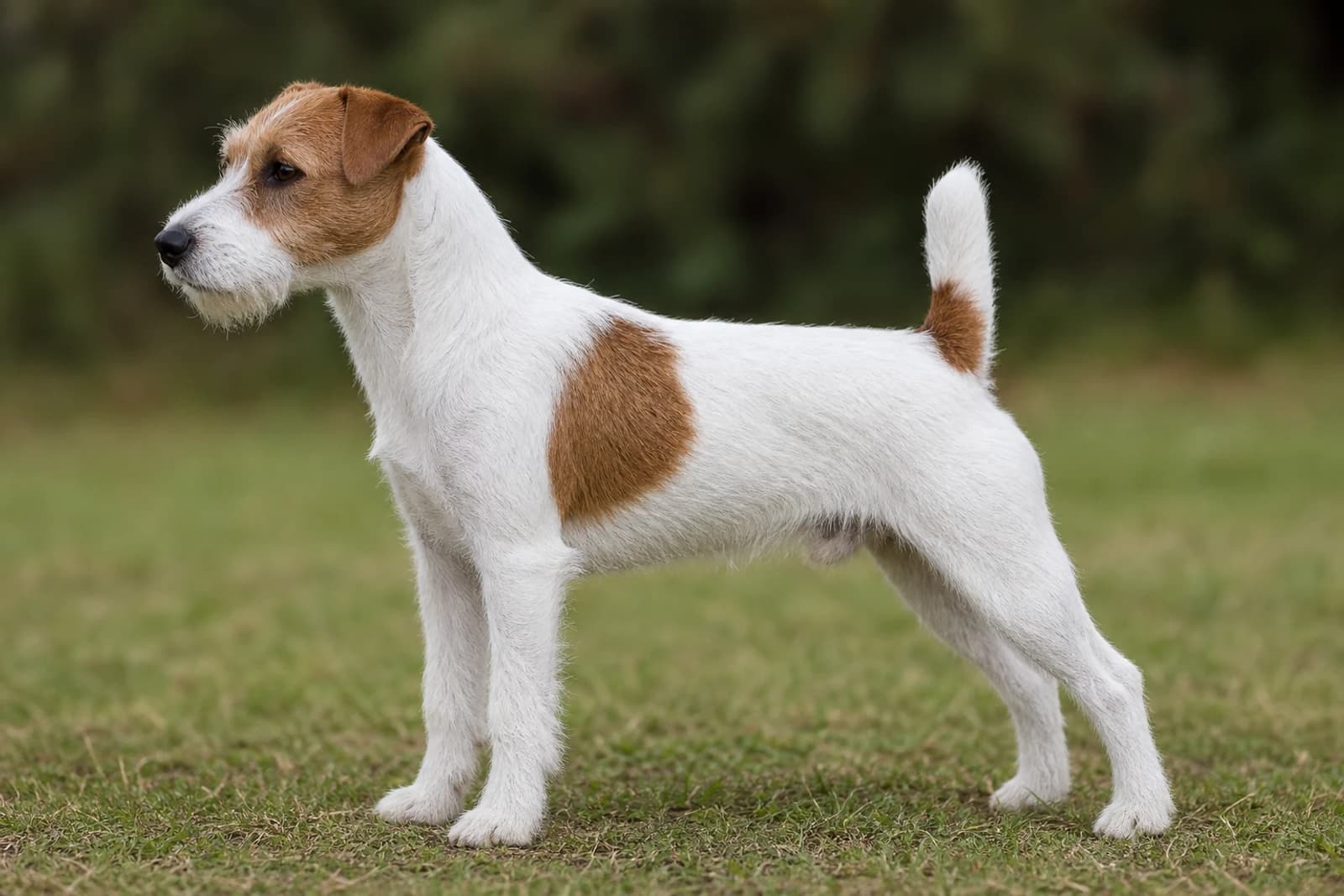
The Parson Russell Terrier is a small, energetic breed originally developed in England for fox hunting. With a bold and intelligent nature, this terrier thrives in active households that can provide ample exercise and mental stimulation. They are best suited for experienced dog owners who appreciate a spirited, independent companion. While they can be affectionate with their family, their high prey drive and strong will require consistent training. Not ideal for apartment living or first-time owners, the Parson Russell Terrier excels in canine sports and outdoor adventures.
At a glance
- Size
- Medium
- Height
- 13–14 in
- Weight
- 13–18 lb
- Life span
- 15 years
- Coat colors
- not specified
- Coat type
- Smooth or broken, dense, harsh
- Group
- Terriers
- Origin
- England
How much does a Parson Russell Terrier cost?
Adopt / rescue
$50–$300
Usually includes spay/neuter, first shots, and a microchip.
Buy from a breeder
$400–$1,200
From a reputable, health-testing breeder.
Approximate USD. Prices vary widely by region, breeder, pedigree, age, and coat colour — adopting is the lower-cost and recommended route. Avoid suspiciously cheap “breeders”; they’re often puppy mills.
Estimate the full cost of a Parson Russell Terrier →Parson Russell Terrier photos
Views
Front, side, rear and top — the full silhouette.Poses
How the breed sits, lies, moves and plays.Puppy to senior
The breed across its whole life.Expressions
The breed’s range of moods.Close-up details
Eyes, ears, nose, paws, tail and coat.Coat colors
The breed’s recognized colors.Click any photo to enlarge. We show the Parson Russell Terrier from every angle — three views, poses, life stages, expressions, close-ups, coat and colors.
Appearance & size
A Parson Russell Terrier is built for the job it was originally bred to do — chasing foxes out of tight earths — and every inch of this dog’s body says athlete. Standing 13 to 14 inches at the shoulder and tipping the scales at a lean 13 to 18 pounds, the dog is medium-sized but carries the strength and endurance of a much larger working terrier. The outline is slightly longer than tall, with a level topline, giving the dog a squared-up, ready-to-launch stance. There’s no slack anywhere: the frame is all muscle and clean angles, with just enough substance to suggest power without any coarseness.
From the front, you see straight forelegs set under a chest that is moderately narrow. The chest is one of the breed’s hallmark features — an adult’s ribcage should be easily spanned by an average-sized pair of hands right behind the elbows. This spannability meant a fox hunter could pull the terrier out of a den without a struggle. The forechest does not bulge forward; it blends smoothly into a compact, oval ribcage. The head is balanced, with a flat skull and a muzzle that’s slightly shorter than the backskull. The stop is moderate, not abrupt. Dark, almond-shaped eyes give a keen, intelligent expression, and the small, V-shaped drop ears fold forward, framing the face without ever looking heavy.
In profile, the dog shows a clean throat, a strong neck, and a back that is firm and level from the withers to the tail set. There’s a short, muscular loin and a moderate tuck-up. The tail is set high and usually docked to a length that maintains the dog’s overall balance. When the dog is alert, the tail is carried upright but never curled over the back — it has a jaunty, confident carriage without being a flag. The hindquarters appear powerful, with well-angled stifles and short hocks that drive the dog forward in a ground-covering stride. From behind, the rear legs are straight and parallel, with no tendency to cow-hocks.
- Coat: The Parson Russell Terrier comes in three coat varieties, all double coats with a dense, weather-resistant undercoat. The smooth coat is short, flat, and hard to the touch. The rough coat is longer, wiry, and dense, often giving the dog a slightly tousled look. The broken coat is an intermediate type, with a mix of smooth and rough patches, often with longer hair around the face, legs, and tail. All three are acceptable in the ring and shed moderately year-round. A rough or broken coat benefits from occasional hand-stripping to keep the texture harsh and the skin healthy.
- Color: The base color is always white or predominantly white, with markings that can be tan, lemon, or black — or a combination of black and tan (tri-color). Markings typically appear on the head (covering one or both ears and sometimes the eye area) and at the base of the tail. A small amount of ticked hair is normal, but heavy ticking or brindle is not desirable.
The overall picture is a balanced, rectangular terrier that looks equally at home racing across a field or fitting through a tunnel. There’s no exaggerration — no bulging muscles, no overly short legs, no snipey muzzle. The dog should appear nimble, not fragile, and always on the verge of action.
History & origin
The Parson Russell Terrier traces straight back to a single-minded Oxford-educated clergyman with a passion for foxhunting. In the early 1800s, Reverend John “Jack” Russell served as a curate in Swimbridge, Devon, and spent his spare time breeding a line of working terriers that could keep pace with a pack of hounds, yet still be compact enough to bolt a fox from underground. In 1819, while out walking, he spotted a small, mostly white, wire-haired female terrier with a tan patch over each eye and a docked tail. He bought the dog on the spot. That dog, named Trump, became the cornerstone of every Parson Russell line that followed.
Russell didn’t set out to create a pretty show dog. He wanted a gritty earth dog with a level head, a strong jaw, a flexible chest narrow enough to be spanned by two hands, and legs long enough to cover rough country without exhausting itself. Color was secondary, but a predominantly white coat was non‑negotiable — it let the huntsman tell terrier from fox at a glance when the two exploded out of a hole. Generations of selective breeding around those functional traits produced a dog that earned a fierce reputation among Devon’s hunting fraternity. After Russell’s death, his type was maintained by local enthusiasts and eventually carried his name — “Jack Russell Terrier” — though “Parson” more accurately credits the man himself.
Over the next century, the breed split along practical lines. Some breeders selected for a shorter, longer‑backed, more bow‑legged dog that could compress itself even tighter underground. Others held to the taller, square‑proportioned terrier Russell originally favored, one that moved with an effortless, ground‑covering stride and stood about 13 to 14 inches at the shoulder. By the 1980s, the divide was deep enough that the longer‑legged type gained recognition as a distinct breed. The Kennel Club (UK) officially recognized the Parson Russell Terrier in 1990, cementing the name and the standard. The American Kennel Club followed later, and today the Parson Russell remains a scrappy, agile dog whose entire body still reads like a blueprint for a day in the saddle behind hounds.
Temperament & personality
A Parson Russell Terrier is a big dog in a small, muscular package: endlessly curious, clever to a fault, and convinced that every day is a new adventure. You’re not getting a lap dog. You’re getting a working terrier who weighs maybe 13 to 18 pounds but can outlast you on a hike, then still beg for a game of fetch. Their default speed is fast, and their mind moves faster still.
Boundless energy meets quick wits
This breed was built to follow hounds and bolt foxes from dens, and that drive translates into a dog who lives to run, dig, and problem-solve. Without a real job — scent work, advanced trick training, or spirited fetch sessions — they’ll invent their own, which often means dismantling couch cushions or excavating your garden. A stroll around the block is barely a warm-up; a solid hour of off-leash running, paired with mental challenges, keeps them from turning that sharp brain toward mischief.
Tough, tenacious, and occasionally opinionated
Parsons love their people fiercely, but they’re not blindly obedient. Bred to work independently underground, they can be strong-willed and will test boundaries if they sense inconsistency. Force doesn’t work — it just makes them dig their heels in. Respectful, consistent training built on positive reinforcement wins their cooperation. If you get frustrated, they’ll shrug. If you make it a game, they’ll shine. That independent streak also means they can be scrappy with other dogs, especially dogs of the same sex, and they’re rarely reliable with small pets that trigger their prey drive.
Watchful and vocal
A Parson Russell notices everything and feels zero hesitation announcing it. Expect barking at doorbells, passersby, squirrels, and suspicious leaves. You can teach a “quiet” cue, but you’ll never erase the instinct to sound the alarm. Left alone for long stretches without exercise or company, this tendency can slide into anxiety-driven barking and destructive chewing — the kind of outlet a bored terrier finds all too easily.
At home with the family
With their own people, these dogs are affectionate and sometimes downright goofy. They thrive on interaction and hate being left out of the action. A forward-leaning, loose-bodied dog with soft eyes is ready for whatever you’re doing next; a stiff stance and direct stare, by contrast, can signal tension, especially around valued resources. Kids need to learn to let the dog eat in peace — interrupting meals can invite a guarding response, not because the breed is mean, but because no terrier appreciates a surprise at its bowl. Supervise younger children mostly because a Parson Russell’s quick movements and no-nonsense reaction to clumsy handling can lead to nips.
The scent-driven brain
A terrier’s nose runs the show. You’ll see it in the way they mark — often on walks, after sniffing the same spot over and over — and in their ability to recall exactly where that interesting smell was yesterday. This is also why accidents inside can become a pattern if the odor isn’t fully erased; a vinegar spray helps neutralize what their nose otherwise reads as “this is the bathroom.” Reward outdoor elimination immediately, and you’ll get a fastidious housemate.
Living with a Parson Russell Terrier is a lively, laugh-filled partnership — but only if you sign up for the full mental and physical workout, not just the cute face.
Good with kids, dogs & other pets
A Parson Russell Terrier who grows up alongside children, with clear rules on both sides, can be a spirited and affectionate playmate. Their 13–18-pound frame is sturdy enough to handle normal rough-and-tumble, but the real challenge is their speed and spring—an excited Parson can bolt through a toddler’s legs or accidentally scratch a face with a flying paw. Kids who understand how to handle a dog gently fare best. No breed should be left unsupervised with a very young child, and this one’s hair-trigger chase reflex makes that doubly important. The good news: a well-socialized Parson Russell is not naturally aggressive toward people. They tend toward a patient, non-confrontational demeanor in the home, provided their need for hard daily exercise is met.
The picture changes around other dogs. Terrier scrappiness runs deep here. Two Parson Russells of the same sex, or any pairing with a bossy breed, can spark posturing that escalates quickly. That doesn’t mean they can’t live with other dogs—it means introductions must be gradual, on neutral ground, and ongoing management is non-negotiable. Adult dogs who have never been socialized may never become dog-park regulars, and forcing the issue often backfires into fear or a fight. A Parson Russell who is content to stick with his family and ignore strange dogs isn’t broken; he’s just a typical terrier minding his own business.
Cats and small pets are where this breed’s wiring complicates things most. Generations of instinct tell a Parson Russell to pursue anything that squeaks, scurries, or fluffs. Some can coexist with a confident cat they’ve known since puppyhood; many cannot. Caged animals like rabbits, hamsters, or birds will never be safe around an unsupervised Parson, no matter how sweet the dog seems. A separated living space and a securely latched door are the difference between a quiet afternoon and a tragedy.
Early socialization makes a deep dent in all of these tendencies. Start by 8 weeks, and push gentle, positive exposure to new people, dogs, surfaces, and sounds through that critical 12–16 week window. Puppies from isolated backgrounds—mill operations, pet shop cages—carry a higher risk of lifelong fearfulness and reactivity, so a transparent breeder who raises pups underfoot is worth their weight in gold. Even with a solid start, remember that this breed craves companionship and unravels when left alone for long stretches. Separation distress can be real; teach independence in small, daily doses from day one.
Trainability & intelligence
A Parson Russell Terrier isn’t just smart — he’s a problem-solver who quickly figures out what’s in it for him. That sharp mind, paired with a terrier’s independent streak, means training often feels less like commanding and more like negotiating with a furry little tactician. He picks up new cues fast, sometimes after just a handful of repetitions, but he’ll also decide whether your request is worth his time in that moment.
Motivation is everything. A squeaky toy, a treat pouch full of chicken, or a game of tug will earn his attention far more reliably than a stern voice. Harsh corrections aren’t just unkind — they backfire by damaging the trust you need to get any real cooperation. Reward-based training, where you mark and reinforce the behavior you want, turns learning into a game he’ll actually want to play. Keep sessions short and varied; drill the same thing too long and he’ll check out or start inventing his own entertainment.
Recall is the big-ticket challenge. These dogs were bred to pursue prey, flush foxes, and work underground, often out of sight and earshot. The instinct to chase is hardwired. Off-leash reliability around squirrels, cats, or anything that moves fast won’t come easily — expect months of patient, high-value reinforcement in controlled environments. Even then, a solid recall may never be completely bulletproof. Many owners keep a long line on them in open spaces for that reason.
Common friction points aren’t defiance for its own sake. Digging, barking at every twitch outside the window, and selective hearing are rooted in what the breed was built to do: patrol, investigate, and react. You channel those drives rather than squash them. Give him a designated digging area, teach a quiet cue with rewards, and provide plenty of mental games — puzzle toys, scent work, agility — to burn the brain energy that otherwise feeds mischief.
Early socialization shapes how all that smarts get used. Before 16 weeks, expose your puppy gradually to different people, friendly dogs, surfaces, and sounds. Pair new experiences with treats and calm praise so he builds confidence instead of suspicion. A Parson Russell who misses out on that social scaffolding can grow up reactive and noise-sensitive, making an already spirited dog a lot harder to live with.
In short, you’re working with a lightning-fast learner who will question you daily. Stay patient, stay consistent, and reward what you want to see. The more you make training feel like a two-way partnership instead of a power struggle, the more that agile little mind will choose to work alongside you — unless a rabbit bolts across the path. Then all bets are off.
Exercise & energy needs
A Parson Russell Terrier isn’t a dog you wear out with a leisurely stroll around the block. Bred to bolt after foxes across the English countryside, this compact 13–18 pound terrier packs a relentless engine. Count on giving your dog at least 60 minutes of real exercise every day, broken into two sessions of 30 minutes or more. That’s a minimum—many thrive on closer to 90 minutes. The key is intensity: a brisk walk on leash won’t touch it. These terriers need to run flat-out, change direction, and think on their feet.
What satisfies them
- Off-leash gallops in a secure, fenced area
- Jogging or running alongside a bike (once joints are mature)
- Fetch, flirt pole, or flyball—anything that lets them explode into a sprint
- Agility and earthdog trials, which tap both prey drive and problem-solving
Why mental work is non-negotiable
Physical exercise alone won’t keep a Parson Russell sane. Their brains are as busy as their legs. Without a job, that sharp terrier mind turns to redecorating your couch or digging escape tunnels. Weave in daily scent games, puzzle toys, or hide-and-seek with a favorite tug. Short, frequent bursts of nose work—like scattering kibble in the grass—can tire them out as effectively as a long run. Even a 10-minute training session that forces them to think hard counts toward their daily energy budget.
Watch the joints
Until growth plates close (around 12–18 months), avoid repetitive high-impact pounding like sustained road running or high jumps. Stick to dirt, grass, and self-directed play. Even adult Parsons sometimes launch themselves with zero self-preservation—keep an eye on that.
If your Parson Russell starts barking at every leaf or snapping at air, look at the exercise column first. A bored, under-exercised one turns anxious, reactive, and destructive fast. Meet that daily quota with the right mix of physical intensity and mental challenge, and you’ll have a dog who crashes hard next to you on the couch—content, quiet, and ready for tomorrow’s adventure.
Grooming & coat care
The Parson Russell Terrier gives you two coat choices — smooth or broken — and both are surprisingly low-maintenance. Neither style needs clipping or scissoring, so you can skip the groomer appointments entirely.
Brushing: a few minutes, a couple times a week
Your dog’s coat dictates the tool. For a smooth, tight jacket, a pig-bristle brush or a rubber grooming mitt works fast. It pulls out dead hair, distributes oils, and leaves the coat gleaming. A broken coat (coarser, slightly longer, with a hint of eyebrow and beard) benefits from a metal slicker brush with rounded pins, followed by a wide-toothed comb to snag any tangles behind the ears or where the collar rubs. Aim for two or three quick sessions a week; during spring and fall shedding peaks, you might bump that up to every other day to keep loose white hair off your dark pants.
Bathing: less is more
These dogs have a harsh, dirt-resistant coat that repels a lot of muck on its own. Most of the time, a rinse with plain water after a muddy dig is plenty. Use a gentle dog shampoo only when they genuinely stink — a few times a year, typically. Overbathing softens the coat and can dry out the skin, so resist the urge to over-tidy.
Nails, ears, and teeth
- Nails: Trim every 3–4 weeks. If you hear clicking on the floor, you’re overdue. The compact, active foot of a Parson Russell wears nails down naturally on pavement, but dewclaws and backyard-only dogs need regular attention.
- Ears: Check weekly for dirt, redness, or a funky smell. Fold over the small V-shaped ear and wipe the outer flap with a damp cotton ball — no poking down the canal.
- Teeth: Daily brushing with dog toothpaste cuts tartar and keeps breath decent. Even a few swipes a week makes a difference with this long-lived breed.
Seasonal shed and coat turnover
Parson Russells are double-coated, with a dense undercoat that blows out heavily twice a year. You’ll see white tumbleweeds under the sofa for a couple of weeks each cycle. More frequent brushing during those weeks takes care of 90% of it. Broken-coated dogs can also benefit from hand-stripping once or twice a year: you pluck dead outer hairs by hand or with a stripping knife, which preserves the wiry texture and weather resistance. It’s optional — your dog won’t suffer without it — but it keeps a broken coat looking crisp and working like a true terrier’s jacket.
Shedding & allergies
Shedding year-round and the seasonal blowout
Don’t let the short, sleek coat fool you — Parson Russell Terriers shed more than you’d guess. The double coat (a harsh, flat outer layer over a soft undercoat) drops a steady supply of small, wiry hairs throughout the year. Those white, prickly strands work their way into upholstery, car seats, and dark clothing like clockwork. Twice a year the undercoat blows out in earnest, leaving tufts you can pluck by hand. During a blowout, a 10-minute daily session with a rubber curry brush or a fine-toothed comb pulls out the dead hair before it blankets your floors. The rest of the year, a couple of brushings a week keeps the scatter under control.
Drool: barely a consideration
Even after a hard run or a long stare at your sandwich, a healthy Parson Russell isn’t a drooler. You won’t need a slobber rag.
The allergy reality
No short-haired terrier is truly hypoallergenic, and the Parson Russell is no exception. The proteins that trigger allergies live in dander (skin flakes) and saliva — and this dog makes plenty of both. A tight coat does trap some dander near the skin, but brushing and the occasional bath release it into the air right where you breathe. Add the breed’s habit of being right in your face, and you’ve got a recipe for irritation if someone in the house is sensitive. Spend real time inside a home with an adult Parson Russell before committing. A five-minute meeting at a park won’t tell you what a full day on the couch will.
Diet & nutrition
A 13- to 18-pound Parson may look like a lapful, but that compact body is built to cover ground. Don't just go by the bag. Feed for the dog that's in front of you — a terrier tearing around the yard all morning can easily need 30% more calories than one who's on light-duty strolls. Because this breed is famously food-motivated, those extra calories have to come from deliberate meals, not guilt-fueled treats. Even a few extra biscuit bits can tip a small frame toward overweight before you notice it.
- Puppies: Start with four evenly spaced meals a day until four months, then drop to three meals until six months, then settle into a twice-a-day rhythm. Whether you choose a top-quality commercial puppy food or a homemade route, transition slowly over 10-14 days with lightly cooked, puréed meats, fish, and veggies. If you go raw, supervised chicken wings around 12 weeks can work well; just match the size to your pup.
- Adults: Split the daily ration into two meals. For a high-octane 15-pounder, that might be roughly ¾ cup of a performance dry food, but watch the ribs — you want to feel them easily, not see them. An adult Parson who gorges his food in 15 seconds flat gets a puzzle bowl to slow him down and give that busy brain something to solve. Some owners lean on a fresh-food formula: roughly 60% meat (raw or cooked), 20–30% fruits and vegetables, and 10% extras like eggs, plain yogurt, or pearl barley. Purée or blend the plant matter; dogs lack the salivary enzymes and grinding molars to break down cell walls efficiently.
- Seniors: As the 15-year lifespan ticks on, activity often eases. That means smaller, more frequent meals and a hard look at every treat. Don't cut protein without a vet’s guidance — older kidneys don't automatically need a low-protein diet — but do cut total calories if the waistline softens. Purée food for dogs with missing teeth.
The Parson's tendency to act like he’s always starving isn't a sign you're underfeeding. It's a sign you’re dealing with a terrier. Use a kitchen scale occasionally for accuracy; a 1-pound gain on a 15-pound dog is like 10 pounds on a person. Leftovers go into his bowl, not from your fork — once begging takes hold, it's miserable to undo. Steer clear of rich, fatty scraps that can kick off pancreatitis, and never impose a vegetarian diet on a digestive system designed for meat.
Health & lifespan
A well-cared-for Parson Russell Terrier often lives to 15 years. They are a sturdy little dog, but that long lifespan means you have to stay on top of a few breed-specific health concerns. The biggest ones responsible breeders work to avoid are heritable eye diseases, patellar luxation, and deafness.
Patellar luxation — where a kneecap pops out of its groove — shows up in some lines. You might see a skip or a hitch in the back leg that comes and goes. A responsible breeder screens parent dogs through OFA (Orthopedic Foundation for Animals) and doesn’t breed affected animals. Mild cases can be managed with weight control and strengthening exercises; severe ones may need surgery.
Eye disorders are another priority. Primary lens luxation (PLL) causes the lens to slip out of place and can lead to glaucoma if left untreated. There’s a DNA test for the mutation, so it’s entirely preventable when breeders test and select mating pairs that won’t produce affected pups. Cataracts and progressive retinal atrophy also appear occasionally. An annual eye exam by a veterinary ophthalmologist is a smart habit once your dog hits middle age.
Congenital deafness is linked to the breed’s heavy white coat patterns, especially in dogs with a lot of white on the head. Reputable breeders have litters BAER-tested at a few weeks old to identify hearing status before puppies go home.
Less frequently, Legg-Calvé-Perthes disease — a degeneration of the hip joint — can affect small terriers. Breeders usually don’t screen for this by default unless a line has a history, but it’s worth asking about.
Skin allergies crop up often enough that diet and environment matter. If a Parson starts licking paws raw or gets recurrent ear infections, it’s often atopic dermatitis. Work with your vet to identify triggers and choose a diet that keeps the skin barrier healthy.
Weight management isn’t optional. This breed is a food-motivated athlete who will happily pack on pounds if you free-feed. Extra weight stresses those knees and hips, so use measured meals and stay consistent.
As far as day-to-day healthcare, keep it boring and predictable. Monthly heartworm prevention during mosquito season — and one month after it ends — is far easier than treating a positive dog. Rabies vaccination is mandatory by law. Annual wellness visits let your vet spot subtle shifts, like a slight limp or a cloudy lens, long before they become emergencies. A Parson Russell Terrier who feels off will still be busy, so watch for small clues: a drop in appetite, a sudden crankiness about being picked up, or a quiet morning when they’d normally be bouncing off the furniture.
Lastly, don’t underestimate the link between early socialization and physical health. A dog raised with positive, respectful handling and plenty of novel experiences is less likely to develop the chronic stress that worsens skin conditions, digestive upset, and anxiety-driven barking. Start young, go at the dog’s pace, and you’ll have a sound terrier who can run with you for well over a decade.
Living environment
A Parson Russell Terrier can live in an apartment or a house, but square footage isn’t the real hurdle — it’s whether your schedule can absorb this breed’s relentless, terrier-brand intensity every single day. A house with a securely fenced yard makes life easier, because these dogs need to sprint flat-out, sniff every blade of grass, and excavate the occasional hole. The fence has to be dig-proof and at least 5 feet high; a bored Parson Russell is an escape artist who will tunnel under or squirm through gaps you didn’t know existed.
Even with a yard, don’t expect to just turn him loose. He still thrives on structured, off-leash romps and puzzle-rich walks. Apartment life is possible if you’re genuinely dedicated — not just a couple of quick leash loops around the block, but multiple sessions totalling at least 60–90 minutes of hard, breathless exercise every day. Break it up: a 20-minute fetch-and-sprint session in the morning, a midday sniffari or scent-work game, and a long, exploratory walk in the evening. Rotate puzzle toys indoors to tire out the problem-solver brain behind those dark, shiny eyes.
Climate-wise, the Parson Russell’s short, dense coat handles cool English drizzle fine, but he’ll shiver in real cold and can overheat chasing tennis balls under a July sun. Use common sense — limit outdoor time in extremes and provide a coat or cooling vest as needed.
Now, about noise: this is a terrier. He’ll bark at the doorbell, the squirrel two blocks away, and the suspicious garbage truck. Early, consistent training can tone it down, but you’ll never mute it entirely. Shared walls in an apartment mean a high risk of friction with neighbors, so factor that in honestly.
Leaving him alone is the biggest sticking point. Parson Russells bond fiercely and can develop separation anxiety if routinely left for long stretches. Expect to build up alone time gradually from puppyhood, stuff a Kong or two, and never make a full workday away the norm. A household where someone is around for much of the day — or one that can swing doggy daycare — fits him far better than a 9-to-5 empty home. If you can’t meet that need, you’ll see that frustration come out as chewed trim, frantic barking, and an anxious little dog who makes his own entertainment.
Who this breed suits
If you want a small dog that acts like a big one, a Parson Russell Terrier might be your speed. But if you’re dreaming of a calm lap warmer, this is not your breed. These 13–18 lb terriers are born athletes with the brain of a puzzle solver and the tenacity of a seasoned hunter. They fit owners who are genuinely active — not just a stroll-around-the-block kind of active, but “solid hour of running or vigorous fetch every single day” active.
Best match: singles or couples who hike, run, or bike and want a portable partner who can keep up. They’re a natural fit for families with older kids (8 and up) who understand that a Parson Russell isn’t a plush toy; rough, rowdy play is exactly what this dog lives for. The breed shines in homes that get involved in dog sports — agility, earthdog, flyball, barn hunt — because they need a job that works their supercomputer brain. A bored Parson Russell will redecorate your yard with craters and sing the song of his people at the fence line.
Experienced dog owners do best here. First-timers can succeed, but only if they’ve done serious research and are ready to tackle a dog who’s smarter than you and faster to react. You’ll spend as much time outsmarting their escape-artist tendencies as you will on basic obedience. Early, ongoing training and a truly fenced yard (at least 4 feet, with buried wire if you value your garden) are non-negotiable.
Think twice if you: have a calm, quiet household; are gone for 8+ hours daily; own rabbits, guinea pigs, or free-roaming cats (the prey drive is real and lightning-fast); or dislike a dog who demands mental engagement every waking moment. Seniors who are still hiking, walking briskly, or doing canine sports can be a great match, but a less mobile retiree will find the daily energy output too demanding. Apartment living is possible only if you’re maniacal about off-leash runs and scent games — these dogs don’t tire from a walk around the block.
Bottom line isn’t a phrase I’ll use, but here’s the real takeaway: a Parson Russell Terrier thrives when your default weekend plans involve dirt, speed, and thinking on your feet. If that’s you, you’ll get 15 years of whip-smart, fearless companionship. If not, there are plenty of mellower terriers who won’t treat a slow Tuesday like a personal insult.
Cost of ownership
A well-bred Parson Russell Terrier puppy from a breeder who screens for hip, eye, and hearing issues typically costs $800 to $2,500. Show-line pups or dogs from proven working homes can push toward $3,000, but a solid companion from health-tested parents almost always falls in that $800–$2,500 band. Expect to get on a waitlist—small litters and careful placement are the norm. Rescue Parsons run $200–$400, but you’ll skip the puppy stage and may not know the full health background.
Monthly Costs
Feed a 13–18 lb Parson about 1 to 1.5 cups of high-quality kibble each day, plus training treats. That comes out to $25–$40 a month. A cheap bag will lower the number now; it often raises the vet column later because this breed does best on a protein-forward diet that supports all that muscle and firecracker energy.
Grooming is light on the wallet. Most Parsons wear a smooth or broken coat that needs little more than a weekly once-over with a stiff brush or hound glove. A stripped broken coat holds up better if you learn to do it yourself, otherwise a professional hand-strip runs $40–$60 every 8–12 weeks. Clip a nail, clean an ear, and you’re looking at $0–$30 a month depending on how much you handle at home.
Don’t under-budget the vet. Monthly flea/tick and heartworm preventatives for a dog this size land around $20–$35. Annual vaccines, an exam, and a heartworm test add $200–$350 a year, or about $17–$30 monthly. Because Parsons can be prone to periodontal disease and patellar luxation, you’ll want to set aside extra for a dental cleaning every couple of years ($500–$1,000) and an emergency fund. All together, realistic routine-and-surprise vet costs sit at $50–$80 a month.
Pet insurance softens the blow when a torn cruciate or a luxated lens shows up. A policy with a reasonable deductible and 80% reimbursement will run $30–$50 a month for a young, healthy Parson. If you keep a dedicated savings account instead, just know a single knee surgery can sail past $4,000.
Stack it up: food, preventatives, basic grooming, insurance, and a dental/vet cushion land you right around $130–$200 a month for the life of the dog. What really keeps the long-term number lower? Daily tooth brushing and a few minutes fetching until that little terrier quits—both are free and pay off bigger than any optional upgrade.
Choosing a Parson Russell Terrier
Breeder or Rescue?
A Parson Russell is a 15-year commitment to a small dog with a giant motor. Many land in rescue because their first home underestimated the daily exercise and mischief-management this terrier demands. That makes adoption a genuinely good path if you are open to an adult dog. You skip the puppy chaos and often get a dog already house-trained, and the adoption fee includes spay/neuter and basic vetting. The trade-off is that you rarely get a full health history, so ask the rescue what they know about any orthopedic or eye issues.
If you go the puppy route, the breeder you choose matters more than anything else. A responsible breeder is your partner for the life of the dog, not a one-time transaction. They will grill you about your yard, your activity level, and your patience for a dog bred to think for himself.
What a Responsible Breeder Shows You
Parson Russell Terriers can inherit a handful of serious conditions, and a good breeder screens for them. Demand to see documentation of these health clearances on both parents:
- Patellar luxation – OFA evaluation of the knees (a slipping kneecap is common in small terriers).
- Eye exam – A current CERF or OFA Eye exam by a veterinary ophthalmologist, focused on lens luxation and cataracts. Ask specifically about DNA results for primary lens luxation (PLL); a dog can be a carrier, but two carriers should never be bred together.
- BAER hearing test – Parson Russell puppies can be born deaf in one or both ears, especially those with a lot of white on the head. A BAER test tells you exactly which ears hear.
Any breeder who waves off these tests with “my lines are healthy” or charges extra for tested parents is a red flag. Walk away. Other deal-breakers: breeders who always have puppies available, sell pups under 8 weeks old, won’t let you meet the dam on-site, or push “rare” colors instead of temperament and health. The only thing rare about a poorly bred Parson is the size of the vet bills waiting around the corner.
Picking Your Pup
Visit the litter in person. A well-raised Parson puppy is curious, into everything, and quick to investigate your shoelaces. You don’t want the pup hiding in the corner or trembling at new sights, but the little tyrant who body-slams his littermates nonstop is going to be a handful in a home with rules. Look for a middle-ground puppy: bold, busy, but capable of settling for a moment when you pick him up.
The puppy should have clear eyes, clean ears, a shiny coat, and good muscle tone with no pot belly (could signal worms). Ask what early socialization the breeder has done: exposure to household noises, different surfaces, friendly strangers. A Parson Russell who misses that window may grow into a sharp, reactive adult. Expect the puppy to come with a health guarantee, first vaccinations, deworming records, and a contract that promises the breeder will take the dog back at any age if you can’t keep him. That’s the difference between someone who wants cash now and someone who stands behind the dogs they produce.
Pros & cons
Pros
- A 15-year lifespan is typical, and many stay active well into their teens—impressive for a dog this rugged.
- Sturdy, portable build (13–18 lb, 13–14 in) that fits in a car, an apartment, or a hiking pack without being fragile.
- Frighteningly smart; if you enjoy teaching complex tricks, agility sequences, or earthdog work, this terrier will run circles around less-driven breeds.
- Minimal grooming on the smooth coat—a weekly brush and an occasional wipedown keep him looking sharp.
- Deeply attached to his people and always game for the next adventure, not a backyard ornament.
- A built-in alarm system who’ll announce every knock, delivery, and suspicious squirrel with conviction.
Cons
- “A walk” means nothing to this dog. He needs a solid 60–90 minutes of hard running, fetch, or off-leash exploration daily; without it, restlessness turns into destruction.
- Prey drive is non-negotiable. Cats, chickens, rabbits, or even a fast-moving plastic bag can trigger a chase you won’t verbally recall. Secure fencing and a leash are non-optional.
- Independence that borders on pig-headedness: he’ll calculate what’s in it for him before obeying, so training requires creativity and consistency, not just repetition.
- Boredom fuels barking, hole-digging, and Houdini acts. Left alone too long without mental challenges, he’ll make his own entertainment—at your expense.
- That enthusiastic, spring-loaded energy can accidentally knock over small children or unsettle frail adults.
- Not a peaceful first-time-owner terrier; he thrives with someone who actually appreciates a dog with strong opinions and a high motor.
- Responsible breeders screen for patellar luxation, lens luxation, and deafness; poorly bred lines may inherit these problems, so spend your money carefully.
Similar breeds & alternatives
If the Parson’s single-minded intensity and sheer athleticism sound a touch overwhelming, a couple of other terriers offer a similar spark in a slightly different package.
-
Jack Russell Terrier: These two are often confused, but the Parson is purposefully leggier and squarer—originally bred to follow hounds on horseback. A Jack Russell typically stands 10–12 inches at the shoulder and carries a more compact, working-terrier frame. Both are whip-smart and need a job, but the Jack Russell often ramps the drive up another notch: think faster, more explosive, and even less inclined to back down from a challenge. If you’re set on a tiny dynamo that might fit more easily into a smaller car or apartment, the JRT is a classic, but expect a dog that can climb trees and dig to China with equal enthusiasm.
-
Smooth or Wire Fox Terrier: A bit taller (up to 15.5 inches) and built with a similar square silhouette, the Fox Terrier shares the Parson’s fire and then some. They’re bold, tenacious, and can be stubborn to a fault. Where the Parson tends to be slightly more handler-focused once you’ve earned its respect, a Fox Terrier often retains a more independent streak. Exercise needs match the Parson’s, but the Fox’s coat—either dense, flat smooth or crisp, weatherproof wire—requires a bit more grooming upkeep than the Parson’s predominantly short jacket.
-
Border Terrier: If you love the terrier game spirit but dread the idea of a dog that never, ever quits, a Border is the softest landing. At 11–14 pounds, they’re smaller but possess an off-switch the Parson usually lacks. They’re affectionate, less combative with other dogs, and just as hardy on a muddy walk. The trade-off: a Border won’t match the Parson’s laser focus during training; they’re cheerful, but a bit more go-with-the-flow.
-
Rat Terrier: Sleek, often taller (13–18 inches) and equally muscular, the Rat Terrier delivers high energy in a slightly more sensitive package. They tend to bond very closely with their people and can be less scrappy with strangers. Coats are nearly carefree. As farm dogs, they share the Parson’s vermin-killing instinct but usually won’t push boundaries quite as relentlessly, making them a touch easier for first-time terrier owners.
Fun facts
- Originally bred for fox hunting, they can squeeze into tight underground dens.
- Named after Parson John Russell, a 19th-century English huntsman who developed the breed.
- They are exceptional jumpers and climbers, often surprising owners with their agility.
- Their independent nature makes them a top competitor in dog sports like agility and earthdog trials.
Frequently asked questions
- Are Parson Russell Terriers good with children?
- Parson Russell Terriers can be good with children if properly socialized and supervised, as they are energetic and may be too boisterous for very young kids. Their terrier nature might make them less tolerant of rough handling. Early socialization with children is important.
- Do Parson Russell Terriers shed a lot?
- They have a smooth or broken coat that sheds moderately, though not excessively. Regular brushing helps manage loose hair. They are not considered hypoallergenic.
- How much exercise does a Parson Russell Terrier need?
- Parson Russell Terriers are high-energy dogs that need plenty of daily exercise, typically at least an hour of vigorous activity. Without enough physical and mental stimulation, they can become destructive or develop behavioral issues.
- Are Parson Russell Terriers easy to train for first-time owners?
- They are intelligent but can be stubborn and independent, which may challenge first-time owners. Consistent, positive reinforcement training works best, but they require patience and firm guidance. They may not be the easiest breed for novices.
- Can Parson Russell Terriers live in apartments?
- Apartment living can be difficult for Parson Russell Terriers due to their high energy and tendency to bark. They can adapt if given ample exercise and mental stimulation, but a home with a fenced yard is often more suitable.
- Do Parson Russell Terriers bark a lot?
- Yes, Parson Russell Terriers are known to be vocal and may bark at strangers, other dogs, or when bored. Early training can help curb excessive barking, but they tend to alert bark frequently.
Tools & calculators for Parson Russell Terrier owners
Quick estimates tailored to Parson Russell Terriers — pre-filled with this breed’s size where it matters.
Articles & stories about the Parson Russell Terrier
Sources & standards
This profile follows recognized breed standards from the American Kennel Club (AKC) and the Fédération Cynologique Internationale (FCI), along with established veterinary and breed-club guidance. These describe general breed tendencies — every dog is an individual.
Owner stories
Have a Parson Russell Terrier? Share your experience — grooming tips, personality quirks, anything goes.