

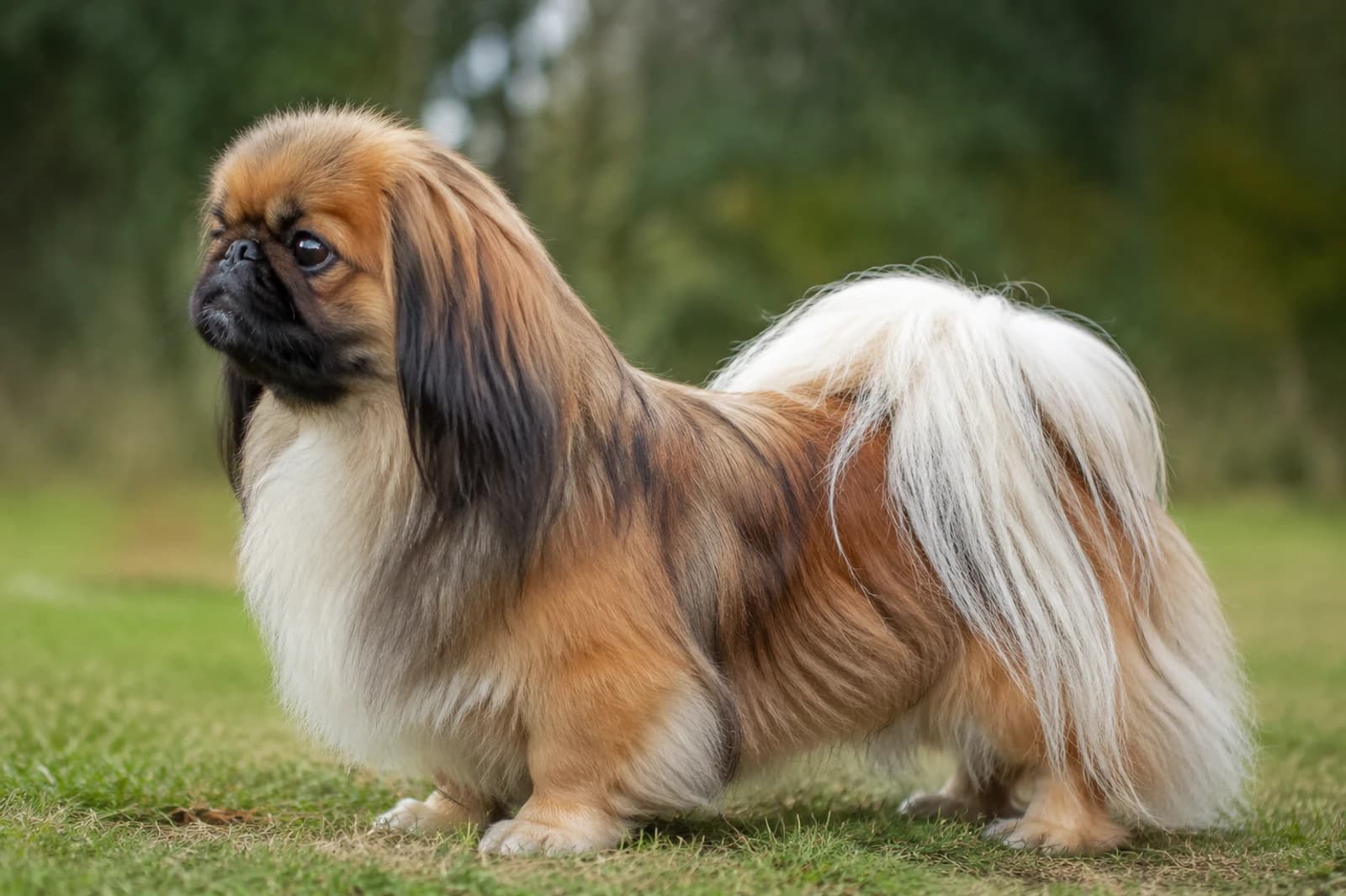
The Pekingese is a tiny, long-coated companion with a royal history and a confident, independent nature. It suits calm homes that enjoy grooming and gentle handling, but it is not the easiest match for very young children or rough play.
At a glance
- Size
- Small
- Height
- 6–9 in
- Weight
- 7–14 lb
- Life span
- 12–14 years
- Coat colors
- Gold, red, sable, cream, black, tan, parti-color
- Coat type
- Long double coat
- Group
- Companion
- Origin
- China
How much does a Pekingese cost?
Adopt / rescue
$75–$400
Usually includes spay/neuter, first shots, and a microchip.
Buy from a breeder
$700–$2,000
From a reputable, health-testing breeder.
Approximate USD. Prices vary widely by region, breeder, pedigree, age, and coat colour — adopting is the lower-cost and recommended route. Avoid suspiciously cheap “breeders”; they’re often puppy mills.
Estimate the full cost of a Pekingese →Pekingese photos
Views
Front, side, rear and top — the full silhouette.Poses
How the breed sits, lies, moves and plays.Puppy to senior
The breed across its whole life.Expressions
The breed’s range of moods.Close-up details
Eyes, ears, nose, paws, tail and coat.Coat colors
The breed’s recognized colors.Click any photo to enlarge. We show the Pekingese from every angle — three views, poses, life stages, expressions, close-ups, coat and colors.
Appearance & size
The Pekingese looks like a tiny, self-important lion that never got the memo about its size. At just 6 to 9 inches tall and a deceptively dense 7 to 14 pounds, the dog is built long and low — a solid, rectangular body carried on short, thick-boned legs. That weight often surprises first-timers; pick one up and you’re holding a muscular little tank, not a fragile puffball.
From the front, the face is unmistakably flat and broad. A prominent chin, a jet-black nose pegged right between the eyes, and a distinct wrinkle — or “nose roll” — that loops from cheek to cheek break up the plane. The eyes are large, round, dark, and set wide apart, giving the Peke a look of perpetual dignified curiosity. Heart-shaped drop ears hang level with the skull and disappear under a profuse mane, which only amplifies the leonine illusion.
In profile you see the deep, wide chest and the short, slightly arched neck. The back is level, the loin short and strong. The tail rides high and arches over the back with long, fringed feathering spilling to one side — that tail never really stops moving. The whole outline from the side screams substance in a small footprint, not delicacy.
A Pekingese coat is a double coat built for serious weather, and it looks it. The outer coat is long, straight, and coarse, while the undercoat is thick and soft. The mane forms a lavish ruff over the shoulders and neck, continuing down the front of the legs and the toes as heavy feathering. On the hindquarters, the breeching is equally profuse, with feathering that runs to the hocks. Behind the dog, you see a solid, well-muscled rear with that plume of a tail cascading like a curtain over the back.
Coat color is a free-for-all — red, fawn, black, black and tan, sable, cream, white, and any combination, often with a black mask. Parti-colors are equally acceptable. A black mask and self-colored eyerims and nose are the only constants, a framing device that makes those liquid dark eyes pop. No matter the shade, the Pekingese looks like it was painted by someone who wanted to remind you that thousands of years of palace living don’t erase the silhouette of a tiny guard dog.
History & origin
Ancient Roots
The Pekingese isn’t just an old breed — it’s practically a living artifact. For at least 2,000 years, these little lion-dogs were the exclusive companions of Chinese emperors and their courts. They were developed within the walls of the imperial palaces in Beijing (then Peking), intentionally bred to resemble the sacred guardian lions of Buddhist mythology. That flat face, broad chest, slow, rolling gait, and proud mane weren’t happy accidents; they were the deliberate result of palace eunuchs selecting for the most regal, lion-like puppies generation after generation.
Buddhist legend claims the Peke came to be when the Buddha shrunk a lion down to the size of a dog, and that reverence played out in practice. These dogs were literally called Sleeve Dogs — small enough to be carried in the voluminous silk sleeves of courtiers, where they served as living hand warmers, status symbols, and tiny watchdogs. They had their own servants, and owning one without imperial permission was a capital crime. The smallest Pekes, sometimes as light as 3 or 4 pounds, were the most prized, but the breed standard we know today (7–14 pounds) reflects the more robust dogs also kept in the palaces.
Arrival in the West
The breed’s shielded existence ended in 1860 during the Second Opium War. British and French troops stormed the Summer Palace, and to prevent their dogs from falling into foreign hands, most of the imperial Pekes were killed. Five were found alive, guarding the body of a princess who had taken her own life. Those five dogs — later named by the British as “Schlorff,” “Hytien,” “Guang,” “Chang,” and “Lo” — became the foundation stock for virtually every Pekingese outside China. One went to Queen Victoria; the others were given to the Duchess of Richmond and the Duchess of Wellington.
Victorian England quickly fell for the breed’s extravagant flat face and dignified stubbornness. From there, fanciers spread them across Europe and to America. The American Kennel Club recognized the Pekingese in 1906, and the breed remained a fashionable companion, even surviving a steep drop in numbers after World War II. Today’s Peke still carries that imperial confidence — it expects to be adored, and usually gets its way.
Temperament & personality
A Pekingese doesn’t act like a 10-pound dog. He carries himself with the self-assurance of a much larger animal and won’t hesitate to boss you around if you let him. Behind that pushed-in face and lion-like mane is a stubborn, independent thinker — the kind who weighs a request before deciding whether it’s worth his time. Force gets you nowhere; respectful, consistent guidance and a dependable routine are the only ways to earn his cooperation.
With his own people, a Peke is famously devoted and becomes a comical little shadow. He’ll nap at your feet for hours, then suddenly tear around the coffee table in a brief, hilarious zoomie session. Indoor energy runs low, but he still needs a couple of 20-minute sniffy walks and a short play bout each day to stay trim and content. Neglect those daily check-ins and the quiet companion can turn into a high-pitched, nonstop barker.
Friendliness toward strangers is a mixed bag. Many Pekingese are reserved and watchful — early socialization helps, but a Peke may never become a greeter. His alert bark makes him a surprisingly good watchdog. Just know that a stiff, forward-leaning body and a direct, hard stare often signal growing irritation, not playfulness. Lip licks, yawns, or a head turned away are his attempts to say “back off” before things escalate.
Around children and other pets, proceed with caution. The breed’s patience for clumsy handling is limited, and food-guarding tendencies can surface. Teach kids to let him eat in peace — never interrupt his meal. Household-friendliness scores often land on the lower side, so a Peke is rarely the right fit for a chaotic home with toddlers or rough-and-tumble dogs.
He takes territory seriously. Urine marking indoors is a scent-based “property line,” especially in less-used rooms that don’t smell enough like his family. If house-training stalls, a vinegar-based spray that neutralizes urine odors works far better than regular cleaners to break the re-soiling cycle. Reward him with a treat immediately after he goes outside and you’ll pile up successes fast. His dignified little mind thrives on that kind of clear, positive feedback.
“Calm,” “brave,” and “dignified” describe typical tendencies, not personality guarantees. A Pekingese brings a big, independent spirit in a tiny body — and he’ll reward an owner who respects that independence as much as the affection.
Good with kids, dogs & other pets
A well-socialized Pekingese can be a calm, affectionate buddy for older children who already know how to handle a small dog gently. He’s patient and non-aggressive by nature, but at just 7–14 pounds with a low-slung build, he’s also physically delicate. A clumsy toddler’s grab or tumble can frighten him, or worse, injure his back or prominent eyes. Even a typically sweet Peke may air-snap or growl if he’s cornered or hurting. Kids should sit on the floor to invite him over, never scoop him up unexpectedly, and always respect his space—especially when he’s on his favorite cushion. Strict supervision with children under six is non-negotiable.
With other dogs, the Pekingese’s royal confidence can cut both ways. He’ll often live easily alongside another quiet, respectful dog he’s known since puppyhood. But a bouncy, in-your-face dog who ignores his grumbles can push him into a snarky defense. He’s not built for raucous play; his idea of socializing is sharing a sunbeam without being jostled. Two Pekes of the same sex sometimes clash over who rules the roost, so early, positive, and carefully managed introductions matter. Forced dog-park greetings or off-leash mobs rarely go well. Adult Pekes who are comfortable with just their owner don’t need a busy social calendar—pushing them to “make friends” can backfire and create fear-based snappiness.
Cats are often a simpler arrangement. The Pekingese isn’t a high-prey-drive breed, and many cohabitate peacefully with a cat that’s introduced gradually. A confident cat who keeps to herself tends to earn a grudging truce. Small, fast pets like hamsters or guinea pigs are more of a wild card; while he wasn’t bred to hunt, the skittering movement can awaken a chase response. Early, positive exposure and secure housing are your best insurance.
All of this rests on what happens during that short socialization window—roughly 3 to 16 weeks. A Pekingese puppy raised in a kennel or pet store without gentle handling from many kinds of people, along with controlled meetings with vaccinated, calm dogs and cats, often grows into an anxious adult who defaults to biting out of fear. After that sensitive period, you can still help a Peke learn to feel safer around the world, but you’re working against a breed that’s already inclined to be watchful and reserved. Accept that your Pekingese may never be a tail-wagging social butterfly. When he chooses his own small circle and you honor that, you have a devoted, drama-free housemate.
Trainability & intelligence
Pekingese are whip-smart, but they don’t wake up looking for ways to earn your approval. Centuries spent as palace lapdogs bred an independent streak that shows up the moment training feels like work. A Peke figures out what you want quickly — and then decides whether it’s worth his while. That means teaching him is less about drilling commands and more about building a relationship where he sees you as a partner, not a boss.
What works (and what backfires)
Force, yelling, or frustration will shut a Pekingese down fast. His dignity is easily bruised, and punishment damages the trust you need to make any progress. Positive reinforcement is non-negotiable. Use tiny, high-value treats, a cheerful voice, or a quick game of tug — whatever he genuinely cares about — and reward the instant he gets it right. Keep sessions short, around 5 to 10 minutes, and stop while he’s still interested. Long repetitions just make him dig in his heels.
The stubbornness you’ll face
Stubborn isn’t the same as stupid. A Pekingese can nail a “sit” and then act as if he’s never heard the word when there’s a squirrel outside. He’s not being disobedient; he’s weighing options. Consistency matters enormously. If you let him ignore a cue three times but enforce it the fourth, he learns that rules are optional. Set clear boundaries from day one and stick to them, calmly. House training can be slow for the same reason — a 7-to-14-pound dog with a mind of his own may see no hurry when it’s cold or wet. Take him out on a predictable schedule, praise quietly but immediately when he goes outside, and never punish accidents you didn’t catch in real time.
Socialization, not optional
A Pekingese’s natural reserve can slide into fear-based reactivity without early, positive exposure. Start between 3 and 14 weeks — well before 16 weeks — and gently introduce him to different people, well-behaved dogs, sounds, and surfaces. Use treats to build pleasant associations. Even as an adult, ongoing exposure in low-pressure situations keeps him confident rather than snappy when guests visit or a skateboard rattles by.
Recall and realistic expectations
Reliable off-leash recall is a stretch goal, not a given. Independence and a low desire to chase (this isn’t a retriever) mean he may ignore you entirely if something more interesting appears. Unless you’re in a securely fenced area, keep the leash on. You’ll both be happier.
Patience, a sense of humor, and the ability to celebrate small wins will take you farther than any fancy training system. Short daily interactions woven into play and cuddles — not rigid drills — turn a Pekingese into a cooperative companion who enjoys working with you simply because you’ve earned his respect.
Exercise & energy needs
Forget long jogs or high-energy hikes. The Pekingese was bred to lounge on silk cushions in imperial palaces, and that low-key temperament still runs deep. He’s a companion, not an athlete. Your job is to offer short, gentle movement that keeps joints mobile and weight in check without ever pushing him past his physical limits.
How much daily activity?
Two or three quick outings totaling 15–20 minutes of sniff-and-stroll walking often hits the sweet spot for a healthy adult. Some Pekes are content with three 5- to 10-minute sessions — one in the morning, one after work, one before bed. Because of that flat face, he’s a brachycephalic breed; he can overheat in minutes on a warm day, and panting hard doesn’t cool him as efficiently as it does a longer-muzzled dog. If your Peke lies down mid-walk, believe him — he’s done.
What counts as safe exercise
- Leashed walks at a meandering pace. Let him dictate the tempo and stop to sniff. That mental nose-work is just as tiring as physical distance.
- Indoor hide-and-seek with kibble or a favorite toy. Scatter a few pieces across the room or tuck them under a soft blanket and let him root around.
- Puzzle feeders and snuffle mats provide a workout without any impact. A loaded Kong or a wobble feeder turns mealtime into a 10-minute brain drain.
- Gentle tug or a low-key game of rolling a ball a few feet across the carpet — no leaping or skidding.
Steer clear of stairs, jumping on and off furniture, and any activity that puts twisting force on the spine. That long-backed, short-legged build makes the breed prone to intervertebral disc disease, even with responsible screening. Install a ramp or pet steps for the sofa and bed, and never let a Peke launch himself down from a high surface.
Signs you’re overdoing it
Labored, noisy breathing, a blue-tinged tongue, or a sudden “I’m not moving” sit-down are red flags. On hot or humid days, skip the walk entirely and run through a few five-minute mental games indoors instead.
A Pekingese will never badger you for a marathon. What he does need is a predictable daily rhythm of short, low-key movement and just enough mental work to keep that imperial brain from getting bored. A treat hidden under a cup in the next room often satisfies both.
Grooming & coat care
A Pekingese’s coat is the breed’s crowning glory — and the single biggest daily chore you’ll take on. That long, flowing double coat is dense, soft, and prone to tangles the moment you look away. Daily brushing isn’t optional; skip a day and you’ll be chipping away at felted mats by the weekend.
Start with a pin brush or a slicker brush with rounded pins to work through the outermost tangles, then switch to a metal greyhound comb to reach all the way down to the skin. Lift the coat in sections and brush from the skin outward — this line-brushing technique clears loose undercoat, spreads natural oils, and catches hidden snarls before they become painful mats. Two or three times a year, when the undercoat blows seasonally, you’ll need extra brushing sessions to manage the hair blizzard.
Bathing comes every four to six weeks, or when your Peke finds something stinky to roll in. Use a gentle dog shampoo and a moisturizing conditioner; that long hair tangles even more when wet, so never scrub or rub roughly. Rinse until the water runs clear, then dry thoroughly. A damp undercoat against the skin invites hot spots and irritation, so a force dryer or a long session with a cool-setting human dryer is worth the effort.
- Face and wrinkles: Pekes have a flat face and deep skin folds that trap moisture and debris. Wipe the folds daily with a soft, damp cloth and dry completely to prevent yeast or bacterial infections. Check the eyes, too — they can collect gunk in the corners.
- Ears: Drop ears mean poor airflow. Flip them open once a week, sniff for anything off, and clean only the outer ear with a vet-approved solution.
- Nails: Trim every three to four weeks if you hear clicking on the floor. Small dogs often need more frequent nail care because they don’t wear them down as easily.
- Teeth: Tooth brushing several times a week fights the dental issues common in tiny mouths. Daily is even better.
Trimming is minimal for a show-style Peke, but many pet owners scissor the hair around the paw pads and sanitary areas for cleanliness. If you opt for a shorter puppy cut, you’ll trade daily line-brushing for professional grooming appointments every six to eight weeks — but you still have to wipe those wrinkles every single day.
Shedding & allergies
Don’t let the small size mislead you — a Pekingese is a heavy, year-round shedder. His glamorous coat has a long, coarse outer layer and a thick, soft undercoat. The undercoat is the real source of the hair you’ll find on every surface. Daily shedding is constant, but it turns into something spectacular during spring and fall blowouts, when clumps of fluff release and drift like tumbleweeds across the floor. Daily brushing with a slicker brush and a steel comb helps grab loose fur before it lands on your sofa, but you’ll still vacuum often and keep a lint roller in every room.
Drool is less dramatic than in giant breeds, but it’s not absent. The Pekingese’s flat face means there’s often a damp patch around the chin after a drink of water. Some individuals drool a little when they’re hot, stressed, or waiting for a treat. A small hand towel near the water bowl handles most of it.
- Shedding intensity: Heavy. Year-round baseline, with two major seasonal blowouts where undercoat comes out in handfuls.
- Drool factor: Low to medium. Mostly water-related; not a slobber machine.
Allergies and the realistic picture: No breed is truly hypoallergenic, and the Pekingese sits far from that ideal. The sheer volume of shed hair carries dander and dried saliva throughout your home, concentrating allergens on upholstery, bedding, and carpeting. Even if you commit to professional grooming every few weeks and run HEPA air purifiers, you’re managing — not eliminating — the allergen load. If someone in your household has dog allergies, spend unhurried time in a home with an adult Pekingese before you bring a puppy into yours. Reactions don’t always show up in a short meet-and-greet, and this breed’s nonstop shedding makes hiding from the triggers nearly impossible.
Diet & nutrition
A Peke’s short back and compact body don’t forgive extra weight. Even a single pound over ideal tips the scales toward back pain, labored breathing, and a lifetime of joint trouble. Because the Pekingese is already built like a little tank with a pushed-in face, every meal counts double.
Puppy portions & timing
From eight weeks to four months, your puppy needs four evenly spaced meals a day. At four months, drop to three meals; by six months, shift to a two-meal adult schedule. Start with a high-quality commercial puppy food—or a vet-approved homemade plan of lightly cooked puréed meats, fish, fruits, and vegetables—and measure everything. Raw meaty bones like small chicken wings can be introduced around twelve weeks, always under close supervision so your pup doesn’t choke or guard.
Keeping an adult Peke lean
An adult Pekingese (7–14 lb) often thrives on 200–250 calories a day, but that number varies with activity. For a typical 10-pounder, that might look like about 1/2 cup of a concentrated small-breed kibble, divided into two meals. Check your food’s calorie-per-cup and then ignore the bowl and use your hands:
- You should feel the ribs under a light layer of fat, no deep digging needed.
- From above, there’s a visible waist behind the ribs.
- From the side, the belly tucks up.
Some Pekes are picky, some are walking stomachs. If yours is food-obsessed, use a puzzle bowl or slow feeder to stretch mealtime and engage that stubborn brain. Never free-feed; a measured, predictable routine catches weight creep before it stresses those low-slung spinal discs.
When teeth go missing
Pekes often have crowded mouths and lose teeth early. If dry kibble becomes a chore, add warm water and let it soften, or switch to a high-quality wet diet. Missing teeth also mean less grinding action, so blending or processing homemade food (raw or gently cooked) into a smooth consistency helps your dog absorb more nutrients. A shallow, wide bowl keeps a flat face from getting frustrated, too.
Senior slowdown
Older Pekingese nap more and move less—often around age nine or ten—but their appetites don’t always get the memo. Sneak calories back down by 10–20% the moment you notice a softer waistline. Splitting the daily ration into three smaller meals can help a waning appetite without upping total intake. There’s no real evidence seniors need less protein, so keep good-quality meat in the bowl.
A word on treats & table manners
Lean snacks are your friend: a couple of baby carrots, a green bean, a thumbnail of plain cooked chicken. Rich, fatty leftovers—holiday trimmings, bacon, greasy pan drippings—can trigger a bout of pancreatitis in small breeds, so keep those far away. If you do share a safe nibble, put it in your Peke’s own dish, never straight from your plate. That one rule stops a snorting beggar from taking up permanent residence at your feet.
Health & lifespan
Pekingese typically live 12 to 14 years — a solid run for a small dog — but that lifespan depends heavily on managing a handful of breed-specific quirks from day one.
-
That flat face is the biggest medical reality. Like other brachycephalic breeds, Pekes have narrowed nostrils and an elongated soft palate, which makes breathing inefficient. They overheat fast. A 75°F day with sun can push a Peke into distress. Skip midday walks; exercise in the coolest parts of the day and watch for raspy breathing or blue-tinged gums. Some dogs need surgery to widen nostrils or shorten the palate if they struggle at rest.
-
Eyes sit prominent and exposed. Corneal ulcers, scratches from a cat or a stray stick, and dry eye (keratoconjunctivitis sicca) are common. Redness, squinting, or a sudden cloudy spot should send you straight to the vet — a minor scratch can turn into a ruptured globe within hours. A responsible breeder screens parents through CAER (formerly CERF) eye exams and produces puppies without inherited retinal problems.
-
Knees and joints. Luxating patellas — slipping kneecaps — affect many tiny breeds, and Pekes are no exception. You’ll spot a hop-skip stride or a dog who holds up a hind leg momentarily. The Orthopedic Foundation for Animals (OFA) evaluates patellas, and a good breeder provides that clearance. Extra weight worsens this overnight, so keep your dog at the leaner end of the 7–14 lb range.
-
Back problems. Though not as notorious as Dachshunds, Pekingese have a long body and short legs, making intervertebral disc disease (IVDD) a real possibility. Teach them to use ramps instead of jumping off couches. A back that’s hunched, or sudden hind leg weakness, is emergency territory.
-
Dental disease is silent and aggressive. A tiny jaw with crowded teeth traps plaque. Daily brushing and annual veterinary cleanings — with careful anesthetic protocols for that flat airway — are non-negotiable. Neglected mouths can seed bacteria into the heart and kidneys.
-
Skin folds over the nose and around the tail need a quick daily wipe with a damp cloth, then drying. Moisture breeds yeast and bacterial infections that smell and itch.
-
Preventive care basics still apply. Heartworm prevention is given monthly during mosquito season (and one month past it), even for indoor dogs. Rabies vaccination is legally required. Yearly bloodwork and a senior panel after age 7 help catch organ changes early.
Responsible breeders screen for eyes, patellas, and select for moderate facial structure — avoiding the extremes that leave a dog gasping. When you buy a puppy, ask for those health clearances; they matter more than any promise. Keep your Peke lean, cool, and dentally cleaned, and those dozen-plus years look a lot more realistic.
Living environment
Apartment vs. house
A Pekingese was practically designed for apartment living. They’re quiet, low-energy, and their exercise needs are modest—roughly 20 to 30 minutes of activity total, split into two or three short sessions. A 10-minute sniffy walk in the morning, another in the evening, and a 10-minute puzzle-toy session indoors gets the job done. They’ll happily get underfoot whether you have 600 or 3,000 square feet. Stairs aren’t a problem, but because those long backs are prone to disc trouble, limit jumping off furniture. A house with steps works fine as long as you sometimes carry them and offer a ramp to the couch.
Yard needs
A fenced yard is a nice perk, not a requirement. These are indoor dogs through and through. They’ll potter outside for a bathroom break and a short sunbath, but they aren’t going to sprint laps or entertain themselves in the grass. If you don’t have a yard, a couple of daily leash walks around the block and a pee-pad setup work just as well. The one outdoor non-negotiable: never leave a Peke unattended outside in warm weather, even for a few minutes—more on that next.
Climate tolerance
Heat is the real danger. That flat face makes panting inefficient, so a Pekingese can overheat shockingly fast. When it’s above 75°F, keep walks to early morning or after sunset, bring water, and never leave them in a parked car. Indoors, air conditioning isn’t optional in summer. Cold, on the other hand, they handle with style. A thick double coat insulates against chilly walks and snow. In freezing winds, a sweater doesn’t hurt, but most Pekes stay comfortable outside longer than you’d guess.
Noise and barking
Pekes are alert. They’ll announce the mail carrier or a neighbor’s cat with a solid woof, but they aren’t usually non-stop barkers. A bored, lonely Peke may get mouthy, so mental stimulation counts for a lot. A stuffed Kong, a food puzzle, or a short training session keeps their busy brain occupied. Teaching a “quiet” cue from puppyhood also nips nuisance barking early.
Being left alone
This is where the breed’s heart-on-the-sleeve personality shows. Pekingese were bred as constant companions, and they take that job seriously. Left alone for a full workday with no break, many will become anxious—barking, chewing, or having accidents. If you’re away long hours, plan on a dog walker, doggy daycare, or a midday drop-in. With gradual desensitization (start with five-minute departures and build slowly) and a steady supply of solo enrichment like snuffle mats and chews, a Peke can learn to settle for a few hours. But if your lifestyle means an empty house from 8 to 6 every day, a Pekingese will struggle—and let you know it.
Who this breed suits
If you want a devoted lap dog that treats you like royalty but doesn’t beg for nonstop attention, a Pekingese might be your match. At 7 to 14 pounds and rarely over 9 inches tall, this compact, lion-maned companion was bred for palace life — and still expects to be the center of a calm, comfortable home.
Who clicks with a Peke
- Seniors and less-active singles. A Pekingese thrives on short, leisurely walks and long stretches of cuddling. He doesn’t need to burn off frantic energy; 15 to 20 minutes of strolling twice a day is plenty. Inside, he’s a low-motion presence, happy to supervise your lap from a cushion.
- Apartment dwellers. Small size and a naturally quiet, dignified streak make him a surprisingly good neighbor. He’ll alert you to the doorbell but is not a nonstop barker — he prefers a measured announcement.
- Owners who appreciate a dog with a mind of its own. You’re not getting a push-button obedience champ. A Peke is independent, even a little stubborn. If you find that charming rather than frustrating, the dog’s loyalty and self-possessed personality will win you over.
- Households with older, respectful kids. A Pekingese can bond with gentle children who understand the dog isn’t a stuffed toy. His stout body is sturdy for his size, but rough handling or sudden grabbing can provoke a defensive snap.
Think twice if …
- You have toddlers or a chaotic household. A Peke will not tolerate clumsy hugs or being chased. Resource guarding over toys or his special person can surface in tense situations. This dog expects a certain level of decorum.
- You want a hiking buddy or a jogging partner. The flat face makes heavy panting a risk in heat, and those short legs aren’t built for endurance. Overdoing exercise in warm weather can turn dangerous fast. This is a climate-controlled companion, not a trail dog.
- You’re squeamish about shedding or upkeep. The glorious double coat drops hair year-round and tangles easily, requiring daily brushing. Snoring, snorting, and the occasional reverse sneeze come with the brachycephalic package too.
- You want a party animal who loves everyone. A Peke picks his people. He can be aloof — even suspicious — with strangers, and he won’t shower every visitor with instant affection. Early socialization helps, but you’ll never erase that discerning, one-person focus.
If your ideal workout is a slow stroll to the couch and you don’t mind a dog who acts like a self-appointed emperor, the Pekingese delivers quiet, steady companionship for 12 to 14 years.
Cost of ownership
A well-bred Pekingese puppy from a breeder who does health testing, shows, or breeds to preserve the breed usually costs between $1,800 and $3,500. Pet-quality pups without breeding rights may fall toward the lower end. Show-prospect puppies or those from exceptional championship lines can easily push past $4,000. On the flip side, you’ll see Pekes listed for a few hundred dollars online or in pet stores — those almost always skip the genetic screenings this breed desperately needs, and you’ll likely pay far more in vet bills down the road.
Monthly upkeep for a Peke isn’t pocket change, largely because that glorious coat and the flat face come with specialized care.
- Food: Plan on $25–$40 for high-quality kibble or fresh food. A 10-pound dog doesn’t eat much, but a diet that supports skin, coat, and joint health is worth it. Add a few extra dollars for dental chews and the occasional probiotic if the wrinkles get yeasty.
- Grooming: The double coat sheds heavily and mats if neglected. A professional groom every 4–6 weeks runs $55–$80 per visit. In between, you’ll need a good pin brush, comb, and tear-stain wipes. All in, budget $60–$85 monthly if you groom at home between appointments, or a bit less if you do it all yourself (not for the faint of heart).
- Vet & preventive care: Routine checkups, vaccines, heartworm, and flea/tick prevention average out to $35–$50 per month. Pekingese are brachycephalic, so you’re more likely to encounter eye ulcers, corneal scratches, breathing snags, and skin-fold infections. Even with a healthy dog, that flat face means you’ll visit the vet more often than a long-nosed breed.
- Insurance: Pet insurance for a Peke typically runs $30–$55 monthly for a solid accident-and-illness plan. Given the breed’s predisposition to intervertebral disc disease (IVDD), luxating patellas, and eye problems, it’s a line item worth serious consideration. Set aside a separate emergency fund if you skip insurance.
- Everything else: Treats, a harness (leash walks are a must — no collar pressure on that trachea), cozy beds, and maybe a ramp to save their back add roughly $20–$35 a month.
All told, a reasonable monthly budget sits between $170 and $265. That number can spike fast if a slipped disc requires surgery or an eye injury needs a specialist. Responsible breeders screen parents for patellas, heart, and hereditary eye disease, but you still need to budget for the care a Pekingese face demands.
Choosing a Pekingese
If you’re set on a puppy, skip the classified ads and find a breeder who treats every litter like a long-term stewardship. Pekingese-specific rescues are also worth a hard look—they often have adults whose personalities, house habits, and breathing quirks are already known, and you skip the fragile puppy stage. Either path commits you to a 12–14 year companion, so a clear-eyed start matters.
The Breeder You Want
A serious breeder isn’t selling puppies on demand—they’ll likely have a waitlist and will grill you as much as you grill them. Expect to meet at least the dam on-site, see where the pups are raised, and walk away with proof of health screenings. They’ll hand over paperwork, not promises.
Health Clearances That Matter
The flat face that defines a Pekingese also brings real respiratory risks, so ask directly how the parents breathe—not just at rest, but after a romp. Look for these specific clearances (OFA or PennHIP evaluations, ideally):
- Patellar luxation — slipping kneecaps, a common small-dog trouble.
- Cardiac exam — congenital heart defects can surface early.
- Eye certification (CAER or OFA Eye) — screens for cataracts, PRA, and painful conditions like entropion where the lids roll inward.
- Hip dysplasia — not as prevalent, but conscientious breeders often test anyway.
No single test guarantees a healthy puppy, but skipping all of them is a glaring red flag.
Red Flags to Walk Away From
Breeders who always have litters available, keep multiple toy breeds in a barn-like setup, can’t show you the mother, or dodge questions about breathing trouble. Walk if you hear “teacup” or “imperial”—a healthy Peke already tops out around 14 pounds; pushing smaller invites fragile bones and organ stress. Puppies offered at eight weeks and not a day later without good reason? Another caution, as toy breeds often benefit from an extra week or two with littermates to learn bite inhibition.
Choosing Your Puppy
Watch the whole litter together. A puppy that hangs back, startles hard, and never warms up may struggle in a noisy household; one that bullies every littermate can become a handful. The sweet spot is a pup that investigates you with tail up, then settles. Physically, look for clear eyes without discharge, a dry nose (not crusted or runny), clean ears, and easy breathing—no honking or labored panting from just toddling around. Pick up the puppy: you want some heft, not a pot-bellied or bony frame. A decent breeder will have already introduced crate time and household sounds, so ask what’s been done.
Pros & cons
Pros
- Big personality in a tiny, regal package. Pekingese carry themselves with a self-assured dignity that’s equal parts charming and comical. They’ll bond deeply with their person and don’t demand constant attention, making them a solid fit if you appreciate an independent companion who isn’t needy.
- Surprisingly low exercise needs. A couple of short walks a day plus some indoor play is enough. At 7–14 lb and standing just 6–9 inches tall, they’re perfectly content trotting around an apartment or a small yard—ideal if you’re not a runner or have limited outdoor space.
- Naturally alert watchdog. Pekes have a deep, resonant bark for their size and won’t hesitate to announce visitors. They’re not incessant yappers, but you’ll always know when the delivery driver arrives.
- Long-lived and sturdy little dogs. With a lifespan of 12–14 years, a well-bred Pekingese can be a loyal sidekick well into their teens. They’re generally robust despite their toy stature, provided you keep their stockingy body at a healthy weight.
Cons
- The coat is a full-time hobby. That magnificent double coat mats if you look away for five minutes. Plan on thorough brushing several times a week and a dedicated grooming schedule, or budget for a professional who knows the breed. Shedding is year-round and heavy during seasonal blows.
- Stubbornness is a feature, not a bug. Training a Peke isn’t like working with a retriever. They think, weigh the cost-benefit, and may decide your treat isn’t worth the effort. Housetraining can test your patience; you’ll need consistency, creativity, and a sense of humor.
- Flat face, real consequences. Like all brachycephalic breeds, Pekingese can struggle in heat and humidity. They’re prone to breathing issues, snoring, and overheating on warm days. Responsible breeders screen for elongated soft palate and pinched nostrils, but you’ll still need to keep any Peke cool, calm, and out of hot cars.
- Don’t expect a rough-and-tumble playmate. Rough handling or chaotic homes with small, grabby children can lead to a defensive snap. A Peke’s delicate build and proud temperament do best with adults or older kids who respect their space.
Similar breeds & alternatives
If the Pekingese appeals for its low-key indoor swagger and independent spirit, a few other companion breeds scratch a similar itch while trading off a trait or two. Each differs in ways that may tip your decision.
-
Shih Tzu
Also bred for palace life, the Shih Tzu shares the Peke’s size (9–10.5 inches, 9–16 pounds) and flat face, but the personality leans more outgoing and eager-to-please. A Shih Tzu typically enjoys meeting new people and plays at fetch a little longer; a Peke is more likely to watch the nonsense from a cushion. Both need regular grooming, but the Shih Tzu’s trainability makes life easier if you want a small dog who actually comes when called. -
Japanese Chin
Slightly lighter and more delicate (8–11 inches, 4–11 pounds), the Chin is another devoted indoor companion with a pushed-in nose and a soft coat. Where the Pekingese plods with a low-slung, heavy-boned dignity, the Chin moves like a dancer, often described as cat-like. The Chin is exceptionally quiet, but its affection tends to be more selective, whereas a Peke bonds hard with its entire household and acts like a tiny lion protecting the den. -
Lhasa Apso
A bit larger (10–11 inches, 12–18 pounds) and more solid than it looks, the Lhasa Apso shares the Peke’s ancient origin and independent streak, but was also used as an indoor watchdog in Tibetan monasteries. Expect more barking at the doorbell and a sharper suspicion of strangers. A Peke is generally less vocal and more content to simply ignore outsiders rather than announce them. -
Pug
If you’re after the same low-exercise, house-happy lifestyle but want a clown instead of a little sovereign, the Pug delivers. Pugs wear a short coat (much less brushing) and crave constant physical contact; they’ll follow you everywhere laughing. The Pekingese is just as affectionate but on its own terms—an owner of a Peke once described the difference as “a Pug asks for attention, a Peke allows it.”
All of these breeds share brachycephalic breathing concerns and heat sensitivity, so responsible sourcing and careful hot-weather management apply equally. If you want a small dog with a huge presence, the Pekingese’s stubborn charm is unmatched. If you’d trade a bit of that independent dignity for more playfulness or neighborly manners, the Shih Tzu or Pug makes a smoother fit.
Fun facts
- The Pekingese was treasured by Chinese imperial families.
- Its flat face means heat and heavy exercise require extra caution.
- The long coat needs regular brushing to avoid mats.
Frequently asked questions
- Are Pekingese good with children?
- Pekingese can be affectionate with gentle, older children who understand how to interact respectfully. Due to their small size and independent nature, they may not tolerate rough handling and can become snappy if provoked. Supervision is always recommended.
- Do Pekingese shed a lot?
- They shed a moderate amount year-round, with heavier shedding during seasonal changes. Regular brushing helps keep loose hair under control and reduces mats in their thick double coat.
- How much exercise does a Pekingese need?
- As a low-energy breed, a Pekingese requires only short daily walks and indoor playtime to stay healthy. They enjoy leisurely strolls but can be prone to overheating, so exercise should be limited in hot weather.
- How much grooming does a Pekingese require?
- The Pekingese has a long, dense coat that needs brushing several times a week, ideally daily, to prevent tangles and mats. Professional grooming every 4–6 weeks can help maintain coat health, along with regular ear cleaning and nail trimming.
- Are Pekingese good for apartment living?
- Yes, their small size and low exercise needs make Pekingese well-suited for apartment living. They are relatively quiet indoors, though they may bark to alert their owners of visitors, and they don’t require a yard.
Tools & calculators for Pekingese owners
Quick estimates tailored to Pekingeses — pre-filled with this breed’s size where it matters.
Articles & stories about the Pekingese
Sources & standards
This profile follows recognized breed standards from the American Kennel Club (AKC) and the Fédération Cynologique Internationale (FCI), along with established veterinary and breed-club guidance. These describe general breed tendencies — every dog is an individual.
Owner stories
Have a Pekingese? Share your experience — grooming tips, personality quirks, anything goes.