

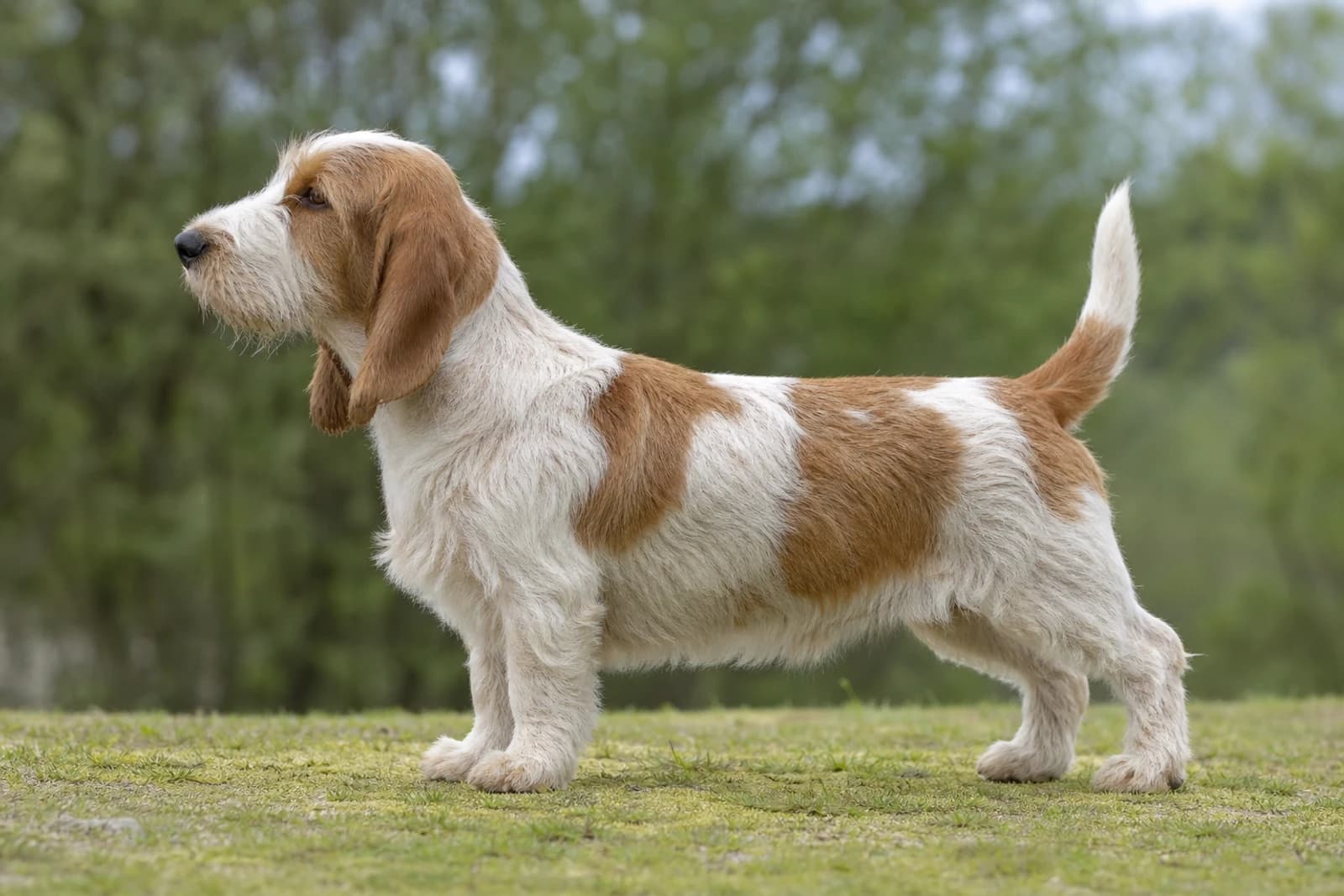
With a name meaning 'small, low, rough-coated dog from Vendée', the Petit Basset Griffon Vendéen is a compact but lively scenthound full of personality. This breed suits active families, couples, or singles who enjoy outdoor adventures and can provide plenty of exercise and mental stimulation. Though affectionate and good-natured, they have an independent streak, so patient, consistent training is essential. Their merry disposition makes them delightful companions for those who appreciate a dog with a sense of humor and boundless energy.
At a glance
- Size
- Medium
- Height
- 13–15 in
- Weight
- 24–42 lb
- Life span
- 12–14 years
- Coat colors
- White & Orange, White & Lemon, White & Sable, White & Grizzle, White & Black, Tricolor
- Coat type
- Rough, wiry double coat
- Group
- Scenthounds
How much does a Petit Basset Griffon Vendéen cost?
Adopt / rescue
$75–$400
Usually includes spay/neuter, first shots, and a microchip.
Buy from a breeder
$700–$2,000
From a reputable, health-testing breeder.
Approximate USD. Prices vary widely by region, breeder, pedigree, age, and coat colour — adopting is the lower-cost and recommended route. Avoid suspiciously cheap “breeders”; they’re often puppy mills.
Estimate the full cost of a Petit Basset Griffon Vendéen →Petit Basset Griffon Vendéen photos
Views
Front, side, rear and top — the full silhouette.Poses
How the breed sits, lies, moves and plays.Puppy to senior
The breed across its whole life.Expressions
The breed’s range of moods.Close-up details
Eyes, ears, nose, paws, tail and coat.Coat colors
The breed’s recognized colors.Click any photo to enlarge. We show the Petit Basset Griffon Vendéen from every angle — three views, poses, life stages, expressions, close-ups, coat and colors.
Appearance & size
If you’ve never seen a Petit Basset Griffon Vendéen in person, picture a rough-coated, low-to-the-ground hound built like a tiny tank. This is a sturdy, medium-sized dog, standing just 13 to 15 inches at the shoulder but packing a solid 24 to 42 pounds onto that compact frame. That weight isn’t fluff — it’s dense bone and hard muscle, purpose-built for a full day scrambling through brambles. The PBGV is longer than tall, with a level topline and a deep chest that shows off its endurance. From the side, the dog’s outline is rectangular and well-sprung in the ribs, ending in a moderately long, saber-shaped tail carried high with a jaunty curve. That tail almost never stops wagging.
Head-on, the breed has an alert, almost mischievous expression, thanks to large dark eyes, long, low-set ears that hang in folds, and a whole lot of facial furnishings. A shaggy beard and mustache frame the muzzle, and prominent eyebrows give the face a distinctly human, questioning look. The skull is domed, the stop clearly defined, and the muzzle slightly shorter than the skull, keeping everything in balance. Walk around to the rear and you’ll see a strong, muscular back end with well-let-down hocks — the kind of angulation that lets a dog push off over uneven ground without tiring.
The coat is the breed’s calling card: a rough, harsh double coat that should never be silky or woolly. The outer hairs are crisp, almost wiry, providing natural armor against weather and underbrush. The undercoat is thick enough for insulation but not so heavy that the dog looks puffy. You’ll find the coat naturally tousled, even a little scruffy, but never unkempt. Color is typically white with patches of lemon, orange, black, sable, grizzle, or tricolor markings — often with a mantle pattern or ticking. No matter the color mix, the eyebrows and beard usually carry a lighter shade that highlights the dog’s lively expression. Don’t expect a perfectly symmetrical show coat; a PBGV looks best when it looks a bit like it just finished a happy ramble.
History & origin
The Petit Basset Griffon Vendéen was built to hunt rabbits through the dense, thorny underbrush of western France when the landowner on horseback couldn’t follow. Unlike larger hounds meant to course game at a gallop, this tough little dog worked on foot alongside hunters who walked. That need — a slow, methodical tracker small enough to push through brambles, with a coat that shed burrs and weather — shaped the breed from the start.
The story begins in the Vendée, a coastal region of western France, where rough-coated scenthounds have been known since the 1500s. The name itself is a checklist: Petit (small), Basset (low-set), Griffon (wire-haired), Vendéen (from the Vendée). For centuries, these dogs were simply the local rabbit hounds, varied in size but all prized for a tireless nose, a merry outlook, and the ability to work alone or in a pack over rocky, uneven ground.
By the late 1800s, breeders began sorting the dogs into distinct types based on leg length and size. Two main varieties emerged: the larger Grand Basset Griffon Vendéen, which hunted larger game like hare and deer, and the smaller Petit, which specialized in rabbit. For a long time, they were registered as a single breed with two height divisions, and interbreeding was common. That changed in 1950, when the French breed club officially separated them, and in 1975 the two became fully independent breeds under the Fédération Cynologique Internationale (FCI).
The breed arrived in North America in the late 1960s, but it was Hubert des Touches, a French breeder, who stoked real interest. Elizabeth Streeter, an American fancier, imported the first PBGVs to the United States in 1975 and founded the Petit Basset Griffon Vendéen Club of America in 1984. The American Kennel Club admitted the breed to the Hound Group in 1990.
Despite a growing fan base charmed by its rough-and-tumble looks and happy temperament, the PBGV has never been a fad breed. It remains a niche scenthound, still very much what it always was: a hardy, low-to-the-ground hunter with a talent for putting rabbits to a zigzagging track — and a voice that lets you know exactly where it’s working.
Temperament & personality
A Petit Basset Griffon Vendéen is a merry, rough-and-tumble scenthound whose entire world runs through his nose. He’s equal parts cheerful shadow and independent problem solver, which means he fills your home with laughter — and occasionally tests your patience.
Energy & daily rhythm
This is not a low-key companion. Expect to put in a solid hour of outdoor activity each day, not just a casual stroll around the block. A brisk walk paired with a long, meandering sniffari where he can follow scent trails at his own pace keeps his brain and body satisfied. A bored PBGV will find his own entertainment, and that often involves dismantling couch cushions or excavating a fresh crater in the yard. Puppies chew to explore and ease teething; adults gnaw on hard objects to keep jaws strong and teeth clean. Redirecting that drive with tough chew toys saves your furniture.
Affection & household fit
With his people, he’s demonstrative without being needy. He’ll greet you at the door with a full-body wag and insist on supervising whatever you’re up to, but he’s not a velcro dog. He does best with older children who understand two key rules: never interrupt him while he’s eating (food guarding can crop up), and give him space when he’s sniffing out something interesting. He’s generally friendly toward strangers and other dogs, though introductions should be calm — a stiff posture and a direct stare are often precursors to a scuffle, not just in this breed but across the board. Learn to read his whole body: relaxed, loose muscles and soft eyes signal a content dog, while a forward-leaning stance often says “I’m ready to investigate that squirrel right now.”
The watchdog who’s more bark than bite
His voice is part of the deal. Expect a baying bark that carries when he spots prey, hears the doorbell, or simply wants to comment on a passing leaf. Early training can put it on a cue, but you’ll never have a silent household. He’s alert and watchful, yet backs up his announcements with a wag rather than suspicion. That said, a PBGV who’s left alone for hours on end can turn that bark into anxiety-driven noise — consistent companionship and mental work prevent that.
Scent-driven quirks you’ll learn to live with
That nose rules everything. Off-leash reliability is a gamble because once a scent grabs hold, selective deafness kicks in. A rabbit trail or a urine mark left earlier will override your recall faster than a treat bag can open. Indoors, that scent obsession creates a house-training twist: a PBGV may mark territory with urine, especially in spots where old odors linger. He’s not being spiteful; scent deposits act like Post-it notes that reassure him he’s home. Clean accidents with an enzymatic cleaner or a vinegar spray (white and cider vinegar work well) to neutralize the cue, and reward him heavily when he eliminates outside. Empty rooms that rarely smell like the family can also trigger marking because his “house” is defined by scent, not floor plans.
And then there’s the classic PBGV move: rolling in things that smell thoroughly dead. He may be masking his own odor, sharing news of a “find” like a four-legged hunter-gatherer, or simply indulging a scavenger’s love of strong smells the way we enjoy perfume. You’ll either learn to laugh or keep a bottle of de-skunking shampoo ready.
Training mindset
PBGVs are clever but think like hounds, not retrievers. They respond best to respectful, consistent engagement — force shuts them down or cranks up the stubbornness. Short, cheerful training sessions with high-value food keep him guessing and eager. If you skimp on exercise and mental challenges, he’ll redirect that energy into chewing, howling, or redecorating your flower beds. A PBGV who has a job — even if it’s just sniffing out hidden kibbles in the living room — is a happy, easier-to-live-with dog.
Good with kids, dogs & other pets
The Petit Basset Griffon Vendéen’s patient, non-aggressive nature is a genuine gift when children are part of the household. These dogs rarely look for a fight and tend to bounce back quickly from the clumsy hugs or tail pulls that come with young kids. That said, a 24–42 lb PBGV on a mission is a compact, muscular bundle of energy, and an overexcited hound can knock a toddler right off their feet without meaning to. Close supervision is the only reliable solution with children under five — not because the dog intends harm, but because a PBGV’s enthusiasm has no built-in pause button.
Socialization lays the groundwork for everything. The critical window closes around 12–16 weeks, so introduce your puppy to a wide range of calm kids, sensible adult dogs, and everyday chaos well before that. Ongoing, positive encounters keep the adult dog steady and less likely to become timid or reactive in unfamiliar situations. PBGVs that miss early exposure can drift into skittishness, particularly around loud noises or rushed handling — something a busy family can easily provide.
Other dogs
PBGVs were bred to work in a pack, and that sociability runs deep. Most live happily alongside other dogs, often forming tight bonds with housemates. They’re not wired for solo backyard living and can become vocal or destructive when left isolated for long stretches. When adding a second dog, aim for a playmate whose energy matches your PBGV’s rowdy, goofy style; a sedate, no-nonsense senior may find the constant pestering exhausting. Group walks and well-run doggy daycare environments typically suit them, but monitor play closely — their rough-and-tumble hound wrestling can overwhelm more reserved dogs.
Cats and small pets
The picture shifts with smaller animals. Scenthounds have a deeply ingrained prey drive, and PBGVs were developed to chase rabbits and other game. A cat that runs can trigger an enthusiastic chase response, even if the dog has no intention of hurting it. Coexistence is possible when the puppy is raised alongside cats from the start, with slow, supervised introductions and plenty of “capture calm” rewards. Pet rodents, birds, or rabbits are a different story: the instinct to pursue is not something training reliably overrides, so a PBGV should never be left loose with a small free-range pet in the same room. Secure enclosures and separate living spaces are non-negotiable.
Early and steady exposure — ideally before 14 weeks — is what tips the balance from “tolerated under direct supervision” to “genuinely trustworthy” with other animals. Even then, always give a PBGV an escape-proof area where small pets are simply not available. Their nose leads the conversation, and a sudden squeak can short-circuit years of good training.
Trainability & intelligence
Your Petit Basset Griffon Vendéen learned the sound of the treat pouch opening from three rooms away before you’d even finished the first official lesson. That’s the kind of intelligence you’re working with: quick, opportunistic, and very tuned in to what benefits him. The challenge isn’t a lack of smarts—it’s that his brain was fine-tuned for centuries to follow a rabbit trail independently, not to check in with a human every 20 seconds.
The nose outvotes the ears
A PBGV will learn a new cue in a quiet kitchen in five repetitions, then blow you off completely when a squirrel dashes past the window. This isn’t stubbornness for its own sake; it’s a hardwired scenthound trait. His entire genetic script says that when a scent hits his nose, following it is the most important job in the world. That makes recall a lifelong project, not a quick fix. Expect him to come when called only after he’s done inventorying the fascinating thing in the grass—unless you’ve put in months of high-value proofing.
Motivation that actually works
Food that stinks. Freeze-dried liver, stinky cheese bits, a crumb of bacon. Pair that with a short, upbeat session—three minutes, not fifteen—and quit while he’s still hungry for more. He won’t work to please you the way a retriever will; he works for payment. That’s fine. Just be honest about it and keep your expectations realistic.
- Use what he loves: A favorite squeaky toy or a game of tug can rival a scent trail, but no praise-only approach will cut it when his nose is engaged.
- Never punish. A harsh voice or a leash correction damages the trust you need for the one time he does look back at you instead of darting off. Punishment makes him more likely to ignore you, not less.
Building a dog who checks in
Start the day he comes home. Before 14 weeks, expose him gently to different surfaces, friendly strangers, and safe new environments—always with treats raining down. The goal is to build a habit of looking at you when life gets interesting. Scatter feeding in the yard? He learns that you predict good stuff. Random jackpots for spontaneous eye contact? He learns that paying attention pays off. That early deposit buys you the split-second pause you’ll need when his nose locks onto a deer path.
The long game
You aren’t training a robot. You’re teaching a merry, determined little hound that cooperation is worth his while. Short daily sessions, laugh at the screw-ups, and never let a training walk become a battle of wills. When he inevitably tunes you out, don’t keep repeating the command—just reset, re-engage his nose with a better reward, and try again. A PBGV who trusts you will learn everything a family dog needs: reliable sit-stays at doorways, a loose-leash walk (most of the time), and even a recall that works in a quiet park. Just don’t bet the farm on calling him off a rabbit in full cry.
Exercise & energy needs
For a dog built close to the ground on stumpy legs, the Petit Basset Griffon Vendéen packs a serious work ethic. These dogs were bred to course rabbits over brambly French terrain all day, and that drive doesn’t evaporate in a family home. Plan on a solid 60 minutes of physical activity every day, split into at least two sessions. A single stroll around the block won’t touch it—this is a scent hound that wants to move with purpose.
How to structure daily exercise
- Morning outing (25–30 minutes): A brisk walk on a harness and long line in a natural area where they can zigzag, follow their nose, and problem-solve. No off-lead wandering unless you’re in a securely fenced space and ready to wait while a scent trail holds them hostage.
- Afternoon or evening session (25–30 minutes): This can be another sniffy walk, a session of scent work or barn hunt games in the yard, or a structured indoor activity like hiding treats in puzzle toys and cardboard boxes.
- Extra short bursts: A five-minute game of “find it” around the living room or a round of tug can take the edge off on a rainy day, but don’t rely on these as the main event.
Mental work isn’t a nice extra—it’s the centerpiece. A PBGV’s brain will spin into mischief if their nose goes unused. Twice-a-day feedings poured into treat-dispensing toys or snuffle mats during a walk cooldown can make a real difference.
What to be careful about
The breed’s long back and dwarfed legs make high-impact landings and repeated jumping a real risk. Avoid flights of stairs, hard stops during fetch, and furniture parkour. Stick to low-impact conditioning: hiking on soft trails, trotting on grass, and swimming (with supervision). Respect that spine, especially in a puppy whose growth plates are still open.
Activities the PBGV was made for
- Nose work and tracking: Sign up for a class or just start with a scent trail of kibble across the lawn. The intensity they’ll bring to this will shock you.
- Barn hunt: An organized sport that lets them hunt for rats (safely caged) in a straw-bale course.
- Long-line hikes: A ten-mile day on a soft surface with unlimited sniffing? A happy, tired dog.
- Hide and seek with people or toys indoors.
Skip the repetitive fetch and generic jogging. You bought a nose on legs. If that nose doesn’t get a real job every day, you’ll hear about it through barking, digging, and creative destructiveness.
Grooming & coat care
The Petit Basset Griffon Vendéen’s coat is half the charm—and a good chunk of the work. That shaggy, rough-and-tumble look comes from a double coat: a harsh, wiry outer layer and a soft, dense undercoat. It’s not a wash-and-wear deal, but it’s also not a coat that sheds bucketloads. Most loose hair gets caught in the undercoat, so without regular attention, it turns into mats, especially behind the ears, under the legs, and along the belly.
- Brushing: Two or three times a week keeps a PBGV in good shape. Start with a slicker brush with rounded pins to break up tangles and pull out dead hair. Follow up with a greyhound-style comb to check for hidden snarls. If you let it slide, a week’s worth of neglect can mean a painful dematting session.
- Bathing: Every 4–6 weeks, or when the dog rolls in something truly rank. A thorough rinse is critical; that dense undercoat holds soap like a sponge. Towel dry vigorously—blow-drying on low heat helps fluff out the coat without softening the texture.
- Trimming and stripping: For the show ring, the coat is hand-stripped to preserve its harsh texture and correct color banding. For a pet, most owners choose clipping every 8–12 weeks. Be aware: clipping softens the coat over time, changing that iconic scruffy silhouette to something fuzzier. Either route, keep the hair between the paw pads trimmed short for traction.
- Nails, ears, teeth: Those long, drop ears are a dark, warm tunnel of happiness for bacteria and yeast. Wipe them out weekly with a vet-approved cleaner and check for redness or odor. Nails need a clip every 3–4 weeks—you’ll hear the click-click on hard floors if you’re behind. Brush teeth at least three times a week to stave off the periodontal disease common in small hounds.
- Seasonal shifts: In spring and fall, the undercoat blows more noticeably. Increase brushing to every other day during those weeks and don’t be surprised if you pull out a small hamster’s worth of fluff each time. A rainy winter means mats form faster; dry, cold air can make the skin flaky, so add an omega-rich fish oil supplement if your vet gives the nod.
Shedding & allergies
That rough, wiry double coat is the big story here. It grabs onto dead hair instead of blanketing your sofa, so shedding tends to be less in-your-face than you’d expect for a medium dog. You’ll still find hair around — just not clouds of it floating through the house. Expect a steady, moderate background shed all year, with a noticeable uptick a couple of times a year as the coat cycles (usually spring and fall).
To keep that from turning into hidden mats, you’ll want to reach for a slicker brush and a comb two or three times a week, and near-daily during the seasonal blowout. Stripping or hand-plucking a few times a year is even better — it pulls the dead undercoat free and keeps the harsh texture looking right, which helps the coat do its job of gripping that loose hair.
Drool is minimal. You might see a drip after a long drink or when a really good treat is in play, but a PBGV won’t leave wet patches on your pants. If you’re after a bone-dry chin, this breed is a solid neighborly choice.
Now for the allergy part: no, they’re not hypoallergenic. That rough coat does not stop dander or the proteins in saliva and urine that trigger most allergies. A Petit Basset Griffon Vendéen produces all of that in normal amounts. Some allergy sufferers do react less to wire-haired breeds simply because the loose hair (which carries dander) isn’t airborne as much, but that’s a gamble, not a guarantee. Spend real time with adult dogs of the breed before bringing a puppy home if allergies are a concern.
Diet & nutrition
A Petit Basset Griffon Vendéen lives for two things: following a scent and eating what you just put in the bowl. That food obsession means portion control isn’t optional — it’s the single most important part of feeding this breed. Extra weight puts real strain on a long-backed, short-legged dog, and a chunky PBGV is a fast track to back and joint trouble down the road.
Portion sizes and weight control
Most adults in the 24–42 lb range do well on about 1 to 1½ cups of a high-quality dry food per day, split into two meals. But that’s just a starting point. A weekend warrior who hunts or runs the woods needs more; a couch-trailing house dog needs less. Forget the bag chart and go by feel: you want to see a waist from above and feel ribs under a thin layer of padding. If you can’t, cut back.
These are world-class beggars. Never feed from the table — one slip turns into a lifetime of hopeful staring, and begging is a nightmare to undo. Serve any leftovers in his own bowl at his own mealtime. And if he inhales his dinner in 20 seconds, a food puzzle bowl slows him down and gives that smart nose a job to do.
What to feed
A biologically sensible diet tilts heavily toward meat. Aim for about 60% raw or cooked meat, 20–30% fruits and vegetables, and the rest from eggs, plain yogurt, or cooked grains like pearl barley or white rice. PBGVs don’t chew much — their jaws move up and down for tearing, not grinding, so blending or puréeing meals helps them actually absorb nutrients. Quick go-to meals: canned fish (in water, no salt), scrambled eggs, steamed veg, or a batch-cooked grain-and-meat mix. Vegetable cooking water (unsalted) makes a decent base if you’re out of stock.
Avoid suddenly doling out rich, fatty table scraps — especially after holidays. A high-fat meal can trigger pancreatitis in a breed already prone to weight issues, and that’s an emergency you don’t want.
Feeding puppies and seniors
Puppies up to 4 months do best on four evenly spaced meals a day. Drop to three meals until 6 months, then two meals for life. When transitioning a pup onto solid food, start with puréed, lightly cooked meats and soft fruits or a premium puppy formula, then introduce raw meaty bones like a chicken wing around 12 weeks — supervised.
Seniors tend to slow down before they lose their appetite. That’s where weight creeps on. Switch to smaller, more frequent meals if needed, but don’t slash protein without a vet’s reason. For an older dog with sore gums, purée everything. Keep a close eye on the scale, and dial back food as activity drops.
No matter the age, measure every meal and resist those eyes. A PBGV will always act like he’s starving 10 minutes after a full bowl. Trust the scoop, not the whine.
Health & lifespan
A well-cared-for Petit Basset Griffon Vendéen routinely reaches 12–14 years, and plenty stay spry well into that range. The catch is that this isn’t a set-it-and-forget-it breed. Their long back, food obsession, and a handful of inherited weaknesses mean a little proactive management goes a long way.
Conditions responsible breeders screen for
Responsible breeders don’t guess — they test. Ask for proof that both parents have clearances for these, because a PBGV with early joint pain or losing eyesight in midlife is heartbreaking and avoidable.
- Hip dysplasia: The loose hip joint that eventually leads to arthritis. Breeders should evaluate hips through OFA or PennHIP and only breed dogs with passing scores.
- Eye disease: Glaucoma, lens luxation, and persistent pupillary membranes appear in the breed. Annual eye exams by a board-certified veterinary ophthalmologist (CAER registration) are the norm for breeding stock.
- Patellar luxation: Kneecaps that slip out of place can cause intermittent lameness. Keeping the dog lean and muscular reduces symptoms, but severe cases need surgery.
- Epilepsy: Primary epilepsy shows up often enough that a breeder should openly discuss any seizure history in their lines. No genetic test exists yet, so transparency matters.
- Hypothyroidism: Some lines produce less thyroid hormone, leading to weight gain, skin problems, and lethargy. A daily pill manages it easily once diagnosed.
What you can’t screen for (but still need to manage)
A PBGV’s build — short legs under a stretched body — creates the same disc risk you’d worry about in a Dachshund. Jumping off the couch or going hard on stairs can trigger intervertebral disc disease (IVDD). Ramps and teaching a solid “wait” before furniture jumping aren’t paranoia; they’re protection. That long back also magnifies the damage of extra pounds, and this breed puts on weight the second you overfill the scoop. They’ll counter-surf, con treats off guests, and polish off the cat’s dinner. Use a measured diet and track body condition every few weeks.
Floppy, hairy ears trap moisture, so a weekly sniff-and-clean ritual prevents painful yeast and bacterial infections. The rough coat can also mask skin allergies — if you notice a musty smell or constant scratching, food or environmental triggers may be the culprit.
Preventive care that pays off
Yearly vet visits catch subtle shifts you might miss — a slight limp, early lens changes, creeping weight gain. Keep up with rabies vaccination (it’s legally required and fatal once symptoms appear) and give monthly heartworm prevention during mosquito season and for at least one month after it ends. Senior PBGVs benefit from bloodwork every six months to catch thyroid or kidney changes before they snowball.
When you bring a puppy home, the single most powerful thing you can hand your vet is a folder of the parents’ hip, eye, and patella clearances. Then, every day, protect that back by keeping your PBGV lean — their spine doesn’t forgive the extra bowl of kibble.
Living environment
The Petit Basset Griffon Vendéen lives with one paw in your lap and the other in a rabbit hole—he’s a 13-to-15-inch, 24-to-42-pound scent hound whose needs tilt more toward a busy, nose-driven schedule than a specific floor plan. Whether an apartment works depends almost entirely on one thing: how you and your neighbors feel about his voice.
Apartment vs. house
A PBGV can live happily in an apartment if you are home most of the day, committed to multiple outings, and have exceptionally sound-tolerant neighbors. His bay is not a soft bark—it’s a loud, carrying hunting call. Without early training and plenty of mental fatigue, he’ll announce every hallway footstep. A house with a securely fenced yard is ideal, but even then you’ll hear him comment on squirrels, delivery trucks, and suspicious leaves. This is not a silent breed.
Yard and exercise needs
A yard is a nice-to-have, not a fix-all. These dogs were bred to push through thick cover after rabbits; they dig, wriggle under gaps, and follow a scent straight out of an open gate. Fencing must be dig-proof and at least 4 feet high. Inside the fence, give him a sanctioned digging spot or a sandbox, or he’ll redesign your flower beds.
His daily movement adds up to 45–60 minutes or more, best split into two or three sniff-heavy walks. A leisurely stroll around the block won’t touch his energy. Think two 20-to-30-minute “sniffaris” plus a romp in the yard. Indoors, puzzle toys, frozen Kongs, and scent games like hiding kibble trails burn off the extra brain power. Because of his long back, protect him from repeat jumping off furniture—ramps or lifting helps, and high-impact agility work should be held back until growth plates close.
Climate tolerance
A rough, wiry double coat gives him decent insulation against cool, damp weather—no surprise for a hound bred in coastal France. He’ll handle mild to cold days well. Hot, humid afternoons are another story. In summer, shift walks to early morning and late evening, keep him in air conditioning, and watch for overheating.
Alone time
PBGVs bond hard to their people. Left alone for long stretches, they can spiral into howling, chewing, or house-soiling. A full eight-hour workday without a break rarely flies. Many owners arrange midday dog walkers, doggy daycare, or a second dog for company. Start alone-time training early: short departures, treat-stuffed puzzles, and no big farewells. Build his comfort gradually, and never mistake his independent streak for a dog who’s okay being ignored all day.
If you can give him a nose-first job and a lap to come home to, a PBGV fits into more settings than you’d guess. Just get the fence dig-proof and practice your “quiet” cue before the first week is up.
Who this breed suits
The Petit Basset Griffon Vendéen is a shaggy, merry scenthound built for rugged outdoor work. He’s got the low-slung build of a Basset but the live-wire attitude of a terrier, and he needs an owner who finds his stubborn independence charming rather than maddening.
You’re a great match if:
- You’re an active person or family who can give at least an hour of real exercise daily—running, hiking, or a long, sniff-heavy walk where the dog sets the pace. A bored PBGV re-invents your furniture arrangement.
- You have a securely fenced yard. This nose-on-legs will follow a scent without a backward glance; off-leash reliability is a fairy tale with nearly every one of them.
- You appreciate a dog who thinks for himself. PBGVs are smart, but they were bred to work independently at their own pace, not to wait for directions. Training demands patience, a good treat stash, and a willingness to laugh when your recall disappears into a bush.
- Kids are part of the picture. These sturdy 24–42 lb hounds are generally upbeat and tolerant with respectful children, especially when raised together. Roughhousing is part of the fun—expect a dog who joins in headfirst, not one who tiptoes around.
- You want to try scent work, tracking, or barn hunt. Giving that nose a job makes this breed light up like nothing else.
Think twice if:
- You want a quiet dog. PBGVs are hounds with opinions, and they share them loudly—when excited, bored, or left too long. Apartment living is a tough sell.
- Your idea of exercise is a gentle leash stroll around the block. This dog won’t thrive on a short potty-break routine. They need room to move and serious mental engagement.
- You’re seeking a biddable, Velcro companion who hangs on your every word. A PBGV adores you, but he’ll also blow you off completely when a rabbit trail fires up his nose.
- You can’t commit to weekly brushing and occasional hand-stripping (or clippering every few months). That wiry double coat mats fast without attention.
If a clownish, rough-and-tumble hunting partner who keeps you moving sounds perfect, a PBGV will fill your life with laughter. If your dream is a serene, obedient lapdog, you’ll both end up frustrated—admire these hounds from a distance.
Cost of ownership
Purchase price
A well-bred Petit Basset Griffon Vendéen puppy from health-tested parents typically costs $1,800 to $3,500. Show-quality lines or hard-to-find litters can push that higher, while rescue adoption fees—when a PBGV turns up in a breed-specific or local shelter—usually run $200 to $500. Expect to join a waiting list; litters are small and breeders don’t churn out puppies.
Monthly upkeep
Once the dog is home, the daily costs settle into a predictable rhythm. Here’s a realistic budget:
- Food: A 24–42 lb dog with a scenthound’s appetite eats 2–3 cups of quality kibble per day. That translates to roughly $40–$70 a month. Training treats and chew toys add a few bucks.
- Grooming: That rough, double coat needs consistent care. Hand-stripping at home keeps costs minimal, but most owners book a professional groomer every 6–8 weeks at $60–$90 a session—or about $30–$45 monthly. Weekly brushing at home and regular ear cleaning (those floppy ears trap moisture and gunk) are non-negotiable.
- Vet care: Routine exams, vaccines, and flea/tick/heartworm prevention average $50–$75 a month when spread over the year. PBGVs can be prone to ear infections, hip dysplasia, and some eye conditions, so you’ll sleep better with a rainy-day fund for surprise bills.
- Pet insurance: For a medium purebred with known hereditary quirks, monthly premiums typically land between $30 and $50. It’s worth considering—an active dog that follows its nose can easily tweak a knee or pick up a foxtail in the field.
Choosing a Petit Basset Griffon Vendéen
If your heart is set on this happy-go-lucky scenthound, you have two solid paths: find a responsible breeder or go through a PBGV-specific rescue. The breed isn’t common, so adult dogs in rescue tend to get placed fast. Start by talking with the Petit Basset Griffon Vendéen Club of America’s rescue network. A rescued adult lets you skip potty training and see the dog’s full personality from day one, though you may need to work through house manners or separation anxiety if its previous life was unsettled.
For a puppy, the breeder you choose matters more than any cute face. Insist on seeing these clearances for both parents—not just a vet check, but the actual paperwork:
- Hips – OFA or PennHIP evaluation
- Eyes – a current CAER exam by a veterinary ophthalmologist plus a DNA test for primary open angle glaucoma (POAG), a painful, blinding disease that appears in the breed and has a known genetic marker
- Patellas – OFA certification for luxating patellas
- Thyroid – OFA evaluation from an approved lab
Ask directly about epilepsy in the lines. There’s no genetic screen for it, so a breeder who claims zero seizures across generations is either uninformed or evasive. Other red flags: multiple litters on the ground at once, a health guarantee that expires in a few days, no questions about your home or experience, and a breeder who won’t let you meet the mother on site.
When you visit the litter, look for curiosity. A well-bred PBGV puppy is busy, uses its mouth and voice, and recovers quickly from a startle. The one hiding under the chair is a risk for a noisy family home—fearfulness can turn into a long-term project. Pick up any puppy you’re considering. Eyes should be clear and bright, coat dense and clean, movement easy without limping. The mother’s temperament is your single best preview; a calm, friendly dam usually produces puppies who will settle into family life with the same steadiness. A breeder who does all of this right will hand you a thick packet of records and stay a resource for the dog’s whole 12- to 14-year life.
Pros & cons
-
Pros
- Compact, rugged build (13–15 inches at the shoulder, 24–42 pounds) — easy to lift, but tough enough to scramble through underbrush all day.
- The definition of merry: quick with a tail wag, gentle with children, and an enthusiastic participant in family life.
- Dog-social to the core; they rarely meet a canine they don’t like and thrive in multi-dog packs.
- Minimal shedding from that wiry double coat, plus a 12–14 year lifespan from well-bred lines.
- Born scent athletes; they turn a stroll into a tracking game and excel at nose work and barn hunt.
-
Cons
- A nose on four legs: once a scent grabs them, recall becomes optional and off-leash reliability is always a gamble.
- Vocal and persistent; they bay, howl, and bark with enthusiasm — not ideal for close neighbors.
- That rough, wiry jacket traps twigs and mud; it needs regular hand-stripping or brushing 2–3 times per week to stay clean and comfortable.
- Independence baked into their hound DNA makes training a slow, creative process — they’re smart but will argue the point.
- High energy for a smaller hound; a quick walk won’t cut it. They need a solid 60–90 minutes of running, sniffing, and mental work daily or they turn destructive.
Similar breeds & alternatives
If you love the PBGV’s rumpled, rough-and-ready look but need a different size or energy level, a few scenthounds come close.
The Basset Hound shares that French pack-hound heritage, but where the PBGV is a 13–15 inch, 24–42 lb dog built to bust through bramble, the Basset is a heavier, low-slung tank (40–65 lb) with smooth, loose skin and ears that sweep the ground. Basset Hounds are mellower and more content with a sniffy stroll than the PBGV’s busy, curious energy. They drool more and shed consistently; the PBGV’s wiry double coat sheds less but needs hand-stripping a few times a year.
For a similar size without the rough coat, the Beagle is the obvious alternative. Both stand about 13–15 inches and share a merry, pack-oriented temperament, but the Beagle’s short coat sheds year-round. Beagles tend to bay more insistently, while a PBGV’s voice is more talkative and varied. The PBGV is often more independent and clownish—a little more apt to make you laugh while ignoring your recall.
The Grand Basset Griffon Vendéen is the PBGV’s direct bigger brother: 15–18 inches tall, 40–45 lb, same shaggy coat and long ears. If you have more room and want a larger hound with the same rustic charm, the Grand is a rare choice, but its exercise needs are a notch higher and it’s even harder to find from a responsible breeder.
If the wiry coat and long body are the draw, consider a Wirehaired Dachshund. At 8–9 inches and 16–32 lb, they’re smaller and bred for tenacious underground work, not pack hunting. A Dachshund will be feistier, often more attached to one person, and less reliably dog-social than the PBGV. Grooming that wire coat is similar, though.
Each of these breeds will follow its nose, so a fenced yard and a sense of humor are non-negotiable no matter which you pick.
Fun facts
- Their name is French for 'small, low, rough-coated dog from Vendée'.
- They were bred to hunt rabbits and hare, using their keen nose and short stature to navigate dense underbrush.
- PBGVs are known for their cheerful, happy-go-lucky attitude and constantly wagging tails.
- Despite their short legs, they are surprisingly fast and agile, capable of keeping up with larger dogs.
Frequently asked questions
- Do Petit Basset Griffon Vendéens shed a lot?
- They have a rough, double coat that sheds moderately year-round, with heavier shedding during seasonal changes. Regular brushing a few times per week helps manage loose hair and keeps the coat healthy.
- How much exercise does a Petit Basset Griffon Vendéen need?
- This breed is energetic and requires daily exercise, such as brisk walks and playtime in a securely fenced area. They thrive with 30–60 minutes of activity per day and enjoy scent games that engage their hunting instincts.
- Are Petit Basset Griffon Vendéens good with children?
- They are generally good-natured and playful with children, making them a cheerful family companion when properly socialized. As with any dog, interactions should be supervised, especially with younger kids, due to the breed's exuberance.
- Do Petit Basset Griffon Vendéens bark a lot?
- As a scenthound, they tend to be vocal and may bark when excited, bored, or following an interesting scent. Training and mental stimulation can help manage excessive barking, but some noise is typical for the breed.
- Can a Petit Basset Griffon Vendéen live in an apartment?
- They can adapt to apartment living if they receive sufficient daily exercise and mental enrichment. However, their tendency to bark and high energy levels may pose challenges in close quarters with noise-sensitive neighbors.
- Is the Petit Basset Griffon Vendéen a good choice for first-time dog owners?
- They can be a rewarding choice for committed first-time owners who are prepared for their independent, sometimes stubborn nature and moderate grooming needs. Early training and consistent leadership are important to channel their keen scent drive positively.
Tools & calculators for Petit Basset Griffon Vendéen owners
Quick estimates tailored to Petit Basset Griffon Vendéens — pre-filled with this breed’s size where it matters.
Articles & stories about the Petit Basset Griffon Vendéen
Sources & standards
This profile follows recognized breed standards from the American Kennel Club (AKC) and the Fédération Cynologique Internationale (FCI), along with established veterinary and breed-club guidance. These describe general breed tendencies — every dog is an individual.
Owner stories
Have a Petit Basset Griffon Vendéen? Share your experience — grooming tips, personality quirks, anything goes.