

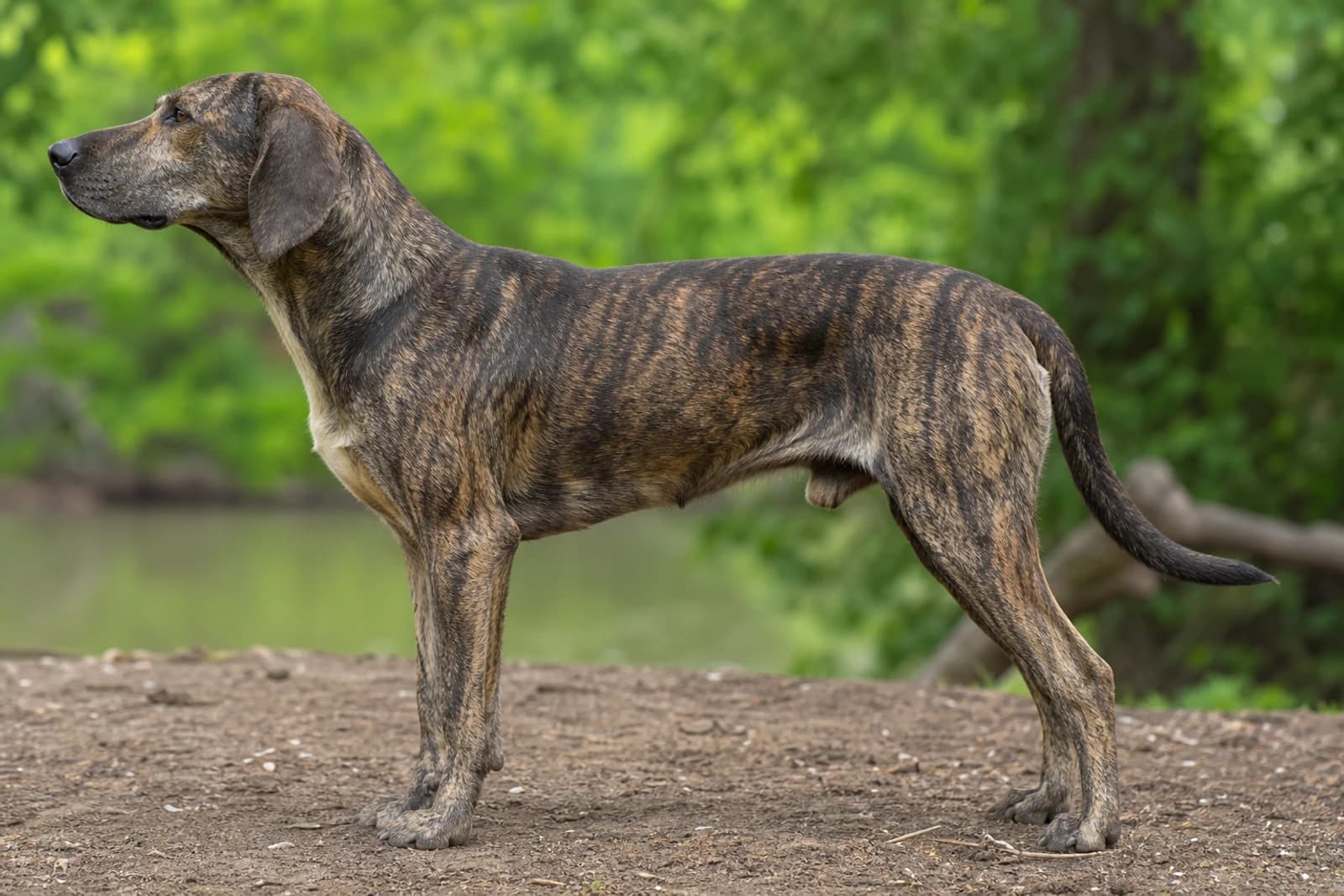
The Plott Hound is a rugged American scent hound with stamina, courage, and a strong working background. It is usually too much dog for a casual apartment life, but it can thrive with active owners who understand hounds.
At a glance
- Size
- Large
- Height
- 20–25 in
- Weight
- 40–60 lb
- Life span
- 12–14 years
- Coat colors
- Brindle, black, buckskin, maltese, saddle markings
- Coat type
- Short smooth coat
- Group
- Scenthounds
- Origin
- United States
How much does a Plott Hound cost?
Adopt / rescue
$75–$400
Usually includes spay/neuter, first shots, and a microchip.
Buy from a breeder
$700–$2,000
From a reputable, health-testing breeder.
Approximate USD. Prices vary widely by region, breeder, pedigree, age, and coat colour — adopting is the lower-cost and recommended route. Avoid suspiciously cheap “breeders”; they’re often puppy mills.
Estimate the full cost of a Plott Hound →Plott Hound photos
Views
Front, side, rear and top — the full silhouette.Poses
How the breed sits, lies, moves and plays.Puppy to senior
The breed across its whole life.Expressions
The breed’s range of moods.Close-up details
Eyes, ears, nose, paws, tail and coat.Coat colors
The breed’s recognized colors.Click any photo to enlarge. We show the Plott Hound from every angle — three views, poses, life stages, expressions, close-ups, coat and colors.
Appearance & size
A Plott Hound should look like it can work all day in rough country—and it can. This is a medium-to-large scenthound with a lean, muscular build that prioritizes endurance over bulk. You’ll notice the athleticism right away: a deep chest, a slightly tucked waist, and long, well-muscled legs that say let’s go.
Standing 20 to 25 inches at the shoulder and weighing anywhere from 40 to 60 pounds, the Plott isn’t a towering hound, but it’s substantial. Males typically run taller and heavier; females stay on the lighter end. The weight sits in dense bone and hard muscle, not padding. When you look at one from the side, the body is slightly longer than tall, with a level topline that stays firm whether the dog is standing or moving. The tail reaches about to the hock, carried saber-like—never curled over the back—and you’ll often see a slight brush of coarser hair along the underside.
The coat is smooth, short, and sleek, with just enough density to turn briars and light rain. On a healthy dog it has a distinct shine. Plott Hounds come in one essential pattern: brindle. That’s the breed’s signature. You’ll see everything from a pale yellow brindle with faint dark stripes to a deep, almost black brindle where the stripes are barely visible. Some dogs have a solid black coat (often still carrying brindle points) and many sport a black saddle that rides over the shoulders and back. White markings are allowed on the chest and feet, but you won’t see large white patches elsewhere—that’s a disqualification in the show ring.
From the front, the Plott’s head is the focal point. It’s carried on a clean, slightly arched neck, and the skull is flat and moderately broad. The stop (the dip between forehead and muzzle) is moderate, not abrupt. The muzzle is long and square-cut, with tight, dark lips that don’t droop. Eyes are dark—hazel or brown—and set fairly wide, with an expression that’s alert and confident, never hard. The ears fold over and lie close to the cheeks, reaching to about the nose tip when pulled forward; they’re set moderately high and have a soft, thin leather. The brow and flews (the upper lip corners) should be dry, so the dog looks clean and unexaggerated.
From the side, the profile shows that deep chest dropping to the elbows, with well-sprung ribs that carry back to a strong loin. You want to see a full ribcage for lung capacity but not so round it interferes with the front legs’ movement. The forelegs are straight and solid, standing square under the shoulders. The hindquarters are broad and powerful, with stifles (knees) well bent—that’s where the drive comes from. Pasterns are nearly upright, and feet are tight and well-knuckled, not splayed. This dog stands on good thick pads.
From behind, you’ll notice the rear legs are parallel when the dog is standing, and the muscling is prominent from hip to gaskin. The tail set is just below the level of the back, not steep. No dewclaws on the rear legs is normal for the breed.
In motion, the Plott is fluid and ground-covering, with reach in front and drive behind that intersect neatly at a trot. It’s a no-wasted-energy kind of gait, built for long hours on a track. If you’re picturing a dog that looks like a streamlined, brindle-coated athlete, you’ve got it.
History & origin
The Plott Hound traces back to a single family and a handful of dogs that crossed the Atlantic in 1750. That makes it one of the very few American hunting breeds not stitched together from existing British or French stock, but built from scratch in the Appalachian mountains by a German immigrant stubborness and a very specific set of dogs.
Johannes Georg Plott, a gamekeeper and huntsman, brought five Hanoverian Schweisshunde (bloodhounds) with him when he left Germany for the colony of North Carolina. Those dogs weren’t the loose-skinned man-trailers people picture today — they were leaner, grittier cold-scent hounds bred to track wounded wild boar over punishing terrain. Johannes settled in the Smoky Mountains, and his dogs proved just as useful on American black bear and mountain lion. He kept the bloodline strictly within the family, so for decades the dogs were known simply as “Plott’s hounds.”
The family didn’t go looking for outside recognition. They bred for one thing: a silent-to-trail, hard-baying strike dog with the tenacity to hold a 400-pound bear at bay until the hunter arrived. Over generations, through careful linebreeding and occasional outcrosses to dogs like the “Leopard Cur” (a black-and-tan blue-spotted dog named “Boss” is the most famous outcross, introduced around 1820), the type solidified. The brindle coat — a signature of the breed today — became etched in.
The Plott family kept their dogs remarkably pure for nearly two centuries. It wasn’t until 1946 that the United Kennel Club formally recognized the breed as the Plott Hound, giving it a name the rest of the country could use. Even then, the Plotts didn’t rush to make them into show dogs or house pets. Most Plott Hounds still hunted bear and boar in the Smokies, and they still do.
North Carolina honored that legacy in 1989 by naming the Plott Hound its official state dog. The breed remains a serious working scenthound — rugged, independent-minded, and bonded to the families that still use them for the job they were created to do.
Temperament & personality
A Plott Hound at work is all business — courageous, methodical, and utterly silent until the trail gets hot; then that deep, ringing bay echoes through the woods. At home, that same dog turns into a surprisingly calm, velcro companion who’ll lean against your leg and steal a spot on the couch the moment you sit down. Expect a dog who is affectionate with family, patient with respectful kids, and reserved but not hostile around strangers. This is not a social butterfly who wants to make friends with everyone at the park.
The nose runs the show. Everything about a Plott revolves around scent. They follow their nose with single-minded intensity, which means off-leash walks in unfenced areas are a gamble unless you’ve drilled a rock-solid recall. Indoors, that same drive can show up as an obsessive response to old accident spots. If a previous potty mishap left even a faint trace, your Plott may feel compelled to re-mark it. Ditch the ammonia-based cleaners and keep a bottle of white vinegar or citrus spray handy — vinegar neutralizes urine odors that otherwise act like a neon “pee here” sign. Housetraining is straightforward once you break that cycle, but letting them sniff and then mark inside sets you back fast.
A calm househound — when the energy is spent. A Plott who gets a solid hour or more of hard running, hiking, or scent-work each day crashes beautifully indoors. She’ll sprawl at your feet, soft-eyed and loose-bodied, sometimes upside down with all four legs in the air. Skip that daily workout, though, and you’ll meet the other side: restless pacing, demand barking, and creative chewing. Provide sturdy chews like antlers or raw bones to satisfy the jaw-cleaning, tooth-scraping urge that every Plott puppy — and many adults — carries. A homemade citrus peel spray on chair legs can save furniture while that young dog figures out what’s allowed.
Strong-willed, not stubborn-hearted. Plotts are independent thinkers bred to solve problems without a human directing every move. With training, that shows up as a dog who blows off a command if your tone is wishy-washy or the reward isn’t worth it. Heavy-handed corrections backfire and can trigger a shut-down or anxiety-driven behaviors like excessive barking. What works is consistent, respectful engagement: short sessions, high-value treats, and a clear set of rules that never shift. Once you’ve earned their trust, they’ll tackle any task with everything they’ve got.
The gross-out factor is real. In classic hound fashion, Plotts may roll in dead things or particularly foul-smelling muck at the first opportunity. Theories vary — masking their scent, showing off to other dogs, or just because they enjoy the stink — but it’s a behavior you either manage or accept. A reliable “leave it” cue and a recall save some baths.
Living with kids and other animals. A well-socialized Plott raised with children is gentle and unflappable, but never let a child mess with the dog while it’s eating. Any dog can develop food guarding when pestered during meals, and a large, muscular hound can do real damage. Give meals in peace. As for other pets, the Plott’s history as a big-game hunter means small animals — cats, rabbits, even small dogs — can trigger a chase response that’s purely instinctive. Supervise introductions carefully, and know that some Plotts can never fully turn off that prey drive, no matter how much you socialize. Early, positive exposure tilts the odds in your favor, but it’s not a guarantee.
Good with kids, dogs & other pets
Plott Hounds tend to be steady, patient dogs that settle into family life without much drama, and that naturally makes them a good fit for homes with kids. Their 40–60 lb frame is sturdy enough to handle enthusiastic play, but also heavy enough to knock over a toddler by accident, so you still need to keep an eye on rambunctious interactions. A Plott isn’t likely to get snappy when a child tugs an ear — their temperament runs non-aggressive and forgiving — but that tolerance evaporates if they’re cornered or hurt, so teach children to give the dog space during meals and rest. Early, positive exposure to kids of different ages helps the dog learn how to dial down intensity around small ones.
With other dogs, Plotts usually bring the pack-friendly mindset of a scenthound. They were bred to hunt cooperatively, and many live peacefully with a second or third dog. Introductions still matter; a slow, neutral-territory meet-up saves you from tension. Same-sex squabbles can flare occasionally, but a well-socialized Plott rarely instigates trouble. The real yardstick is how and when the dog met other canines. Puppies who get 3–14 weeks of gentle, varied dog-to-dog exposure carry that social ease into adulthood, while an isolated adult may never fully trust strange dogs. Don’t force a dog-park friendship on a Plott who’d rather stick with his people and a known housemate.
Cats, rabbits, and other small pets put the hound’s prey drive to the test. This is a breed developed to pursue and hold large game — a scurrying animal can light up instincts that no amount of training erases entirely. Some Plotts cohabitate calmly with indoor cats if they are raised together from puppyhood with carefully managed introductions. Others treat a free-roaming cat exactly like quarry the moment the chase begins. Never leave a Plott unsupervised with small critters unless you’ve seen month after month of safe, relaxed behavior. If you’re starting with an older rescue, assume the dog views pocket pets as a sprinting invitation and manage the house accordingly.
Build all of this on consistent, kind socialization. Introduce the puppy to new people, friendly dogs, different surfaces, and household sounds before that critical window starts to close around 12–16 weeks. A Plott who misses out early can grow into a fearful, noise-sensitive adult who struggles with vet visits and strange encounters. For an adult dog who’s already nervous, skip the forced mixer; targeted desensitization in quiet settings does more than a chaotic meet-and-greet ever will. Every Plott benefits from a childhood — or a second chance — filled with calm, positive experiences that teach him the world is safe.
Trainability & intelligence
A Plott Hound learns fast — they’re shrewd problem-solvers bred to work a cold trail and corner a 500-pound bear without a handler micromanaging them. That independence is the thing to understand up front. They aren’t labs who live to please you; they’ll weigh your request against whatever scent has just lit up their nose, and the scent often wins.
That doesn’t mean they’re untrainable. It means you need a different playbook. Positive reinforcement is non-negotiable. Reward what you want — right as it happens — with high-value treats, a favorite tug toy, or a joyful burst of praise. Punishment, stern corrections, or trying to out-stubborn them tends to shut down trust and make a Plotter harder to reach. They don’t forget rough handling.
The recall problem
A rock-solid recall is the single biggest challenge with this breed. Once a Plott drops his head and inhales a scent trail, his ears effectively turn off. You’re competing with a nose that processes the world in high definition, so building distance reliability takes months — often years — of layered, patient work. Start on a long line, practice in a dozen different low-distraction spots, and always, always make coming back to you the most rewarding part of his day.
What works
- Short, game-based sessions. A Plott gets bored with mindless repetition. Hide a scent article, work a find-it cue, or practice a quick down-stay that ends in a chase game. End the session while he’s still hungry for more.
- Start puppyhood, not adolescence. Begin by 8–10 weeks with simple impulse-control work: wait at doors, settle on a mat, swap a toy for a treat. A 45-pound adolescent with zero frustration tolerance is a rodeo you don’t want.
- Socialization is real training here. Plotts can be reserved with strangers and quick to alert. Expose your puppy to a wide range of calm, positive encounters with people, sounds, surfaces, and other dogs before 16 weeks — and keep it up. A poorly socialized Plott who decides something is sketchy is loud, hard-bodied, and hard to call off.
What trips people up
Assuming that because the dog knows a command, he should obey it every time. A Plott Hound will show you he understands perfectly — and then blow you off when a more interesting option presents itself. That’s not defiance; it’s a 200-year-old breeding contract that says “go make the call in the field.” You close the gap by building a relationship where your dog wants to check in, not by drilling compliance into him.
Stick with relationship-based training that gives this dog a voice without letting him run the show. His intelligence thrives when you give his nose a job — mantrailing, barn hunt, or just structured sniff walks where he gets to lead with his nose on cue. A mentally satisfied Plott is a cooperative Plott.
Exercise & energy needs
A Plott Hound doesn’t just need a daily walk—this dog is a coiled spring wrapped in muscle, bred to chase game through rugged mountain terrain for hours. Treat him like a casual stroller and you’ll get a restless, destructive shadow who finds his own jobs, like dismantling your couch. Plan on at least 60 to 90 minutes of hard exercise every day, split into two sessions. A single lap around the neighborhood won’t cut it; he needs to move with purpose.
Mornings might be a 30-minute off-leash run, a bike ride beside you, or a strenuous hike with elevation. Afternoons can tackle another 30–45 minutes of fast-paced walking, chasing a flirt pole, or a challenging game of fetch. Watch his body language: a tired Plott flops contentedly; a bored one paces, whines, or stares holes through you.
Physical output alone misses half the equation. This is a scenthound whose brain lights up when his nose is engaged. Pair every exercise session with mental work, or you’ll build an ultrafit dog who still vibrates with unused drive.
- Hide his meals in a snuffle mat or scatter kibble across the yard for him to hunt down.
- Teach him formal nosework or trailing—activities he was literally designed for.
- Rotate puzzle toys, but don’t be surprised when he solves them in three minutes and looks at you for the next challenge.
Good sports for Plotts include barn hunt, tracking, canicross, and serious backcountry hiking. Puppies and adolescents need special handling: keep high-impact running on soft surfaces until growth plates close, usually around 12–14 months, to protect developing joints.
Ignore these needs and you’ll see the fallout quickly. A Plott without enough outlet often becomes a barker, an anxiety case, or an escape artist who digs under fences just to follow an interesting scent. Give him the movement and nose time he craves, and you’ll have a steady, affectionate partner who saves his intensity for the trail.
Grooming & coat care
Brushing: minimal effort, maximum shine
The Plott Hound’s short, dense coat is a wash-and-wear affair. A quick once-over with a pig-bristle brush once or twice a week is all it takes to distribute natural oils and bring out the deep, rich brindle or solid color. If you get into the habit after a run, you’ll catch loose dirt and dead hair before it lands on the couch. During heavy shedding spells in spring and fall, skip the bristle brush’s light touch and grab a rubber curry brush or a textured hound glove instead. These lift the undercoat fluff that a soft brush misses, and a few minutes of circular scrubbing will dramatically cut down on flying fur. Because the coat lies so flat, you can also simply run a damp cloth over your Plott after a dusty hike—no water, no fuss.
Bathing: when dirt calls for more than a wipe
Plotts are not the type to demand a rigid bath schedule. A bath every few months—or just when they’ve rolled in something unspeakable—works fine. Use a mild dog shampoo that won’t strip the skin’s natural defenses. Overbathing can leave a Plott Hound with dry, flaky skin, so let “smellable” be your cue rather than a calendar. After the tub, towel-dry vigorously; the short coat air-dries fast, and a quick bristle brush while the coat is still slightly damp revives that healthy gloss.
Ears, nails, and teeth: the real weekly work
That clean, low-maintenance coat is a deal, but the grooming trade-off lands squarely on those drop ears. Floppy ears trap moisture and debris, especially in a dog that follows his nose through thick brush. Lift each ear weekly, wipe gently with a veterinary ear cleaner, and check for redness or a funky smell. Nails typically need attention every month or so. If you hear clicking on hard floors, it’s time. Active Plotts often wear their hind nails down naturally, but front nails and dewclaws rarely get the same workout. For teeth, aim for two or three brushing sessions a week with a dog-formulated paste. This keeps tartar at bay and lets you catch any early gum issues that can sneak up on a dog who lives for hard field days.
Seasonal shedding and skin checks
You’ll notice the coat blowing hardest when daylight hours shift—usually twice a year for a few weeks. That’s when the weekly brush turns into daily curry sessions. It’s also the perfect time to run your hands over every inch of your dog, feeling for bumps, scrapes, or tender spots. A Plott’s smooth coat offers zero camouflage for skin problems, and outdoor dogs can pick up minor cuts and stickers without a whimper. All that roaming and scent work doesn’t just tire him out—it stimulates blood flow to the skin, which promotes a healthy, glossy coat year-round. A quick brush after each outing will keep his coat clear of hitchhikers and let you spot a hotspot before it becomes a vet visit.
Shedding & allergies
You’ll find short, sleek hairs woven into your couch and car upholstery year‑round with the Plott. Their smooth, single-layer coat sheds moderately — not in huge clumps like a double‑coated breed, but with a fine, constant drizzle you’ll notice on dark fabrics. Weekly sessions with a rubber curry brush or hound glove grab most of the loose stuff before it spreads, and that quick routine also keeps the natural oils distributed and the coat gleaming.
Twice a year, usually as the weather shifts in spring and fall, the shedding kicks into a more obvious seasonal blowout. For a few weeks you’ll pull off noticeably more hair, so bump the brushing up to every other day. The silver lining: because there’s no dense undercoat, you aren’t dealing with the massive fluff storms you’d get from a Husky or a Lab.
Drool is part of the picture, but Plott Hounds are not champions of slobber. Expect some moisture after drinking, maybe a string now and then when a treat appears — it’s worth keeping a hand towel near the water bowl. The lips are fairly tight, so it rarely becomes a constant stream.
And the big question: are they hypoallergenic? No. A short coat that sheds means dander gets into the air just like it does with longer-haired dogs, and proteins in saliva and urine also trigger reactions. If someone in the house has serious allergies, spending time around an adult Plott before committing is smarter than betting on a label. A solid vacuum with a pet hair attachment and a few lint rollers will become daily allies.
Diet & nutrition
Plott Hounds burn plenty of energy in the field, but they’ll pack on pounds surprisingly fast if the calories outrun the actual exercise they get. Portion control matters just as much as what’s in the bowl. Most adults in that 40–60 lb range do well on 2 to 3 cups of quality dry food per day, split into two meals — less if your Plott is more couch-hound than coonhound on a given day. Use the feeding guide on the bag as a starting point, then adjust by how your dog looks and feels: you want to see a waist tuck and feel ribs without pressing hard.
A lean Plott is a healthier Plott, because extra weight stresses elbows, hips, and a long working back. Combine that with the breed’s enthusiastic appetite — many will Hoover a meal in seconds — and the risk of creeping obesity is real. Slow things down with a puzzle bowl or food-dispensing toy; it turns mealtime into a short mental workout and cuts the chance of gulping air.
Life stage specifics
- Puppies (up to 4 months) need four evenly spaced meals a day. From 4 to 6 months, drop to three meals, then twice daily like an adult. Transition a new puppy gradually by offering lightly cooked, puréed meats, fish, fruits, and vegetables, or a high-quality large-breed puppy food that supports steady, not rapid, growth.
- Seniors often benefit from smaller, more frequent meals. There’s no strong evidence to slash protein; instead, watch the scale and reduce calories as daily activity tapers off. If teeth are missing or the mouth is sensitive, purée meals to aid nutrient absorption.
Keeping meals safe and practical
Like many deep-chested hounds, Plott Hounds can be at higher risk for bloat (GDV). Feed two moderate-sized meals, not one huge feast, and avoid vigorous exercise for at least an hour after eating. Skip the elevated bowls unless your vet specifically recommends them for a medical reason.
If you go the home-prepared route, aim for roughly 60% animal protein (muscle meat, fish, organ meats), 20–30% fruits and vegetables, and 10% other ingredients like eggs, yogurt, or cooked grains such as pearl barley. Cooked vegetables, canned fish, and batch-cooked grains make quick, nutrient-rich add-ins. Never feed from the table — it teaches begging that’s brutally hard to undo — and reserve rich, fatty holiday scraps for the trash to avoid pancreatitis. Treats count toward the daily total; even a few extra chews add up fast on a 50-pound frame.
Health & lifespan
A healthy Plott Hound typically gives you a solid 12 to 14 years—a good long run for a large dog. These are sturdy, no-fuss dogs without the laundry list of problems that plague some breeds, but a handful of issues are worth keeping an eye on, and the important ones tend to show up in the joints.
Hips and elbows are where you’ll see the most discussion among breeders. Like many substantial, active dogs, Plotts can be prone to hip dysplasia and elbow dysplasia. Responsible breeders don’t guess on this — they screen breeding stock with OFA or PennHIP evaluations and share those results openly. When you’re talking to a breeder, ask for the actual scores, not just a “vet checked” nod.
Ear infections are another practical nuisance. Those drop ears trap moisture and cut airflow, especially if your Plott regularly charges through brush, water, or mud. A quick weekly sniff-and-wipe routine with a vet-approved cleaner prevents most trouble before it starts. Bloat (gastric dilatation-volvulus) is a real risk in any deep-chested hound. Feed two or three smaller meals instead of one big pile, and enforce a quiet hour after eating — no hard running on a full stomach.
Obesity can creep up fast because Plotts are famously food-motivated and can be louder about second breakfast than about a raccoon in a tree. An overweight Plott puts extra strain on those joints, so measure portions with a real cup and keep treats lean. A 50-pound dog that drifts to 60 is a dog headed for avoidable aches.
Short, smooth coat means cold-weather protection comes down to you. In freezing temps, limit exposure or throw on a dog coat; on hot, sunny days, watch for overheating during intense work. They aren’t brachycephalic, so breathing issues aren’t baked in, but a Plott will push as hard as you let him and needs you to call the water breaks.
Preventive care that applies everywhere hits the same notes: monthly heartworm prevention during mosquito season and for 30 days after it ends, a rabies vaccination (legally required, and zero treatment once symptoms appear), and annual wellness exams. For senior Plotts, bump those exams to twice a year. Early socialization and calm, respectful handling — Plotts are strong-willed — lowers stress that can spill into anxiety-driven behaviors, which in turn can mess with appetite and overall health. Watch for subtle shifts like reduced enthusiasm for a favorite hike or sudden pickiness at mealtime. Those quiet signals are often your first heads-up that something’s off.
Living environment
This is a large, driven scenthound bred to work all day in rough country. An apartment sets you both up for failure. A Plott Hound belongs in a house with a secure, well-fenced yard — think 6-foot wood or chain link with buried dig guards, because a scent trail doesn’t care about property lines. Without that containment, you’ll spend your afternoons chasing a hound who’s locked onto a raccoon three miles away.
- Noise is real. Plotts bay — a deep, ringing howl that carries. If you’ve got close neighbors, you’ll hear about it. They don’t just bark; they announce. This is a feature on a hunt, but a liability in a subdivision.
- Climate tolerance is decent but not extreme. That short, dense coat handles heat okay with shade and water, but in freezing weather they need a quick-dry coat or insulated shelter. They’re not meant to live outdoors full-time — they’ll glue themselves to your couch if allowed.
- Being left alone? Not their strength. Plotts form tight bonds with their people. Left solo for full workdays, they can develop howling, chewing, or pacing habits out of sheer boredom and loneliness. If your schedule demands long absences, invest in a dog walker, daycare, or a safe, quiet area where they can stay occupied. Scent games — hidden treats, snuffle mats, boxes to shred — buy you calm, but they don’t replace human connection.
- Mental exhaustion matters as much as the physical. A tired sniffer is a content hound. Without it, a Plott will design his own projects, and you won’t like the blueprints he draws on your drywall. Short, frequent puzzle sessions work better than one long stretch, especially when paired with early desensitization to alone time. Start small, leave a frozen Kong, and build duration over weeks — not the night before you go back to the office.
Who this breed suits
This is a hard-charging hunting partner, not a casual companion. If you’re an experienced dog owner with serious outdoor habits — long hikes, trail running, or the time and land to let a scent-obsessed hound work — you’ll click with a Plott. They’re at their best with someone who understands that a tired Plott is a happy Plott, and “tired” comes after a solid hour of off-leash running or tracking in the woods, not a stroll around the block.
Who fits
- Hunters and dedicated outdoorspeople. The Plott was built to chase bear and boar through rough terrain. If you still hunt over dogs or do competitive tracking, this breed’s grit, nose, and endurance are legendary. Even a non-hunting home can work if you seriously commit to daily scent games, rugged exercise, and a securely fenced acreage.
- Active, experienced singles or couples who have handled independent hounds before. The Plott is smart but stubborn; they need a calm, consistent leader who doesn’t take their aloofness personally. They bond deeply but aren’t velcro dogs.
- Families with older, dog-savvy kids. A 50-lb Plott in full zoomie mode can flatten a toddler. With respectful older children, they’re loyal and tolerant, but always supervise — their prey drive doesn’t switch off indoors.
Think twice if…
- You’re a first-time owner. Plotts are intense and single-minded. They’ll test your patience daily, and their strength on a leash drags you down the street the moment a raccoon scent hits.
- You have a small apartment or no yard. This is not a quiet indoor breed. They bay — a deep, carrying chop that neighbors will hear — and boredom leads to shredded walls. A tall, dig-proof fence is non-negotiable; invisible fences don’t stop a hound on a hot trail.
- You keep cats, rabbits, or small dogs. Generations of selective breeding produced a dog that sees small fleeing animals as quarry. Some Plotts live peacefully with their own pack’s cat, but the instinct is always there. Off-leash recalls vanish when their nose takes over, so plan on lifelong leash work and never letting them loose near a road.
- You want a push-button obedient dog. They’ll learn a command fast and then decide whether it’s worth doing. Training a Plott means out-stubborning them, not just handing out treats.
Seniors looking for a quiet walking buddy should pass. The Plott’s work ethic and power demand a home ready to treat daily exercise and mental challenge as a non-negotiable — not a nice-to-have.
Cost of ownership
Bringing home a Plott Hound puppy from a responsible breeder usually costs $600 to $1,200. Hard-charging lines bred for bear or boar hunting can push that higher, while a companion-focused pup from a health-tested litter might land closer to $600. A lower price tag that skips hip and elbow certifications isn’t a deal—it’s a red flag. Adoption through a Plott rescue or shelter typically runs $50 to $400 and often includes spay/neuter and first-year vaccines, making it a solid alternative if you don’t need a blank-slate puppy.
Monthly expenses are manageable but real. Here’s where the money goes:
- Food: $50–$70. A 40–60 lb scenthound with an athletic motor eats a surprising amount. A high-protein kibble keeps them lean and fueled without unnecessary fillers.
- Grooming: $0–$20. The short, tight coat needs nothing more than a rubber curry brush and a bath every few months. You can easily do it at home and save almost all of this.
- Routine vet and preventives: $40–$70. Annual checkups, vaccinations, and monthly heartworm plus flea/tick meds add up fast. Spread over a year, that’s a reliable baseline.
- Pet insurance: $30–$60. They’re deep-chested and driven, which makes bloat and orthopedic injuries a genuine risk. Good coverage turns a $5,000 emergency into a manageable deductible.
First-year costs run higher thanks to puppy shots, spaying or neutering, and a crate that’s quickly outgrown. After that, a healthy Plott’s routine monthly tab lands in the $150–$250 range, not counting surprise vet visits.
Choosing a Plott Hound
A Plott Hound is a serious working scenthound—buying one on a whim almost guarantees trouble. They need a job and a handler who understands that a strong nose and high drive don’t get exercised with a few leashed walks.
Rescue or breeder?
Start with breed-specific rescue groups if you’re open to an adult. Plott Hounds frequently land in shelters because someone underestimated the dog’s prey drive, endurance, and independent nature. An adult rescue lets you skip the destructive puppy phase and see exactly what you’re getting right away. Ask hard questions: How does the dog react to cats, small dogs, or livestock? Has it ever lived indoors with a family? A Plott who’s been on a chain its whole life may need serious house-training and socialization.
A responsible breeder is your best route for a puppy with predictable health and temperament. Expect a waiting list—this isn’t a breed cranked out for pet stores. A good breeder won’t sell to just anyone. They’ll ask pointed questions about your fencing, your daily exercise routine, and your experience with independent hounds. Run if they only want your credit card number.
Health clearances and red flags
Plott Hounds typically live 12–14 years and are a robust breed, but they can be prone to a few inherited problems. You need to see it in writing.
- Hips: OFA or PennHIP scores on both parents. Acceptable OFA ratings are Excellent, Good, or Fair; a PennHIP DI should fall within the breed’s normal range.
- Elbows: OFA elbow clearance for dysplasia.
- Eyes: Annual CERF or OFA eye exams, since some lines carry progressive retinal atrophy or other eye diseases.
- Bloat (GDV) history: While there’s no single test, a breeder who openly discusses gastric torsion in the pedigree—and doesn’t dodge the topic—is a plus. Deep-chested breeds like Plott Hounds have a higher risk.
Walk away without hesitation if a breeder:
- Can’t produce those health clearances and instead offers a “vet check.”
- Breeds dogs that are under two years old (hips and elbows can’t be finalized until then).
- Always has puppies available, runs multiple litters constantly, or sells over the internet with a “buy now” button.
- Won’t let you meet the dam (and ideally the sire) in person, on the property where the dogs live.
- Pairs dogs only for color or size, not for working ability or sound temperament.
Since this is a hunting breed, a breeder who never hunts, does nose work, or trials their dogs in any capacity is a yellow flag—they aren’t selecting for the traits that define a Plott Hound. Even a companion-only puppy benefits from parents with strong bodies and minds that can handle a solid hour of off-leash running without falling apart.
Picking a puppy
Visit the litter when the pups are 7–8 weeks old. You want a bold, curious puppy, not the one cowering under the deck. A shy Plott often turns into a fearful adult, and fear plus a powerful hound mouth can spell trouble. But don’t grab the one bullying its littermates either—that’s a future headache around other dogs. Aim for the middle-ground pup: the one that walks up, sniffs your hand, maybe gives a little bay, then wanders off to investigate a noise.
Check for clean ears (no dark gunk or sour smell), clear eyes with no discharge, and a coat that feels healthy, not greasy or flaky. The belly should be round but not bloated, and the pup should feel solid, with that sturdy 20–25 inch frame starting to show. Ask how the breeder socializes the litter—pups raised in a sterile garage will need a lot more work.
Males often push toward the top of that 40–60 lb range and can be more assertive; females tend to be a little smaller and may have an even sharper hunting focus. Neither is easier, just different. The real decision is whether you can provide a daily, off-leash outlet for a dog built to trail game for miles. If you can’t commit to that, the pup isn’t the problem.
Pros & cons
Pros:
- Deeply loyal and brave — this is a dog that bonds hard and will stick with you through thick and thin, in the field or on the couch.
- Short, smooth coat is low-maintenance. A quick weekly brushing handles shedding; no expensive groomer trips required.
- Exceptional nose and relentless stamina make them a standout tracking partner for boar, raccoon, or even search-and-rescue work.
- Watchful and naturally alert without being needlessly aggressive. That booming bark tells you long before anyone reaches the door.
- Generally robust and long-lived (12–14 years), with a hardworking constitution built to cover rough country all day.
Cons:
- Sky-high prey drive trumps recall. A flapping leaf or a distant scent can trigger a full sprint — off-leash freedom is rarely safe without exhaustive training.
- Independent and stubborn. They’ll question a wishy-washy command, so if you’re not consistent, they’ll run the show.
- Loud, baying voice that carries for a quarter mile. Apartments, shared walls, or touchy neighbors are a guaranteed headache.
- Real exercise means a solid hour or more of hard running, hiking, or scent work every day. A leash stroll around the block just bottles up frustration.
- Wary of strangers and can be dog-selective. Early, ongoing socialization is critical to prevent aloofness from hardening into defensiveness.
- Can be prone to bloat (GDV) and hip dysplasia. Responsible breeders screen for both, but you’ll need to manage feeding routines and watch joint health as they age.
Similar breeds & alternatives
The Plott Hound stands apart from the classic treeing coonhounds — most North American scenthounds hail from English Foxhounds, but the Plott traces back to German big-game dogs. That changes how it hunts and lives with you. If you are weighing alternatives, here is how the Plott differs from breeds that often fill a similar slot.
- Treeing Walker Coonhound: A leggy, hot-nosed coonhound bred to push raccoons up trees. Walkers are typically more sociable with strangers and other dogs, while the Plott can be aloof or dog-selective. If your hunting demands a dog that trees hard and bays loud, the Walker is the natural pick. A Plott is more likely to stand its ground on boar or bear, and less likely to look up at a tree; its instinct is to corner, not climb.
- Redbone Coonhound: That rich red coat and even, friendly temperament help the Redbone slide into family life easily. A Plott, at a similar 45–70 lb, is usually more intense, more protective, and less forgiving. Families who want a warm-natured hound often land on the Redbone; for a no-nonsense hunting partner that won’t back down, the Plott’s grit is tough to beat.
- Black and Tan Coonhound: A heavier (65–110 lb), more methodical trailer famous for working a cold trail long after it has gone stale. Plott Hounds prefer a fresher track and a more physical finish. The Black and Tan is famously good-natured and lazy at home; a Plott needs a job and won’t settle as easily. Pick the gentle giant if you want a relaxed companion. Pick the Plott if you need a compact, hard-muscled hound that hunts with real fire.
- Bluetick Coonhound: Determined and gritty, but the Bluetick is generally more cold-nosed and more inclined to tree. Its coat is speckled, not brindle, and its temperament typically runs softer with family. A Plott tends to be more standoffish. Both are high-energy dogs that need real work, but a Plott usually brings more fight to a close-quarters catch, while the Bluetick often hangs back and voices.
- Catahoula Leopard Dog: Not a scenthound but often used for the same rough hog hunting. A Catahoula works silently, using sight and scent, and can be more territorial at home. The Plott relies on its nose first and, once on a track, tunes out everything else. For a multi-purpose farm dog that handles stock, the Catahoula has the edge; for pure, relentless scent trailing on dangerous game, the Plott outlasts most.
Fun facts
- The Plott is the state dog of North Carolina.
- Many Plotts have brindle coats.
- The breed was developed for tough tracking work.
Frequently asked questions
- Are Plott Hounds good with children?
- They can be loyal and protective, but their high energy and boldness may overwhelm very young kids. With proper socialization and supervision, they often do well in active families. Early training is important to ensure gentle interactions.
- How much do Plott Hounds shed?
- Plott Hounds have a short, smooth coat that sheds seasonally, typically rated low to moderate. Weekly brushing helps manage loose hair and keeps shedding under control.
- How much exercise does a Plott Hound need?
- As a high-energy scent hound, the Plott Hound requires plenty of daily exercise—at least an hour of vigorous activity. Long walks, runs, and scent games can help meet their needs and prevent restlessness.
- Are Plott Hounds easy to groom?
- Yes, their short coat requires minimal upkeep. Occasional brushing and baths as needed are sufficient, making their grooming needs among the lowest of dog breeds.
- Do Plott Hounds bark a lot?
- Like many hounds, they can be vocal, especially when on a scent trail or alerting to strangers. They tend to have a deep, baying bark, but training can help manage excessive barking.
- Are Plott Hounds suitable for apartment living?
- Their high energy and need for space to roam make them better suited to homes with a securely fenced yard. Apartment living may be challenging unless they get plenty of outdoor exercise, but a house is generally more suitable.
Tools & calculators for Plott Hound owners
Quick estimates tailored to Plott Hounds — pre-filled with this breed’s size where it matters.
Articles & stories about the Plott Hound
Sources & standards
This profile follows recognized breed standards from the American Kennel Club (AKC) and the Fédération Cynologique Internationale (FCI), along with established veterinary and breed-club guidance. These describe general breed tendencies — every dog is an individual.
Owner stories
Have a Plott Hound? Share your experience — grooming tips, personality quirks, anything goes.