

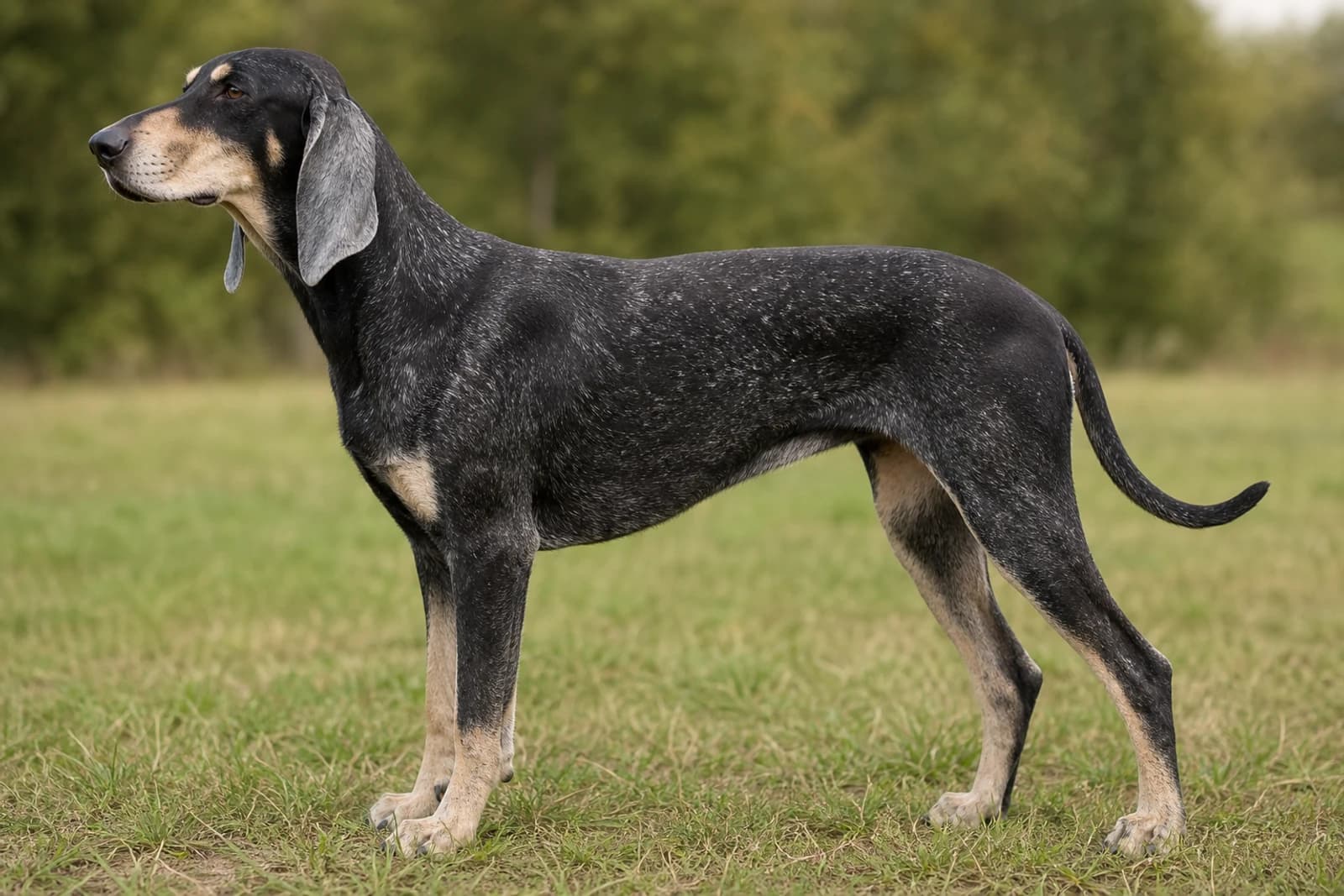
The Poitevin is a giant French scenthound built for endurance and pack hunting. This rare breed thrives with active, experienced owners who can provide ample space and consistent exercise. Gentle and loyal with their family, they are best suited to rural or spacious suburban homes without small pets. With their deep bay and strong prey drive, they excel in outdoor activities but require patient training. Their short, tricolor coat is low-maintenance, but their size and energy make them a poor fit for apartments or novice owners. A devoted companion for the right household.
At a glance
- Size
- Giant
- Height
- 24–28 in
- Weight
- 132–146 lb
- Life span
- 11–12 years
- Coat colors
- black, white, and tan
- Coat type
- short, smooth
- Group
- Scenthounds
How much does a Poitevin cost?
Adopt / rescue
$75–$400
Usually includes spay/neuter, first shots, and a microchip.
Buy from a breeder
$700–$2,000
From a reputable, health-testing breeder.
Approximate USD. Prices vary widely by region, breeder, pedigree, age, and coat colour — adopting is the lower-cost and recommended route. Avoid suspiciously cheap “breeders”; they’re often puppy mills.
Estimate the full cost of a Poitevin →Poitevin photos
Views
Front, side, rear and top — the full silhouette.Poses
How the breed sits, lies, moves and plays.Puppy to senior
The breed across its whole life.Expressions
The breed’s range of moods.Close-up details
Eyes, ears, nose, paws, tail and coat.Coat colors
The breed’s recognized colors.Click any photo to enlarge. We show the Poitevin from every angle — three views, poses, life stages, expressions, close-ups, coat and colors.
Appearance & size
You see a Poitevin and the first thing that registers isn’t just size—it’s the silhouette. This is a giant scenthound built on a racer’s chassis: long legs, a remarkably deep chest, and an outline that pulls your eye from the tip of his long muzzle all the way back to the saber tail.
Build and stance
Standing 24 to 28 inches at the shoulder and carrying 132 to 146 pounds on a lean, well-muscled frame, the Poitevin manages to be imposing without a trace of bulk. The body is rectangular, slightly longer than tall. The back is level and strong, the loin broad and muscular, and the croup slopes gently. A long, well-arched neck with a touch of dewlap flows into a chest that reaches down to the elbows, giving the heart and lungs plenty of room for all-day gallops. Front legs are dead straight, with flat bone and slightly sloping pasterns; hindquarters are powerfully angulated, with thick thighs that drive the ground-covering trot this breed was designed for. The feet are oval, tight, and hare-like—built for grip, not just for show. From the side, you see the depth of the chest and the long underline with a well-tucked flank. From the front, the narrow, deep body and straight columns of leg read as pure endurance machinery. From the rear, the parallel hocks and muscular second thighs tell you this dog doesn’t tire easily.
Head and expression
The head is long, aristocratic, and unmistakably hound-like. The skull is slightly domed, the stop only lightly marked, and the muzzle straight and powerful—lengthy but not snipey. The nose is black and rather prominent. Eyes are large, dark, and rimmed in black, with a calm, slightly sad expression typical of the pack-hunting scenthounds. Ears are a defining feature: set low, fine, and so long they reach at least to the nose tip, hanging in soft folds that seem to catch every scent particle in the air.
Coat and color
The coat is short, dense, and sleek—almost polished in feel. It lays flat against the body, with no feathering anywhere, and you won’t find undercoat to speak of. The Poitevin is always tricolor. White forms a base on the muzzle, chest, collar, belly, legs, and typically the tail tip. Black covers the body as a saddle or blanket-like patch, sometimes extending partway down the sides. Tan points mark the eyes, fill the cheeks, line the inside of the ears, and color the legs and the underside of the tail. The precise pattern varies from dog to dog, but the black-tan-on-white tricolor is the breed’s uniform, and you’ll rarely see a Poitevin without a crisp white blaze running up the face.
The overall effect is a dog that looks equally at home vaulting a fence line or dozing on a cool stone floor after a thirty-mile hunt.
History & origin
The Poitevin’s story starts with a single-minded goal: hunting wolves. In the late 1600s, the forests and marshes of western France still held thriving wolf packs, and the local hounds couldn’t match a wolf’s endurance or outright aggression. Marquis François de La Porte (later the Marquis de Foudras) set out to build a hound that could. He bred the region’s native Poitou hounds to English Foxhounds, which brought speed and relentless drive, and crossed the result with the now-extinct Chien Gris de Saint Louis — a large, deep-voiced descendant of the old St. Hubert hounds prized for its nose and fearless close work on big game.
The mix worked. By the early 18th century, these “Haut Poitou” hounds were pulling down wolves and running boar and deer in packs across the Poitou countryside. The breed’s rangy frame — we’re talking 132 to 146 pounds on 24 to 28 inches at the shoulder — gave it the stride length and lung capacity a full day’s hunt demanded.
The French Revolution shattered that carefully curated world. Aristocratic hunting packs were disbanded, and the breed scattered. A few enthusiasts pieced it back together in the mid-19th century, and around that time the name settled to Poitevin. The recovery was fragile. The wolves disappeared, so the breed’s purpose pivoted sharply to boar and stag. Then World War II delivered another near-knockout; only a handful of Poitevins survived.
Dedicated breeders, including Comte de La Treich, rebuilt the population by selectively incorporating Grand Gascon-Saintongeois and a dash of other French scenthound blood to widen the gene pool without losing type. Even so, the Poitevin remains rare to this day — you won’t stumble across one at a suburban dog park. Most live in their native France as working pack hounds. A small number have found homes as companions, where their calm, pack-oriented nature does surprisingly well in family life if you can provide enough space and, ideally, a way to scratch that deep-seated scenting instinct.
Temperament & personality
Bred to hunt deer and boar in large, vocal packs, the Poitevin pours every ounce of his 132–146 lb body into the chase — then flops at your feet like a contented rug. That split personality is the key to living with this giant scenthound. At home, with his people, he’s remarkably calm and even gentle. On a scent trail, he’s a single-minded, courageous engine that doesn’t hear a word you say.
Pack hound to the bone. Isolation hits hard. These dogs were built to work side-by-side with other hounds, so left alone for long stretches, they can unravel into howling, chewing, or frantic barking. A Poitevin does best with at least one canine housemate and a family that’s around most of the day. Consider it a non-negotiable, not a luxury.
Exercise that actually counts. A quick lap around the block won’t touch his energy. This is a dog who needs a solid 60 minutes of off-leash running or hard hiking, plus mental work — think nose games, long tracking lines, or scent work classes. Adequately exercised, he’s surprisingly easy indoors and will happily lounge in your orbit. Under-exercised, he’ll manufacture his own job (destruction, deafening bay included).
Affectionate without being needy. The Poitevin leans into you — sometimes literally — and thrives on being in the same room. He’s not a Velcro dog, but he forms a deep bond with his family and can be reserved, even aloof, with strangers. That said, aggression is not the breed’s trademark; a relaxed Poitevin shows loose body language, soft eyes, and maybe a sleepy tail wag. A stiff stance and a hard stare, on the other hand, mean something has his full attention and a strong chase impulse may be about to fire. Teach kids to read those signals.
With kids, gentle — but big. A well-socialized Poitevin is patient and tolerant, but 140 lb of enthusiastic dog can accidentally knock over a toddler. Supervision matters. Early, positive exposure teaches him to be soft-mouthed and careful, but never leave a young child alone with a dog this size, no matter how sweet his reputation.
Other animals: proceed with caution. His pack instinct translates to thriving with other dogs, especially other hounds. Small pets — cats, rabbits, even tiny dogs — trip his prey drive hard. If raised together from puppyhood, some Poitevins learn to accept them, but don’t count on it. Assume the hunting brain will override good intentions, and manage the environment accordingly.
Quirks of a nose on legs. Living with a Poitevin means accepting that his nose runs the show.
- Scent rolling: He’ll find the most putrid dead thing and roll ecstatically. It’s not a bath-time fail — it’s a hound thing, possibly a social broadcast from his scavenger ancestry. A heavy-duty dog shampoo lives in your future.
- Marking: Urine marking is part of how he maps his world. A recently neutered adult or any intact male can become a repeat offender inside. Clean accidents with an enzymatic cleaner or a vinegar spray (white and cider vinegar) to neutralize the scent cue, or he’ll return to the same spot.
- Chewing: Puppies chew to explore and relieve teething pain. Adults chew hard objects to keep their jaws strong. Provide sturdy, appropriate chews, and deter off-limits items with a homemade citrus spray — boiled citrus peels steeped in water.
- The voice: His deep, melodious bay carries for miles. That’s a feature when trailing game, but a frequent complaint in suburbs. Training a “quiet” cue with positive reinforcement can trim the edges, but you’ll never erase the instinct.
Training requires respect, not force. The Poitevin’s independent streak runs deep. He’s not stubborn for sport; he was selectively bred to problem-solve in the field without a human directing his every move. Yelling, physical correction, or jerking him around erodes trust and can trigger anxiety-driven behaviors. Calm, consistent, reward-based work — especially tapping into his nose — gets results. Even then, forget off-leash reliability in an unfenced area; if he catches a scent, his ears turn off.
A note on body language. A forward lean usually signals confidence or intent to move forward, while a backward lean often means fear or retreat. Lip licking, yawning, and head turns are common calming signals — learn to spot them, especially when the dog is unsure around kids or new people. A Poitevin that suddenly goes still and fixes his gaze on a small animal isn’t being calm; he’s locking onto potential prey.
A Poitevin isn’t the dog for a novice, a neatnik, or anyone craving a quiet, off-leash stroller. He’s a devoted, big-hearted partner for an active household that understands pack dynamics and won’t leave him alone to climb the walls. If that’s you, you’ll have a brave, funny, and deeply loyal companion who’ll run all day and then lean against you with a sigh that seems to shake the floors.
Good with kids, dogs & other pets
A Poitevin’s patient, non-aggressive temperament gives it a solid foundation for living with kids, but a 132–146 lb scenthound that stands up to 28 inches tall doesn’t always know its own size. Toddlers can get knocked over by an enthusiastic tail wag or a bump during a zoomie, so you’ll need to supervise moments between a young child and this dog just as you would with any giant breed. School-aged kids who understand how to interact respectfully usually become the dog’s favorite napping partners and trail buddies.
Start socializing a Poitevin puppy early — ideally between 3 and 12 weeks — with calm, positive exposure to children of different ages, along with their shrieks, sudden movements, and sticky hands. That window closes around 14–16 weeks, and a giant hound that missed those gentle introductions can grow into an adult who startles or shuts down around kids rather than feeling at ease.
With other dogs, the breed’s pack-hunting background normally makes it easygoing and tolerant. A well-socialized Poitevin rarely picks a fight and typically enjoys having a canine buddy at home. However, do not mistake that for an “easy” dog you can just leave outside with another hound and forget about. This breed needs high companionship and develops distress when isolated for long stretches — being physically housed with a dog friend doesn’t replace daily human connection and mental engagement.
Cats, rabbits, and other small pets are a more complicated story. Scenthounds chase what moves and smells interesting, and a Poitevin’s instinct to bay and pursue game doesn’t disappear just because it was raised indoors. You can stack the odds by introducing the puppy to household cats and small animals during the critical early weeks, teaching a rock-solid “leave it,” and never leaving them unsupervised together. Even then, some adult Poitevins remain unreliable around pocket pets and stray cats. In those cases, management (gates, separate spaces) keeps everyone safe — forced interactions after the sensitive period typically backfire by creating fear or triggering chase sequences that resemble hunting practice, not play.
Trainability & intelligence
A Poitevin won’t hang on your every word the way a retriever might. This giant scenthound is built to follow his nose across miles of rough country, making independent decisions the whole way. Intelligence here is practical and problem-solving—he quickly figures out which behaviors earn a reward and which rules he can bend when something interesting blows in on the breeze.
Motivation is everything. High-value food rewards work, but many Poitevins will blow right past a treat pouch for the chance to work a scent line. Tap into that drive with training games that mimic tracking, or use a favorite tug toy as a jackpot for a job well done. Keep sessions short and upbeat—repetition bores him, and a bored 140-pound hound will simply check out.
Recall is the honest sticking point with this breed. When a deer trail lights up, your voice can become background noise. There’s no quick fix; you build a rocket-proof recall over months by rewarding every check-in so heavily that coming back feels like winning the lottery. Never punish a Poitevin for finally returning, even if he’s been ignoring you for ten minutes. Punishment teaches him that you’re the thing that ruins the fun, and a distrustful dog this size is both anxious and physically unmanageable.
Start young. Cram the 3–14 week window with gradual, positive exposures to strange surfaces, new people, and everyday sounds. A poorly socialized Poitevin defaults to wariness, and a fearful giant leaning into his collar is a runaway risk nobody needs. Match that early socialization with patient, reward-based handling for nail trims, ear checks, and vet exams—rushing anything with a sensitive hound just erodes trust.
The relationship is the real training tool. Clear, consistent communication paired with gentle persistence gets you a dog that wants to cooperate, even when instinct screams otherwise. That trust takes time, but it’s the difference between wrestling a 146-pound animal who ignores you and walking a powerful partner who checks back in before following his nose.
Exercise & energy needs
A Poitevin doesn’t just need a walk around the block — this giant scenthound was built to cover miles of rough terrain while working a cold trail, and that endurance is still wired into the breed. Plan on at least 90 minutes of vigorous daily exercise, split into two sessions. A short morning jog or brisk off-leash hike, followed by a longer afternoon run or scent-tracking session, is closer to what keeps him physically and mentally settled. Without it, that calm, friendly demeanor can tip into restlessness, nuisance barking, or escape attempts.
Intensity matters just as much as time. Leash walks alone won't cut it. Free running in a securely fenced area, long hikes with elevation changes, or work on a 30-foot long line lets him stretch out and use his nose. Scent games and tracking exercises are non-negotiable for mental stimulation — they burn energy more efficiently than just pounding pavement. Deer trails, hidden treats in the yard, and canine nose work classes all play to his deepest drives.
Because the Poitevin tips the scales at 132–146 pounds and stands 24–28 inches tall, you need to protect those growing joints. Avoid forced running on hard surfaces before he's fully mature (around 18–24 months), and ease off high-impact jumping once he's a senior. Responsible breeders screen for hip and elbow issues, but common sense still applies: build fitness gradually, warm up before hard runs, and watch for stiffness afterward.
Good match activities:
- Scent work and tracking (his favorite)
- Hiking and canicross on soft trails
- Swimming, which spares the joints
- Puzzle toys and frozen slow feeders for off-day brain work
- Barn hunt or field trialing
Even a 10-minute nose game in the backyard can take the edge off when you can't get out for a full session. Skip it, and you'll both feel the difference by dinnertime.
Grooming & coat care
The Poitevin’s short, dense coat is all about efficiency—it’s a working hound’s coat, not a fashion statement. You’ll spend far less time grooming than you would with a long-haired breed, but a quick weekly once-over makes a real difference in shedding control and skin health.
-
Brush: A horsehair or soft pig-bristle brush is your go-to. It’ll sweep out dead hair, distribute natural oils, and bring up a noticeable shine without irritating the skin. During heavier shedding weeks in spring and fall, swap in a rubber curry or grooming glove for a few minutes first—those rounded nubs loosen more undercoat and massage the skin at the same time. Aim for 5–10 minutes, once or twice a week normally, and maybe three times a week when the coat is blowing out.
-
Bathe sparingly. These dogs don’t need frequent baths unless they’ve rolled in something memorable. A bath every two to three months with a gentle dog shampoo is plenty; over-washing strips the coat’s weather-resistant oils. After a wet, muddy hunt or hike, a thorough rinse with plain water and a towel-dry often does the trick.
-
Ears demand your attention. Like most scenthounds, Poitevins have long, drop ears that trap moisture and reduce airflow, setting up a prime environment for infections. Check them weekly—lift each ear, sniff for any sour or yeasty odor, and wipe the inner flap with a damp cotton round or vet-approved ear cleaner. Never dig into the ear canal. If the ears look red or the dog is shaking its head a lot, get a vet involved early.
-
Nails and teeth: On a giant breed that can tip the scales at over 140 pounds, untrimmed nails can alter gait and put stress on joints. Plan on a nail trim or grind every 3–4 weeks. A daily dental chew helps between brushings, but nothing replaces a real toothbrushing two or three times a week with dog-specific toothpaste.
-
Seasonal notes: You’ll see a bump in shedding as days get longer in spring and shorter in fall. This is when that extra grooming-glove session keeps loose fur off your couch and stimulates the skin underneath. It’s also a perfect window to run your hands over the dog’s whole body and catch any cuts, ticks, or dry patches early—something you’ll appreciate given how much time a scenthound spends crashing through brush.
Shedding & allergies
A Poitevin’s short, dense coat drops a steady dusting of hair year-round — think tumbleweeds under the kitchen table, not a carpet of fur after every nap. The real mess arrives with seasonal blowouts in spring and fall, when he sheds heavily for a few weeks. A quick daily once-over with a rubber curry brush or a hound glove during those periods pulls the dead hair before it lands on your couch, and a weekly brushing the rest of the year keeps things manageable.
The drool is a bigger daily presence. Those long, loose flews are built for scent work, but they also pour slobber onto your floors, walls, and clothes after a drink of water and whenever food is in sight. You’ll learn to stash drool towels in every room.
No shorthaired blower is truly hypoallergenic, and the Poitevin is no exception. What triggers allergies isn’t just hair — it’s dander, saliva proteins, and urine. A giant dog with this much skin surface and slobber gives those allergens plenty of real estate. If someone in your home reacts to dogs, a Poitevin is not a safer pick, no matter what you read about “low shedding” hounds. Plan on a good vacuum, washable slipcovers, and a tolerance for the occasional flung strand of drool.
Diet & nutrition
A 130-plus-pound hound eats a lot, but the real challenge isn’t the grocery bill — it’s keeping him lean. Extra weight on a Poitevin hammers the elbows, hips, and spine, and you can’t undo that joint stress later. An adult at working weight typically carries 132–146 lb on a 24–28 inch frame, so every pound counts.
Portion sizes by age
Start counting early. Puppies need four evenly spaced meals a day until four months old, then three meals until six months, then drop to an adult schedule of two meals a day. Use a large-breed puppy food that controls growth rate — rapid gains strain developing bones. Transition to a new diet slowly with lightly cooked and puréed meats, fish, fruits, and vegetables, or a high-quality commercial food.
For adults, feed according to size and real activity, not the fantasy version. A Poitevin who hunts or runs hard for an hour may need twice the calories of a couch-loving companion. Watch the waist and adjust. Seniors often need smaller, more frequent meals as metabolism slows; don’t cut protein unless your vet has a specific reason.
Weight management and bloat risk
This is a deep-chested scenthound, so bloat is a genuine threat you manage with mechanics. Never feed one giant meal. Split the daily ration into at least two feedings, and keep the dog quiet for an hour before and after eating. A puzzle bowl or slow feeder kills two birds: it stops him from vacuuming down air and gives that scent-driven brain something to figure out.
Obesity worsens joint trouble and shortens an already modest 11–12 year lifespan. You’ll know you’re on track when you can easily feel ribs under a thin layer of padding. Weigh him monthly; if the number creeps up, trim 5–10% of the food and up the walking, not the other way around.
What to put in the bowl
A practical, species-appropriate mix focuses on meat. Aim for a foundation of raw and cooked muscle meat, plus a good chunk of blended or puréed vegetables and some fruit. Dogs’ jaws move vertically and lack salivary enzymes to break down plant cell walls, so blending is how you unlock the nutrients. Add eggs, plain yogurt, or cooked grains like pearl barley or white rice for variety. White rice works well if his stomach is upset.
That might look like: canned fish, sautéed ground meat, a handful of steamed, blended greens, and a scoop of barley. Skip the vegetarian idea entirely — a dog’s digestive system is built for meat, and forcing a plant-only diet deprives him of what his body expects.
Special notes for puppies and seniors
Around twelve weeks, you can introduce raw chicken wings under supervision to teach chewing and jaw strength. For an older Poitevin with missing teeth or a tender mouth, purée the entire meal to keep nutrition up and frustration down. Weight gain in seniors is sneaky; as activity tapers, cut back food before the scale forces your hand.
Avoid rich, fatty leftovers — a sudden load of holiday grease or bacon ends can trigger pancreatitis in a giant breed. If you do share leftover cooked veggies or a bit of plain meat, put it in his bowl, never from the table. You’re feeding a working hound, not creating a beggar who stands eye-to-edge with your dinner plate.
Health & lifespan
Typical lifespan
A well-cared-for Poitevin usually lives 11 to 12 years. That’s solid for a giant breed, but hitting the high side takes attention to joint health, weight, and catching problems before they get entrenched.
Risks that come with the size
At 132 to 146 pounds and 24 to 28 inches at the shoulder, these deep-chested hounds are built for all-day endurance—but that frame makes bloat (gastric dilatation-volvulus) a genuine emergency. A distended abdomen, gagging with nothing coming up, and sudden restlessness mean get to a vet immediately. Some owners opt for a prophylactic gastropexy during spay or neuter to tack the stomach and dramatically lower the odds.
Joint stress is a lifelong reality. Hip and elbow dysplasia show up often enough that responsible breeders screen breeding dogs through OFA or PennHIP and will share the results without hesitation. Even dogs with clean scores can develop arthritis, so keeping a Poitevin lean starting in puppyhood is not optional.
Other health concerns
- Ears: Long, drop ears seal in moisture. Yeast and bacterial infections become a recurring theme if you don’t dry them after a wet outing and do a quick sniff-and-wipe check every week.
- Heart: Like several large breeds, Poitevins can be prone to dilated cardiomyopathy. A reputable breeder runs cardiac exams—typically an echocardiogram—before breeding.
- Weight: These are strong, food-motivated dogs. Leaving feed out is an open invitation to both bloat and obesity. Measure meals, skip the free-feeding, and track their weight. Every extra pound punishes aging joints.
Preventive must-haves
Annual vet exams, with bloodwork starting around age 7 or 8, catch early kidney or thyroid changes you won’t see at home. Heartworm prevention given on schedule during mosquito season (and one month after) is non-negotiable, and the rabies vaccination is legally required.
Early, positive socialization does more than build a steady temperament—it lowers chronic stress that can suppress the immune system. A Poitevin that feels secure is healthier.
When you talk to a breeder, ask to see the actual health clearances: hip, elbow, eye, and cardiac at minimum. No paperwork, no deal. It won’t guarantee a problem-free life, but it’s the best head start you can give a giant, determined hound.
Living environment
A Poitevin in an apartment is a non-starter. This is a giant, deep-chested scenthound — 132 to 146 pounds, standing up to 28 inches — bred to run for miles behind a pack. Confining one to a small space will lead to destruction, howling, and a dog that makes you miserable. Even a townhouse with a postage-stamp yard won't cut it. You need a large, securely fenced yard with a fence at least six feet high. These dogs can scale or dig under anything shorter when a scent trail fires up.
A rural property or a house on a big suburban lot is the baseline. Inside, they're calm and affectionate… after their needs are met. Plan on two solid exercise sessions every day — 45 to 60 minutes each — and not just a stroll around the block. This dog wants to gallop and follow its nose. Scent work, puzzle toys, and long sniffy walks on a harness are essential mental outlets. Because they're giant, avoid repetitive high-impact exercise like nonstop jumping or hard-surface running until growth plates close (typically around two years). Older Poitevins with worn joints benefit from swimming or softer terrain.
Noise is a real issue. Scenthounds bay — a deep, rolling sound that carries. Your neighbors will hear it. If you live within earshot of people who value quiet, you'll be fielding complaints.
Climate-wise, the short, dense coat offers limited insulation. This is a house dog that sleeps on your couch, not an outdoor-only breed. In bitter cold, they'll need a coat and quick outings. Heat tolerance is decent with shade and plenty of water, but never leave them out in direct summer sun with no escape.
The hardest part for many families: Poitevins are pack hounds bred to work with other dogs. They often struggle badly when left alone. Expect separation anxiety — chewed doorframes, inconsolable howling — unless you put in serious work. Gradual desensitization and puzzle feeders can help, but this breed does best in a home where someone is around most of the day. If your household empties out for nine hours straight, five days a week, a Poitevin will come apart.
Who this breed suits
The Poitevin is a high-octane pack hound built to chase big game across miles of French marshland, and that pretty much defines who he’s for. This is not a dog who adjusts to a quiet suburban life if you just try hard enough. He suits an experienced owner who already understands scent hounds — someone who hunts, runs a working pack, or is dead serious about canine sports like tracking or canicross. If you have acreage, a securely fenced area the size of a football field, and the time to give him two or more hours of hard, off-leash running daily, you’re in the conversation.
Active rural families who want a tall, leggy shadow for long days outdoors can make it work, provided someone is home most of the time. Poitevins are bred to live and hunt in a group. They’ll settle better with at least one other large dog, ideally another hound, and can struggle with isolation. Expect a dog who bays like a foghorn when excited. That’s non-negotiable, so close neighbors are a dealbreaker.
Who should think twice? Anyone without direct hound experience, first-time dog owners, and apartment or townhouse dwellers. Seniors or people with limited mobility will find a 140-pound athlete who can pull hard after a scent simply unmanageable. Families with toddlers or small pets should also pass — prey drive is deep and instinctual. This is a dog who can knock a grown adult flat in a joyful greeting and will clear a kitchen counter without breaking stride. If your idea of exercise is a leashed walk around the block, the Poitevin will be a frustrated, noisy, and destructive housemate. He needs space, a purpose, and an owner who genuinely enjoys the sound of a baying hound echoing through the pines.
Cost of ownership
Finding a Poitevin puppy in the US is a project in itself. This is a rare French scenthound, and only a handful of dedicated breeders exist on this side of the Atlantic. You’ll likely wait a year or more. A well-bred puppy from health-tested parents typically runs between $2,000 and $4,000, and that often doesn’t include the cost of transporting a pup from Europe, which can tack on another $500 to $1,500 depending on the logistics. If you go the rescue route — even rarer — expect a few hundred dollars in adoption fees.
Once the dog is home, the monthly numbers stay steep. A male Poitevin can weigh 140-plus pounds and burns through 4 to 5 cups of high-quality dry food a day. That works out to roughly a 40-pound bag every two to two-and-a-half weeks, so budget $120 to $180 a month just for kibble. A joint supplement with glucosamine and chondroitin is smart for a giant breed, adding another $25 to $40 monthly. Treats for training and scent-work sessions add $15 to $25.
Grooming isn’t a major line item — a short, dense coat needs a quick weekly brushing and an occasional bath — but you’ll still pay for nail trims and basic hygiene if you don’t do it yourself. Plan on $30 to $50 a month for professional grooming, or less if you handle it at home.
Veterinary care hits hard because everything is weight-dosed. Monthly flea, tick, and heartworm prevention for a dog this size runs $40 to $70. An annual exam with vaccinations and bloodwork might average out to $50 to $80 a month when you spread it across the year. Then there’s insurance. Poitevins are deep-chested and at risk for bloat, plus hip dysplasia, so a comprehensive policy with a decent reimbursement rate commonly lands between $70 and $120 a month. Without insurance, a single emergency bloat surgery can cost $5,000 and up — a number worth staring down before you commit.
All told, the predictable monthly nut sits around $350 to $500, and that’s before you factor in a sturdy crate, a harness rated for a 140-pound puller, and replacing chewed leashes. Setting aside an extra $100 a month in a dedicated dog emergency fund softens the blow when big bills hit.
Choosing a Poitevin
If you’re looking for a Poitevin, you’re chasing a rare working hound, not a dog you’ll find on a whim. Most breeders are in France, and they breed for the hunt—specifically for pack work on wolf, boar, or roe deer. That means finding a responsible source takes patience, a willingness to travel, and a hard look at whether your life can absorb a 140-pound scent machine that needs to run for miles with other hounds.
Breeder or rescue Rescue Poitevins are nearly nonexistent in North America. Occasionally a hunting pack in Europe rehomes a dog that doesn’t fit, but you’d be dealing with import logistics and a dog that likely hasn’t lived as a house pet. A responsible breeder is the more realistic path. Expect to get on a waiting list, because good litters are planned years in advance. The breeder should ask you just as many questions as you ask them—about your fencing, your daily routine, your experience with baying hounds, and your plan for giving the dog hard physical work.
Health clearances you want to see For a giant breed with a deep chest, clearances aren’t optional. Ask for:
- Hip and elbow dysplasia screening (OFA or PennHIP, or the FCI equivalent—scores should be excellent, good, or the top grading tier for the country).
- Cardiac exam (a board-certified cardiologist, not just a vet listening with a stethoscope). Dilated cardiomyopathy shows up in some scenthound lines.
- Eye exam (CERF or equivalent) to rule out inherited retinal issues.
- Bloat awareness—while not a clearance, a breeder who can talk about gastropexy and feeding practices in their lines is a green flag. Poitevins eat fast and gulp air; some breeders tackle a preventative stomach tack during spay/neuter.
Red flags that should send you elsewhere
- No hunting titles or pack trial records on the sire and dam. The Poitevin’s temperament, voice, and endurance are shaped by selection for work; a breeder who skips this isn’t preserving the real dog.
- A breeder who sells puppies individually without grilling you about pack dynamics. These hounds are wired to live and run in a group. A solo Poitevin often becomes a howling, destructive mess.
- No health testing paperwork—or vague promises that “they’re healthy because they hunt.” Giant joints and hearts need more than that.
- Puppies available immediately with no wait. High-quality litters are spoken for before birth.
Picking your puppy Visit the breeder in person if you can. Watch the dam and any other pack hounds. You want a pup that’s bold, curious, and uses its nose immediately—not one that hangs back and startles easily. A Poitevin with a soggy temperament will be a liability, not a family companion. Ask how the litter has been socialized around stock, strange dogs, and different terrain. If the breeder raises pups in a kennel run with minimal handling, walk away. You need a puppy that’s been touched, walked on lead, and exposed to household noises from three weeks on; a 146-pound adult with zero early socialization is a disaster.
Be prepared to crate-train and housebreak a hound that will voice its opinion at top volume. If the breeder breaks into a smile and says, “They do have a voice, don’t they?”—that’s a good sign. They know what they’re selling.
Pros & cons
Pros
- Affectionate and steady with their family. Poitevins are pack-oriented hounds that bond deeply — they tend to be gentle, patient, and surprisingly careful around children for a dog this size.
- Calm indoors after real exercise. Once you’ve drained that houndy energy, this 145-pound dog will curl into a surprisingly small ball on the couch and stay quiet for hours.
- Low-maintenance coat. Their short, dense fur sheds seasonally but only needs a quick weekly brush and the occasional bath. No mats, no professional grooming bills.
- A nose that changes everything. If you hunt, track, or just love scent work and long trail runs, you’ll have a partner with staggering drive and stamina. They don’t get bored mid-search.
- Dog-social by nature. Bred to hunt in large packs, a well-socialized Poitevin rarely starts trouble with other dogs and often does best with a canine buddy at home.
- Good lifespan for a giant. At 11–12 years, a well-bred Poitevin often outlasts other breeds in the 130+-pound category, giving you more time with that big, loping personality.
Cons
- Massive size and strength. A 24–28-inch-tall, 132–146-pound hound can drag a full-grown adult off their feet when a scent grabs them. They need a tall, secure fence and a handler who can physically manage a headstrong giant.
- Serious exercise demands. This isn’t a stroll-around-the-block breed. Plan on a solid hour or more of hard running, long hikes, or scent games every day. Without it, you’ll see destructive chewing and relentless pacing.
- Prey drive with an off switch that’s hard to find. Squirrels, cats, loose chickens, even a small dog running — a Poitevin’s instinct to chase and bay is instant. Reliable recall evaporates once their nose locks on, so off-leash walks are only safe in fully fenced areas.
- An impressive, and loud, bay. Their deep, booming voice can carry for blocks. That’s part of their charm in the field, but it’s a fast track to unhappy neighbors in a suburban backyard.
- Independent, stubborn mind. They were bred to solve scent puzzles without a human directing every move. Training takes patience, creativity, and a good-natured acceptance that your hound may think about a cue before deciding whether to bother.
- Drool and slobber. Wipe-downs become routine — after drinking, on warm days, or when food is around, expect wet jowls and flying strings.
- Health watch requires commitment. Like many deep-chested giants they can bloat, and the breed carries risks for hip dysplasia and chronic ear infections. Responsible breeding helps, but it still means you’ll need to feed carefully, learn bloat signs, and stay on top of ear cleaning.
Similar breeds & alternatives
Grand Anglo-Français Tricolore
If the Poitevin’s rough, weatherproof coat is less important to you than a very similar tri-color hound with more stamina for long days in the field, this is your direct offshoot. The Grand Anglo-Français Tricolore was built by crossing Poitevins with English Foxhounds, so you get the same imposing 24–28 inch frame, a deep voice, and a nose that locks onto a scent. The big difference: a short, dense coat that sheds muck easier and a slightly hotter, faster hunting style. They’ll still tip the scales around 130 pounds, so you’re not downsizing. Expect the same pack-first brain and a need for wide-open running.
Billy
Maybe you want the Poitevin’s clean tri-color outlines but in a far lighter body. The Billy carries those same black, white, and tan markings on a frame that shoots up to 28 inches yet weighs just 70–80 pounds. The coat is short and fine, not harsh, so grooming is wipe-and-go. Originally blended from Poitevin, Montemboeuf, and Ceris stock, the Billy is an elegant, swift chaser built for hare — not the heavy wolfhound legacy of the Poitevin. If you’ve got a smaller house or prefer a hound you can physically manage more easily on leash, this is a sensible pivot.
Grand Bleu de Gascogne
For a different look entirely, consider the Grand Bleu. Instead of the Poitevin’s tri-color, you get a heavily blue-mottled coat and a more easygoing, deliberate way of working a scent line. Similar height (24–28 inches) and weight (up to 145 pounds), but the Grand Bleu tends to be slower, methodical, and famously patient — qualities that make him a steadier house companion when he’s not baying through the woods. He’ll still need miles of walking and a securely fenced area, just with a calmer, less electric off-switch once the run is done.
Otterhound
Stepping outside France, the Otterhound gives you another giant scenthound in the 80–115-pound range, but with a shaggy, oily double coat that laughs off cold water. You trade the Poitevin’s harsh, short coat for a scruffy beard and webbed feet. Both breeds are extremely rare, both have that echoing hound voice, and both demand a lot of outdoor time. The Otterhound is often described as more clownish and less intense about constant patrolling than a pack-bred Poitevin, though don’t underestimate the nose — it’s every bit as dedicated.
Fun facts
- Originally bred for wolf hunting, the Poitevin is one of the rarest French scenthounds.
- They are renowned for their endurance and deep, resonant bay.
- Despite their large size, they are gentle and loyal with family.
- These pack-oriented dogs work best in groups and need ample outdoor space.
Frequently asked questions
- Are Poitevins good with children?
- Poitevins can be gentle and patient with children when properly socialized from a young age. Their large size means supervision is recommended around small kids to prevent accidental bumps. They tend to be affectionate family companions but may be too boisterous for toddlers.
- How much exercise does a Poitevin need?
- As a scenthound bred for stamina, the Poitevin requires substantial daily exercise, typically an hour or more of vigorous activity. Long walks, jogging, and opportunities to sniff in safe areas are ideal. Without enough exercise, they may become restless and develop destructive behaviors.
- Do Poitevins shed a lot?
- Poitevins have a short, dense coat that sheds moderately year-round, with heavier shedding during seasonal changes. Weekly brushing can help manage loose hair and keep their coat healthy. They are not considered a hypoallergenic breed.
- Are Poitevins suitable for apartment living?
- Due to their giant size and high energy levels, Poitevins are generally not well-suited for apartment living. They thrive in homes with a securely fenced yard where they can stretch their legs. A quiet, rural or suburban setting is typically more appropriate.
- Are Poitevins easy to train for first-time owners?
- Poitevins are intelligent but can be independent and strong-willed, which may challenge novice owners. Consistent, positive reinforcement training works best, but they tend to follow their nose and may be easily distracted. First-time owners might find them demanding without prior breed experience.
- Do Poitevins bark a lot?
- Like many scenthounds, Poitevins can be quite vocal, especially when they catch an interesting scent or are left alone for long periods. They have a deep, loud bay that may not be ideal for noise-sensitive neighborhoods. Early training can help manage excessive barking.
Tools & calculators for Poitevin owners
Quick estimates tailored to Poitevins — pre-filled with this breed’s size where it matters.
Articles & stories about the Poitevin
Sources & standards
This profile follows recognized breed standards from the American Kennel Club (AKC) and the Fédération Cynologique Internationale (FCI), along with established veterinary and breed-club guidance. These describe general breed tendencies — every dog is an individual.
Owner stories
Have a Poitevin? Share your experience — grooming tips, personality quirks, anything goes.