

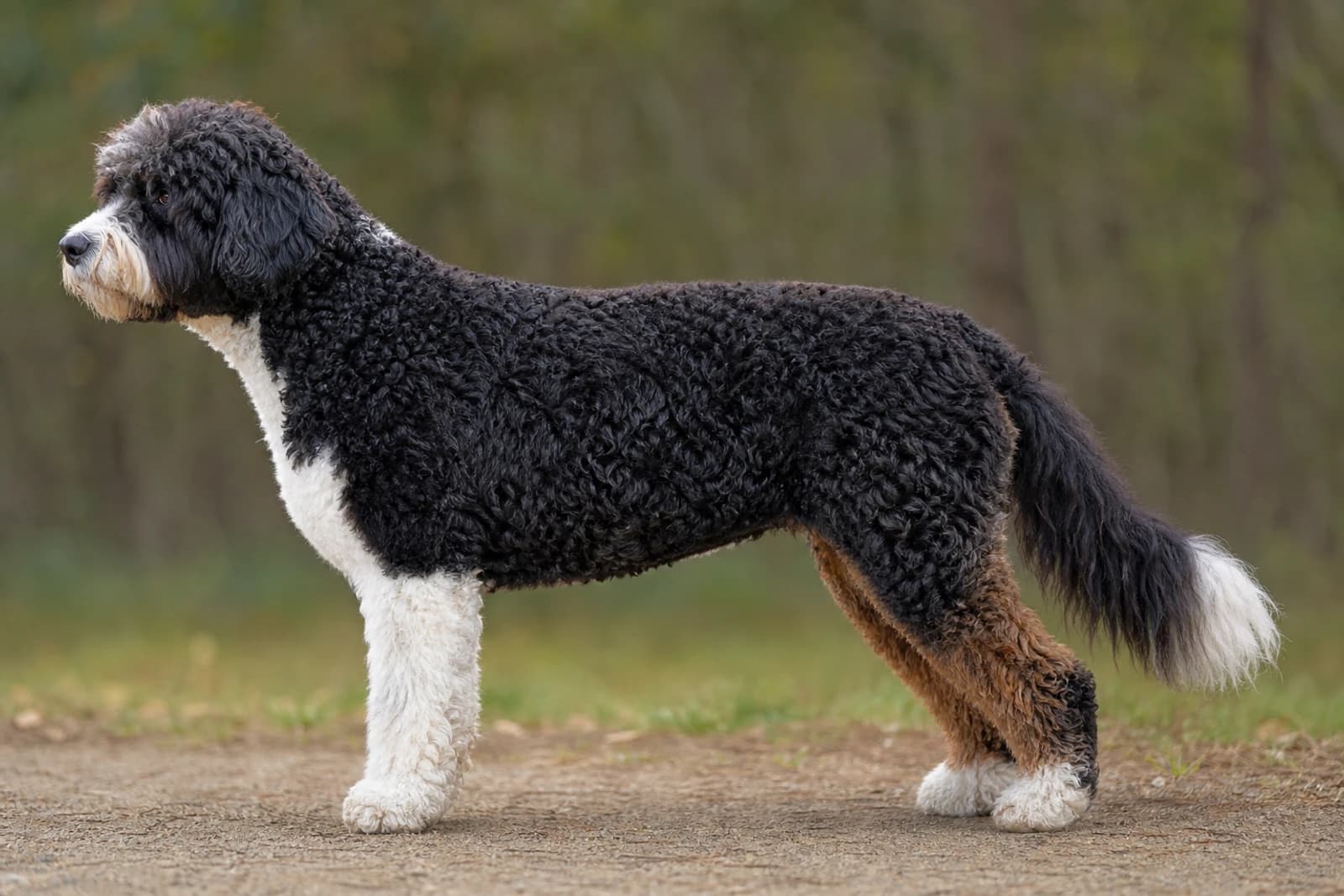
The Portuguese Water Dog is a robust, medium-sized breed originally from Portugal, where they assisted fishermen by herding fish, retrieving lost gear, and carrying messages between boats. Their curly or wavy coat is low-shedding, making them a popular choice for allergy sufferers. Highly intelligent and trainable, they thrive on mental and physical challenges, excelling in dog sports and outdoor adventures. Affectionate and loyal, they form strong bonds with their families but require consistent exercise to prevent boredom. Best suited for active individuals or families who can provide plenty of swimming, running, and engagement.
At a glance
- Size
- Large
- Height
- 17–22 in
- Weight
- 35–55 lb
- Life span
- 10–14 years
- Coat colors
- Black, White, Brown, Black and White, Brown and White
- Coat type
- Curly or wavy, thick, waterproof
- Group
- Gun
How much does a Portuguese Water Dog cost?
Adopt / rescue
$100–$450
Usually includes spay/neuter, first shots, and a microchip.
Buy from a breeder
$1,200–$3,000
From a reputable, health-testing breeder.
Approximate USD. Prices vary widely by region, breeder, pedigree, age, and coat colour — adopting is the lower-cost and recommended route. Avoid suspiciously cheap “breeders”; they’re often puppy mills.
Estimate the full cost of a Portuguese Water Dog →Portuguese Water Dog photos
Views
Front, side, rear and top — the full silhouette.Poses
How the breed sits, lies, moves and plays.Puppy to senior
The breed across its whole life.Expressions
The breed’s range of moods.Close-up details
Eyes, ears, nose, paws, tail and coat.Coat colors
The breed’s recognized colors.Click any photo to enlarge. We show the Portuguese Water Dog from every angle — three views, poses, life stages, expressions, close-ups, coat and colors.
Appearance & size
You’ll spot a Portuguese Water Dog by its profuse, single coat and an athletic, rectangular build that’s all muscle with zero bulk. Stand one next to a Lab and you’ll see a body slightly longer than tall, a deep chest that reaches the elbows, and a level topline that stays firm whether the dog is standing or trotting. From the front, the legs are straight, the bone is substantial but not heavy, and the feet point forward—those feet are round and flat, with webbed toes you can actually spread apart. The skin between the toes runs nearly to the nail, turning every paw into a swim fin.
Size splits clearly by sex. Males hit 20 to 22 inches at the shoulder and weigh 42 to 55 pounds. Females run 17 to 20 inches and 35 to 49 pounds. Don’t mistake the moderate height for a lightweight dog; the body is compact, well-sprung in the ribs, and carries dense, working muscle. Look from the side and you’ll notice the chest dropping to the elbow level and a slight tuck-up at the loin. From the rear, the hindquarters are powerful, with the stifles well-bent and a tail that curves into a plume when the dog is alert. That tail is never docked—it’s thick at the base, tapers gradually, and acts as a built-in rudder.
Coat is the breed’s signature. There’s no undercoat, so shedding is minimal, though you’ll pay for that with regular grooming. Two textures are equally correct: a curly coat with tight, cylindrical curls that feel dense and have little shine, or a wavy coat that falls in soft, flat waves with a subtle gloss. Both cover the dog from head to tail, including the legs. Colors range from solid black, white, or brown to particolors—black-and-white, brown-and-white—and you’ll sometimes see a bluish tint to the skin underneath.
You might see a Portie in a “lion clip” (hindquarters and muzzle shaved to the skin, leaving a tufted tail tip) or a “retriever clip” (an even inch of hair all over). Both are traditional working cuts that reduced drag while keeping vital organs and joints warm in cold water.
Distinctive head: broad and well-proportioned, with a defined stop, a square muzzle, and a black or brown nose that matches the eye pigment. The eyes are medium, set well apart, and dark. Ears are heart-shaped, set high, and hang close to the head. When the dog moves, the whole picture comes together—a smooth, ground-covering trot with plenty of reach and drive, exactly what you’d expect from a breed that spent centuries swimming miles alongside fishing boats.
History & origin
The Portuguese Water Dog didn’t come from a show ring or a hunting estate — it came from the deck of a wooden fishing boat. For centuries along Portugal’s Algarve coast, these dogs worked alongside fishermen as indispensable crew members, earning their keep by herding schools of fish into nets, retrieving broken tackle and escaping fish, and swimming messages from boat to boat and boat to shore. Even on foggy days when the shoreline vanished, a Portie’s steady swim could deliver a line or a note.
The breed’s build tells the story. Webbed feet, a tail used as a rudder, and a coat that ranges from tight curls to loose waves protected them from cold Atlantic water. At 17 to 22 inches tall and 35 to 55 pounds, they were big enough to handle rough seas but compact enough to live on a crowded trawler without stumbling over gear. Fishermen also counted on the dogs to guard the catch and bark a warning if a stranger approached the boat. It was a gritty, all-purpose job.
By the early 20th century, that job nearly disappeared. Modern fishing methods and radios made the old ways obsolete. The dogs, once common from Lisbon to Sagres, dwindled to a handful. A wealthy Portuguese shipping magnate named Vasco Bensaude refused to let them go. In the 1930s, he gathered the remaining dogs and started a careful breeding program, basing it on a standout sire named Leão. After Bensaude’s death, others — notably Alvaro Ribeiro de Faria and Dr. António Cabral — carried the torch, and the breed was officially recognized in Portugal.
The first trickle of Portuguese Water Dogs reached the United States in the late 1950s, but the real foundation was laid in 1968 when Deyanne and Herbert Miller imported a dog and bitch directly from Portugal and launched a breeding program that would anchor the breed here. The AKC recognized them in 1983. For years, Porties stayed a well-kept secret among water-sport enthusiasts and families who wanted a smart, athletic dog without heavy shedding.
Then came Bo. When the Obama family brought a Portuguese Water Dog into the White House in 2009, demand exploded overnight. But even before the cameras arrived, the breed had already proved it could shift from fisherman’s partner to family companion without losing its water-loving core. Today you’ll see Porties earning dock-diving titles, retrieving bumpers in open water, and still dragging their owners toward any puddle wider than a bathtub.
Temperament & personality
The Portuguese Water Dog brings an exuberant, working-dog spirit into the house. He’s smart, biddable, and utterly devoted to his people — the kind of dog who follows you from room to room just to keep you company. That velcro loyalty is a core trait, not a quirk: he wants to be part of everything, whether you’re cooking, folding laundry, or heading out for a jog. Left alone for long stretches, his brain and body don’t idle well; a bored Portie can invent his own entertainment, and you won’t like what he comes up with.
Energy and drive
Plan on a solid hour of activity every day, and by activity, we don’t mean a leisurely stroll. This is a dog who needs to swim, retrieve, run, or solve a puzzle. He has the stamina of a true working breed — originally he spent full days on Portuguese fishing boats herding fish, carrying messages, and diving for lost gear. Without that outlet, his enthusiasm curdles into chewing, digging, and counter-surfing. A tired Portie is a happy Portie, and he’s at his best after a good romp.
Affection and watchfulness
With his own family, he’s a marshmallow — affectionate, gentle, and surprisingly cuddly for such an athletic dog. He’ll greet you at the door with a wiggling body and a soft mouth that loves to carry a toy (or your shoe) as a gift. With strangers, he’s more reserved, sizing them up with a watchful eye. He’ll bark an alert if someone approaches the house, but his default is not aggression; a loose, relaxed body and soft eyes tell you he’s just doing his self-appointed job.
Quirks you’ll notice
Water is his element. Puddles, hoses, sprinklers, the kids’ wading pool — he’ll be in it, splashing and dunking his face. He may even try to “save” you from the bathtub. That retrieving instinct means he’ll pick up and carry things constantly, so keep laundry and remotes out of reach. His mind needs as much exercise as his legs: puzzle toys, hide-and-seek, and reward-based training are non-negotiable. A strong-willed streak means he responds to respectful, consistent engagement — never heavy-handed corrections. Watch his body language: a forward lean and a stiff stare often mean he’s overstimulated and about to jump or mouth, while a head turn or a lip lick says he needs a moment to settle.
In the household
A well-socialized Portie gets along famously with kids, though he might try to herd them with a nudge — teach children to let him eat in peace and to read his calming signals. With other dogs and even cats, he can fit right in if introduced early. Puppies chew to explore and soothe teething pain, so stock up on hardy chew toys; a squirt of diluted citrus spray on table legs can redirect him. Adult chewing on hard objects is normal, but if it’s destructive, he’s probably under-exercised. Housetraining is generally straightforward: he’s eager to please and a treat right after outdoor pottying goes a long way. If you occasionally find a marked spot, it’s his scent-based way of saying “I live here,” but prompt cleaning with vinegar-based solutions breaks the cue and prevents repeats. At the end of the day, this is a dog who thrives on togetherness. Give him a job, let him soak his feet, and you’ll have a loyal companion who’s as happy to race around the yard as he is to curl up on your feet.
Good with kids, dogs & other pets
A Portuguese Water Dog’s patient, even-keeled temperament is the real headline here. They’re not quick to spook or snarl, which makes them a solid match for households with kids. But at 35–55 pounds and up to 22 inches tall, they’re no lapdog — an enthusiastic Portie can accidentally body-check a toddler during a game of fetch. So, ground rules matter: teach children to interact gently, never disturb a dog while eating or sleeping, and always supervise. This breed craves companionship and despises being stuck outdoors alone. You’ll get the best family fit when your dog lives inside, fully woven into daily life.
Other dogs
They typically play nicely with other canines when introduced early. The critical window is before 16 weeks of age; a puppy who meets a wide range of friendly, well-socialized dogs during that time usually carries that confidence into adulthood. Without that foundation, a Portie can become standoffish or over-excited around unfamiliar dogs. If you’re adopting an older dog who missed early socialization, don’t force meet-and-greets at the dog park — that can backfire. Instead, stick to calm, controlled walks and parallel greetings with known dogs. Some adult Porties are perfectly content as the only dog, and that’s okay.
Cats and small pets
Their working background as a water retriever means some Portuguese Water Dogs have a chase instinct — not out of aggression, but because movement triggers a game of “catch it.” Early, positive exposure to cats (again, in that puppy socialization window) can teach them that the family cat is off-limits. Start with baby gates and treat-based calm behavior around the cat. For pocket pets like rabbits or guinea pigs, always secure enclosures and supervise. A Portie who grows up with a cat from puppyhood often becomes a reliable housemate. Miss that window, and you’ll need lifelong management, not miracles.
Trainability & intelligence
A Portuguese Water Dog can learn a new cue in half the repetitions some breeds need — but that quick mind also means he’ll rewrite the game if you don’t keep it interesting. Boredom, not stubbornness, is usually what looks like disobedience. Short, upbeat sessions that feel like play win every time.
What motivates them
Food works, but real leverage comes from mixing in a favorite squeaky toy, a retrieve into the water, or simply a round of wild personal praise. These dogs were bred to work alongside fishermen all day, so they crave interaction and a clear job. Tap that drive and you’ll have a dog who throws himself into training. Treats that can be tossed or hidden reward the nose as well as the mouth — use that when you’re teaching the recall.
The recall conversation
A PWD’s recall isn’t automatic; it’s built. Off-leash, that surge of interest in a duck or a bouncing kid can override your voice unless you’ve put in the reps with high-value rewards in distracting places. Practice near water early — their bliss point — and gradually add distance and wildlife. A long line is your friend until the response is truly reliable.
Where things go sideways
The same mouth that gently retrieves a dumbbell likes to steal socks, remotes, and unattended sandwiches. Puppies are especially mouthy and will jump up to investigate counters with surprising vertical reach. Instead of chasing him, teach a bombproof “drop it” and “leave it,” and swap the stolen treasure for something better. Redirection, not force, keeps the relationship intact.
- The eager-to-please trap: he learns the routine and then starts skipping the boring parts. Vary the order of commands so he actually listens rather than running on autopilot.
- The sensitivity you don’t see coming: hard corrections or an impatient tone can make a PWD shut down or avoid you. He needs a steady, calm handler who delivers clear criteria and pays generously for effort.
- The bored-dog tax: a mentally underworked PWD turns into a counter-surfing, shoe-collecting menace. Crate training and puzzle toys buy you sanity while you ramp up the daily mental work.
The training road that actually works
Start puppy kindergarten the week your vet clears it. Pile on positive exposure to different people, surfaces, and dogs before 16 weeks, and don’t stop after the first class. These dogs can tip toward caution with strangers if they’re under-socialized, but a well-rounded adult is friendly and unfazed.
Use tiny, high-value reinforcers and a marker word or clicker to capture what you like. Because they think fast, you can chain behaviors early — sit, down, go to mat — but keep criteria black-and-white. Inconsistency teaches a PWD that rules are negotiable.
When things get frustrating, step back. Often the breakdown is communication, not defiance. Rebuild the foundation with a game, not a correction, and the obedience you get back will be a whole lot more honest than anything punishment can buy.
Exercise & energy needs
Expect a high-octane buddy, not a couch companion. Portuguese Water Dogs were bred to work alongside fishermen all day, so a quick walk around the block won’t cut it. Plan on a minimum of 60–90 minutes of real exercise every day, split into at least two sessions. The closer you get to 90 minutes, the calmer your Portie will be indoors.
These dogs thrive on activities that tax body and brain simultaneously. Swimming is their birthright — whether it’s retrieving a bumper from a lake, dock diving, or chasing waves. On land, they love running, hiking, agility, and advanced obedience work that keeps their quick minds busy. A game of fetch in a fenced yard burns steam, but it won’t replace the focused interaction they crave. Rotate in puzzle toys, scent games, or a 10-minute training drill to give their brain a workout alongside the physical outlet.
Without enough exercise, a Portuguese Water Dog goes from clever to destructive fast. Chewing, digging, barking, and general restlessness are reliable signs you’re falling short. The breed’s intensity peaks during adolescence (roughly 6–18 months), so consistency matters. For a young dog, avoid repetitive high-impact pounding on pavement until growth plates close — soft surfaces and swimming are safer bets. A tired Portie will curl up contentedly; an under-exercised one will invent his own job, and you probably won’t like what he comes up with.
Grooming & coat care
The Portuguese Water Dog’s coat—whether curly or wavy—is a magnet for mats but a blessing for allergy sufferers, because it sheds very little. That trade-off means you’ll be reaching for your brush every day. Skipping a day invites tangles that tighten against the skin and turn into painful mats. Work through the coat in sections with a slicker brush (medium to firm pins, rounded tips), then follow up with a greyhound comb to catch any hidden snarls. Get all the way down to the skin; surface brushing is a waste of time. If you hit a stubborn tangle, mist it with a detangling spray and gently tease it apart with your fingers before you brush.
Bathing
Bathe every three to six weeks—or whenever the dog rolls in something foul. Use a gentle dog shampoo and always follow with a conditioner to restore slip, which makes the next brushing session far less miserable. After the dog swims in a pool, lake, or the ocean, rinse the coat thoroughly with fresh water. Salt, chlorine, and bacteria dry out the skin and stiffen the curls.
Trimming & clipping
This coat grows continuously, so plan on a full clip every six to eight weeks. Many owners keep their Porties in a retriever clip: one even length (usually an inch or less) all over the body, with a clean tail and tidy feet. The traditional lion clip leaves a mane and a tufted tail, but it’s labor-intensive and honestly overkill for a family pet. Learn to use clippers yourself, or budget for a groomer who knows the breed—a shoddy scissor job will leave you fighting mats again within days.
Nails, ears & teeth
Nails that click on the floor are overdue. Trim or grind them every three to four weeks. Ears demand extra vigilance: those floppy leathers trap moisture, especially after a swim, so check and clean them with a vet-approved drying solution at least once a week. Lift the ear flap, sniff for mustiness, and wipe away any debris. For teeth, a quick daily brushing with enzymatic dog toothpaste beats a deep clean every Saturday—your vet bills will thank you.
Seasonal coat notes
You won’t deal with a dramatic seasonal blowout because this breed has a single coat. Still, you might see a little extra loose hair in spring or fall. Just stick to your daily brushing routine and it won’t accumulate. If you clip the coat short for summer, leave at least half an inch to shield the skin from sunburn, and be aware that a very short clip can actually make the dog hotter by removing the insulating layer that buffers against heat.
Shedding & allergies
The Portuguese Water Dog sheds so little that you’re more likely to find your own hair on the furniture. This breed has a single coat — no insulating undercoat — made up of hair that grows continuously, much like a Poodle’s. Instead of dropping fur all over the house, loose hairs tend to get caught in the curls or waves and need to be brushed out. If you skip grooming, those trapped hairs can form mats, but you won’t see tumbleweeds drifting across the floor.
There is no heavy seasonal “blowout” because the coat doesn’t cycle the way a double coat does. Year-round shedding is minimal and entirely manageable with a thorough brushing two to three times a week. To keep the coat clean and at a practical length, most owners clip their Portie every six to eight weeks — either at a groomer or with a good set of clippers at home.
Drool is a non-issue for the vast majority of Portuguese Water Dogs. You might spot a few drips of water after they drink, or a little anticipation slobber when the treat jar opens, but they won’t leave strings of saliva on your walls or clothes.
The hypoallergenic reality. No dog is completely allergen-free. Allergies are triggered by proteins in dander, saliva, and urine, not just hair. Because the Portie sheds so little, it spreads far less hair and dander around your home than a heavy-shedding breed, which is why many people with mild dog allergies do well with them. That said, some individuals react to the saliva proteins or to the small amount of dander that still exists. The only reliable way to know is to spend real time around adult Portuguese Water Dogs — ideally for several hours indoors — before committing to a puppy. Responsible breeders will welcome that request and can also discuss the low-shed traits they select for in their lines.
Diet & nutrition
Managing your Portuguese Water Dog’s weight starts the moment you fill his bowl — because this is a breed that often acts like every meal might be his last. Many Porties are highly food motivated, which makes them brilliant during training but also easy to overfeed if you aren’t paying attention. The result is extra weight that can strain joints, and since hip dysplasia does show up in the breed (responsible breeders screen for it), keeping him lean matters. An adult usually lands between 35 and 55 pounds; you’ll keep him there by measuring portions precisely and keeping a clear-eyed view of his body condition, not just the number on the bag.
Age-based feeding schedules
Puppies need to eat more often to support rapid growth without overloading tiny stomachs.
- Up to 4 months: four evenly spaced meals a day.
- 4–6 months: three meals a day.
- 6+ months: switch to two meals a day, which you’ll stick with as an adult.
When you bring a puppy home, transition him gradually to whatever you plan to feed — lightly cooked, puréed meats, fish, fruits, and vegetables, or a high-quality commercial puppy formula. By around twelve weeks, supervised raw options like chicken wings can appear on the menu if you go that route, but always with your vet’s blessing and a close eye.
What to put in the bowl
You don’t need to overcomplicate it. A practical guideline many owners follow is roughly 60% raw or cooked meat, 20–30% fruits and vegetables, and 10% other items like eggs, grains, or plain yogurt. If your dog wolfs down food — common with this breed — use a puzzle bowl or slow feeder to stretch out the meal and prevent gulping. And because a dog’s jaw works up and down (no sideways grinding) and saliva lacks digestive enzymes, blending or processing meals when warranted — especially for puppies, seniors with missing teeth, or dogs prone to scarfing — can aid nutrient absorption.
Cooked grains like pearl barley or plain white rice can be gentle, digestible additions, especially if your Portie has a sensitive stomach. Unsalted vegetable cooking water works as a quick stock in a pinch. And you can batch-cook grains, veggies, and proteins to have meal foundations ready during a busy week.
The weight trap and what to watch for
Porties are active working dogs that need real exercise (an hour of swimming, running, or vigorous play). If his activity drops — winter weather, an injury, aging — cut portions back immediately. Use the feeding guide on your dog food as a starting point for his ideal weight, then adjust until you can easily feel his ribs without a thick layer of fat. Treats count: if you’re training with high-value snacks, reduce the next meal accordingly.
Risk of obesity climbs again in the senior years. As his pace slows, smaller, more frequent meals can help digestion without encouraging extra pounds. There’s no solid evidence that aging dogs need lower protein, but you do want to monitor the scale and trim calories gradually as exercise declines.
A few hard-and-fast rules to sidestep bad habits and health scares:
- Absolutely no feeding from the table. Once a Portie learns that staring at your fork pays off, you’ll have a beggar for life.
- If you have safe leftovers, put them in the dog’s own bowl at his normal mealtime to avoid reinforcing the begging circuit.
- Steer clear of excessively rich or fatty foods, especially after holiday meals — a Portie who’s used to lean meals can get pancreatitis from a sudden overload of fat.
If you measure every meal, stay honest about exercise, and resist those “I’m starving” eyes, you give your Portie the best shot at a long, active run.
Health & lifespan
A healthy Portuguese Water Dog typically lives 10–14 years. For a dog that stands 17–22 inches at the shoulder and weighs 35–55 pounds, that’s a solid run — but reaching the upper end depends on informed breeding and consistent care.
What responsible breeders screen for
The breed has a few inherited conditions that good breeders take seriously. Hip dysplasia crops up in some lines, so look for parents with OFA or PennHIP clearances — not just a vet’s glance. Eye disease is another focus. Progressive retinal atrophy (PRA) causes a gradual loss of vision and has a DNA test (prcd-PRA) that lets breeders avoid producing affected pups. Annual exams by a board-certified veterinary ophthalmologist back up the genetic results.
GM1 gangliosidosis is a neurological storage disease that shows up in young dogs and is uniformly fatal. It’s recessive, meaning a simple cheek swab identifies carriers, and responsible breeders never pair two carriers. Less common but worth asking about is juvenile dilated cardiomyopathy — a heart condition that can strike before age 6 months. A DNA-linked marker allows testing for one form, though not every case is explained by that gene, so a breeder who also completes cardiac exams adds an extra layer of caution.
Everyday health you can control
Those floppy, water-loving ears trap moisture, which makes ear infections a recurring nuisance if you don’t dry them thoroughly after every swim or bath. A weekly clean with a vet-approved drying solution helps, too. Weight management matters just as much: these dogs are chowhounds, and extra pounds on a 35–55 pound frame speed up joint degeneration. Keep portions measured and pair them with the breed’s typical need for a real hour of moving — not just a leash stroll.
Preventive care that can’t slide
Given the amount of time a Portie spends outdoors and in water, heartworm prevention is essential year-round in mosquito-heavy regions, and at minimum monthly during mosquito season with an extra month tacked on after it ends. Rabies vaccination is a legal requirement, and distemper/parvo series are non-negotiable. Annual wellness exams catch subtle shifts — a slight heart murmur, a change in retinal reflection — before they become emergencies.
When you’re interviewing breeders, skip general assurances. Ask to see hard copies of OFA hip results, a current ophthalmologist’s eye exam, and DNA reports for PRA and GM1. Many will also hand you a cardiac clearance. Those documents give you the clearest picture of the genetic hand your puppy was dealt.
Living environment
A Portuguese Water Dog can make an apartment work, but only if you treat the outdoors as his real living room. A house with a securely fenced yard gives him room to blow off steam between dedicated workouts, but square footage alone won’t cut it. This is a 35–55 lb working athlete who needs a solid hour of daily exercise split into at least two sessions — a quick trip to the dog park or a leashed stroll around the block barely registers.
Space and yard needs A yard is a major plus, though don’t expect it to do the heavy lifting. He’ll patrol, sniff, and do a few victory laps, but he still looks to you for the real action: retrieving, swimming, or a hard game of fetch. If you’re in an apartment, commit to multiple daily outings and look for nearby water access or open fields where he can run flat-out. A bored Portie left to his own devices invents his own job — often one that involves redecorating the baseboards.
Barking and noise This breed was developed to work alongside fishermen, so he’s not shy about using his voice. A sharp, alert bark comes with the package, especially when a delivery truck or a squirrel dares to trespass. You can blunt the edge with early training, but you won’t get a silent dog. Apartment dwellers with thin walls need to factor that in.
Climate notes His dense, water-resistant coat makes him fairly adaptable. He’s happiest in cool to moderate weather and will plunge into a lake long after you’ve put on a jacket. In serious heat, stick to morning and evening sessions and always have water on hand. The lion or retriever clip isn’t just for looks — it’s a practical way to manage that coat through a warm, active season.
Tolerance for being left alone This is the sticky part. Porties bond hard and can develop genuine distress when left for long stretches — think barking, chewing, or escape attempts, not sad sighs. If your household is empty for eight or nine hours straight most days, this breed will struggle. Crate training, puzzle toys, and a midday dog walker can bridge a half day, but isolation isn’t something they simply outgrow. A Portie wants to be near his people, in the water, or preferably both.
Who this breed suits
This is not a laid-back dog that will nap while you binge-watch. The Portuguese Water Dog was built to work alongside fishermen for hours in cold Atlantic water, and that drive still hums under the surface. If you don’t have a plan to burn that energy every single day — rain, shine, or snow — the dog will make one, and you won’t like it.
You’re the right fit if…
- You genuinely love daily, high-output exercise. We’re talking a solid 60–90 minutes of running, swimming, hiking, or off-leash fetch, not a casual stroll around the block. These dogs are retrievers at heart and will chase a ball into the waves until your arm gives out. If you’re a runner, surfer, paddleboarder, or long-distance hiker, a PWD will keep pace and then some.
- You enjoy training as a hobby, not a chore. They’re scary-smart — one of the most trainable breeds out there — but that means they need constant mental meat. Obedience, agility, dock diving, scent work, trick training: pick two or three and cycle through them. A bored PWD becomes a full-time problem solver, and the problems they solve tend to involve dismantling your couch.
- You have a family with older kids and a sense of humor. These dogs are goofy, affectionate, and generally rock-solid with children who can handle an energetic 40-pound dog that may “counter-surf” as a lifestyle. With toddlers, that same exuberance can lead to unintentional knockdowns. Supervise and teach both sides, and you’ll get a devoted, playful companion who treats the kids like part of the crew.
- You or someone in the house is committed to grooming. The curly or wavy coat sheds minimally, which is a blessing for allergy-prone homes, but it mats like Velcro if you let it. Plan on brushing every few days, plus a full clip every 6–8 weeks — either you learn to do it yourself or you budget for a professional groomer. Neglect the coat, and you’ll end up shaving a poodle-like dog on the kitchen table at 10 p.m.
Think twice if…
- You’re a first-time owner who just wants an easy dog. I won’t say it’s impossible — plenty of determined beginners have succeeded — but a PWD will test you with its intensity and independence. They’ll outsmart a half-hearted handler in a week. If you’re new to dogs, you need a local positive-reinforcement trainer and a real willingness to put in the work.
- You’re away from home for 8+ hours regularly. Portuguese Water Dogs bond tightly to their people and don’t handle isolation well. Left alone too long, they can slide into barking marathons, chewing drywall, or escaping the yard. A dog walker or doggy daycare isn’t a luxury; it’s nearly mandatory.
- You want a quiet, low-key house companion. These dogs are alert and vocal, quick to announce the mail carrier like it’s an old-timey fishing boat pulling into port. They also have a demanding, almost conversational bark when they want something. Seniors or apartment dwellers looking for a calm lap-warmer should steer firmly toward another breed.
- You live a low-maintenance lifestyle. Everything about the PWD is high-maintenance: the exercise, the training, the grooming, the need to be involved in whatever you’re doing. If you’re not ready to share your life — and your hiking boots, your pool, your Saturday morning training class — with a dog that thinks it’s your co-pilot, this isn’t the match for you.
Cost of ownership
A well-bred Portuguese Water Dog from a breeder who screens hips, eyes, and the breed’s known genetic concerns typically lands between $2,500 and $4,000. Some lines with working or show titles push higher. Good breeders spend serious money on health clearances and puppy socialization, and that upfront cost buys you a strong start.
Monthly expenses settle into a steady rhythm once you’re past the initial setup. This is an active, medium-large dog with a substantial single coat that never stops growing — so two line items dominate.
- Grooming: $80 to $120 every 6–8 weeks for a professional clip, plus $15–$30 on shampoo, conditioner, and a quality slicker brush to stay on top of tangles at home. Skipping the pro and learning to clip yourself saves cash but demands a real investment in clippers and time.
- Food: $60 to $90 a month for high-quality kibble or a balanced raw diet. Portions aren’t enormous (35–55 lb), but this breed runs hot and swims hard; cheap fillers often show up in skin and coat trouble.
- Routine vet and prevention: around $250–$400 a year, broken down monthly that’s $20–$35. Heartworm, flea/tick prevention, and annual bloodwork keep a swimming dog from running into parasites or hidden issues.
- Pet insurance: $40 to $75 a month for a solid accident-and-illness policy. PWDs can be prone to hip dysplasia, eye disorders, and Addison’s disease, so having coverage before anything pops up is worth it.
- Extras: a $200–$300 annual budget for replacing chewed-up water toys, a sturdy life vest, and maybe a few sessions with a trainer if young Portie energy needs channeling.
Realistically, expect to spend $180 to $320 a month on the essentials. The grooming commitment is the non-negotiable piece — a matted Portie is a miserable, itchy Portie with a higher vet bill waiting in the wings.
Choosing a Portuguese Water Dog
You can find a Portuguese Water Dog through a breeder or a rescue; both paths work, but they demand different trade‑offs. Because the breed is still fairly uncommon, rescue Porties don’t show up in shelters every day, so working with a breed‑specific rescue group usually gets you on the radar. That often means an adult dog with a known temperament—ideal if you want to skip the puppy chaos, though you may inherit training gaps or unknown health history. A good rescue will have the dog fully vetted and will be blunt about what that dog needs.
If you go the puppy route, your job is to find a breeder who sweats the health details. Portuguese Water Dogs can be prone to hip dysplasia, progressive retinal atrophy (PRA), GM1 gangliosidosis, and juvenile dilated cardiomyopathy. A responsible breeder screens for all of them and can show you the paperwork without hesitation. Ask for:
- Hip evaluation — OFA or PennHIP clearance on both parents. A “fair” OFA rating is still passing; “borderline” or “mild” in young dogs is something to dig into.
- Eye exam — yearly CAER exam by a veterinary ophthalmologist, not just a vet glance. This catches PRA and other inheritable eye issues.
- GM1 DNA test — the breed carries this fatal storage disease. Both parents should be “clear” or, at most, one “carrier” bred only to a clear mate. No affected puppies.
- Cardiac screening — an echocardiogram or board‑certified cardiologist evaluation for juvenile dilated cardiomyopathy, especially in lines that haven’t produced longevity.
Beyond paperwork, red flags that should make you pause: a breeder who markets “rare red/chocolate” or “hypoallergenic” as the reason to buy, without centering health and temperament. Puppies should not go home before eight weeks; by that age a good breeder will have already started potty training, crate exposure, and early socialization. Visit if you can. You want to see the mother interacting with the pups (the sire may not be on‑site, which is normal). The puppies should be plump, clean, and curious—not cowering in a corner or frantic with anxiety. A little initial wariness is fine; a Portie that refuses to engage or startles badly at normal household sounds is a concern in a breed that needs confidence for water work and an active family life.
A reputable breeder will interview you just as hard as you interview them. Expect questions about your fencing, your exercise plan, and whether you really understand what a 50‑pound retrieving machine does to a yard and a schedule. They’ll give you a contract that spells out a health guarantee, a spay/neuter clause, and a return‑to‑breeder safety net. They’ll also tell you the honest downsides: the grooming, the constant demand for mental work, the fact that “non‑shedding” doesn’t mean no upkeep. If you hear none of that, walk away.
Finally, while you watch a litter, focus on middle‑of‑the‑road temperament unless you’re experienced with working dogs. The hyper‑driven puppy that bolts for the water bucket every chance? That one will easily run you ragged if you don’t have a job lined up for it. The laid‑back observer might be a better fit for a family, but a Portie still needs a solid hour of real exercise plus brain work daily—not just a walk around the block. Pick the puppy whose energy matches your reality, not your fantasy.
Pros & cons
Bred to retrieve from the sea, this medium-to-large gun dog packs a ton of athleticism into a 35–55 pound, low-shedding frame.
Pros
- Hypoallergenic single coat sheds very little; the continuously growing hair means no seasonal blowouts, though it does need clipping.
- Remarkably smart and eager to please — picks up commands fast and excels at water trials, agility, and advanced obedience.
- Born swimmer with webbed feet and a water-repellent coat; thrives on swimming, dock diving, or boating adventures.
- Playful, goofy personality that bonds tightly with the whole family and does well with children when given enough daily action.
- Sturdy and long-lived: expect a 10–14 year lifespan with proper care and responsible breeding.
Cons
- Demands at least an hour of vigorous daily exercise — a couple of short walks won’t cut it. Boredom quickly turns into relentless chewing, barking, or counter-surfing.
- Grooming is a real commitment: plan on clipping every 6–8 weeks and brushing every 2–3 days to prevent painful matting.
- Strong retrieving drive and mouthiness — they’ll steal and carry anything not nailed down, so puppy-proofing and consistent redirection are non-negotiable.
- Prone to separation anxiety when left alone too long; this is a velcro dog that needs a plan if you work full-time away from home.
- Responsible breeders screen for hip dysplasia, progressive retinal atrophy, and GM1 storage disease; always ask for OFA and CERF clearances.
Similar breeds & alternatives
If the Portuguese Water Dog’s sturdy, no-fuss build and webbed-foot lifestyle appeal but you want to explore other water retrievers with similar non-shedding coats, several breeds sit in the same conversation — each with real trade-offs in size, drive, and daily routine.
Standard Poodle
The closest match in sheer brains and coat care. A standard Poodle stands over 15 inches at the shoulder and weighs 40–70 pounds, overlapping the Portie’s frame but often taller and leggier. Both have dense, curly coats that barely shed and require clipping every six to eight weeks. The Poodle tends toward sharper biddability and thrives on complex training; a Portuguese Water Dog can be more independent and dogged. If you want a goofy, water-crazy partner who won’t hang on your every cue, the Portie may edge out the Poodle. If you prize precision in obedience and an aloof, elegant bearing, the Poodle fits.
Irish Water Spaniel
The IWS is the class clown of the curly-coated retrievers. Standing 21–24 inches and 45–65 pounds, this breed brings a larger, lankier body and a signature rat tail. Coat upkeep is comparable — tight ringlets that need regular brushing and clipping to prevent matting. Temperament-wise, the Irish Water Spaniel can be more reserved with strangers and bolder in play, sometimes described as a mischievous handful. A Portie typically lands somewhere between the IWS’s silliness and the Poodle’s measured restraint. Both need a solid hour of off-leash swimming or running, not just a neighborhood stroll.
Lagotto Romagnolo
For someone drawn to the Portie’s water heritage but without room for a larger dog, the Lagotto packs the same curly, nonshedding coat into a 16–19-inch, 24–35-pound body. Originally a water retriever and now used for truffle hunting, the Lagotto is compact, energetic, and affectionate. The size difference is the headline: less dog to feed, crate, and tow on a leash. However, the Lagotto’s nose keeps it just as busy as any Portie, and it can be more watchful and possessive than the typically outgoing Portuguese Water Dog.
Barbet
The Barbet holds the middle ground in bulk — 19–24.5 inches and 35–65 pounds — with a thick, wavy-to-curly coat and a calm, friendly nature. Unlike the Portie’s sometimes intense, work-focused energy, the Barbet often carries a softer, more placid demeanor off duty. Both breeds are equally at home in water, and both need the same dedication to coat maintenance. If the Portuguese Water Dog’s drive feels like more engine than you want, a Barbet might settle more readily after a good soak and a walk. But don’t expect a couch potato: neither breed does well without a job.
Every alternative on this list demands daily sweat, consistent training, and a standing appointment with a groomer. The choice typically comes down to whether you want a more biddable partner (Poodle), a larger, joker-type retriever (Irish Water Spaniel), a compact truffle seeker (Lagotto), or a softer-edged swimmer (Barbet).
Fun facts
- They have webbed feet for powerful swimming.
- Their coat is considered hypoallergenic.
- They were historically used by Portuguese fishermen.
- President Obama's dogs, Bo and Sunny, were Portuguese Water Dogs.
Frequently asked questions
- Do Portuguese Water Dogs shed a lot?
- Portuguese Water Dogs are a low-shedding breed because they have hair that grows continuously rather than fur that sheds seasonally. This can be beneficial for allergy sufferers, but their coat requires regular grooming to prevent mats and tangles.
- Are Portuguese Water Dogs good with children?
- Portuguese Water Dogs are typically affectionate, playful, and patient with children, making them great family companions. Their energy and enthusiasm can be overwhelming for very young kids, so supervision and early socialization are recommended.
- How much exercise does a Portuguese Water Dog need?
- This active breed needs at least an hour of vigorous exercise each day, such as swimming, running, or interactive play. Without adequate physical and mental stimulation, they may develop unwanted behaviors like chewing or excessive barking.
- What kind of grooming does a Portuguese Water Dog require?
- Their curly or wavy coat needs brushing several times a week and professional clipping every 6–8 weeks to prevent matting. Routine ear checks and nail trims are also important to maintain their overall health.
- Is the Portuguese Water Dog a good choice for first-time dog owners?
- Portuguese Water Dogs can be a good fit for first-time owners who are committed to consistent training and providing plenty of daily activity. Their intelligence and eagerness to please make them relatively trainable, but they thrive with structure and engagement.
Tools & calculators for Portuguese Water Dog owners
Quick estimates tailored to Portuguese Water Dogs — pre-filled with this breed’s size where it matters.
Articles & stories about the Portuguese Water Dog

Hypoallergenic Dogs for Families: What "Low-Shedding" Actually Means
No dog is 100% hypoallergenic—the real trigger is dander and saliva, not fur. These low-shedding breeds cut down on allergens and love kids, but ‘low-shed’ doesn’t mean no grooming.
Sources & standards
This profile follows recognized breed standards from the American Kennel Club (AKC) and the Fédération Cynologique Internationale (FCI), along with established veterinary and breed-club guidance. These describe general breed tendencies — every dog is an individual.
Owner stories
Have a Portuguese Water Dog? Share your experience — grooming tips, personality quirks, anything goes.