

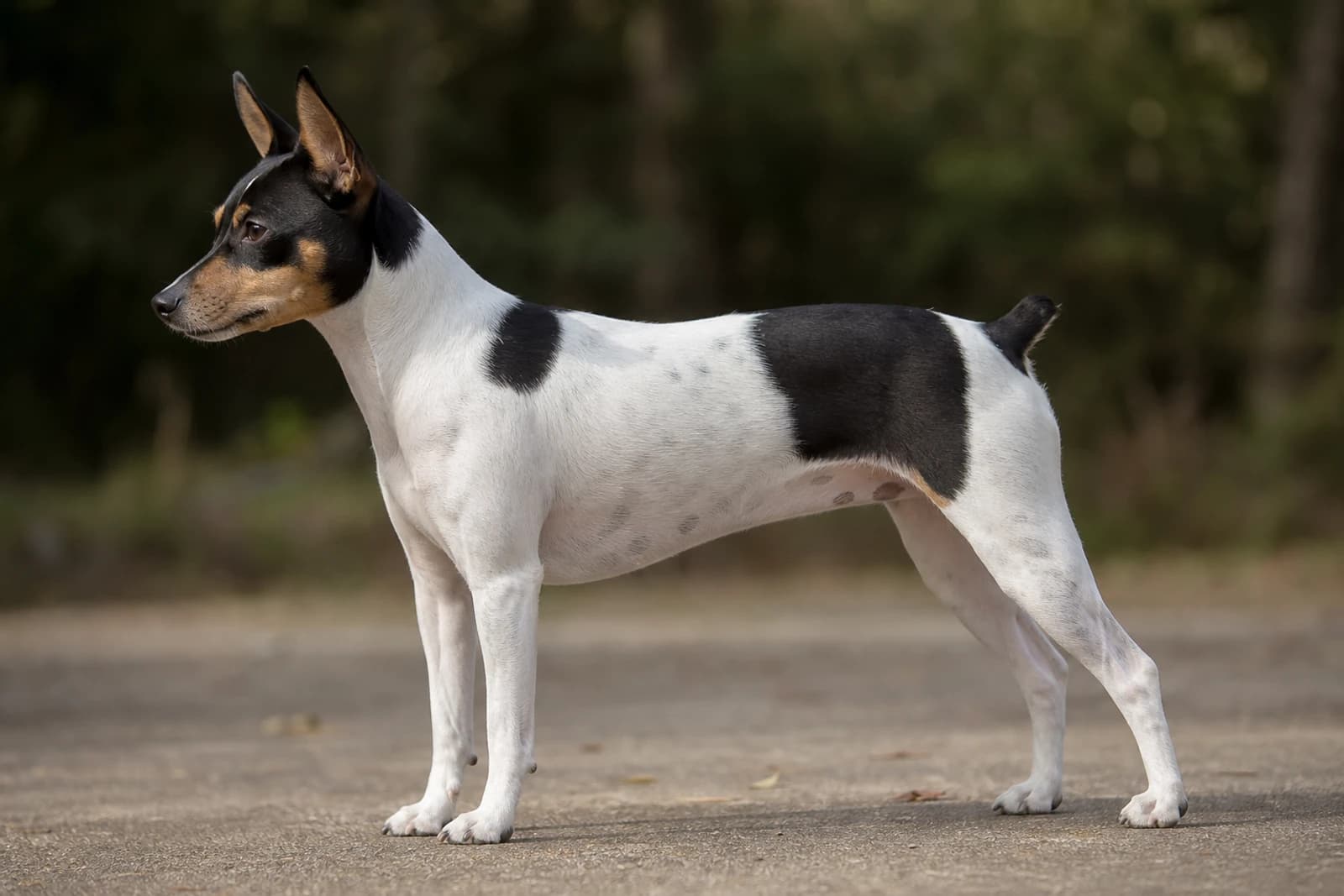
The Rat Terrier is a lively, intelligent, and versatile farm dog, perfect for active families seeking a spirited companion. They thrive in environments with ample exercise and mental stimulation, excelling at dog sports and outdoor adventures. Affectionate with their people, these alert watchdogs are loyal and playful, though their high prey drive requires supervision around small pets. Best suited for homes with yards and experienced owners, they bring endless energy and charm.
At a glance
- Size
- Large
- Height
- 14–22 in
- Weight
- 11–35 lb
- Life span
- 11–14 years
- Coat colors
- Black & Tan, White & Black, White & Red, White & Chocolate, White & Blue
- Coat type
- Short, smooth, dense coat
- Group
- Terriers
How much does a Rat Terrier cost?
Adopt / rescue
$50–$300
Usually includes spay/neuter, first shots, and a microchip.
Buy from a breeder
$400–$1,200
From a reputable, health-testing breeder.
Approximate USD. Prices vary widely by region, breeder, pedigree, age, and coat colour — adopting is the lower-cost and recommended route. Avoid suspiciously cheap “breeders”; they’re often puppy mills.
Estimate the full cost of a Rat Terrier →Rat Terrier photos
Views
Front, side, rear and top — the full silhouette.Poses
How the breed sits, lies, moves and plays.Puppy to senior
The breed across its whole life.Expressions
The breed’s range of moods.Close-up details
Eyes, ears, nose, paws, tail and coat.Coat colors
The breed’s recognized colors.Click any photo to enlarge. We show the Rat Terrier from every angle — three views, poses, life stages, expressions, close-ups, coat and colors.
Appearance & size
With Rat Terriers, the first thing that hits you is how much dog they pack into a tidy, no-waste frame. These are tough little farm terriers, not fragile toy dogs. The official numbers cover a wide spread because “Rat Terrier” still spans two distinct sizes: the Miniature (typically under 13 inches and 10–15 pounds) and the Standard (up to 22 inches and 35 pounds of solid terrier muscle). So you’ll see everything from a leggy 14-inch go-getter to a blocky 22-inch dog who can seriously keep up with big hounds.
Everything about the build says functional athlete. They’re slightly longer than tall, which gives them a ground-covering trot, but the proportions stay square enough that you never get a low-slung, Basset-like silhouette. The chest is deep and narrow between the front legs — built to squeeze into tight burrows and barn corners after rats. Ribs spring out well back, then tuck up sharply into a definite waist. Stand beside one and you’ll notice a level topline from withers to tail set; from the side, that clean underline curve (chest to belly) reads as “ready to work” without being Greyhound-greyhound.
Front view: a smooth, moderately wide skull, a defined stop, and a strong muzzle that tapers just enough. The eyes are round, set well apart, and always look bright and a little calculating. Ears can come up pricked, half-pricked, or neatly folded over as button ears — all are perfectly acceptable, and many pups’ ears go through a wild in-between stage. The neck is clean and muscular, blending into well-laid-back shoulders. From the rear, you see strong, driving hindquarters with well-bent stifles; the legs stand straight and parallel, not cow-hocked.
The coat is a low-maintenance dream: short, dense, and smooth, with a hard gloss when the dog is in good condition. Color is where Rat Terriers get loud. They’re nearly always pied — a base of white splashed with patches of black, chocolate, red, blue, tan, or lemon. Some sport a full black mask or a spot of color over one eye and the base of the tail (old-timers call those “hat and tail” markings). You’ll also see solid white bodies with colored heads, tri-colors with tan points, and the occasional solid red or blue — though solid dogs with no white at all are uncommon. The skin itself is thin and tight, so these dogs rarely look soft or plush; they look like a terrier who means business.
History & origin
President Teddy Roosevelt didn’t just keep a Rat Terrier in the White House — he set the breed’s name in stone after his own dog Skip cleared the building of rats. That 1900s presidential nod helped cement the dog’s identity, but the breed itself had been quietly taking shape on American farms for over a century.
The Rat Terrier’s story starts with working-class immigrants who brought their smooth-coated foxing terriers from England in the 1800s. Farmers crossed those dogs with Manchester Terriers to sharpen the ratting instinct, then added a dose of Bull Terrier for tenacity and bite strength. Some accounts even weave in Whippet or Italian Greyhound blood to explain the breed’s quick acceleration and lean body lines. The goal was ruthlessly practical: a compact, all-purpose farm dog that could wipe out vermin, bolt a rabbit for the stew pot, and sound an alarm when strangers approached.
By the early 20th century, hunters began to value the dogs for squirrel and hare work, so many lines got an infusion of Beagle. That added more nose, a stronger pack mentality, and a baying bark that carried in the field. Two distinct types emerged: a leggier, slightly rangier dog (often called the Type A Rat Terrier) and a stockier, shorter-legged version (Type B) — both still under the same breed umbrella and both capable of the same relentless prey drive.
The breed hovered for decades without formal registry, maintained purely by farmers and hunters who valued function over paperwork. The United Kennel Club recognized Rat Terriers in 1999, and the American Kennel Club followed with full recognition in the Terrier Group in 2013. Today’s Rat Terrier still carries that scrappy, no-fuss ancestry: a 14-to-22-inch dog bred to work first and charm second. You’ll spot the Roosevelt connection in that alert, inquisitive expression — it’s the same look old Skip must’ve worn when the president gave him the run of the nation’s most famous residence.
Temperament & personality
The Rat Terrier is a big personality poured into a conveniently portable frame — and you’ll never forget you are living with a terrier. These dogs are whip-smart, relentlessly curious, and brimming with the kind of self-assurance that makes a 14-pound dog patrol the house like a much larger guardian. They form deep attachments to their people but rarely turn into mindless shadows; a Rat Terrier wants to be part of the action, not just in the room.
Energy runs high and stays high well into middle age. You aren’t looking at a dog content with a couple of short leash walks. A Rat Terrier needs daily off-leash sprinting, a solid half-hour of focused play, or a job like barn hunting, trick training, or agility to keep that sharp brain and body satisfied. Under-exercise a Rat Terrier and you get a creative problem-solver: digging under fences, dismantling the couch cushions, or barking at every leaf that trespasses on the lawn.
Affection in this breed is often on their terms. They’ll burrow under blankets with you one moment and then, without apology, relocate to the sunny spot by the window when they’ve had enough. They’re kissy and cuddly with family members they trust, but initial wariness with strangers is normal — not fear-based, just a calculating assessment. That reserve, paired with catlike alertness, makes them excellent watchdogs. A Rat Terrier’s bark is big, sharp, and readily deployed. You’ll know the mail carrier’s schedule by the minute.
Around the household, these dogs can be full of contradictions. They’re comedic, bossy, and sometimes petty. A Rat Terrier who feels ignored might deliberately snatch a shoe and parade through the living room with a grin. They’re opportunistic chewers from puppyhood through adulthood — not out of anxiety as much as for the sheer joy of disassembling something. Sturdy chew toys and a citrus or vinegar deterrent on off-limit items are practical lines of defense. Homemade citrus sprays from boiled peels work surprisingly well, and a wiped-down spot with white vinegar removes the urine scent that can lure a dog back to mark inside.
Speaking of marking: intact males and even confident females can be quick to claim territory with a lifted leg, especially in new environments or less-used rooms that don’t carry the family’s scent strongly. This isn’t spite; it’s a scent-based signal rooted in a keen spatial memory. Patient house training with immediate treat rewards for outdoor elimination beats punishment every time. The Rat Terrier’s memory is long and specific, and harsh corrections only teach them to be sneaky.
These dogs read body language like a book. A loose, soft-eyed posture means you’re dealing with a relaxed dog; a stiff body paired with hard staring is a warning you can’t ignore. Even mild signals like lip licking or a head turn during a tense moment tell you the dog is dialing back pressure. That sensitivity is a two-way street: a Rat Terrier notices your mood and may test it, especially if you waver. Respectful, consistent routines work. Force creates resistance.
With children and other pets, the Rat Terrier’s suitability depends heavily on early socialization and honest management. Many do beautifully with kids who respect the dog’s space and mealtimes — never interrupt while eating, or you risk building food-guarding behavior. However, the breed’s prey drive is not theoretical. They were bred to dispatch vermin, and a fleeing cat, rabbit, or even a fast-moving small dog can flip a switch. A Rat Terrier who grows up with a cat may be fine indoors, but outdoor chases are another story entirely.
Quirks worth embracing: these dogs are gifted sunbathers, obsessive about burrowing under covers, and sometimes comically dramatic. They’ll roll in something foul — maybe to mask their own scent, maybe just because they like it — and then look at you like you’re the weird one for objecting. You’ll need a sense of humor and a willingness to have an equal, not a subordinate.
Good with kids, dogs & other pets
A Rat Terrier who grows up with respectful kids usually turns into a tireless playmate and an unexpectedly patient nap buddy. These dogs lean into family life hard — they’re quick, funny, and up for any game a child invents, from fetch marathons to blanket-fort reconnaissance. But because many Rat Terriers top out around 25–35 pounds, a young child’s clumsy hug or an accidental tumble can hurt them, so supervision is non-negotiable. Teach kids early not to snatch toys or disturb a sleeping dog, and give the terrier an escape route — a crate or a quiet room — when they’ve had enough.
With other dogs, early socialization makes the difference. Rat Terriers who’ve had positive, varied puppyhood experiences (starting well before the 16-week mark) often live harmoniously with housemates. They’ll wrestle, chase, and curl up together. However, terrier scrappiness can surface with same-sex dogs, especially if both are intact adults. Watch for stiff body language and resource guarding, and don’t assume a dog-park stranger will be instantly accepted. Patient, supervised introductions on neutral ground go a long way.
Cats? If a Rat Terrier is raised alongside a cat, they can become fast friends who sunbathe on the same windowsill. But that acceptance rarely extends to a strange cat darting through the backyard. The breed’s vermin-hunting instinct is deep — bred to clear rats from farms, they’re wired to notice and pursue small, scurrying things. That means pocket pets like hamsters, gerbils, rabbits, and even pet birds are a real risk. Even a well-socialized Rat Terrier may live peacefully with the family rabbit for years and then have an instinct-driven moment. Separate spaces, secure enclosures, and never leaving them unsupervised together is the only safe play.
This is also a dog that bonds tightly to its people. They don’t do well dumped outside or left alone for 10-hour days. Isolation breeds stress, which can show up as barking, digging, or destructiveness. A Rat Terrier who gets daily mental challenges, a solid hour of real exercise, and plenty of couch time is a balanced, kid-friendly family member.
Trainability & intelligence
Rat Terriers are scary-smart problem solvers — the kind of dog that figures out latches, unpacks puzzles, and remembers exactly which cupboard holds the treats. They learn new commands in a handful of repetitions when you make it worth their while, and they genuinely enjoy working side-by-side with you. That said, this is not a breed that will endlessly repeat a sit-stay just because you asked. Boredom kicks in fast, and the brain that makes them brilliant also makes them experts at inventing their own rules when the lesson loses momentum.
What motivates them
Food is the great equalizer, but mix it up. A Rat Terrier will happily work for tiny bits of cheese one day and completely snooze you if you trot out the same kibble the next. Play — especially a tug toy or a chance to chase a flirt pole — can be just as powerful. Use whichever currency gets the brightest eyes in the moment, and keep sessions short and snappy. Five to ten minutes, two or three times a day, beats a single long slog.
The recall challenge
This is a terrier with a capital T. When a squirrel shoots across the yard, the wires cross and the ears shut off. Recall doesn’t fail because the dog is stubborn or disobedient; it fails because the prey drive overwhelms the training. You can’t bribe a moving rabbit. This means you start recall work indoors with zero distractions, build it on a long line in progressively exciting environments, and never punish a slow return — or you’ll teach them that coming back ends the fun. For some Rat Terriers, a rock-solid off-leash recall in high-critter areas is a moon shot. Manage expectations and use fenced spaces.
What works (and what backfires)
- Positive reinforcement sticks. Behavior that gets rewarded — with treats, a game, a happy voice — gets repeated. These dogs are sensitive enough that harsh corrections sour them on training altogether. Raised voices or yanked collars build avoidance, not compliance.
- Consistency across the household matters. If one person lets counter-surfing slide and another corrects it, you’ve just taught the dog that rules are negotiable. They’re fast enough to exploit that.
- Socialization isn’t optional. Between 3 and 14 weeks, gently expose your puppy to a wide variety of people, sounds, surfaces, and calm dogs. Ongoing positive experiences reduce the chance of fear-based reactivity later. A Rat Terrier that missed early exposure can become skittish or snappy with strangers — not out of meanness, but because nobody showed her the world is safe.
- Patience over pressure. This breed has an independent streak a mile wide. When they’re not convinced, they’ll try to outsmart the exercise instead of comply. Push too hard and you get a dog that shuts down or shows “stubbornness” that’s really stress. Pause, lower the difficulty, and celebrate the small wins.
Training a Rat Terrier is a thinking game for both of you. If you approach it as a partnership rather than a power struggle, you get a quick, creative canine athlete who genuinely wants to nail the job — as long as the job is interesting.
Exercise & energy needs
A Rat Terrier is a small body wrapped around a big, working-terrier engine. If you’re picturing a lap dog that’s content with a stroll around the block, think again. This breed was built to hunt vermin all day, and that drive doesn’t switch off just because they’re now a house pet. Plan on at least 60 minutes of real exercise every day, split into two sessions. One short morning walk won’t cut it.
Break that hour into a morning workout and an evening session. The morning might be a brisk 30-minute jog, a hard game of fetch, or a flirt-pole session in the yard — something that gets them panting and engages the chase instinct. The second half should mix physical and mental work: a long sniffy walk where they can track scents, hide-and-seek with a favorite toy, or a training session that challenges their brain as much as their legs. On weekends, double down with an off-leash hike, an agility class, or barn-hunt practice. They thrive in canine sports that let them problem-solve and move fast — earthdog, Fast CAT, lure coursing, and nose work are all in their wheelhouse.
Mental stimulation is not optional. A Rat Terrier with a bored mind will invent their own jobs, and you probably won’t like the results — digging, barking, and chewing are classics. Use puzzle toys, frozen Kongs, snuffle mats, and trick training to fill the gap between walks. Even 10 minutes of scent games (hide a treat under a box, ask them to find it) can take the edge off.
You can adjust intensity based on your dog’s size and build — the breed ranges from 11 to 35 pounds — but don’t assume the smaller ones need less exercise. They often make up for it with higher octane. If your dog has any joint quirks (patellar luxation can pop up in terriers), swap repetitive jumping for low-impact work like swimming or long walks on softer ground. The real behavioral key: a tired Rat Terrier is a good-natured housedog; an under-exercised one is a tiny tornado.
Grooming & coat care
A Rat Terrier’s short, dense coat is about as wash-and-wear as it gets. These dogs are low-maintenance groomers, but “low-maintenance” doesn’t mean “no-maintenance.” A once-a-week session with the right tool keeps shedding under control and the skin in good shape.
For most Rat Terriers, a pig-bristle brush or a rubber grooming mitt does the job. The bristles grab loose hair and distribute natural oils, leaving the coat slick and shiny. Skip the metal slicker — there’s nothing here to detangle, and the pins are overkill on a tight single coat. If your dog carries a light undercoat (some lines do), you’ll notice a heavier shed for a few weeks in spring and fall. During those seasonal flurries, swap in a fine-toothed comb or use the rubber mitt twice a week to pull out the dead fluff before it lands on your couch.
Bathing is a “when needed” event. A Rat Terrier who rolls in something foul gets a rinse with a gentle dog shampoo; otherwise, every three or four months is plenty. Over-bathing strips the natural oils that give the coat its break-and-dirt resistance.
Don’t let the easy coat fool you into neglecting the rest of the routine. Nails grow fast on these active little terriers — plan on a trim every three to four weeks, or listen for the telltale click on hard floors. Ears should be checked weekly for dirt or redness and wiped out with a damp cotton ball; never dig into the canal. Teeth need daily brushing if you can manage it, because small terriers can build tartar quickly, and a raw, gnarly bone only does so much. A quick nightly swipe with dog toothpaste keeps the vet cleanings shorter and cheaper.
The payoff of an active outdoor lifestyle shows up in the coat: plenty of running and sun exposure promotes healthy turnover and cuts down on stress-related shedding. Even on a low-shed breed, that’s a win.
Shedding & allergies
You’ll notice Rat Terrier hair on your clothes, but it’s more of a light dusting than a total takeover. Their short, dense single coat sheds moderately all year. A quick daily once-over with a rubber curry or hound glove grabs loose hair before it migrates to the sofa, which keeps the mess manageable.
Twice a year — typically spring and fall — shedding kicks up a notch. It’s not a dramatic blizzard like you’d get from a double-coated breed, but you’ll want to brush every day for a couple of weeks and maybe give a warm bath to loosen dead fur. Those seasonal blows pass, and then you’re back to steady, low-grade shedding.
Drool is almost nonexistent. A Rat Terrier’s tight lips mean you won’t be wiping slobber off walls or your pant legs, which is a genuine plus if you’re squeamish about that sort of thing.
As for allergies, hold the idea of a “hypoallergenic” dog loosely. No breed is allergen-free, and Rat Terriers aren’t an exception — they produce dander and the proteins in saliva that trigger reactions. That said, because their shedding isn’t heavy and they don’t create giant hair tumbleweeds, some people with mild allergies do okay with them. The lower drool factor helps too. There’s no shortcut: spend real time in a home with adult Rat Terriers before you commit. A breeder can’t promise you’ll stop sneezing, but the breed’s clean, low-odor, low-shed habits often make it easier to live with than you’d expect.
Diet & nutrition
A Rat Terrier’s size can sit anywhere between a lean 11-pound pocket rocket and a solid 35-pound farm dog, so there’s no single scoop that suits them all. What they do share is a quick metabolism and, very often, an intense food drive that can tip into pleading eyes at every meal. That makes portion control just as important as what’s in the bowl. Extra weight on a dog that already likes to launch off the furniture and twist midair is a direct path to strained joints and back trouble.
How much to feed Start with the feeding guide on a high-quality kibble, based on your dog’s ideal weight, not the number on the scale today. A smaller 11‑ to 15‑pound terrier might need about ¾ to 1 cup of dry food daily, while an active 30‑ to 35‑pound dog can burn through 2 to 2½ cups. Always split the day’s ration into two meals, and use your hands: you want to feel the ribs easily beneath a light cover of flesh, and see a visible waist from above. If that’s fading, trim the daily total by about 10% and swap some treats for a few pieces of the regular kibble.
What belongs in the bowl A nutritionally complete commercial food (dry, wet, or freeze-dried) covers the bases without guesswork. If you go the homemade route, think of the plate as roughly 60% meat (muscle meat, organ, raw meaty bones like chicken wings once the pup is 12 weeks old), 20–30% fruits and vegetables, and the rest from eggs, plain yogurt, or digestible grains such as pearl barley or white rice. Purée or finely process vegetables and grains — dogs don’t chew side-to-side and lack the salivary enzymes we do, so breaking down plant cell walls helps them actually absorb the nutrients. A food puzzle bowl or a snuffle mat is worth its weight in gold for the Rat Terrier who inhales meals; it engages that busy brain and puts the brakes on scarf-and-barf behavior.
Puppy to senior rhythm Puppies grow fast and burn fuel in bursts:
- 4 meals a day until 4 months old
- 3 meals a day until 6 months old
- 2 meals a day from 6 months on
When transitioning a pup to a new diet, go slow and start with lightly cooked, puréed meats and vegetables or a high-quality puppy food. Older dogs tend to slow down, so watch the scale closely and cut back calories gradually if they’re padding out. There’s no good reason to slash protein for a healthy senior; smaller, more frequent meals can be gentler on aging digestive systems.
A few non-negotiables Never feed from the table or slip the dog tidbits from your plate. Once begging takes root, it’s a bear to undo. Leftovers you want to share can go into their own bowl — no face-to-table ritual. Keep holiday fat trimmings and excessively rich foods off the menu; a single overload can trigger pancreatitis. And if your Rat Terrier has missing teeth or a sensitive mouth, puréeing meals will keep nutrition on track without turning mealtime into a chore.
Health & lifespan
A healthy Rat Terrier lives 11 to 14 years — and they often fill every one of those years with a surprising amount of scrappy, high-energy fun. They’re generally a sturdy, long-lived breed, but a few predictable trouble spots deserve your attention from day one.
Patellar luxation — a kneecap that pops out of place — is one of the most common issues you’ll hear about, especially in smaller individuals. It’s often genetic, so responsible breeders screen their dogs and can share OFA (Orthopedic Foundation for Animals) results. You might notice a quick skip or bunny-hop in the back legs, then a return to normal. Mild cases can be managed with weight control and exercise, but severe ones may need surgery.
Their sharp eyes are another focus area. Primary lens luxation and progressive retinal atrophy (PRA) show up in the breed. A CERF (Canine Eye Registration Foundation) exam from the parents is a green flag when you’re choosing a puppy. Watch for squinting, cloudiness, or night vision trouble as your dog ages, and have a veterinary ophthalmologist check anything suspicious.
Skin allergies — food or environmental — can make a Rat Terrier persistently itchy, lick their paws raw, or develop hot spots. This isn’t rare in terriers, so a high-quality diet and quick attention to flare-ups save a lot of discomfort. The smallest members of the breed (under 10 pounds or so) also face higher odds of dental disease; crowding in a little mouth means daily tooth brushing and regular cleanings are non-negotiable.
These dogs love to eat and rarely say no, so obesity creeps up fast. Extra weight strains joints, worsens back problems (some Rat Terriers have a longer back that’s more vulnerable to disc issues), and shortens life. Measure meals, limit treats, and keep up the solid daily exercise they’re built for.
That short, smooth coat is low-maintenance but offers zero insulation. Your Rat Terrier will get cold fast in winter and can sunburn on thin-haired ears and the bridge of the nose. Dog-safe sunscreen and a fitted coat during walks are practical, not pampering.
Heartworm prevention is a must. Give the monthly medication during mosquito season and for one month after it ends; in warmer regions many vets recommend year-round coverage. Rabies vaccination is legally required — there’s no treatment once symptoms appear, so staying current protects you and your dog. Annual checkups that include bloodwork and a look at knees, eyes, and teeth will catch problems early. As your Rat Terrier moves into their senior years (around age 10), twice-a-year exams help you stay ahead of the subtle shifts in activity or appetite that signal something is off.
Living environment
This is a dog that wants to do things. Whether you’re in an apartment or a house with acreage, the real question is how much sweat you’re willing to put into daily exercise. A fenced yard helps — a lot — but it won’t replace two or three solid sessions of running, fetching, or brain work. Count on at least an hour total of heart-pumping activity, not a couple of strolls around the block.
Apartment vs. house — A house with a securely fenced yard is the easier fit, because Rat Terriers have a hair trigger for squirrels, passing cars, and the neighbor’s cat. That said, an apartment works if you treat the outdoors as their personal gym and keep that prey drive under tight leash control. The catch is noise: these are terriers through and through. Alert barking at doorways, hallway sounds, and delivery trucks comes standard. You can train a “quiet” cue and ramp up mental enrichment to dial it down, but if you share walls with touchy neighbors, think twice.
Yard needs — The fence needs to be dig-proof and tall enough that a 13-inch-tall acrobat can’t pop over it. A yard is perfect for sprinting and scent games, but don’t leave a Rat Terrier out there alone to get bored. Boredom plus terrier ingenuity equals landscaping projects you didn’t approve.
Climate tolerance — A short coat and lean build mean they feel the cold hard. In winter, a jacket and shorter outdoor sessions keep them comfortable. Summer heat isn’t as harsh, but these dogs will keep going until they drop, so enforce shade and water breaks during vigorous play.
Tolerance for being left alone — This breed glues itself to its people. Long hours alone can breed anxiety, which often comes out as barking, chewing, or frantic window patrolling. Crate training, rotting puzzle toys, and practice departures (starting with just a minute or two) help them learn to settle. If you’re gone nine hours a day, a midday dog walker or neighbor check-in isn’t a luxury — it’s about the only way to keep a Rat Terrier sane.
Who this breed suits
You’ll click with a Rat Terrier if you want a dog that’s half farmhand, half comedian, and always up for a project. They’re built for people who actually enjoy doing stuff together — not just a walk around the block, but a solid 45–60 minutes of running, chasing a flirt pole, or working through a puzzle toy. A securely fenced yard is ideal; these terriers have a hair-trigger prey drive and zero recall when a squirrel appears.
Their 11–35 lb range gives you options. The smaller end (under 15 lb) suits condo life better, provided you still meet that daily exercise quota. The bigger, 25–35 lb dogs make rugged hiking buddies and can handle more rough-and-tumble play with older kids. Families with very young children should be realistic — Rat Terriers aren’t snappy without cause, but they won’t tolerate tail-pulling or clumsy handling the way a retriever might. If your kids are old enough to throw a ball and respect “leave it,” this breed fits right in.
First-time owners can absolutely succeed here. These dogs are whip-smart and food-motivated, so training moves fast, but they’ll also test your consistency. If you let them surf the counters just once, you’ve created a counter surfer. Seniors who stay active — think daily brisk walks and maybe a beginner agility class — will find a spirited, portable companion. Singles who work long hours will struggle unless they can hire a dog walker or come home midday; a bored Rat Terrier will dismantle your couch methodically.
Think twice if:
- You want a quiet lapdog. They bark at delivery trucks, neighbors, and suspicious leaves.
- You keep pocket pets like hamsters or rabbits. The terrier’s job is vermin control, and that instinct doesn’t take days off.
- You picture a dog that hangs out at the dog park without a thought. Some Rat Terriers are dog-selective or territorial; early and ongoing socialization is non-negotiable.
- You can’t provide mental work. A couple of 10-minute training sessions or a food-dispensing toy split across the day keeps them from inventing their own games — which usually involve digging up your garden.
If you’re looking for a clever, intense little athlete who will keepturning on a dime and crash on your lap afterward, the Rat Terrier slots right in. If “lazy Sunday” means not leaving the couch, keep looking.
Cost of ownership
Plan on spending $800–$2,000 for a puppy from a breeder who screens for patellas, cardiac issues, and eye disease. Adoption through a breed rescue typically runs $200–$400.
Monthly food for a 15–25 lb dog (the size most Rat Terriers land in) runs $30–$50 for a high-quality kibble. Raw or fresh diets push that higher. Grooming is almost a non-expense: a rubber curry brush and an occasional bath handle the short, dense coat at home. If you’d rather not dremel nails or express anal glands yourself, budget $30–$60 every couple of months for a quick pro visit.
The line items that add up are vet care and prevention. Routine annual exams, vaccinations, heartworm, and flea/tick meds total $500–$700 a year. Dental cleanings are the hidden budget killer — Rat Terriers collect tartar aggressively, and ignoring it leads to pricey extractions. Set aside $300–$600 for a cleaning every 12–18 months unless you’re religious about daily toothbrushing. Pet insurance (comprehensive accident and illness) usually costs $30–$50 a month and is worth a hard look for a dog that launches off furniture and hunts with zero self-preservation.
First-year gear — crate, leash, sturdy toys, and a puzzle feeder to occupy a quick mind — runs $200–$400. A group obedience class ($100–$200) pays for itself by teaching you how to channel that terrier tenacity before your fence line becomes a full-time squirrel lookout.
Choosing a Rat Terrier
Rat Terriers pack a lot of drive into a compact, athletic frame. Before you commit, know what you’re signing up for: a sharp, high-energy terrier who needs a job and a sense of purpose, not just a back yard. If you want a laid-back lap dog, keep looking.
Responsible breeder or rescue — both are solid paths
Rescue is the right first stop if you’re flexible on age and background. Plenty of adolescent and adult Rat Terriers land in foster care simply because their owners underestimated the breed’s intensity. You’ll skip the puppy chaos and can often find a dog whose personality is already on display. Look for a foster-based rescue that knows the dog’s quirks — not just a shelter that passes them off with a vague “terrier mix” label and zero history.
If you go the breeder route, hold out for one who treats breeding like a serious project. A good breeder is nose-deep in health testing, titles their dogs in sports or work, and raises puppies in a home setting with early neurological stimulation. They’ll ask you just as many questions as you ask them. You’ll wait for a litter, and that’s a good sign.
Health clearances you should verify
Rat Terriers are generally hardy, but a few inherited problems lurk in the gene pool. Responsible breeders screen, and they hand you paperwork — not promises. Ask for these clearances on both parents:
- Patellar luxation — OFA evaluation (or equivalent) for loose kneecaps, a common small-terrier issue.
- Hip dysplasia — OFA or PennHIP radiographs, especially for dogs in the larger end of the breed range (over 20 lb).
- Eye exam — annual CAER (OFA Eye) exam by a veterinary ophthalmologist to rule out progressive retinal atrophy, cataracts, and other inherited eye disease.
- BAER hearing test — important in a breed with known congenital deafness, particularly if the pedigree includes a lot of white on the head.
- Legg-Calvé-Perthes and cardiac — less universal, but top-notch breeders often check for hip joint degeneration (Legg-Calvé-Perthes) and heart defects via echocardiogram.
Don’t be shy about pulling up the parents’ test results on the OFA website yourself. If a breeder can’t produce clearance numbers or gets defensive, move on.
Red flags that should send you walking
- Multiple litters on the ground at once or a constant supply of “available” puppies.
- No health testing beyond a vet check — “my vet said they’re healthy” doesn’t cut it.
- Puppies ready to go before eight weeks. Rat Terrier pups need that time with littermates to learn bite inhibition and dog manners.
- Answering every question with what you want to hear instead of honestly outlining breed challenges (digging, barking, escape-artist tendencies).
- Selling “teacup” or “mini” at a premium. Rat Terriers come in a genuine size range, but using cutesy size labels is a marketing ploy that often hides sketchy breeding practices.
Picking your puppy
You’re looking for a confident, curious pup — not the one cowering in the corner or bullying littermates nonstop. Watch the litter interact without you hovering. A good match for a family home is often the middle-of-the-road puppy: friendly, biddable, recovers quickly from a startle, and checks in with the breeder when called. The breeder should have already observed them for weeks; lean on their assessment of drive, nerve, and off-switch. Spend time with the dam to gauge adult temperament — if she’s anxious or snarly, that’s a hard pass.
When the day comes, you get a puppy who’s been dewormed, microchipped, and had age-appropriate shots, plus a written contract and a health guarantee that spells out what’s covered and for how long. No contract? Walk. That’s not a breeder; that’s a transaction.
Pros & cons
Pros
- A lively, adaptable size range. At 11–35 lb and 14–22 in, you get a compact dog that can be a sturdy small companion or a leggy medium-sized athlete, depending on the line.
- Sharp, quick-to-learn mind. They pick up commands fast and thrive in agility, rally, barn hunt, or trick training — this is a dog that needs a job and will shine when you give it one.
- Easy-care coat. The short, smooth fur sheds moderately, needs only a quick weekly brush, and dries fast after a muddy walk.
- Long-lived and generally robust. With a typical lifespan of 11–14 years and no extreme structural exaggerations, a well-bred Rat Terrier often stays active into old age.
- Devoted family companion. They form tight bonds, love to snuggle under blankets, and are playful, sunny housemates when their exercise needs are met.
- Vigilant watchdog. Quick to sound the alarm at a knock or an unfamiliar sound — you won’t miss a visitor.
Cons
- Rocket-fueled prey drive. Squirrels, rabbits, stray cats, even a blowing leaf can trigger a full-throttle chase. Off-leash reliability requires a securely fenced area and rock-solid recall training.
- Demanding mental and physical needs. A bored Rat Terrier is a demolition crew — digging, chewing, fence-climbing, and nonstop barking. Plan on a solid 45–60 minutes of movement daily, plus scent games or puzzle toys.
- Natural-born digger. These terriers were bred to go to ground after vermin, and your flower beds will pay the price without a designated digging pit.
- Independent streak. They’re smart enough to decide your command isn’t worth it, so training must be consistent, creative, and reward-based — frustration will get you nowhere.
- Vocal tendencies. Alert barking can become habitual, especially in apartments or with visual triggers through windows; early quiet-cue training helps but won’t erase the instinct.
- Stranger reserve. Many Rat Terriers are aloof or watchful with new people; early, frequent socialization is non-negotiable to prevent skittishness.
- Velcro-dog intensity can tip into separation anxiety. They hate being left out of the action and may howl, pace, or destroy exit points if routinely left alone for hours.
Similar breeds & alternatives
If you’re drawn to the Rat Terrier’s farm-dog smarts and compact, wash-and-wear body, a handful of other terriers might also fit your life—but they each trade off something specific.
-
Jack Russell Terrier. The most obvious comparison. Jacks top out around 10–15 lb and 10–15 in, so they’re smaller than all but the tiniest Rat Terriers. That smaller frame packs a hair-trigger intensity Rat Terriers typically don’t have. A Rat Terrier will happily sprint after a ball, then settle beside you for an evening; a JRT often treats “settle” as a suggestion and needs a much more relentless outlet. If you want a less full-throttle terrier, the Rat Terrier gives you the same prey drive with an off-switch.
-
Smooth Fox Terrier. An ancestor of the Rat Terrier, and it shows. Both have the sleek coat, keen expression, and love of digging. Fox Terriers run smaller (15–18 lb, around 15 in tall) and lean more toward dog-on-dog scrappiness if not well socialized. Rat Terriers were bred to work in packs and tend to be dog-social by default. Coat care is identical—a quick once-over with a hound glove handles it.
-
Toy Fox Terrier. Essentially a downsized Rat Terrier cousin, standing 8.5–11.5 in and weighing a mere 3.5–7 lb. You get the same alert, personable brain in a tiny package, but you lose the rugged, farm-built durability. A Toy Fox Terrier fits apartment life gracefully; a Rat Terrier, especially the larger end up to 22 in and 35 lb, is built for a yard and real exercise.
-
Miniature Pinscher. Not a terrier, but often mistaken for one. Min Pins are 10–12.5 in and 8–10 lb—smaller and sleeker, with a more independent, sometimes bossy streak. Rat Terriers aim to please and partner with you; Min Pins aim to run their own show. If you value a biddable, off-leash-reliable dog, the Rat Terrier wins. If you prefer a pint-sized guard dog with terrier-like sass, the Min Pin’s your candidate.
-
Border Terrier. Roughly the same height at 11–16 in, but typically lighter (11.5–15.5 lb) and more of an easygoing family companion. Borders have a soft, wiry double coat that needs hand-stripping a couple times a year—Rat Terriers skip that entirely with their single, close coat. Both are sturdy, patient with kids, and up for a hike. The Rat Terrier edges ahead on grooming effort and that distinct upright-ear, alert silhouette.
Each of these breeds shares the terrier tenacity, but the Rat Terrier stands apart as a notably moderate-minded dog within the group: sharp enough to course a squirrel, calm enough to put his head on your knee when the day is done.
Fun facts
- Originally bred to control vermin on American farms and ranches.
- President Theodore Roosevelt owned a Rat Terrier named Skip.
- They come in two sizes: miniature and standard.
- Known for their high prey drive and love of digging.
Frequently asked questions
- Are Rat Terriers good with children?
- Rat Terriers can be good family dogs when properly socialized from a young age. They tend to be energetic and playful, which matches well with active children, but supervision is recommended for very young kids due to the breed's spirited nature. Their small-to-medium size makes them less intimidating, yet they can be sensitive to rough handling.
- How much exercise does a Rat Terrier need?
- Rat Terriers are high-energy dogs that typically need at least 45–60 minutes of daily exercise. They enjoy a mix of brisk walks, play sessions, and mental challenges like puzzle toys or agility training. Without sufficient activity, they may become restless or develop unwanted behaviors.
- Do Rat Terriers shed a lot?
- Rat Terriers have a short, smooth coat that sheds a moderate amount year-round, with a slight increase during seasonal changes. Regular weekly brushing can help manage loose hair, and they are considered relatively low-maintenance compared to heavier-shedding breeds. Their minimal undercoat means shedding is not excessive.
- Are Rat Terriers easy to groom?
- Grooming a Rat Terrier is generally straightforward due to their short coat, requiring only occasional brushing and baths when necessary. Their nails should be trimmed regularly, and teeth brushed a few times a week to maintain health. Overall, they are a low-maintenance breed in terms of grooming.
- Can Rat Terriers live in apartments?
- Rat Terriers can adapt to apartment living if their exercise needs are met with daily walks and indoor play. However, their tendency to bark at noises and high energy levels can be challenging in close quarters. Early training and mental stimulation help, but they may do best in a home with a securely fenced yard.
- Do Rat Terriers bark a lot?
- Rat Terriers are naturally alert and can be frequent barkers, often vocalizing at strangers, other animals, or unusual sounds. This trait makes them good watchdogs, but it may require consistent training to manage excessive barking. With early socialization and positive reinforcement, the behavior can be controlled.
Tools & calculators for Rat Terrier owners
Quick estimates tailored to Rat Terriers — pre-filled with this breed’s size where it matters.
Articles & stories about the Rat Terrier
Sources & standards
This profile follows recognized breed standards from the American Kennel Club (AKC) and the Fédération Cynologique Internationale (FCI), along with established veterinary and breed-club guidance. These describe general breed tendencies — every dog is an individual.
Owner stories
Have a Rat Terrier? Share your experience — grooming tips, personality quirks, anything goes.