

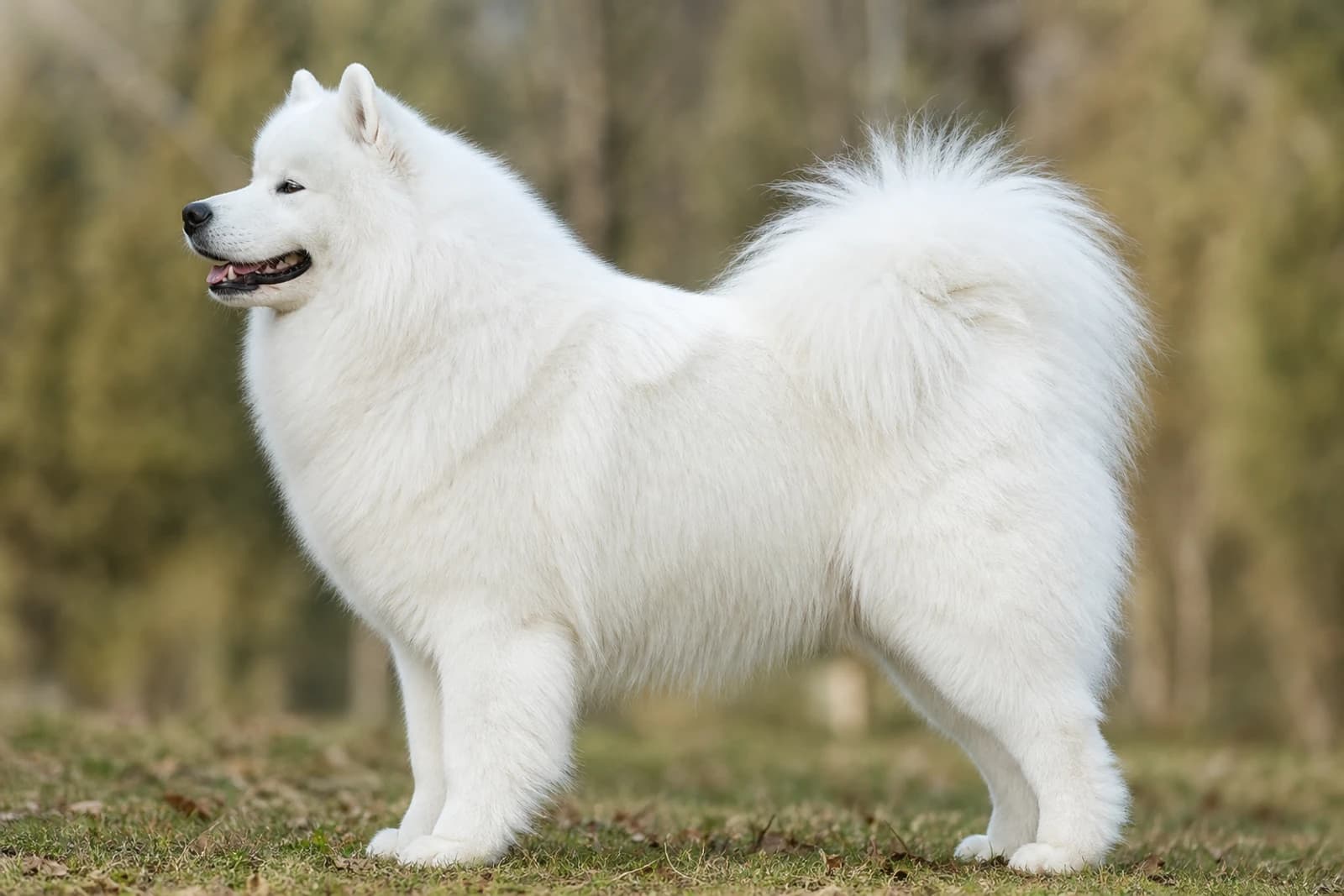
The Samoyed is a gentle, playful, and affectionate breed, known for its iconic 'Sammy smile'. Bred for herding and sled-pulling in Siberia, they thrive in active households that offer plenty of exercise and companionship. Their friendly nature makes them excellent family dogs, especially with children, though they can be vocal and independent. Best suited for owners with time for training, daily exercise, and regular grooming of their thick white coat. Not ideal for apartments or first-time owners seeking a low-maintenance pet.
At a glance
- Size
- Large
- Height
- 18–22 in
- Weight
- 35–66 lb
- Life span
- 12 years
- Coat colors
- white, cream
- Coat type
- thick double coat
- Group
- Spitz-Type
- Origin
- Russia (Siberia)
How much does a Samoyed cost?
Adopt / rescue
$150–$500
Usually includes spay/neuter, first shots, and a microchip.
Buy from a breeder
$2,000–$4,000
From a reputable, health-testing breeder.
Approximate USD. Prices vary widely by region, breeder, pedigree, age, and coat colour — adopting is the lower-cost and recommended route. Avoid suspiciously cheap “breeders”; they’re often puppy mills.
Estimate the full cost of a Samoyed →Samoyed photos
Views
Front, side, rear and top — the full silhouette.Poses
How the breed sits, lies, moves and plays.Puppy to senior
The breed across its whole life.Expressions
The breed’s range of moods.Close-up details
Eyes, ears, nose, paws, tail and coat.Coat colors
The breed’s recognized colors.Click any photo to enlarge. We show the Samoyed from every angle — three views, poses, life stages, expressions, close-ups, coat and colors.
Appearance & size
A full-grown Samoyed is a picture of snowy strength — a medium-large Spitz with a plush, weatherproof coat and a face that always seems to be smiling. Adults stand 18 to 22 inches at the shoulder and weigh anywhere from 35 to 66 pounds. In practice, males usually fall in the 50–65 pound range and females a trimmer 35–50 pounds, but height stays moderate enough that the dog never looks gangly or stubby. The body is compact, with a straight, medium-length back that’s well-muscled and a deep chest that tapers into a moderate tuck-up.
The coat is the breed’s signature: a dense, stand-off double layer built for Siberia. Outer guard hairs are straight and harsh, while the undercoat is soft and woolly. Color is brilliant white, cream, or white with just a hint of biscuit. The tail is a heavily coated plume that loops up over the back or drapes to one side when the dog is alert, and hangs down when relaxed.
Move in close and the details get even more distinctive. Almond-shaped eyes are deep-set and dark, with lower lids that slant slightly toward the ear base — giving an expression that’s bright and inquisitive. The ears are thick, triangular, and just rounded at the tips; they sit well apart on the skull, completely erect and fringed with heavy feathering. A broad black, brown, or liver nose is standard, though many Samoyeds develop “snow nose” where pigment fades to a pinkish-brown in cold weather before darkening again later. And that famous upturn at the corners of the mouth isn’t an accident — it’s breed type, keeping the dog looking cheerful while also preventing drool from freezing.
Samoyed feet are large, flat, and hare-like, with well-arched toes, extra-thick pads, and insulating hair sprouting between them — natural snowshoes. From the front, the legs are straight and strong, framing a deep chest. From the side, the topline remains level, the tail arches forward, and the whole silhouette suggests a worker built for pulling sleds over powder. From the rear, the hindquarters look powerful, with the plumed tail held high.
- Ears: thick, triangular, slightly rounded tips, set well apart, fully upright.
- Eyes: almond-shaped, deep-set, dark; lower lid slants toward ear base.
- Nose: black, brown, or liver; often lightens in winter.
- Back: straight, medium length, well-muscled.
- Feet: large, flat, hare-like; arched toes, thick pads, protective hair between toes.
- Tail: long, heavily coated; carried over the back or to one side when alert, down when resting.
Expect the coat to shed heavily — you’ll find tumbleweeds of white fluff in every corner during seasonal blowouts.
History & origin
Once you know where the Samoyed comes from, everything about the breed clicks. These dogs didn’t develop in a kennel — they were forged in the brutal cold of Siberian winters, working shoulder-to-shoulder with the nomadic Samoyede people (ancestors of today’s Nenets) on the vast, treeless tundra.
For thousands of years, the Samoyede depended on this single dog to do it all: herd stubborn reindeer, haul loaded sleds across hundreds of miles of ice, and guard the camp from predators. But the job didn’t stop when the sun disappeared and the temperature crashed to 60 below. Samoyeds slept inside the family’s choom — a reindeer-skin tent — sharing body heat through the long polar night. That close-quarter living etched the breed’s signature gentleness and an almost human-like attunement to their people. They were never just tools; they were beloved family members who worked all day and cuddled all night.
That famous “Smiling Angel” expression isn’t just a random quirk. The upturned corners of the mouth serve a dead-serious purpose: they keep drool from freezing into painful icicles on the dog’s muzzle in extreme cold. Pair that with a dense, bright white or cream double coat that sheds wind and snow, and you have a living sled-pulling heater that genuinely seems to enjoy a blizzard.
The rest of the world caught on in the late 19th century. English zoologist Ernest Kilburn-Scott brought a small group of Samoyeds to England in 1889 and poured decades into establishing a consistent type. Queen Alexandra became a vocal fan and ran a prominent kennel, which catapulted the breed into high society. The dogs also cemented their polar legend alongside explorers: Roald Amundsen used Samoyeds on his 1911–12 South Pole expedition, and a Samoyed named Etah led the first sled-dog team to reach the North Pole.
For all the show-ring glamour they’ve picked up since then, today’s Samoyed remains startlingly unchanged. That insatiable need for a real job — and the unfiltered joy they bring to a tent or a living room — is still pure Siberian tundra.
Temperament & personality
A Samoyed isn’t a dog you can tuck away in the backyard when life gets busy. This breed is wired for togetherness. Leave one alone for hours at a stretch and you’ll hear about it — barking, howling, or the crunch of a chair leg being reimagined as a chew toy. Neglect or isolation can quickly lead to anxiety-driven behaviors, so if you want a quiet, independent dog, keep looking. But if you’re after a bright, affectionate shadow who treats every household moment like a team project, you’re in the right place.
They pair a gentle, loyal nature with real smarts. Most learn fast, though aptitude varies, and they’re not pushovers. Strong-willed and sometimes comically stubborn, a Samoyed reads pressure as a challenge, not a cue. You’ll get the best from this dog when you lead with patience, consistency, and the sense that you’re partners, not boss and subordinate. Force fizzles; respectful engagement gets the tail wagging and the brain working.
Around the house they’re alert but rarely suspicious. Expect a cheerful announcement when someone rings the doorbell — a “woo,” a full serenade, or the yodel-like chatter the breed is known for — but not a guard-dog response. Most will happily escort a stranger inside and offer up a toy, which makes them flunk protection duty and ace family life. They tend to bond with everyone: kids, adults, other dogs. That patience and adaptability show up strongest when they’ve been raised alongside what they’re expected to tolerate. Still, teach children to respect the dog’s space during meals and rest; a peaceful home keeps that sunny temperament steady.
Their sociability comes with a quirky side. A Samoyed will follow you from room to room, lean on your legs, and insert themselves into conversations. They may steal a sock not to destroy it but to lure you into a game of chase. When they’re bored or under-exercised, though, that cleverness turns toward remodeling your shoes or serenading the neighborhood at dawn. Plan to meet their need for real connection — mental puzzles, play, and plain old company — and you’ll have a dog whose default mode is an easygoing, slightly mischievous grin. Without that, they’ll find their own fun, and you probably won’t like the playlist.
Good with kids, dogs & other pets
Samoyeds have a patient, non-aggressive nature that makes them one of the steadier large-breed choices for families with young children. That 35–66 lb frame and 18–22 inch height can easily knock over a toddler during an excited greeting, so supervision is a must — not because the dog intends harm, but because a Sammy’s default setting is “joyful enthusiasm.” Kids who are old enough to understand gentle handling will get a tireless playmate who’s up for romps in the snow, fetch in the yard, or just flopping nearby while they do homework.
Early socialization is non-negotiable. The critical window slams shut around 12–16 weeks, so expose your puppy to children of different ages, varied handling, and everyday chaos before then. Even with a solid foundation, a Samoyed’s need for companionship means they don’t do well left alone in a backyard for hours — loneliness can unravel all that good temperament work.
With other dogs, Samoyeds usually bring the same social, playful energy they show humans. Many live happily in multi-dog households, provided introductions are gradual and positive. They’ll roughhouse and chase, but their herding background can surface as a pushy style if the other dog isn’t matching the vibe.
Cats and small pets are a different conversation. A Samoyed’s prey drive isn’t typically through the roof, but it’s there. A running cat or a squeaking rabbit can flip a switch. If you’re raising a puppy alongside a cat, diligent, supervised exposure from day one — and a solid “leave it” cue — stacks the odds in your favor. Skip that, and you might have a dog who views the family hamster as a furry squeaky toy. No amount of good-natured spirit overrides instinct.
Trainability & intelligence
Samoyeds are whip-smart, but that intelligence comes wrapped in an independent streak shaped by centuries of pulling sleds across the tundra, often making their own decisions. They pick up routines and commands quickly when you give their brain something to chew on, but they aren’t the type to blindly repeat a trick just because you asked. Think of training less as obedience school and more as a negotiation with a cheerful, stubborn partner.
They learn best through clear, consistent cues paired with hand signals—a flat palm for “stay,” a sweeping arm for “come.” Mix up your commands? They’ll remember your sloppiness and conveniently ignore you next time. Keep sessions short, 5 to 10 minutes a couple times a day, and end them while the dog still wants more. Drill the same sit-stay sequence ten times in a row and you’ll watch that famous Sammy smile turn into a yawn; they bore easily and will find their own entertainment (digging, barking, or “forgetting” everything).
Recall is the big real-world test, and frankly, a Samoyed off-leash in an unfenced area is a gamble. Their brain is wired to spot movement and chase—squirrel, blowing leaf, distant jogger—and the reward of running after it often trumps your “come.” You build a reliable recall by layering it with the highest-value rewards (think shredded chicken or a squeaky toy) and practicing from day one, but even then, respect that this breed may never be 100% off-leash reliable. A long training line and a securely fenced yard are your training allies here.
The one thing that will wreck your progress faster than anything else is a harsh tone or force. Samoyeds are sensitive; they shut down if you yell, and they’ll remember the person who frightened them long after the incident. This is a dog that works for someone they trust, not someone they fear. Build that trust with immediate praise, a quick treat, or a burst of tug-of-war the moment they get something right.
Start puppy training the week you bring them home. Between 3 and 14 weeks, flood them with gentle, positive exposures—new people with hats, different floor textures, the sound of a vacuum across the room, calm dogs. Don’t overwhelm; toss a treat each time something novel appears. This early social map is the single biggest buffer against the Spitz-type wariness that can morph into reactivity later on. Miss that window, and you’ll spend far more time managing a dog that barks or backs away when guests visit.
Expect training to feel lopsided: they’ll nail a new trick in three repetitions, then stare at you blankly the next morning. That’s not stubbornness for sport; it’s an intelligent dog deciding whether today’s payoff is worth the effort. Your job is to stay consistent with the words and gestures you use, keep the reward currency fresh, and never try to out-bully them—you’ll lose. Instead, accept that you’ll always need to manage their environment; a leash and a baby gate aren’t failures, they’re smart backups for a breed that will always have a mind of its own.
Exercise & energy needs
Plan on at least an hour of real exercise every day — split into two sessions. These are sled dogs built to pull weight across snow for miles, and a quick spin around the block does nothing to empty their tank. A morning run of 30–45 minutes, then a long afternoon hike, a vigorous game of fetch, or an off-leash romp with a sturdy dog friend gets close to what a Samoyed actually needs. If you can let them pull — canicross, skijoring, or a wheeled cart — you’ll watch a dog move the way their body craves.
Mental work matters just as much. Samoyeds are clever and independent, and a bored Sammy will invent his own entertainment: landscape redesign via digging, barking symphonies, or redecorating your couch with stuffing. Scatter meals in a puzzle toy, hide treats around the house for scent work, or weave five-minute training drills into your day. Teaching a new trick or practicing obedience commands burns mental energy that walks alone never touch.
Puppy exercise needs extra care. Growing joints are soft, and pounding pavement or forced running can damage them. Stick to softer ground, short play sessions, and let the pup set the pace until growth plates close — your vet will give the all-clear, usually around 12–18 months. Adult Samoyeds can be prone to hip dysplasia, so even a fit adult benefits from minimizing repetitive high-impact jarring on concrete.
That dense double coat makes them overheat fast in warm weather. Shift activity to early mornings or evenings when it’s cool, always bring water, and never assume a panting Samoyed in a sunny yard is just “having fun.” Give them snow to plow or a cold lake to splash in, and you’ll see the real Sammy smile. Skip the exercise, and that signature friendliness twists into anxiety and noise — so if you put in the time consistently, you get a worn-out, content dog who flops at your feet instead of staging a home renovation.
Grooming & coat care
That bright white coat is a showstopper, but it comes with a price: Samoyeds are champion shedders. They have a dense double coat — a soft, woolly undercoat beneath a harsher, weather-resistant outer layer — that drops fur year-round and then blows out in massive clumps twice a year. You’ll need to commit to line brushing at least three to four times a week with a metal slicker brush and a greyhound comb to reach the skin, or you’ll find tangled mats and a permanent white layer on every surface. During the peak shedding seasons (spring and fall), daily brushing with an undercoat rake or a pin brush is the only way to stay ahead of the fluff storm; many owners also use a high-velocity dryer to blast loose hair outdoors before it fills the house.
Bathing every six to eight weeks with a whitening dog shampoo keeps the coat bright without stripping natural oils, but don’t overdo it — too much washing can dry the skin. The good news? Samoyeds have a self-cleaning quality to their coat, so dirt often brushes right off once dry. You won’t need to trim or shave (never shave a double-coated breed; it ruins their insulation), but pay attention to the feathering on legs and tail, where debris collects.
Beyond the coat, routine care means nail trims every two to three weeks to prevent splitting, weekly ear checks for wax and redness, and daily tooth brushing if you can manage it. Getting a puppy used to all this handling early makes the whole process less of a wrestling match and more of a bonding ritual. And when your Samoyed shakes after a walk, just be ready for a dusty snow shower of kicked-up loose fur — that’s the price of living with a living cloud.
Shedding & allergies
If you’re picturing a pristine white dog that won’t dust every dark surface in the house, reset those expectations now. Samoyeds shed heavily, all year, with two seasonal blowouts that crank the fur production to comical levels.
A Samoyed wears a dense double coat—a soft, woolly undercoat beneath a harsh outer guard coat. Dead undercoat works loose daily, creating pale tumbleweeds that drift across floors and cling to fabric. Twice a year, usually spring and fall, the undercoat sheds in a full “blowout.” For four to six weeks, fur comes out in fistfuls and trash-bag-sized wads during brushing sessions. Many owners do a thorough line-combing outdoors during these stretches to keep the worst of the fluff outside.
Drool is minimal. Those tight black lips don’t leak much, so you won’t find damp spots on your pants or couch after a friendly greeting.
The allergy picture. Samoyeds often get tagged as hypoallergenic. No dog truly is. Allergens come from dander, saliva, and urine—not hair alone. The breed’s coat can trap some dander, and the near-absence of drool reduces airborne saliva proteins. However, a shedding Samoyed still distributes dander-laden hair across your whole living space. If you have dog allergies, spend serious time around an adult Samoyed before bringing a puppy home, and consult your allergist, not a breeder’s assurances. Expect to run your vacuum daily and keep lint rollers in every room.
Diet & nutrition
A Samoyed’s cheerful attitude at mealtime often masks a serious food drive — many will eat whatever you put in front of them and then look for more. That makes portion control the single most important piece of managing this breed’s diet. Because they range from 35 to 66 pounds and carry a dense double coat, it’s easy for extra weight to sneak up on you. Keep your dog lean: you should be able to feel the ribs without pressing hard, and there should be a visible waist when you look down from above.
How much to feed
There’s no one-size-fits-all number. A highly active adult Samoyed running with a sled or doing daily vigorous exercise needs more fuel than a weekend-hiking companion. Start with what the food manufacturer recommends for your dog’s ideal weight, then adjust up or down based on body condition. Split the daily ration into two meals to help prevent bloat — a real risk in deep-chested large breeds — and use a puzzle bowl or slow feeder if your Sammy inhales food in 30 seconds. That slows them down and adds mental work.
Puppy and senior shifts
Puppy diets need careful attention. Under four months, feed four evenly spaced meals a day. From four to six months, drop to three. After six months, twice-a-day feeding is fine. Introduce new foods gradually, starting with lightly cooked puréed meats, fish, and vegetables or a high-quality puppy kibble. By 12 weeks, supervised raw meaty bones like chicken wings are acceptable for some pups.
Senior Samoyeds (around 8 years and up) burn fewer calories, so watch the scale closely. Obesity in older dogs strains joints and can shorten an already limited lifespan. Smaller, more frequent meals can be gentler on aging digestion, but there’s no evidence you need to drastically cut protein. Instead, reduce calories from fat and carbs while keeping the protein level moderate to maintain muscle. Purée meals if teeth are missing or gums are tender — blending actually aids nutrient absorption since dogs don’t have salivary digestive enzymes.
What to put in the bowl
A biologically appropriate diet centers on meat. Aim for roughly 60% meat (raw, cooked, or a combination), 20–30% fruits and vegetables, and the rest from eggs, grains, or plain yogurt. That blueprint works whether you home-prepare or select a high-quality commercial food. Avoid rich, fatty scraps and holiday leftovers — they can trigger pancreatitis. Grain-inclusive foods are fine; pearl barley provides digestible fiber, and white rice is a bland choice for sensitive stomachs. Cook extra batches of grains and vegetables to have on hand, and use unsalted vegetable cooking water as a broth base. If you feed raw, do so under guidance and always supervise bone consumption.
A no-table rule that pays off
Serve meals and any leftovers strictly in your dog’s own bowl, never from your plate or the counter. Samoyeds are smart and charming — once they learn that staring or pawing earns a handout, breaking the habit is tough. It’s far simpler to prevent begging from day one than to undo it later.
Health & lifespan
The average Samoyed lives about 12 years, with many reaching their early teens when weight, joints, and overall health are managed from day one. Like any purebred, this breed has some hereditary conditions, but a responsible breeder screens parents to tilt the odds in your favor.
Samoyeds can be prone to hip dysplasia and several eye diseases — progressive retinal atrophy (PRA), cataracts, and retinal dysplasia can all steal vision over time. Reputable breeders use OFA or PennHIP evaluations for hips and CERF or OFA eye clearances, and they won’t blink if you ask for the paperwork.
A more Samoyed-specific concern is Samoyed hereditary glomerulopathy (SHG), a kidney failure that often hits young males hard. A DNA test exists to identify carriers, so ethical breeders can avoid producing affected pups. Always ask whether both parents were tested. Hypothyroidism and diabetes also show up, particularly in dogs carrying extra weight. This is a food-driven dog — portion control and a slim waistline aren’t optional if you want to protect joints and lower diabetes risk.
That dense double coat makes Samoyeds overheat quickly. Work out in the cool of the morning or evening, and always have shade and water nearby. The same coat traps moisture against the skin, so allergies and hot spots aren’t rare. Routine brushing, drying down to the undercoat after a swim or bath, and a diet with enough omega-3s help keep skin calm.
Heartworm prevention should be given monthly during mosquito season and for one month after it ends. Rabies vaccination is legally required, with no effective treatment once symptoms appear. Schedule annual vet checkups, twice yearly once your dog turns 7, and don’t ignore small shifts — a Samoyed that normally ricochets off walls but suddenly hangs back is telling you something.
Living environment
A Samoyed does not shrink to fit a small space, and they’ll tell you so. Bred to pull sleds and herd reindeer across frozen Siberia, these 35–66 lb spitfires need a home with breathing room, a securely fenced yard, and an owner who views exercise as a twice-daily appointment. An apartment usually ends badly — the barking alone (and there will be barking) can strain neighbor relations, and a bored Samoyed with pent-up energy will redecorate your baseboards, dig craters in the yard, or serenade the block.
That yard is non-negotiable, but even a large one won’t do the job on its own. Samoyeds demand serious, structured movement: think at least an hour of hard running, pulling, or off-leash romping twice a day, not a quick stroll. Split it into a morning sprint and an evening game of chase; mental work like puzzle toys and scent games fills the gaps. Without that outlet, they invent their own jobs, and they’re destructively creative.
Climate matters a lot. This is a double-coated dog engineered for subzero wind. They will lie in a snowdrift blissfully and then dramatically wilt when the thermometer climbs past 75°F. In warm weather, shift walks to dawn and dusk, keep a kiddie pool in the shade, and watch for heavy panting. Air conditioning isn’t a luxury here — it’s basic safety.
Then there’s the alone-time problem. Samoyeds bond with a fierce, pack-oriented loyalty that makes them terribly prone to isolation distress. Leave one alone for a full workday, and you may come home to howling, frantic window-scratching, or a dog who has dismantled the couch. Gradual desensitization, crate training from day one, and a midday dog walker help, but this breed suffers in a house that stays empty for long stretches. If your calendar keeps you away for 9-to-10 hours daily, a Samoyed will voice its unhappiness until something gives — and it won’t be the dog.
Who this breed suits
If you dread a quiet house and crave a dog that treats every snowfall like a personal invitation to party, a Samoyed might be your perfect match. These 35–66 lb bundles of white fluff are hardwired for companionship and group living — they’re not backyard dogs and they’re definitely not solo apartment dwellers. The ideal owner is home a lot, physically active, and genuinely enjoys a dog who wants to be part of everything, from morning jogs to folding laundry.
Samoyeds thrive with:
- Active families where someone is around most of the day. They’re famously gentle with kids, but their enthusiasm (and size) can accidentally bowl over a toddler, so early training goes a long way.
- Runners, hikers, and skijorers who need a winter-ready partner. A Samoyed isn’t satisfied with a couple of leash walks. Plan on a solid hour of off-leash running, pulling, or fast-paced movement daily — they were bred to haul sleds across Siberia, after all.
- Cold-climate households. That dense double coat is engineered for sub-zero temps. If you live somewhere with real winters, your Samoyed will be in heaven. If you’re in a hot, humid place, you’ll be managing indoor life during summer and exercising at dawn.
- Singles or couples with an open schedule — and a sense of humor. These dogs are clever, independent thinkers. Training requires patience, consistency, and the ability to laugh when your “no” gets a full-body wiggle in response.
Think twice if:
- You prize a clean, fur-free home. Samoyeds shed constantly and “blow” their undercoat twice a year, leaving drifts of white hair on every surface. This isn’t a hypoallergenic breed.
- You’re gone for 8+ hours a day. Left alone too long, a bored Samoyed can dismantle drywall or serenade the neighborhood. Separation anxiety is common, and their piercing bark carries.
- You dislike dog conversations. Sammies talk — yodels, woos, grumbles — and they’ll share their opinion on everything. Quiet-loving neighbors will not be amused.
- You want an off-leash dog that ignores small animals. Spitz-type prey drive is real. A squirrel or cat can trigger full chase mode, so a secure fence is non-negotiable.
- You’re a first-time owner looking for an easy ride. While they’re not impossible for a dedicated newbie, their stubborn streak and exercise demands are a heavy lift. If you can’t commit to professional training classes or daily runs, the relationship goes sideways fast.
Samoyeds live around 12 years, and every one of those years comes with big personality and fierce loyalty. They’re not a casual pet — they’re a lifestyle upgrade for someone who truly loves a dog that throws its whole heart (and all its hair) into family life.
Cost of ownership
Purchase price
A well-bred Samoyed puppy from a breeder who screens for hip, eye, and heart health typically costs $1,800 to $3,500. Show-line prospects or unusually small litters can push the price higher. Puppies listed for $800–$1,200 almost always come from sources cutting corners on health testing, which you’ll pay for later. Adopting an adult through a regional rescue usually lands between $200 and $500, though the dog may arrive with gaps in its medical history.
Monthly upkeep
- Food: High-quality kibble for a 35–66 lb dog runs $60–$100 a month. Many Samoyeds do well on fish-based or limited-ingredient formulas, which tend to be pricier.
- Grooming: This is the line item that shocks new owners. The thick double coat mats quickly without frequent brushing and blows coat twice a year. Budget $50–$100 every 4–6 weeks for a professional groom, or invest $150–$250 upfront in a high-velocity dryer, slicker brush, and undercoat rake and do it yourself. Even with home grooming, expect to spend $25–$40 a month on shampoos, detanglers, and replacement tools.
- Routine vet care: Annual exams, core vaccines, heartworm prevention, and flea/tick control average $50–$70 a month. Samoyeds can be prone to hip dysplasia, eye conditions, and hypothyroidism—responsible breeders screen for them, but ongoing monitoring may add specialist visits over time.
- Pet insurance: For a large breed with hereditary risks, premiums run $35–$60 a month for a solid policy with a reasonable deductible. One emergency bloat surgery or orthopedic procedure can hit $5,000 overnight, so insurance that covers breed-related conditions is worth the peace of mind.
One-time and first-year hits
- Supplies: crate, bed, non-tip bowls, heavy-duty leash, and a fenced yard or high dog run cost $300–$800.
- Spay/neuter and first-year vetting: plan on $500–$700 for surgery, microchipping, and extra puppy wellness visits.
Count on a total first-year outlay between $2,500 and $3,800, then roughly $1,500–$2,500 a year after that—excluding a major medical event. If you can’t absorb a sudden $4,000 surgery, a good insurance plan isn’t a luxury; it’s the only buffer that keeps a treatable condition from becoming a financial crisis.
Choosing a Samoyed
Rescue or Responsible Breeder?
You can find a Samoyed through a breed-specific rescue or a careful breeder—and the choice shapes the dog you’ll live with for the next 12 years. Rescues often have young adults whose energy and temperament are already on display. You skip the mouthing and house-training drills, but you also give up a known health history and early socialization. That trade-off can work beautifully if you’re patient and realistic.
Still, most people start with a puppy, and that’s where finding a serious, preservation-minded breeder matters. A well-bred Samoyed should stand 18–22 inches at the shoulder and weigh 35–66 pounds as an adult—anyone selling “teacup” or “giant” lines is steering away from the standard. White, cream, and biscuit are the only coat colors; paying a premium for “rare champagne” is a red flag dressed in fluff.
Health Clearances That Matter
Samoyeds can be prone to hip dysplasia, eye disease, certain heart conditions, and a serious kidney disorder. A breeder who does right by the breed opens the filing cabinet without hesitation. Ask for:
- OFA or PennHIP hip evaluation, with a rating of Fair or better
- CAER eye exam by a veterinary ophthalmologist within the last 12 months (look for hereditary cataracts and progressive retinal atrophy)
- Cardiac evaluation by a board-certified cardiologist (auscultation alone isn’t enough; ask for an echocardiogram to rule out subaortic stenosis)
- DNA test for Samoyed Hereditary Glomerulopathy (SHG)—carrier parents can be bred carefully, but both parents should be tested so no puppy is affected
- Thyroid panel and, increasingly, a DM (degenerative myelopathy) test
If a breeder waves these off with “my vet says they’re healthy,” find another phone number.
Red Flags Beyond Paperwork
Puppies should go home no earlier than eight weeks, with age-appropriate vaccinations, deworming, and a written contract that includes a return-to-breeder guarantee for life. Beware of anyone with multiple litters on the ground at once, no curiosity about your lifestyle, or a pay-now-ask-later checkout process. Run from setups where you can’t meet the mother dog—seeing her coat condition and demeanor tells you a lot about what you’re getting.
Picking the Puppy
A healthy Samoyed puppy is plush but clean, with no discharge from eyes or nose, and a quick, bouncy stride. Spend time watching the litter. You want the pup who comes to investigate you, not the one cowering in the corner or the one who relentlessly body-slams its littermates. The Samoyed’s famous grin should look relaxed, not anxious. Breeders who raise puppies underfoot and begin gentle grooming, crate exposure, and household sounds early are setting you up for a much smoother transition.
Take your time. The right breeder will ask you at least as many questions as you ask them—about your yard, your schedule, and how you’ll handle a dog that sheds enough to stuff a small mattress every spring.
Pros & cons
-
Exceptionally friendly and gentle — bred for centuries to work alongside people, Samoyeds greet everyone with the famous “Sammy smile” and a wagging tail.
-
Natural with kids: patient, playful, and remarkably tolerant, they rarely snap, making them a solid choice for family life.
-
Striking coat that stops traffic — pure white or cream, plush, and undeniably beautiful.
-
Highly social and rarely dog-aggressive; they happily coexist with other pets and thrive on human and canine company.
-
Moderate, sturdy size (35–66 lbs, 18–22 inches tall) — big enough to be a real dog, small enough to fit in your SUV, not your lap.
-
12-year lifespan is solid for a large breed, especially if you keep them lean and active.
-
Relentless shedding — that glamorous double coat drops a blizzard of white fluff daily, and twice a year the undercoat comes out in handfuls.
-
Grooming is a real time commitment: weekly brushing minimum, more during coat blows, plus baths and thorough drying to prevent skin funk.
-
Smart, but selectively deaf — they bore easily in training and will ignore a command if you don’t make it worth their while.
-
High exercise demands — a stroll around the block won’t dent their energy. Expect to provide a solid hour of running, pulling, or fast-paced play daily, or they’ll find their own (destructive) entertainment.
-
Vocal and opinionated: howls, yodels, alert barking, and chatty “talking” — you’ll hear about every squirrel and delivery truck.
-
Miserable in heat — that Arctic coat makes them overheat fast in hot, humid weather, so exercise shifts to early mornings and air conditioning becomes essential.
-
Velcro tendencies — they bond hard and can develop separation anxiety if left alone for long workdays, leading to barking, digging, and chewed-up doorframes.
Similar breeds & alternatives
If you’re drawn to the Samoyed’s cloud-white coat and constant grin, a few other Spitz breeds deserve a look—but the differences matter more than the fluff.
The Siberian Husky runs in the same sled-pulling circles, weighing 35–60 pounds and standing a touch taller at 20–23.5 inches. That’s where the easy comparison ends. A Husky is a born escape artist with a high prey drive and a stubborn, “what’s in it for me” attitude. A Samoyed, by contrast, hangs on your every word and will shadow you from room to room rather than dig under the fence.
On the larger side, the Alaskan Malamute is a powerhouse at 75–85 pounds. He’s built for heavy freight, not long-distance smiles. Samoyeds top out around 66 pounds and have a softer, more overtly friendly disposition. Malamutes can be reserved or even dominant with other dogs; Samoyeds tend toward social butterfly.
If size is the sticking point, the Keeshond (35–45 pounds, 17–18 inches) packs a similar foxy face and dense double coat, but in shades of gray and black with signature “spectacles.” Keeshonds are bright little watchdogs that bark with purpose—something the Samoyed rarely does—and they make excellent city companions for an owner who enjoys alert barking.
The American Eskimo Dog (standard size: 25–35 pounds, 15–19 inches) is another snowy alternative. Don’t let the matching white coat fool you: Eskies are more guard-minded and vocal, while Samoyeds greet strangers like long-lost friends. An Eskie needs early socialization to avoid becoming overly suspicious, where a Samoyed typically just wags.
What you trade with every alternative is the Samoyed’s unique blend of tireless good cheer, gentle kid-patience, and a true desire to be at the center of family life. If shedding is a dealbreaker, none of these double-coated breeds will help—but if you want a dog whose default setting is sunshine, the Samoyed’s smile is hard to beat.
Fun facts
- Known as the 'Smiling Sammie' for their characteristic upturned mouth.
- They were bred to herd reindeer and pull sleds in Siberia.
- Their thick white coat is naturally odorless and dirt-resistant.
- They are one of the oldest Arctic dog breeds.
Frequently asked questions
- Are Samoyeds good with children?
- Samoyeds are generally very good with children due to their friendly and gentle nature. They tend to be patient and playful, making them excellent family dogs, though supervision is always recommended with young kids because of their large size and energy.
- Do Samoyeds shed a lot?
- Samoyeds are heavy shedders, especially during seasonal changes. Their thick double coat sheds year-round and requires frequent grooming to manage loose fur around the home.
- How much exercise does a Samoyed need?
- Samoyeds have high exercise needs and typically require at least an hour of vigorous activity daily. They thrive on runs, hikes, and play sessions, and without enough physical and mental stimulation, they may become destructive.
- Is a Samoyed suitable for apartment living?
- Samoyeds can adapt to apartment living if their exercise and mental stimulation needs are met, but it's not ideal. They are active and can be vocal, which may disturb neighbors, so a home with a securely fenced yard is often a better fit.
- Are Samoyeds easy for first-time dog owners?
- Samoyeds can be a challenge for first-time owners due to their intelligence, independence, and high energy. They respond best to consistent, positive training but may test boundaries, so experienced handling is often helpful.
- Do Samoyeds bark a lot?
- Samoyeds are known to be vocal dogs that bark, howl, and 'talk' to express themselves. This tendency can be managed with training, but they are naturally alert and may bark at unfamiliar sounds or when seeking attention.
Tools & calculators for Samoyed owners
Quick estimates tailored to Samoyeds — pre-filled with this breed’s size where it matters.
Articles & stories about the Samoyed
Sources & standards
This profile follows recognized breed standards from the American Kennel Club (AKC) and the Fédération Cynologique Internationale (FCI), along with established veterinary and breed-club guidance. These describe general breed tendencies — every dog is an individual.
Owner stories
Have a Samoyed? Share your experience — grooming tips, personality quirks, anything goes.