

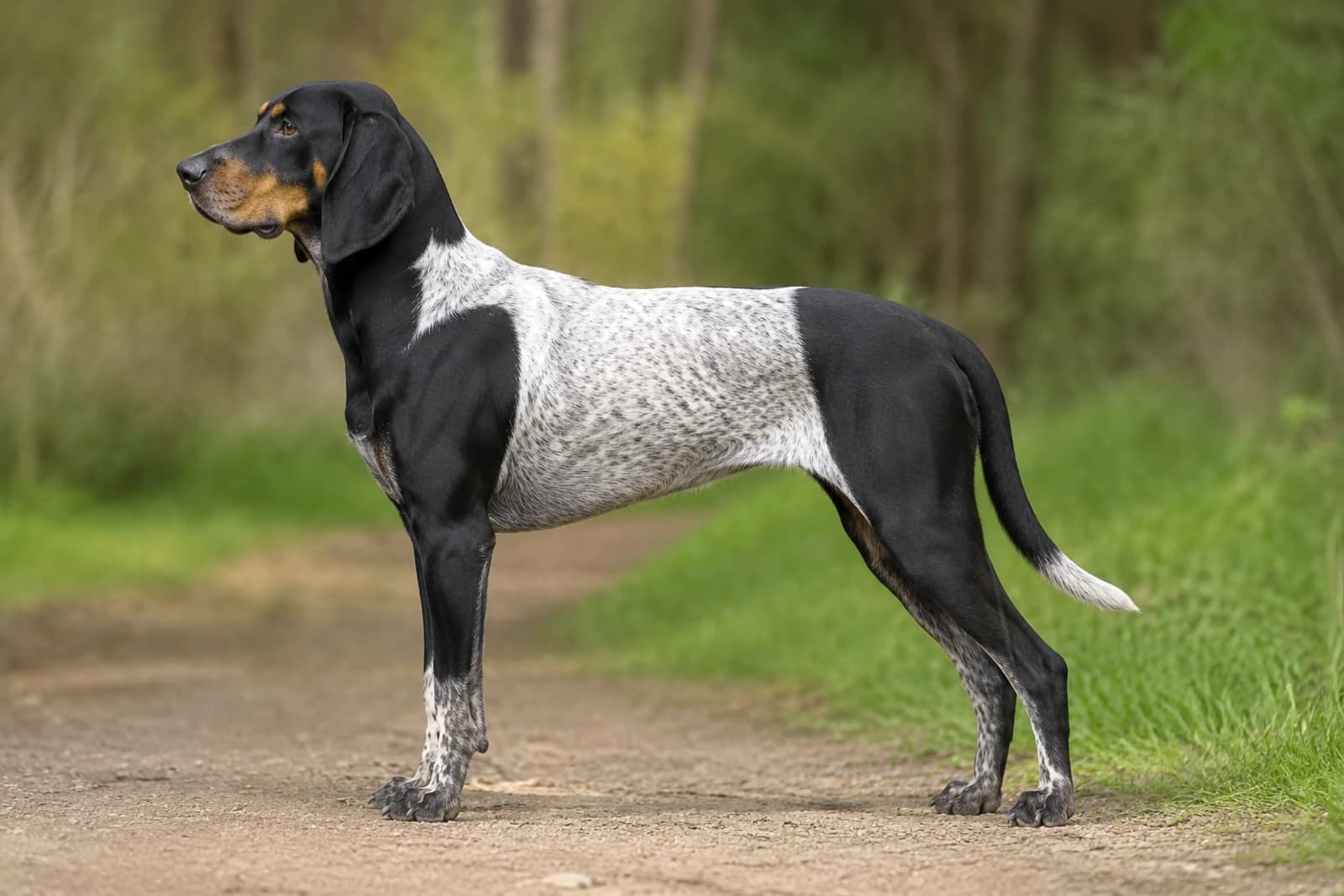
The Serbian Tricolored Hound is a rare and energetic scenthound bred for endurance in the field. This breed suits active, experienced owners who can provide ample exercise and mental stimulation. Loyal and affectionate with family, they thrive in rural settings and require consistent training due to their independent nature. Their short, low-maintenance coat and distinctive tricolored pattern add to their charm, but a keen prey drive and tendency to bark make them less suited for city life or novice handlers. Ideal for those seeking a tireless hunting companion with a melodious voice.
At a glance
- Size
- Large
- Height
- 17–22 in
- Weight
- 44–55 lb
- Life span
- 12 years
- Coat colors
- Black, tan, and white
- Coat type
- Short, dense, and weather-resistant
- Group
- Scenthounds
How much does a Serbian Tricolored Hound cost?
Adopt / rescue
$75–$400
Usually includes spay/neuter, first shots, and a microchip.
Buy from a breeder
$700–$2,000
From a reputable, health-testing breeder.
Approximate USD. Prices vary widely by region, breeder, pedigree, age, and coat colour — adopting is the lower-cost and recommended route. Avoid suspiciously cheap “breeders”; they’re often puppy mills.
Estimate the full cost of a Serbian Tricolored Hound →Serbian Tricolored Hound photos
Views
Front, side, rear and top — the full silhouette.Poses
How the breed sits, lies, moves and plays.Puppy to senior
The breed across its whole life.Expressions
The breed’s range of moods.Close-up details
Eyes, ears, nose, paws, tail and coat.Coat colors
The breed’s recognized colors.Click any photo to enlarge. We show the Serbian Tricolored Hound from every angle — three views, poses, life stages, expressions, close-ups, coat and colors.
Appearance & size
A hunter’s dog through and through, the Serbian Tricolored Hound has the shape, coat, and expression that tell you it was built for long, hard days in rough country. It stands 17 to 22 inches at the shoulder and tips the scale at 44 to 55 pounds — solid, but never heavy or lumbering. You’re looking at a rectangular, slightly longer-than-tall body with a deep chest that drops to the elbows, a level topline, and a muscular loin. This is a dog with real lung room and the endurance to match.
The head is the classic scenthound shape: long, slightly domed skull, a distinct stop, and a straight, strong muzzle. Dark oval eyes have an intelligent, steady expression framed by thin, black-rimmed lids. The ears sit high and hang flat in wide, rounded folds. Bring them forward and the leathers just about reach the corner of the mouth. The tail carries as a gentle saber — thicker at the base, tapering evenly — and a dog working scent naturally lifts it level with the back, never curled over.
From the front, the legs are straight and parallel, with broad forechest and well-laid shoulders. Seen from the side, the topline stays firm, the underline rises gradually from deep brisket to tucked-up belly, and the rear angulation matches the front for a ground-covering, economical trot. From behind, you see a strong pelvis and balanced, straight-moving hocks.
The coat is short, dense, and flat-lying with a glossy finish. It’s weather-resistant enough to shed light rain and easy to dry after a morning push through wet grass. The color, true to the name, breaks into three clean zones:
- A rich, dark mahogany or red-tan base covers much of the body.
- A black saddle or blanket drapes over the back and can extend partway down the ribs.
- Crisp white markings show up as a full or partial collar, a chest blaze, lower legs, and almost always the tail tip — a working advantage when you need to spot your dog at distance in thick cover.
That tail tip, often a bright white flag, is one of the first things an owner notices. It bobs above ferns or corn stubble like a signal, even when the rest of the dog disappears into the field. Tan points sit above the eyes, on the cheeks, inside the ears, and on the legs where the black and white areas meet. Altogether, the pattern is bold, clean, and completely practical — no frills, just the unmistakable look of a Balkan briar dog that can go all day.
History & origin
The Serbian Tricolored Hound’s roots dig deep into the Balkan Peninsula, where scenthounds have worked alongside hunters for centuries. While local hounds similar in type appear in records as far back as the 14th century, the tricolor variety we know today was deliberately shaped in Serbia during the early 1900s. Breeders set out to refine a dog that combined the stamina and nose of existing Balkan hounds with a distinctive, flashy coat — black, rich tan, and white — and a baying voice that carried over rough terrain.
What they got was a rugged, large scenthound standing up to 22 inches and 55 pounds, built to trail hare, fox, and even wild boar across the wooded hills and plains of the region. The breed was officially recognized as the “Yugoslavian Tricolored Hound” in 1940, and a written standard was published that same year. Then World War II nearly erased that progress. Breeding stock dwindled drastically, and the post-war years demanded a slow, careful rebuild by committed hunters and fanciers.
By 1950, a revised standard was in place, and the Federation Cynologique Internationale (FCI) fully accepted the breed in 1961. The name shifted to Serbian Tricolored Hound after the breakup of Yugoslavia, reflecting its country of origin. Unlike its close cousin, the solid-colored Serbian Hound, the tricolor version stayed consistently rare. Even today, you won’t trip over one at a dog park outside Serbia and neighboring countries. Most remain in the hands of hunters who prize the breed’s methodical, persistent tracking style and its willingness to work alone or in a pack. When the dog finds game, it lets out a high-pitched, insistent cry that’s been described as almost melodious — a practical, no-nonsense tool for a hunter on foot, not just a pretty sound.
Temperament & personality
A Serbian Tricolored Hound’s world runs on scent — and that one fact shapes everything about living with him. He’s a hardwired scenthound through and through: independent enough to follow a trail for miles, yet deeply attached to his people. Expect a dog who’s calm and steady indoors after a solid run, but single-minded and almost headstrong when a fascinating smell catches his attention. The typical weight runs 44–55 lb and height 17–22 inches, giving him the substance to work all day without being too big to curl up at your feet afterward.
With family, he’s usually affectionate but not clingy. Many owners describe them as calm, brave, and gentle — just remember those are tendencies, not guarantees. Early socialization matters, especially if you have cats or small pets; his scent-driven prey instinct can kick in fast. He’s generally good with children who respect his space, but he’s not a dog meant to roughhouse for hours. And that independent streak means a first-time owner might find him challenging. He responds to respectful, consistent handling, not a heavy hand or constant repetition. Force just makes him shut down.
You’ll notice his watchfulness right away. He’ll announce strangers with a deep bay, but he’s more of a sentinel than a guard. The real quirk is his nose-driven sense of territory. A Serbian Tricolored Hound may urine-mark more than other dogs — both outside (it’s his social media) and sometimes inside if scents from previous accidents linger. That’s not spite; it’s scent memory in action. He smells and then re-marks the same spot. So clean-up after any indoor mistake needs a vinegar-based spray that neutralizes odor, not just masks it. Likewise, a homemade citrus spray can redirect chewing — puppies chew to explore teething pain and adults gnaw hard stuff to keep jaws strong. Provide plenty of appropriate chews, and never interrupt him while he’s eating or chewing a prized bone, or you risk creating a guarding habit.
He’s a dog who rolls in things that smell disgusting to you — dead things, manure, whatever — and that’s just his ancestral scavenger brain at work. It’s annoying, but understanding why helps. When training, watch his body language: a forward lean often means confidence, while a stiff, staring posture can signal trouble. Lip licking, yawning, or turning his head away are calming signals to back off. Reinforce outdoor elimination with a treat the instant he finishes; his scent-driven brain makes the connection fast. Never punish accidents after the fact — he won’t get it, and you’ll just ramp up his anxiety.
All this independence means isolation hits him hard. Left alone too long, he can become a barking, anxious mess. A tired, well-socialized Serbian Tricolored Hound, though, is a quiet, patient companion who’s just as happy hiking a mountain as he is dozing under your desk.
Good with kids, dogs & other pets
This is a large, 44–55-pound scenthound built for all-day pack work, so the short answer is: a Serbian Tricolored Hound comes with a patient, non-aggressive baseline that stacks the deck in your favor around kids and other dogs. That patience has limits, though. A 17–22-inch dog in full happy-body-wag mode can accidentally flatten a toddler, so supervision around small children is non-negotiable — not because of intent, but because of momentum.
With other dogs, the breed’s history as a pack-driven hunter usually makes them a natural fit. They read canine social cues well and rarely start trouble without cause. Early socialization still matters. Puppies need calm, positive run-ins with a wide variety of dogs between 3 and 14 weeks old. Once that window closes around four months, you can’t just force an adult who missed those experiences to "catch up"; you play maintenance, not catch-up. For the Serbian Tricolored Hound, ongoing dog playdates or a second household dog often work beautifully because they genuinely enjoy company, but a dog who’s been isolated will look more anxious than social.
Small pets are where the scenthound brain takes the wheel. These dogs were bred to find and follow game, and that drive doesn’t just switch off indoors. A cat, rabbit, or pocket pet that darts can trigger a hard chase response. If you raise a puppy alongside a cat with careful, gradual introductions, many Serbian Tricolored Hounds learn to coexist peacefully — but you’ll still want to manage loose ferrets or backyard chickens with zero room for error. Never leave a hound unsupervised with small animals that might move like prey.
Companionship needs shape everything here. A Serbian Tricolored Hound who’s left alone in the yard all day — or crated for nine hours straight — won’t just get lonely; you’ll see that stress spill out into noise, destructiveness, or clingy behavior. This breed does best in a home where somebody is around often, because they want to be in the thick of family life. That attachment makes them tender with gentle children who know how to respect a dog’s space. Just remember that sensitivity cuts both ways: rough handling or chaotic households can turn that soft temperament anxious. Treat the puppy like a new family member you’re actively introducing to the world — every person, every safe dog, every weird sound and floor surface — and you’ll end up with a steady, unflappable adult who knows the difference between guests and game.
Trainability & intelligence
If your idea of training is a dog who hangs on your every word, a Serbian Tricolored Hound will happily rewrite the script. These are scent hounds, bred to follow their nose with relentless focus — and that nose will always be the loudest voice in the room. Intelligence isn’t the issue. This breed can figure out a puzzle toy or a problem faster than you can blink. The challenge is that they’re independent problem-solvers who see commands as a negotiation, not a given.
What motivates them
Your tone of voice won’t cut it. Figure out what flips the switch: tiny, high-value treats, a squeaky toy, or a chance to sniff out a hidden prize. Many Serbian Tricolored Hounds work hardest when the reward is a short tracking game — their brain lights up at scent work, so use that to your advantage. Food alone often works, but if a leaf blows by carrying a rabbit smell, expect your treat to become invisible.
The recall reality
Recall is where most owners hit a wall. A hound mid-trail is in a different world. That doesn’t mean you give up — it means you train a reliable recall on a long line, in a fenced area, for a hundred repetitions before ever testing it off-leash. Never trust a Serbian Hound loose near a road or unfenced woods. It’s not stubbornness. It’s genetics: a 44–55 lb dog with centuries of single-minded trailing behind it won’t suddenly choose your voice over a fresh deer track. Build the skill in distraction-free environments, then gradually add mild scent distractions, always rewarding heavily for check-ins.
Socialization matters early
Puppies need exposure to a wide variety of people, kids, noises, and surfaces between 3 and 14 weeks. A well-socialized Serbian Tricolored Hound becomes steady and confident; one that isn’t can become wary or reactive. Introduce new experiences gently, pairing each with something the dog loves — a piece of chicken, a quick game. Rushed or scary introductions backfire. Take your time.
The training approach that actually works
Drop punishment-based methods entirely. Yelling or yanking a leash won’t create a better listener; it’ll chip away at trust and make a sensitive hound distant or anxious. Instead, keep sessions short (5–10 minutes), end on a win, and be more consistent with your criteria than you think you need to be. If you let the dog pull on leash once, you’ve taught pulling. If you repeat a cue three times, you’ve taught that the first two don’t count. Patience and stubbornness trump force every time.
To get reliable behaviors from this breed, you build a relationship where working with you feels better than ignoring you. That means the reward for a sit isn’t a pat — it’s a smelly piece of cheese, a tug session, or permission to go sniff a specific bush. Reverse your thinking: instead of fighting the nose, make the nose a reward you control.
Exercise & energy needs
Count on this dog working for his meals—mentally and physically. A Serbian Tricolored Hound is a true scenthound, bred to hunt all day, and a couple of 20-minute leashed walks around the block will leave him restless, loud, and looking for trouble. Plan for 60 to 90 minutes of vigorous exercise every day, split into at least two sessions. The sweet spot is a long morning outing that lets him really move, followed by a shorter evening walk with plenty of sniffing stops.
Intensity matters more than simple clock time. These dogs want to cover ground off-leash in a safe, fenced area or on a long line. A sprint through the woods or a field, nose skimming the ground as he unravels scent trails, does more for his brain and body than twice the time on pavement. Because he’s a scent hound first, recall can vanish the moment he catches an interesting smell, so a secure place is non-negotiable. Hiking, jogging alongside a mountain bike (after growth plates close), and canicross all fit the bill for an adult hound.
Mental exercise is just as crucial. A Tricolored Hound that only runs and never uses his nose is missing half the equation. Work in scent games every day: hide a smelly treat or a favorite toy in the house or yard and send him to find it. Nose Work classes, barn hunt, or even a simple snuffle mat at home can take the edge off when weather keeps you indoors. Puzzle toys that require dismantling a contraption to release kibble are good, but nothing beats the real thing—tracking a scent trail you’ve laid through the grass.
- Good activities: long off-leash hikes in safe natural areas, sniffy walks on a long line, scent work, canicross, joring sports, jogging over soft surfaces, controlled tracking drills.
- Watch out for: repetitive high-impact exercise on concrete before joints are mature (usually around 12–18 months). This breed can be prone to hip dysplasia, so responsible owners avoid forced running on hard ground during the growth phase. Puppies still need ample free play and short, self-directed bursts of activity, but not structured marathon sessions.
Without enough outlet, you’ll likely hear about it. Under-exercised Serbian Tricolored Hounds can turn to window-barking, digging, or howling concerts that convince your neighbors you’ve adopted a foghorn. Meet his hardwired needs, and you get a calm, satisfied dog who’s happy to sprawl next to you. Get him to the woods, let him untangle a deer trail for an hour, and you’ve earned the quiet.
Grooming & coat care
The Serbian Tricolored Hound’s coat is about as undemanding as it gets. That flashy black, white, and tan pattern sits on a short, dense, smooth coat that naturally repels dirt and dries fast. You’re not signing up for hours of brushing; you’re signing up for a quick maintenance routine that keeps the dog shining and your furniture only lightly furred.
Brushing & Tools
A weekly once-over with a bristle brush or a rubber grooming mitt is all it takes most of the year. The bristle brush pulls loose hair, distributes skin oils, and brings up that healthy gleam without scratching the skin. On a mitt, you can just run your hands over the dog while watching TV—it grabs shed hairs before they hit the couch. During spring and fall, the coat will blow a bit harder; step it up to a few minutes every other day.
Bathing
You’ll bathe this hound when he’s rolled in something foul or come home plastered in mud—maybe every couple of months. The coat’s natural oils are your friend, so over-shampooing dries it out. A lukewarm rinse, a dog-specific shampoo, and a good towel dry are plenty. Between baths, a wipe-down with a damp cloth takes care of road dust.
Ears, Nails & Teeth
Those long, drop ears need a weekly check. Lift the flap, sniff for any funky odor, and wipe out visible dirt with a vet-approved ear cleaner. Floppy ears trap moisture, so if your hound swims or gets a bath, dry them thoroughly afterward. Nails get a trim every 4–6 weeks—if you hear clicking on the floor, you’ve waited too long. Brush teeth a few times a week with dog toothpaste to match that 12-year lifespan with fresh breath and healthy gums.
Seasonal Notes
When the weather warms up and your hound is trotting through fields or woods, you’ll see a bump in shedding. Daily brushing for those couple of peak weeks handles it neatly. A quick feel along the body after heavy cover also lets you catch burrs, ticks, or cuts before they become problems. Because the coat is so tight and short, a simple wipe with a damp towel after hunting trips or muddy hikes is usually all the post-adventure cleanup you’ll need.
Shedding & allergies
If you bring home a Serbian Tricolored Hound, know this: the short, dense double coat drops hair year-round, and it gets serious during spring and fall. That's when the undercoat lets go in clumps, kicking off a three‑ to four‑week blowout that leaves fur on every rug, couch cushion, and pair of dark pants you own. The rest of the year, it’s a steady rain of fine, short hairs — easy to overlook until sunlight hits your floor.
A rubber curry brush or a hound glove, used for five minutes a day, will catch the bulk of it before it ends up in your coffee. It’s mindless maintenance that makes a real dent.
Drool isn’t a headline here. The breed may drip a little after a long drink or when you’re holding a piece of cheese, but you won’t be wiping slobber off walls. Expect a damp chin after exercise, not a constant wet trail.
And no, this is not a hypoallergenic dog. That dense coat sheds dander right along with the hair. If a family member reacts to dogs, the Serbian Tricolored Hound will absolutely set them off. A HEPA vacuum and off‑limits bedrooms can reduce the load, but they can’t magic away the allergens. Spend a weekend with the breed before you commit — your sinuses will give you the only answer that matters.
Diet & nutrition
Puppy feeding
Start with four evenly spaced meals a day until 4 months old, then drop to three meals until 6 months, and finally settle into the adult two-meal rhythm. Transition any diet change gradually: begin with lightly cooked, puréed meats, fish, fruits, and vegetables, or a high-quality commercial puppy formula designed for medium-to-large breeds. Around 12 weeks you can offer a raw chicken wing under close supervision—it’s a natural way to tear and chew, but never leave a puppy unattended with it.
Adult portions and weight management
A Serbian Tricolored Hound in the 44–55 pound range is all muscle and drive. Most adults need roughly 2 to 3 cups of quality dry food daily, split between morning and evening—or the equivalent in raw/home-prepared meals. If your dog hunts or runs long hours, bump that up; a couch-loving hound needs less. This breed often has a food radar that never shuts off. Scoop, don’t pour, and use a measuring cup. Keep your dog lean: you should feel the ribs with light pressure, not see them sharply, but never have to dig through padding. Obesity piles extra stress on the joints and spine, and with a scenthound built for endurance, that’s a fast track to early breakdowns.
A diet centered around meat works best. Aim for roughly 60% raw or cooked muscle meat, 20–30% fruits and vegetables, and the remaining 10% from eggs, grains like pearl barley or rice, or plain yogurt. Blending or puréeing ingredients aids absorption because a dog’s jaw lacks sideways grinding and saliva doesn’t start carbohydrate digestion. If your hound inhales meals, dump the regular bowl and invest in a puzzle feeder or slow-feed dish—it turns a 30-second gulp into a five-minute mental workout. Keep overly rich, fatty foods and table scraps far away, especially after holidays; they can trigger a dangerous bout of pancreatitis. If you have safe leftovers (plain veggies, cooked grains), serve them in the dog’s own bowl after the family has eaten, never from the table, to prevent begging.
Senior adjustments
After about 8 or 9 years old, metabolism starts to slow. Switch to two or three smaller meals per day—easier on aging digestion and steady energy. You don’t need to slash protein; just watch the waistline like a hawk. Reduce portions gradually as daily mileage drops, and weigh your dog monthly. If teeth are worn or missing, purée meals to help nutrient uptake. No matter the age, a meat-free diet simply doesn’t align with a dog’s physiology—this is a creature whose teeth and gut evolved to process animal protein, not a plant-based menu.
Health & lifespan
A Serbian Tricolored Hound typically lives about 12 years — a respectable run for a large scenthound carrying 44 to 55 pounds on a frame that stands 17 to 22 inches tall. Keeping one healthy is less about dodging a laundry list of breed-specific disasters and more about respecting what this dog was built to do. Run hard, eat smart, and stay lean.
The breed doesn’t come with a widely publicized set of inherited nightmares, but that doesn’t mean you skip the screening. Responsible breeders still submit hips and elbows for OFA or PennHIP evaluation. Eye anomalies and autoimmune thyroiditis can surface in working lines, so a breeder who hands you clearances on both parents is someone who’s paying attention. Ask for those results.
Weight is the slow-moving enemy here. A Serbian Tricolored Hound will put it on fast if you eyeball the food scoop, and extra pounds torch joints already hammering across uneven ground. Measure meals. Use a high-quality food. You want to feel ribs without pressing hard, and you want a visible waist from above.
Stuff you can’t afford to ignore
- Rabies vaccination — legally required, and absolutely zero treatment exists once clinical signs appear. Don’t let the schedule slip.
- Heartworm prevention — give it monthly during mosquito season and for a full month after your last frost. This dog sticks its nose everywhere; a missed dose is not worth the risk.
- Annual vet exams — even a stoic hound hides things. Bloodwork and a hands-on check catch thyroid dips, heart changes, and early joint stiffness you’ll miss at home.
Environment matters more than most people expect. A Serbian Tricolored Hound left isolated gets anxious, and anxiety comes out as noise, destruction, or shut-down behavior — all of which have real health consequences. Early, positive socialization and consistent, no-force engagement keep stress levels low. Watch for small shifts: a day or two of reduced appetite, quieter movement, or reluctance to jump up. These dogs won’t always complain. You have to notice.
Living environment
A Serbian Tricolored Hound belongs in a house with a securely fenced yard, not an apartment. At 44–55 pounds with the drive of a true scenthound, he needs room to move and a sturdy boundary to keep his nose from leading him into trouble. A standard 4-foot fence often isn’t enough—these dogs can climb or dig if a fox or rabbit trail catches their attention, so burying chicken wire at the base or installing a 6‑foot barrier is a safer bet.
He’s a pack‑oriented dog through and through. Left alone for long stretches, he can develop anxiety and fill the silence with a deep, rolling bay that carries right through walls. Baying is hard‑wired into his DNA; you’ll never extinguish it completely, though solid daily exercise and mental work take the edge off. If you’ve got noise‑sensitive neighbors or share thin walls, he’s a poor fit.
Climate‑wise, the Tricolored’s short coat handles moderate heat well but offers little protection against cold. He’ll need a draft‑free indoor spot in winter and a quick‑dry coat when temperatures drop below freezing. Summer is easy as long as he has shade and fresh water, but avoid hard exercise during the hottest part of the day.
Plan for two activity sessions each day, totaling at least 60 minutes of real movement—running, hiking, or long sniff walks where he can work his nose are what satisfy him. Mental stimulation is just as critical; scatter feeding, scent‑tracking games, and puzzle toys bleed off the brain energy that otherwise turns into pacing or nonstop barking. Short, frequent bursts often work better than one marathon session and leave him calmer in the evening.
If your schedule keeps you away, set him up with a frozen Kong or a snuffle mat and introduce alone time gradually from puppyhood. A Tricolored Hound who’s had a good run and a thorough scent session will settle quietly—but only when his environment and routine respect the working dog inside.
Who this breed suits
This is not a dog for anyone looking for a quiet, easygoing companion who’s content with a couple of leash walks a day. The Serbian Tricolored Hound is a driven scenthound through and through — loud, tireless, and laser-focused on his nose. He fits best with active, experienced owners who genuinely enjoy long, strenuous outings and don’t mind a dog who will bay with gusto.
Who should consider one
- Active families with older, dog-savvy kids. This hound is pack-oriented and bonds tightly with his people, but he’s a sturdy 44–55 lb of muscle and enthusiasm. He can easily knock over a toddler in a burst of excitement. Older children who can handle a strong, independent dog will find a playful, affectionate friend.
- Runners, hikers, and hunters. A Serbian Tricolored Hound is built for endurance. He needs a solid hour of hard, off-leash running in a securely fenced area, not just a walk around the block. Think: trail running, scent work, lure coursing, or long backcountry hikes. A tired hound is a manageable hound — anything less, and he’ll find his own entertainment, often at your expense.
- Rural or suburban homeowners with tall, dig-proof fences. This breed has an exceptional nose and a single-track mind. If a scent catches his attention, he will follow it, regardless of traffic or property lines. A yard without a 6-foot fence is an escape waiting to happen. Underground shock fences won’t stop him when he’s in full pursuit.
- Multi-dog households. As a pack hound, he typically gets along well with other dogs. He thrives with canine companionship and playmates that match his energy level.
Who should think twice
- First-time dog owners. The Serbian Tricolored Hound is independent and stubborn. Training requires consistency, patience, and a sense of humor — he’s not an eager-to-please breed. While food motivation helps, he’ll still prioritize a fresh scent over your recall command. If you’re not ready for a dog who questions your authority daily, look elsewhere.
- Apartment dwellers or anyone with close neighbors. This hound has a deep, carrying bay that he uses generously — when on a scent, when bored, when excited, when he wants something. It’s charming in the right context, but it will earn you noise complaints in an urban setting.
- Sedentary people and homebodies. A couch potato lifestyle doesn’t cut it. Without a daily physical and mental outlet, he becomes destructive, vocal, and anxious. If you’re not already an active person, this dog won’t magically make you one; he’ll just make your life chaotic.
- Cat or small-pet owners. His prey drive is high. While some hounds learn to coexist with cats they’re raised with, his instinct to chase anything that runs is strong. Off-leash reliability around small animals is a gamble you shouldn’t take.
The Serbian Tricolored Hound is a 12-year commitment to loud, active, nose-driven living. If a secure fence, daily hard exercise, and a good-natured tolerance for baying don’t fit your reality, you’ll both be miserable.
Cost of ownership
A purebred Serbian Tricolored Hound from a responsible breeder who screens for hip and elbow dysplasia typically lands between $1,500 and $2,800. You’re paying for rarity — this is not a kennel-club mass-produced breed, so litters are small and waitlists common. A bargain puppy under $800 almost always skips health clearances, and vet bills later can wipe out that “savings” fast.
Once the dog is home, expect $150–$250 a month in steady costs, with the first year running higher because of spay/neuter, microchipping, and a full round of puppy vaccinations.
- Food: A 44–55 lb adult with a working scenthound’s drive burns serious calories. Budget $55–$80 a month for a high-protein kibble that keeps lean muscle on without packing on fat. Knuckle bones or raw meaty treats add another $15.
- Routine vet and preventatives: Annual checkup, heartworm test, flea/tick and heartworm prevention average out to $40–$65 a month. Dental cleanings every couple of years hit $400–$800 a pop, so bank $20/month toward that if your dog won’t tolerate toothbrushing.
- Grooming: A short, dense coat needs nothing beyond a quick weekly rubber curry and an occasional bath. Nail trims and ear cleaning (those drop ears trap moisture) done at home cost pocket change. If you pay a groomer for nails, $15–$25 a visit.
- Insurance: With a lifespan around 12 years, a solid accident-and-illness policy runs $45–$70 a month for a medium-large breed. Without it, a single bloat surgery or torn cruciate ligament can reach $4,000–$7,000 overnight. Many owners skip the monthly premium and instead fund a dedicated savings account with $75–$100 a month just for emergencies.
- Gear and training: A no-pull harness and a 20- to 30-foot long line are essential for giving a scent-driven hound safe sniffing freedom; figure a one-time $80–$120. Group obedience classes or a nose-work intro series ($150–$250) pay off in a calmer house dog.
This breed is wired to follow its nose, so replacing a destroyed dog bed or a chewed leash now and then is just part of the deal. Build a $50 monthly cushion for the surprises.
Choosing a Serbian Tricolored Hound
Because the breed is rare in the U.S., your search will almost certainly start with a breeder—not a shelter. The Serbian Tricolored Hound has no widespread rescue pipeline, though you can connect with hound-specific groups or the breed’s parent club (check UKC listings) for occasional adult placements. A responsible breeder won’t just have puppies; they’ll have a waiting list, a questioning process for you, and a deep involvement in field trials or conformation.
What a good breeder shows you
- Hip screening. Look for an OFA or PennHIP evaluation on both sire and dam—hip scores better than fair or a percentile of .50 or above. These are large, active scenthounds, and dysplasia can surface in the 44–55 lb frame.
- Eye clearance. A current CAER (Companion Animal Eye Registry) exam from a veterinary ophthalmologist rules out inherited conditions like progressive retinal atrophy before breeding.
- Ear and skin awareness. No genetic test exists for the chronic ear infections these drop-eared hounds can battle, but a breeder who keeps the parents’ ears clean, dry, and odor-free—and who talks openly about management—understands the daily reality.
- Parent temperament. Both parents should be approachable, steady, and vocal without being timid or snarly. If the breeder won’t let you meet at least the dam on site, walk away.
Red flags
- No questions asked. A breeder who doesn’t grill you about your fence, your schedule, or your experience with loud, high-octane hounds is not protecting the pups.
- Multiple litters on the ground. This isn’t a high-volume breed; more than one litter at a time is a warning sign.
- Health guarantees without paperwork. A verbal promise is meaningless. Insist on seeing the actual clearance certificates and their numbers.
- “Rare color” or “champion lines” hype. The breed has one color pattern—deep red with a black saddle and white markings. Unusual markings aren’t rare, they’re off-standard.
Picking your puppy
At 8–10 weeks, a well-raised pup will amble over to inspect you, tail up, not cower in the corner. Avoid the one that freezes or the bully that body-slams its littermates without backing off. A middle-of-the-road pup—curious, a little mouthy, easy to redirect—usually fits an active home best. Look for clear, bright eyes, a clean rear, and a belly that isn’t bloated hard. Because these hounds are pack animals, plan on early, positive exposure to other people and dogs—isolation can make them sulky or destructively vocal. A 12-year commitment to a 22-inch, 55-pound scenthound means you’re signing up for at least an hour of nose-led exercise a day, every day, and a voice that carries across three backyards. If that sounds right, you’ll get a dog that works and lives with honest, steady enthusiasm.
Pros & cons
This is a tenacious scenthound that brings stamina and a steady temperament to an active hunting or hiking home, but his nose-driven independence can frustrate a casual owner.
Pros
- A tireless, medium-to-large trail partner (44–55 lb) who can keep up for hours without needing a sherpa. That size is substantial but not apartment-crushing.
- Even-keeled around people and other dogs. With proper introductions, same-sex skirmishes are rare — these are pack hounds, not solo scrappers.
- Coat care is a non-issue. A weekly wipe-down with a damp cloth handles the sleek, short fur.
- An honest, low-fuss worker inside the house. After a real run, he’ll sprawl and snore, not pace and whine.
- The voice. Deep, ringing, and carries for miles — exactly what you want if you’re following a track in thick cover.
Cons
- That same bay makes him a poor candidate for close-quarters suburbs or attached walls unless you’re home all day. Barking is baked in, not an accident.
- Recall is a negotiation, not a guarantee. A scent trumps your shout; off-leash freedom off-trail demands years of proofing or a GPS collar.
- Exercise needs are specific. A 20-minute stroll won’t dent the gas tank. Plan on a solid hour of trotting, free-running, or scent work daily, or you’ll resurface the yard.
- Deep-chested and can be prone to bloat. Two smaller meals and no heavy exercise right after eating aren’t optional niceties — they’re safety measures.
- Hound stubbornness means training flashy obedience takes real consistency. House training can stretch long if you don’t manage the schedule tightly.
- Hard to find. Puppies are few, and an adult rescue may arrive with strong hunting drives already hard-wired, so you’re often shaping, not starting from a blank slate.
Similar breeds & alternatives
If you like the Serbian Tricolored Hound’s rugged, pack-hunting vibe but aren’t set on this exact breed, a handful of scenthounds offer similar builds and drives with a few key twists.
Beagle – The obvious downsized alternative. Beagles stand 13–15 inches and weigh 20–30 lb, so they fit easier into apartments and smaller yards. They share the same booming voice and nose-driven stubbornness, but need less brute exercise; a long sniffy walk and a game of scent work often does the trick. The trade-off is less guarding instinct and a far lower tolerance for being alone — Beagles tend to be more social but also more prone to separation anxiety than the more independent Tricolored.
Harrier – The closest size match outside the Balkans. Harriers run 19–21 inches and 45–60 lb, with that same tricolor coat. They’re pack hounds bred for hare, so their sprint endurance is right up there with the Serbian Tricolored’s. Temperamentally, Harriers skew a touch more cheerful and outgoing, while the Tricolored can be a little more reserved with strangers. Finding a Harrier in the U.S. is tough, and the same goes for the Serbian Tricolored; if you’re after a rare hound, both require patience.
Serbian Hound (Balkan Scenthound) – Basically the Tricolored’s sibling, down to the 17–22 inch height and 44–55 lb frame. The biggest visible difference is the coat: the Serbian Hound is black with rich tan markings, no white. They share the same serious hunting background, deep bark, and need for a job. If you don’t care about the tricolor pattern, the Serbian Hound is the laziest swap — identical drive, identical care requirements.
American English Coonhound – A larger, louder cousin. Coonhounds often top 23–27 inches and 45–65 lb (some males push 70 lb). They’re built to tree game, so their voice is more piercing and persistent. The Tricolored Hound’s big-game style means it might be a hair less frantic on the trail, but both will happily drag you after a scent. Coonhounds are a bit more common and have slightly shorter coats, but they match the Tricolored’s need for a solid hour of off-leash running and a household that can laugh off the occasional window-rattling bay.
If sheer baying volume is a dealbreaker, none of these scenthounds are quiet. But if you’re comparing size and hunting style, the Harrier and the Serbian Hound land closest to the Tricolored while the Beagle shrinks the footprint and the Coonhound dials everything up.
Fun facts
- Bred in Serbia as a versatile hunting dog, excelling in tracking and trailing.
- Known for its distinct tricolor coat pattern of black, tan, and white.
- The breed is relatively rare outside its native region.
- Possesses a deep, resonant bark used to alert hunters during the chase.
Frequently asked questions
- What is the Serbian Tricolored Hound's temperament with children?
- Serbian Tricolored Hounds can be patient and gentle with children when properly socialized from a young age. They tend to be loyal and affectionate family members, though their strong hunting instincts mean interactions with very small kids should always be supervised. Early training and positive reinforcement help them become well-mannered companions.
- How much daily exercise does a Serbian Tricolored Hound require?
- As a scent hound bred for endurance, this breed generally needs at least an hour of vigorous exercise each day. Long walks, jogging, or ample time in a securely fenced area to follow scents can help meet their physical and mental needs. Without adequate activity, they may become restless or destructive.
- Do Serbian Tricolored Hounds shed a lot?
- Their short, dense coat tends to shed moderately year-round, with heavier shedding during seasonal changes. Weekly brushing with a grooming mitt or bristle brush can help manage loose hair and keep the coat healthy. Overall grooming requirements are relatively low-maintenance.
- Is a Serbian Tricolored Hound suitable for apartment living?
- This large, active breed is generally not well-suited to apartment life unless given extensive daily outdoor exercise. The Serbian Tricolored Hound’s high energy level and strong nose can lead to frustration in confined spaces. A home with a securely fenced yard is often a better fit.
- Are Serbian Tricolored Hounds known for barking?
- As a scent hound, the Serbian Tricolored Hound can be quite vocal, especially when following an interesting scent or if left alone for long periods. They may bark or bay, which is typical for the breed, but training can help moderate excessive noise. Potential owners should be prepared for a dog that expresses itself through sound.
- How well does the Serbian Tricolored Hound adapt to a first-time owner?
- While affectionate and loyal, this breed may present challenges for a first-time owner due to its independent hunting nature and high exercise needs. Consistent, patient training and a firm but gentle hand are important. Experienced owners who understand scent hounds often find the Serbian Tricolored Hound to be a rewarding companion.
Tools & calculators for Serbian Tricolored Hound owners
Quick estimates tailored to Serbian Tricolored Hounds — pre-filled with this breed’s size where it matters.
Articles & stories about the Serbian Tricolored Hound
Sources & standards
This profile follows recognized breed standards from the American Kennel Club (AKC) and the Fédération Cynologique Internationale (FCI), along with established veterinary and breed-club guidance. These describe general breed tendencies — every dog is an individual.
Owner stories
Have a Serbian Tricolored Hound? Share your experience — grooming tips, personality quirks, anything goes.