

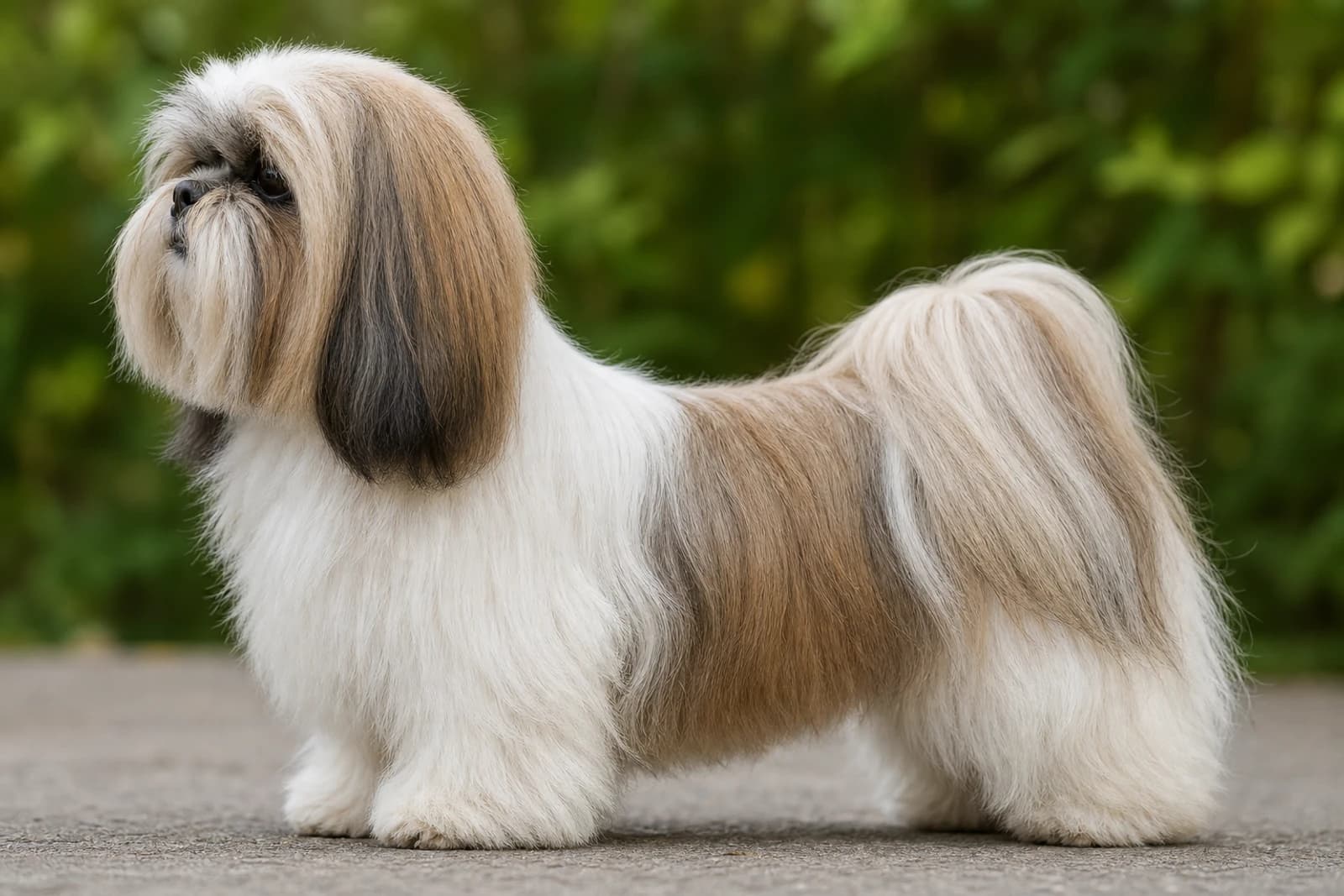
The Shih Tzu is a small, sturdy companion dog with a long, silky coat and a sweet, affectionate nature. Originally bred as lapdogs for Chinese royalty, they thrive on human companionship and make excellent pets for a wide range of owners—from families with gentle children to seniors seeking a devoted friend. Their moderate energy level suits apartment living, but they require regular grooming to maintain their luxurious coat. With a friendly, outgoing temperament, the Shih Tzu is a joyful addition to any home looking for a loyal and loving companion.
At a glance
- Size
- Small
- Height
- 11 in
- Weight
- 11–18 lb
- Life span
- 10 years
- Coat type
- long, silky double coat
- Group
- Companion
How much does a Shih Tzu cost?
Adopt / rescue
$75–$400
Usually includes spay/neuter, first shots, and a microchip.
Buy from a breeder
$700–$2,000
From a reputable, health-testing breeder.
Approximate USD. Prices vary widely by region, breeder, pedigree, age, and coat colour — adopting is the lower-cost and recommended route. Avoid suspiciously cheap “breeders”; they’re often puppy mills.
Estimate the full cost of a Shih Tzu →Shih Tzu photos
Views
Front, side, rear and top — the full silhouette.Poses
How the breed sits, lies, moves and plays.Puppy to senior
The breed across its whole life.Expressions
The breed’s range of moods.Close-up details
Eyes, ears, nose, paws, tail and coat.Coat colors
The breed’s recognized colors.Click any photo to enlarge. We show the Shih Tzu from every angle — three views, poses, life stages, expressions, close-ups, coat and colors.
Appearance & size
A Shih Tzu is built like a little lion — low, solid, and surprisingly sturdy under all that hair. They stand about 11 inches at the shoulder and weigh 11 to 18 pounds, fully grown. That’s a compact package with more bone and substance than you’d expect from a lapdog. When you pick one up, you feel a well-muscled body, not a fragile puffball.
The coat is the breed’s crown jewel: a long, flowing double coat that’s dense and straight. It can come in just about any color or pattern — solid black, white, gold, liver, brindle, or combinations with white markings. A classic look includes a white blaze on the forehead and a white-tipped tail, but there’s no wrong answer. The outer coat is slightly coarse to the touch, while the undercoat is soft and insulating. This coat will keep growing, so if you don’t clip it for easier care, you’re signing up for floor-length glamour and daily brushing.
From the front, the head grabs your attention immediately. It’s round and broad, with a distinct stop (the indentation between the eyes). The muzzle is short, square, and flat, ending in a nose that sits roughly level with the lower eye rim. That gives the classic “chrysanthemum-faced” look when the hair on the nose grows upward. Large, dark, round eyes are set wide apart, giving an expression that’s warm and attentive. Ears are set just below the crown and hang down, covered in long fringe that blends into the neck coat. You’ll notice the slight undershot bite — the lower jaw is a bit wider than the upper, so the teeth close in front of the lower teeth. It’s normal for the breed but worth checking for any breathing or dental issues.
Seen from the side, the Shih Tzu has a level topline and a body that’s slightly longer than tall, with a deep chest and well-sprung ribs. The neck is long enough to carry the head proudly, blending smoothly into laid-back shoulders. Legs are straight and muscular, with heavy bone for a small dog. The plumed tail curls tightly over the back, often lying to one side, and carries so much hair it can look like a fountain.
From the rear, the tail is the star — carried high and curving forward. The hind legs are straight when viewed from behind, with strong thighs and well-angled stifles. The coat parts naturally along the spine, falling evenly to both sides, which gives a symmetrical silhouette even when the dog is moving. Overall, you get the impression of a confident, balanced little dog who moves with a smooth, effortless stride and just enough swagger to remind you of his imperial Chinese origins.
History & origin
The Shih Tzu’s job description has always been short and sweet: sit on a silk cushion, warm a royal lap, and look like a living piece of art. The breed traces back to the palaces of ancient China, but its raw material came from Tibet, where small, lion-like dogs were bred by Buddhist monks and gifted to Chinese emperors as tributes. Over centuries—likely during the Ming and Qing dynasties—palace eunuchs took those Tibetan dogs and refined them into what we call the Shih Tzu, purposefully shrinking them into an even more luxurious, flat-faced companion that fit under the sleeve of an imperial robe.
By the 19th century, the Empress Dowager Cixi kept a kennel of Shih Tzus and controlled their breeding so tightly that they were virtually unknown outside the Forbidden City. That exclusive bubble didn’t pop until after her death in 1908, when palace dogs trickled out, and a few made their way to England in the 1930s. Soldiers returning from WWII brought more dogs back, and the breed’s numbers grew in the West. American Kennel Club recognition came in 1969, slotting the Shih Tzu into the Toy Group (now called the Companion Group). Along the way, the breed nearly vanished at least once, and all modern Shih Tzus trace back to just 14 dogs—seven males and seven bitches—used to resurrect the line in the mid-20th century.
What you see today is still very much the royal ornament of old: a small, sturdy dog standing about 11 inches tall and weighing 11 to 18 pounds, with that signature pushed-in face and flowing coat. They were never asked to herd, guard, or retrieve—just to exist beautifully and keep a lap warm for 10 years or so. That single-minded companion purpose is baked into every Shih Tzu’s personality, and it’s why they tend to make lousy guard dogs but excellent professional snugglers.
Temperament & personality
A Shih Tzu’s first job is you. This is a dog built from the ground up to be a personal companion, and his 11-pound frame is perfectly sized to share your chair, your bed, and your lap for as long as you’ll allow. Expect a shadow — he’ll follow you from room to room, lean against your leg while you cook, and curl into any available hollow of your body. That devotion cuts both ways: left alone for long stretches, many Shih Tzus develop barking or chewing habits that are rooted in plain isolation stress.
Charm with a stubborn streak
These dogs aren’t doormats. They can be surprisingly strong-willed, and they respond to consistent, respectful handling rather than a heavy hand. Your relationship works best when you treat a Shih Tzu like a small, benevolent roommate with firm opinions. He’ll learn house rules quickly with a treat-based nudge — a reward right after he goes outside is far more effective than scolding an indoor accident. Speaking of potty training, his instinct to remark familiar scent spots means you’ll need an enzyme cleaner to fully erase urine smells, or he’ll head straight back to the “approved” area.
Energy and day-to-day rhythms
A 10-year lifespan gives you plenty of time to settle into a quiet routine. He’s a companion breed, not an athlete. A couple of 15-minute walks plus a short romp inside usually satisfy his exercise needs. When excited, he often pops up onto his hind legs like a little prairie dog, and his whole rear end wiggles — a forward-leaning, loose-bodied posture that says, “I’m interested, let’s go.” A stiff, staring stance, on the other hand, is your clue he’s feeling defensive or overstimulated, and it’s a signal to give him space.
Around the household
Shih Tzus generally slide into family life smoothly, but small children need two clear rules: never bother the dog while he’s eating, and don’t loom over him when he’s resting. Resource guarding can surface in any dog if mealtimes feel unsafe. Hard chewers? Absolutely. Puppies gnaw to ease teething, and adults keep their jaws strong by working on firm toys. If he decides a chair leg is more appealing, a homemade citrus spray (boiled peels steeped in water) makes the forbidden item taste miserable without hurting him. A vinegar solution does double duty by neutralizing urine odors on floors.
He may be small, but a Shih Tzu takes his household watch seriously. A knock on the door often earns you a few sharp barks, though the tail usually starts wagging the moment the guest steps inside. Don’t be surprised if he greets visitors by bouncing up; that’s the emotional stimulation talking, and you can redirect it by asking for a “sit” before any petting happens.
Pay attention to the quieter signals, too. Lip licking, a big yawn out of nowhere, or a head turned away means he’s trying to settle things down — maybe you’re leaning in too close or speaking a bit too loudly. A calm, soft-eyed dog with a relaxed body is inviting interaction. A Shih Tzu who leans backward or tucks his tail is asking for retreat, not cuddles.
Good with kids, dogs & other pets
With children
A Shih Tzu’s patient, non-aggressive personality is exactly what you want when kids are in the picture. They rarely snap or overreact to clumsy handling, and that 11–18 pound body is sturdier than it looks. Still, their small size means a toddler’s overenthusiastic hug or a stumble can hurt them, so supervision is non-negotiable. Teach children to sit on the floor for cuddle time and to avoid picking the dog up — a wriggling Shih Tzu can slip and injure a leg.
Because these dogs were bred purely for companionship, they genuinely enjoy family chaos. They’ll tag along from room to room, settle on a lap during movie night, and soak up attention without getting overexcited. The catch: they hate being left out. If your household is empty for eight-plus hours every day, this isn’t the right fit — a lonely Shih Tzu can become clingy, vocal, or fretful.
With other dogs and cats
Shih Tzus typically get along with other dogs. They were never designed to work alone or guard territory, so aggression toward housemates is uncommon. Many do especially well with a second small dog, which gives them a buddy when you’re not around. Introductions still matter: take it slow, let them meet on neutral ground, and watch for any resource guarding around your lap or food bowls.
Cats are usually fine too. The breed’s low prey drive means a swishing tail isn’t a call to chase. If they grow up together, a Shih Tzu and a cat often ignore each other or become low-key napping partners.
Small pets and supervision
With rabbits, guinea pigs, and other caged animals, proceed carefully — not because Shih Tzus have strong hunting instincts, but because a curious dog can accidentally injure a tiny creature. Always supervise when they’re in the same room, and never leave them alone together. Many Shih Tzus do learn to coexist calmly, but every dog is an individual.
The socialization head start
What tips the scales in every category — kids, dogs, cats — is early, positive exposure. The window where a puppy’s brain is most open to new experiences closes around 16 weeks. A good breeder will have already introduced the litter to different people, household sounds, and safe dogs. Once your puppy comes home, keep that momentum going: short trips to a friend’s house, calm meet-and-greets with vaccinated adult dogs, gentle handling by friendly strangers. A Shih Tzu that misses out on this often grows into an adult who startles easily, hides from new faces, or gets shaky at the vet. Put in the effort during those first few months, and you get a confident, easygoing dog who’s genuinely comfortable no matter who’s visiting.
Trainability & intelligence
The Shih Tzu’s intelligence is the real deal — just not the kind that flips on command for a pat on the head. Bred strictly as palace companions, they never had to herd, guard, or retrieve. They learned early that a soft gaze and a well-timed paw could get a human to hand over anything. Training, then, is less about drilling obedience and more about outsmarting a charming little negotiator.
What actually works
Food. Small, high-value treats — pea-sized bits of chicken, cheese, or freeze-dried liver — turn a training session into something a Shih Tzu is willing to engage with. Praise and play matter, but they rarely beat a tangible payoff. Sessions stay short: 5–10 minutes max, ending on a win before the nose wanders off. Clickers or an upbeat “yes!” mark the behavior you want, and you reward immediately. Forget punishment. These dogs are sensitive to tone and will shut down if they feel corrected. Raise your voice and you’ll teach them to avoid you, not the mistake.
Where they’ll dig in their heels
That independent streak shows up most in house training. A Shih Tzu can take months longer than other breeds to get reliable. You’ll need puddles of patience, a strict schedule, and jackpot treats every single time they potty outside. Accidents aren’t spite; they’re just learning at their own pace. Rubbing a nose in it only creates anxiety and a dog who hides to pee.
Recall is another humbling spot. Low biddability means “come” competes with every interesting scent and distraction. Practice on a long training lead in a fenced yard with rewards that are worth sprinting for. Even then, a truly off-leash-reliable Shih Tzu is more exception than rule.
Building trust from day one
Early socialization — between 3 and 14 weeks — is non-negotiable. Gradually expose your puppy to different people, surfaces, sounds, and polite dogs. A poorly socialized Shih Tzu can become wary or snap at unfamiliar hands; a well-exposed one leans into the breed’s natural friendliness. The same gentle, gradual approach applies to all training. Breeds with this level of sensitivity, much like the Japanese Spitz, need trust-building first and commands second. When your Shih Tzu believes you’re fair and rewarding to be around, they’ll pick up almost anything a house companion really needs to know — on their own timetable, not yours.
Exercise & energy needs
Your Shih Tzu doesn’t need—and honestly shouldn’t get—long, strenuous walks. This is a small, flat-faced breed that tires quickly and can overheat or strain its heart if you push for distance. A couple of 10–15 minute strolls a day is plenty, and often indoor free play handles the bulk of their activity just fine.
Think short sessions spread across the day. Two or three 10-minute bursts of movement, whether that’s a sniffy walk around the block or a gentle game of fetch down your hallway, keeps a Shih Tzu physically content without stressing their breathing or joints. On hot or humid days, skip the walk entirely—indoor wrestling with a squeaky toy or chasing a rolled ball gets the heart pumping with zero risk of heat exhaustion.
Mental exercise matters just as much. These dogs were bred for companionship, not endurance, so a puzzle toy with hidden treats or five minutes of “find it” scent work goes a long way to burn off the mental restlessness that can lead to nuisance barking or chewing. Short, upbeat training sessions (think two or three minutes at a time) for tricks like spin or paw tap into their brain without their body overheating.
Because of their long back and potential for spinal issues, avoid high-impact jumping and lots of stairs. Stick to activities on level ground. If your Shih Tzu starts panting loudly, lying down, or falling behind, you’ve already crossed into too-much territory. Stop, offer water, and let them rest. The goal isn’t to tire them out in an athletic sense—it’s to keep them pleasantly busy and comfortable, matching their calm companion personality.
Grooming & coat care
No getting around it: that beautiful floor-length coat is a daily commitment. A Shih Tzu’s double coat — soft undercoat, long silky topcoat — mats like Velcro if you skip a day. Plan on 15–20 minutes of line brushing every evening. Work through the coat from the skin outward with a slicker brush (look for one with rounded pins), then go over every inch with a metal greyhound comb to catch tangles the brush missed. Pay extra attention behind the ears, the armpits, and the belly where friction creates knots you can’t see.
Bathe every 2–4 weeks using a gentle, dog-specific shampoo. Thorough rinsing and a force dryer or cool blow-dryer are non-negotiable — damp undercoat quickly turns into hot spots. A high-velocity dryer also blows out loose undercoat, which cuts down on matting.
Most owners keep their Shih Tzu in a “puppy cut” — an all-over shorter clip. You’ll still brush 3–4 times a week, but it’s far more forgiving than a full long coat. Whether you go long or clipped, you’ll need to trim the hair around the eyes with blunt-tipped scissors so it doesn’t poke, and keep the paw pads and sanitary area clean and cropped. A professional groomer every 4–6 weeks is the easiest rhythm for a short clip; every 2–3 weeks if you’re maintaining a show coat.
Floppy ears mean moisture and wax get trapped easily. Clean the ears weekly with a vet-approved solution and a cotton ball — never a Q-tip. Nails grow fast on these little house dogs; clip or grind them every 3–4 weeks, as long nails can splay the feet and cause joint discomfort. Teeth need daily attention: small breeds often battle periodontal disease early, so a daily brush with enzymatic toothpaste and a supply of dental chews go a long way.
Seasonal coat changes are subtle — Shih Tzus shed minimally, but the undercoat turnover still ramps up mats in spring and fall. Rake out dead undercoat more often during those months. In summer, a shorter belly clip can help them stay cool without shaving into the coat (which risks sunburn and damage to the guard hairs).
Start handling paws, ears, and mouth from day one, and never turn a grooming session into a wrestling match. A few treats and a calm attitude early on pay off every single day for the next decade.
Shedding & allergies
Shih Tzus shed more like you do than like a typical dog. Their long, silky coat is really hair, not fur — it grows continuously and falls out only when a strand reaches the end of its life cycle or breaks. Dead hairs tend to get caught up in the coat itself instead of drifting onto your couch. You’ll see that hair in the brush, not on your black pants.
That’s the trade-off. Without regular brushing, that trapped shed hair mats into tight knots against the skin, fast. A thorough line-combing every day or two pulls out the loose stuff before it tangles. You’ll also need a professional groomer every 4–6 weeks to keep the length manageable. So yes, you’re rarely lint-rolling the sofa, but you’re spending real time and money on coat upkeep.
Seasonal blowouts aren’t a thing for this breed. You may notice a slight uptick in loose hair in spring and fall, but it’s minor compared to a heavy double-coated dog. There’s no weeks-long flurry of fur.
Drool is essentially a non-issue. Shih Tzus have a dry mouth and don’t leave puddles or wet chin marks around the house.
Now the “hypoallergenic” reality. No dog is completely allergen-free — allergies are triggered by proteins in dander, saliva, and urine, not just hair. A Shih Tzu produces less airborne shed hair to carry dander around, which often makes life easier for mild allergy sufferers. But the long coat can also trap dust and pollen on walks, so you’re bringing those irritants inside. If allergies are severe, spend hours in a breeder’s home with adult dogs before committing. What you're really getting is a dog that keeps its shed hair to itself — until you comb it out.
Diet & nutrition
A Shih Tzu who’s even slightly over their ideal 11–18 lb feels those extra ounces in every joint—and in every breath. This is a breed that doesn’t need much food to stay well, but they often act like they do. Portion control matters more than the exact brand.
For a typical adult around 13–15 lb, start with about ½ cup of high-quality dry food split into two meals a day, or the equivalent in fresh food. Adjust up or down based on what you see and feel: you want a visible waist from above and ribs that are easy to feel under a thin layer of padding, not buried. If you’re feeding a commercial food, stick to the weight-based chart on the package, but treat it as a ceiling, not a target.
Puppy meal frequency breaks down like this:
- Up to 4 months: four evenly spaced meals.
- 4–6 months: three meals.
- After 6 months: transition to two meals a day, same as an adult.
When you bring a new puppy home, ease into whatever diet you’ll be feeding—start with lightly cooked, puréed meats, fish, fruits, and vegetables or a high-quality puppy kibble. Raw bones like chicken wings can be introduced around 12 weeks, always under supervision.
Senior Shih Tzus tend to slow down, and their waistlines show it. Gradually reduce portions as activity drops; there’s no need to cut protein unless your vet advises it. If teeth go missing, a quick purée of their usual meal aids nutrient absorption and makes eating comfortable.
Because this breed carries weight low and long, obesity rapidly worsens any tendency toward spinal or joint trouble. Couple that with a flat face that can make heavy breathing harder, and you’ve got every reason to keep them lean. Avoid rich, fatty treats—especially holiday table scraps—since they can trigger pancreatitis in small dogs. Use a puzzle bowl if your Shih Tzu inhales their food; it slows them down and gives their brain a workout. And never feed directly from the table. Serve any extra scraps in their own bowl afterward, or you’ll create a beggar with a memory like an elephant.
Health & lifespan
A Shih Tzu typically lives about 10 years. That’s not a long run for a small dog, and much of it comes down to the flat face, compact build, and a handful of inherited quirks that show up if nobody breeds or watches for them.
The most immediate thing you’ll deal with is the brachycephalic airway. Those short muzzles mean narrowed nostrils, an elongated soft palate, and a windpipe on the small side. In summer, a Shih Tzu can overheat in minutes — panting hard, gums turning bluish. Keep walks to early morning or evening when it’s hot, and never leave one in a parked car. Air conditioning isn’t a luxury; it’s a necessity in warm climates.
Eye problems are another big-ticket item. Because the eye sockets are shallow, the eyeballs sit prominently. A jolt, a collar yank, or rough play can cause a proptosis (eye pops out) — it’s a flat-out emergency. Even day-to-day, you’ll see corneal ulcers, dry eye, and lashes rubbing the surface. Look for squinting, tearing, or a cloudy spot, and get to a vet fast. Responsible breeders screen parents for inherited eye disease and won’t pair two dogs with known issues.
Dental crowding is a given in that tiny, pushed-in jaw. Shih Tzu teeth often overlap and trap plaque fast. Without daily brushing and a dental cleaning under anesthesia every year or two, you’ll see gum disease, rotten teeth, and eventually bacteria that hit the heart and kidneys. Start handling the mouth as a puppy, even if it’s just rubbing a finger on the gums, so the dog tolerates a brush later.
Patellar luxation (wobbly kneecaps) pops up in a lot of toy breeds, and Shih Tzus are no exception. You might see a little skip-step or a back leg held up for a stride, then popped back down. Mild cases don’t need much beyond keeping the dog lean, but severe ones require surgery. Extra weight makes every joint problem worse. An adult Shih Tzu should hover between 11 and 18 pounds; anything over that, and you’re asking those stubby legs to carry too much load. Use a measuring cup for kibble, not your gut.
The long, low back can be prone to intervertebral disc disease (IVDD). A sudden yelp, a reluctance to jump on the couch, or a drunken walk means immediate crate rest and a vet call. Ramps for furniture and no stairs help stack the deck in your favor.
Skin and ears deserve a once-over every few days. Folded ears trap moisture and yeast; the dense double coat can hide hot spots or flaky skin. Regular grooming isn’t just about looks — it lets you spot lumps, rashes, or ear gunk before they blow up.
Preventive care that actually moves the needle for this breed:
- Monthly heartworm prevention during mosquito season (and one month after), plus a year-round flea/tick plan your vet approves.
- A rabies vaccine on the legally required schedule — there is no effective treatment once clinical signs appear.
- A wellness exam every six to twelve months. Vets can hear a subtle heart murmur or catch an eye pressure change before you notice anything.
- Socialization that’s gentle and positive early on. A stressed Shih Tzu is more likely to bark incessantly or guard resources, and chronic stress quietly undermines physical health.
If you’re buying a puppy, ask the breeder for written proof of hip, eye, and patella clearances on the parents — OFA or CERF certificates, not just a quick vet note. A breeder who doesn’t screen is gambling with your dog’s next decade.
Watch your dog’s day-to-day rhythm. A Shih Tzu that suddenly skips a meal, pants at odd times, or refuses stairs isn’t being stubborn — something hurts or isn’t right. Catch it early, and ten years can feel a whole lot longer than the number suggests.
Living environment
Apartment vs. house
A Shih Tzu doesn’t need a house—he needs you. These dogs were bred purely as indoor companions, and a one-bedroom apartment with attentive owners suits them just as well as a house with a big footprint. At 11–18 lb and about 11 inches tall, they take up very little physical space, and their modest exercise needs mean a few short hallway play sessions can cover half the day’s activity.
Yard needs
A securely fenced yard is a bonus, not a requirement. It’s handy for a quick potty trip or a two-minute zoomie, but if you don’t have one, leash walks and a toss-the-toy routine inside fill the gap easily. These aren’t dogs who gaze longingly at a wide-open lawn; they’d rather be on the couch next to you. If you do have a yard, check for fence gaps or sharp drops—a curious Shih Tzu will investigate an opening.
Climate tolerance
The flat face that makes them so endearing also makes them heat-intolerant. Shih Tzus overheat fast in warm or humid weather. Walks on hot days belong in the early morning or late evening, and sometimes swapping a walk for a scent game in air conditioning is the smartest play. In cold weather, their long double coat gives them decent insulation, but they’re low to the ground and can get chilled quickly when it’s wet or windy. A sweater on winter potty breaks isn’t just cute—it’s practical.
Noise and time alone
Shih Tzus are alert little watchdogs. They’ll bark at a knock, a delivery truck, or a squirrel on the windowsill, which makes them a reliable doorbell. That trait can tip into nuisance barking if they’re left alone for long stretches or if every bark gets a big reaction. Teaching a “quiet” cue and ignoring demand barking keeps it manageable.
The real limit is time alone. These dogs bond fiercely and often struggle to cope when their people are gone for a full workday. Separation anxiety can show up as howling, destructive chewing, or accidents. They thrive in homes where someone is around most of the day—retirees, work-from-home setups, or families with staggered schedules. If you must be away, build up absences slowly from puppyhood, leave a frozen food puzzle, and consider a midday dog walker. A second dog offers company but doesn’t replace their deep attachment to humans. A lonely, bored Shih Tzu is not a quiet one, and managing their alone time takes honest planning.
Who this breed suits
If you want a dog who’s happier curled on your lap than chasing a tennis ball across a muddy field, the Shih Tzu was practically designed for you. These 11–18 lb charmers were bred solely as indoor companions, and they take that job seriously — they’ll follow you from room to room, nap on your feet, and greet you like a long-lost friend every time you walk through the door. They thrive in apartments, condos, or any home where they can be near their person most of the day.
First-time owners get along beautifully with Shih Tzus. The breed is famously friendly and forgiving, not prone to the intense wilfulness or high-octane drive that can overwhelm a novice. Training a Shih Tzu often involves a little patience with housebreaking, but they’re eager to please and respond well to positive, reward-based methods. Seniors and singles looking for a steady, low-exercise housemate will find a Shih Tzu is content with short daily walks and indoor play — 20–30 minutes of gentle activity is usually plenty. Families with respectful older children also do well; the dog’s sturdy build for its size means it’s less fragile than some toy breeds, but it still won’t tolerate rough handling.
Think twice if you’re away from home 10 hours a day. A Shih Tzu’s devotion crosses into velcro territory, and long stretches of solitude can lead to separation anxiety and nuisance barking. This isn’t the breed for someone who wants a jogging buddy or a weekend hiking partner — the flat face that gives the Shih Tzu its endearing expression also makes it prone to overheating and breathing difficulties during strenuous exercise. You also need to be honest about grooming. That floor-length, flowing coat — or even a shorter trim — requires daily brushing to prevent painful mats, plus regular baths and frequent trips to a professional groomer every 4–6 weeks. If the time or ongoing expense of that routine feels like a burden, look elsewhere. Finally, households with toddlers can be a mismatch; a clumsy lunge or an ear pull can make a typically mellow Shih Tzu snap. For someone ready to trade a hard-core running partner for a dedicated couch companion who lives 10 years and thrives on simple togetherness, the Shih Tzu slots in perfectly.
Cost of ownership
A well-bred Shih Tzu puppy from a health-testing breeder costs $1,500–$3,000, with champion bloodlines pushing the price past $4,000. You’ll occasionally spot them in rescues for $200–$600, but purebred adults are uncommon and get adopted quickly. Be wary of $500 “deals” — they often skip the genetic screening that matters for this breed’s eyes, breathing, and knees.
Monthly expenses
Once your Shih Tzu is home, the real ongoing cost is upkeep. Here’s what to budget each month:
- Food: $25–$40
This dog eats only about ½ to 1 cup of kibble a day. High-quality small-breed formulas aren’t cheap, but a single bag lasts a while. - Grooming: $70–$120
This is where Shih Tzu ownership gets pricey. Most owners keep the coat in a short puppy cut to avoid daily matting, but you’ll still visit a pro groomer every 4–6 weeks at $60–$100 per session. At home, you need a pin brush, metal comb, and detangler — figure another $10–$15 a month for supplies. Unless you learn to clip the coat yourself, grooming is a non-negotiable line item. - Veterinary & prevention: $40–$60 (routine), plus a cushion for surprises
Annual shots, exams, heartworm, and flea/tick prevention average $40–$60 a month spread across the year. However, this breed’s flat face and prominent eyes make ulcers, dry eye, corneal scratches, and breathing problems common. Patellar luxation and dental crowding add to the risk. A single eye injury or dental extraction can run $500–$2,000, so keep a separate vet fund or consider insurance. - Pet insurance: $35–$60
Comprehensive policies for a small purebred often fall in this range. Many owners find the premium worthwhile, especially if a chronic eye condition crops up early. - Miscellaneous: $15–$25
Poop bags, toys, a new bed, occasional pee pads if you potty-train indoors, and licensing.
Combined, you’re looking at roughly $200–$300 per month for the basics. The grooming commitment alone means this little companion never slides into the low-maintenance category.
Choosing a Shih Tzu
You’ve got two solid paths to a Shih Tzu: a responsible breeder or a rescue. Both work, but the rules differ.
Start with a breeder who treats health clearances as non-negotiable. A Shih Tzu stands about 11 inches, weighs 11–18 pounds, and typically lives around 10 years—but those years can get expensive if you skip screening. Ask to see proof both parents were tested and cleared for:
- Luxating patellas (wobbly kneecaps are common in small dogs)
- Hip dysplasia, even in little breeds
- Eye problems like progressive retinal atrophy, cataracts, and dry eye—look for current CERF or CAER exams
- Brachycephalic airway issues (noisy breathing isn’t cute, it’s a red flag that may need surgery)
A good breeder raises puppies underfoot, lets you meet the dam, and never pressures you. Red flags: litters always available, multiple breeds on the property, no health paperwork, a dam who seems skittish or hides, and puppies sent home younger than 8–10 weeks. Pick the puppy who waddles over to investigate your shoelaces—not the one cowering or bullying littermates. You’re after a companion dog, so look for curiosity and a calm, friendly nature.
Rescue is the other route. Many Shih Tzus wind up in shelters because their coat upkeep surprised a previous owner. Adopting lets you skip puppy chaos and often gives you a dog with a known adult temperament and health status. Breed-specific rescues can match you with a dog suited to a busy household or a quieter rhythm. Ask about vetting for eyes and knees, even though you won’t get the genetic guarantees a breeder provides.
Whatever path you take, book your first vet visit promptly for a baseline exam and a frank conversation about their flat-faced breathing. That way you’re not guessing if that little snore is normal.
Pros & cons
- A lapdog that actually lives up to the name. Shih Tzus were bred for companionship, not herding or guarding, so they genuinely want to be with you — on the couch, in your home office, wherever.
- Apartment-sized through and through. At 11 inches tall and 11–18 pounds, they fit into small spaces without knocking things over. A few short walks and indoor play sessions cover their exercise needs; they’re not demanding a daily 5K.
- Friendly, not fragile. Well-socialized Shih Tzus tend to get along with respectful kids, other dogs, and even cats. Their even-keeled nature makes them a natural in multi-pet households.
- Low prey drive means simpler outings. You won’t be dragged toward every squirrel. A stroll around the block keeps them happy, and they’re content to sniff instead of chase.
- That coat is a commitment, not a casual brush-out. The long, flowing double coat mats fast if you skip a day. Many owners keep their Shih Tzu in a short “puppy cut” to save time, but even then you’re looking at daily brushing and a professional groom every 4–6 weeks. Factor in regular eye cleaning, too — those big, beautiful eyes tend to tear-stain and collect gunk.
- Housebreaking can try your patience. Small bladder, stubborn streak, and a dislike for rain or cold mean accidents happen well past puppyhood. You’ll need a consistent schedule and a tolerant attitude.
- Brachycephalic risks are real. Their flat face makes them prone to overheating, snoring, and breathing troubles in humidity or during overexertion. They also can’t swim worth a darn, so pool time requires constant supervision.
- Health issues add up. Responsible breeders screen for hip dysplasia, luxating patellas, and eye problems like progressive retinal atrophy, but the breed is still susceptible to allergies, ear infections, and dental crowding. Typical lifespan hovers around 10 years, and later years often bring expensive senior care.
- Velcro dog to the extreme. If you’re gone 10 hours a day, expect a howling, anxious mess — or a neighbor who complains. Separation anxiety runs deep in a breed bred to sit on laps all day.
Similar breeds & alternatives
Lhasa Apso
People often mix up the Shih Tzu and Lhasa Apso, but the Lhasa is a different animal. It typically weighs 12–18 pounds and stands a little taller, with a longer muzzle that avoids the Shih Tzu’s flat-faced breathing risks. The Lhasa’s coat is just as heavy but has a harder, more weather-resistant texture. Temperament is the real fork in the road: Lhasas were bred as indoor watchdogs in Tibetan monasteries, so they’re naturally reserved with strangers, independent, and quicker to sound an alarm. A Shih Tzu is more likely to greet a new person as a long-lost friend. Both need daily grooming, but the Lhasa can be less demanding in the personality department if you want a dog that doesn’t crave constant lap time. Life span runs 12–15 years, notably longer than the Shih Tzu’s 10-year average.
Pekingese
If the Shih Tzu’s flat face and small size appeal to you but you want even less go-go-go, the Pekingese is worth a look. Pekes run 7–14 pounds, stand lower to the ground, and carry themselves with a rolling gait. They share the brachycephalic anatomy, so heat sensitivity and respiratory caution apply just as much—if not more. The coat is profuse but tends toward a coarser outer layer. Personality differences are sharp: Pekes are famously self-contained, sometimes aloof, and less likely to solicit constant attention. A Shih Tzu is a more outgoing companion who actively follows you around; a Peke often prefers to hold court from a cushion. Exercise needs are minimal—a short stroll and indoor play suffice. Both breeds demand serious grooming commitment.
Maltese
The Maltese stays even smaller at 4–7 pounds, making it a pure toy breed where a Shih Tzu can tip the scales at 18 pounds. The show-stopping white coat is silky, single-layered, and sheds far less than the Shih Tzu’s double coat, but it mattes just as fast and requires daily brushing. Temperament is softer: Maltese are gentle, playful, and famously attached to their people—similar to the Shih Tzu, though without the occasional stubborn streak. They adapt well to apartment life and don’t need a yard, but their tiny size makes them more fragile around young children. Life expectancy is a robust 12–15 years, a meaningful difference from the Shih Tzu’s 10-year figure.
Havanese
For a slightly larger, more trainable alternative, the Havanese weighs 7–13 pounds and stands about 8–12 inches—close to the Shih Tzu’s 11-inch height but often lighter. The coat is long and silky but can be corded or brushed out, and it’s less profuse around the face, so you skip the topknot and constant eye wiping that come with a Shih Tzu. Havanese are famously biddable and pick up tricks quickly, whereas a Shih Tzu might decide training is optional. Energy level is a bit higher: they need daily play and a couple of short walks. Both breeds are true companion dogs that want to be with you, but the Havanese is a better choice if you want a small dog with more interactive smarts and fewer breathing problems.
Fun facts
- The name 'Shih Tzu' means 'Lion Dog' in Chinese.
- They were cherished by Chinese royalty and were often kept in palaces.
- Their facial hair grows in a distinctive pattern, earning them the nickname 'chrysanthemum-faced dogs'.
- They are an ancient breed with roots in Tibet and China.
Frequently asked questions
- Are Shih Tzus good with children?
- Shih Tzus can be affectionate and patient with children when properly socialized and supervised. Their small size makes them vulnerable to rough handling, so interactions with young kids should be monitored. With gentle treatment, they often form strong bonds with family members of all ages.
- Do Shih Tzus shed a lot?
- Shih Tzus are a low-shedding breed, though they do lose some hair, especially if kept in a long coat. Regular brushing helps minimize loose hair around the home. Many allergy-sensitive owners find them more tolerable than heavy-shedding breeds.
- How much exercise does a Shih Tzu need?
- A Shih Tzu typically requires moderate exercise, such as brief daily walks and indoor play. They are not high-energy dogs and often adapt well to their owner's activity level. Avoiding overexertion in hot weather is important due to their flat faces.
- Are Shih Tzus easy to groom?
- Grooming a Shih Tzu can be demanding, especially if their coat is kept long. They need daily brushing to prevent mats and tangles, along with regular baths and professional trims every few weeks. Many owners opt for a shorter 'puppy cut' to reduce maintenance.
- Can Shih Tzus live in apartments?
- Shih Tzus tend to be well-suited for apartment living due to their calm temperament and moderate exercise needs. They are generally quiet indoors, though some may bark at unfamiliar sounds. Consistent training helps keep any nuisance barking to a minimum.
- Are Shih Tzus good for first-time dog owners?
- Shih Tzus can be a good choice for first-time owners because of their friendly, adaptable nature and relatively low exercise requirements. However, their grooming needs and potential for stubbornness during training may require extra patience and commitment.
Tools & calculators for Shih Tzu owners
Quick estimates tailored to Shih Tzus — pre-filled with this breed’s size where it matters.
Articles & stories about the Shih Tzu
Sources & standards
This profile follows recognized breed standards from the American Kennel Club (AKC) and the Fédération Cynologique Internationale (FCI), along with established veterinary and breed-club guidance. These describe general breed tendencies — every dog is an individual.
Owner stories
Have a Shih Tzu? Share your experience — grooming tips, personality quirks, anything goes.