

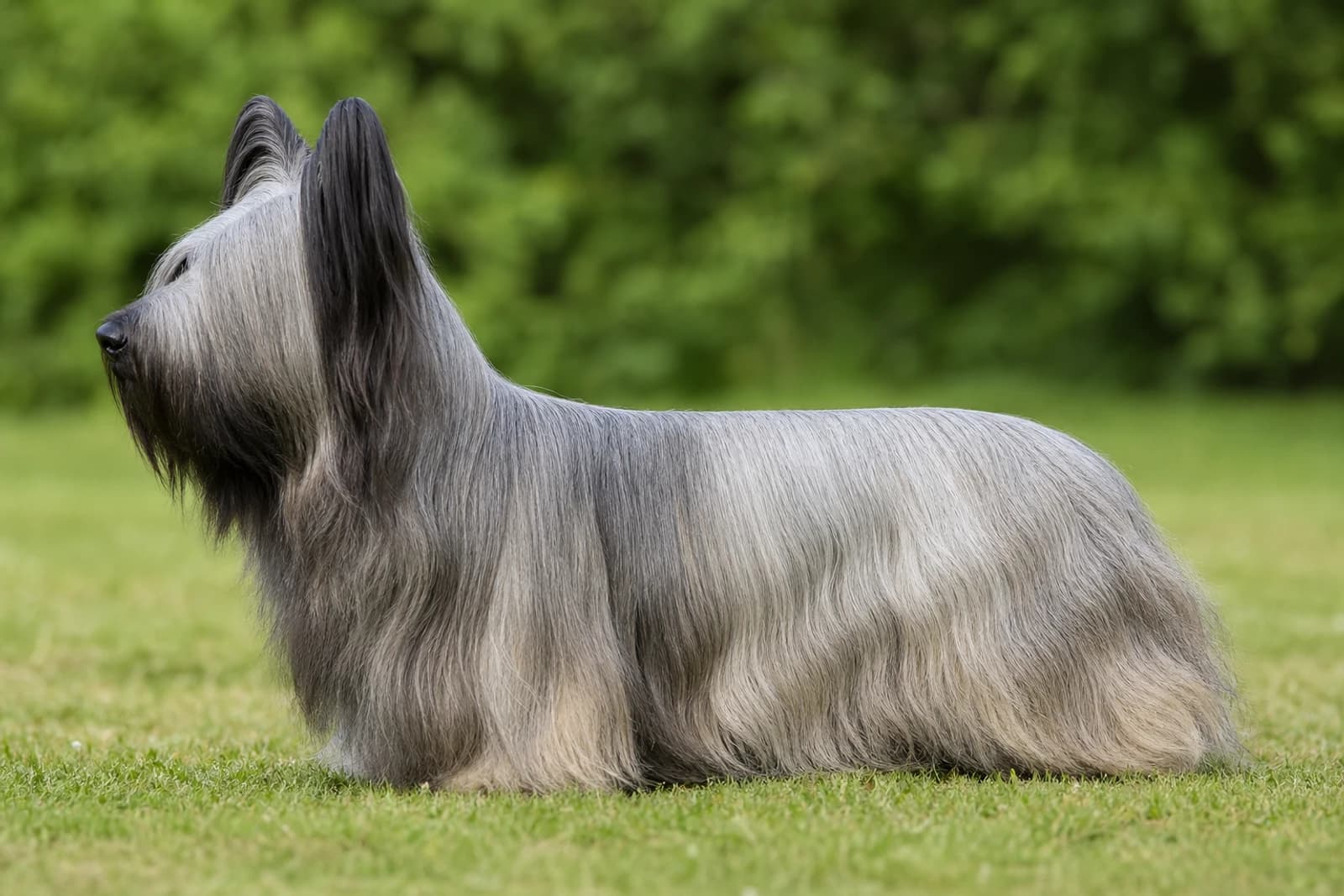
The Skye Terrier is a small, long-bodied terrier from Scotland known for its loyalty and distinctive long, flowing coat. This breed suits experienced owners who appreciate a dog with a mind of its own – they are independent yet deeply devoted. While affectionate with their families, they can be reserved with strangers and may exhibit typical terrier stubbornness and prey drive. Their moderate energy level makes them adaptable to apartment living with daily walks, but their long coat demands regular grooming. Best for those seeking a spirited companion with a rich history, including the famous Greyfriars Bobby.
At a glance
- Size
- Small
- Height
- 10 in
- Weight
- 24–40 lb
- Life span
- 12–15 years
- Coat colors
- black, blue, grey, silver, fawn, cream
- Coat type
- long, straight, double coat
- Origin
- United Kingdom (Scotland)
How much does a Skye Terrier cost?
Adopt / rescue
$75–$400
Usually includes spay/neuter, first shots, and a microchip.
Buy from a breeder
$700–$2,000
From a reputable, health-testing breeder.
Approximate USD. Prices vary widely by region, breeder, pedigree, age, and coat colour — adopting is the lower-cost and recommended route. Avoid suspiciously cheap “breeders”; they’re often puppy mills.
Estimate the full cost of a Skye Terrier →Skye Terrier photos
Views
Front, side, rear and top — the full silhouette.Poses
How the breed sits, lies, moves and plays.Puppy to senior
The breed across its whole life.Expressions
The breed’s range of moods.Close-up details
Eyes, ears, nose, paws, tail and coat.Coat colors
The breed’s recognized colors.Click any photo to enlarge. We show the Skye Terrier from every angle — three views, poses, life stages, expressions, close-ups, coat and colors.
Appearance & size
The Skye Terrier is a long, low dog — a stretched rectangle on very short legs. At the withers, a full-grown Skye stands about 10 inches tall, but don’t mistake that modest height for a toy breed’s frame. These dogs carry real bone and muscle, tipping the scales anywhere from 24 to 40 pounds. That heft, combined with a deep chest and substantial ribcage, makes them feel solid and surprisingly dense when you lift one.
From the side, the silhouette is the breed’s signature. The body is exceptionally long and level-backed, ending in a dangling, well-feathered tail that never curls or rises above the topline. Legs are so short that the coat’s fringe often brushes the ground, yet the dog should never appear squat or clumsy. A strong, arched neck flows into well-laid-back shoulders, creating a smooth, horizontal top line that reads as purposeful rather than exaggerated.
The head is long and powerful, with a strong muzzle that tapers only slightly from a broad skull. Dark, medium-sized eyes sit close together, giving a keen, intelligent expression. Two ear types are acceptable: prick ears, set high and gracefully feathered, or drop ears that hang close to the skull. Both are fully functional and don’t alter the working ability.
The double coat is the breed’s crowning feature. A soft, woolly undercoat lies beneath a straight, hard outer coat that can reach the floor. The hair parts naturally down the center of the back and falls in smooth curtains, with heavy feathering on the ears, tail, and legs. Even the face carries a soft fall of hair that often obscures the eyes if not tied back. Colors run from black, blue, dark gray, light gray, and silver to fawn and cream, typically with darker pigmentation on the ears, muzzle, and tail tip contrasting a lighter body. White markings are virtually non-existent — solid and shaded hues are the norm.
From the front, the coat frames the face like a mantle, while the deep, moderately broad chest is visible between short, straight front legs. Viewed from the rear, the tail hangs straight down with rich feathering, and the muscular, well-angulated hindquarters drive the long body in a ground-covering stride that looks almost effortless.
History & origin
The Skye Terrier took shape on the Isle of Skye, where the raw Scottish Hebrides demanded a dog with grit, a weatherproof coat, and no hesitation about going to ground after badger, fox, and otter. For centuries, crofters and farmers relied on these little terriers — roughly 10 inches at the shoulder but a solid 24 to 40 pounds — to protect livestock and rid stone-walled fields of vermin. The long, low body let the dog squeeze into narrow earths; the hard outer coat and soft underwool fended off biting wind and constant damp.
Where the type actually began is a mix of fact and fireside tale. One persistent story points to small, long-bodied dogs that survived the wreck of a Spanish Armada ship off Skye’s coast in 1588. According to the legend, those castaways bred with local terriers and stamped the modern breed with its characteristic length. Whether the shipwreck story holds water or not, a distinct terrier of this general build was already rooted in the Hebrides by the 1600s, described in early accounts as a fearless vermin-killer equally at home in rocky dens and on open hillsides.
For most of its working life, the Skye Terrier was a purely practical dog — prized for its gameness, not its looks. That shifted in the 19th century when Queen Victoria, an avid dog lover, became smitten with the breed. Her Skye Terrier, Islay, went everywhere with her, and the royal spotlight turned the rough island working dog into a Victorian sensation. Breed clubs formed, a formal standard emerged (allowing both drop and prick ears), and the dog’s long, low, heavily-coated silhouette became a familiar sight in the show ring. Underneath the polished presentation, though, the working spirit remained — a well-bred Skye still held the tenacity and independent judgment of its ancestors.
Two world wars and changing tastes nearly ended the breed. By the middle of the 20th century, registrations had dropped so low that the Skye Terrier faced real extinction. It never fully bounced back. Today it’s listed as a Vulnerable Native Breed by The Kennel Club, with only a few dozen puppies registered each year. If you run across one, you’re looking at a rare piece of living Scottish history — a hardy, self-assured terrier that earned its keep on the Isle of Skye and still walks with a quiet dignity that expects you to respect its past.
Temperament & personality
You get a Skye Terrier for the personality — and that personality is equal parts loyal, stubborn, and courageous, packed into a surprisingly sturdy 24–40-pound frame. This isn’t a terrier that bounces off the walls, but don’t mistake a calm, watchful presence for low energy. A Skye is always taking mental notes: who belongs, who doesn’t, and where you are at all times.
Loyalty with a one-person leaning. Skyes bond hard with their own people, often choosing a particular favorite. They’re affectionate without being clingy — a quiet lean against your leg or following you from room to room is their love language. Strangers get polite distance, not instant tail wags. That wariness makes them excellent watchdogs; a Skye rarely barks for no reason, but you’ll hear about the delivery truck every single time.
Brains over biddability. This breed thinks for itself, and that can slide into outright stubbornness. A Skye isn’t interested in mindless repetition. Training works best when it’s a respectful negotiation, not a power struggle. Harsh corrections tend to backfire — these dogs will simply dig their heels in. Consistent, creative, reward-based engagement gets far more out of a Skye than force ever will.
Territorial instincts run deep. Like many terriers, Skyes can be possessive of their homes and people. Indoors, urine marking may surface if a household member leaves for a while or if a guest’s scent feels unfamiliar. Remove accidents with an enzymatic cleaner that destroys the odor cue; a vinegar spray (white and cider vinegar mixed) can also neutralize the smell and discourage re-soiling. Reward outdoor elimination immediately with a treat — it’s the fastest way to cement the right habit.
Chewing as a lifestyle. Puppies chew to explore and soothe teething pain; adults keep their jaws strong and teeth clean by gnawing on hard objects. A Skye will find something to chew. Keep appropriate chews handy and protect off-limits items with a homemade citrus spray (boil citrus peels in water, cool, and apply). It’s a safe, effective deterrent that won’t harm your dog or your furniture.
Behavior with the household. A well-socialized Skye can thrive in a family, but this is not a push-button kid dog. Young children need clear rules: never interrupt the dog while eating, and respect calm, quiet resting spaces. Food-guarding can emerge if meals become a free-for-all. Early, positive introductions to other dogs help blunt same-sex aggression and a general suspicion of strange canines. Expect a backward lean and stiff posture if the dog feels threatened; a loose, soft-eyed body and a relaxed tail mean you’re in the clear. Lip licking, yawning, or turning the head away are the Skye’s early requests for space — heed them before a stare stiffens into something sharper.
This is a dog that repays respect with fierce devotion, but the first two years demand patience and honest self-assessment. A Skye isn’t for every home, and that’s exactly how the breed likes it.
Good with kids, dogs & other pets
A well-socialized Skye Terrier is surprisingly patient and gentle with respectful children. This breed’s steady, non-aggressive nature shines in a calm household where kids know how to interact with a small dog. At 10 inches tall and 24–40 pounds, a Skye is sturdy enough to handle affectionate play, but still vulnerable to clumsy grabs or falls. Toddlers need close supervision—and every child in the home should learn to avoid hovering over the dog, pulling ears, or interrupting meals. Because Skyes can be thin-skinned emotionally, loud shouting or roughhousing can make them withdraw. It’s not about the dog being fragile; it’s about building mutual trust.
One quirk that directly affects family life: Skye Terriers were bred as close companions, and they want to be with their people. A Skye left alone for long stretches or exiled to the backyard will often develop separation anxiety—barking, chewing, and misery. This is not a dog for a household where everyone is gone 9-to-5 unless you’re ready to arrange a midday walk or doggy daycare. The ideal home has someone around most of the day.
With other dogs, the picture depends heavily on early socialization. Puppies raised with a friendly, balanced adult dog often form a tight bond, and ongoing positive exposure to new dogs during the critical 8–16 week window can produce a Skye that ignores or politely greets unfamiliar canines. Without those experiences, however, many adults become dog-selective or reactive, especially around pushy dogs. They’re not fighters by nature, but a sensitive Skye backed into a corner may snap. Same-sex aggression can crop up. Controlled playdates with calm dogs work; chaotic dog parks usually don’t.
Cats and small pets are where terrier instincts override patience. Skye Terriers were originally sent after badgers and foxes, and that hardwired drive to chase and grab a fleeing creature is alive and well. A Skye raised with a confident indoor cat from puppyhood might coexist peacefully, but a skittering hamster, rabbit, or pet bird will almost certainly trigger a lightning-fast pursuit. Keep pocket pets in secure enclosures, and never leave any small animal unsupervised with a Skye. Supervision and solid “leave it” training help, but they don’t erase centuries of instinct. If you have a multi-species household, you’ll need to manage the environment, not just hope for the best.
Trainability & intelligence
Skye Terriers are sharp as a tack, but they didn’t read the manual on blind obedience. Bred to work independently on Scottish farms, this 24–40 pound dog thinks for himself—and training is about earning his respect, not giving orders. He learns new cues faster than you’d expect, especially when there’s something in it for him. High-value treats, a favorite squeaky ball, or a burst of genuine praise work better than any correction.
Punishment backfires fast. A Skye remembers roughness and will either shut down or turn smoothly evasive. You’re building trust, not scoring points, so drop the heavy-handedness entirely. Keep sessions short and game-like. Five minutes of lively practice trumps half an hour of drilling—he’ll simply lose interest and go find his own entertainment.
- Recall is the big hurdle. Once his nose locks onto a scent, your voice can become background noise. Some owners never achieve dependable off-leash recall; a long line or a securely fenced area often becomes a way of life.
- Socialization needs to start early. The 3- to 16-week window is critical. Expose him gently to unfamiliar people, calm dogs, different surfaces, and everyday sounds. Without it, a Skye can grow into a suspicious adult who defaults to barking at anything new.
- Consistency makes or breaks you. If one family member lets him launch onto the couch and another scolds him for it, he’ll figure out the loophole instantly. Pick your rules and stick to them, using the same cues every time.
Motivation shifts from dog to dog. Some will work happily for a crinkly treat bag, others for a tug session. Find what lights him up and use it to reinforce the behaviors you want. A Skye Terrier with a solid foundation still has plenty of opinions—but he’ll choose to cooperate because the relationship you’ve built makes cooperating the best option.
Exercise & energy needs
The Skye Terrier doesn’t need a marathon runner—but don’t mistake that for a couch potato. Plan on 30 to 45 minutes of real exercise a day, split into at least two outings. A couple of 15- to 20-minute walks on a harness, ideally with sniff stops where your dog can work his nose, hits the sweet spot. These terriers were bred to dig after vermin, so they’re built for short bursts of purposeful activity, not endless pavement pounding.
- Walks: Two 15–20 minute walks daily. Let them set the pace, and weave in plenty of sniffing time—a Skye Terrier’s brain lights up when he tracks a scent.
- Play & mental work: A quick game of tug, a hide-and-seek session with a favorite toy, or a food puzzle that demands problem-solving. Scent games (hide treats in a snuffle mat or around the room) are gold. A 10-minute nose-work session can wear out their busy mind as effectively as another walk.
- What to avoid: Skyes have a long back and short legs. High-impact moves—jumping off furniture, chasing a Frisbee in the air, repetitive stair climbing—put unnecessary strain on their spine. Stick to ground-level activity, and use ramps or steps if you’re serious about saving their discs.
Because they’re independent thinkers with a terrier’s persistence, boredom can turn into nuisance barking, digging at the couch cushions, or outright anxiety. Consistent daily activity isn’t optional; it’s your best tool for preventing that tightly wound edge. On days when the weather traps you indoors, a 10-minute trick-training refresher (sit-stay, spin, find-it) combined with a puzzle toy keeps their mind from chewing on trouble.
Most adult Skye Terriers settle into this rhythm nicely, but puppies and adolescents need more frequent, shorter spurts of play and training scattered through the day—five minutes here, ten minutes there—to burn off puppy zoomies without overdoing it. Seniors still want that walk and sniff, just dialed back in intensity.
A fenced yard is helpful, but never assume a Skye will guard an open gate; prey drive and a bold nature can lead them off after a squirrel. Off-leash time is safest in a securely enclosed area with a solid recall—something you’ll build over time, not a given with this breed.
Grooming & coat care
The Skye Terrier’s coat is one of the most distinctive features of the breed — a long, straight, hard outer layer that falls to the floor, paired with a soft, dense undercoat. That combination traps loose hair and debris, so thorough grooming isn’t optional. Plan on a full brushing at least every other day, using a metal pin brush or a slicker brush with rounded pins to work through the outer coat, followed by a long-toothed metal comb right down to the skin. The woolly undercoat mats easily, especially behind the ears, under the front legs, and where the harness rubs. A spritz of water or a light coat conditioner helps break static and prevent breakage while you work.
Bathe your Skye roughly every four to six weeks — or whenever your nose says it’s time — with a gentle dog shampoo. Fully dry the coat to the skin, because damp undercoat is a fast track to hot spots and skin irritation. If you’re not showing, you can keep the coat manageable by trimming the feet, the hair between the paw pads, and the sanitary area with blunt-tipped scissors. Avoid shaving the body; it changes the hard texture of the outer coat and the undercoat can regrow unevenly. The long beard and mustache collect food and water, so wipe them daily, and check for yeast buildup around the lower lip.
Weekly nail trims are a must — those low-to-the-ground feet don’t wear claws down naturally. Clean the ears weekly with a vet-approved solution, and brush teeth several times a week to keep tartar in check. During spring and fall, the undercoat blows out heavily. You’ll need to brush more often during those seasons — daily if you can — to clear the dead hair before it mats. Stick with the comb; it’s your best tool for catching the loose undercoat before it turns into a solid felted layer.
Shedding & allergies
The Skye Terrier is a low-shedding breed, but “low” doesn’t mean zero. You’ll spot stray hairs on dark pants now and then, just far fewer than with a typical double-coated dog. That long, straight outer coat actually traps dead hair against the body, so most of what comes loose ends up in your brush instead of floating into your air vents. Neglect the brushing, however, and mats lock everything in. When you finally work a comb through a matted coat, you’ll release a surprising amount of fluff all at once.
Seasonal shedding is real. Twice a year—usually spring and fall—the soft, woolly undercoat lets go in a bigger way. During those weeks, daily line brushing with a pin brush and metal comb keeps the worst of it contained. Stay ahead of it, and you’ll only deal with a few tufts; fall behind, and you’ll find tumbleweeds of grey undercoat drifting across the floor.
Drool is a non-issue. Skye Terriers have tight, dry lips and aren’t jowl-y. You won’t find chin-wet spots on your couch or a slobbery leg after a greeting. Any sudden, noticeable drooling points to a dental issue or mouth injury—not a breed habit.
As for allergies: no dog is hypoallergenic, but a properly groomed Skye comes close to being a thoughtful match for many allergy sufferers. The breed sheds minimally, producing less airborne dander than heavy shedders. And because the coat holds onto dead hair and skin cells until brushed out, you get less of it circulating in your home. There’s a trade-off, though. That floor-length coat is a magnet for pollen, dust, and grass clippings. If you’re allergic to what a dog drags in from outside—not just the dog itself—you’ll need to wipe the coat down after walks and rinse off muddy bellies. A monthly bath with a gentle shampoo keeps allergen load manageable, but over-bathing strips the harsh outer coat of its natural oils, leading to dry, flaky skin and more dander. Find a bathing rhythm that respects your individual dog’s skin, and keep the brush sessions frequent—that’s where the real cleanup happens.
Diet & nutrition
The single most important diet rule for a Skye Terrier: keep him lean. Those short legs and long, low body put real stress on his spine, and even a few extra pounds can accelerate disc trouble you won’t see until it’s serious. Portion control isn’t a suggestion — it’s the foundation of keeping him sound.
Meal frequency and amounts
Feed an adult Skye Terrier twice a day. A 25 lb dog needs roughly 500–600 kcal daily; a 40 lb dog may need 700–800 kcal. That usually works out to 1 to 1½ cups of high-quality dry kibble, split into two meals, but calorie density varies — always measure by weight and the feeding guide on the bag. If you feed raw or home-cooked, build meals around animal protein (about 60%), with the rest coming from dog-safe vegetables, fruit, and small amounts of digestible grains like pearl barley or white rice.
Puppies need more frequent fuel. From 8 weeks to 4 months, give four evenly spaced meals. Drop to three meals until about 6 months, then move to the adult two-meal schedule. Transition any new food gradually over a week, starting with lightly cooked and puréed meats, fish, and vegetables, or a premium puppy kibble. If you’re experienced with raw feeding, supervised raw chicken wings can be offered around 12 weeks.
Weight and portion control
Skye Terriers often have a healthy appetite and will happily overeat if given the chance. Never free-feed. Measure every portion, and remember that training treats count toward the daily total — cut back on meals accordingly. A puzzle bowl is your friend: it slows a fast eater and gives that terrier brain a job.
As your dog ages and exercise tapers off, reduce calories gradually. Older Skye Terriers often do better on three smaller meals a day instead of two large ones. If teeth are missing or gums are sensitive, purée the meals for easier absorption. Keep weighing him regularly; the moment his waist starts to disappear, pull back.
What to avoid
Rich, fatty table scraps and holiday leftovers can trigger pancreatitis, especially in a small, lean breed. Never feed him directly from the table or your plate — once begging takes root, it’s a hard habit to break. If you want to add a little something, put plain canned fish, a cooked egg, or unsalted cooked vegetables into his own bowl, in his own spot.
Everything you put in that bowl either protects or pressures his long back. Stick to a measured, twice-daily routine, use a slow-feeder, and stay stubborn about treats — it’s the simplest way to add healthy years.
Health & lifespan
A well-bred Skye Terrier with steady care typically lives 12 to 15 years. That extended lifespan is one of the breed’s gifts, but it’s not automatic—this dog’s unique shape comes with specific vulnerabilities you need to watch from day one.
Back and joint health
The Skye’s long body, short legs, and barely 10‑inch shoulder height put extra pressure on the spinal column. Intervertebral disc disease (IVDD) is a real concern. One wrong jump off the sofa can rupture a disc and lead to severe pain, nerve damage, or even paralysis. Control the environment: use ramps or low dog stairs, and never let a Skye become a furniture-leaping athlete. Patellar luxation—a kneecap that pops out of place—also crops up in the breed; you might spot a sudden skip or a few seconds of three‑legged hopping. Responsible breeders screen for orthopedic soundness, but weight management and regular nail trims on soft surfaces make a significant difference at home.
Dental and eye care
A small mouth packed with teeth invites periodontal disease early. Daily brushing and veterinary dental cleanings are not optional extras—they prevent painful infections that drag down overall health. Eye health is equally urgent. Skye Terriers can inherit primary lens luxation (PLL), where the lens shifts out of position inside the eye, a potentially blinding condition that strikes middle‑aged dogs. Good breeders use DNA testing to avoid producing affected puppies; ask to see the results. Annual exams with a veterinary ophthalmologist catch lens movement, cataracts, or retinal abnormalities before they steal vision.
Weight, routine visits, and the real-life stuff
A Skye carrying 40 pounds on that long frame is a back problem waiting to happen. Keep your dog lean—ribs easily felt, just a light fat cover. Monthly heartworm prevention during mosquito season (and one month after it ends) and a legally required rabies vaccine protect against non‑breed‑specific threats that are still deadly. These dogs bond fiercely and stress visibly; long stretches of isolation can dampen appetite or energy. Schedule a vet checkup at least yearly, and twice a year once your dog hits senior status. Subtle changes in gait, weight, or cloudiness in the eye often show up long before a crisis—and catching a loose kneecap or a shifting lens early is the difference between management and major surgery.
Living environment
Skye Terriers adapt surprisingly well to apartment living, provided you meet their exercise and companionship needs. At 10 inches tall and weighing 24–40 pounds, they’re compact enough for small spaces, but their long, low body and dense double coat shape the environment details.
### Yard and exercise A fenced yard is a bonus, not a requirement. This breed does fine without one, as long as you commit to two or more short, purposeful outings each day. Plan on a total of at least 40–50 minutes of movement split into sessions — a couple of 15–20 minute walks plus an indoor play or training round. Because the Skye Terrier has a notably long back, high-impact activities like repetitive jumping or hard-charging fetch on slippery floors are off the table. Stick to walks on soft surfaces, gentle tug, and mental workouts: puzzle toys, scent games, and trick training tire out a sharp terrier mind without straining vulnerable joints.
### Climate sensitivity That glamorous, floor-length double coat is built for Scottish weather. Skyes shrug off cold, damp days and may even prefer a brisk walk in the rain. Heat is their real enemy. In warm climates or summer months, limit outdoor time to early mornings and late evenings. Keep indoor spaces air-conditioned, and watch for heavy panting or lagging on walks.
### Noise and barking Skye Terriers are alert watchdogs and will announce visitors or suspicious squirrel activity with a surprisingly big bark. This can become a problem in shared-wall apartments if left unchecked. Early, positive training to reward quiet helps, but expect some vocal commentary. A Skye won’t be a silent roommate.
### Being left alone This is where the breed’s temperament most shapes the living environment. Skyes form extremely tight bonds with their people — often one particular person — and can tip into serious separation anxiety when left alone for long stretches. A household where someone is home much of the day, or a dog-friendly workplace, is ideal. If you must be gone, crate-training, frozen food puzzles, and gradual desensitization starting from day one will be essential. Even then, a Skye prefers a steady, present presence. Frequent short absences, dog walkers, or a second calm dog can help bridge the gap, but this is not a breed that happily bounces between solo hours. If your routine keeps you away 8+ hours daily, a Skye Terrier will likely struggle.
Who this breed suits
A Skye Terrier is a loyal shadow to one or two people, not a social butterfly. This breed suits an owner who respects a dog with an independent mind and a long memory — you’ll earn that loyalty, not command it with a cookie-cutter approach.
Best-fit homes
- Experienced terrier owners who’ve navigated the mix of cleverness and stubbornness before. The Skye is less frantic than a Jack Russell but equally self-assured.
- Singles, couples, or retirees who want a close canine bond and can bring the dog along in daily life. They thrive on consistent companionship and will return it tenfold.
- Households with older, dog-savvy children (say, 10 and up). A 25-pound dog with a low center of gravity might seem sturdy, but Skyes don’t appreciate clumsy handling or chaos. Respectful kids who can follow rules about giving the dog space are a better fit.
- Someone with time for grooming. That long, profuse coat mats easily and needs a thorough comb-out a couple of times a week, plus professional grooming every few months. If you enjoy that ritual, this dog will look like a little work of art.
Think twice if you…
- Expect a friendly, tail-wagging greeter for every stranger. Skyes are reserved to aloof — early socialization helps, but they often remain one-person dogs who might turn their back on houseguests.
- Have a bustling home with toddlers or multiple boisterous kids. A Skye can react defensively if cornered or startled, and they’re not endlessly patient.
- Already have other dogs or plan on dog park socializing. Many Skyes are selective or outright prickly with other canines; same-sex aggression is common. Off-leash reliability is a gamble due to a strong prey drive and selective hearing.
- Want a dog that’s easy to train with food and praise. Skyes get bored with repetition. You’ll need short, varied sessions and a sense of humor — they’re perfectly willing to ignore a command if there’s something more interesting to sniff.
- Travel frequently without the dog. This breed bonds deeply and can mourn the absence, so boarding or pet-sitters need to be true stand-ins, not casual drop-ins.
A Skye Terrier is a 12-to-15-year commitment to a dog that operates more like a roommate than a pet. If you’re looking for a character-rich, devoted, slightly contrarian companion and you’re okay with a dog that sets its own terms, the fit can be deep. If you need an easygoing, everyone-loves-me breed, spend your time with a Golden Retriever.
Cost of ownership
Skye Terriers are uncommon, and that rarity shows up right away in the price. A well-bred puppy from health-tested parents usually lands between $1,800 and $3,500, and you may spend months on a waitlist. Rescue is a long shot; you might pay $150–$500 if one surfaces, but it’s not a reliable path.
Once the dog is home, the coat becomes your main recurring cost outside of routine vet care. That long, straight double coat doesn’t shed much, but it mats fast without constant attention. Most owners budget for professional grooming every 6–8 weeks at $70–$100 a session, plus at-home brushing several times a week with a pin brush and greyhound comb.
A dog this size (24–40 lb) eats about 1.5 to 2 cups of high-quality kibble a day, running roughly $30–$50 a month. Treats, chews, and the inevitable puzzle toys to keep a terrier brain busy add another $15–$25.
Veterinary costs are typical for a small, long-lived breed but carry a few extras. You’ll have the usual annual exams, vaccines, and heartworm prevention ($250–$400 a year), plus a dental cleaning every year or two because smaller mouths tend to build tartar. Skyes can be prone to orthopedic issues like hip dysplasia and patellar luxation, and some develop autoimmune or eye conditions. Responsible breeders screen for these, but insurance or a dedicated savings fund is wise. A solid accident-and-illness policy often runs $40–$70 a month for this breed.
A realistic monthly budget, counting food, grooming, routine vet sinking fund, and insurance, sits between $150 and $250. That doesn’t include the first-year gear (crate, bed, leash, safe puppy gate for stairs) or the surprise $300 emergency visit because a terrier decided to eat something in the yard. Plan for the groomer, save for the vet, and you’ll be ready—this isn’t a dog you can skip the brush-outs with and just drop at the kennel now and then.
Choosing a Skye Terrier
A Skye Terrier isn’t a dog you stumble on at a strip-mall pet shop — they’re rare, and that rarity shapes how you find one. You’ll either work with a dedicated breeder or wait for a rescue. Both paths reward patience.
What “responsible breeder” looks like
The real thing is a steward of the breed, not a puppy producer. Expect to get on a waiting list. A good breeder will ask you just as many questions as you ask them: about your yard, your household, how you plan to socialize a naturally reserved terrier. They raise puppies underfoot in a home, not in a kennel. They’ll show you the dam (and often the sire) and be transparent about any health hiccups they’ve seen in the line.
Health clearances to ask for:
- Patellar luxation – OFA evaluation (Skye knees can slip).
- Hip dysplasia – OFA or PennHIP screening, even on a small breed.
- Eye exam – by a veterinary ophthalmologist (OFA Eye or CERF equivalent).
- Copper-associated hepatopathy – No DNA test exists yet, but a responsible breeder tracks liver health across generations and won’t shrug off the topic. If you get a blank stare when you bring it up, walk away.
Also request a thyroid panel. It’s not an OFA requirement for every Skye, but it’s cheap insurance against a problem that can look like stubbornness.
Red flags are the usual: “rare colors” and huge price tags, litters always available, refusal to take a dog back if your situation changes, and puppies sent home before 10 weeks. Skye Terriers benefit from that extra time with mom and littermates to learn bite inhibition and canine manners.
The rescue route
Skye Terrier rescue is tiny. Regional breed clubs may have rehoming contacts, and occasionally an adult dog surfaces. You’ll likely wait months or longer. The upside: you skip the land-shark puppy stage and often get a dog whose personality is a known quantity. Just vet any rescue placement as carefully as you would a breeder — ask about liver issues, patella history, and how the dog reacts to strangers, kids, and cats.
Picking your puppy
When you finally meet a litter, don’t let the fluff make the decision for you. Watch for a puppy who trots over to investigate, then settles in your lap without excessive squirming or shaking. Extreme avoidance and over-the-top bossiness are both caution signs. The breeder should have handled each pup daily, introduced different surfaces and sounds, and started crate training. A Skye Terrier who never learned to be alone for 30 minutes in a crate as a puppy can turn into an anxious adult you can’t leave without a soundtrack of barking.
Whatever path you take, the person you get the dog from should be your first phone call when something feels off — not just on day one, but a decade later. If the relationship ends at the sale, you picked the wrong source.
Pros & cons
Pros
- 12–15 years with you — a long-lived terrier who settles into your daily rhythms for the long haul.
- Sturdy small package: 10 inches at the shoulder and 24–40 lb of bone and muscle — big enough for real hikes, compact enough for city living.
- One-person devotion that’s hard to match. Once you earn his trust, you’re the sun and moon; he’ll shadow you quietly, no clingy drama.
- A genuine watchdog with a voice that belies his size. You’ll never miss a delivery or an unexpected knock.
- Low-shedding coat with a soft undercoat and straight, flowing outer hair. It’s dirt-repelling and surprisingly odor-resistant when clean.
- Hardy and agile despite those short legs — bred to bolt down fox holes on the Isle of Skye, he still tackles rough terrain with a terrier’s swagger.
Cons
- Grooming is a real commitment. That glorious double coat mats fast behind the ears, under the legs, and along the belly. Plan on line-brushing every 2–3 days and a thorough wet-down monthly.
- Early socialization is non-negotiable. A poorly socialized Skye can be standoffish to outright defensive with strangers and other dogs. He’s not a take-anywhere pub dog without serious puppy work.
- Terrier brain, terrier stubbornness. Training flows best with short, reward-based sessions and a calm sense of humor. You’ll still negotiate over the same things for years.
- Long-backed body raises the odds of intervertebral disc disease. Responsible breeders screen parents, but you’ll need ramps for sofas and careful handling to protect his spine.
- Low rider, high mess. His undercarriage picks up mud, snow, and wet grass like a mop. Towel-offs at the door become ritual.
- Rare breed realities: finding a healthy puppy often means a long waitlist, and your local vet or groomer may never have seen one. You’ll need to advocate for his quirks.
Similar breeds & alternatives
If you’re drawn to the Skye Terrier’s low, long silhouette and tenacious character but need a slightly different off-switch or coat commitment, a handful of other terriers are worth a look.
Scottish Terrier
Same height (10 inches) but built more squarely and about 6–10 pounds lighter. The Scottie’s hard, wiry double coat needs hand-stripping rather than the daily brushing a Skye’s floor-length coat demands. Temperament-wise, Scotties share that famous terrier fire but tend to be more independent and less overtly cuddly with their person. If you want a dignified, self-possessed watchdog who’s content with brisk walks and minimal fuss, the Scottie often fits. The Skye, by contrast, typically bonds more intensely with one individual and can be more demonstrative within that circle.
Dandie Dinmont Terrier
The closest body-double: a long, low frame, topknot, and soft, expressive eyes. A Dandie’s coat is about half the length and softer—requiring less daily detangling but regular scissoring. They’re generally more amiable with strangers and other dogs than the naturally reserved Skye. A Dandie might suit a household that wants a conversation-piece terrier with a bit more social flexibility, while the Skye remains the better fit if you want a fiercely devoted, one-person dog who takes a while to trust newcomers.
Cairn Terrier
Shaggier, smaller (13–14 pounds), and far less coat maintenance. The Cairn is famously adaptable and often gets along with kids and other pets more readily than a Skye, who can be territorial and choosy. Cairns still have plenty of pluck, but they lack the Skye’s intense loyalty to a single person. If you’re torn between terrier grit and an easier-going household companion, the Cairn bridges that gap.
West Highland White Terrier
A similar height but stockier, always white, and noticeably more outgoing with visitors. Grooming is simpler—a regular clip or strip—but the Westie’s higher social drive means they typically enjoy meeting new people, whereas a Skye will remain aloof. Choose the Westie if you want a friendly, portable terrier that doesn’t fixate on one person; stick with the Skye if that unwavering, shadow-like devotion is the whole point.
Fun facts
- One of the oldest terrier breeds from Scotland, dating back to the 16th century.
- The legendary Greyfriars Bobby, who guarded his owner's grave for 14 years, was a Skye Terrier.
- Their long coat served as protection against the harsh Scottish climate and predators.
- They have a unique 'otter' head shape with a long, strong muzzle.
Frequently asked questions
- Are Skye Terriers good with children?
- Skye Terriers can be good with older, respectful children who understand how to handle a dog gently. They may not tolerate rough play or teasing, so supervision and early socialization are important to ensure positive interactions.
- Do Skye Terriers shed a lot?
- Skye Terriers shed minimally, which can be a plus for allergy sufferers. However, their long double coat requires regular grooming to prevent mats and tangles.
- How much exercise does a Skye Terrier need?
- Skye Terriers need moderate daily exercise, such as brisk walks and interactive play sessions. They enjoy mental stimulation as well and can adapt to apartment living if their activity needs are met.
- Is the Skye Terrier easy to groom?
- Grooming a Skye Terrier requires a commitment, as their long, straight coat needs brushing several times a week to avoid matting. Occasional trimming around the feet and ears helps maintain a neat appearance.
- Do Skye Terriers bark a lot?
- Skye Terriers are naturally alert and tend to bark at unfamiliar sights or sounds, which can make them effective watchdogs. Early training can help manage excessive barking.
- Are Skye Terriers suitable for first-time dog owners?
- Skye Terriers can be a challenge for first-time owners due to their independent and sometimes stubborn nature. They respond best to patient, consistent training with positive reinforcement.
Tools & calculators for Skye Terrier owners
Quick estimates tailored to Skye Terriers — pre-filled with this breed’s size where it matters.
Articles & stories about the Skye Terrier
Sources & standards
This profile follows recognized breed standards from the American Kennel Club (AKC) and the Fédération Cynologique Internationale (FCI), along with established veterinary and breed-club guidance. These describe general breed tendencies — every dog is an individual.
Owner stories
Have a Skye Terrier? Share your experience — grooming tips, personality quirks, anything goes.