

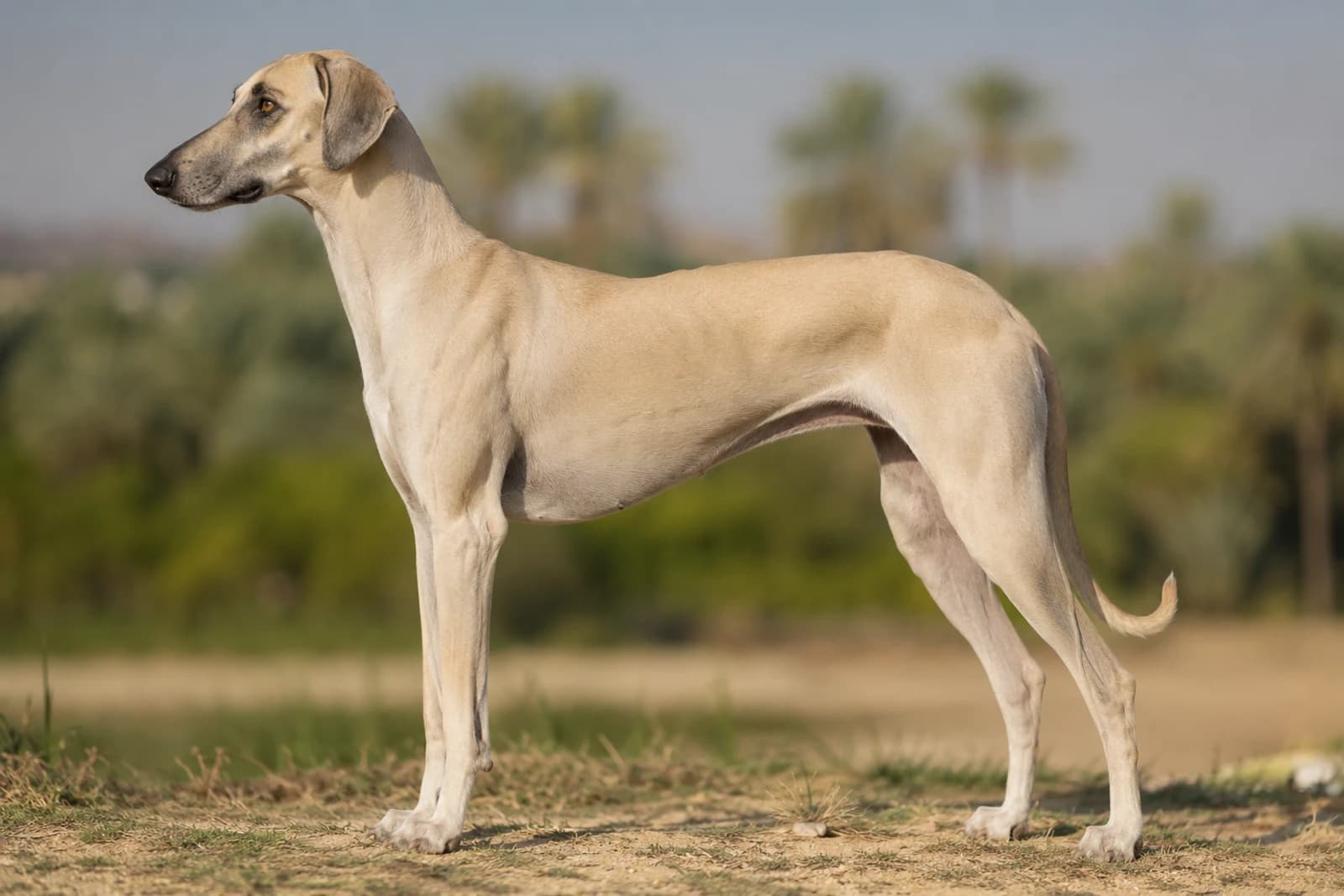
The Sloughi is an elegant and ancient sighthound originating from North Africa, where it was prized by nomadic tribes for hunting. This breed is best suited for experienced dog owners who appreciate its dignified, aloof nature and can provide a calm, consistent environment. Sloughis form deep bonds with their families but remain reserved with strangers. They thrive in homes with a securely fenced yard, as they have a strong prey drive and need regular opportunities to run. Not ideal for first-time owners or families with small pets, the Sloughi rewards a patient handler with quiet devotion and loyalty.
At a glance
- Size
- Giant
- Height
- 24–28 in
- Weight
- 44–60 lb
- Life span
- 12 years
- Coat colors
- Cream, Fawn, Red, Brindle
- Coat type
- Short, smooth, fine
How much does a Sloughi cost?
Adopt / rescue
$75–$400
Usually includes spay/neuter, first shots, and a microchip.
Buy from a breeder
$700–$2,000
From a reputable, health-testing breeder.
Approximate USD. Prices vary widely by region, breeder, pedigree, age, and coat colour — adopting is the lower-cost and recommended route. Avoid suspiciously cheap “breeders”; they’re often puppy mills.
Estimate the full cost of a Sloughi →Sloughi photos
Views
Front, side, rear and top — the full silhouette.Poses
How the breed sits, lies, moves and plays.Puppy to senior
The breed across its whole life.Expressions
The breed’s range of moods.Close-up details
Eyes, ears, nose, paws, tail and coat.Coat colors
The breed’s recognized colors.Click any photo to enlarge. We show the Sloughi from every angle — three views, poses, life stages, expressions, close-ups, coat and colors.
Appearance & size
The Sloughi is the opposite of bulky — a tall, leggy sighthound whose angles and long muscles telegraph speed and stamina. Males run 24 to 28 inches at the shoulder, females slightly smaller within that same window, but the real story is how light the dog stays on those long legs: a full-grown Sloughi weighs just 44 to 60 pounds. You’re looking at a frame built to cover rough ground fast, not to crash through it. The chest is deep and narrow, the waist tucks up hard behind the ribcage, and the whole dog looks like it’s been stretched lengthwise.
Coat and color
The coat is a single, fine layer — short, smooth, lying absolutely flat against the skin without any undercoat to speak of. Run your hand over a Sloughi and you’ll feel almost no texture beyond the warmth of the dog. The standard accepts a range of dry-country shades: sand, clear fawn, red, mahogany, and brindle, with or without a black mask, black mantle, or black ear fringes. Small white markings on the chest and a few white hairs on the toes are common and accepted, but a large white blaze or collar is not typical. The skin itself is thin and pliable, which helps these dogs thermoregulate in the heat they were bred for.
The head and expression
A Sloughi’s head is long, refined, and wedge-shaped — never coarse. The stop is barely defined, the muzzle about as long as the skull, and the whole impression is one of gentle dignity. Dark, almond-shaped eyes are set slightly obliquely, giving a soft, sometimes melancholy expression that’s typical of the breed. Ears are medium-sized, drop down close to the head at rest, and often rise into a triangular “rose” ear when the dog is alert. The neck is long, well-arched, and merges smoothly into a sloping shoulder — no stuffy front here.
Standing still: what you see from every angle
From the front, the Sloughi’s chest is deep but decidedly narrow; the forelegs drop straight down from the shoulders with fine bone and tight feet. You’ll often see clearly defined breastbone, not a bulky fill. From the side, the silhouette reads like a living archery bow: prominent hipbones, a long, slightly arched loin (not a roach back), a deep chest that reaches almost to the elbows, and a tuck-up so pronounced you could nearly look through behind the last rib. The croup slopes to a low-set tail. From the rear, the hindquarters stand parallel and straight, with well-angulated stifles and strong, lean thighs — no cow-hocks, no sprawling stance. The tail reaches at least to the hock, carried low with a gentle upward curve at the end. You’ll never see a Sloughi carrying its tail over the back or docked; it’s an honest, full-length tail that curves only when the dog moves.
History & origin
You can trace the Sloughi’s roots straight into the sands of North Africa, where it shaped itself over centuries alongside Berber and Bedouin nomads. This is an old, old sighthound — ancient Egyptian tomb art and rock carvings hint at a dog very much like it already thousands of years ago. It developed across what is now Morocco, Algeria, Tunisia, and Libya, molded by desert heat and the needs of people who moved with the seasons and relied on lean, tireless hunters.
The dog was built for a single purpose: to course game across open, unforgiving terrain. It hunted gazelle, hare, jackal, and even desert fox, relying on keen eyesight, explosive speed, and the kind of dry-muscled endurance that could keep going long after heavier hounds gave up. At 24 to 28 inches tall and just 44 to 60 pounds, the Sloughi is surprisingly light on its feet — a frame that trades bulk for efficiency. That giant category label is about height and presence, not heft. Its owners prized the dog so much that only chieftains and honored guests received a Sloughi puppy, and a healthy hound was often adorned with jewelry and amulets as a sign of status.
Europe didn’t really notice the breed until the 19th and early 20th centuries, when French soldiers and diplomats brought a few dogs home. Organized breeding outside North Africa began in the 1920s, and the FCI officially recognized the Sloughi in 1935. Still, it never exploded in popularity. Two World Wars, political instability in its homeland, and strict breeding pools kept numbers tiny. The AKC admitted it to the Hound Group in 2016, but it remains a rare sight at most shows and dog parks.
Today, dedicated breeders in North America and Europe work carefully to preserve the Sloughi’s desert-bred qualities: a short, fine coat that sheds heat, a long arched neck, and that smooth, floating trot. The gene pool is narrow, so responsible preservation breeders screen for hereditary issues and coordinate globally to maintain genetic diversity. A Sloughi in the 21st century is still a functional hunting hound in its native regions and a quiet, watchful companion elsewhere — an ancient athlete that hasn’t been softened into something else.
Temperament & personality
The Sloughi is a calm, reserved giant that bonds fiercely with its own people and holds strangers at a polite distance. This isn’t a dog that flings itself at every visitor; aloofness is a breed trait, not a failing. Early, frequent socialization makes the difference between a Sloughi that merely watches newcomers from across the room and one that cowers or snaps out of fear. If you want a dog that works the crowd, look elsewhere.
At home and on the couch
Built for short, explosive sprints — not endurance — the Sloughi spends most of the day lounging. In the house, you’ll find a quiet, almost cat-like shadow that seeks out soft surfaces and stretches out in a sunbeam. A couple of 20‑ to 30‑minute leash walks, plus regular chances to tear around a securely fenced yard, keep an adult fit and mentally settled. Without that release, restlessness builds. The fence has to be tall and dig‑proof; a sighthound locked onto a rabbit forgets about recall.
Affection is understated but constant. A Sloughi leans heavily against your leg, rests its long muzzle on your lap, and follows you from room to room. Eye contact is soft and lingering. You get devotion, not a sideshow.
Watchful, not noisy
These dogs take property surveillance seriously. Many will station themselves where they can scan the front door or the yard and offer a low, rolling bark if something shifts. They are not nuisance barkers, but they won’t let the delivery truck sneak up. With strangers, the Sloughi remains dignified — assessing, not fawning. Let guests ignore the dog and allow it to approach once curiosity overrides caution. Forcing a meeting backfires.
Quirks you’ll want to know
A Sloughi has a long memory and an independent streak. Harsh corrections either shut it down or provoke quiet defiance. Reward‑based training with high‑value treats and a patient, steady tone wins far more than force. A frustrated human who tries to muscle a Sloughi into a down‑stay often gets a dog that plants its feet and stares through you.
Sensitivity runs deep. A sudden schedule change or long solo days can trigger separation anxiety. From puppyhood, teach them that alone time is safe, and aim for no more than a few hours of solitude daily. When stressed, they show classic canine calming signals — lip‑licking, yawning, turning the head away — long before any escalation. Learn to read those signs and you can dial back the pressure.
Sloughi puppies explore with their mouths. Shoes, chair legs, and throw pillows all suffer during teething, so provide a steady stream of sturdy chew toys. Adults also enjoy gnawing on tough, safe chews, which helps keep teeth clean and jaws strong. If a youngster locks onto a table leg, a homemade citrus spray (boiled citrus peels) often breaks the fixation, and a white‑vinegar wipe‑down removes the scent cue that invites repeat offenses.
The household dynamic
A well‑socialized Sloughi gets along with older children who give the dog space. Teach kids early: never bother the dog while it’s eating or deeply asleep. Food guarding can surface, and even a typically gentle Sloughi may snap if startled at its bowl. Mealtime must be interruption‑free.
The breed’s high prey drive makes small, fast‑moving animals a gamble. Some Sloughis coexist with indoor cats if raised together, but the chase instinct never fully disengages. A rock‑solid “leave it” cue and constant management around anything squirrel‑sized keep everyone safe.
A Sloughi asks for a calm home, a secure place to sprint, and a handler who listens as much as they lead. In return, you get a quiet, elegant shadow — a dog that would rather lean on you than run the world.
Good with kids, dogs & other pets
Around children
A well-socialized Sloughi is generally calm and patient by nature — not aggressive or snappy. That’s the good news for families. The practical piece to watch is that this is a 44–60 pound dog who can zip across a yard in an instant. A happy Sloughi can accidentally knock over a toddler, so physical supervision with young children is non-negotiable. Teach kids to approach gently, avoid startling the dog when it’s resting, and never pull on its long, lean legs. Early socialization between 3 and 14 weeks matters enormously. A puppy who meets gentle children, hears everyday noise, and experiences positive handling during that window is far less likely to grow into a fearful adult who might react defensively. Even with a solid temperament, no Sloughi should be left unsupervised with an infant or a small, unpredictable child.
With other dogs
Sloughis can coexist well with other dogs in the home, but they are not a “dog park dog” by default. Their sighthound wiring makes them selective; they may ignore unfamiliar dogs or become tense if crowded. Start gradual, positive introductions early and often. Expose the puppy to friendly, stable adult dogs well before 16 weeks of age. After that sensitive period closes, forcing a timid adult Sloughi into high-density off-leash situations adds stress and can trigger a spat. Many adults live happily with one or two other dogs they know well and rarely seek out large groups. Pay attention to body language — a stiff posture or fixed stare is a sign to give space, not press harder.
With cats and small pets
This is where instinct slams into daily life. Sloughis were bred to chase fast-moving prey over open ground, and they still carry that drive deep in their DNA. A darting cat, a loose rabbit, or even a small toy dog can flick the switch. Some individuals raised with a cat from puppyhood learn to share a sofa peacefully, but you cannot train out the chase reflex entirely. Introduce cats with the dog on a leash, reward calmness, and always provide the cat with a high, escape-proof route. Off-leash time together should never happen without direct supervision. If you have pet rodents, ferrets, or free-roaming birds, secure enclosures are a must — a Sloughi can be lightning quick. The safest Sloughi-cat arrangement treats coexistence as a managed success, not guaranteed safety.
Trainability & intelligence
A Sloughi isn't a dog that falls over himself to please you — and that’s not a flaw, it’s just how his mind works. He’s intelligent in a quiet, watchful way, but he’s been bred for centuries to make independent decisions while chasing game across open terrain. Translation: he learns fast, but he won’t blindly obey a command unless he trusts your judgment and you’ve made it worth his while.
That means you skip the heavy-handed correction. Punishment-based methods don’t produce a more obedient Sloughi; they produce a dog who shuts down or avoids you entirely. His sensitivity runs deep, and force damages the very thing you need most — a solid bond. Instead, make every interaction a transaction he wants to repeat. Reward the behavior you want, the instant it happens, with a high-value treat, a quick tug session, or calm, genuine praise. He’s not a perpetual-motion retriever; your approval and a bit of roasted chicken often motivate him more than a tennis ball.
Start the day you bring your puppy home, and don’t let up. The first 12 to 14 weeks are prime time for gentle exposure to new faces, dogs, flooring, sounds, and handling. Sloughis can tip into reserved or wary if you skip this step, so gradual, positive experiences are non-negotiable. A well-socialized Sloughi still won’t be a tail-wagging greeter at the dog park — expect dignified aloofness — but you’ll head off the fear-based reactivity that can surface in an under-socialized adult.
Recall is a challenge. When a Sloughi locks onto something moving, his chase instinct can override everything. This isn’t stubbornness; it’s a sighthound’s design. Build a reliable “come” by layering it into daily life for months, practicing in fenced areas, and always — always — using a paycheck-level reward. A 50-pound dog who can cover ground in a blink means your training is also a safety matter.
Short, consistent sessions work best. He bores quickly with drilling, so mix obedience into walks, mealtime, and play. Ask for a sit before you clip the leash, a down before dinner. Keep your communication calm, clear, and fair, and you’ll end up with a Sloughi who learns nearly anything you teach — on his terms, not yours.
Exercise & energy needs
A Sloughi needs a solid hour of daily exercise, but it's not just about the minutes — intensity matters. Split that hour into two sessions: a long morning walk on lead or a vigorous free run, and a second outing later in the day. These are sighthounds, built to stretch their legs at full gallop for short bursts, so a fenced area where they can truly run flat out is non-negotiable. A tired Sloughi is calm indoors; without that release, restlessness and anxiety can creep in.
Off-leash time in a secure, enclosed space lets them satisfy their sprint instinct. A casual stroll around the block won't cut it — think 20–30 minutes of jogging or a wide-open play session, not just sniffing. Because they can hit high speeds, never trust recall in an unfenced area if something small and furry darts past. Many owners find that two shorter, intense sessions work better than one marathon outing, keeping the dog physically satisfied without overtaxing young, still-growing joints.
Mental stimulation is just as critical. Puzzle toys that dispense treats, hide-and-seek games, or short scent-tracking exercises indoors tire a Sloughi's alert mind. They were bred to hunt by sight, so lure coursing or straight-line sprints after a flirt pole are perfect, breed-fulfilling activities. Avoid repetitive high-impact exercise on hard surfaces until growth plates close (around 18–24 months), and stick to soft ground for fast running.
Consistency matters. A Sloughi thrives on predictable daily outlets. Skipping a day can make them edgy or reactive. If your schedule doesn't reliably allow for two active periods — one of which includes a true off-leash run — this breed's energy needs will frustrate both of you.
Grooming & coat care
A Sloughi’s coat is about as low-maintenance as it gets: short, smooth, single-layered, and built for a quick once-over, not a marathon grooming session. Weekly brushing with a soft bristle brush or a grooming mitt strips away dead hair, distributes natural oils, and leaves a healthy gleam. You can skip slicker brushes and rakes entirely—this is thin skin we’re talking about, and anything sharp or stiff can scratch.
Shedding is light year-round, with no seasonal blowout to manage. A few passes once a week catch most of those fine, short hairs before they end up on your furniture. Bathing follows the same sparing rhythm. A Sloughi rarely smells doggy. Two or three baths a year—or a rinse after a particularly muddy sprint—is plenty. Use a gentle, soap-free dog shampoo so you don’t strip those protective skin oils.
The real grooming priorities sit above the shoulders. Those elegant drop ears are quiet collectors of moisture and wax. Lift each ear weekly, check for redness or gunk, and wipe the inside flap with a damp cloth or a vet-approved ear cleaner. Dry thoroughly. Nails need a firm hand, too. Because a Sloughi stands on lean, hare-like feet, overgrown nails can tilt the toes and throw off their effortless trot. Trim every two to three weeks, or whenever you hear a click on hard floors. Add a few toothbrushing sessions each week and you’ve covered the basics.
What about weather? A Sloughi’s coat offers zero insulation, so a light coat or fleece is smart on cold, wet days. Light-colored dogs can burn on exposed skin—the nose leather and the tips of those fine ears—so dab dog-safe sunscreen on sunny afternoons. With no clippers, stripping, or blowouts to worry about, grooming becomes a five-minute ritual that leaves you more time for the long runs this breed truly craves.
Shedding & allergies
The Sloughi’s short, sleek coat is a genuine low-maintenance perk — but don’t mistake that for “no shedding.” They shed lightly year-round, and you’ll find fine, needle-like hairs on darker furniture and car upholstery. Twice a year, usually as the seasons shift, expect a modest blowout where the shedding picks up for a couple of weeks. A quick once-over with a rubber curry brush or a hound glove every few days handles most of it, pulling loose hair before it ends up on your floors.
Drool is essentially a non-issue with this breed. If you see it, something’s wrong — a dental problem or nausea — not a slobbery habit.
Now, the allergy question. No dog is truly hypoallergenic, and the Sloughi is no exception. People aren’t allergic to hair itself but to dander, saliva proteins, and urine. Sloughis produce all three. Their short coat doesn’t trap much dander, so it may be less of a trigger for some than a heavy-shedding double-coated breed, but it’s a gamble. If someone in your household has dog allergies, spend real time around adult Sloughis before committing. There’s zero guarantee a Sloughi will be easier on allergies, and no responsible breeder will promise otherwise.
Diet & nutrition
A Sloughi’s lean, leggy build can fool you. You might think they need extra padding, but carrying even a few extra pounds strains those long, fine-boned limbs and deep chest. Keep them at a weight where the last two ribs are easily felt but not staring out. Most adults in the 44–60 lb range do well on two meals a day totalling 3 to 4 cups of high-quality dry food, or an equivalent amount of raw or home-prepared diet, split between morning and evening. Adjust up or down based on how much they actually run — a weekend lure courser burns more fuel than a calm house companion.
What belongs in the bowl
Build meals around animal protein. A practical target is meat (raw or lightly cooked) making up the bulk of the dish, with the remainder coming from vegetables, fruits, and the occasional egg, plain yogurt, or digestible grain like pearl barley or white rice. This mirrors what their digestive tract is designed to handle. Canned fish, cooked veg, and leftover grains can be combined for quick, healthy meals — just serve it in their own bowl, never from the table, to avoid hard-to-break begging habits.
Blunting the bloat risk
Like many deep-chested sighthounds, Sloughis can bloat. Feed them from a puzzle bowl if they bolt their food, and rest them for at least an hour after a meal, no hard sprinting. Smaller, more frequent feedings are safer than one big pile of kibble.
Puppies
From weaning to four months, they need four evenly spaced meals. Drop to three meals until six months, then settle into the adult two-meal rhythm. Start with lightly cooked, puréed meats, fish, and soft fruits and vegetables, or a well-regarded commercial puppy formula. Raw chicken wings can be introduced around twelve weeks under close supervision to encourage natural chewing.
Seniors
As the sprint sessions taper off, cut back food gradually. An older Sloughi’s metabolism slows, and obesity becomes a real health thief — extra weight hurts aging joints and can shorten that 12-year lifespan. Switch to three or even four smaller meals if appetite stays strong. Purée food for dogs with missing teeth or tender mouths; they still extract more nutrition that way. Rich, fatty scraps — the kind that show up after holidays — are a pancreatitis trigger, so keep the menu clean and predictable.
Health & lifespan
A healthy Sloughi typically lives about 12 years — a respectable run for a giant breed, and a sign that this is generally a robust, no-fuss sighthound. They’re not plagued by a laundry list of inherited disasters, but you still need to go in with your eyes open. Any deep-chested, lean-bodied dog carries a real risk of bloat (gastric dilatation-volvulus) , and the Sloughi is no exception. Know the signs — restlessness, unproductive retching, a distended belly — and have a plan for getting to a vet immediately. Like many sighthounds, they also tend to have low body fat, which makes them more sensitive to certain anesthetics; always make sure your vet is comfortable with sighthound protocols before any procedure.
Responsible breeders screen for what does show up. Progressive retinal atrophy (PRA) and some cardiac concerns, including dilated cardiomyopathy, have been noted in the breed, so ask to see current eye exam and heart testing results from both parents. You’re not just buying a pretty dog; you’re buying the genetic homework behind it.
At 44 to 60 pounds, a Sloughi should look almost shockingly lean to owners used to stockier breeds. Those ribs should be easily felt, and a visible waist tuck is normal. Weight management here isn’t just cosmetic — extra pounds stress joints and can amplify any underlying heart issue. Combine free-choice running in a secure area with measured meals, and skip the guilt-treats.
Their short, fine coat and minimal body fat leave them with zero insulation. In cold weather they need a coat; in blazing sun, they can overheat fast or burn pink-skinned areas. Protect them accordingly.
Routine preventive care matters. Give monthly heartworm prevention during mosquito season and for one month after it ends. Keep the rabies vaccine current — it’s legally required and there’s no effective treatment once symptoms appear. An annual wellness exam (twice a year for seniors) catches subtle shifts — reduced activity, appetite changes — that a stoic Sloughi won’t advertise. Pair that with early socialization and a calm, predictable home to head off stress-related health fallout. A Sloughi left isolated or handled harshly can slide into anxiety, and chronic stress takes a physical toll. The best shield? A vet you trust, a lean body condition, and daily off-leash movement on a soft surface.
Living environment
House or apartment?
A Sloughi needs room to move but doesn’t need a sprawling estate—commitment matters more than square footage. A single-family house with a securely fenced yard is the easy button. This sighthound can clear a four-foot fence without a running start, so six-foot fencing that can’t be climbed or tunneled under is non-negotiable. The yard serves as a safe sprint track, not a weekend lounge spot; he’ll stretch those long legs in brief, explosive bursts, then doze for hours.
Apartment living is doable if you go in with eyes wide open. You’ll be trading a backyard for a twice-daily pilgrimage to a fenced field, open desert space, or a reliable long-line area. A route around the block on a six-foot leash isn’t enough. He needs to flat-out run a few times a week—otherwise, that calm indoor presence you wanted evaporates into relentless pacing or redirected chewing.
Climate comfort
Bred in the North African heat, this breed tolerates hot days better than most, but don’t push it during a heatwave. Provide shade, cool water, and morning or evening romps when the sun isn’t blazing. The real vulnerability is cold and wet. A Sloughi carries almost zero body fat and has a thin, single coat that offers no insulation. Once the mercury drops below about 50°F, a well-fitted coat or fleece becomes a daily necessity. Rain and snow? He’ll likely balk at the door and give you a look that says “absolutely not.” He belongs inside with a soft bed and a warm lap nearby.
Noise and barking
You won’t get a canine alarm system, but you will get a sharp alert when something unusual catches his eye. A Sloughi typically barks once or twice at a delivery truck or a stranger approaching, then goes quiet again once he’s assessed the situation. He’s not a yapper or a nuisance barker. In an apartment, this restraint works in your favor. The bigger noise risk comes from the occasional zoomies session—sixty pounds of sighthound doing laps sounds like a herd of miniature horses overhead. Thick rugs help, but a bottom-floor unit is still your safest bet.
Handling alone time
Sloughis bond deeply, and that attachment has a flip side: separation anxiety is common. Leaving him alone for an eight-hour workday without preparation will backfire. You may come home to shredded pillows, frantic howling, or a dog who’s lost trust in the routine. Work up to longer absences gradually. Start with short departures while you’re still home (yes, that means stepping out for five minutes, returning calmly, and repeating). Leave him with a frozen puzzle toy or a snuffle mat to keep his brain occupied—mental work tires him out faster than you’d guess. Even with training, many Sloughis do best when a family member works from home part of the week or when a midday dog walker breaks up the silence.
A bored, under-exercised Sloughi will dismantle your sofa cushions with surgical precision. Stick to a rhythm of daily hard runs, brain games, and short training sessions, and you’ll sidestep that crisis entirely.
Who this breed suits
A Sloughi fits best with an owner who reads the dog, not one who expects the dog to read them. You’ll thrive together if you’re an experienced sighthound home or at least a calm, observant handler who appreciates a sensitive, independent mind. This is not a breed that lives for your applause — they live for the opportunity to stretch their legs in a full-out sprint, then curl up next to you on the couch for the rest of the day. A securely fenced yard or regular access to a safe, enclosed running area is essential; these are 44- to 60-pound athletes built to chase, and their recall off-leash is never 100%.
– Active singles and couples who run, hike dirt trails on a long line, or can provide a daily hard run (not a stroll) will meet the Sloughi’s exercise needs. Inside, they’re quiet, clean, and nearly cat-like — no doggy odor, minimal shedding. They don’t bark much, but they do alert to genuinely strange sights.
– Families with older, respectful kids (think 8 and up) can work well. The Sloughi’s reserved, almost aloof personality doesn’t handle rough grabbing or chaotic noise. They’ll bond deeply, but on their own terms — not as a fuzzy playroom accessory.
– Seniors who are still physically active and have a fenced property can keep up, provided they understand the dog’s need for speed and their startle reflex if bumped when asleep. The short coat and low grooming demands are a plus.
– First-time dog owners should think twice. The independence, high prey drive, and sensitivity make novice mistakes (heavy-handed corrections, off-leash parks, underestimating fences) especially costly. A Sloughi won’t bounce back from harsh training; they shut down.
Who should look elsewhere? Apartment dwellers without private land, owners who insist on off-leash hiking in open country, or homes with free-range small pets (cats, rabbits) unless you’ve raised the dog from puppyhood with strict management. The Sloughi’s quiet dignity also doesn’t suit a household that wants a gregarious, tail-wagging greeter for every guest — this breed reserves affection for its inner circle and may stand back for a long while before accepting a stranger.
Cost of ownership
A Sloughi puppy from a health-tested, preservation-focused breeder typically runs $1,500 to $3,000, and you’ll almost certainly be on a waiting list — the breed is rare in the U.S., and litters are planned sparingly. Show- or coursing-prospect pups can push toward $4,000. If you find one for significantly less, dig hard into health clearances and living conditions; back-yard breeding of an uncommon sighthound is a red flag.
Monthly upkeep
A lean 44–60 lb adult eats less than many “giant” breeds. Budget $50–70 a month for a high-quality kibble or raw diet, plus another $10–20 for lean treats. Grooming is almost a non-expense: a weekly once-over with a curry glove or soft brush handles the short, dirt-shedding coat. A bath every few months and regular nail trims are all the professional grooming most Sloughis ever need.
- Routine vet and prevention: Plan on $400–600 a year ($35–50/month) for annual exams, vaccines, heartworm and flea/tick prevention. Consider banking another $200–300 annually for an eye exam by a veterinary ophthalmologist — responsible breeders screen for progressive retinal atrophy, and you’ll want to keep tabs on those big, light-sensitive eyes.
- Insurance: A midsize sighthound with few structural extremes, the Sloughi is generally hardy. Still, accidents happen to dogs that run flat-out for the sheer joy of it. A policy with a moderate deductible often lands between $30 and $50 a month, depending on your area and coverage level. Set aside a cash reserve instead if you’d rather self-insure.
- Miscellaneous: A martingale collar, long lead, and a tall, sunk-in fence are not monthly costs, but they’re non-negotiable security for a breed that can hit 40 mph in three strides. When you add a solid bed (Sloughis crave soft spots) and the usual chew toys, first-year gear can easily total $400–700.
Realistically, expect $120–180 a month for routine care, excluding any major emergency. The bigger financial surprise is often the time spent finding the right breeder and waiting — but that patience pays for itself in a sound, steady dog.
Choosing a Sloughi
Your first task is actually locating a Sloughi. They’re one of the rarest sighthounds in North America, so you won’t stumble on a litter by accident. Getting on a waiting list with a responsible breeder or connecting with a breed-specific rescue is the realistic path. Expect a wait, sometimes a year or more.
Responsible breeders don’t just produce puppies—they prove their dogs are sound. That means running them in lure coursing or open-field hunts to confirm working instinct, and showing in conformation to ensure the dog matches the Sloughi’s distinct, functional build. Health clearances are non-negotiable. Ask for hip evaluations (OFA or PennHIP), a recent eye exam by a board-certified veterinary ophthalmologist (looking for PRA and cataracts), and thyroid testing. Some breeders also screen for cardiac issues. Don’t let anyone tell you “the breed is healthy, so tests aren’t needed.” A Sloughi can be prone to hip dysplasia and autoimmune conditions that warrant proactive screening.
Red flags to steer clear of:
- Breeders who always have pups available or run multiple litters at once
- Selling puppies before 8 weeks
- No application process or interview—a good breeder interviews you as hard as you interview them
- No contract with a return clause covering the dog’s whole life
- Won’t let you meet at least one parent on-site (usually the dam)
- A fearful or aggressive parent is a dealbreaker; the Sloughi temperament is aloof but stable
When you go to pick your puppy, watch the litter. You want a pup that investigates you with quiet curiosity, not one that bolts to the corner or launches all over you. This is a sensitive breed that bonds deeply but doesn’t hand out trust like a Lab. The pup that checks you out, maybe offers a brief lean, then retreats to watch—that’s the classic Sloughi temperament. Ask the breeder which pups they’d match to a first-time sighthound home versus an experienced hunting household. They usually have clear insights by 8–10 weeks.
Rescue is a slim but worthwhile channel. The American Sloughi Association maintains rescue contacts, and occasionally adult dogs are placed through breed fanciers. You’ll skip puppyhood but still get the breed’s gentle, soulful nature—often from dogs who simply outlasted an owner’s circumstances. Be prepared to travel; a Sloughi in need rarely lives next door.
A well-bred Sloughi from health-tested lines typically lives a full 12 years. The legwork you do now locks in the soundness and sanity you’ll live with for more than a decade.
Pros & cons
Pros
- A 44–60 lb sighthound built for explosive speed, but once the sprint is over, they’re content to couch-surf the rest of the day. You get a tall, elegant dog (24–28 inches) without the heavy-boned bulk of many giants.
- Minimal coat care. The short, fine hair barely sheds, and a quick wipe with a damp cloth handles dirt. No stripping, clipping, or professional grooming bills.
- Deeply devoted to their people. Inside the home, a well-exercised Sloughi moves quietly, keeps itself clean, and stays close — often leaning against your leg or claiming the softest cushion.
- A typical lifespan around 12 years gives you a long run with a giant-breed dog.
- Gentle and patient with respectful children in their own family, forming quiet, steady bonds without overwhelming the kids.
Cons
- Prey drive is non-negotiable. When a cat, squirrel, or small dog moves fast in the distance, his brain checks out. Off-leash walks in unfenced areas are a gamble you’ll lose.
- Reserved to the point of standoffishness with strangers. This isn’t the dog who greets company with a wagging tail. Socialization builds tolerance, not a party host.
- Exercise isn’t just a couple of block walks. They need safe, open space to stretch out at a full gallop at least a few times a week, or restlessness and destructive chewing follow.
- A soft soul that crumples under harsh methods. Training needs a calm, patient approach — yelling or heavy-handed corrections will make him shut down and distrust you.
- Escape artist instincts. A fence under 6 feet or with a gap at the bottom reads as an invitation, and once he’s out, the chase is on.
Similar breeds & alternatives
If you’re drawn to the Sloughi’s lean, reserved presence but wonder what else might fit, three sighthounds share that desert-bred, long-legged silhouette — with distinct shifts in temperament and care.
Azawakh – This West African cousin is even more extreme in build (often taller but 33–55 lb) and personality. Where a Sloughi is watchful yet can warm up to polite strangers, an Azawakh is fiercely aloof and takes intense, early socialization to function calmly in public. They match the Sloughi’s need for a serious daily run and a securely fenced area. An Azawakh is the sharper-edged choice for someone who wants a deeply devoted, highly protective companion and doesn’t mind managing a dog that never becomes a social butterfly.
Saluki – The Saluki can be feathered or smooth, standing 23–28 inches and weighing 35–65 lb. They share the Sloughi’s sensitive nature, high prey drive, and cat-like independence, but generally have a softer, more elegant look. Off-leash reliability is even less guaranteed; a Saluki will chase a squirrel and keep going. If you appreciate the Sloughi’s quiet dignity but want a coat you might need to brush (in the feathered variety) and a breed that’s existed for millennia, a Saluki is an equally demanding but emotionally nuanced alternative.
Greyhound – If the Sloughi’s aloofness gives you pause, the Greyhound is a more easygoing sighthound. Standing 27–30 inches and weighing 60–70 lb, they are larger and thicker, but famously low-key indoors — a short sprint satisfies their exercise need, and they’re more likely to greet visitors with curiosity than suspicion. Expect the same chase instinct and need for leash walks. Life expectancy is comparable, around 10–14 years.
All three will test your fencing and your commitment to leash walking. The Sloughi sits in a sweet spot: less stranger-danger than the Azawakh, a bit more emotionally attuned than the Saluki, and more watchful than the retired-racer Greyhound lounging on your sofa.
Fun facts
- Sloughis are one of the oldest domesticated dog breeds, dating back thousands of years in North Africa.
- They were traditionally used by Berber and Bedouin tribes for hunting desert game like gazelles and hares.
- The Sloughi is known as the 'Arabian Greyhound' and can reach speeds up to 40 miles per hour.
- This breed is known for its extreme loyalty and often forms a particularly strong bond with one person.
Frequently asked questions
- Are Sloughis good with children?
- Sloughis can be gentle and affectionate with children they know, but they are sensitive dogs that may not tolerate rough handling. Early socialization and supervision are important, and they tend to do best with older, respectful kids.
- How much exercise does a Sloughi need?
- Sloughis are athletic sighthounds that require daily opportunities to run in a safely fenced area. They benefit from long walks and free sprinting, but indoors they are generally calm and relaxed.
- Do Sloughis shed a lot?
- Sloughis have a short, fine coat that sheds minimally. Regular brushing helps control loose hair, but overall they are a low-shedding breed.
- Are Sloughis easy to groom?
- Grooming is very simple—occasional brushing and bathing as needed. Their short coat and clean nature make them one of the easier breeds to maintain.
- Can a Sloughi live in an apartment?
- Sloughis can adapt to apartment living if their exercise needs are met, but they are large dogs that require space to stretch out. A home with a securely fenced yard is ideal, as they need safe off-leash running.
- Do Sloughis bark a lot?
- Sloughis are generally quiet and not prone to excessive barking. They may alert to strangers or unusual sounds, but overall they are a reserved and calm breed indoors.
Tools & calculators for Sloughi owners
Quick estimates tailored to Sloughis — pre-filled with this breed’s size where it matters.
Articles & stories about the Sloughi
Sources & standards
This profile follows recognized breed standards from the American Kennel Club (AKC) and the Fédération Cynologique Internationale (FCI), along with established veterinary and breed-club guidance. These describe general breed tendencies — every dog is an individual.
Owner stories
Have a Sloughi? Share your experience — grooming tips, personality quirks, anything goes.