

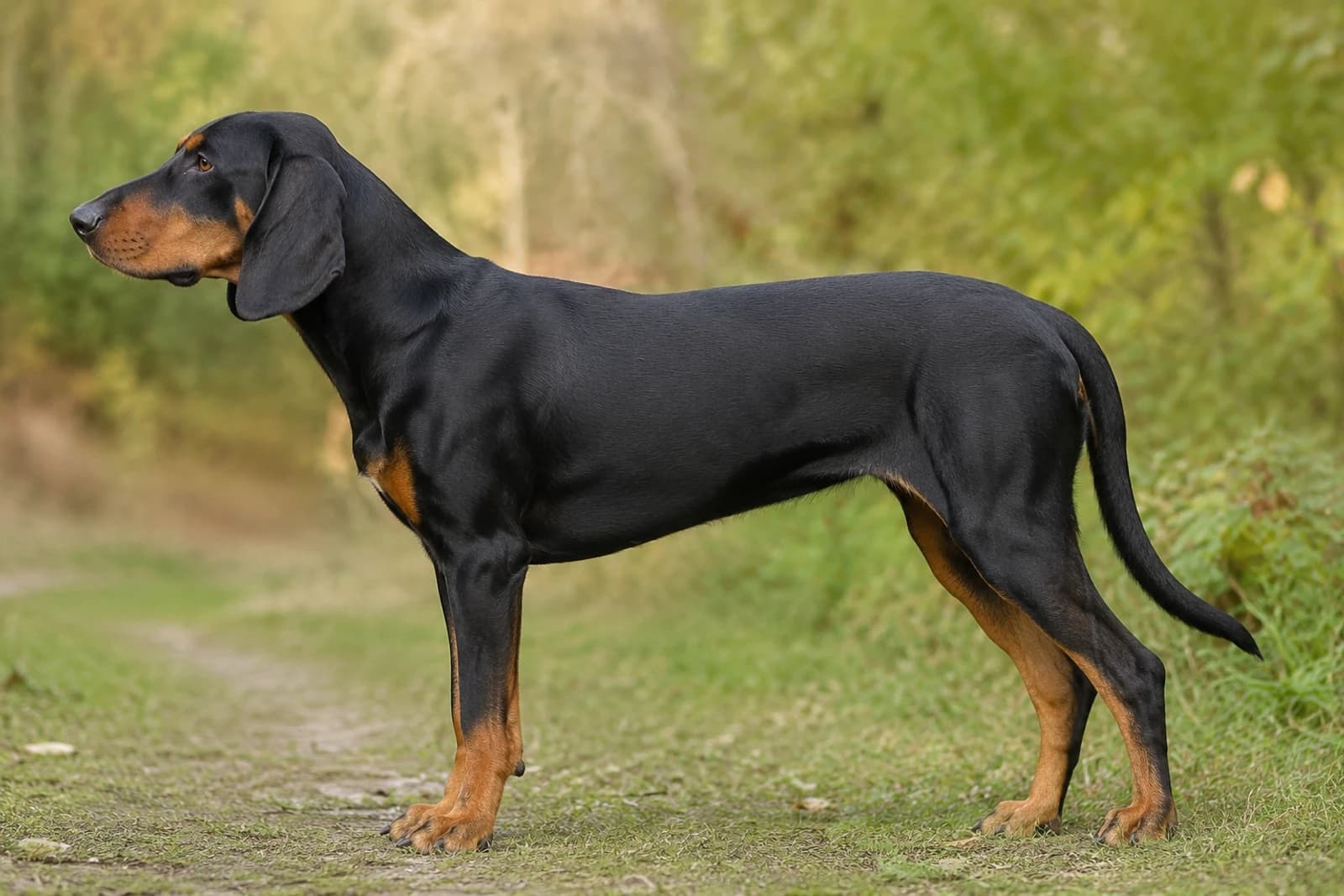
The Slovensky Kopov is a rare and ancient scenthound from Slovakia, originally bred to track and bay wild boar in the dense forests of the Carpathian Mountains. This medium-to-large breed is known for its tenacity, independence, and unwavering loyalty. With a sleek black-and-tan coat and a melodious howl, they are striking and vocal companions. Not for novice owners, the Kopov thrives with experienced handlers who can provide firm, consistent training and ample daily exercise. Best suited for active homes with space to roam, they are protective and affectionate with their families but may have a high prey drive.
At a glance
- Size
- Large
- Height
- 16–20 in
- Weight
- 33–44 lb
- Life span
- 11–12 years
- Coat colors
- black and tan
- Coat type
- Short, dense, harsh coat
- Group
- Scenthounds
- Origin
- Slovakia
How much does a Slovensky Kopov cost?
Adopt / rescue
$75–$400
Usually includes spay/neuter, first shots, and a microchip.
Buy from a breeder
$700–$2,000
From a reputable, health-testing breeder.
Approximate USD. Prices vary widely by region, breeder, pedigree, age, and coat colour — adopting is the lower-cost and recommended route. Avoid suspiciously cheap “breeders”; they’re often puppy mills.
Estimate the full cost of a Slovensky Kopov →Slovensky Kopov photos
Views
Front, side, rear and top — the full silhouette.Poses
How the breed sits, lies, moves and plays.Puppy to senior
The breed across its whole life.Expressions
The breed’s range of moods.Close-up details
Eyes, ears, nose, paws, tail and coat.Coat colors
The breed’s recognized colors.Click any photo to enlarge. We show the Slovensky Kopov from every angle — three views, poses, life stages, expressions, close-ups, coat and colors.
Appearance & size
The Slovensky Kopov is a streamlined, lightweight scenthound that feels more athletic than dense. For a dog classed as large, the numbers are modest: 16 to 20 inches at the shoulder and 33 to 44 pounds. That puts it right between a Beagle and a small Coonhound, but with a rangy, rectangular frame that stretches farther than it stands tall.
Build and body proportions. The Kopov has a long, lean body, a deep chest reaching to the elbows, and a straight, firm back. There’s no tuck-up as dramatic as a sighthound’s, but the underline rises gently, hinting at the endurance bred for hours of work in rough Slovakian forests. Legs are straight, well-boned, and end in tight, rounded paws. From the side, you’ll notice a level topline and a tail set high, carried in a gentle sabre curve when the dog is alert.
Coat and color. The coat is short, dense, and lies flat against the body—practical for shedding water and brushing through underbrush. There’s only one acceptable color: black with rich tan markings. The tan shows on the muzzle, cheeks, above the eyes, on the chest, lower legs, and under the tail. The black should be deep, without brindling or white patches. The contrast is crisp, making the dog look almost painted.
Head and expression. From the front, the head is the breed’s signature. The skull is moderately broad with a slight stop. The muzzle is deep, squared-off, and roughly equal in length to the skull. Dark, almond-shaped eyes give a serious, intelligent expression—no sclera shows. Ears are set high, hanging flat along the cheeks with softly rounded tips, reminiscent of other European scenthounds but slightly shorter.
From the rear and on the move. Viewed from behind, the hindquarters are muscular and parallel, with well-angulated stifles. The tail never curls over the back. When a Kopov trots, the stride is fluid and ground-covering; the topline stays solid, and the tail lifts just above horizontal.
The overall impression is a dog built for purpose: an honest, unexaggerated hunter that looks like it could go all day without a heavy meal weighing it down. You won’t find any bulldog heaviness or greyhound fragility here—just a clean, athletic hound that blends into dark forest lines.
History & origin
The Slovensky Kopov is a homegrown Slovakian scent hound that came into sharp focus after World War II, but its roots go deeper. Bred to run wild boar and large predators through the rugged Carpathian Mountains, this compact, tenacious dog was purpose-built for endurance, not bulk. Standing just 16 to 20 inches at the shoulder and weighing only 33 to 44 pounds, the Kopov slips through dense underbrush where heavier hounds would struggle. Its bark — loud and cutting — let hunters track the dog’s location from a mile away.
The name “Slovensky Kopov” simply means Slovakian Hound. Some sources call it the Black Forest Hound, a direct translation of the Slovak “Čierny les,” but don’t confuse it with any German breed. That name nods to the dark, conifer-rich forests the dog worked, and to its solid black coat with those sharp mahogany markings. The breed’s ancestry is a patchwork of old scent-hound blood. Hunters in the region likely drew on ancient Celtic hounds brought by migrating tribes, then infused Austrian Black and Tan Hounds, Polish Hounds, and other Eastern European scenthounds to sharpen nose and voice.
The Kopov nearly disappeared during the chaos of the war. By the late 1940s, only a handful of working dogs remained. A core group of Slovakian breeders painstakingly gathered survivors and reestablished the bloodlines. They drafted the first official standard in the 1960s, and the Fédération Cynologique Internationale (FCI) recognized the breed in 1963. Even today, the Kopov is rare outside its homeland. You’ll still find them working in the forests of Slovakia and neighboring countries, baying on a hot scent trail, driving game toward waiting hunters or tracking wounded animals. They hunt silently when following a track and explode into voice only when the quarry is cornered — a trait that made them invaluable in dense cover.
This isn’t a dog built for a casual stroll. The breed’s history as an all-day trailing hound means a Kopov needs real outlets for its nose and grit. Take it on long, meandering hikes where it can work a scent line, or consider scent-work sports. Skip that, and you’ll have a frustrated, vocal shadow that invents its own jobs indoors.
Temperament & personality
The Slovensky Kopov is a scenthound through and through — independent, nose-driven, and more interested in the next interesting odor than in pleasing you on command. That doesn’t mean he’s cold or aloof. He bonds fiercely with his own family and can be remarkably affectionate, often leaning against your legs or curling up quietly after a long day afield. But he’s not a velcro dog and won’t smother you with constant attention. With strangers, he tends toward reserve, and early, ongoing socialization keeps that natural wariness from tipping into suspicion.
Expect a calm, steady presence indoors when his needs are met, coupled with a stubborn streak the size of the Carpathians. This is a strong-willed breed that thinks for himself. You’ll get miles further with respectful, consistent handling than with heavy-handed corrections. He responds to voice tone, body language, and a clear sense of partnership — not drill-sergeant commands.
Energy-wise, ignore the 33–44 pound frame and 16–20 inch shoulder height — this dog was bred to track boar and predator over rough terrain for hours. A couple of leash walks around the block won’t cut it. An adult Kopov needs at least an hour of hard, off-lead exercise every day, ideally split into a vigorous run or hike and a session of scent games, trailing, or puzzle work. Without that outlet, you’ll see destruction, nonstop baying, and inventive escape attempts. A tired hound is a quiet hound.
His nose rules everything. Inside the house, that can mean real house-training challenges. Even a well-trained Kopov may urine-mark indoors if the scent of previous accidents lingers. Clean up messes immediately with an enzymatic cleaner or a vinegar spray — plain soap won’t fully neutralize the odor, and that leftover scent acts as a flashing “pee here” sign. Before you get frustrated, remember: this is a dog that uses urine as a calling card, a memory trigger, and a territory marker all at once. You’re not fighting him — you’re managing a deeply rooted instinct. Reward outdoor elimination with a treat right then, not minutes later, and you’ll build the habit faster than punishment ever will.
Watchfulness is hardwired, too. The Kopov barks — or more accurately, bays — with a deep, carrying voice when something doesn’t belong. He’ll alert to strange sounds, visitors, and the neighbor’s cat on the fence line. Many owners find this an asset; if you want a silent dog, look elsewhere. Left alone too long or relegated to the yard with no human contact, he easily slides into anxiety-driven barking, digging, and marking, so households where everyone is gone all day are a poor match.
A few quirks come with the territory. Like many scenthounds, the Kopov may feel an overwhelming urge to roll in dead fish, fox scat, or anything powerfully stinky. Theories abound — masking his own scent, advertising a rich food find, or just enjoying the perfume — but the end result is the same: a dog that goes from dignified to disgustingly fragrant in five seconds. And his intense drive to follow scent means a secure, fenced yard is non-negotiable. Off-lead walks in unfenced areas are a gamble unless you’ve trained an absolutely bombproof recall, and even then, a trailing hound with his nose full of deer scent may not hear you.
Living with children and other pets requires thoughtful management. The breed can do well with older kids who respect his space, particularly around food. Never let a child interrupt the dog while he’s eating; a Kopov can develop food-guarding tendencies, and a stiff posture and direct stare are often the only warning before a snap. Teach everyone in the house that mealtime is hands-off time. With other dogs, he can be social and pack-oriented, especially if raised together, but his strong prey drive makes cats, rabbits, and other small pets a constant risk. You’ll need to supervise, separate, and be honest about what you can manage.
Puppies chew — it’s how they explore the world and soothe teething pain. Adult Kopovs keep their jaws busy, too, gnawing on hard objects to maintain jaw strength and clean teeth. Give them ample appropriate chews, bones, and puzzle toys, and use a safe deterrent spray (a diluted citrus solution works well) on furniture or shoes you can’t squirrel away. Redirecting that natural urge, rather than trying to stamp it out, saves your belongings and your sanity.
This is not a dog for a casual owner or a small apartment. The Slovensky Kopov shines with someone who sees his drive as an opportunity, not an annoyance. Give him a real job — tracking, trailing, hunting, or advanced nose work — and you get a partner who is calm, brave, and unshakable in the field. Give him boredom and neglect, and you’ll get exactly the reverse.
Good with kids, dogs & other pets
The Slovensky Kopov’s patient, non-aggressive nature can make him a steady companion for families who take introductions seriously. At 33–44 pounds, he’s sturdy enough to handle clumsy petting, but small toddlers can get bumped over when a nose gets excited. Always supervise, and teach kids to respect a dog who’s eating or napping.
With other dogs, the breed’s deep pack-hunting heritage often shows as a genuine enjoyment of canine company. He was developed to work closely with other hounds, so he usually reads canine body language well. Still, early and ongoing positive experiences matter. Get him meeting stable, vaccinated dogs before 16 weeks, and keep those interactions calm and rewarding through adolescence. Even a well-socialized adult can be selective about same-sex housemates; a slower introduction plan that lets him meet a potential buddy on neutral ground prevents tension.
Cats and small pets are a real question mark. Like many scenthounds, the Kopov has a high prey drive and a nose that overrides recall when something small runs. A cat who stands their ground and gives a hiss may earn his wary respect, but a bolting cat or a loose rabbit can trigger a full-throttle chase. Introduce them behind a barrier first. Use leashed parallel walks where the cat is safely elevated or crated, and reward any calm glance away. Never leave them alone together, and manage the house so the cat always has escape routes the dog can’t follow.
The breed thrives on companionship and shouldn’t be left isolated for long hours. A Kopov who’s been properly introduced to kids, dogs, and the family cat during the critical 3-to-16-week window generally handles daily life with a steady, easygoing attitude. Missing that window doesn’t mean you can’t make progress, but it does require more patience and may never fully erase wariness around triggers. Grab a responsible breeder who raises puppies underfoot with plenty of gentle handling, varied sounds, and exposure to older, tolerant dogs—that foundation goes a long way toward the relaxed family hound you’re after.
Trainability & intelligence
A quick mind with its own agenda
The Slovensky Kopov is sharper than many people expect from a scenthound. He figures out patterns, reads your body language, and learns new commands in just a handful of repetitions — when he’s motivated. That’s the catch. He isn’t wired to hang on your every word. Bred to hunt boar and follow cold trails alone or in a small pack, he’s an independent problem-solver who weighs whether your request is worth his time. Training has to be a negotiation, not a lecture.
What actually motivates him
Food is the obvious gateway — small, smelly treats keep him engaged — but don’t overlook the power of access to a scent line or a quick game of tug. His drive to use his nose is enormous. Short, upbeat sessions (five to ten minutes) beat drilling the same thing over and over. You’re competing with over 200 million scent receptors, so if a training spot smells like last night’s rabbit, you’ve already lost his attention.
The recall elephant in the room
A Kopov off leash in an unfenced area is a calculated risk. His hearing works fine; his selective attention when a deer trail crosses the path is legendary. Build a rock-solid recall from puppyhood using a long line and rewards that are genuinely better than the environment — think real meat, not dry biscuits. Never punish a dog that finally comes back after ignoring you. All that teaches him is that returning ends the fun plus gets him in trouble. Instead, clip on the leash, give a quiet “good,” and move on. He’ll learn that checking in with you doesn’t mean the adventure stops.
Trust before blind obedience
Harsh corrections and punishment-based methods backfire spectacularly with this breed. They damage the trust you need for any reliable off-leash work, and a Kopov who shuts down or grows anxious becomes even harder to reach. Stick to reward-based training that shows him cooperation pays. When he’s being “stubborn,” he’s usually just following his natural programming. Patient consistency — repeating expectations calmly, rewarding the behavior you want — reshapes his choices without a fight.
Socialization is non-negotiable
Many Kopovs are reserved with strangers and can tip into fear reactivity if not carefully exposed early. Start between 3 and 14 weeks: introduce him gradually to different people, sounds, surfaces, and calm, vaccinated dogs. Keep every new experience short and paired with something good (a treat, a low-key play session). A well-socialized Kopov becomes watchful but steady — alert without alarm. Skimp on this window and you’ll spend the next decade managing a dog who spooks at delivery trucks or growls at unfamiliar hands.
A Kopov trained with respect, clear communication, and a sense of humor turns into a partner who reads you almost telepathically — but he’ll never be a robot. That independence is the point of the breed, not a flaw to eradicate.
Exercise & energy needs
The Slovensky Kopov is a scenthound with a work ethic that doesn’t have an off switch. A couple of quick walks around the block won’t even register. Plan on 60 to 90 minutes of focused exercise every day, split into at least two sessions — one all-out physical release, one a long, sniff-heavy outing.
A morning jog, a hard run alongside your bike, or a session of canicross burns the physical energy. In the evening, switch gears and let his nose lead the way. A 45-minute hike where he’s free to zigzag after scent trails often wears him out more deeply than the same time spent running. Even a 20-minute indoor scent game — hiding a piece of cheese or a favorite toy in increasingly difficult spots — taps into that hard-wired drive and leaves him mentally spent.
Sports that mirror his original purpose are the ultimate outlet. Competitive nose work, mantrailing, barn hunt, and track-laying give this breed a job he’ll throw himself into. Skijoring or bikejoring turns his natural pull into a controlled team activity. If you live near woods or fields, long-line “sniffaris” let him follow every whiff without tangling around park-goers.
- Daily minimum: 60–90 total minutes, across morning and evening.
- Intensity: Mix high-output cardio (running, pulling) with deliberate, nose-focused work.
- Mental must: Puzzle toys help, but nothing replaces true scent games. 15–20 minutes of searching beats a bowl of kibble and leaves a Kopov tired in the best way.
Without that daily drain, a Kopov’s frustration doesn’t fade quietly. You’ll hear it in persistent baying and see it in destructive chewing or digging. This dog doesn’t just enjoy tracking — he needs it to stay sane. If your routine already includes active trail time and you’re eager to add scent sports, he’s an intense, rewarding partner. If the idea of standing in the rain while your dog sniffs a single patch of moss for four minutes sounds like a chore, the Kopov isn’t your match.
Grooming & coat care
The Slovensky Kopov’s coat is built for the job: a short, straight, harsh double layer that shrugs off brush and rain. The outer hairs lie flat and dense, while a softer undercoat provides insulation—practical, no-fuss protection for a scenthound that works in thick forest. The color is always black with rich mahogany or tan markings above the eyes, on the muzzle, along the legs, and underneath the tail. You might see a small white patch on the chest or toes, but anything larger is considered a fault.
Brushing & shedding
For most of the year, this coat is remarkably low-maintenance. A quick weekly session with a bristle brush or a rubber hound glove pulls out loose hair, spreads natural oils, and brings up a healthy shine. Five minutes is often all it takes.
Twice a year—typically spring and fall—the undercoat blows out in earnest. You’ll know it’s happening when your dark clothes start collecting a fine black frost. During these heavy shedding weeks, grab an undercoat rake or a rubber curry comb and brush outdoors daily. It keeps the mess off the furniture and speeds up the turnover so your hound’s coat can regulate body temperature again.
Bathing & skin
Bathe only when the dog is genuinely dirty or beginning to smell “houndy.” Shampooing strips the protective oils that make that rough coat so weather-resistant. A few baths a year usually suffice. After a muddy run, a rinse with plain water and a towel-dry is often enough.
Ears, nails & teeth
Those drop ears are a breed hallmark, but they trap moisture and debris. Flip them weekly and wipe the inner flap with a damp cotton ball or an ear cleaner recommended by your vet. Redness, a yeasty odor, or head-shaking means an infection may be brewing, so don’t skip this check.
Nails typically get worn down naturally if the dog runs on pavement or hard-packed trails. Still, keep a monthly trim schedule handy—if you hear clicking on the floor, the nails are too long. Brush teeth two or three times a week with a dog-formulated toothpaste to keep tartar at bay, especially since this breed rarely turns down a good chew.
Shedding & allergies
A short, sleek coat might trick you into thinking this dog is low-maintenance, but the Slovensky Kopov is a steady shedder all year long. You’ll find coarse, dark hairs woven into your rugs, couch cushions, and car seats. That’s because the breed carries a dense double coat that’s built to protect against rough underbrush and cold mountain air, and it continually releases dead hair.
Twice a year—usually spring and fall—the shedding kicks into overdrive during a full seasonal blowout. For a few weeks, you’ll pull tufts of fur off their flanks and watch hair drift across the floor no matter how often you sweep. A good deshedding tool or rubber curry brush used several times a week during those peaks makes a real dent, and a weekly once-over with a hound glove keeps the baseline under control the rest of the year.
Drool, thankfully, isn’t part of the package. A Slovensky Kopov has tight, dry lips, so you won’t be wiping slobber off walls.
There’s no honest way to spin this breed as hypoallergenic. The dander produced by that dense coat, combined with the constant hair fall, triggers allergies in sensitive people just as reliably as any heavy-shedding dog. If someone in your home has dog allergies, spend extended time around adult Kopovs before committing—and budget for a solid vacuum cleaner either way.
Diet & nutrition
Feeding an adult Kopov
The Slovensky Kopov is a lean, muscular scenthound built for endurance, not bulk. A healthy adult weighs 33–44 lb and stays fit by covering miles of ground. Still, the exact amount you feed depends entirely on your dog’s daily workload. A high-energy hound that runs a solid hour or more may need closer to 3 cups of high-quality dry food per day, split into two meals. A more subdued companion doing two moderate walks might do fine on 2 cups. Treat the bag recommendation as a rough guide only — your hands on his ribs tell you more. You should feel them easily under a thin layer of padding; no visible waist means it’s time to scale back.
- Use a food puzzle bowl for any Kopov that inhales meals. Slower eating reduces gulped air and turns dinner into a low-key nose-work session, which suits this breed’s brain.
Weight management for an active scenthound
Extra pounds hit a working dog hard. Even a few carry extra stress on joints and can sap the stamina that makes a Kopov shine. Portion control matters here because some individuals are surprisingly food-motivated and will treat every glance at the fridge as a negotiation. If your dog’s exercise routine drops — bad weather, an off-week — drop the calories the same day, not a week later. Keep treats tiny and infrequent, and never let leftovers from the counter become a habit. Once a Kopov learns to beg at the table, breaking that pattern is a grind. Serve any healthy scraps in his own bowl, well away from the dining area.
Puppy nutrition
From weaning until about four months old, feed four evenly spaced meals a day. Between four and six months, drop to three meals, then settle into the adult two-meal rhythm. A gradual transition onto new food is key. Start with a high-quality commercial puppy formula, or lightly cooked and puréed meats, fish, fruits, and vegetables. Around twelve weeks, you can introduce supervised raw recreational bones like a chicken wing — not just for nutrition, but for chewing satisfaction. Build a foundation around animal protein; a Kopov’s digestive system is designed for meat, not a grain-heavy or vegetarian diet.
What to feed a home-prepared diet
If you go the homemade route, aim for about 60% raw or cooked meats, 20–30% fruits and vegetables, and the remaining 10% from eggs, grains, or plain yogurt. Purée or lightly process the plant matter — dogs’ jaws chew vertically and lack salivary enzymes, so blending aids nutrient absorption. Cooked pearl barley or white rice work well for sensitive stomachs, and the unsalted water from steamed vegetables makes a decent soup base for dry food when stock isn’t on hand.
- Easy meal combos: canned fish (in water, no salt), scrambled eggs, cooked squash, or spinach mixed with a bit of rice.
- Avoid extremely rich, fatty foods — especially holiday table trimmings — which can trigger pancreatitis.
Senior dogs
At 11–12 years, a Kopov’s metabolism usually slows. Cut back on total daily calories gradually as the grey muzzle appears and marathon days turn into shorter sniff walks. Two or even three smaller meals are easier on an older gut than one big serving. There’s no solid evidence to justify slashing protein for a healthy senior, so keep the meat content robust. If teeth become a problem, purée the meals to the same consistency you’d use for a young puppy. Watch the scale; obesity sneaks up quietly and makes every step harder on aging hips and elbows.
Health & lifespan
A healthy Slovensky Kopov usually lives 11 to 12 years — a solid, active lifespan for a medium-large scenthound. They’re rugged dogs, but a few inherited issues deserve your attention from day one.
What can crop up. Bloat (gastric dilatation-volvulus) is the big, sudden emergency in deep-chested breeds like this. Feed two or three smaller meals a day instead of one big one, and hold off on hard running for at least an hour after eating. Those long, floppy ears trap moisture, so you’ll be cleaning them weekly to head off yeast and bacterial infections. Hip dysplasia shows up in some lines; responsible breeders screen parents through OFA or PennHIP and will happily show you those results. Eye disorders aren’t rampant, but a board-certified ophthalmologist exam on breeding stock is a green flag. Skin trouble — hot spots, yeast overgrowth, food-related itching — can flare up, especially if the dog spends a lot of time wet. A diet that agrees with your individual dog and a quick towel-dry after rain or a swim go a long way.
Keeping weight in check. At 33–44 pounds, a Kopov carries dense muscle on a lean frame. They are powerful eaters and will pack on pounds if you’re not measuring meals. Extra weight punishes joints and spine, so keep your dog in working condition with daily off-leash runs. Their dense, short coat handles cool weather fine, but you’ll want to exercise yours early or late during the summer and always have shade and water handy.
Basics you shouldn’t skip. Monthly heartworm prevention during mosquito season (plus one month after it ends) is mandatory — treatment is hard on the dog and your wallet. Rabies vaccination is the law, and a scenthound that roams the woods should stay current on distemper, parvo, and lepto. Annual vet visits matter, especially once a dog hits seven or eight. Subtle changes — drinking more, lagging on a favorite trail, losing interest in food — are often the only early warning you get. Notice them, and act.
Living environment
Apartment vs. house
A securely fenced yard is non-negotiable; apartments simply don’t work. The breed’s intense sniffing drive, loud baying, and need for off-leash exploration create constant friction in shared spaces. The fence should be at least 6 feet tall and buried to block digging. A Kopov on a scent ignores flimsy barriers, and without a safe area to track, destructive behavior fills the gap.
Exercise and mental stimulation
Plan 60–90 minutes of daily exercise, split into at least two sessions. A leashed jog isn’t enough. He needs to work his nose through scent trails, nosework classes, or puzzle toys. Mental exhaustion matters as much as physical fatigue.
Noise
Expect loud, carrying baying. He’ll announce any interesting scent or visitor, and apartment walls won’t hide it.
Climate tolerance
A short, dense coat handles cool, damp weather well. In summer, exercise during cooler hours and provide shade; in freezing temps, limit outdoor time or add a coat.
Time alone
These pack dogs bond hard and suffer when left alone for full workdays. Howling, destruction, and escape attempts are typical. Daycare, a sitter, or a canine companion help, but even with gradual alone-time training and food puzzles, a Kopov usually craves company.
Who this breed suits
The Slovensky Kopov is a specialist’s dog through and through. If you want a casual weekend walking companion, this breed will frustrate you at every turn. These dogs were built to track boar and other large game through rough, forested terrain — a job they chase with unshakeable intensity. A 33- to 44-pound frame standing 16 to 20 inches at the shoulder holds a surprising amount of endurance and single-minded drive.
Best-fit owners are active hunters who actually take the dog into the field, or dedicated scent-work people who compete in tracking, barn hunt, or mantrailing year-round. The dog needs a real nose-driven job for a solid hour or two daily, off-leash on safe ground, not a leashed jog around the neighborhood. You’ll need a securely fenced yard with a dig-proof base; boredom turns a Kopov into an escape artist within an afternoon.
Experienced hound people who don’t mind a loyal but not clingy partner will click. The breed bonds deeply and shows devotion by working alongside you, not by draping itself over the couch. Active families can make it work, but the children should be older (think ten and up), calm around dogs, and able to follow rules. The Kopov’s prey drive is hard-wired — cats, rabbits, and even small off-leash dogs can trigger a chase you can’t call off. Same-sex aggression with other dogs isn’t a given, but it surfaces often enough to require careful introductions and management.
First-time owners need to sit this one out. The breed’s independent problem-solving and near-zero desire to obey for obedience’s sake will steamroll a novice. Apartment living? Unthinkable. A Kopov denied adequate exercise and mental outlet announces its misery with a deep, booming bark that was meant to carry through dense forest — your neighbors won’t mistake it for a friendly yap. Sedentary seniors will find the 11- to 12-year commitment exhausting. The only senior who fits is the one still hiking rugged trails every day with decades of hound handling under their belt.
If you can’t provide off-lead nose work, handle a dog that weighs your command against whatever scent just hit its brain, and accept that your flower beds might become excavation sites after a rainy week, this is the wrong breed. A Slovensky Kopov doesn’t adapt to a quiet pet life — it dismantles it.
Cost of ownership
Bringing a Slovensky Kopov home starts with a hunt of its own—finding one. This is a rare breed outside Central Europe, so a pup from a responsible US breeder who health-tests parents typically runs $1,800 to $2,800, sometimes higher if you need to import. Rescue is a long shot, but worth checking with scenthound-specific groups.
Once the dog is yours, the monthly bills settle into a steady rhythm that’s more medium-sized-dog than large. Here’s what to budget:
- Food: A 35–44 lb adult with a working nose needs good fuel. Count on about $50–70 per month for a high-quality kibble (2–3 cups a day), plus maybe $10–15 for training treats or chews.
- Grooming: The short, dense coat pretty much takes care of itself. A hound glove once a week and occasional nail trims are all he needs. If you outsource nails and an occasional bath, figure $25–40 every two months.
- Vet & prevention: Annual checkups, vaccines, heartworm/flea/tick meds and a dental cleaning now and then average $50–75 a month across the year. Responsible breeders screen for hip and elbow issues, but like any deep-chested scenthound, the Kopov can be prone to bloat—factor in a gastropexy discussion with your vet.
- Pet insurance: For a healthy breed with an 11–12 year lifespan, a solid accident-and-illness plan often lands between $35 and $55 a month, depending on your deductible and location.
- Training & gear: These hounds are independent and follow their nose. A few months of scent-work or recall classes ($150–250) and a secure harness plus a long line ($80–120 upfront) prevent much bigger headaches later.
All told, expect to spend $150–$250 a month on top of the purchase price, not counting emergency surprises. Over the dog’s lifetime, that’s a realistic $20,000–$30,000 commitment for a partner who will out-track anything in the woods.
Choosing a Slovensky Kopov
Slovensky Kopovs are not the kind of dog you stumble across in a local shelter or on a whim. In the US, the breed is scarce — there may only be a handful of litters born each year, if that. Your first real decision isn’t just breeder vs. rescue, but whether you can wait months or longer for the right puppy. Rescue Kopovs are virtually unheard of in North America. If one surfaces through a hound-specific rescue, it will likely be an adult dog needing an adopter who understands primitive scenthound behavior. For most people, finding a responsible breeder is the only path.
What a responsible breeder looks like here
A good Kopov breeder is in it for the hunting dog, not the pet market. They breed for nose, drive, temperament, and structural soundness. They’ll ask you pointed questions about your land, your fence, and how you plan to work the dog’s brain. Expect to be waitlisted. A breeder who doesn’t hunt their own dogs or at least trial them in tracking or scent work is a red flag — without those proofs, the core traits that make a Kopov a Kopov get blurry fast.
Health clearances to ask for
The Slovensky Kopov doesn’t carry a long baggage of breed-specific disorders, but a 16–20 inch, 33–44 lb dog built for endurance in rough terrain should have certain structural boxes checked. Ask to see:
- Hip dysplasia screening (OFA or PennHIP) on both parents — not just a vet’s note, but an official evaluation.
- Elbow dysplasia screening (OFA) — less common but worth verifying, given the breed’s working demands.
- Eye exam by a veterinary ophthalmologist within the past year.
- Patellar luxation evaluation, especially if the breeder’s lines trend toward the lighter end of the weight range.
If a breeder claims they “don’t need to test because the breed is healthy,” walk away. Healthy breeds stay healthy because breeders test and select. Also, ask for average ages of the dogs in their lines — with an 11–12 year lifespan, a breeder whose dogs routinely die at 8 or 9 from cancer or heart issues is one to avoid, even without a specific genetic test.
Red flags that should make you pause
- Always has puppies available. A real Kopov breeder doesn’t breed on demand.
- Won’t let you see where the dogs live. The setup should be clean but practical — these are not kennel dogs that never see the woods.
- No puppy aptitude testing or honest discussion of temperament. A 7-week-old Kopov might already show boldness or reserve; a breeder who labels every pup “great with kids” without specifics isn’t leveling with you.
- Sells puppies under 8 weeks old. Hound puppies need that extra week with littermates to learn bite inhibition and pack rules.
- No contract or return policy. Good breeders take back their dogs at any age, no questions asked.
Picking your puppy
You’re looking for a confident, middle-of-the-road temperament unless you’re an experienced handler who explicitly wants the most driven dog in the litter. A Kopov puppy shouldn’t cower in a corner, but it also shouldn’t be the one hurtling toward you without a shred of caution. Watch how the puppies react to a novel noise or a sudden movement (keys dropping, a metal bowl clattering). The one that startles, recovers quickly, and then goes to investigate for more is your hound. Avoid the pup that chases its siblings relentlessly and never lets up — that intensity can turn into handler frustration when you’re trying to teach an off-switch indoors. Pick a puppy that will engage with you, then settle for a moment before the next round of play. That flicker of focus is what you’ll build a working partnership on.
Pros & cons
Pros
- Built to follow a trail all day. Slovensky Kopovs work with an unwavering, cold-nose determination — given a scent, they lock on and push through thick brush without a second thought.
- Surprisingly handy size for a scenthound. At 33–44 lb and 16–20 inches tall, you get a big-dog tracking engine in a compact, agile frame that’s easier to take in a vehicle and won’t bowl you over at the door.
- Fiercely loyal once bonded. These are not aloof, standoffish hounds. Earn their trust and you’ll have a steady, affectionate shadow who genuinely wants to be with you, at home or in the field.
- Low-coat-maintenance. The short, dense double coat sheds a bit but needs almost nothing from you — a quick weekly brushing handles the dead hair and keeps things tidy.
- Straightforward health picture. With a typical lifespan of 11–12 years and no extreme physical exaggerations, they tend to be a robust breed; responsible screening focuses on joint and eye health.
Cons
- Prey drive runs the show. A rabbit, deer, or even a neighborhood cat can flip a switch that makes the off-leash recall vanish. Unfenced areas are a gamble you’re almost certain to lose.
- Independent decision-maker. Bred to figure things out on a blood trail, the Kopov doesn’t live to please you the way a retriever does. Training takes patience, clear fairness, and zero force — he’ll match stubborn with stubborn.
- Noise level can be a dealbreaker. This is a hound that bays, and bays loud. Boredom, excitement, or a fresh scent can turn into a concert your neighbors won’t appreciate, especially in close quarters.
- Exercise needs aren’t negotiable. A couple of leash walks won’t cut it. Count on a hard hour or more of running, scent work, or intense play daily, or you’ll see that drive channeled into digging, barking, and redecorating your yard.
- Escape artist when under-stimulated. That same nose-and-guts combo that makes him a great hunting dog will also make him test fences, gate latches, and any weakness in your containment the moment boredom sets in.
Similar breeds & alternatives
The Slovensky Kopov is a lean, light-footed scenthound built to push through rough Slovakian forest on a cold boar trail. If you’re drawn to that independent drive and the striking black-and-tan coat but want to weigh your options, a few other hounds share the job description—though each brings a different balance of size, voice, and rarity.
Black and Tan Coonhound
- Size & weight: At 23–27 inches and 65–110 pounds, the Coonhound is a big step up. The Kopov’s 33–44-pound frame feels almost petite by comparison.
- Voice: Both breeds bay, but a Coonhound’s long, drawn-out bawl is one of the loudest in dogdom. Kopovs are vocal on a line, yet far less likely to rattle the windows when they’re off duty.
- Temperament: Coonhounds tend to be more mellow and clownish indoors—true couch hounds between hunts—where a Kopov often stays more alert and reserved with strangers. The Coonhound also usually handles other dogs more easily.
- Findability: If you’re in the US, a Black and Tan is much easier to locate; the Kopov is exceptionally rare outside Central Europe.
Bavarian Mountain Scent Hound
- Build: The closest working cousin. Same height range (17–20 in), but the Bavarian carries an extra 10–15 pounds of bone and a thicker, denser coat. The Kopov feels quicker and more spindly in thick cover.
- Prey and persistence: Both are bred for cold-trailing wounded game, so expect a similar single-minded nose and a refusal to quit a scent. Neither is a casual suburban pet.
- Indoor life: The Bavarian often settles into a calmer house rhythm than the always-watchful Kopov, though both need a solid hour of off-lead running, not a leisurely walk around the block.
- Rarity: Still very uncommon on this side of the Atlantic, but you’ll find slightly more breeders than you will for the Kopov.
Hanoverian Scenthound
- Scale: Bigger and heavier—19–22 inches and 55–62 pounds—with a broader head and a more substantial frame. Think of it as the Kopov’s stouter, more deliberate cousin.
- Temperament: The Hanoverian can be even more serious and handler-focused on a track, but famously quiet and level indoors. A Kopov often shows a sharper edge and quicker reactivity to sounds and movement.
- Exercise needs: Both require rigorous daily scent work or long off-lead forest hikes. Hanoverians mature a little later and may take more patience to housebreak.
- Availability: Like the Kopov and the Bavarian, a true Hanoverian is a rare find outside Europe; expect a waitlist and a careful screening process.
Fun facts
- Originally bred to hunt wild boar in the Carpathian Mountains.
- Known for their loud, melodious howl, which helps hunters locate them in dense forest.
- The breed is also called the Black Forest Hound due to its distinctive black and tan coat.
- Slovensky Kopovs are extremely rare outside their homeland.
Frequently asked questions
- Is a Slovensky Kopov a good choice for first-time dog owners?
- The breed’s independent and tenacious nature can make training a challenge, so they are often better suited to owners with some experience. Their high energy and strong hunting instincts require consistent, patient guidance that a first-time owner might find overwhelming. Early socialization and firm, positive training are essential.
- Do Slovensky Kopovs bark a lot?
- As a scent hound, the Slovensky Kopov can be quite vocal, especially when following an interesting trail or alerting to something unusual. With proper training and sufficient exercise, excessive barking can often be managed. They are naturally alert watchdogs and may bark to announce unfamiliar sounds or visitors.
- How much exercise does a Slovensky Kopov need?
- This is a very high-energy breed that needs at least an hour of vigorous daily exercise, such as running, hiking, or engaging in scent work. Without adequate physical and mental stimulation, they may become bored and develop destructive behaviors. A securely fenced yard is ideal, but off-leash time should only be in safe, enclosed areas due to their strong prey drive.
- Do Slovensky Kopovs shed a lot?
- Slovensky Kopovs are moderate shedders with a short, dense coat that sheds year-round and more heavily during seasonal changes. Weekly brushing helps control loose hair and keeps the coat healthy. Overall grooming needs are minimal, requiring only occasional baths and basic nail and ear care.
- Can a Slovensky Kopov live in an apartment?
- Apartment living is typically not recommended for this active, vocal breed. They need plenty of space to move around and can develop nuisance barking if their exercise needs aren’t fully met. A home with a large, securely fenced yard is much more suitable for their energetic lifestyle.
Tools & calculators for Slovensky Kopov owners
Quick estimates tailored to Slovensky Kopovs — pre-filled with this breed’s size where it matters.
Articles & stories about the Slovensky Kopov
Sources & standards
This profile follows recognized breed standards from the American Kennel Club (AKC) and the Fédération Cynologique Internationale (FCI), along with established veterinary and breed-club guidance. These describe general breed tendencies — every dog is an individual.
Owner stories
Have a Slovensky Kopov? Share your experience — grooming tips, personality quirks, anything goes.