

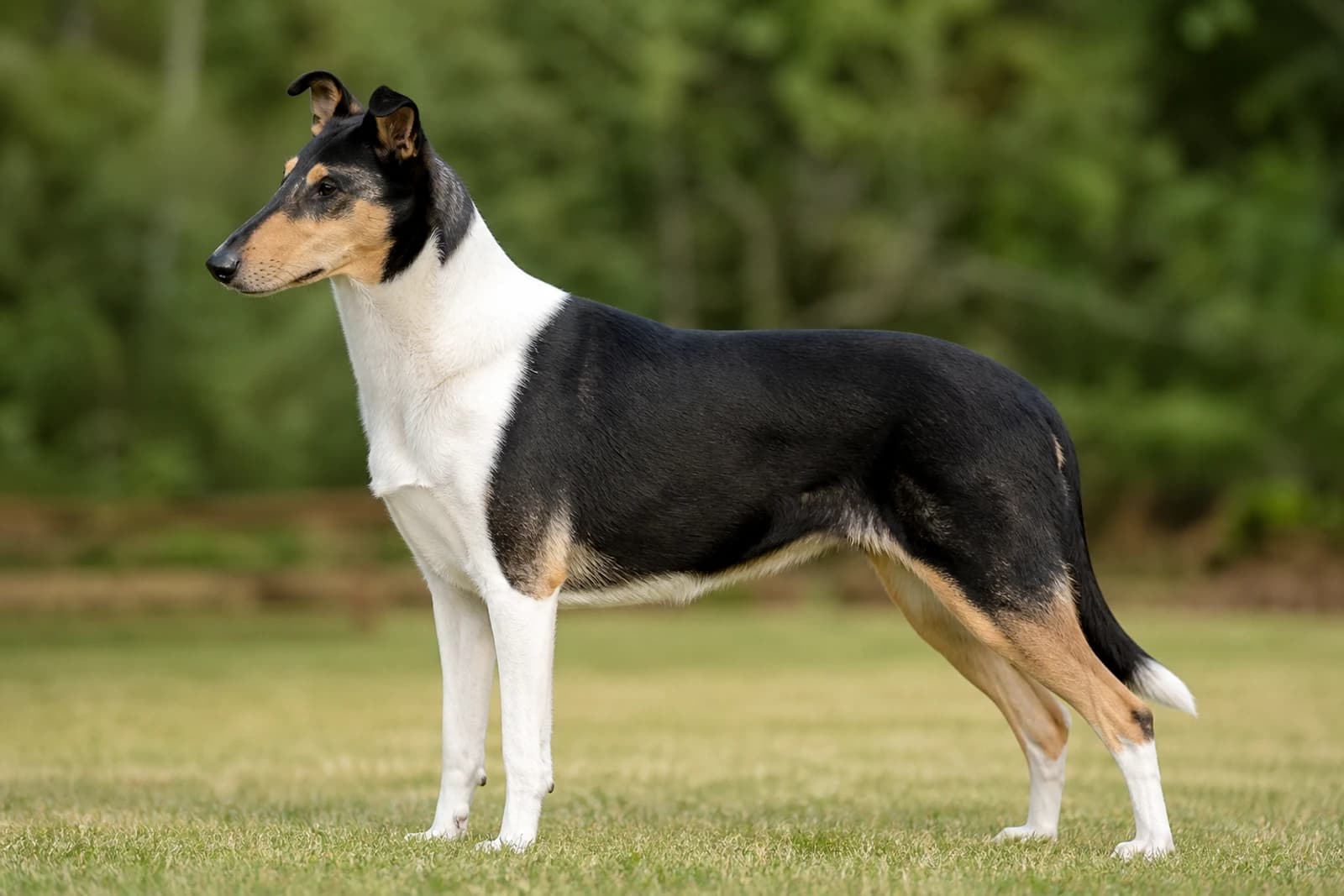
The Smooth Collie is a devoted and intelligent herding breed, best suited for active families who can provide daily exercise and mental stimulation. With a gentle and patient nature, they are excellent with children and generally good with other pets. Their short, low-maintenance coat makes them practical companions for those who appreciate the classic Collie temperament without extensive grooming.
At a glance
- Size
- Large
- Height
- 20–24 in
- Weight
- 40–66 lb
- Life span
- 10 years
- Coat colors
- Sable & White, Tricolor, Blue Merle, White
- Coat type
- Short, dense, smooth outer coat
- Group
- Working
How much does a Smooth Collie cost?
Adopt / rescue
$75–$400
Usually includes spay/neuter, first shots, and a microchip.
Buy from a breeder
$700–$2,000
From a reputable, health-testing breeder.
Approximate USD. Prices vary widely by region, breeder, pedigree, age, and coat colour — adopting is the lower-cost and recommended route. Avoid suspiciously cheap “breeders”; they’re often puppy mills.
Estimate the full cost of a Smooth Collie →Smooth Collie photos
Views
Front, side, rear and top — the full silhouette.Poses
How the breed sits, lies, moves and plays.Puppy to senior
The breed across its whole life.Expressions
The breed’s range of moods.Close-up details
Eyes, ears, nose, paws, tail and coat.Coat colors
The breed’s recognized colors.Click any photo to enlarge. We show the Smooth Collie from every angle — three views, poses, life stages, expressions, close-ups, coat and colors.
Appearance & size
Standing 20 to 24 inches at the shoulder and weighing between 40 and 66 pounds, the Smooth Collie reads as a balanced, long-bodied herding dog — never heavy, never weedy. The frame is slightly longer than tall, with a deep chest that reaches the elbows, well-sprung ribs, and a gently sloping shoulder that allows easy, ground-covering strides. From the side, a level topline and moderate tuck-up give the silhouette a clean, athletic sweep. The hindquarters are muscular and well-angulated, and the tail reaches at least to the hock, carried low with an upward swirl at the tip when the dog is moving or alert. You see a dog built for a full day’s work, not a sprint.
Head and expression
The head is a clean, lean wedge — flat on top, with a muzzle that tapers slightly but never looks snipey. The stop is slight but distinct, breaking the parallel planes of skull and foreface. A large, black nose fronts it all. Almond-shaped, medium-sized eyes sit under slightly arched brows and give the breed its trademark intelligent, inquisitive softness. Dark brown is the norm, though blue merle dogs can have one or both eyes blue or flecked. Ears are carried semi-erect: the lower third stands up, the upper two-thirds break forward, tipping toward the listener. That forward-tipped break is one of the features that most sets Collie look apart from other long-headed breeds.
Coat and color
The obvious difference from a Rough Collie is the short, hard coat. Across the body it lies close — about 1 to 2 inches long — with a dense, soft undercoat beneath. The hair is smooth on the head, ears, and fronts of the legs; you’ll see modest feathering on the backs of the forelegs, breeches, and underside of the tail. No heavy ruff, no fancy mane.
Three main colors show up, all topped with classic Collie white markings (a full or partial collar, white chest, legs, tail tip, and often a blaze on the face):
- Sable and white — any shade from pale gold to deep mahogany.
- Tri-color — black body with rich tan points on cheeks, eyebrows, legs, and under the tail.
- Blue merle — a marbled mix of black-silver-blue patches with tan points where they occur, all on a gray-blue base.
Without the profuse outer coat, the Smooth Collie’s athletic build is easier to see and far easier to brush out — though twice a year you’ll still deal with a substantial undercoat dump.
History & origin
The Smooth Collie is simply the short-coated version of the dog the world knows as Lassie, and its story starts not on a movie set but in the sheep-dotted hills of Scotland and northern England. By the 1700s, these tough, intelligent herding dogs were already woven into the fabric of Border life. Farmers valued a dog that could read sheep at a glance, work all day in rain and mud, and come home to sleep by the fire—not one that needed hours of combing. A dense, flat, weather-shedding coat was a practical choice, and that’s what the smooth-coated dogs offered.
The exact origin of the breed’s name is still kicked around, but many point to the old Anglo-Saxon word col, meaning black, or the black-faced “Colley” sheep they managed. Whatever the etymology, the collie type was the essential farmhand of the region long before anyone called it a breed. In the early 1800s, these dogs caught the eye of a new class of dog fancier, and the modern Collie began taking shape. Breeders sought a refined head, balanced silhouette, and sweeter expression, often crossing in setters and, later, Borzoi for elegance. The smooth variety and the rough were considered the same breed—born in the same litters, judged side by side at early shows, and registered together.
Queen Victoria’s well-known love affair with the breed in the 1860s lit a fire under the Collie’s popularity, but she favored the dramatic flowing coat of the Rough. The Smooth Collie quietly stuck to what it did best: honest work. It remained the shepherd’s dog, the drover’s partner, and a fixture on rural farms while the Rough ascended to parlor-star status. By the time the Collie Club of America was founded in 1886, both varieties were recognized, but the Smooth was already the rarer of the two.
Through the 20th century, the Smooth Collie kept its practical edge. American kennel clubs originally placed the breed in the Working Group, a nod to its roots, though today it’s often grouped with herding breeds elsewhere. Its temperament—methodical, steady, remarkably in tune with a handler—eventually drew interest beyond the farm. You now see Smooth Collies in obedience rings, as search-and-rescue dogs, as therapy dogs, and in active family homes. They’ve never lost the mind of a shepherd, but they’ve adapted to a world that needs a dog that thinks on its feet and gets along without fuss. The breed’s numbers remain small compared to its rough-coated cousin, which keeps it a kind of well-kept secret among people who value intelligence, versatility, and a coat that dries in ten minutes flat.
Temperament & personality
A Smooth Collie reads the room before you’ve finished walking through the door. This is a thinking dog, tuned in to family rhythms and quick to notice when someone’s mood shifts. Affectionate without being needy, they’d rather lean against your leg than demand constant petting. That gentle observation can look like aloofness with strangers—they aren’t aggressive, just discerning, and early socialization turns wariness into polite acceptance.
Energy lands in the moderate but engaged zone. Expect a dog that’s ready for a long morning walk, a midday training session, and an evening fetch game, then settles indoors without ricocheting off the furniture. When their mind is under-challenged, that settled nature can flip into nuisance barking or shadow-chasing, so puzzle toys and trick training are not extras—they’re requirements.
Herding instinct runs deep. You may see it as circling the kids in the yard, nudging a wandering cat back toward the group, or a light nip at a running heel. Teach a solid “leave it” and redirect that drive into a job, whether it’s learning the names of toys or accompanying you on hikes. The breed’s sensitivity means harsh corrections backfire; these dogs shut down under a heavy hand. A calm, consistent approach that respects their intelligence brings out the eager partner underneath.
With children, a well-socialized Smooth Collie is patient and watchful, often positioning themselves between a toddler and an open door. That same watchfulness makes them excellent alert barkers—they’ll announce the delivery truck but rarely escalate beyond a sharp, this-is-weird woof. The flip side: if left alone for long stretches or ignored in a backyard, they can become anxious noisemakers. They need to be part of daily life, not just a weekend companion.
A few real-world quirks to know: many are “talkers,” using whines, grumbles, and a range of yips to comment on the day. They also mature slowly; expect playful, adolescent energy until around age three. Because they form such tight bonds, rehoming or long kennel stays hit them hard. Give this dog a steady routine, a reason to think, and a spot near the family action, and you get a calm, brave friend who doesn’t need to be the center of attention—they just want to be part of what matters.
Good with kids, dogs & other pets
A Smooth Collie is one of the steadiest family dogs you’ll find—patient, gentle, and wired to get along. They typically adore kids, matching a toddler’s unpredictable movements with an easygoing, non-aggressive stance that rarely frays into snapping or guarding. Still, this isn’t a set-it-and-forget-it situation. At 40 to 66 pounds, an excited Collie can accidentally body-check a small child during zoomies, so ground rules and supervision make all the difference. The real watch-out is the breed’s ingrained herding instinct: without an outlet, they may circle, nudge, or nip at running children’s heels, trying to “gather the flock.” Redirect that drive into fetch or structured play, and you’ll have a loyal shadow who’d rather sleep at the foot of a kid’s bed than anywhere else.
With other dogs, Smooth Collies lean toward the sociable side, but their sensitivity means rough, pushy play can shut them down fast. Early and ongoing socialization is the lever that tips them toward relaxed, appropriate greetings instead of worry. The critical window slams shut around 12–16 weeks, so you’ll want to introduce your puppy to a wide variety of calm, well-mannered dogs before that clock runs out. Miss it, and you risk a dog who’s timid, overexcited, or reactive—problems that don’t just vanish with age. Even after that period, dedicated positive exposure helps, but forcing an already fearful adult Collie into a dog-park free-for-all adds stress, not confidence.
Cats and small pets? That’s a mixed bag. A Collie raised alongside a cat from puppyhood often becomes a respectful housemate, even a napping partner. But without that early imprinting, the chase instinct can light up around a darting squirrel or a neighbor’s free-roaming rabbit. Gradual, controlled introductions behind a baby gate or on leash give you the control to teach “leave it” before anyone panics. Small, caged animals like guinea pigs should never be within unsupervised reach—not because Collies are malicious, but because a squeaky, fast-moving critter reads as a toy to many herding dogs.
The biggest caveat: Smooth Collies were bred to be with their people, not parked in a backyard. Leaving one isolated for long hours invites whining, pacing, and distress. If your household is often empty, this isn’t the breed for you. But if you’re around to include them in daily life, commit to a solid socialization plan during puppyhood, and supervise heavily around the very young or tiny pets, you’ll get a dog that weaves kids, adults, and other animals into a cohesive, easygoing pack.
Trainability & intelligence
A Smooth Collie learns a new cue in a handful of repetitions — and she’ll remember the exact tone of voice you used to teach it a year later. This is a breed that reads micro-expressions, routines, and emotional shifts faster than most people do. Biddability runs deep in the herding lines; they were built to take direction at a distance and adjust on the fly, which makes them a joy to train for anyone willing to work with the dog’s sensitivity rather than against it.
-
Motivation. Most Smooth Collies light up for a mix of food, a squeaky toy, and genuine verbal praise. They aren’t mercenary — the relationship is the primary reinforcer. Once you've built trust, a quiet “good” carries more weight than a whole hot dog.
-
Recall & reliability. Their off-switch isn’t built-in. Distractions like a darting squirrel can short-circuit the best training. Still, a recall trained with a long line and high-value rewards in gradually tougher environments becomes rock-solid because the Collie wants to return to her person. Expect to proof it thoroughly around movement; their eye is always tracking motion.
-
The sensitivity catch. Correction-based methods backfire spectacularly. A harsh voice or a jerk on the leash can cause a Soft Collie to shut down or become anxious, erasing progress for days. You’ll get far more mileage from a short time-out than from any physical reprimand. This dog remembers unfair treatment.
The right approach
Start the day you bring the puppy home — the socialization window is open from roughly 3 to 14 weeks, and you want to fill it with positive exposures to different people, friendly dogs, floor surfaces, and common sounds. Keep sessions short (5-10 minutes) and always end on success. Use a clicker or a crisp verbal marker to pinpoint exactly what you want, and reward with whatever makes your dog’s tail keep wagging. If you hit a training plateau, check your delivery for frustration; the Collie will mirror it back at you.
The real challenge isn’t the dog’s intelligence — it’s the owner’s consistency. Smooth Collies thrive on predictable rules and gentle guidance. A pet home that relies on punishment or sporadic expectations will create a confused, anxious adult. Stick with reward-based shaping, add plenty of early and ongoing socialization, and you’ll have a dog that walks off-leash with an eye-lock on you — not because she’s afraid, but because she’s decided you’re the most interesting thing in the field.
Exercise & energy needs
What daily exercise really looks like
Count on 60 to 90 minutes of real, engaged activity every day, split across at least two sessions. A casual 20-minute stroll won’t scratch the surface for this dog. They’re a working herder with real stamina, so the best outlets tap that drive: off-leash hikes, long jogs on soft trails, agility courses, or herding trials. A fenced yard is a bonus for full-tilt zoomies, but don’t expect them to self-exercise — they need you in the equation.
The brain needs a workout, too
Physical exercise alone won’t keep a Smooth Collie content. A bored mind in this breed quickly becomes a problem that looks like obsessive chasing, barking at nothing, or herding your kids around the house. Daily obedience sessions, trick training, scent games, or puzzle feeders are non-negotiable. Short, frequent brain breaks — even 10 minutes of hide-and-seek or practicing a new heelwork pattern during your lunch break — burn energy just as effectively as another lap around the block. They genuinely thrive on collaborative work, so the more you treat every outing as a partnership, the calmer your dog will be indoors.
Protecting growing joints
Puppies and adolescents need you to pump the brakes. Those long legs grow fast, and growth plates stay vulnerable until around 12–18 months. Skip forced running on pavement and repetitive jumping. Instead, stick to free play on grass, controlled walks, and low-impact strength builders like balancing on a cushion or walking gentle inclines. Responsible breeders screen for hip and elbow issues, and your vet can help you map out a safe timeline for higher-impact sports. Give growing bodies a sensible foundation, and you’ll have a sturdy partner ready for years of active life.
Grooming & coat care
The Smooth Collie’s short, dense double coat is a wash-and-wear marvel — until it isn’t. Twice a year, that sleek jacket practically explodes, carpeting your floors, furniture, and dark pants in a fine undercoat blizzard. If you hate vacuuming, brace yourself. The upside? Weekly upkeep is minimal and the coat naturally resists dirt.
Brushing
A once- or twice-weekly session with a boar-bristle brush keeps the outer coat glossy and distributes natural oils. During heavy seasonal shedding, swap to a rubber curry brush or an undercoat rake two to three times a week to pull dead fluff before it drifts into every corner. Work in the direction of hair growth with short, brisk strokes; the whole dog should take under 10 minutes once you get the rhythm. This isn’t a breed that mats, but skipping brushing during a blowout means tumbleweeds of hair for weeks.
Bathing
Smooth Collies stay surprisingly clean. Bathe only when they roll in something truly foul or develop that unmistakable doggy odor — usually every 6 to 8 weeks, if that. Over-bathing strips the waterproofing oils and can trigger dry skin. Use a gentle dog shampoo, rinse thoroughly, and towel dry. A quick blow-dry on a cool setting helps blast out loosened undercoat.
Trimming
There’s no clipping or shaping required. Trim just the few stray long hairs on the backs of the hind legs and tidy the feet if hair grows between the pads. Clean, natural lines are the goal.
Nails, Ears, and Teeth
Trim nails every few weeks — if you hear clicking on the floor, they’re too long. Check the upright ears weekly for wax buildup or irritation; a damp cloth swipe is usually enough. Brush teeth at least two to three times a week to head off tartar and keep that expressive grin healthy.
Seasonal Coat Care
Spring and fall are shedding supernovas. During those three- to four-week periods, daily brushing for even five minutes makes a dramatic difference. A bath mid-shed can also loosen the dying undercoat. Keep a lint roller in the car and embrace the ritual — the dog handles the rest.
Shedding & allergies
Smooth Collies shed — generously and continuously. No clever loophole hides behind that sleek, flat coat: it’s a dense double coat, and it works year-round to decorate your dark pants and sofa with a fine layer of pale undercoat. Twice a year, during the spring and fall coat blow, the volume escalates from steady to startling. You’ll pull tufts of loose fluff by the handful, and tumbleweeds of hair will drift across the floor hours after you vacuum.
- Grooming reality: A thorough session with a pin brush or undercoat rake 3–4 times a week catches the worst of it. During the big seasonal shifts, plan on daily brushing outdoors — it cuts the indoor fallout noticeably but never eliminates it.
- Drool factor: Almost zero. Smooth Collies don’t string slobber or leave wet spots behind. A quick drip after drinking water is the most you’ll see.
- Hypoallergenic? No. This is a shedding breed, not an allergy-friendly one. The constant release of hair spreads dander and proteins throughout your home. Even with religious grooming and HEPA filters, someone with moderate to severe dog allergies will react. Mild allergy sufferers sometimes report tolerating specific individuals better, but banking on that is a gamble, not a plan. The Rough Collie sheds just as much, just in longer strands — so that’s not a workaround either.
The trade-off for that elegant short coat is a house that demands a high-grade lint roller in every bag and car.
Diet & nutrition
A Smooth Collie that packs on extra pounds is a dog headed for trouble — those long, lean frames weren’t built to carry excess weight. Even a few extra pounds can strain joints and the spine, potentially cutting into an already average 10-year lifespan. Keep your dog’s ribs easily felt but not visible, and adjust portions the moment you notice the waistline disappearing.
How much to feed
A typical adult Smooth Collie (50–60 lb) with a decent daily run or herding session usually does well on about 2½–3 cups of high-quality dry food, split into two meals. That number shifts with your dog’s exact weight, metabolism, and the calorie punch of the food — a 66 lb intact male working stock all day easily needs more than a 40 lb spayed female who walks twice around the block. Always go by the feeding guide on the bag as a starting point, then tweak.
Puppies follow the same rhythm: four meals a day until 4 months old, then three meals until 6 months, then settle into the adult two-meal routine. Large-breed puppy formulas help control growth rate, which is kinder on developing joints. If you’re transitioning to a new food, do it gradually over a week, starting with lightly cooked and puréed meats, fish, fruits, and vegetables, or a premium puppy kibble softened with warm water.
Around 12 weeks, you can introduce raw chicken wings (under supervision) for chewing — great for teeth and mental engagement. Just don’t leave a pup unattended with raw bones.
What to put in the bowl
Aim for a balance that roughly works out to about 60% animal protein (muscle meat, organ meat, fish), 20–30% fruits and veggies, and the rest from eggs, plain yogurt, or digestible grains like pearl barley or white rice. That could be a top-tier commercial food that lists a named meat first, or a well-researched home-prepared diet. White rice is a lifesaver for a dog with an upset stomach — bland, easy on the gut, and won’t make things worse.
Avoid vegetarian or vegan diets entirely. A dog’s teeth and digestive system aren’t wired for that, and you’ll end up shorting them on nutrients they need straight from animal sources. Rich, fatty scraps (think holiday ham or turkey skin) can trigger pancreatitis, so don’t share that plate.
Weight-management and feeding habits
Smooth Collies aren’t notorious chowhounds, but some individuals will eat whatever you put in front of them and beg for more. Free-feeding is a fast track to obesity. Use a puzzle bowl or a snuffle mat if your dog inhales meals — it forces them to slow down and works their brain at the same time.
Never feed directly from the table; once begging is learned, it’s a nightmare to undo. Any leftovers you intend to give go into the dog’s own bowl, away from the dinner table.
As your Collie gets older and naturally slows down, cut food back a little before the scale tells you to. Senior dogs often do better on two or three smaller meals a day rather than one or two big ones. There’s no solid reason to drop protein for healthy seniors, but you may need to purée meals if teeth go missing or the mouth gets tender. Unsalted water from cooking vegetables makes a nice low-sodium broth to moisten food when stock isn’t handy — simple, cheap, and dogs love it.
Health & lifespan
A Smooth Collie’s typical lifespan lands right around 10 years. That number can shift a bit either way depending on genetics, diet, and how proactive you are with preventive care, but it’s a realistic baseline to plan around.
This is a large, deep-chested breed, so bloat (gastric dilatation-volvulus) sits high on the watch list. Feed two or three smaller meals a day instead of one giant bowlful, and avoid heavy exercise right before and after eating. Learn the early signs — a distended belly, unproductive retching, pacing — because it can go from quiet to crisis in minutes.
Eye health is another area where a good breeder makes all the difference. Collie Eye Anomaly (CEA) can show up, though responsible breeders screen breeding stock and can often tell you a puppy’s status before you bring him home. Also, that hallmark long nose means the eyes are somewhat exposed; surface scratches and irritations happen more easily than in flat-faced dogs, so keep an eye out for squinting or excess tearing.
You might hear about the MDR1 gene mutation — a drug sensitivity that affects many herding breeds, Smooth Collies included. It doesn’t cause day-to-day illness, but it means certain common medications (including some dewormers, sedatives, and chemotherapy drugs) can cause severe neurological reactions. A simple cheek swab test tells you if your dog carries the mutation, and you adjust his drug list accordingly. Reputable breeders test for this.
Hips can become an issue as dogs age. Hip dysplasia isn’t rampant in the breed, but it’s common enough that responsible breeders screen breeding pairs through the Orthopedic Foundation for Animals (OFA) or PennHIP. Keeping your dog at a lean 40 to 66 pounds, with ribs you can easily feel but not see, takes pressure off those joints.
On the skin front, Smooth Collies can be prone to environmental allergies and occasionally dermatomyositis, an inflammatory condition that shows up as hair loss and crusty lesions, often on the face and legs. Mild cases flare and fade; severe ones need ongoing management. Either way, catching it early matters.
Across the board, standard wellness habits hold: monthly heartworm prevention during mosquito season and one month beyond it, a legally required rabies vaccine, and annual exams where your vet listens for heart murmurs, checks eyes, and screens for early arthritis. Weight creep is surprisingly easy in a food-motivated dog with a gentle couch-potato mode, so measure meals, not eyeball them. When a Smooth Collie drops activity or walks away from a meal he’d normally inhale, that’s your cue to call the vet — don’t write it off as a minor mood shift.
Living environment
A Smooth Collie doesn’t do well in a home where everyone is gone for 10 hours a day. These dogs bond hard with their people and can become anxious or destructive when isolation is a regular part of the routine. If you work long hours away, this isn’t the breed for you unless you can arrange midday breaks, doggy daycare, or a stay-at-home companion.
Apartment or house? A house with a securely fenced yard is the easiest fit. Smooth Collies love to stretch out and run, and a yard gives them an easy outlet between walks. An apartment can work, but only if you’re genuinely committed to meeting their exercise needs with multiple daily outings. They’re large dogs — 40 to 66 pounds and up to 24 inches at the shoulder — so a cramped studio with no green space nearby is a tough sell.
Yard needs. A physical fence is ideal, and 5 feet or taller is a good benchmark. Smooth Collies have a herding dog’s instinct to chase movement, and a squirrel or a bike can trigger a dash into the street. Underground fencing doesn’t stop that prey drive and leaves them vulnerable. The yard itself doesn’t have to be huge, but it needs to be a place where they can really move — a short potty break isn’t enough.
Exercise and mental work. Plan on a solid hour of active movement every day, split into at least two sessions. A stroll around the block won’t cut it. Brisk walks, hiking, and off-leash running in a safe area are all good bases. Just as important is what happens between exercise sessions. Smooth Collies are sharp and perpetually tuned in to their household. Without mental engagement — puzzle toys, scent games, trick training, or even a job like carrying a backpack on walks — they’ll find their own entertainment, and that usually means barking, pacing, or re-arranging your couch cushions.
Climate tolerance. The short, dense double coat gives them more adaptability than their Rough Collie cousins. They handle cool and cold weather well and will happily romp in snow. Hot weather requires more care. They can overheat if pushed hard in the summer, so schedule exercise for early morning or late evening and always provide shade and water.
Noise and barking. Smooth Collies are alert and will announce visitors, passing delivery trucks, and the neighbor’s cat. That makes them decent watchdogs but a potential nuisance if you have noise-sensitive neighbors. The barking ramps up sharply when they’re bored or under-exercised. A tired, mentally satisfied Smooth Collie is far quieter.
Alone-time tolerance. This is where the breed draws a hard line. Left alone for long stretches, these dogs tend to develop separation distress — whining, barking, chewing, or worse. Gradual desensitization from puppyhood and enrichment toys can build some independence, but expecting this breed to tolerate a 9-to-5 absence five days a week is asking for trouble. They need a household where someone is around enough to keep that sensitive herding brain busy.
Who this breed suits
You won’t find many large dogs that bend this gracefully around a first-timer’s learning curve. Smooth Collies are highly biddable, steady-nerved herding dogs that read their people like a book and rarely dial the intensity up to Border Collie levels. That makes them a standout pick for novice owners willing to do the work — sign up for a positive-reinforcement class, put in daily training sessions, and give the dog a job, even if that job is just fetching the newspaper or learning trick sequences on a rainy afternoon. They’re sensitive, not hard-headed, so harsh corrections backfire; a calm voice and a clear routine get you further.
A great fit if…
- You’re an active family with kids. A well-socialized Smooth Collie is famously gentle and watchful, often shadowing children from room to room. Just be ready to redirect inherited herding tics — like shoulder-nudging a running 5-year-old — with a “place” cue, and teach the kids to respect the dog’s quiet times. Expect a solid 45–60 minutes of real exercise daily, not a quick lap around the block. A fenced yard helps, but they’d rather be doing something with you.
- You’re a single or couple who wants a weekend adventurer and a weekday buddy. This breed will jog, hike, and camp with you, then curl up on the couch afterward without crawling the walls — provided its brain gets worked too. Puzzle toys, nose work, or a few short backyard agility drills go a long way.
- You’re an active senior. A Smooth Collie from show lines can have an adaptable off-switch and gentle leash manners that won’t yank you off your feet. That said, this is still a 40–66 lb working dog that lives about 10 years, so plan for a genuine walk, not just a potter in the garden. For the right retiree who wants a devoted daily companion and has friends or a dog walker as backup, it’s a lovely match.
- You have other pets. With proper introductions, most Smooth Collies live peaceably with cats and other dogs. They’re not generally dog-aggressive, though herding instincts may need management around smaller animals.
Think twice if…
- You’re gone 9+ hours most days. Smooth Collies form a deep bond and can develop separation-related barking or destructiveness if routinely left alone. They do far better when someone works from home, works part-time, or can arrange midday help.
- Couch potatoes need apply elsewhere. A short stroll and a backyard won’t cut it. Without enough movement and mental engagement, you’ll get a restless, vocal dog who invents his own jobs — like rounding up the mail carrier or reorganizing your throw pillows.
- You need a quiet apartment dog. They’re moderate shedders, but they’re also alert and will announce visitors, delivery trucks, and suspicious squirrels. If you share walls with sensitive neighbors, the barking could be a dealbreaker.
- Your household runs on chaos or loud conflict. This breed absorbs tension; a perpetually tense home can make them anxious, shy, or noise-phobic.
Cost of ownership
A well-bred Smooth Collie puppy from health-tested parents runs between $1,200 and $2,500. If you see a price much lower, you’re almost certainly skipping critical screenings for collie eye anomaly, hip dysplasia, and MDR1 drug sensitivity — all of which can turn into four-figure vet bills down the road. Rescue is an option, but smooths are harder to find than rough collies; adoption fees usually land around $200–$400.
Once the dog is home, monthly costs settle into a predictable rhythm. Here’s what a typical month looks like for an adult Smooth Collie:
- Food: $60–$80. A 45–60 lb dog eats through a 30-lb bag of quality kibble in about three to four weeks. Cheap food often means more fill, more waste, and duller coat, so this isn’t the place to pinch pennies.
- Grooming: $15–$20 averaged monthly. A weekly brush at home handles most of it. A pro bath and nail trim every few months might cost $40–$60, but many owners do it themselves.
- Routine vet + preventatives: $50–$80. This covers annual exams, vaccines, and monthly heartworm/flea/tick meds. Smooth Collies can have drug sensitivities (the MDR1 gene), so your vet may opt for pricier preventatives — ask about that upfront.
- Pet insurance: $40–$70. For a large breed with a 10-year lifespan, emergency surgery (bloat, injury) or a chronic issue like hip dysplasia can run $3,000–$8,000. A decent policy keeps that from blindsiding you.
- Treats, toys, misc.: $20–$40. Collies are gentle chewers compared to some herding breeds, but they’ll still dismember stuffed animals and wear through tennis balls at a steady clip. A couple of puzzle toys and a well-made long line for training are worth the upfront cost.
Factor in a one-time hit of $1,500–$3,000 for a secure fence if you don’t already have one. These dogs were built to cover ground, and their herding brain means an unfenced yard with squirrel traffic is a recipe for a missing dog. All told, budget $200–$300 a month to keep a Smooth Collie healthy and happy, with the understanding that a single bad accident or bloat scare can compress a year’s worth of that into a weekend.
Choosing a Smooth Collie
A healthy Smooth Collie that hits the breed’s average 10-year lifespan starts with one decision: who you get the dog from. This isn’t a breed with extreme structure problems, but a handful of inherited issues pop up often enough that you can’t skip the paperwork.
Responsible breeder vs. rescue
A good breeder focuses on health and temperament, not just coat color or a quick sale. They’ll hand you actual test results—not a verbal “the parents are healthy”—and they’ll ask you just as many questions as you ask them.
Breed-specific rescue is a solid alternative, especially if you’re open to an adult dog. Rescues often have Smooth Collies or Smooth-mix dogs from owner surrenders. You lose the puppy stage but gain a dog whose personality is already on display. Expect the rescue to screen for known health issues and MDR1 status if records exist.
Health clearances you should ask for
Responsible Smooth Collie breeders screen for multiple conditions. Always verify results in the OFA database or ask for physical certificates from a veterinary specialist.
- Eyes: Annual exam by a board-certified veterinary ophthalmologist (OFA or CERF). Looks for Collie Eye Anomaly (CEA), progressive retinal atrophy (PRA), and other inherited eye diseases. Normal results at age 2 or older carry more weight.
- Hips: OFA or PennHIP evaluation. The breed can be prone to hip dysplasia even at a lean 40–66 pounds. Parents should have at least a “Fair” OFA rating or a PennHIP score in the breed’s tighter range.
- MDR1 sensitivity: A genetic test that tells you if the dog carries the multidrug resistance mutation. Collies with two copies can have severe reactions to common drugs like ivermectin. A breeder should test both parents and know the status of every puppy before it goes home.
- Autoimmune thyroiditis: Not universal, but many breeders include OFA thyroid panels via an approved lab. Low thyroid can shorten that already-modest 10-year lifespan.
Red flags that walk like a breeder
- No health certifications or “vet checked” only.
- Breeding dogs before they hit 2 years old—too young for final hip and eye clearances.
- Multiple litters on the ground at once or always having puppies available.
- Gives you a hard sell on a puppy in your first conversation.
- Won’t let you meet the dam, or keeps the litter in a garage/kennel away from household activity.
Picking a puppy
You want a puppy raised underfoot, not in a barn run. The litter should be comfortable around people, curious, and recovering quickly from a startle. At pickup (usually 8–10 weeks), you should get a health record, MDR1 results, microchip info, and a contract that spells out the breeder’s return policy if you ever can’t keep the dog.
A shy or skittish 8-week-old Smooth Collie isn’t a project—it’s a risk. Temperament is the long game with this breed; choose the puppy that engages you without crawling over littermates. And never leave without knowing the MDR1 genotype. That single piece of information can prevent a life-threatening drug reaction and will follow the dog for a decade.
Pros & cons
Pros
- Highly trainable: A bright, eager-to-please mind makes them stars in obedience, agility, and therapy work — you’ll see results fast with positive reinforcement.
- Wash-and-wear coat: The smooth double coat shrugs off dirt and needs only a weekly brushing. No mats, no clipping, no expensive groomer bills.
- Gentle family dog: Patient by nature, they form deep bonds with kids and usually coexist peacefully with other pets when raised together.
- Alert, not aggressive: They’ll bark an announcement when someone arrives, but introductions typically turn them into a calm, friendly host.
- Athletic but balanced: Up for a long hike or a hard game of fetch, then happy to lounge at your feet — they have a real off-switch once exercise needs are met.
Cons
- Serious exercise commitment: A quick walk won’t cut it. Plan on 60–90 minutes of off-leash running, herding games, or focused training daily, or that clever brain finds its own (destructive) outlets.
- Strong herding drive: Expect chasing bicycles, nipping at running children, or circling the cat. Impulse-control training is a must, not a nice-to-have.
- Shedding machine: They shed year-round and blow undercoat heavily twice a year. Short, clingy hairs weave into upholstery — a good vacuum becomes a household staple.
- Vocal watchdog: Barking at squirrels, delivery trucks, and unfamiliar sounds is standard operating procedure. A quiet home is not likely unless you train an “enough” cue early.
- Wary of strangers: Without thorough puppy socialization, natural reserve can tip into shyness or fear-based reactivity — you’ll be managing introductions for life.
- Health hurdles to screen for: Responsible breeders test for Collie Eye Anomaly, hip dysplasia, and the MDR1 drug sensitivity that makes common medications dangerous. You must confirm clearances.
- Shorter lifespan: Around 10 years is on the low end for a 50-pound dog, so you’ll have fewer years together than many owners expect.
Similar breeds & alternatives
If a Smooth Collie’s mix of gentle family-dog manners and low-coat-care is what caught your eye, a few other breeds might tempt you — each with their own trade-offs you’ll want to weigh.
Rough Collie
This is the most direct alternative because, in many registries, Smooth and Rough Collies are simply coat varieties of the same breed. A Rough Collie will give you the same sweet, alert, trainable temperament, the same 50–66 lb frame, and the same instinct to keep the kids rounded up. The difference is all in the grooming. That dramatic, flowing double coat needs thorough brushing two or three times a week, blows coat heavily once or twice a year, and brings a whole lot more hair into your house. If you love the Lassie look and don’t mind the upkeep, go Rough. If you want the collie mind with a wash-and-wear coat you can towel off after a muddy walk, the Smooth is your dog.
Border Collie
Same herding heritage, but a completely different engine. Border Collies are lighter (30–45 lb) and wired with a relentless work ethic that demands a job, not just a couple walks. While a Smooth Collie will happily settle beside you after an hour of running, a Border Collie may stare at you waiting for the next command. They can be more prone to motion-sensitivity, nipping at running kids, and developing neurotic habits without intense mental stimulation. A Smooth Collie is a thinking breed too, but bred to work independently and with a calmer off-switch. If you run agility courses or work sheep, the Border may be a better fit; for a family pet who learns fast but doesn’t climb the walls, the Smooth is the safer bet.
Shetland Sheepdog
Often described as a collie in a smaller package, Shelties stand 13–16 in and top out around 20–25 lb. They share the Smooth Collie’s sensitivity, intelligence, and eagerness to please, but come with a few key differences. Shelties are notoriously vocal — a bark alert for every leaf that blows by — where the Smooth Collie, while an alert watchdog, tends to be less yappy. The Sheltie’s thick double coat needs weekly brushing to prevent mats, so it’s more high-maintenance than the Smooth’s flat, hard coat. If size is a deciding factor and you can commit to managing the noise and coat, a Sheltie offers that collie-like devotion in a compact size. Just don’t expect the quiet.
Australian Shepherd
Aussies run 35–70 lb and stand 18–23 in, so size-wise they overlap. The temperament gap, however, is significant. Australian Shepherds are often more intense, more reserved with strangers, and tend toward a stronger protective streak. Their energy demand is closer to a Border Collie’s — they are built to work all day and need a job. A Smooth Collie’s brain comes with a longer fuse; they are generally softer, friendlier to new people, and less prone to the suspicious edge you may see in a well-bred Aussie. Coat care on an Aussie, with its thick undercoat and moderate feathering, requires more frequent brushing than a Smooth’s. If you want a lively, trainable dog but prefer a smoother temperament curve and a lower-maintenance coat, the Smooth Collie edges ahead.
Fun facts
- The Smooth Collie is the short-coated variety of the Rough Collie, made famous by the fictional character Lassie.
- They rank among the most intelligent dog breeds, excelling in obedience and problem-solving tasks.
- Their herding instinct is strong, and they may gently try to herd children, other pets, or even adults.
- Smooth Collies are naturally alert and make excellent watchdogs, though they are friendly rather than aggressive.
Frequently asked questions
- Are Smooth Collies good with children?
- Smooth Collies tend to be gentle and patient, making them excellent family dogs. Early socialization is important to ensure comfort around kids, and supervision is recommended with very young children due to herding instincts that can lead to nipping. They typically form strong bonds with all family members.
- How much exercise does a Smooth Collie need?
- This breed has moderate to high energy and needs at least an hour of daily exercise, such as long walks, jogging, or playtime in a secure area. They also benefit from mental stimulation like training or puzzle toys to prevent boredom. Without enough activity, they may become restless and potentially destructive.
- Do Smooth Collies shed a lot?
- Yes, they have a thick double coat that sheds seasonally, with heavier shedding typically twice a year. Regular brushing once or twice a week helps manage loose hair and keep the coat healthy. They are not considered hypoallergenic and can leave noticeable fur around the home.
- Is a Smooth Collie suitable for apartment living?
- They can adapt to apartment living if they receive enough daily exercise and mental stimulation. However, as a large, active breed, they thrive with more space and may bark if under-stimulated. A home with a yard is often preferable, but not strictly required with dedicated care.
- Are Smooth Collies easy for first-time dog owners?
- They can be a good choice for first-time owners because of their intelligence and eagerness to please, which makes training relatively straightforward. Their sensitivity means they respond best to positive reinforcement and a calm, consistent approach. Exercise and grooming needs do require commitment, so research is important.
- Do Smooth Collies bark a lot?
- Smooth Collies tend to be vocal and may bark to alert, express excitement, or when herding. Proper training and mental engagement can help manage excessive barking, but potential owners should be prepared for a dog that enjoys using its voice. This trait also makes them effective watchdogs.
Tools & calculators for Smooth Collie owners
Quick estimates tailored to Smooth Collies — pre-filled with this breed’s size where it matters.
Articles & stories about the Smooth Collie
Sources & standards
This profile follows recognized breed standards from the American Kennel Club (AKC) and the Fédération Cynologique Internationale (FCI), along with established veterinary and breed-club guidance. These describe general breed tendencies — every dog is an individual.
Owner stories
Have a Smooth Collie? Share your experience — grooming tips, personality quirks, anything goes.