

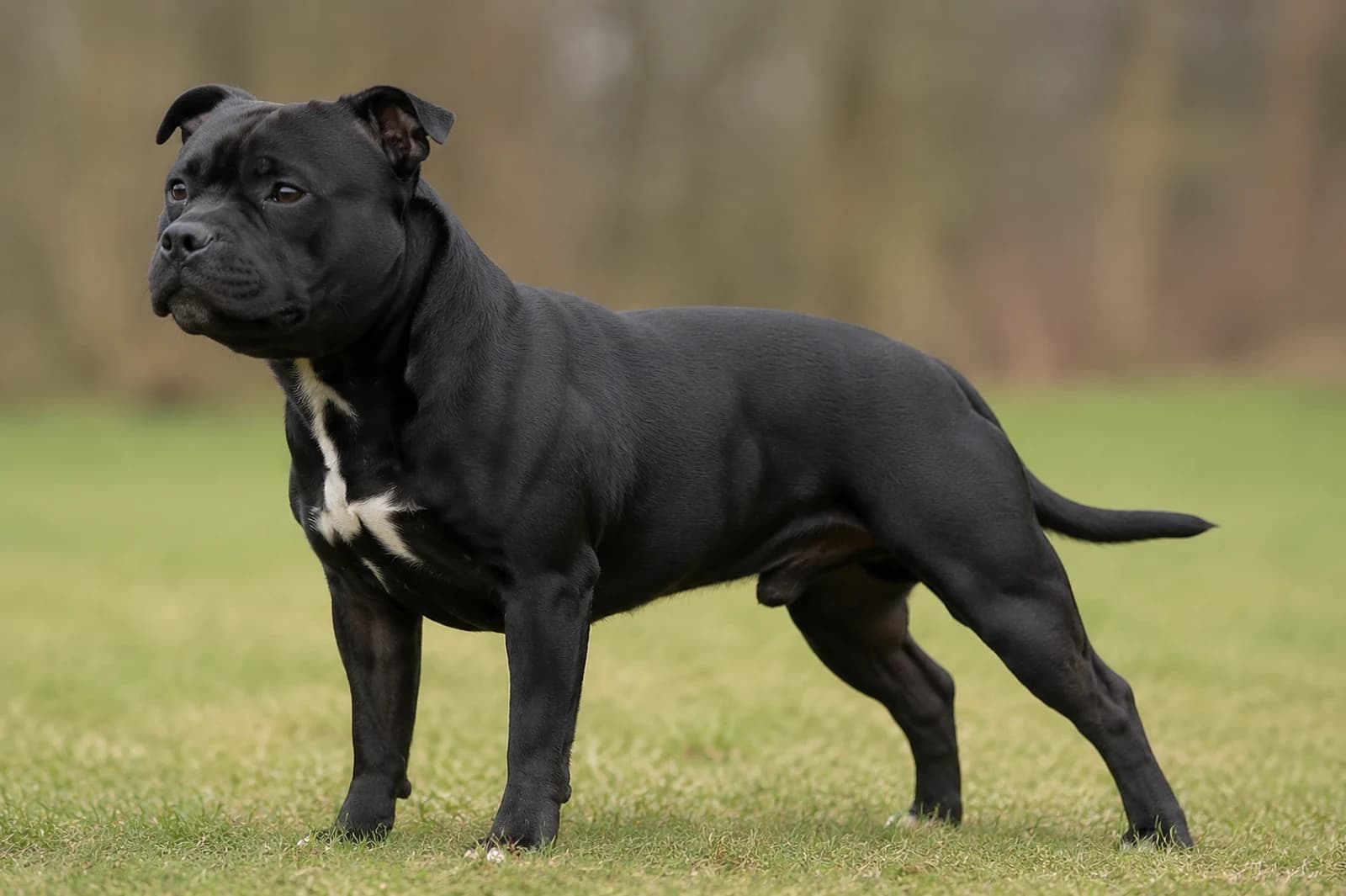
The Staffordshire Bull Terrier is a compact, muscular powerhouse with an unwavering love for people. Known for their affectionate 'nanny dog' nature, they thrive in active families where they can be involved in all aspects of life. Despite their tough appearance, they are gentle and patient with children, making them exceptional companions. This breed requires consistent training, daily exercise, and plenty of mental stimulation. Ideal for experienced owners who can provide structure and affection, the Staffy rewards with boundless loyalty and a joyful, playful spirit.
At a glance
- Size
- Medium
- Height
- 14–16 in
- Weight
- 24–37 lb
- Life span
- 10–16 years
- Coat colors
- Red, Fawn, White, Black, Blue, Brindle, Red & White, Fawn & White, Black & White, Blue & White, Brindle & White
- Coat type
- Short, smooth, close-lying
How much does a Staffordshire Bull Terrier cost?
Adopt / rescue
$75–$400
Usually includes spay/neuter, first shots, and a microchip.
Buy from a breeder
$700–$2,000
From a reputable, health-testing breeder.
Approximate USD. Prices vary widely by region, breeder, pedigree, age, and coat colour — adopting is the lower-cost and recommended route. Avoid suspiciously cheap “breeders”; they’re often puppy mills.
Estimate the full cost of a Staffordshire Bull Terrier →Staffordshire Bull Terrier photos
Views
Front, side, rear and top — the full silhouette.Poses
How the breed sits, lies, moves and plays.Puppy to senior
The breed across its whole life.Expressions
The breed’s range of moods.Close-up details
Eyes, ears, nose, paws, tail and coat.Coat colors
The breed’s recognized colors.Click any photo to enlarge. We show the Staffordshire Bull Terrier from every angle — three views, poses, life stages, expressions, close-ups, coat and colors.
Appearance & size
The Staffordshire Bull Terrier packs a whole lot of dog into a surprisingly compact frame. These are medium-sized dogs standing 14 to 16 inches at the shoulder and tipping the scales at 24 to 37 pounds, with males typically at the higher end. Don’t let the numbers fool you — a fit Stafford weighs far more than he looks like he should, thanks to a dense, muscular build that earned the breed its reputation as the “iron dog.” Every pound is solid.
From the front, the first thing you notice is the head. It’s broad and deep, with a short muzzle, distinct stop, and cheek muscles so pronounced they look chiseled. The eyes are round, set straight on, and dark (though a lighter shade can appear in liver-colored dogs). The ears are rose or half-prick — never full drop or full prick — small and neat, folding back or tipping forward just enough to frame the face. The jaws are strong, the lips tight and dark-pigmented, and the nose is always black. The neck is short, thick, and clean, widening into a chest that’s wide and powerful but never overdone.
A side view of the Staffordshire Bull Terrier reveals a level topline, a deep brisket, and well-sprung ribs that give the barrel a round, capacious shape. The front legs are straight with heavy bone and end in compact, well-knuckled feet. The hind end is equally muscular, with a broad, slightly sloping croup and stifles that bend just enough to produce ground-covering drive without exaggeration. From the rear, you see hind legs that are straight and parallel, with no trace of cow hocks, and a tail set low that tapers to a point and reaches about to the hock. The tail is never docked and is carried low, curling upward only slightly when the dog’s excited.
The coat is a single, short, smooth layer that lies flat and shines when the dog is healthy. Colors include red, fawn, white, black, blue, brindle, and any of these with white markings. White often appears on the chest, neck, feet, or as a partial or full collar. Brindle coats can be black-brindle, red-brindle, or blue-brindle, with subtle striping that really shows in sunlight. The coat sheds moderately and requires little beyond a quick wipe-down or weekly brushing, but all that dog does leave occasional white hairs on dark furniture — part of the deal with a short-haired power breed.
What sticks with you is the dog’s overall silhouette: square-ish, low-slung without being dwarfed, and so heavily muscled that the skin sometimes shows a ripple over the shoulders. A well-bred Stafford isn’t chunky or soft; he’s a study in clean lines and coiled strength. When you put your hands on him, he feels like a bag of bricks wrapped in velvet.
History & origin
The dog we call the Staffordshire Bull Terrier today has its roots in the grim but practical world of early 19th-century England. In the coal-mining and pottery districts of Staffordshire — the Black Country — working men crossed old-style Bulldogs with nimble terriers. The goal wasn’t a show dog; it was a compact, explosively strong fighter for the pit. Bull-baiting had been outlawed in 1835, so the action moved to ratting and dog-on-dog combat, which could be conducted in a small, easily hidden space. The early “Stafford” bulls-and-terriers had to combine a Bulldog’s tenacious grip and pain tolerance with a terrier’s fire and quickness.
By the mid-1800s, breeders around Birmingham and the Black Country were shaping a distinct type: muscular but not cloddy, standing around 14 to 16 inches and weighing 24 to 37 pounds when fully mature. Unlike the taller, more refined English Bull Terrier that James Hinks was developing at the same time by adding White English Terrier and Dalmatian blood, the Stafford version remained closer to the original pit-dog blueprint. Early names like “Bull-and-Terrier” and even “Half-and-Half” stuck for decades.
While dog fighting was the breed’s grim origin, the dogs quickly proved themselves as loyal family companions once they left the pit. Miners and factory workers kept them as house dogs, and their gentle patience with children earned them the nickname “nanny dog” — a term that’s a bit romanticized but reflects a real historical pattern of trust. In 1935, the Kennel Club of England officially recognized the breed as the Staffordshire Bull Terrier, distinguishing it from its smoother-faced cousin. The first breed standard was written, and the focus shifted entirely toward temperament and sound structure.
American servicemen stationed in Britain during World War II brought some of the first Staffords back to the States, but the breed didn’t gain a serious foothold until the 1970s. The American Kennel Club accepted the Staffordshire Bull Terrier into its Terrier Group in 1975. Today, the Stafford is a medium-sized powerhouse with a 10- to 16-year lifespan, far removed from its fighting past yet still carrying that unmistakable blend of grit and affection.
Temperament & personality
A Staffordshire Bull Terrier is a people-obsessed firecracker packed into a muscular, 24–37 lb frame. This is a dog that doesn’t just like being with you — it needs it. Expect a shadow that follows you from room to room, a 14–16 inch tank who forgets he isn’t a lapdog, and a level of affection that some owners describe as “aggressively cuddly.” They lean, they lick, and they will find a way to wedge themselves between you and the armchair every single evening.
That bond cuts both ways. A Staffie left alone in the backyard or ignored for long stretches often spirals into anxiety-driven behaviors — nonstop barking, shredded couch cushions, or destroying anything that fits in those powerful jaws. They’re not backyard dogs; they belong in the thick of family life. Even a few hours of isolation can be too much for some.
With people, especially children, many Staffies show remarkable patience and gentleness. They’ll tolerate clumsy hugs and accidental tail pulls with surprising grace. Don’t let the old “nanny dog” stories make you complacent, though. No dog is a babysitter, and that stocky body can easily bowl over a toddler during a zoomie episode. Supervision is non-negotiable. What’s true is that they often form an intense, protective bond with the household — not aggressive guarding, but a watchful awareness that makes them reliable alert dogs. A stiff, fixated stare or a low forward lean toward a stranger at the door usually means “I’m watching you,” not an immediate threat, but you’ll want to teach a solid “settle” command to dial it back.
Around other dogs, the picture gets more complicated. The breed carries a tenacious streak and a history that can surface as same-sex dog aggression, even in well-socialized adults. Many live peacefully with a compatible opposite-sex housemate, but playdates at the dog park are not always a safe bet. A relaxed, loose body and soft eyes around another dog is what you’re after — stiff posture and a hard stare often precede trouble. Off-leash greetings demand keen judgment, and you’ll need to be honest if your individual dog simply doesn’t do well with others.
They’re smart, but they aren’t pushovers. A Staffie can be stubborn, and heavy-handed corrections backfire. You get farther with consistent, respectful engagement — short training sessions, clear rules, and a reward right when they get it right. Their love of food helps, but their real currency is your attention. Chewing is a natural outlet for that jaw strength; you’ll save your furniture by providing heavy-duty chew toys and using a citrus or vinegar spray to protect off-limits items. Puppies chew to explore, adults to keep teeth clean and jaws strong — redirecting, not punishing indoor accidents, is the way to keep your home intact.
At the end of the day, this is a clown with the heart of a gladiator. They’ll make you laugh by rolling on their back with a goofy “Staffy smile,” then demand a 60-minute power walk or a flirt pole session to burn off their considerable fuel. Meet that need, and you get a calm, snoring companion who’s all in for the family.
Good with kids, dogs & other pets
Kids are where the Staffordshire Bull Terrier’s reputation for patience really shows. These dogs pack 24–37 lb of muscle into a 14–16 inch frame, and they tend to be non-aggressive and remarkably tolerant with children — provided the kids have been taught to handle a dog respectfully. That said, a cheerful Staffy can bowl over a toddler without meaning to, so close supervision is a must, especially during rowdy play. Never leave a young child alone with any dog, no matter how solid the temperament.
Other dogs can be a mixed bag. Early, heavy socialization — starting well before that 12- to 16-week window closes — is the biggest factor. A Staffy raised with positive exposure to varied dogs, people, and environments often stays dog-friendly through adulthood. Without it, you can get an adult who’s over-excited, reactive, or selectively intolerant, particularly toward dogs of the same sex. Even a well-socialized Staffy sometimes decides she doesn’t like a particular dog, so off-leash greetings deserve a careful, gradual approach. Forced adult‑dog interactions or rushed intros can trigger fights rather than friendship.
Cats and small pets tap into the breed’s terrier roots. A playful chase or a quick grab can end a small animal’s life, so never leave them unsupervised together. Some Staffies learn to coexist with a household cat when introduced as a puppy, but the prey drive doesn’t vanish. Keep expectations realistic and separate them when you’re not there.
Socialization and companionship basics that apply across the board: these are dogs built for human connection, not isolation. They can develop serious separation distress if left alone for long hours or relegated to the backyard. Start puppyhood with gentle exposure to city noises, strangers, car rides, and friendly dogs. If you adopt an adult who’s already timid, don’t force interactions — pushing a fearful dog past its comfort zone adds stress instead of building confidence. A Staffy that’s content with its own family doesn’t need to be a social butterfly with every dog at the park, and that’s perfectly fine. What you do need is to make the dog a true part of the household, with as much time indoors with you as you can give.
Trainability & intelligence
A Staffordshire Bull Terrier learns fast when the deal makes sense to him. He’s not the type to robotically repeat a command just because you said so—he wants a reason, usually a pocketful of diced chicken or a squeaky toy whipped out at the right second. The upside: new cues stick in as few as five or six reps when you make it feel like a game. The catch: drill him too long or lean on corrections, and that eager-to-please face disappears behind a stubborn wall. Keep sessions short, upbeat, and rich in praise, play, and immediate rewards.
- Start the moment your puppy comes home, well inside the 3–14 week socialization sweet spot. Pair every new sound, surface, and stranger with treats before he ever has a chance to get suspicious.
- Use a clear marker word or clicker to pinpoint exactly what earned the reward. This crisp communication speeds up learning and builds trust without nagging.
- Be boringly consistent with rules. A stocky 24–37 pound dog who is allowed to launch himself onto guests on Tuesday but not Wednesday will ignore the “off” command—and your bruised shins will prove it.
The stubborn streak and recall reality. A Staffy carries terrier independence in his DNA. Squirrel, skateboard, another dog across the street? The same dog who aced “sit-stay” in your living room can suddenly develop selective hearing. Teach recall on a long line, starting in dead-quiet areas and layering in distractions one at a time. Always reward him for coming back, even if he took the scenic route—punishing a late return just teaches him that the fun ends when he gets close to you.
Socialization is non-negotiable. Without early, structured exposure to other dogs, a Staffy’s natural tenacity can flip into reactivity. Puppy classes, controlled play with calm adult dogs, and plenty of just-watching-the-world sessions build the neutrality that makes walks safe and relaxed.
With a relationship built on positive reinforcement rather than force, this whip-smart breed can excel in rally, agility, even therapy visits. The whole deal rests on treating training like a conversation, not a lecture—and never, ever boring him.
Exercise & energy needs
You’re not just taking a small dog for a stroll — you’re managing a muscular, 24–37 lb athlete with a serious work ethic. A Staffordshire Bull Terrier needs at least 60–90 minutes of daily activity, and a single walk around the block won’t cut it. Split that time into two or three focused sessions to protect their joints and accommodate their shorter muzzle, which makes them heat-sensitive. Early morning and evening are your best bets in warm weather.
Intensity matters as much as the clock. Staffies thrive on burst-and-recover games: tug, flirt pole, fetch with a Chuckit, or a controlled romp with a well-matched dog friend. They have the power and tenacity for canine sports like weight pull, spring pole, and agility, but keep high-impact jumping on hard surfaces moderate while they’re growing. A tired Staffy is a cooperative Staffy — skip a session and you’ll likely see your fence tested or your couch cushions dissected.
Don’t separate the brain from the body. These dogs were bred to problem-solve and hang on, so mental exercise burns off the same restless energy. A 10-minute nose-work game, puzzle feeders, or a short clicker session teaching a new trick often settles them faster than an extra mile. Hide a toy, ask for a prolonged down-stay while you move around, or stuff a Kong with something challenging.
- 60–90 minutes total physical activity per day, broken into at least two chunks.
- Favor multiple shorter bouts over one marathon — they overheat easily and benefit more from frequent, manageable exercise.
- Combine intense play bursts (flirt pole, tug) with sniffy walks or structured heelwork to engage different drives.
- Watch the heat: brachycephalic dogs can’t cool themselves efficiently. On hot days, shift to indoor games or early/late outdoor time.
- A flirt pole is your secret weapon — five minutes of it correctly done will leave your dog panting and satisfied.
- Puppies need free play and short, self-limited sessions; no forced pavement-pounding until growth plates close (12–18 months).
- That muscular build carries extra wear on cruciate ligaments, so surface matters — grass and dirt over concrete when you can.
If you give a Staffy a job, even something as simple as carrying a backpack on a walk or solving a treat puzzle after dinner, you turn a potential demolition crew into a calm, happily exhausted dog that’s ready to curl up beside you.
Grooming & coat care
The Staffy’s short, single-layer coat is one of the easiest in the dog world to maintain — you won’t need clippers, combs, or hours of detangling. But “low effort” doesn’t mean “no effort.” A consistent, simple routine keeps that sleek look and catches small problems early.
Brushing
- Grab a soft-bristle brush or a rubber grooming mitt once a week. This pulls up loose hair before it ends up on your couch and spreads natural oils across the coat for a healthy shine. During the twice-a-year shedding bumps in spring and fall, bump it to two or three quick sessions a week.
- Skip the slicker brush or pin brush — the fur is too short to mat or tangle, and those tools are overkill here.
Bathing
- Bathe only when the dog actually looks or smells dirty, which might be every couple of months or after a particularly muddy romp. Over-bathing strips the coat’s oils, leaving the skin dry and flaky. A mild, oatmeal-based dog shampoo works well when you do suds up.
- Between baths, a wipe-down with a damp cloth handles dusty paws and light grime.
Nails, ears, & teeth
- Nails: Trim every 3–4 weeks. If you hear clicking on hard floors, they’re too long. A grinder can take the edge off if you’re nervous about quicking a dark nail.
- Ears: Lift those folded ears weekly. A quick swipe with a vet-approved ear cleaner and a cotton ball clears out wax and helps stave off infections — Staffies aren’t especially prone, but the flap traps moisture.
- Teeth: Brush at least three times a week with a dog-specific toothpaste. Dental chews help between brushings, but they don’t replace the real thing. This breed can live well into its teens, and neglecting teeth often means painful extractions down the line.
Seasonal notes
- Shedding picks up as daylight hours change, so that’s when a few extra passes with the bristle brush or a grooming glove really pay off. No dramatic coat blows or bald spots — just a bit more fuzz in your lint roller.
- In winter, rinse off road salt after walks and check paw pads for cracks; in summer, skip mid-day asphalt and stick to morning or evening strolls to protect bare pads.
A five-minute brush-out in the yard once a week, a nail trim when the clicking starts, and the occasional bath — that’s the total coat-care package. Nothing fussy, just enough to keep your Staffy looking and feeling solid.
Shedding & allergies
The Staffordshire Bull Terrier is a moderate shedder with a single, short coat — don’t let the smooth, sleek look fool you. That fine fur has a way of working itself into upholstery, car seats, and dark clothing, and it keeps coming all year round. You won’t get clumps or tumbleweeds, but you will see a steady dusting of hair on the floor, especially during spring and fall when shedding ramps up for a couple of weeks.
A quick daily once-over with a rubber curry brush or a hound glove does the heavy lifting: it pulls out dead hair, massages the skin, and spreads natural oils. During the seasonal blowout, bump that to a quick session twice a day and you’ll still be finding hair stuck to throw pillows. Baths help loosen dead coat, but over-bathing dries the skin, so every 6–8 weeks is plenty — unless he’s rolled in something memorable.
Drool is real but not Pug-level. Excitement over a treat or a hot day can get a wet chin or a few drips on the floor. That short muzzle and tight lips usually keep things tidy, though a good shake after drinking sends a spray radius worth knowing about.
If allergies are a concern, put "hypoallergenic" out of your mind. No breed truly is, and the Staffy definitely isn’t. The protein in their dander and saliva is the main trigger, and since these dogs are notorious face-and-paw snugglers, your direct exposure is high. You’ll still react less to a well-groomed dog — regular brushing and wiping down with a damp cloth can reduce airborne allergens, but there’s no guarantee. Prospective owners with dog allergies should spend time in a Staffy household before committing. The breed’s short coat means you won’t get long hair floating into your sinuses, but the constant low-grade shedding and the close-quarters affection mean plenty of contact.
Diet & nutrition
Staffies run on enthusiasm, and that extends to mealtime. Many will eat whatever’s in front of them—then convince you they’re still starving. At 24–37 pounds on a compact, 14–16-inch frame, even a couple of extra pounds strain joints and can shorten a life that should reach 10–16 years. Keep your dog lean by measuring portions against real-world activity, not the back of the bag.
A high-protein diet built around meat, fish, and organs suits their carnivore-leaning digestion. Roughly 60% raw or cooked meat, 20–30% fruits and vegetables, and the remaining 10% from eggs, plain yogurt, or digestible grains like pearl barley or white rice works well. Blend or finely process ingredients when you can—dogs lack salivary enzymes and their jaws only move vertically, so breaking down cell walls aids nutrient uptake.
Puppies need four evenly spaced meals until four months, then three meals until six months, then the two-meal adult rhythm. Transition a new pup gradually with lightly cooked, puréed meats and veggies or a premium puppy kibble. Raw chicken wings can be introduced around twelve weeks, under supervision, to build chewing skills.
Adults thrive on two meals a day. If your Staffie inhales food, a puzzle bowl or slow-feeder forces them to work for it and prevents gulping air. The risk of pancreatitis is real here—skip the holiday ham fat and rich table scraps entirely. Never feed from the table; put any healthy leftovers (cooked vegetables, plain fish, a bit of grain) into their own bowl so begging never takes root.
Seniors often slow down but keep the same appetite. Dial back portions incrementally as exercise drops off, and monitor the waistline monthly. Smaller, more frequent meals can help an older dog’s digestion, and puréeing food is a game-changer when teeth go missing. Cook a big batch of grains, proteins, and chopped veggies on Sunday, and you’ve got ready-to-go meal bases all week.
Health & lifespan
A healthy Staffordshire Bull Terrier often reaches 10 to 16 years — a wide range that owes a lot to genetics, diet, and routine care right from puppyhood. While the breed is muscular and tough in appearance, a few inherited conditions pop up more often than in the average dog, so a little knowledge goes a long way.
Inherited conditions worth knowing
- Joint problems like hip dysplasia, elbow dysplasia, and luxating patellas (kneecaps that slip) can show up, especially in lines that haven’t been screened. You might notice a subtle hitch in the stride or stiffness after exercise.
- Eye disorders, particularly hereditary cataracts, can develop young and progress. An affected dog may not show pain, but vision loss creeps in.
- L-2-hydroxyglutaric aciduria (L2-HGA) is a metabolic disorder that affects the central nervous system and is unique to Staffies. Dogs with two copies of the faulty gene can develop seizures, tremors, or wobbliness. A DNA test identifies carriers and affected dogs before symptoms begin.
- Skin allergies (atopic dermatitis) are a recurring headache. You’ll see itching, licking of paws, ear infections, or a red belly — often tied to food proteins, pollen, or dust mites.
None of these are guarantees, and a dog from health-tested parents dodges the worst of them.
What a responsible breeder screens for
You want a breeder who treats health clearances as non-negotiable. Ask for:
- Hip and elbow evaluations (OFA or PennHIP)
- Patella exam
- Eye clearance from a veterinary ophthalmologist (CAER), repeated periodically
- DNA test results for L2-HGA and HC-HSF4 (hereditary cataract gene)
If the breeder can’t show you certificates or public database listings, walk away. This upfront diligence prevents heartbreak you’ll feel a decade later.
Keeping a Staffy sound day to day
Staffies are food-motivated, squarely built, and carry a lot of muscle on a medium frame. Extra weight sneaks on fast and punishes vulnerable joints, so measure meals, skip the table scraps, and keep a rib or two easily felt under a thin layer of fat. Even 2 or 3 extra pounds matter.
Monthly heartworm prevention is mandatory during mosquito season and for one month after it ends; rabies vaccination is legally required and has no effective treatment once symptoms appear. Schedule annual vet exams — bloodwork catches early endocrine shifts like hypothyroidism, which can trigger weight gain and skin problems — and step them up to twice a year once your dog hits senior status.
Because the Staffy’s short muzzle doesn’t cool air efficiently, overheating happens quickly. Exercise in the cooler parts of the day, provide constant shade and water, and never leave the dog in a parked car. Indoors, brush that tight coat weekly to loosen dead hair and check ears for wax or redness.
Finally, a Staffy that grows up with calm, consistent handling and early socialization carries less stress, and that translates into a stronger immune system and fewer behavioral flare-ups. Notice small changes — a slower rise in the morning, a new crustiness around the eyes, a meal left half-eaten — and you can tweak diet, routine, or medication years before a condition takes hold.
Living environment
This is a dog who wants to be where you are, period. A Staffordshire Bull Terrier fits into an apartment just as easily as a house with a yard — but only if you’re willing to be the center of their universe. They’re medium-sized (24–37 lb) and compact, so square footage matters less than the human contact inside it. Leave one alone for eight hours a day and you’ll likely come home to a stressed-out chewer, not a peaceful pet.
A securely fenced yard is a bonus, not a requirement. It gives them a safe place to rip around, since off-leash parks can be a gamble with a strong, determined terrier who may not always play well with unfamiliar dogs. Without a yard, you’re signing up for dedicated leash walks — at least two brisk 20–30 minute sessions daily, plus vigorous play. This is a muscular athlete in a 16-inch package; a lazy stroll won’t cut it. Mental work matters equally: puzzle feeders, scent games, or a simple tug session indoors knocks the edge off.
Climate-wise, the Staffy’s short coat and pushed-in muzzle make them heat-sensitive. Skip midday pavement walks in summer and favor early morning or evening exercise. They’ll feel cold too, so a coat in freezing weather makes sense. Barking is moderate — an alert bark at the door, but not nonstop noise. The real dealbreaker is isolation. These dogs can be prone to separation anxiety. Gradual desensitization, cozy crate training, and leaving them with a stuffed Kong help, but they’ll never be happy as a backyard-only dog. If your lifestyle keeps you out of the house for long stretches, a Staffy isn’t the right fit. When you’re around, they’re calm, cuddly, and remarkably adaptable — just don’t expect personal space.
Who this breed suits
If you want a dog that’s built like a little tank and has an off-switch cuddle mode, the Staffordshire Bull Terrier might be your match. They average 24–37 pounds of solid muscle packed into a 14–16-inch frame — light enough to lift, strong enough to drag you across the park if a squirrel shows up. This is a breed for people who adore a dog that wants to be in the middle of everything: on the sofa, in the kitchen, wedged against you in bed.
Active families with school-age kids are a natural fit. Staffies are famously patient and playful with children, but their exuberance can send a toddler flying, so supervision around little ones is non-negotiable. Singles and couples who want a constant companion will find a Staffie ready to follow them from room to room. Just plan on at least 60 minutes of hard exercise a day — a quick walk won’t take the edge off. A fenced yard helps, but a apartment works if you’re committed to daily jogs, flirt pole sessions, or long games of tug.
First-time owners can do well if they’re ready to be firm, consistent, and eager to attend training classes. Staffies are people-pleasers but also stubborn; they’ll test boundaries with a wagging tail. If you’re easily intimidated by a strong dog that throws its whole body into a pull, think twice. Seniors are a trickier fit. An exceptionally active older person who can handle a muscular dog on leash and keep up with the exercise demands might be fine, but this breed’s intensity can overwhelm someone looking for a calm retirement buddy.
Who should think twice:
- Couch potatoes or demanding work schedules. Without a solid daily workout and mental challenges (nose work, agility, puzzle toys), a Staffie will get destructive and mouthy. They hate being left alone for long hours and can develop a real anxiety-driven chewing habit — drywall isn’t off the menu.
- Homes with small pets. Terrier prey drive is baked in. Cats, rabbits, and even small dogs can trigger a chase that doesn’t end well, no matter how sweet your Staffie is with people.
- Anyone unprepared for potential dog reactivity. Same-sex aggression is common, and some Staffies never become dog-park dogs. You need to be okay with managing that, not trying to force a social butterfly.
This is a 10-to-16-year commitment with a dog that feels everything deeply. You get a clownish, fiercely loyal sidekick who lives to make eye contact and lean his full weight against your leg. Give him structure and a job — even if the job is just carrying his own backpack on a hike — and you’ll have a best friend that’s impossible to ignore.
Cost of ownership
Bringing home a well-bred Staffordshire Bull Terrier puppy from a responsible breeder typically runs $1,500 to $2,500 in the United States. Dogs with exceptional lineage or proven show/working parents can push past $3,000. Adoption through a bully-breed rescue is a solid way to cut that initial cost to $150 to $400, often including spay/neuter and first vaccinations. Just be ready for a thorough application process — legit rescues dig into your lifestyle because they know the breed.
Monthly costs stack up quickly. Here’s a realistic breakdown for a 24–37 lb adult:
- Food: $40–$65. A high-protein kibble made for muscular, active medium breeds. Many Staffies have sensitive stomachs or skin allergies, so you might land on a limited-ingredient or salmon-based formula that nudges the bill toward the higher end.
- Grooming: $10–$25. The short, smooth coat is dead simple to maintain. You’ll mostly spend on ear cleaner, nail trims, and the occasional professional bath if you hate wrestling a dog in a tub. No clipping or stripping needed.
- Vet & routine prevention: $50–$80/month averaged over the year. This covers an annual exam, vaccines, heartworm and flea/tick prevention. Count on a spike in the first year for spay/neuter and puppy series. Hereditary issues like hip dysplasia, patellar luxation, and certain eye conditions exist in the breed, so budget for early health screenings if your breeder hasn’t already done them.
- Insurance: $30–$60. Staffies can trigger higher premiums because some insurers flag “bully breeds” as a risk category. Shop around — a few companies don’t penalize by breed. A policy with hereditary-condition coverage is worth it given the 10–16 year commitment.
All in, plan on $130 to $230 per month for the basics. Stash an emergency fund ($500–$1,500) on top of that for the unexpected — a torn cruciate or a bad allergic reaction isn’t cheap. You’ll also face indirect costs: indestructible chew toys, a sturdy no-escape harness, and possibly higher renters’ premiums if your landlord’s insurance has breed restrictions. None of this should be a shock, but it adds up across a decade and a half with a dog that never thinks it’s too old to wrestle.
Choosing a Staffordshire Bull Terrier
If you’re set on a Staffy puppy, a responsible breeder gives you the best shot at the sweet, stable temperament the breed is known for. But don’t sleep on rescue – adult Staffords land in shelters constantly, often because of breed restrictions, a divorce, or an owner who underestimated the exercise needs. Adopting lets you bypass the razor-toothed puppy months and pick a dog whose personality you can see from day one. A good breed-specific rescue will test for heartworm, evaluate the dog with kids and other pets, and be honest about any baggage. You’ll skip the mystery of how a 12-week-old will turn out, and a 24–37 lb adult won’t suddenly sprout bigger on you.
Health Clearances That Matter
A breeder who waves off testing with “the breed is healthy” is someone you walk away from. Staffords can be prone to a few inherited problems, and DNA tests aren’t optional. Ask to see original paperwork – not just a vet note – for both parents:
- L2HGA and HC DNA tests: These screen for L-2-hydroxyglutaric aciduria, a metabolic disorder, and hereditary cataracts. At least one parent must be clear to produce unaffected pups.
- Hip and elbow dysplasia screenings: Look for an OFA evaluation or PennHIP score. Less common than in larger dogs, but joint pain still shows up.
- CAER eye exam: A veterinary ophthalmologist checks for cataracts and other issues; do it annually on breeding dogs.
Red Flags You Can’t Ignore
Scrolling listings? Steer clear if you see any of these:
- The breeder has multiple litters on the ground or “always has puppies.”
- Puppies are offered before 8 weeks, or you’re pressured to pay a deposit right then.
- You can’t meet the mother on site. She should be friendly, not cowering or snarly.
- The seller can’t produce a written health guarantee or a contract stating they’ll take the dog back for life if you can’t keep it.
Picking Your Puppy
When the litter’s ready (around 8 weeks), plop down and let the pups come to you. A healthy Stafford puppy walks with a swagger, not a limp, and should be curious enough to tug your shoelaces. The one hiding behind the chair might not be “just shy” – poorly socialized pups often stay fearful. Ask what the breeder has done for early exposure: different floor surfaces, household sounds, being handled all over. Meeting the mother tells you the most about future size and personality. If she’s a goofy, wiggly mess who crawls into your lap, her litter stands a good chance of growing up the same way. That’s exactly what you’re signing up for over the next 10 to 16 years: a compact, people-obsessed clown who’s as tough as he is soft.
Pros & cons
-
People-loving to the core. A Staffy is happiest stuck to your side like Velcro — they form intense bonds and thrive on human contact, not solitude.
-
Sturdy, kid-friendly companion. With their patient, tolerant nature and compact muscle (24–37 lb), they often earn the “nanny dog” label. Supervise as you would with any breed, but a well-raised Staffy is a surprisingly gentle playmate.
-
Low-maintenance coat. The short, smooth fur sheds lightly and needs little more than a quick wipe-down or occasional brush. Easy grooming for a busy household.
-
Long-lived for a medium dog. A 10–16 year lifespan means a healthy, responsibly bred Staffy can be part of the family for a long stretch.
-
Up for adventure, but not a marathoner. A solid hour of daily exercise — brisk walks, tug sessions, flirt pole sprints — keeps them fit and happy. They’ll gladly do more, but they won’t destroy the house if you miss a day.
-
Food-and-praise motivated. Training clicks when you bring treats and enthusiasm. They’re clever, even if they choose to play dumb when it suits them.
-
Strong prey drive and dog selectivity. Squirrels, cats, and unfamiliar dogs — especially of the same sex — can trigger intense reactions. Early, ongoing socialization is non-negotiable, and you still may never have a dog-park dog.
-
Not trustworthy off-leash. A fenced yard is a must; recall evaporates the moment they lock onto a target. A long line saves your sanity.
-
Chewing champions. Boredom or anxiety channels straight into their jaws. Redirect with tough chew toys or expect remodeled furniture.
-
“What’s in it for me?” stubbornness. They’ll test house rules just because they can. First-time owners need patience and a sense of humor — firm consistency wins, harsh corrections backfire.
-
Heat sensitivity. That short muzzle and muscular build put them at risk in hot weather. Hard exercise on sticky days can lead to overheating fast.
-
Breed-specific legislation and bias. Many municipalities still restrict “pit bull types,” and Staffies often get lumped in. Check local laws, and brace for rental or insurance headaches.
-
Velcro dog downside: isolation distress. Left alone too long, a Staffy can bark, howl, or redecorate the doorway. They need a household where someone is around more often than not.
Similar breeds & alternatives
If you’re drawn to the Staffordshire Bull Terrier but want to understand how it compares to breeds that often pop up in the same conversation, a few candidates matter most. The key difference for almost all of them is size — the Staffy is a compact dog who packs a lot of muscle into a 24–37 pound frame, while its closest relatives tend to be taller and bulkier.
American Staffordshire Terrier
The most common point of confusion. An AmStaff is essentially a larger, leggier version of the Staffy bull — 17–19 inches at the shoulder and often 40–70 pounds. That extra mass means more raw strength and a noticeably bigger footprint in your home. Both breeds share the same people-obsessed, affectionate nature, but an AmStaff typically needs more space and can be a handful on leash if not trained early. If you want the same “Velcro dog” personality with a smaller, more portable body, the Staffy is the lighter choice. If you have the room and want a dog that feels more substantial without leaving the bull-and-terrier family, the AmStaff is worth a look.
American Pit Bull Terrier
The American Pit Bull Terrier is not a single standardized breed, and its size varies wildly — anywhere from 30 to 60 pounds, sometimes more. Like the Staffy, a well-bred Pit Bull is bouncy, human-friendly, and intensely playful. Because they’re not bred to a uniform standard, you’ll find Pit Bull types that are taller, leaner, and more driven than a Staffy. The Staffy is purposefully bred to be a steady, family-oriented companion with a consistent build, while a Pit Bull’s energy, prey drive, and dog tolerance can fluctuate a lot more from dog to dog. If you appreciate the bull-breed temperament but want a more predictable, medium-sized package, the Staffy fills that niche.
Bull Terrier
With its unmistakable egg-shaped head and tri-colour or white coat, the Bull Terrier stands apart visually. At 21–22 inches and 50–70 pounds for the standard variety, it’s a larger, more powerful animal than the Staffy. Bull Terriers are clowns — mischievous, stubborn, and full of antics that can test your sense of humor. The Staffy is equally affectionate but typically easier to train and less likely to invent creative trouble. A Miniature Bull Terrier (10–14 inches, 20–35 pounds) actually lands closer to the Staffy in weight, but brings the same impish, sometimes hard-headed temperament in a smaller body. If the Staffy’s steadiness appeals to you but the Bull Terrier’s comedic streak calls your name, the Mini might be an alternative worth investigating.
Fun facts
- Nicknamed 'nanny dogs' for their gentle care of children.
- Developed in 19th-century England from Bulldog and terrier crosses.
- Known for their distinctive 'Staffy smile' when they're happy.
- They excel in canine sports like agility and obedience despite their muscular build.
Frequently asked questions
- Are Staffordshire Bull Terriers good with children?
- Often called 'nanny dogs,' they can be affectionate and patient with children, forming strong bonds. However, due to their muscular build and high energy, supervision with young kids is recommended to prevent accidental knocks. Early socialization helps ensure gentle interactions.
- How much do Staffordshire Bull Terriers shed?
- They have a short, smooth coat that sheds moderately throughout the year. Weekly brushing with a soft brush or rubber mitt can help remove loose hair and keep shedding under control.
- What are the exercise needs of a Staffordshire Bull Terrier?
- They are energetic and require at least 30–60 minutes of daily exercise, such as brisk walks, runs, or interactive play. Without adequate physical and mental stimulation, they may become restless or develop destructive behaviors.
- Are Staffordshire Bull Terriers suitable for first-time dog owners?
- They can be a good fit for first-time owners who are committed to consistent training and exercise. Their intelligence and eagerness to please make them trainable, but they can be stubborn, so early socialization and positive reinforcement are important.
- Do Staffordshire Bull Terriers bark a lot?
- They are not typically excessive barkers, but they may vocalize when excited, bored, or alerting to strangers. Proper training and sufficient exercise can help minimize nuisance barking.
Tools & calculators for Staffordshire Bull Terrier owners
Quick estimates tailored to Staffordshire Bull Terriers — pre-filled with this breed’s size where it matters.
Articles & stories about the Staffordshire Bull Terrier
Sources & standards
This profile follows recognized breed standards from the American Kennel Club (AKC) and the Fédération Cynologique Internationale (FCI), along with established veterinary and breed-club guidance. These describe general breed tendencies — every dog is an individual.
Owner stories
Have a Staffordshire Bull Terrier? Share your experience — grooming tips, personality quirks, anything goes.