

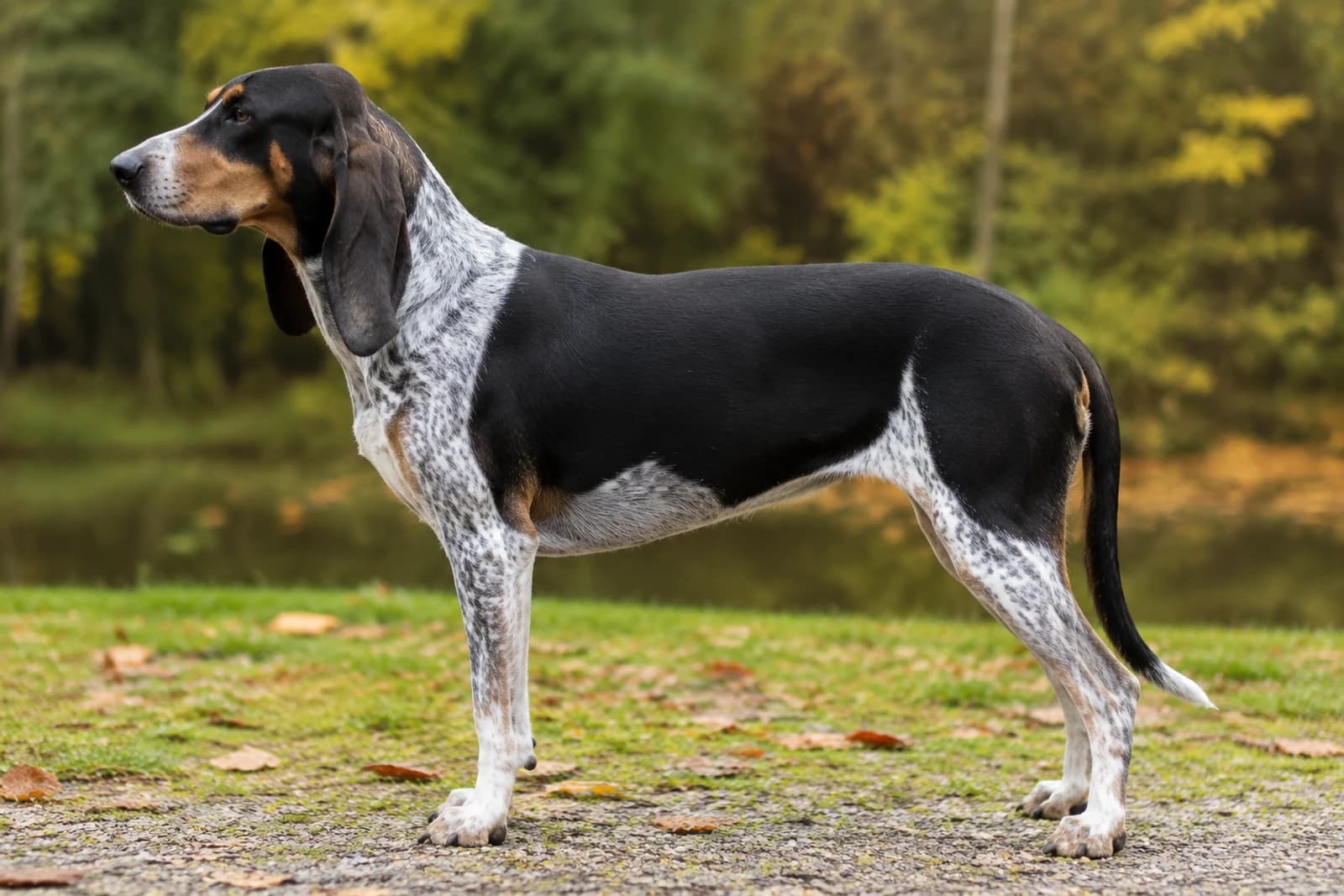
The Swiss Hound, also known as the Schweizer Laufhund, is a versatile and tenacious scent hound developed in Switzerland for hunting hare and fox. With its sturdy build, keen nose, and melodious bark, this breed is well-suited for active families or individuals who enjoy outdoor adventures. The Swiss Hound is gentle and affectionate at home but requires regular exercise to satisfy its high energy. Its short coat is easy to maintain, and its friendly nature makes it a loyal companion, though its strong prey drive calls for secure areas.
At a glance
- Size
- Large
- Height
- 19–23 in
- Weight
- 33–44 lb
- Life span
- 12 years
- Coat colors
- White with orange patches, Tricolor, Black and tan, Blue speckled with black and tan
- Coat type
- Short and smooth
- Origin
- Switzerland
How much does a Swiss Hound cost?
Adopt / rescue
$75–$400
Usually includes spay/neuter, first shots, and a microchip.
Buy from a breeder
$700–$2,000
From a reputable, health-testing breeder.
Approximate USD. Prices vary widely by region, breeder, pedigree, age, and coat colour — adopting is the lower-cost and recommended route. Avoid suspiciously cheap “breeders”; they’re often puppy mills.
Estimate the full cost of a Swiss Hound →Swiss Hound photos
Views
Front, side, rear and top — the full silhouette.Poses
How the breed sits, lies, moves and plays.Puppy to senior
The breed across its whole life.Expressions
The breed’s range of moods.Close-up details
Eyes, ears, nose, paws, tail and coat.Coat colors
The breed’s recognized colors.Click any photo to enlarge. We show the Swiss Hound from every angle — three views, poses, life stages, expressions, close-ups, coat and colors.
Appearance & size
The Swiss Hound reads as a serious working dog the moment you see it—long-bodied, leggy, and built to cover ground all day without burning out. It has a rectangular silhouette: the distance from the point of shoulder to the buttock is distinctly longer than the height at the withers. Expect a dog that stands 19 to 23 inches tall and weighs 33 to 44 pounds, with just enough bone to look substantial without ever appearing heavy.
From the front, the chest dominates. It’s deep, reaching down to the elbows, and moderately broad, with well-sprung ribs that taper into a tucked-up belly. Forelegs are straight, lean, and set cleanly under the body. The head is long and dry—no loose skin. A chiseled muzzle roughly equals the skull in length, the lips are tight, and the nose is solid black (or brown in some color varieties). Dark, almond-shaped eyes set the expression to calm and attentive. The ears are a trademark: low-set, hanging right at eye level, long enough to reach the tip of the nose when pulled forward, and draped in a soft fold without flaring out.
In profile, the back is firm and slightly elongated, the loin broad, and the croup slopes gently. The tail continues that line smoothly—carried low or in a slight saber curve, never up over the back. Hind legs show moderate angulation; they drive the dog forward in an easy, ground-covering trot. From the rear, the legs stand straight, with defined thighs and low hocks that give extra leverage for climbing and turning in rough country.
Across all four varieties, you get the same short, smooth, dense coat that lies flat and stays practically maintenance-free. The differences are all in the color:
- Bernese Hound: tricolor—white base, large black patches, plus tan markings over the eyes, on the cheeks, and inside the legs.
- Jura Hound: single-color tan or red, typically with a black saddle; a small white chest spot is allowed.
- Lucerne Hound: white or blue-roan ground color, speckled, with black patches and tan points.
- Schwyz Hound: clean white with distinct orange or red-orange patches.
Skin fits tightly everywhere, with no dewlap or wrinkle. The coat is not built for bitter cold—these are house dogs by night and relentless trackers by day. Notice the ears again: that generously long, folded shape funnels scent to the nose, a design that makes the whole dog look ready to drop its head and go.
History & origin
Roots in Medieval Switzerland
The Swiss Hound’s story begins more than 500 years ago, when hunters in the Alpine foothills needed a dog that could work scent trails over steep, rocky ground without tiring. Written records and artwork from the 15th century already show a hound remarkably similar to today’s breed — a lean, medium-sized dog with long drop ears and a deep, carrying voice. Its ancestors likely trace to ancient Gaulish scent hounds brought across the Alps by Roman legions, which then blended with local hunting dogs.
The breed was never a sprinter. Hunters on foot, not horseback, followed the pack as it systematically unraveled the night-old trail of hare or the fresher scent of roe deer. The dog’s job was to stay steady, give tongue freely, and keep the hunter informed of every twist and turn. That practical origin shaped the Swiss Hound’s structure: a deep chest for lung capacity, strong but not heavy bone, and an effortless, ground-covering trot that can last all day. The name Laufhund — literally “running hound” — points directly to that stamina.
Four Canton Varieties
As the breed spread across Switzerland’s cantons, isolation and local preferences carved out four distinct varieties. Each one adapted to the specific terrain and game of its region, but all shared the same hunting style and working temperament.
- Bernese Hound: Smooth-coated, tricolor (white, black, and tan patches). Developed around the canton of Bern, often used for hare hunting in open fields and rolling hills.
- Jura Hound: Smooth-coated, black with rich tan markings. This variety hails from the Jura Mountains in the northwest, where it worked dense forests and rocky slopes.
- Lucerne Hound: Smooth-coated, with a distinctive blue-gray speckled pattern on a white background, plus black or tan patches. It originated near Lucerne and was prized for its nose on tough scent lines.
- Schwyz Hound: The only wire-haired variety, white with orange or red patches. Its coarse, weather-resistant coat made it the go-to choice for hunting in the wet, brushy high country of central Switzerland.
No matter the coat, all Swiss Hounds stood between 19 and 23 inches and carried a muscular, lightly built frame of 33 to 44 pounds — enough substance to push through undergrowth but not so heavy that it tired on long mountain hunts.
Near Extinction and Revival
By the late 1800s, the Swiss Hound was in serious trouble. New hunting laws restricted the use of packs, and fashionable imports like the Basset Hound and Anglo-French scent hounds tempted breeders to cross their dogs, diluting the old pure lines. By 1900, truly original specimens were extremely scarce. A few committed hunters refused to let the breed vanish. In the 1930s, they scoured remote Alpine valleys, gathered the best remaining examples of each variety, and established strict breeding standards. The Schweizer Laufhund Club formed in 1933 to consolidate the revival work.
That careful, hands-on restoration saved the Swiss Hound, but it also cemented its identity as a specialist’s dog. Even today, nearly all Swiss Hounds in their homeland live as working pack hounds kept by hunting communities. Outside Switzerland, the breed remains a rarity — you'll see very few in North America or other European countries, and annual registrations still number only a few hundred dogs worldwide.
Temperament & personality
Your Swiss Hound’s world is mapped in scent. That quiet, easygoing dog sprawled on the rug can transform into a single-minded tracker the moment a breeze carries something interesting through the window. He works first and cuddles later—though he does enjoy gentle affection once he’s emptied his nose and his legs.
Inside the house, expect a calm, steady presence. He’s not high-strung or reactive; his baseline is relaxed with a soft eye and a loose body. But don’t mistake that low-key attitude for low energy. A 33–44 lb Swiss Hound needs a solid hour of hard running or off-leash forest time, not a couple of polite leash walks around the block. Without it, that ingenious nose finds its own projects—often involving your trash can, your countertops, or the stitching on your sofa.
Training a Swiss Hound means negotiating with an independent spirit. He’s smart but bred to make decisions far from his handler, so a heavy hand shuts him down. Short, positive sessions that end with a reward keep him engaged. Strong-willed hounds thrive on respectful consistency, so figure out what motivates him (food usually works) and use it to your advantage.
With his own people, he’s gentle and affectionate. He tends to be patient with children who respect his space, especially at mealtime. Like any dog, he can develop food guarding if pestered while eating; teach kids to let him finish his dinner in peace. The same goes for chewing sessions. Adult Swiss Hounds need hard chews to keep their large jaws strong and teeth clean, so a frozen marrow bone isn’t just a treat—it’s natural dental care. Just don’t interrupt him mid-crunch, or you might get a stiff, warning stare.
This isn’t a watch dog. He may bay or bark when someone approaches the door, but anyone with a friendly word quickly becomes a pal. His real alarm system is olfactory: you’ll know a deer passed through the yard long before you see it, because your hound will be baying and leaning forward, body stiff and focused, ready to follow.
Expect a few fragrant quirks. Urine marking is a hound’s way of leaving scent postcards; your Swiss Hound may refresh his “messages” on every walk and occasionally indoors if he smells a spot that needs his signature. Clean indoor accidents with an enzymatic cleaner (white vinegar works in a pinch) to break down the chemical cue, or he’ll keep returning to the area. And yes, he will roll in rotting things. Whether to mask his own scent, announce a find to other dogs, or simply because he enjoys eau de decay, it’s a normal, if nose-wrinkling, part of life with a scent hound.
This breed soaks up company. Long hours alone can lead to anxiety-driven barking or destructive chewing. A home where someone is around most of the day, or a household with a second dog, keeps him grounded. In return, you get a loyal, good-natured companion who will follow your hiking boots for a dozen years or so—just plan your pace around the fact that a Swiss Hound’s walk is 20% forward motion and 80% deep, investigative sniffing.
Good with kids, dogs & other pets
The Swiss Hound’s patient, non-aggressive nature makes it a steady family companion, but its size (33–44 pounds, 19–23 inches at the shoulder) means enthusiasm can knock a toddler off balance. Direct supervision is a must until kids learn calm, respectful interaction — no tugging on long ears or tail, no disturbing the dog during meals or rest. When those basics are in place, this breed usually becomes a loyal shadow that would rather stay near the action than retreat to a corner.
With other dogs
Pack-hunting roots run deep. The Swiss Hound was bred to work in a tight-knit group across demanding terrain, so it tends to be genuinely dog-friendly and settles smoothly into multi-dog homes. Same-sex tension isn’t universal, but it can crop up, especially if early socialization fell short. Use the critical window — before 16 weeks old — to arrange positive, controlled off-leash sessions with stable adult dogs. A Swiss Hound that missed that early exposure may act skittish or overreact on leash; later-life introductions still help, but go slow and never force a greeting that worries the dog.
With cats and other small pets
Expect the scenthound brain to fire up when small, fast animals appear. A fleeing squirrel, a neighbor’s outdoor cat, or a pet rabbit darting across the floor can trigger the same drive that was historically aimed at hare and boar. Inside the house, a Swiss Hound raised from puppyhood alongside a family cat often learns to coexist peacefully — but only if you supervise for months and manage doors and gates. Pocket pets and free-roaming rabbits are rarely a safe bet. Secure, elevated enclosures and separate living zones prevent accidents.
The socialization piece
Everything hinges on gentle, early exposure. Begin between 3 and 14 weeks: let the puppy meet children of different ages, friendly dogs, and a variety of sounds and surfaces in short, upbeat spurts. This is not an independent, backyard-only breed. A Swiss Hound bonds hard to its people and can unravel if left alone for long stretches — digging, nonstop baying, and clinginess often signal loneliness, not mischief. A gradual alone-time plan paired with serious mental work (scent games, puzzle feeders) helps an adult dog cope when you’re away, but the foundation is a home where someone is around a good chunk of the day.
Trainability & intelligence
The Swiss Hound is a sharp, independent dog bred for centuries to follow a scent trail with relentless focus. That independence means your training won’t look like it would with a retriever angling for approval. You’re not teaching a dog that lives to obey; you’re building a working partnership where the dog learns that listening to you leads to something even better than the next fascinating smell.
How they learn
These hounds are smart problem-solvers. They figure out puzzles quickly when food is involved, but they bore just as fast with repetitive drilling. Short, 5- to 10-minute sessions keep their brains engaged. Use high-value treats—tiny bits of chicken, cheese, or freeze-dried liver—because a dry biscuit won’t compete with rabbit scent in the grass. They respond beautifully to marker training (a clicker or a consistent “yes!”) paired with an immediate reward. Heavy-handed corrections backfire hard, eroding the trust that’s essential for a breed that can easily decide to ignore you.
The recall challenge
Recall is the single biggest training hurdle. When the Swiss Hound’s nose locks onto a scent, his ears seem to shut off completely. Expect to spend months—sometimes the first year or more—building a recall that holds up outdoors. Start inside, then in a fenced yard, and only progress to long-line work in open spaces when the response is reliable. A 33–44 lb dog can cover a lot of ground fast, and you’ll never outrun him. Never punish a dog who finally comes back, even if he’s been galloping after a deer for ten minutes; throw a party with treats and praise instead, because that teaches him that returning to you is always safe.
Socialization is non-negotiable
Because the breed tends toward caution with strangers and can be vocal, early and broad socialization matters more than with many other dogs. Get your puppy out between 8 and 16 weeks to meet friendly new people, hear city noises, walk on different surfaces, and encounter other calm dogs. Pair every new experience with a tasty treat so the default reaction becomes curiosity instead of suspicion. This gentle exposure prevents the fear-based reactivity that can otherwise surface in adulthood.
A training plan that sticks
Consistency across all family members keeps the Swiss Hound from gaming the system. If jumping up works once, he’ll try it a hundred times. Decide on house rules early and stick to them. While he’s not a dog that needs to be constantly working for you, he does need a job that taps his natural drives. Nose work classes, hide-and-seek games with a scented toy, or even tracking a long drag line in the woods are gold. These outlets satisfy his need to sniff and tire his brain faster than a straight walk. Pair that with a calm, reward-based approach, and you’ll get a cooperative, enthusiastic partner who respects the bond you’ve built—on his terms, but solidly so.
Exercise & energy needs
You can’t fake a workout with a Swiss Hound. This is a medium-large running hound bred to follow a scent trail for hours over rough ground, so a pair of 20-minute leash walks barely registers. Plan on 60 to 90 minutes of genuine exercise every day, split into at least two sessions. One of those needs to be off-leash in a safe, fenced area where he can stretch into a gallop and follow his nose. A sniff-heavy hike on a long line works if you lack a secure field, but he’ll be much happier running free.
Intensity matters as much as the clock. Jogging alongside a bike, canicross, or skijoring push his body the way he was designed to go. Combine that with mental work and he’ll actually relax at home. Scent games are non-negotiable. Hide his meals in puzzle toys, scatter kibble across the yard, or set up a simple drag track for him to unwind. A ten-minute “sniffari” where he deciphers a fresh deer trail tires his brain more than another mile on pavement. Formal nose work classes or barn hunt are natural fits for a hound already obsessed with his nose.
Skip high-impact acrobatics on hard surfaces while he’s growing—responsible breeders screen for hip dysplasia, but it’s still smart to protect young joints. A Swiss Hound short on exercise and nose time doesn’t just get restless; he gets loud. Incessant howling, fence pacing, and destructive chewing are classic signs of a bored scent hound. If you can’t give him daily, muddy, full-throttle outings that leave him sniffed-out and satisfied, he’ll tell the whole neighborhood about it.
Grooming & coat care
The Swiss Hound’s short, dense coat is practically wash-and-wear, but those long, drop ears demand a chunk of your grooming time. A quick weekly brush-out and a disciplined ear routine will keep this hound looking and smelling like a clean, hardworking dog.
The weekly once-over
Skip the complicated tool kit. A rubber curry brush or a hound glove does the heavy lifting—it loosens dead hair, lifts dirt, and spreads natural oils across that smooth coat. In shedding season (usually spring and fall), bump brushing to twice a week, and follow up with a soft bristle brush if you want extra shine. You’ll see hair tumbleweeds collect in corners, but it’s never overwhelming; just a steady, manageable drizzle. A bath is rarely necessary. When muddy paws and swampy field smells build up, a quick rinse with a gentle dog shampoo and a thorough towel-dry brings the coat right back. Over-bathing strips the coat’s natural water resistance, so save the suds for genuinely grimy moments.
Ears, nails, and teeth
Here’s where a little neglect turns into a vet visit. Those pendant ears trap moisture and debris, making weekly ear checks non-negotiable. Lift the flap, sniff for any funky odor or redness, and wipe the outer ear with a vet-approved cleaner on a cotton ball—never dig into the canal. After a wet romp or a swim, dry the inside of the leather thoroughly.
Nails on a working hound often wear down naturally, but don’t rely on that. A monthly nail trim keeps the feet comfortable and prevents the toes from splaying. If you hear clicking on hard floors, it’s time. Dental care: aim for a few brushings per week with dog-specific paste. A weekly chew or raw meaty bone helps too, but nothing replaces actual brushing for fighting tartar buildup as this breed ages.
Seasonal and extra notes
Despite the short coat, this dog does shed. During heavy blows, a ten-minute bristle brush session outside cuts the indoor fur fallout by half. Check between paw pads for burrs or ice balls after time in the field, and a quick wipe-down with a damp cloth after hikes removes pollen and ticks before they become a problem. The coat itself needs no trimming—just the occasional loose tuft behind the ears that a quick scissor snip can tidy. Start all handling routines early, especially if you’re raising a puppy, because a hound that resents ear exams will make your life harder than it needs to be.
Shedding & allergies
If your picture of a low-shedding dog involves the occasional stray hair on a black sweater, the Swiss Hound will quickly correct that. These are short-coated hounds with a dense, double-layer coat built for all-weather fieldwork, and it sheds — a lot — year-round. Those fine, needle-sharp hairs work their way into upholstery, car seats, and clothing with surprising efficiency.
Twice a year, usually in spring and fall, the shedding shifts into overdrive as the dog blows its undercoat. During these seasonal blowouts, daily brushing with a rubber curry or hound glove becomes non-negotiable if you want to keep your floors from looking like a blonde carpet. Even outside of peak season, plan on a thorough once- or twice-weekly brush to manage the constant fallout.
Drool is less of a headline issue, but it’s not zero. Swiss Hounds have clean, moderately tight lips, so you won’t find ropes of slobber flinging from the jowls like on a Bloodhound. Still, after a long drink of water or when a scent gets their full attention, expect a wet chin and the occasional drippy trail across the kitchen floor.
No dog is truly hypoallergenic, and the Swiss Hound lands squarely in the “not a good choice for allergy sufferers” category. The combination of steady hair loss and normal dander production means plenty of allergens circulating in your home. If allergies in your household are a serious concern, spend time around adult Swiss Hounds before committing — your sinuses will give you an honest answer.
Diet & nutrition
Most Swiss Hounds love to eat. Left to their own devices, plenty would pack on weight fast, so measured portions and a consistent schedule are what keep this athletic breed lean and sound through a typical 12-year life. An adult at a healthy 33–44 pounds usually does well on 2 to 3 cups of high-quality dry food a day, split into two meals. If your kibble runs about 400 calories per cup, that’s roughly 800 to 1,200 daily calories. A dog that gets a solid hour of hard running or scent work can lean toward the upper end; a quieter companion does better near the low end.
Puppies need the calories broken into more meals. Until four months old, feed a high-quality puppy food or a carefully balanced home-prepared diet in four evenly spaced meals. From four to six months, drop to three meals, then settle into the adult two-meal rhythm. Transition any new food gradually over a week to avoid digestive fireworks.
A home-prepared raw or lightly cooked diet often follows a ratio of about 60% muscle meat and raw meaty bones, 20–30% dog-safe fruits and vegetables, and 10% extras like eggs, grains, or plain yogurt. Blitzing the vegetables in a blender helps a hound absorb more nutrients, since a dog’s jaw doesn’t grind side-to-side and lacks the salivary enzymes we rely on. Just avoid a vegetarian or vegan approach — a hound’s digestive equipment is built for meat, and a diet without animal protein shortchanges it.
Because this breed rarely says no to a meal, obesity is the biggest dietary hazard to manage. Extra pounds hammer the joints of a running dog and can chip away at stamina. You should feel ribs without pressing. If you spot padding, cut total food back 10–20% and bulk the bowl with green beans or a spoonful of plain pumpkin. Using a puzzle bowl or scattering kibble also turns dinner into a scent job, which matches a Swiss Hound’s wiring perfectly. Keep training treats tiny — a sliver of freeze-dried liver, not a whole biscuit — and all treats count toward the daily calorie tally.
For sensitive stomachs, boiled white rice and poached chicken breast are the classic bland standby. Pearl barley is another gentle, high-fiber option you can cook into the mix. Canned fish packed in water and scrambled eggs make quick protein boosts when you’re short on time. Never feed rich holiday scraps or greasy leftovers; one fatty meal can trigger pancreatitis in a dog meant to run on lean fuel.
Older Swiss Hounds slow down but still need quality protein to hold onto muscle. Switch to smaller, more frequent meals if digestion gets iffy, and purée the food for dogs with missing teeth or tender mouths. Monitor the waistline year-round and taper calories as activity naturally declines. A lean hound is a longer-lived hound.
Health & lifespan
A healthy Swiss Hound typically lives about 12 years—solid mileage for a dog bred to cover miles in a day. That lifespan isn’t a guarantee; it’s what you get when you stay smart about a handful of practical things, because while these are hardy dogs, they’re not bulletproof.
First on the list is weight management. At 33–44 lb, a Swiss Hound is lean and leggy. Even a few extra pounds put real strain on long joints, and this breed rarely says no to a meal. Measure portions carefully and keep that daily run happening. Responsible breeders often screen for hip and elbow dysplasia even though the breed isn’t famously riddled with it—any athletic, large-frame dog benefits from that precaution. Eye exams are another part of a sound breeding program, looking for inherited eye conditions that can pop up down the line.
Those classic long, drop ears are an infection waiting to happen if you don’t stay on top of them. Moisture and debris get trapped, leading to yeast or bacterial ear infections, especially after wet weather or swimming. A weekly check and thorough drying goes a long way. The short, dense coat sheds mud easily, but skin sensitivities—hot spots, allergies—can flare up in response to diet or environment. Some lines may also inherit hypothyroidism, which sometimes looks like a skin problem at first. If your dog’s coat turns dull or his usual bounce fades, a vet visit can sort it out.
Preventive care is straightforward but non-negotiable:
- Heartworm prevention given monthly during mosquito season and for one month after it ends.
- Rabies vaccination, which is legally required in the U.S.
- Annual wellness exams (twice a year once the dog hits senior status) to spot subtle shifts like a changed gait or quieter appetite before they blow up.
These dogs want to be in the middle of the action, and isolation or harsh handling can push them into anxiety-driven habits—excessive barking chief among them—that grind down both the dog and your household. Early, positive socialization lowers that stress load and keeps the immune system running cleaner. Zero in on a breeder who tests breeding pairs and doesn’t skip the social piece, and you’ll tip the odds in your favor before you even bring your dog home.
Living environment
A Swiss Hound doesn’t adapt to your living situation—you adapt to the dog’s deeply ingrained need to run, sniff, and sound off. A house with a physically fenced yard isn’t a nice-to-have; it’s the minimum. These 33–44-pound athletes were built to course game over mountain terrain all day, so a stroll around the block doesn’t register.
-
Apartment living is a recipe for misery on both sides. Their voice is a rolling, resonant bay that carries through walls and floors. Expect noise complaints and a stressed-out dog if you try to squeeze a born scenthound into shared walls.
-
Yard requirements are specific. A 6-foot solid fence with dig-proof reinforcement at the base is your starting line. A Swiss Hound’s nose overrules its ears; if there’s a scent trail under the fence, he’ll excavate until he can follow it. An invisible fence won’t cut it—once the nose locks on, pain doesn’t register.
-
Climate tolerance tilts toward the cool and damp. Their dense, short double coat sheds mud readily and handles Swiss mountain weather without fuss, but they can overheat quickly on warm days. Provide shade, water, and limit hard exercise to mornings or evenings when it’s hot.
-
Noise level is the big one. This is not a quiet breed. The bay is deep, musical, and deployed whenever something interesting is happening—a squirrel, a knock at the door, or just the sheer joy of being outside. Close neighbors need to be on board with hearing a hound’s opera regularly.
-
Being left alone is a vulnerability. Swiss Hounds are pack-oriented and form tight bonds. Left solo for long workdays, many will howl, chew, or destroy things out of loneliness and boredom. If your schedule keeps you away more than 4–5 hours consistently, pair them with another dog and invest heavily in gradual alone-time training, puzzle feeders, and midday exercise breaks.
On the exercise front, think two substantial sessions a day, each at least an hour, with real off-leash running in a safe area or long sniff-centered walks where the nose leads. Mental work—nose games, tracking sessions, hidden treats—is just as draining as a run and cuts boredom-related barking. When you meet these demands, you get a content, worn-out hound who’ll curl up quietly. Skip them, and you’ll have a vocal, fence-digging escape artist who lets the whole neighborhood know you’re gone.
Who this breed suits
This breed fits active hunters and dedicated outdoorspeople first, and casual pet homes a distant second. The Swiss Hound was made for a full day on the trail, working hare or roe deer with a deep, ringing voice. If your weekends are more about the couch than a long, off-leash hike up a ridge, you will both be miserable.
You’re a good match if you run, trail ride, or hunt and want a partner built for real stamina. Singles or couples who spend hours outside every day, rain or shine, will meet this dog’s baseline. The ideal owner has access to safe, fenced space or vast rural land where a 33–44 lb hound can stretch his legs at a gallop. Families with older kids who understand a dog that’s affectionate but not clingy can make it work, provided the household revolves around a morning run and an afternoon scent-work session, not a quick loop around the block.
Experienced dog owners who appreciate a hound’s independence will click with this breed. You get a calm, tidy housemate indoors—once the exercise tank is empty. A first-timer can succeed, but only with realistic expectations about recall, baying, and a nose that overrides everything. Seniors who are extremely fit, still cover 5–7 miles a day, and have a fully fenced acre or two might consider one, but most will find the physical demands too much long-term.
Think twice if you live in an apartment, a townhouse, or anywhere with close neighbors. The Swiss Hound’s voice is a beautiful, melodic bay that carries half a mile—charming on a mountain hunt, a guaranteed noise complaint in a cul-de-sac. You also need to be honest about off-leash control. When a scent trail grabs this dog’s brain, your shouted “come” means nothing. A securely fenced yard is non-negotiable, and you’ll still need to drive out to safe open spaces for real running. If you have cats, rabbits, or other small pets, the prey drive is hardwired and rarely compatible. This is a dog that wants to work with you in the field, not wait while you’re at the office. A single person working long hours away from home will come back to a frustrated, vocal hound who has redecorated the baseboards.
Cost of ownership
A Swiss Hound puppy from a responsible breeder typically costs $1,500–$3,500. Because the breed is rare outside Switzerland, you may need to travel to pick up your dog or budget an extra $500–$1,000 for import health certifications and transport. Rescue is a long shot—expect $200–$500 if one turns up in a hound-specific group, but it's uncommon.
Monthly expenses break down like this:
- Food: $50–$70 for good-quality kibble (2–2.5 cups a day for a 33–44 lb dog). Raw or fresh feeding pushes that higher.
- Vet: A yearly wellness exam, vaccinations, and monthly heartworm/flea/tick preventives average $40–$60 a month. The long, drop ears trap moisture and can lead to ear infections; hip dysplasia also shows up in the breed. Pet insurance ($30–$50/month) takes some sting out of those bills.
- Grooming: The short, dense coat needs little more than a weekly hound-glove session and the occasional bath. Nail trims and ear cleanings, if you hire a pro, add $15–$25 a month.
- Training: A sharp nose and an independent streak make a basic obedience course ($150–$300 for 6–8 weeks) money well spent. A no-pull harness and a 20–30-foot long line add another $60–$100 upfront.
Plan on $150–$250 a month for the basics. The financial wildcard is a surprise injury or surgery—torn cruciate ligaments or a foreign body removal can cost thousands—so build an emergency fund or secure solid insurance before the puppy comes home.
Choosing a Swiss Hound
Deciding between a responsible breeder and rescue is your first real step. Swiss Hounds are scarce in the US, so you’re unlikely to stumble on one in a general shelter. A breed-specific rescue might surface an adult, but expect a long wait. If you go the rescue route, ask about the dog’s recall and reactivity around wildlife — these are tough-wired scenthounds, and a dog that bolts after a deer isn’t a match for every home.
Breeder vs. rescue
A serious breeder does more than produce puppies; they prove their dogs. Because Swiss Hounds were developed to hunt by chasing scent at a gallop, look for a breeder who runs them in field trials, hare hunts, or similar scent-work sports. That tells you they’re selecting for the engine, nose, and level-headedness a family pet needs. Ask how the pups are raised — kitchen-raised litters who meet visitors, hear household noise, and are exposed to gentle handling from week two onward produce the most adaptable dogs.
Health clearances to ask for
Responsible breeders screen for issues that can show up in a medium-to-large scenthound. Ask to see OFA or PennHIP hip scores (good or excellent), elbow dysplasia clearance, and an annual CAER eye exam certificate. Thyroid testing isn’t universal but worth requesting. Because drop ears trap moisture, a good breeder checks and cleans ears regularly and will tell you what to watch for. They hand over written documentation, not just a verbal “they’re healthy.” With a 12-year average lifespan and a 33–44 lb frame, sound joints matter.
Red flags
Walk away if a breeder won’t show you the dam on-site, can’t produce health clearances, or dismisses hunting and scent work as unnecessary. Puppies offered without a spay/neuter contract, a multi-year health guarantee, or a take-back clause are a gamble. Multiple litters on the ground at once, dirty kennels, or pups slinking away rather than greeting you are non-negotiable dealbreakers. Also watch for anyone selling Swiss Hound puppies younger than 8 weeks — a hound’s early socialization window is too precious to rush.
Picking a puppy
Sit with the litter and toss a set of keys or a crumpled paper ball. A Swiss Hound pup should startle, then quickly investigate, nose down. The one who follows a scent trail you drag in the grass and recovers fast from a surprise noise is showing you exactly what this breed is about. Avoid the pup that hides in a corner or the one that stiffens and guards a toy. You want bold curiosity, not sharpness. If possible, meet the sire too — his temperament is half the picture.
Pros & cons
-
A nose that loves a job — this is a true scent hound with a tireless work ethic. If you enjoy long, rambling hikes or want a partner for nose-work sports, a Swiss Hound will go all day without complaint.
-
Steady, pack-oriented temperament — originally hunted in small groups, these dogs tend to get along well with other dogs and bond closely with their family. They’re generally easygoing indoors once their exercise needs are met.
-
Low-maintenance grooming — the short, dense coat needs little more than a quick weekly brushing and the occasional wipe-down to stay glossy and clean.
-
A sturdy, manageable build — at 33–44 pounds and 19–23 inches tall, you get a large-dog presence without the bulk that can bowl over kids or make travel difficult.
-
Ears, nose, and no brakes — the same nose that makes them brilliant on a trail also erases recall the moment a rabbit or deer crosses their path. Off-leash freedom requires heavy training, and even then, a fenced area is safer.
-
A voice you’ll hear from three blocks away — Swiss Hounds bay with a deep, musical, and very loud voice. It’s a feature of the breed, not a glitch, and apartment living is off the table.
-
Stubborn streak in a thinking dog — they’re not push-button obedient. Training takes patience, consistency, and a sense of humor, because a Swiss Hound will often decide whether your request is worth his time.
-
Exercise demands beyond a daily stroll — a couple of leash walks won’t cut it. Plan for at least an hour of hard running, scent games, or structured tracking work every single day, or you’ll see furniture turned into a puzzle toy.
Similar breeds & alternatives
The Swiss Hound’s combination of a calm house demeanor and a driven nose puts it in a specific niche. If you’re weighing alternatives, these breeds share some of the same DNA but shift the balance in size, energy, or voice.
-
Harrier – The Harrier is the closest size relative at 19–21 inches, but it packs on more muscle, typically 45–60 pounds. You still get a short-coated pack hound that’s friendly and good with other dogs. The trade-off is temperament: Harriers tend to be more high-spirited and mischievous, needing a firmer hand and a longer daily run than the Swiss Hound’s steady, almost laid-back indoor presence. They also carry that musical bay, often with less of an off-switch.
-
Beagle – A Beagle shrinks the package to 13–15 inches and under 30 pounds, making it a practical choice for smaller homes. The nose is every bit as obsessive, and the merry, inquisitive personality mirrors the Swiss Hound’s sociable side. You lose the lanky, long-legged build and the deeper, more melodious voice. Beagles also trend harder to distract and can be more prone to separation barking, while a well-exercised Swiss Hound is more likely to settle quietly.
-
English Foxhound – If you want a larger, sturdier hound with a similar smooth coat and pack mentality, an English Foxhound stands 21–25 inches and weighs 60–75 pounds. They were bred for all-day stamina, so they demand significantly more structured exercise than the Swiss Hound’s moderated daily needs. The temperament is gentle and affectionate, but the size and sheer endurance push them out of many family settings.
All three alternatives share the scent hound’s single-mindedness and need for secure fencing. The Swiss Hound lands in a useful sweet spot: large enough to keep up on long hikes, small enough at 33–44 pounds to be manageable indoors, and bred for a quieter, more methodical working style that translates to a less frantic household companion. Availability in the U.S. will be more challenging than a Beagle’s, so if you land on a Swiss Hound, be ready to wait for a responsible breeder.
Fun facts
- The Swiss Hound is one of the oldest native Swiss dog breeds, with records dating back to the 15th century.
- It comes in four distinct varieties: Bernese, Jura, Lucerne, and Schwyz, each with unique coat colors.
- This breed is known for its exceptional scenting ability and endurance, making it a favorite among hunters.
- Despite its hunting prowess, the Swiss Hound is a calm and affectionate household companion.
Frequently asked questions
- Are Swiss Hounds good with children?
- Swiss Hounds are known for their gentle and friendly temperament, which can make them good family pets. However, due to their high energy and sometimes boisterous nature, interactions with young children should be supervised to prevent accidental knocks. Early socialization and training help ensure a harmonious household.
- How much exercise does a Swiss Hound need?
- With an energy level of 5 out of 5, Swiss Hounds need a substantial amount of daily exercise to stay happy and healthy. They thrive with long walks, runs, or hikes, plus mental stimulation to prevent boredom. Without enough activity, they may become restless or develop unwanted behaviors.
- Do Swiss Hounds shed a lot? Are they hypoallergenic?
- Swiss Hounds have a moderate shedding level, rating 3 out of 5, so they are not hypoallergenic. Regular brushing a couple of times a week can help manage loose hair and keep their coat healthy. Expect some fur around the home, especially during seasonal changes.
- Are Swiss Hounds suitable for apartment living?
- As a large, high-energy breed, Swiss Hounds are generally not well-suited to apartment living unless owners are exceptionally committed to providing extensive daily outdoor exercise. They do best with access to a securely fenced yard where they can run and explore. Without enough space and activity, they may become noisy or destructive.
- Are Swiss Hounds easy to train for first-time dog owners?
- Swiss Hounds can be independent and tenacious, which may present training challenges for novice owners. Their intelligence and energy respond well to consistent, positive reinforcement methods, but they require patience and a firm, gentle hand. First-time owners might find them easier with guidance from an experienced trainer.
Tools & calculators for Swiss Hound owners
Quick estimates tailored to Swiss Hounds — pre-filled with this breed’s size where it matters.
Articles & stories about the Swiss Hound
Sources & standards
This profile follows recognized breed standards from the American Kennel Club (AKC) and the Fédération Cynologique Internationale (FCI), along with established veterinary and breed-club guidance. These describe general breed tendencies — every dog is an individual.
Owner stories
Have a Swiss Hound? Share your experience — grooming tips, personality quirks, anything goes.