

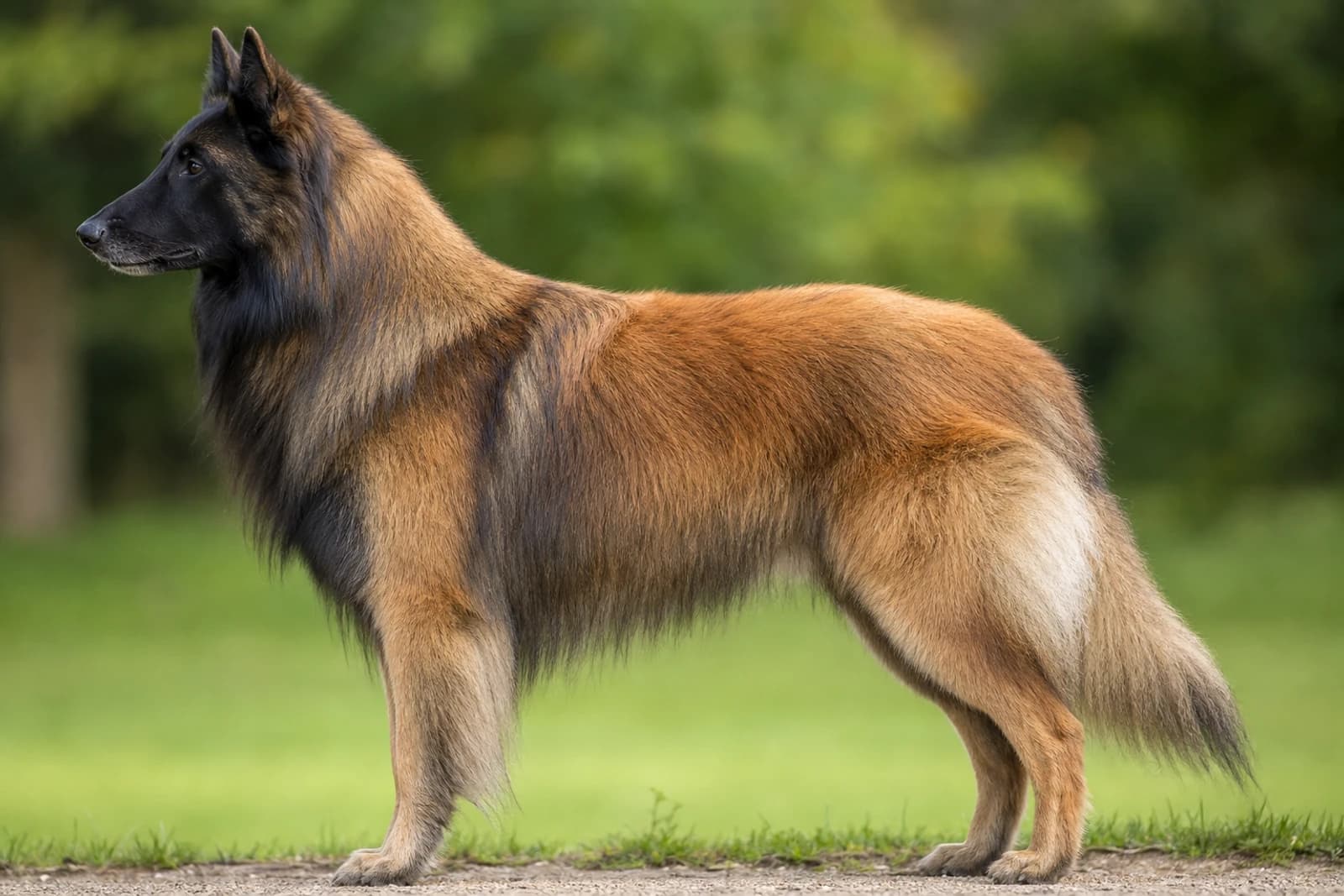
The Belgian Tervuren is an elegant Belgian Shepherd variety with a long coat, high intelligence, and intense working drive. It is best for active owners who want training, sports, and daily mental work, not a casual low-effort companion.
At a glance
- Size
- Large
- Height
- 22–26 in
- Weight
- 45–75 lb
- Life span
- 12–14 years
- Coat colors
- Fawn and black, mahogany and black
- Coat type
- Long double coat
- Group
- Working
- Origin
- Belgium
How much does a Belgian Tervuren cost?
Adopt / rescue
$75–$400
Usually includes spay/neuter, first shots, and a microchip.
Buy from a breeder
$700–$2,000
From a reputable, health-testing breeder.
Approximate USD. Prices vary widely by region, breeder, pedigree, age, and coat colour — adopting is the lower-cost and recommended route. Avoid suspiciously cheap “breeders”; they’re often puppy mills.
Estimate the full cost of a Belgian Tervuren →Belgian Tervuren photos
Views
Front, side, rear and top — the full silhouette.Poses
How the breed sits, lies, moves and plays.Puppy to senior
The breed across its whole life.Expressions
The breed’s range of moods.Close-up details
Eyes, ears, nose, paws, tail and coat.Coat colors
The breed’s recognized colors.Click any photo to enlarge. We show the Belgian Tervuren from every angle — three views, poses, life stages, expressions, close-ups, coat and colors.
Appearance & size
Lean, square, and striking, the Belgian Tervuren manages to look both athletic and refined—never bulky. Males stand 24 to 26 inches at the withers and weigh 55 to 75 pounds; females run 22 to 24 inches and 45 to 60 pounds. Under all that hair is a medium-boned, muscular frame built for sustained action, not just a sprint around the yard.
The coat is the breed’s hallmark. It’s a true double coat: a dense, weather-resistant underlayer, topped by long, straight guard hairs that lie flat against the body. The hair forms a dramatic ruff around the neck—much thicker and more pronounced in males—plus feathered backs on the front legs and ample trousers on the rear. The tail is set low, furnished with heavy coat, and hangs down at rest; when the dog moves, it lifts in a graceful curve but never curls over the back.
Color is always rich fawn to mahogany with a distinctive black overlay. Each guard hair is tipped black, creating a shaded, soot-like effect that concentrates over the shoulders and withers. A solid black mask covers the muzzle, whisker area, and eye rims, and the ears are solid black. Keep an eye out for tiny white allowances—a small chest spot, the tips of the toes, or a little chin mark—but large white patches are a fault.
From the front, you catch the erect, triangular ears, dark almond-shaped eyes with a sharp, questioning gaze, and a clean head with a flat skull that tapers to a moderately pointed muzzle. Step to the side and you’ll see a deep chest, a firm level back, and a sloping croup that sets the tail naturally low. Rear angulation mirrors the front, so the dog never looks downhill or overbuilt. From behind, the hind legs are straight and parallel, the hocks well let down and strong. The whole silhouette tells you this is a handler’s dog—balanced, elegant, and ready to cover ground the instant you ask.
History & origin
The Belgian Tervuren didn’t start out as a separate breed — it emerged as one of four coat-and-color varieties of the Belgian Shepherd Dog, all developed in the late 1800s in Belgium. By the 1890s, Belgian shepherds were still a grab bag of regional working types, and a group of breeders and veterinarians set out to bring order. In 1891, the Club du Chien de Berger Belge formed, and Professor Adolphe Reul of the Cureghem Veterinary School led the effort to define a standard. The first official breed standard dropped in 1892, recognizing three main coat types (long, short, and rough) and a handful of colors.
The long-haired fawn-to-mahogany dog with a black overlay and mask took its name from the village of Tervuren, where a brewer named M. Corbeel kept a pair — "Tom" and "Poes" — considered the foundation of the variety. Those two produced a fawn long-haired bitch named "Miss," and she, bred back to a black long-haired dog (a Groenendael type), cemented the look we recognize today. Early on, the Tervuren was the least common of the Belgian varieties; fanciers focused more on the solid-black Groenendael and the short-coated Malinois.
Belgium’s early breeders cared far more about work ethic than coat color. These dogs had to herd and guard flocks, drive cattle, and protect the farm — all on their own judgment. When World War I hit, Belgian Shepherds became battlefield messengers, ambulance dogs, and sentries. Many Tervurens served alongside the other varieties, but the wars took a heavy toll on the gene pool, and dedicated breeders rebuilt it cautiously in the 1920s and ’30s.
In the United States, the Tervuren arrived in 1953, when a Wisconsin couple imported a pair. The American Kennel Club recognized the Tervuren as a separate breed in 1959, but this split is purely a U.S. and Canadian convention. In most of the world, the Belgian Shepherd remains one breed with four varieties, and inter-variety breeding is still allowed under FCI rules. That divergence matters if you’re looking at pedigrees: a Tervuren on one side of the Atlantic might have Malinois or Groenendael littermates on the other.
The breed’s modern existence still leans on versatility. In the decades after AKC recognition, the Tervuren found steady work in obedience, protection sports, search and rescue, and competitive herding. No single moment made it a household name; instead, word spread slowly through people who wanted a sharp, trainable, all-purpose dog with a seriously striking silhouette.
Temperament & personality
A Tervuren isn’t a low-key family dog that’s happy with a couple of short walks. He’s a high-octane working partner bred to think and move all day. If you want a dog who matches your active lifestyle and treats training like a shared puzzle, this breed can be an incredibly loyal shadow. If you’re away 10 hours a day, look elsewhere—isolation here often translates to anxiety, nonstop barking, and a house torn apart by bored jaws.
These dogs run hot on energy; plan on at least 60-90 minutes of hard running, swimming, or fast-paced herding games, not just a neighborhood stroll. Without that outlet, a Tervuren turns his cleverness against you, finding ways to dismantle cushions or open cabinets. They’re not wired to flop on the couch until the job is done.
Affection is intense but selective. You’ll get a Velcro dog who follows you room to room, leans against your leg, and reads your mood with unsettling accuracy. Strangers? Expect polite indifference or a watchful stare until you signal “friend.” That built-in suspicion makes them excellent watchdogs—barking alerts the moment something shifts outside—but it’s never mindless noise; they’re sizing up the situation.
Around the household, a well-socialized Tervuren is loyal and gentle with his own people, yet his herding instincts don’t vanish. He may circle running children, nudge ankles, or even nip if movement triggers that old livestock-chasing impulse. Young kids need adult supervision and a dog who’s been taught that humans aren’t woolly charges. Because he’s sensitive and strong-willed, harsh corrections backfire. Respectful, consistent training using what he values (a tug toy, a ball) gets the best engagement. Never interrupt a Tervuren while he’s eating—teach children to give him space so food guarding doesn’t take root.
A few quirks: boredom unleashes a chewing machine. Provide heavy-duty chew items and, if furniture legs become targets, a homemade spray of boiled citrus peels or diluted white vinegar often repels him without a fight. Scent drives a lot of his world. You might catch him rolling joyfully in something dead—some scientists think it’s his way of announcing a find to the pack. Clean indoor accidents with an enzymatic cleaner; lingering urine odor is a potent cue that can turn one mistake into a routine. This is a dog who thrives in a partnership where his mind and motor get equally exhausted.
Good with kids, dogs & other pets
A Tervuren that grows up alongside kids often turns into a gentle shadow and tireless playmate — but the breed’s herding instincts don’t switch off when the back door closes. At 45–75 pounds and 22–26 inches at the shoulder, an enthusiastic Terv can accidentally knock over a toddler, and those keen herding eyes will zero in on running, shrieking children. Chasing and a quick nip at the heels are not aggression; it’s a hardwired job description. That means supervision is non-negotiable with small kids. Teach children not to bolt and yell, and give your dog a rock-solid “leave it” and an off-switch for mouthing from day one. A Tervuren who understands the house rules is patient and remarkably tender — but you stay the referee.
With other dogs, early, careful socialization is the single biggest factor. Tervurens are sensitive and often watchful with strangers, and that can extend to other canines. Many live peacefully with a compatible housemate, especially if raised together. However, same-sex aggression — particularly between males — shows up more often here than in some other breeds. Controlled, positive introductions during puppyhood, puppy classes, and neutral on-leash walks work far better than letting two adult strangers “sort it out” at a dog park. If you have an adult Tervuren who’s comfortable just with you, don’t force interactions. Forced meetings can spike stress and trigger fights instead of friendship.
Cats and small pets are a different equation. Prey drive runs deep in this herding breed. A Tervuren puppy raised alongside a confident cat who stands its ground, with plenty of rewarded calm moments, may learn to coexist indoors. But never mistake tolerance for trust: the chase reflex often fires up the moment a small animal dashes. Birds, rabbits, and pocket pets should be securely separated. Leave them alone together, and you’re gambling with a deeply ingrained instinct.
Early socialization locks in the confidence you’ll rely on. The window between three and fourteen weeks is critical. Expose your puppy softly — to calm people, household sounds, different indoor surfaces, and a few patient, vaccinated dogs. A Tervuren’s sensitivity makes harsh corrections backfire, so keep every new experience upbeat and short. Miss that window, and you’ll be managing a fearful or reactive adult. You can still make progress later, but pushing a skittish dog into greetings only dials up anxiety. Above all, this is a dog who needs to be in the middle of family life, not banished to a yard. Isolation invites stress, barking, and destruction. Keep your Tervuren close, involved, and busy, and you’ll have a deeply bonded, family-velcro companion for 12–14 years.
Trainability & intelligence
A Tervuren doesn’t just learn commands — he studies you. This is a dog who picks up patterns in a handful of repetitions, then gets bored just as quickly if you don’t keep the work challenging. High intelligence paired with a strong herding drive means he’s wired to anticipate your next move and make independent decisions. Turn training into a predictable drill, and you’ll lose him. Frame it as a puzzle to solve together, and he’ll blow past your expectations.
The key is trust, not correction. Tervs are sensitive, handler-focused dogs. Harsh words or punishment-based methods can make them shut down or become anxious. They thrive on clear communication and reward-based work — treats, a thrown ball, a quick game of tug, or just genuine praise. Mark and pay for what you want, and he’ll offer that behavior again with enthusiasm. Early, consistent training from puppyhood sets the tone, but you can’t coast on that foundation. A 6-month-old Tervuren who knows his basics will absolutely invent his own “rules” if you don’t give him a real job to do daily.
Socialization is part of trainability. A Tervuren who isn’t carefully exposed to new people, sounds, and environments between 3 and 14 weeks can become reactive or skittish. That native wariness toward strangers is a feature of the breed, not a flaw, but it needs a steady, positive counterbalance. Take him to new places often, pair novelty with something good, and let him build confidence at his own pace. Rushed introductions backfire.
Recall deserves extra honesty. A Tervuren with a strong prey-drive stripe may chase a squirrel mid-retrieve and forget you exist. Long-line work, rock-solid “here” training, and decades of patient reinforcement are non-negotiable. He’s not being defiant — he’s operating on deeply bred impulse. Manage that with high-value rewards and off-leash practice only when you’re sure it’s safe.
For the right owner, a Tervuren is a dog who learns entire scent-work or agility routines in a week and still asks for more. If you show up as a thoughtful, consistent partner, he’ll match your effort tenfold. If you don’t, he’ll take over the job himself — and you probably won’t like the result.
Exercise & energy needs
A quick walk won’t touch a Tervuren’s energy reserves. Plan on 60 to 90 minutes of real exercise every day, split into at least two sessions, plus daily mental work that makes them think. This herding breed was built to move for hours — and that drive shows up whether you have sheep or not. Skip the outlet and you’ll get a reactive, anxious, or destructive dog. Bored Tervurens don’t suffer quietly.
“Real exercise” means off-leash running in a safe area, fast-paced fetch, hiking rugged trails, canicross, swimming, or training games that blend movement with obedience. A leashed stroll around the block is a warm-up at best and won’t dent their working-dog battery. Ideal activities include agility, flyball, herding trials, rally, and scent work — all sports that pair their athleticism with a handler they adore. If you have access to livestock, they’ll work with intense focus, but even a suburban Tervuren needs a job, not just a yard.
Mental exercise is just as non-negotiable. A dog who runs five miles but never uses his brain is still a recipe for trouble. Daily training sessions, puzzle toys, hide-and-seek, and scent games (think hidden treats or a snuffle mat) give the breed the cognitive challenge they’re wired for. Without that, they’ll invent their own “jobs” — herding children, barking at every passerby, or dismantling your couch.
While Tervurens are generally sound, avoid repetitive high-impact on hard surfaces, especially with growing puppies. Stick to several short play-and-train bursts for young dogs to protect developing joints. By adulthood, a well-conditioned Tervuren can handle hard-charging activity and still want more — but variety matters as much as the miles. If your downtime still includes a 5-mile trail run and an evening training class, you’re on the right track. If not, the breed’s surplus energy will find an outlet, and you’ll be the one cleaning up the aftermath.
Grooming & coat care
The Tervuren’s double coat is a project — not a once-over-and-done. That rich fawn-to-mahogany sable, complete with a black mask and overlay, sits on top of a dense, woolly undercoat that will fill your house with hair if you let it. A quick once-over with a bristle brush won’t cut it. You need a metal slicker brush with rounded pins and a steel greyhound comb to get down to the skin and break up tangles before they become mats, especially behind the ears, under the elbows, and in the feathered hind pants.
How often should you brush?
Three to four times a week keeps most adults tidy during the off-season. When the coat blows — typically twice a year, often in spring and fall — crank that up to daily line-brushing. Expect tumbleweeds of undercoat everywhere. During these heavy shedding windows, an undercoat rake will pull out loose wool faster than a slicker alone, and a high-velocity dryer after a bath will blast out what’s left.
Bathing and seasonal care
Bathe only when the dog genuinely needs it: a muddy hike, a roll in something ripe, or when the coat dump is so intense that a warm bath helps loosen the dead hair. Over-bathing strips the natural oils that give the outer guard hairs their dirt-shedding, weather-resistant quality. Every three to four months is a reasonable rhythm for a house dog, but you can go longer if the coat isn’t greasy or smelly. Always rinse thoroughly — residual shampoo invites itchiness.
Trimming
The body coat is meant to stay natural. Don’t shave or scissor it down; the double coat protects from heat as well as cold, and it won’t grow back right. Trimming is limited to neatening the edges: tidy the hair between the paw pads for traction, and lightly shape the feathering on the legs and tail if it drags. No show cut required for a family companion, but those tufted feet can collect mud and snow, so keeping them trimmed saves your floors.
Nails, ears, and teeth
Long nails on a large, athletic dog that twists, jumps, and pivots can cause toe splay and joint strain. Grind or clip nails every two to three weeks — if you hear clicking on hard floors, they’re past due. Those erect, triangular ears trap less moisture than floppy ones, but they still need a weekly check for wax buildup or debris; a soft, damp cloth does the job. Brush teeth several times a week with dog-specific toothpaste to stave off periodontal disease, which these dogs can be prone to as they age.
Invest in the right tools — a quality slicker, a steel comb, and an undercoat rake — and treat grooming as a quiet ritual, not a chore. Your dog’s comfort and your vacuum cleaner will thank you.
Shedding & allergies
If you're looking for a dog that won't leave hair everywhere, the Tervuren is not your breed. These are heavy shedders with a thick double coat that drops fur continuously — and then, twice a year, they go into what owners call a "blowout." During those seasonal peaks in spring and fall, the undercoat comes out by the fistful, floating across floors and furniture no matter how often you vacuum.
The coat itself is built for all-weather work: a dense, woolly underlayer topped by long, straight guard hairs, especially pronounced around the neck (the "collarette"), legs, and tail. That combination means you'll find both short, fluffy undercoat fluff and longer, coarse hairs woven into your carpets, clothes, and car seats. Expect to brush thoroughly at least two or three times a week to keep the tumbleweeds at bay; daily brushing is often needed during blowout season to keep the dog comfortable and your home remotely presentable.
Drool is the one bright spot. Tervs are a dry-mouthed breed. You won't deal with strings of slime or wet spots on your pants after a greeting. That's rare for a dog this size, and it's worth appreciating.
As for allergies: no, the Belgian Tervuren is not hypoallergenic. That heavy shedding releases plenty of dander and saliva-coated hair into your environment. Anyone with a dog allergy should spend significant time inside a Terv-owning home before considering the breed. There's no shortcut around the fur. If managing a constant layer of hair on every surface sounds like a dealbreaker, a Tervuren will break the deal fast.
Diet & nutrition
A Belgian Tervuren’s diet has to support an intense combination of brains and athleticism. This is a working breed that will put every calorie to use — or pack on extra pounds if the balance tilts wrong. Because Tervs can be food-motivated and are built for speed and agility, staying lean protects their joints, especially hips and elbows. An adult male around 65–75 lb might need 2,500–3,000 calories a day when training hard, but a couch-potato companion (rare, but it happens) might thrive on 1,600–1,800. Use a measuring cup, not a scoop, and adjust every few weeks based on how your dog looks and feels — you want a visible waist and easily felt ribs.
What to feed
A species-appropriate diet leans heavily on animal protein. Many Terv owners aim for a mix of roughly 60% raw or cooked meat, 20–30% fruits and vegetables, and the rest from eggs, grains, or yogurt. High-quality commercial kibble works, too, provided the first few ingredients are named meats, not fillers. Pearl barley adds digestible fiber without common grain sensitivities, and plain white rice can soothe an upset stomach. If you cook at home, purée or finely chop vegetables — a dog’s jaw moves only up and down, so breaking down cell walls helps nutrient absorption. Steamed veggies, canned fish (in water), scrambled eggs, and batch-cooked grains make quick, healthy meals.
Puppy and adult feeding routines
- Puppies: Four meals a day until four months old, then three meals until six months, then twice-a-day like an adult. Transition any new food slowly over a week. Lightly cooked, puréed meats, fish, and soft fruits or veggies are gentle starters. Raw chicken wings can be introduced around 12 weeks, always under your eye.
- Adult dogs: Split the daily portion into two meals to lower bloat risk and keep energy steady. Use a slow-feed bowl or a food puzzle if your Terv inhales meals — it slows them down and exercises that brain.
- Seniors: Older Tervuren often do well on smaller, more frequent meals. There’s no good evidence to cut protein, but you’ll need to dial back total calories as activity drops. Purée meals for dogs with missing teeth or sore mouths.
Weight-management watchpoints
Obesity is a real threat for this breed because it amplifies joint stress and can shorten an already medium-length lifespan. A Terv who’s just a few pounds heavy puts extra load on hips and spine every time they pivot or jump. Weigh your dog monthly and keep a body-condition chart handy. If your dog starts gaining, cut back the main meals slightly — a quarter-cup less per day can make a difference over a month — and replace that volume with green beans or pumpkin for bulk. Never free-feed, and resist the urge to give table scraps; once a dog learns to beg at the table, it’s a hard habit to break. If you want to share leftovers, put them in your dog’s own bowl after your meal.
Stay away from excessively rich, fatty foods (holiday trimmings, greasy meat drippings) — they can trigger a bout of pancreatitis. And no vegetarian or vegan diet: a Terv’s teeth, gut, and metabolism evolved to process meat, and cutting it out deprives them of nutrients they can’t easily get from plants alone.
Health & lifespan
A healthy Tervuren typically lives 12 to 14 years — a nice long run for a large, athletic dog. Reaching that upper end isn’t a matter of luck alone; it comes from a combination of careful breeding, steady routine care, and swift attention when something feels off.
Like many herding breeds, the Tervuren can be prone to a handful of inherited conditions. Responsible breeders don't guess at this. They screen breeding stock for hip and elbow dysplasia (via OFA or PennHIP evaluations), have a veterinary ophthalmologist check for progressive retinal atrophy (PRA) and other eye diseases annually, and often test thyroid function. Epilepsy also crops up in the breed more often than in the general dog population — there’s no genetic test for it yet, so a breeder who is open about seizure history in their lines is worth their weight in gold. You also want to ask about any incidence of gastric dilatation-volvulus (bloat) in relatives; deep-chested dogs like the Tervuren are at higher risk, so knowing the signs and feeding smaller meals can make a real difference.
Beyond inherited issues, a few practical points matter a lot for this breed. Weight management is huge — a lean Tervuren puts less stress on developing joints and stays mobile well into its senior years. The breed’s thick double coat can mask extra pounds, so an honest hands-on check every few weeks helps. Some lines deal with skin allergies that flare up with food or environmental triggers; if your dog suddenly turns itchy or loses coat quality, a vet visit before you try ten different shampoos saves time and frustration.
Preventive care isn’t complicated, but skipping it bites you later. Monthly heartworm prevention during mosquito season, along with a yearly heartworm test, is non-negotiable. Annual wellness exams — twice a year once the dog hits age 7 — catch subtle changes in bloodwork, eyes, or joint comfort before they become crises. A Tervuren that suddenly starts lagging on walks or acting irritable may be signaling orthopedic pain or a brewing thyroid issue, not just a change in mood. Keep vaccinations current, including the legally required rabies shot, and don’t underestimate how much dental care at home and with your vet can add healthy years.
The dog’s sharp mind feeds into health, too. Chronic stress from boredom or isolation can surface as anxious, gut-wrenching behaviors that wear down the immune system. A Tervuren with steady work, clear boundaries, and calm handling is simply a healthier animal.
Living environment
A Belgian Tervuren isn't an indoor ornament—this breed needs a living situation built around its compulsion to patrol and problem-solve. Square footage isn't the decider. Your daily availability and patience for noise are.
Yard and Fencing
A large, securely fenced yard is non-negotiable. Tervurens don't just run laps; they track motion, sprint the perimeter, and herd anything that moves. A four-foot chain-link fence is a jumpable suggestion. You need six-foot wood privacy fencing, and you'll still want to reinforce the bottom against digging. An apartment creates two headaches: constant trigger-barking at hallway sounds, and no safe off-leash outlet for a dog that needs to explode into a full sprint at least twice a day.
Alert Barking
This is a feature, not a bug, of the breed. Tervurens were expected to notice and announce anything out of place on a farm. That instinct persists. They will bark at delivery trucks, guests arriving, and a leaf skittering past the window. You can shape the behavior with a "quiet" cue and desensitization games, but you will never silence it. If shared walls or strict noise rules define your housing, a Tervuren is a terrible match.
Climate Tolerance
That rich mahogany coat is a double layer of armor against cold, damp, and wind. These dogs thrive in crisp weather and willingly play in snow. Heat is their kryptonite. Anything above 80°F significantly raises their risk of overheating. During hot spells, shift active time to early morning or late evening, offer a shaded water station, and keep sessions short and intense rather than one long midday slog.
Being Left Alone
A Tervuren forms a fierce, often singular bond with its handler. Being left for a standard eight-hour workday typically unravels that composure into destructive chewing, neurotic pacing, or endless howling. With dedicated crate training, puzzle toys stuffed with frozen food, and a reliable midday walker, some adults can tolerate four to six hours alone. But many cannot. This is a breed that needs its people present—a multi-member household where schedules overlap, or a dog-friendly workplace, is the only honest baseline.
Who this breed suits
A Belgian Tervuren is a dog that demands to be at the center of your world—mentally and physically. If you’re after a high-octane partner for dog sports, long trail runs, or advanced obedience, you’ve found your match. This is a breed for people who already know their way around a clicker and aren’t rattled by a dog that thinks three steps ahead. It’s not a breed that settles for a casual stroll around the block. Expect to provide a solid hour or more of hard, focused exercise every day, plus training sessions, puzzle toys, or scent work to drain a brain that never quits.
Active singles and couples who work from home or can bring the dog along thrive. The Tervuren bonds deeply and hates being left out, so it fits lifestyles that revolve around canine companionship. Families with older kids—roughly age 10 and up—can succeed if the whole household learns to channel the dog’s herding instincts without encouraging nipping and chase games that spiral out of control. The breed’s natural reserve with strangers and sharp watchdog tendencies make early, extensive socialization non-negotiable; otherwise, aloofness tips into reactivity.
Seniors and low-energy households should look elsewhere. This dog won’t adapt down to a sedentary rhythm. First-time owners often get in over their heads because the Terv’s intelligence and intensity need a handler who reads canine body language and manages drive confidently.
- You live in an apartment or lack a securely fenced yard. Tervurens cover ground fast and will chase anything that moves.
- You work long hours away from home.
- You have toddlers or small, dashing pets (the herding drive triggers nipping and relentless pursuit).
- You’re uncomfortable with heavy shedding and a twice-yearly coat blow that leaves fur on every surface.
A bored Tervuren is loud, destructive, and creatively naughty. If you can’t promise a lifestyle built around daily high-intensity work and training for the next 12 to 14 years, pick a mellower breed and spare yourself the headache.
Cost of ownership
Bringing home a well-bred Tervuren puppy from parents with clear hip, elbow, and eye screenings usually costs $1,500 to $3,000. Puppies from proven working or show lines can run higher. Adoption through a breed rescue is a less predictable route — you’ll find older dogs for a few hundred dollars, but they’re rarely in rescue as puppies.
Once they’re yours, the monthly rhythm adds up fast. These are large, high-energy dogs with equally high nutritional needs. Count on $60 to $100 a month for quality kibble — roughly three to four cups a day for a 60-pound adult.
Grooming is a job you’ll either take on yourself or pay for regularly. The double coat sheds year-round and blows massively twice a year. Doing it at home means buying a solid slicker brush and an undercoat rake. A professional groomer every six to eight weeks will set you back $80 to $120 per visit.
Routine vet care — exams, vaccines, and year-round flea, tick, and heartworm prevention — averages $50 to $80 a month. Because hip and elbow dysplasia show up in the breed, many owners carry pet insurance. Premiums land in the $40 to $80 a month range, depending on your deductible.
Smart and driven, a Tervuren without structured training becomes a full-time project. Group classes or one-on-one sessions can run $100 to $200 a month for the first year. Add toys, treats, and a steady supply of puzzle feeders, and a realistic all-in estimate lands at $250 to $400 a month.
Choosing a Belgian Tervuren
If you’re set on a Belgian Tervuren, the first critical choice is where your dog comes from — a poor match here hands you a nervy, under-exercised dog with a hidden seizure disorder or hips that give out by age five. A dog that ranges 45 to 75 lb and stands up to 26 inches at the shoulder needs a solid temperament and sound structure to handle the intense work and play this breed thrives on, whether you’re doing herding, agility, or just long trail runs.
Responsible breeders vs. puppy mills and backyard breeders Look for a breeder whose dogs do more than look pretty — they earn titles in herding, IPO, agility, or advanced obedience. Tervurens are sharp and high-drive; a dog without proven working ability often produces puppies whose wiring doesn’t fit a family home. The breeder should hand you verifiable health clearances, no excuses:
- Hips: OFA (fair or better) or PennHIP, current at minimum after 24 months of age.
- Elbows: OFA evaluation to rule out elbow dysplasia.
- Eyes: annual CAER exam by a veterinary ophthalmologist, checking for progressive retinal atrophy, cataracts, and other heritable eye disease.
- Thyroid: a full panel from an approved lab, as autoimmune thyroiditis can lurk.
- While there’s no DNA test for the epilepsy that plagues some lines, a reputable breeder knows their pedigrees inside out and will talk openly about any seizures — the silence, stonewall, or “not in MY lines” without proof is a red flag.
A good breeder raises pups in their home, handling them daily and exposing them to household sounds, crates, car rides, and friendly strangers from the time their eyes open. They ask you as many questions as you ask them — about your fencing, your activity level, your experience with high-drive dogs. You’ll sign a contract that requires you to return the dog to them if you can’t keep it, and they’ll be your resource for the next 12 to 14 years.
Red flags that should make you walk away
- No health clearances or “cleared by vet” but no OFA/PennHIP numbers.
- Breeding dogs that haven’t mentally or physically proven themselves — a ribbon from a tiny local show isn’t enough.
- Several litters on the ground at once or a website with a constant “buy now” button.
- Refusing to let you meet the dam (or at least the sire, but the dam’s temperament is what the pups imprint on daily).
- Pricing litters based on color or marking rarity — sable is the standard, and flashy isn’t worth bad joints.
- Overly shy or skittish puppies on a meet-and-greet. A Tervuren pup should be curious and biddable, not cowering. If the whole litter backs away from a stranger, the genes and early rearing are off.
Picking a specific puppy Spend time with the litter if possible. Watch which pup recovers quickly from a loud noise, investigates a new toy, and then settles in your lap for a brief cuddle. Extreme boldness that looks like flat-out pushiness can later translate into a handful that strips your patience. A breeder who does a formal temperament test (like the Volhard PAT) and can describe each pup’s quirks — not just “they’re all sweet” — is golden. Feel the puppy: a pot belly and dull coat scream worms or poor nutrition. Clear eyes, clean ears, and a tight, bouncy gait on a non-slip surface matter more than the size of the paws.
The rescue option Belgian Tervuren Rescue groups often have young adults and seniors. You skip the chew-everything puppy phase, and you get a dog whose energy level and temperament are already on display. The trade-off: you won’t have health clearances on the parents, and some dogs land in rescue because their first home couldn’t manage their intensity. That’s not the dog’s fault, but it means you need to be extra honest about your dog experience. A foster-based rescue can tell you whether the dog is housebroken, good with kids, or has a hair-trigger reaction to bikes. Don’t overlook a settled 5-year-old who just wants a running partner, especially if you don’t have the bandwidth to raise a Tervuren pup from scratch.
A breeder who winces and dodges the epilepsy question is one you walk away from, no matter how adorable the puppy in your lap.
Pros & cons
Pros
- Razor-sharp mind and work ethic. Tervs are thinking dogs that master obedience, agility, herding, and protection work. They need a job and will invent one if you don’t.
- Fiercely devoted to their people. A well-socialized Tervuren is a loyal shadow who watches over the household with natural protectiveness, not unwarranted aggression.
- Head-turning good looks. The rich mahogany coat with black overlay, alert expression, and graceful, square build make this dog unforgettable.
- A large dog you can live with. At 22–26 inches and 45–75 pounds, they’re substantial enough for serious sport but compact enough to share your home—if you meet their exercise demands.
- Long partnership potential. 12–14 years is remarkable for an active large breed, giving you over a decade of adventure together.
Cons
- Energy that doesn’t quit. A couple of leash walks are a joke to a Terv. Count on at least 60–90 minutes of hard running, sprinting, or focused training every day.
- Brain needs are just as high. Without mental heavy lifting—scent work, advanced obedience, herding—bored Tervs become destructive chewers, fence climbers, or neurotic barkers.
- The fur is a lifestyle. That plush double coat blows thick undercoat seasonally and sheds year-round. Your floors, clothes, and couch will never be clean again.
- Stranger-danger radar runs hot. They bond tightly to their inner circle and can tip into reactivity or fear-biting if not meticulously socialized from puppyhood through adolescence.
- Not a beginner’s breed. They read your moods, resent harshness, and exploit inconsistency. An inexperienced or time-strapped owner will quickly find themselves outmatched by a dog that’s smarter, faster, and more driven.
- Velcro personality. Left alone for long workdays, a Tervuren is prone to intense separation anxiety—pacing, howling, or destroying exits.
Similar breeds & alternatives
If the Tervuren’s blend of brains, drive, and that flashy mahogany coat catches your eye, the closest relatives are the other three Belgian shepherd varieties. They share a square build, similar size (45–75 lb, 22–26 in), and a deep need for real work. The differences are mostly coat and a few temperament nudges — not night-and-day, but enough to matter.
- Belgian Malinois: Same high-octane brain, only wrapped in a short, fawn-and-black-mask coat. Malinois tend to be harder-charging and more intense. They dominate police K9 and protection sports for a reason. If the Tervuren is a finely tuned sports car, the Malinois is often a race bike without brakes. For a pet home that isn’t actively doing bite work, scent work, or hours of focused training daily, a Malinois rarely fits — and the Tervuren is usually the more manageable choice.
- Belgian Sheepdog (Groenendael): Essentially the long-haired black cousin. Same elegant feathering, same height and weight, same 12–14 year lifespan. Many owners find the Groenendael a touch softer and less reactive than the Tervuren, but it’s still a sensitive, high-energy herder that won’t tolerate a sedentary routine. Grooming is comparable; the jet-black coat hides dirt better but still sheds seasonally.
- Belgian Laekenois: The rarest of the four, with a wiry, fawn-colored coat that feels like scruffy wool. They’re alert and territorial, just as ready to notice every leaf that blows past the window. The Laekenois is for someone who wants the Belgian shepherd package without the long, flowing coat maintenance, but with the same intense need for engagement.
- German Shepherd Dog: Larger (50–90 lb) and heavier-boned, with a more common presence in family neighborhoods. A well-bred German Shepherd gives you protective instincts and high trainability too, but they shed year-round and have a higher risk of hip and elbow dysplasia. The Tervuren typically carries fewer structural issues when sourced from responsible health-screened lines, and its athletic, leaner frame stays agile longer.
- Border Collie: If the herding instinct and intelligence are what draw you, the Border Collie brings similar mental firepower in a smaller (30–55 lb) package. The difference is a Border Collie’s focus skews hard toward motion and control, with little guarding instinct. A Tervuren adds watchfulness and stronger suspicion of strangers — a plus if you want a natural alert dog, a challenge if you don’t socialize like your life depends on it.
Any of these breeds will run circles around a standard walk around the block. The Tervuren’s calling card is a stunning coat and a slightly more moderate edge than a Malinois, but you’re still signing up for a dog that needs a job, not just a backyard. Don’t let the beauty fool you into thinking this is a medium-energy breed.
Fun facts
- The Tervuren is one of the Belgian Shepherd varieties.
- Its long coat is usually fawn or mahogany with black overlay.
- The breed excels when given structured work.
Frequently asked questions
- Does the Belgian Tervuren shed a lot?
- Belgian Tervurens have a thick double coat that sheds moderately year-round and more heavily during seasonal changes. Expect regular vacuuming, but shedding is manageable with weekly brushing.
- Are Belgian Tervurens good with children?
- They can be good with children when raised with them, as they are devoted and protective. However, due to their high energy and herding instincts, they may try to herd or knock over small children, so supervision is necessary.
- How much exercise does a Belgian Tervuren need?
- This breed has very high exercise needs, requiring at least 60–90 minutes of vigorous activity daily. They thrive on runs, hikes, and advanced training like agility to keep their intelligent minds and athletic bodies satisfied.
- Is the Belgian Tervuren suitable for apartment living?
- Typically, no; their high energy and need for space make them a poor fit for apartments. They can adapt if given extensive daily exercise and mental stimulation, but a home with a yard is ideal.
- Do Belgian Tervurens bark a lot?
- They tend to be vocal, especially when alerting to strangers or unusual activity. Early training can help manage excessive barking, but some barking is inherent to their watchful nature.
- Is a Belgian Tervuren a good choice for first-time dog owners?
- They are often not recommended for first-time owners due to their intense need for exercise, mental stimulation, and consistent training. Their intelligence and sensitivity require an experienced handler to prevent behavioral issues.
Tools & calculators for Belgian Tervuren owners
Quick estimates tailored to Belgian Tervurens — pre-filled with this breed’s size where it matters.
Articles & stories about the Belgian Tervuren
Sources & standards
This profile follows recognized breed standards from the American Kennel Club (AKC) and the Fédération Cynologique Internationale (FCI), along with established veterinary and breed-club guidance. These describe general breed tendencies — every dog is an individual.
Owner stories
Have a Belgian Tervuren? Share your experience — grooming tips, personality quirks, anything goes.