

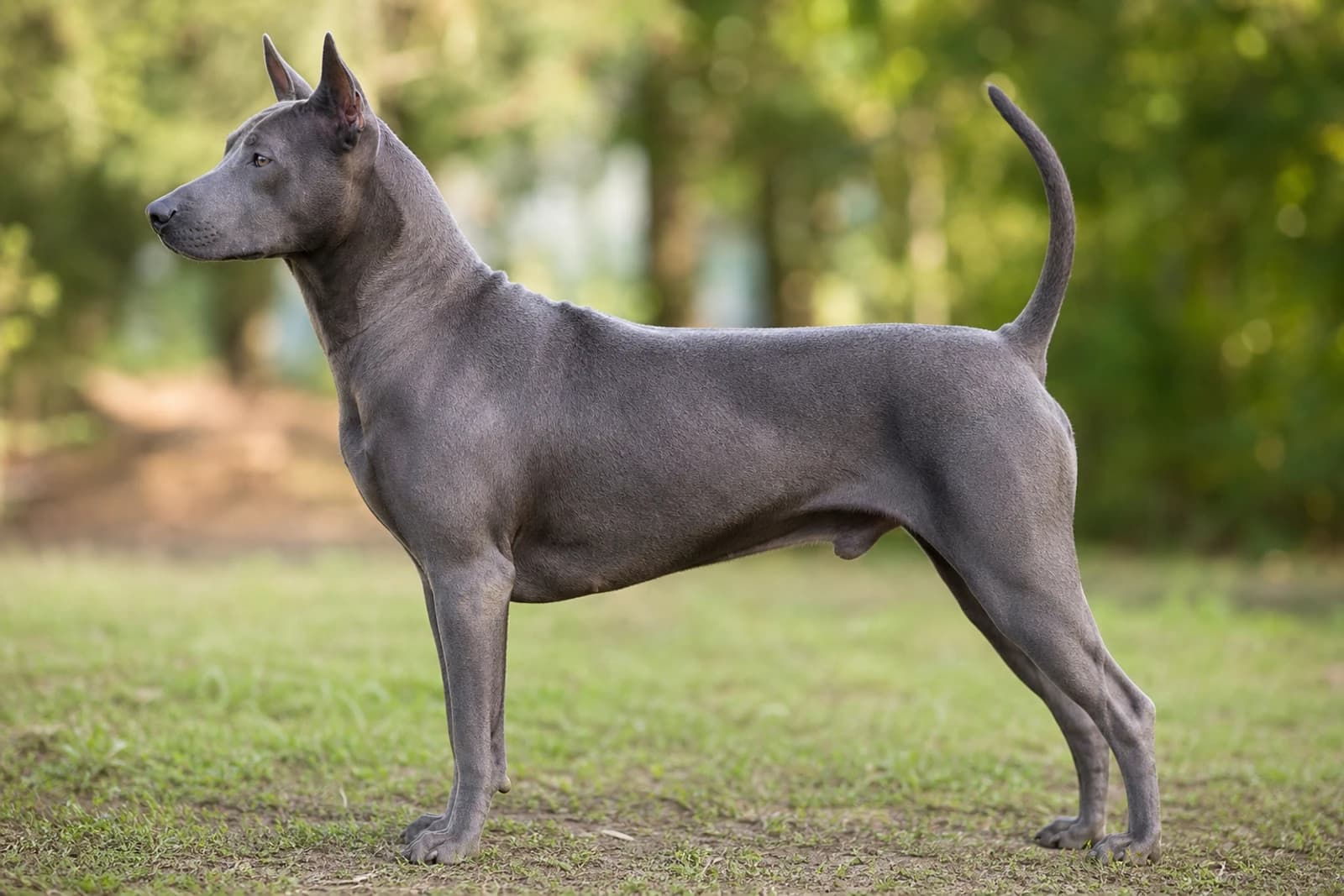
Thai Ridgeback is a muscular, agile breed from Thailand, recognized by the distinctive ridge of hair along its back. This ancient pariah-type dog was historically used for hunting, guarding, and cart escorting. Loyal and protective, they bond deeply with their family but remain aloof with strangers. Intelligent and independent, they require experienced handling for consistent training and socialization. High energy and strong prey drive demand an active home with a secure yard. Not suited for first-time owners or apartments, the Thai Ridgeback is a unique, devoted companion for the right family.
At a glance
- Size
- Large
- Height
- 20–24 in
- Weight
- 51–75 lb
- Life span
- 10–12 years
- Coat colors
- Black, Blue, Fawn, Red, Brindle
- Coat type
- short, smooth coat
- Origin
- Thailand
How much does a Thai Ridgeback cost?
Adopt / rescue
$75–$400
Usually includes spay/neuter, first shots, and a microchip.
Buy from a breeder
$700–$2,000
From a reputable, health-testing breeder.
Approximate USD. Prices vary widely by region, breeder, pedigree, age, and coat colour — adopting is the lower-cost and recommended route. Avoid suspiciously cheap “breeders”; they’re often puppy mills.
Estimate the full cost of a Thai Ridgeback →Thai Ridgeback photos
Views
Front, side, rear and top — the full silhouette.Poses
How the breed sits, lies, moves and plays.Puppy to senior
The breed across its whole life.Expressions
The breed’s range of moods.Close-up details
Eyes, ears, nose, paws, tail and coat.Coat colors
The breed’s recognized colors.Click any photo to enlarge. We show the Thai Ridgeback from every angle — three views, poses, life stages, expressions, close-ups, coat and colors.
Appearance & size
The Thai Ridgeback is a large, athletic dog built more like a sprinter than a heavy draft animal. You’ll notice the lean muscle right away — these dogs carry their 51 to 75 pounds on a frame that stands 20 to 24 inches at the shoulder, with a tucked-up waist and a deep chest that doesn’t get in the way of agility. They’re substantial but never blocky, with a silhouette that’s all clean angles and efficient movement.
Coat and color The coat is one of the easiest-care features you’ll find: short, smooth, and tight to the body, with no undercoat worth mentioning. It’s designed to shed dirt and heat in its native Thailand, so it feels sleek and almost glossy. Colors are solid: red, black, blue, and fawn. Blue is a dilute black that can look smoky-silver in the right light. A black mask is preferred on reds and fawns, though it isn’t always present. You won’t see patches, brindle, or white markings — the breed standard keeps it to a single, clear color.
The ridge The breed’s namesake feature is a strip of hair growing in the opposite direction along the backbone. It starts just behind the shoulders and flows toward the hips, with clear borders on both sides. There are two accepted shapes: a needle ridge (narrow and tapering) and a wider crown ridge that can include a whorl or swirl at the top. The ridge is visible even when the dog is wet or a puppy, and it’s the first thing your fingers will find when you stroke the back. A dog without the ridge simply isn’t a Thai Ridgeback.
Head and expression From the front, the head is a tapered wedge — broad between the ears and narrowing to a strong but never snipey muzzle. The ears are large, triangular, and held erect with a slight forward tilt, so the dog always looks alert. The eyes are almond-shaped and dark amber or brown, depending on coat color, and they’re set well apart. The brow is strong, giving a thinking, watchful expression that matches the breed’s independent nature.
Body and movement View from the side and you’ll see a level topline with only a slight rise over the loin, a deep brisket that reaches to the elbows, and long, well-muscled thighs. The tail is thick at the base and tapers to a point; when the dog is moving or excited, it’s carried high in a sickle curve, sometimes straight up but never curled over the back. From the rear, the hocks are straight and parallel, and the dog moves with a ground-covering, double-suspension trot that looks effortless. A healthy Thai Ridgeback in motion is fluid and springy — this isn’t a breed that plods.
History & origin
The Thai Ridgeback is an old, resilient breed carved out of isolation in Southeast Asia—specifically, the remote villages and islands of eastern Thailand. Its story isn’t one of royal courts or imported refinement but of a dog that evolved alongside rural families who needed a jack-of-all-trades partner that could handle serious heat, thick jungle, and long stretches without human handouts.
You’ll find references to ridgebacked dogs in Thai archaeological drawings that push the breed’s origins back at least 300 to 400 years. Because the communities that kept them were largely cut off from the rest of the country—places like the island of Phu Quoc (shared culturally with Vietnam) and the eastern provinces of Chanthaburi and Trat—the Thai Ridgeback stayed genetically isolated, preserving its distinctive traits. The breed’s signature ridge of fur growing opposite the coat is the same type of anatomical quirk you see in the unrelated Rhodesian Ridgeback, but here it’s backed by a completely different gene pool and a separate evolutionary path.
These dogs earned their keep doing the jobs that made life possible in subsistence-farming settlements. They hunted small game—snakes, rodents, and nuisance predators—with a sharp, independent prey drive. They guarded homesteads and pull carts. At roughly 20 to 24 inches tall and 51 to 75 pounds, a Thai Ridgeback was big enough to deter intruders but lean and athletic enough to move fast in dense cover. Their short, low-maintenance coat, prick ears, and minimal need for close veterinary care suited a place where resources were scarce and a dog had to pull its own weight without complaint.
Because the breed wasn’t a trade commodity, it rarely left its home region until well into the 20th century. The first documented exports trickled out in the 1990s, mostly to the United States and Europe, where a handful of enthusiasts started establishing small breeding programs. The United Kennel Club recognized the Thai Ridgeback in 1996; the Fédération Cynologique Internationale followed in 2003. Even today, the breed sits outside the AKC’s major registries, and puppy seekers routinely face waitlists. That limited availability, combined with a lifespan of 10 to 12 years, means anyone bringing one home is signing up for a dog that still acts like the self-reliant survivor it was bred to be—not a mass-produced companion.
Temperament & personality
Your Thai Ridgeback won’t greet strangers like a long-lost friend. These dogs are reserved, watchful, and deeply bonded to their own people — everyone else gets a cool, appraising stare until trust is earned. Inside the household, you’re likely to see a calm, self-assured companion who shows affection on their own terms. Expect a dog that leans against your leg, follows you from room to room, and parks itself where it can keep an eye on everything, rather than a Velcro lap dog.
Strong-willed and independent is an understatement. A Thai Ridgeback isn’t hardwired to please you; they’re hardwired to problem-solve and make their own calls. That means training works best through respectful, consistent engagement — not force, not repetition drills. They’ll walk all over an owner who confuses “firm” with “loud.” The upside? Once you prove you’re worth listening to, the loyalty runs deep.
Energy levels sit in that athletic middle ground. Count on a need for at least an hour of genuine movement — free running, long sniff walks, or mental puzzles, not just a backyard potter. Without it, these clever dogs create their own entertainment, often chewing furniture, digging, or dismantling belongings. A bored Ridgeback’s jaws can shred a couch cushion in minutes, and those powerful jaws are meant to work. Provide sturdy chew items; adult dogs chew hard objects to keep jaw muscles strong and teeth clean, and puppies chew to relieve teething pain. A homemade citrus or vinegar spray on off-limit items can redirect that drive while you teach “leave it.”
Watchfulness comes pre-installed. You’ll notice a still, forward-leaning posture when something — or someone — unusual crosses the property line. That stiff body language, often paired with a direct stare, is not playfulness; it’s a primitive guarding expression. Context matters, so read the whole dog: a relaxed, soft-eyed Ridgeback is no threat, while lip licking, yawning, or turning away signals discomfort. Teach children to respect these calming signals and never interrupt the dog during meals, which can trigger food guarding.
Quirks? They can be enthusiastic about rolling in foul-smelling finds — likely an ancient scavenger impulse, possibly to “share” news of a resource — and they’re fastidious about their own spaces. Territory marking via urine can crop up if you don’t thoroughly remove indoor accident scents. Vinegar spray neutralizes those odor cues, breaking the re-soiling cycle. Because scent-based memory is strong, a single missed spot can draw them back.
This is not a breed that glides into a busy household with small kids or other small pets. Their prey drive runs high, and their friendliness score with strangers is low. Early, extensive socialization reduces the edge, but a Thai Ridgeback is best matched with an experienced owner who appreciates a dog that thinks, assesses, and acts — sometimes before you’ve finished the cue. In the right hands, you get a dignified, fiercely loyal partner who won’t waste affection on just anyone.
Good with kids, dogs & other pets
A Thai Ridgeback in a family setting thrives on early, steady exposure to the chaos of daily life—but never mistakes that steady temperament for a free pass. These are 51–75 lb dogs with a strong independent streak and a prey drive that runs deep. The combination means you do the work upfront, and you stay watchful.
With children
Raised alongside kids, a well-socialized Ridgeback is often patient and remarkably gentle with his own pack. He may tolerate ear tugs and clumsy hugs from toddlers if he’s learned since puppyhood that small humans are part of the family. However, that same dog can accidentally knock over a running preschooler simply by leaning or turning—they’re solid animals. Teach kids to respect the dog’s space, especially around food and resting areas. Never leave a young child and any dog unattended, no matter how bombproof the temperament seems. An aloof breed by nature, the Ridgeback won’t seek out rough-and-tumble play the way a Labrador would; he’s more likely to watch from the periphery—and that’s perfectly normal.
With other dogs
Here the word is management. Many Thai Ridgebacks live with another household dog without drama, particularly dogs of the opposite sex or those introduced during puppyhood. But same-sex aggression and general dog-selectivity aren’t uncommon. A Ridgeback that’s fine with the neighbor’s Golden Retriever on leash may intensely dislike a strange intact male at the dog park. Forced adult-dog “friendships” can backfire badly, leading to fights that aren’t just posturing. If you have a multi-dog home, feed separately and give each dog a private retreat zone. Puppy socialization classes (ideally during the 8–16 week window) and ongoing controlled meet-and-greets help, but don’t expect a Ridgeback to become a happy-go-lucky dog-park regular. He may simply prefer his people and a known circle of canine acquaintances—and that’s okay.
With cats and small pets
The prey drive is the headline here, and it’s not a maybe. Historically used to hunt and guard, the breed has an ingrained instinct to chase and seize small fleeing animals. A Ridgeback puppy raised with a confident cat may learn to coexist indoors, but outdoor squirrels, rabbits, or the neighbor’s free-range chicken will trigger a hardwired response you can’t train away. Even a cat that the dog ignores inside can become a target if it darts across the yard. Management is straightforward: never trust the dog off-leash around small animals, use sturdy gates to separate spaces, and supervise interactions relentlessly. If you have pet rodents, birds, or an outdoor cat colony, a Thai Ridgeback will always pose a serious risk. That’s not a training failure—it’s just the dog you have.
Trainability & intelligence
Teaching a Thai Ridgeback feels less like training a dog and more like negotiating with a whip-smart roommate who has strong opinions. They’re bright — really bright — but that intelligence comes wrapped in a stubborn, independent streak that can’t be bullied out of them. If you push too hard, they simply dig in and stop listening. The whole thing runs on trust.
Crack that trust early, and you’ve got a dog who learns fast and retains it. Start the day your puppy comes home, and don’t waste the critical socialization window between 3 and 14 weeks. Before that window closes around 16 weeks, calmly introduce your pup to a parade of new people, different sounds, slick floors, strange hats, and other animals. Keep every encounter low-pressure and pair it with a high-value reward. A Thai Ridgeback who missed this early exposure often grows into an adult who views strangers and unfamiliar situations with deep suspicion — and a 51–75 lb dog with a guarding instinct isn’t something you want to manage reactively later.
For day-to-day work, forget the heavy hand entirely. Punishment, leash corrections, or shouting will corrode the bond and can spike their anxiety. Instead, lean hard on what they love: real meat treats, a squeaky toy, or just your goofy praise when they nail a loose-leash walk. They have a transactional brain — they’ll ask, “What’s in it for me?” — and that’s fair. Because they’re so clever, they get bored with mindless repetition. Five sharp, cheerful minutes of “sit/stay/come” beats twenty minutes of drilling.
The real test is usually recall. A Thai Ridgeback with a squirrel in sight isn’t checking back for your treat pouch. Their prey drive hits hard, and that independent mind will override a half-hearted “come” in a heartbeat. You prove yourself here by building it slowly on a long line, in a dozen different places, until the response is a reflex — not a negotiation. Even then, an unfenced field is a gamble.
Meet them halfway. Be clear, be consistent, and never, ever make it a fight. When a Ridgeback works with you rather than for you, they’re a fiercely loyal partner — but you earn that one interaction at a time.
Exercise & energy needs
A Thai Ridgeback isn’t the kind of dog you can wear out with a casual stroll. This breed was built to hunt, guard, and think on his feet, so he needs serious, daily output — aim for 60 to 90 minutes of hard exercise, split into at least two sessions. A 30-minute leash walk won’t make a dent. Think sprinting, climbing, and chasing, not just sniffing the mailbox.
Mix intensity with mind games. A Ridgeback left without mental work gets bored fast, and a bored Ridgeback will redesign your furniture or dig an escape route. Puzzle toys, scent work, and trick training aren’t extras — they’re as necessary as the running. Hide his breakfast in a snuffle mat or teach him to identify a specific toy by name; a five-minute brain session can take the edge off when the weather keeps you indoors.
Activities that click with this breed’s wiring:
- Lure coursing and Fast CAT — his prey drive is instant-on, and chasing a mechanical lure gives him a safe, legal outlet.
- Hiking and trail running — uneven terrain forces him to think about foot placement while burning energy.
- Nose work or barn hunt — he’ll spend himself mentally locating hidden scent sources, which is just as tiring as a run.
- Advanced trick training — string together behaviors that require concentration and impulse control.
A sky-high prey drive means off-leash freedom in unfenced areas is a gamble you rarely take. Even a hundred perfect recalls can evaporate when a rabbit bolts. Invest in a long training line or scout out fully fenced fields instead. Also, because he’s a large, fast-growing breed, keep high-impact pounding — repetitive jumping, forced road work — on hold until growth plates close around 18 months. Two shorter, intense sweat sessions per day typically work better than a single marathon, and they’ll deliver what you actually need: a Ridgeback who can finally flop on his side, mentally cashed out, until you pick up the leash again.
Grooming & coat care
The Thai Ridgeback’s short, single coat is about as low-maintenance as it gets. These dogs don’t have an insulating undercoat, so you won’t battle the heavy seasonal blowouts that double-coated breeds go through. A quick weekly once-over is all it takes to keep them looking sleek.
For brushing, grab a soft bristle brush or a rubber grooming mitt. These tools pull out the few loose hairs that do accumulate and spread the skin’s natural oils across the coat, which boosts that natural shine. Work in the direction the hair naturally lies — except for the signature ridge, which grows the opposite way. Just brush up to the ridge and leave it alone; it doesn’t need special styling. During the modest spring and fall shed, you might brush twice a week to catch extra dead hair before it lands on the couch, but that’s about it.
Bathe only when you can see dirt or smell the dog. For most Ridgebacks, a bath every two to three months is plenty. Overdoing it can strip the coat’s natural protective oils, and this breed’s tight skin and short fur shed dirt pretty well on their own. When you do bathe, use a mild dog shampoo and rinse thoroughly to avoid dandruff.
The rest of the routine is standard for any dog, but it’s where many people get lazy. Nails need trimming every 3–4 weeks; if you hear clicking on hard floors, they’re overdue. Ears should be wiped weekly with a vet-approved cleaner — especially if your dog has been swimming — to prevent yeast or bacterial infections in those upright, exposed ear canals. Teeth benefit from daily brushing with dog toothpaste; a few times a week is a realistic minimum to keep gum disease at bay.
A healthy, active Ridgeback who gets plenty of outdoor exercise will naturally shed dead coat as they move, so a solid walk or run does half your grooming work for you.
Shedding & allergies
A Thai Ridgeback’s short, smooth coat is wonderfully easy to care for, but you’ll still find fine, sharp hairs woven into your carpets and clinging to your dark clothing. They shed a moderate amount all year long — more than you might guess from just looking at that sleek, single-layered coat. There’s no fluffy undercoat to blow out twice a year like a husky, but in spring and fall, the shedding does pick up noticeably. A quick weekly session with a rubber curry brush or a hound glove will trap most of the loose hair before it spreads. During the seasonal uptick, you might run that brush over them twice a week.
Drool is rarely an issue. A Thai Ridgeback won’t leave slobber trails on your walls or soak your pant leg. You may see a little bit of moisture after they drink water or when they’re staring intently at a treat, but that’s about it. The breed is not known for heavy, spontaneous drooling.
No dog is truly hypoallergenic, and the Thai Ridgeback is no exception. Allergies are triggered by proteins in dander, saliva, and urine — not just the hair itself. Because they lack a dense undercoat, they may release slightly less dander into the air than a double-coated breed, and the short hair is easier to manage and vacuum up. Some allergy sufferers report that they do better with a Thai Ridgeback, but there’s no guarantee. If you or someone in your home has significant allergies, spend at least an hour with an adult dog of this breed before committing. That personal reaction tells you far more than any label ever will.
Diet & nutrition
A 51–75 lb athlete like the Thai Ridgeback can pac-man through a bowl in thirty seconds if you let him. That’s where the trouble starts. Food motivation varies — some individuals will overeat without blinking — so free-feeding is out. Keep him lean. Excess weight on a large frame invites joint stress, and you want those hocky, spring-loaded legs working without extra load.
How much and how often
Start with 2 ½ to 3 ½ cups of high-quality dry food a day, split into two meals, and adjust until you can feel ribs without seeing them. An intact male running a couple of miles daily may need the top end; a spayed female who patrols the yard might do best on the low end. Measure with a real cup, not a coffee mug.
Puppy feeding schedule
From weaning through four months, four evenly spaced meals prevent blood-sugar dips. Drop to three meals until six months, then settle into the adult two-meal rhythm. Transition new foods slowly — start with lightly cooked, puréed meats, fish, fruits, and vegetables. Introduce raw chicken wings around twelve weeks, always under direct supervision.
What goes in the bowl
Aim for a meat-forward plate: roughly 60% raw or cooked animal protein, 20–30% fruits and veggies, and the remaining 10% from eggs, plain yogurt, or digestible grains like pearl barley or white rice. Blending or lightly processing meals helps a dog’s up-and-down jaw motion extract more nutrients, especially for seniors or picky eaters. Scramble an egg, toss in some canned sardines (in water, no salt), or use cooking water from vegetables as a broth — simple, unprocessed stuff beats rich holiday scraps every time. Rich, fatty foods can set off pancreatitis.
Weight management and slow eating
If your Ridgeback inhales his dinner, a puzzle bowl or snuffle mat slows him down and burns a little mental energy. Obesity creeps up quietly, so weigh him every couple of weeks. Drop portions before you notice a pudgy waistline.
Senior adjustments
Older dogs often move less. Switch to three smaller meals a day to keep digestion easy, and don’t slash protein — there’s no good evidence that healthy seniors need less. Purée meals if teeth are missing or gums are sensitive, and watch the scale. A lean, well-muscled Thai Ridgeback whose ribs are easily felt but never visible will nearly always outpace the breed’s typical 10–12 year lifespan. Serve every meal in his own bowl, never from the table, and you’ll dodge the begging habit before it starts.
Health & lifespan
A Thai Ridgeback typically lives 10 to 12 years. That number isn’t set in stone — how well your dog ages comes down to daily habits and the choices you make long before you bring a puppy home.
What responsible breeders watch for
The gene pool for this breed remains small in North America, so a breeder who can speak honestly about what has — and hasn’t — shown up in their lines matters more than a flawless guarantee. Reputable breeders prioritize structural soundness and screen for skin issues that can plague individuals. Ask about any history of dermoid sinus (a neural tube defect that can occur in ridgeback breeds) even though it’s rare; a responsible breeder will discuss it openly. They’ll also avoid pairing dogs with chronic allergy problems or anxious temperaments, since both can surface in the offspring.
Preventive care that pays off
- Heartworm prevention: Administer a monthly preventive during mosquito season and for one month after it ends. This is non-negotiable — treating full-blown heartworm is rough on a large dog and far more expensive than prevention.
- Rabies vaccination: Legally required, and there’s no effective treatment once symptoms appear. Keep it current.
- Weight control: A lean 51–75 pounds on a 20–24 inch frame is a strong dog. Extra weight stresses joints and shortens those 10–12 years. Measure his meals, don’t free-feed, and limit high-value treats — many Thai Ridgebacks are food-motivated and will charm you into overdoing it.
- Skin and coat: Sensitive skin crops up often enough to warrant attention. If your dog starts scratching more than normal or you see recurrent hot spots, try switching to a simpler protein source and examine environmental triggers (dust, pollen, laundry detergent). A fish-based diet sometimes helps.
- Mental health matters: A Thai Ridgeback left alone in the yard for hours can develop anxiety-driven behaviors like nonstop barking or destructive chewing. Early socialization and consistent, respectful engagement cut that risk. This is a strong-willed dog, not a pushover — force just backfires, while clear routines lower his stress and yours.
- Regular vet checks: Annual exams catch subtle changes early. For a senior dog, bump that to twice a year. Pay attention to reduced appetite, stiffness getting up, or a sudden drop in activity — those quiet signs often show up before bloodwork does.
Living environment
A Thai Ridgeback is a big, athletic dog who needs space to stretch out and burn off real energy. Cramped quarters can work, but only if you are dead serious about multiple long outdoor sessions every day. Without that, a house with a securely fenced yard is the smarter choice. This breed is a jumper with a strong prey drive, so a six-foot privacy fence is not overkill. Invisible fencing won’t cut it; if they spot a squirrel or stray cat, instinct takes over.
The short, smooth coat tells you a lot about climate tolerance. These dogs were built for the Thai heat and handle warm weather well — provided they have shade and water. Cold is another story. Once the temperature drops, they need a coat or sweater and shorter outings. Left shivering in a drafty house, they’ll be miserable.
Noise levels are moderate to high if you’re not paying attention. They’re natural watchdogs with a suspicious streak toward strangers, so alert barking is part of the package. Early training can shape it into something manageable, but a bored Thai Ridgeback left in a backyard will find his voice and use it, loudly.
Alone time is where this breed really needs honesty. They bond fiercely with their people and can tip into destructive anxiety if left alone for eight or nine hours regularly. A home where someone works from home or a schedule that avoids long absences is ideal. Pair that with serious mental work — puzzle toys, scent games, obedience drills — or you’ll find your couch dismantled. This is not a dog you can just walk around the block twice and call it a day. Plan on at least an hour of real running, hiking, or off-leash sprinting in a safe area, split into morning and evening sessions, to keep the dog settled indoors.
Who this breed suits
A Thai Ridgeback slots into a very specific kind of life. This is a primitive, independent thinker — not an off-the-rack companion for just anyone. The ideal owner already has solid dog experience, preferably with breeds that don’t live to please. They provide calm, consistent leadership without ever turning it into a battle of wills.
Where they thrive
- An active, fenced-in home with a job to do. This is a large (51–75 lb), athletic dog that needs at least 60–90 minutes of hard daily exercise — think off-leash running in a safe area, flirt pole work, or long hikes, not a quick lap around the block. A securely fenced yard is non-negotiable; these dogs are escape artists with a strong prey drive and the vertical leap to match.
- Singles or couples who want a protective, thinking dog. Expect a dog that is deeply loyal to its family but aloof — sometimes bordering on suspicious — with strangers. Early, never-ending socialization is mandatory, and even then, the Ridgeback won’t be a golden retriever at the door. They suit people who appreciate a guardian, not a greeter.
- Homes with older, dog-savvy kids. Raised with respectful children, they can be steady indoor companions. But the Ridgeback has little patience for clumsy handling or chaotic energy. Unsupervised time with toddlers or rambunctious youngsters is a bad idea.
- Owners who enjoy training a partner, not an obedient robot. Ridgebacks are clever problem solvers with an independent streak. They respond to short, positive, motivation-based sessions, but they’ll shut down or push back if you get heavy-handed. The relationship works when you treat them as a near-equal.
Who should think twice
- First-time dog owners, or anyone looking for a biddable, eager-to-please breed.
- Apartment dwellers or those without a secure, privacy-fenced outdoor space. Insufficient containment and this dog’s high prey drive and wanderlust spell disaster.
- Households with cats, rabbits, or other small pets. Their prey drive is intense, and the impulse to chase and grab isn’t something you train out with a few treats. Coexistence ranges from risky to impossible.
- People who want a dog-park socialite or a cuddly lap dog. Many Thai Ridgebacks are dog-selective (especially same-sex) and can be domineering. Their affection is real but understated — they lean, they shadow, but they rarely smother.
- Those who can’t commit to a decade-plus of mental and physical output. With a 10–12 year lifespan, this breed’s needs don’t relax with age; a senior Ridgeback is still a capable, driven animal that needs daily outlets.
Cost of ownership
Bringing home a Thai Ridgeback is a serious financial commitment. The breed’s rarity pushes puppy prices higher than many other large dogs. From a responsible breeder who screens for dermoid sinus and hip health, expect to pay $1,500 to $3,000. Show-quality pups or those from imported lines can run $4,000 or more. If you find one for much less, you’re likely cutting corners on health testing or early socialization.
Once the dog is yours, monthly costs are manageable but not trivial. Factor these in:
- Food: A 55–70 lb active adult will eat 3–4 cups of high-quality kibble daily. Budget $60–$90 a month depending on brand and protein content. Raw or home-prepared diets can double that.
- Grooming: This is the easy part. Their short, single coat needs a quick weekly brush and an occasional bath. Nail trims every few weeks and ear cleaning are all the maintenance you’ll need. A DIY approach costs maybe $10–$20 a month for supplies; a pro groom every 6-8 weeks adds $30–50 per visit.
- Veterinary care: Routine checkups, vaccinations, and year-round heartworm/flea/tick prevention average $40–$70 a month. As a large breed, they can be prone to hip dysplasia, and dermoid sinus is a known congenital issue — responsible breeding helps but doesn’t eliminate risk. Setting aside extra for unexpected vet visits is smart.
- Pet insurance: For a large, active dog, premiums typically run $45–$75 monthly for comprehensive coverage. If you self-insure, plan on a savings buffer of at least $2,000–$3,000 for emergencies.
- Training and extras: A primitive breed that reads body language, not commands, often benefits from positive-reinforcement classes. Group classes might be $150–$250 for a 6-week session; private sessions more. Don’t skip early socialization, or you’ll pay the price in behavior work later.
All in, a Thai Ridgeback costs roughly $150–$300 per month, not counting the initial puppy price or major surprise bills. The numbers reflect a reality: these dogs are an investment of mind as much as money.
Choosing a Thai Ridgeback
You have exactly two solid routes: a breeder who puts decades of work into preserving this ancient pariah dog, or a rescue that places adult dogs into experienced homes. The breed’s rarity in the U.S. means you won’t stumble across a litter on a classifieds site without a reason to pause. A responsible breeder is a member of the Thai Ridgeback Club of America or an equivalent parent club, actively shows or titles their dogs, and can talk your ear off about prey drive, same-sex tolerance, and why this is not a city-park-and-latte breed. They’ll have waiting lists, not a constant supply of puppies.
Health testing is non-negotiable. The big one is dermoid sinus — a neural tube defect along the back that can tunnel deep and cause serious infection. Every breeding dog needs a vet certification of clear status. Hips should be x-rayed and evaluated through OFA or PennHIP; elbow and thyroid screens are a plus. Don’t let a breeder wave off testing because the breed is “primitive and healthy.” They can live 10–12 years, but hips and sinus tracts don’t care about ancient bloodlines.
Red flags that should send you walking
- No dermoid sinus testing, or vague answers. Run.
- Puppies always available. Good breeders have one or two litters a year at most.
- “Rare blue/lilac” pricing. A Thai Ridgeback’s color is secondary to structure and temperament. Upcharges for color scream money grab.
- Pushing guard-dog narrative without training talk. Yes, they’re alert. No, they don’t come pre-programmed to protect the homestead responsibly — that’s all on you.
- Can’t show you the mother (or both parents) on site. You want to see an adult’s aloof but stable temperament with your own eyes, in a home or kennel that doesn’t smell of neglect.
- Selling two puppies to the same home. Littermate syndrome hits this intense, same-sex-sensitive breed hard.
Rescue is a slow game worth playing
Thai Ridgebacks don’t flood shelters, but dedicated breed rescue networks exist. An adult through rescue skips the land-shark phase and shows you exactly what you’re getting in terms of size (that 51–75 pound range on a 20–24 inch frame), dog tolerance, and prey intensity. The trade-off: many come with little history, so a trial period is essential if you have cats, small dogs, or chickens. Expect a home check and blunt questions about your fencing — these are escape artists with a vertical leap that makes a 6-foot fence feel polite.
Picking a puppy from a litter
At 8–10 weeks, a well-bred Thai Ridgeback puppy should be curious and willing to investigate you after a brief hesitation. Back away from the one that freezes in the corner or the one that bullies littermates relentlessly. The breed is independent, not shut-down. Cradle the pup on his back; a little squirming is normal, but a puppy who panics and snaps will be a project. Look for a clean ridge with no open skin or dimples — while ridges come in different patterns, any sign of a dermoid sinus opening is a hard no. The breeder should have already had the litter vet-checked for this.
Ask to see early socialization work: exposure to crates, car rides, different surfaces, and calm handling of paws and mouth. The window shuts fast. That independent streak means puppy class isn’t optional — start the day he comes home.
Pros & cons
Pros
- Athleticism that matches an active lifestyle. This is a natural jumper and climber with a lean 51–75 lb frame and a 20–24 inch height that thrives on real work. Plan on a solid hour of running, fetch, or off-leash hiking — a slow walk around the block won’t cut it.
- Low-shedding, easy-care coat. The short, slick coat needs a quick weekly brush to pull out dead hair and a bath when muddy. You won’t wrestle with mats or seasonal blowouts.
- Fierce loyalty and a strong watchdog instinct. Thai Ridgebacks bond tightly with their people and stay alert to anything out of place. They don’t bark without reason, which makes the alertness honest, not noisy.
- Distinctive, head-turning appearance. The signature ridge of hair growing in the opposite direction along the back, combined with a muscular, rectangular build, makes this breed unmistakable. It’s a look that starts conversations.
- A generally robust health profile. With a 10–12 year lifespan and no extreme structural exaggerations, they tend to hold up well. Responsible breeders screen for conditions like dermoid sinus (linked to the ridge gene) and hip dysplasia, so inherited issues remain low in well-bred lines.
Cons
- Stubbornness baked into the DNA. This is a primitive breed that thinks for itself. Training requires patience, clear boundaries, and zero heavy-handedness — coercion backfires. You’ll earn cooperation through trust and consistency, not commands.
- Sky-high prey drive. Squirrels, cats, small dogs, or even a rogue chicken can trigger chase mode in seconds. Off-leash reliability in unfenced areas is a long-term project, and many never coexist peacefully with small pets unless raised together from day one.
- Wary of strangers and quick to guard. Without extensive, ongoing socialization starting in puppyhood, reserve can slide into suspicion. You’ll manage this for the dog’s whole life with controlled introductions and a calm household routine.
- Escape artist tendencies. A bored or under-exercised Thai Ridgeback can scale a 6-foot fence or dig under one with surprising speed. Secure containment is not optional — count on reinforcing your yard and supervising outdoors.
- Hard to acquire and not a beginner’s dog. The breed remains rare outside Thailand. Expect long waitlists, high puppy costs, and breeders who interview you as thoroughly as you interview them. First-time dog owners will find the independent temperament and exercise demands overwhelming.
Similar breeds & alternatives
If the Thai Ridgeback’s aloof intelligence and independent streak appeal to you, but you’re not 100% sold on the package, a handful of breeds scratch a similar itch with their own twist.
-
Rhodesian Ridgeback — the obvious comparison. Both carry that unmistakable dorsal ridge, but the Rhodesian is a much bigger animal: 70–85 pounds of power-bred lion hunter. Where the Thai Ridgeback is lean, catlike, and reserved, the Rhodesian is more open with family, though still wary of strangers. They need a lot of running room and firm handling, but if you want a larger, more biddable guardian with the same heat-tolerant, short coat, this is your dog. Expect a shorter lifespan (9–11 years) and a higher food bill.
-
Basenji — often called the “barkless dog,” this small African breed shares the Thai Ridgeback’s clean habits, high prey drive, and independent thinking. Both are primitive, sight-houndy dogs that bond tightly but will never be lab-like pleaser. The Basenji tops out at 24 pounds, so its exercise can fit a smaller yard or longer daily walks. It’s also an escape artist with a mischievous streak. A good pick if you want the self-cleaning, catlike personality without the 60-pound guard dog intensity.
-
Carolina Dog — the American dingo. This pariah type mirrors the Thai Ridgeback’s survival instincts, lean frame, and aloofness with strangers. They’re similarly moderate in size (30–55 pounds), with upright ears and a tan-to-red coat, though they lack the ridge. More pack-oriented than the Thai Ridgeback, they still need early socialization to avoid skittishness. If you’re drawn to the “wild dog in the house” vibe and can provide a secure fence and a patient hand, this is a quieter, slightly smaller alternative.
-
Phu Quoc Ridgeback — if you’re set on the ridge and the Southeast Asian lineage, this Vietnamese sighthound is the closest cousin. It’s slightly smaller and finer-boned, with a distinct ridge pattern and often webbed feet for swimming. Temperament is similar: loyal to its own, cool toward the rest. Hard to find outside Southeast Asia, so you may wait years for a well-bred puppy.
-
Shiba Inu — a more common alternative. The Shiba caps out at 23 pounds but brings the same fastidious, independent, foxlike energy. Both breeds are escape artists and need mental engagement to prevent boredom mischief. The Shiba’s double coat sheds more heavily, but its smaller size can be easier in apartments if you’re committed to daily long walks and training games. Not a guard dog, but it will definitely alert you.
Fun facts
- One of only three breeds with a ridge of hair growing opposite to the rest of the coat.
- Believed to have originated in isolated eastern Thailand over 4,000 years ago.
- Historically used to hunt wild boar and guard homes.
- Their natural ears are prick and they require minimal grooming.
Frequently asked questions
- Is a Thai Ridgeback good with children?
- Thai Ridgebacks can be loyal and protective family members, but they tend to be better suited for homes with older, respectful children. Early socialization and training are essential, as their independent nature and strong prey drive can lead to rough play or chasing if not properly managed. Supervision is recommended.
- How much does a Thai Ridgeback shed?
- Thai Ridgebacks have a short, smooth coat that sheds minimally year-round. Regular brushing once a week helps remove loose hair, and they are considered a relatively low-shedding breed, though not hypoallergenic. Seasonal shedding may increase slightly.
- How much exercise does a Thai Ridgeback need?
- Thai Ridgebacks are energetic and athletic, requiring at least 60 minutes of daily exercise, including walks, runs, or playtime. Without sufficient physical and mental stimulation, they can become bored and destructive. They excel in activities like agility or hiking.
- Are Thai Ridgebacks easy to groom?
- Yes, grooming a Thai Ridgeback is simple due to their short coat, needing only occasional brushing and baths as needed. They are generally clean dogs with little odor, but regular nail trimming, ear cleaning, and dental care are still important.
- Can a Thai Ridgeback live in an apartment?
- While adaptable, Thai Ridgebacks are large, active dogs that typically do best in a home with a securely fenced yard. An apartment can work if they receive ample daily exercise and mental stimulation, but their alertness can lead to barking at noises, which may be problematic in close quarters.
Tools & calculators for Thai Ridgeback owners
Quick estimates tailored to Thai Ridgebacks — pre-filled with this breed’s size where it matters.
Articles & stories about the Thai Ridgeback
Sources & standards
This profile follows recognized breed standards from the American Kennel Club (AKC) and the Fédération Cynologique Internationale (FCI), along with established veterinary and breed-club guidance. These describe general breed tendencies — every dog is an individual.
Owner stories
Have a Thai Ridgeback? Share your experience — grooming tips, personality quirks, anything goes.