

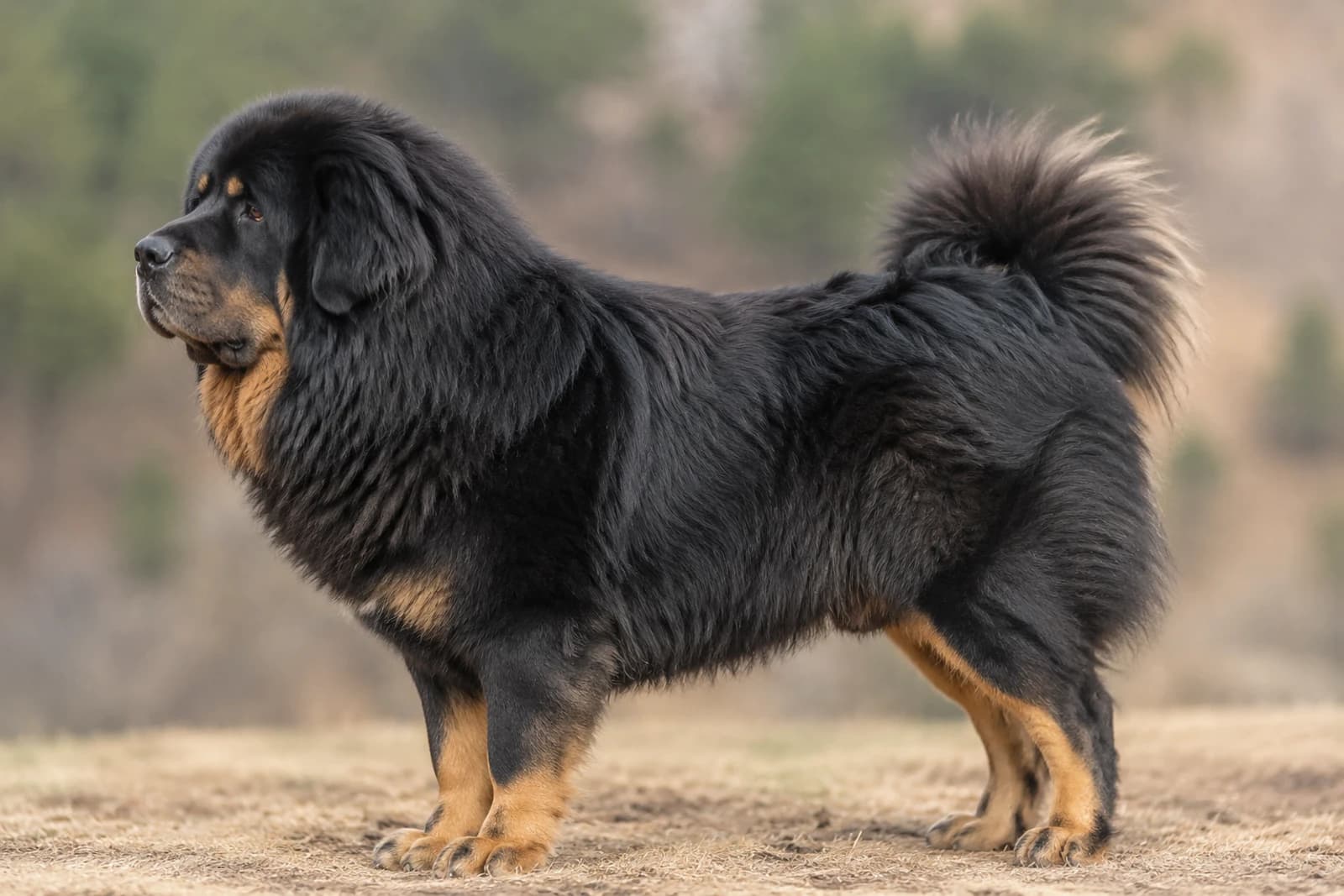
The Tibetan Mastiff is a massive, powerful breed originally developed to guard livestock in the Himalayas. This ancient guardian is fiercely loyal to its family but aloof and protective around strangers, making it an excellent watchdog. Its thick double coat and lion-like mane add to its imposing presence. Best suited for experienced owners with a securely fenced yard, this breed requires early socialization and consistent training. Not recommended for first-time owners or apartment living, the Tibetan Mastiff thrives in a calm, assertive household appreciating its independent, strong-willed nature.
At a glance
- Size
- Giant
- Height
- 24–26 in
- Weight
- 85–280 lb
- Life span
- 10 years
- Coat colors
- Black, Black & Tan, Blue Gray, Brown, Brown & Tan, Cream, Gold, Red Gold, Sable
- Coat type
- Thick double coat, medium to long length, straight and hard
How much does a Tibetan Mastiff cost?
Adopt / rescue
$200–$600
Usually includes spay/neuter, first shots, and a microchip.
Buy from a breeder
$2,500–$6,000
From a reputable, health-testing breeder.
Show and imported lines can reach five figures.
Approximate USD. Prices vary widely by region, breeder, pedigree, age, and coat colour — adopting is the lower-cost and recommended route. Avoid suspiciously cheap “breeders”; they’re often puppy mills.
Estimate the full cost of a Tibetan Mastiff →Tibetan Mastiff photos
Views
Front, side, rear and top — the full silhouette.Poses
How the breed sits, lies, moves and plays.Puppy to senior
The breed across its whole life.Expressions
The breed’s range of moods.Close-up details
Eyes, ears, nose, paws, tail and coat.Coat colors
The breed’s recognized colors.Click any photo to enlarge. We show the Tibetan Mastiff from every angle — three views, poses, life stages, expressions, close-ups, coat and colors.
Appearance & size
You’ll spot a Tibetan Mastiff by the sheer substance of the dog before you register any single detail. This is a giant breed that carries its 85 to 280 pounds on a frame that’s only 24 to 26 inches tall at the shoulder — not towering, but massively boned and densely muscled. Males routinely weigh 140 to 180 pounds, while females settle between 85 and 140. A 280-pound male isn’t the norm, but the range exists, and even smaller individuals have surprising width and heft.
The body is slightly longer than tall, forming a sturdy rectangle. From the side, you see a deep, broad chest that drops to the elbows, a straight, level back, and a powerful loin. The neck carries a thick ruff — part of a heavy double coat that adds a good deal of visual bulk. The coat itself is a coarse, straight outer layer over a dense, woolly undercoat, heavier in winter and around the neck and shoulders where it forms a pronounced mane. That mane, more lavish in males, gives the front view the classic lion-like silhouette.
Head-on, the head is broad and massive, with a square muzzle and a distinct stop. Dark, almond-shaped eyes sit deep under heavy brows, and the medium-size pendant ears hang close to the skull. The face often wears a calm, almost aloof expression. Rectangular flews and a black nose complete the look.
From the rear, the tail is a signature feature: set high, richly plumed, and curled over the back or to one side. The hindquarters are thick and well-angulated, with heavy britches feathering the backs of the thighs. The tail’s curl and the dense britches together make the rear view as substantial as the front.
Coat colors include solid black, black and tan, various shades of gold to red, and blue-gray with or without tan markings. A small white star on the chest and white on the toes are accepted but not required. The overall impression is a dog built for cold nights and big spaces — broad, deep, and coated in weather-resistant profusion.
History & origin
If you could trace the Tibetan Mastiff all the way back, you’d end up high in the Himalayan mountains — a place so remote and harsh that for centuries, the outside world knew almost nothing about these dogs. They didn’t develop under the careful eye of a kennel club or a breed program. They were shaped by necessity, in villages and nomadic camps that relied on them to face down wolves, snow leopards, and human intruders, often without a shepherd in sight. That ingrained ability to work independently — making calls on their own while protecting livestock or property — is the bedrock of the breed, exactly the reason you’ll find them wired to watch, assess, and act without waiting for a command.
For Tibetan herders and villagers, the dog’s job was brutally simple: guard the flock by night, patrol the perimeter, and never back down. Pairs of dogs would often be tied up near the animals their family depended on, one dozing with one eye open while the other circled. A Tibetan Mastiff wasn’t a dog that needed handler direction; it needed to recognize a threat and neutralize it. That selective pressure over countless generations produced the massive frame (even today, a working-line male can easily top 160 pounds, and some historical accounts describe dogs reaching 280), the dense double coat, and a temperament that’s calm until it isn’t. In the thin air and bitter cold, the Tibetans couldn’t afford a dog that needed hand-holding.
The breed’s name first reached Europe through travelers like Marco Polo, who wrote in the 13th century of dogs “as tall as donkeys” that could kill a lion. Exaggerated? Probably. But the accounts stoked a mystique that lasted until the first documented Tibetan Mastiffs arrived in the West in the mid-19th century. Queen Victoria received one in 1847 — named “Siring” — and a trickle of imports followed. Still, the extreme isolation of their homeland kept them out of the mainstream. It wasn’t until the late 20th century, as China’s influence in Tibet increased and more dogs entered North America and Europe, that the breed really started to catch on with fanciers.
Today’s Tibetan Mastiff has split into two rough tracks: the show lines, often selected for sheer bulk and heavy bone, and the traditional working lines that still guard herds across Tibet, Nepal, and parts of India. The independent streak that made them so effective for nomads is alive and well, and it makes them a poor fit for an owner who expects a dog that lives to please. They reached the modern world with their guardian instincts entirely intact, at home in a well-fenced yard or a mountain pasture — but never fully domesticated in spirit.
Temperament & personality
This is a 100-plus-pound guardian built for independence and serious watchfulness — not a breed that hands out affection to every stranger or bends easily to your will. Bring a Tibetan Mastiff into your home, and you’re signing up for a calm-but-keen sentinel who decides for himself who belongs and who doesn’t. He bonds deeply with his own people, yet remains aloof with outsiders; a visitor you welcome may still get a hard stare and a low rumble until the dog decides they check out. That wariness extends to other dogs, too. Same-sex aggression isn’t uncommon, and off-leash dog-park greetings can go south fast, so you’ll manage his world carefully.
Physically, this is all power: 24 to 26 inches at the shoulder and anywhere from 85 to a truly enormous 280 pounds, with a short 10-year lifespan typical of giant breeds. His energy sits on the moderate side — a long walk and a fenced yard to patrol often do the job — but without daily mental engagement he’ll find his own work, and it’s rarely the work you’d pick. Neglect or isolation easily triggers barking marathons, digging, and escape attempts, because a bored Tibetan Mastiff is a 150-pound problem solver with strong jaws.
Reading the room — and the dog. Body language here matters more than with an eager-to-please retriever. A forward lean and stiff posture, especially paired with a direct stare, signals a decision to act, not curiosity. A backward lean or a dog suddenly freezing tells you he’s overwhelmed. When you see lip licking, yawning, or a deliberate head turn, he’s trying to defuse tension — ignore those and you lose your window to intervene before a growl or snap. A truly relaxed Tibetan Mastiff carries a loose, wiggly body and soft eyes, and you’ll learn to treasure those moments.
Kids and other pets. The breed’s low friendliness scores and sheer mass make it a poor fit for homes with young children. Even a tolerant giant can accidentally flatten a toddler, and obedience training alongside kids rarely works — these dogs don’t take direction from someone they perceive as a lower-ranking pack member. With older, dog-savvy teens who respect his space, it can click, but never let a child interrupt him while he’s eating; food guarding escalates fast. Other household pets need slow, structured introductions, and even then some Tibetan Mastiffs simply won’t accept a strange dog in their territory.
Territory, inside and out. To this breed, “home turf” isn’t just the yard — it’s wherever your family’s scent pools. He’ll urine-mark to draw a map he reads with his nose, which is why a less-used guest room might become a bathroom without you realizing. Clean accidents with a vinegar spray (white and cider vinegar) to neutralize the odor cue, and reward outdoor elimination with a treat the moment he finishes. If rolling in something foul on a walk is his idea of a good time — well, theories range from scent-masking to bragging about a great find, but it’s a habit that keeps you on your toes.
Chewing and staying out of trouble. Puppies chew to explore and soothe teething pain; adults gnaw to keep their jaws strong and teeth clean. Supply rugged, safe chews, and if he locks onto a table leg, a homemade citrus spray from boiled citrus peels often sends him elsewhere. Force doesn’t work with a will this strong. Respect, clear rules, and a whole lot of consistency do — along with the humility to admit when he’s simply out-thunk you.
Good with kids, dogs & other pets
A 150-pound dog who takes family protection personally doesn’t mix with roughhousing kids by accident. Tibetan Mastiffs are patient and generally non-aggressive with their own household, but that patience doesn’t cancel out physics. A friendly body block or a full-speed zoomie can flatten a toddler. Supervise every interaction between this breed and young children, period. Older kids who respect a dog’s space and understand calm handling often find a quiet, watchful friend who tolerates a lot before walking away.
Nipping, chasing, or wrestling that gets too loud can flip a Tibetan Mastiff’s guardian switch. The dog may insert itself between the child and a perceived threat — a friend yelling, a parent scolding — and that 200-pound barrier doesn’t come with a discussion. Teach children to be predictable indoors and to never crowd the dog while it’s eating or resting.
Other dogs
Same-sex aggression is real in this breed, especially between males. A Tibetan Mastiff may live peacefully with a dog of the opposite sex it was raised alongside, but inviting strange dogs onto the property or into the house is asking for a display of teeth and posturing. Off-leash dog parks are a gamble best avoided; these dogs don’t do casual meet-and-greets. They guard their territory and their people with zero interest in making new canine friends at 18 months.
Early, controlled exposure — between 3 and 14 weeks — is the only decent shot at building tolerance for other household dogs. Pile on positive interactions with stable, well-mannered adult dogs before that window closes. After four months, a Tibetan Mastiff’s opinions about other dogs solidify fast, and trying to force socialization on a suspicious adult backfires, adding stress and often escalating to fights, not play.
Cats and small pets
A Tibetan Mastiff can live alongside cats, rabbits, or even chickens if raised with them from puppyhood. The breed’s livestock-guarding roots mean they often accept resident small animals as part of the flock to watch over. A cat that grew up next to the dog may curl up for a nap against that thick ruff. A cat who dashes through the yard at 11 months when the dog’s instincts are peaking? Different story. Supervise introductions slowly, keep small pets safely separated when you’re not around, and never assume a smooth puppyhood means a prey-chase won’t kick in the first time a new ferret skitters across the floor.
Trainability & intelligence
A Tibetan Mastiff is smart in the way that counts for a guardian who spent centuries making independent decisions at 15,000 feet — but that doesn’t always line up with snappy obedience. This is a dog that thinks before it acts, and if your command doesn’t make sense to him, he may simply decline. Expect a quick learner who understands new concepts fast, then applies them only when he respects the relationship and sees a reason to cooperate. Motivation doesn’t come from a need to please you; it comes from trust, clear communication, and whatever’s in it for him.
What training looks like in practice
- Work with the dog’s nature, not against it. Force, intimidation, or punishment-based methods backfire badly — they erode the trust that’s non-negotiable with a breed this powerful and protective.
- Start early and stay consistent. Puppyhood is your window. Begin socialization between 3 and 14 weeks, gradually introducing the pup to new people, sounds, surfaces, and calm, well-behaved dogs. Ongoing positive exposures directly reduce the chance of fear-based reactivity later.
- Use what motivates him. For some, high-value treats work; for others, a favorite tug toy or a brief play session gets a better response. Reward the behavior you want the instant it happens — praise alone is rarely enough for a dog this self-contained.
- Recall deserves extra respect. A Tibetan Mastiff off leash in an unfenced area is a gamble. His independent judgment and guarding instinct can override a recall cue the moment he decides something needs his attention on the other side of the field.
The challenge you need to prepare for
This breed’s size makes training a safety issue, not just a convenience. A 140-pound dog that blows off a “come” or lunges at a stranger is a liability. The same intelligence that solves problems can turn into creative stubbornness if you’re inconsistent or boring. He won’t nag you for direction like a retriever; he’ll weigh your request and possibly ignore it if the bond isn’t strong.
Patience is everything. Build a relationship founded on respect and thousands of positive repetitions, and you’ll have a calm, cooperative dog who trusts your guidance. Rush the process, lean on corrections, or skip early socialization, and you’ll spend the next decade negotiating with an immovable 100-plus-pound independent thinker.
Exercise & energy needs
Think of a Tibetan Mastiff less as a runner and more as a deliberate, powerful patrol dog. This is a giant breed that can tip the scales at 280 pounds. He doesn’t need hours of high-octane exercise; he needs a predictable routine of low-impact movement and a reason to use his mind. Pushing a young or growing TM into long runs or stair-climbing can set the stage for joint trouble later—his growth plates can stay open until he’s two or even three years old.
Aim for two solid leash walks of 30 to 45 minutes each day. Let him set a slow, snuffling pace. The point isn’t to wear him out physically; it’s to let him survey his territory and process the world through his nose. A bored Tibetan Mastiff will find his own job, and that often means perimeter pacing, digging, or testing fences. The right amount of daily walking, around 60 to 90 minutes total split into morning and evening sessions, keeps that restless edge in check without overloading his frame.
Mental work matters just as much. Scent games, puzzle toys loaded with treats, and supervised yard time where he can watch over the property all scratch the guarding itch. He’s an independent problem-solver, so toys that require taking apart (like a stuffed Kong inside a box) often hold his attention better than obedience drills. Because of the thick double coat, exercise him in the early morning or after sunset when it’s cool, and never push him in heat or humidity.
Skip the jogging, keep him off high-impact agility equipment, and give him long, leisurely walks where he can pause, stare, and decide when to move on. That’s his workout and his version of a job.
Grooming & coat care
Your Tibetan Mastiff comes with a coat built for Himalayan winters: a heavy, insulating undercoat paired with a thick, coarse outer layer. That luxury has a price — shed hair is a constant in your house, and twice a year it will feel like the dog is coming apart.
Brushing and the tools you’ll need
A metal slicker brush with rounded pins and a long-toothed undercoat rake are non-negotiable. The slicker glides through the outer guard hairs and snags dead undercoat before it hits your sofa. The rake reaches all the way to the skin without tearing, which matters when you’re working through the dense britches, elbow fringe, and the thick ruff around the neck.
- Routine maintenance: Brush him out two or three times a week, every week. Pay extra attention behind the ears and under the arms — those spots mat up first.
- Shedding season: When he blows coat in spring and fall, daily raking sessions become your new ritual. A sturdy metal comb with wide and narrow teeth helps you split and release tangles before they tighten into a felted mess. If you skip days, mats can pull skin tight and become painful.
Bathing — less is more
Resist the urge to bathe him often. His coat actually repels dirt once it’s dry, and those natural oils are what keep it weatherproof. Wash him only when he’s genuinely rank, using a mild dog shampoo. After the bath, rinse until you think you’re done, then rinse again — any soap left in that dense undercoat will fester. Finally, let him dry completely; a damp undercoat is a hotspot waiting to happen. Between baths, a damp cloth plus some spot-cleaning covers most messes.
Nails, ears, and teeth
Giant breed nails grow fast and can crack or splay if they get too long. If you hear clicking on hard floors, get the clippers out. Weekly ear checks are wise — those drop ears harbor moisture, so wipe them out with a clean, damp cloth. Brush his teeth several times a week to keep tartar down. Start all of this when he’s a puppy, because convincing a 150-pound adult to hold still for a nail trim is a battle you don’t want to fight.
Seasonal coat realities
During a big shed, take the job outside if you can. A high-velocity dryer — the kind groomers use — will blast loose undercoat out in minutes after a bath and cut down on stray fur indoors. Don’t ever shave a Tibetan Mastiff to “reduce shedding.” That coat is his insulation and his sun shield. A shaved dog can overheat, sunburn, and may not regrow the outer coat properly. Stick with the rake, and he’ll stay comfortable through every season.
Shedding & allergies
A Tibetan Mastiff doesn’t just shed — it molts in quantities that will reshape your cleaning routine. This is a giant double-coated breed that dumps fur year-round, then kicks it into overdrive once or twice a year with a full-blown undercoat blowout.
The coat consists of a dense, woolly underlayer beneath a coarse, straight outer coat. You’ll notice a steady stream of hair on your floors, furniture, and clothes no matter the season. During the spring blowout (and often a lighter one in fall), fistfuls of undercoat release all at once, and daily brushing turns into a workout. If you don’t stay ahead of it, you’ll find tumbleweeds of hair drifting across the room within an hour of vacuuming.
Drool adds another layer. These dogs have loose flews, and after drinking or when they’re hot, streams of saliva end up on walls, legs, and floors. The combination of heavy shedding plus wet, sticky drool means hair literally gets glued to surfaces.
There is no hypoallergenic version here. All that fur and dander, plus saliva proteins, make the Tibetan Mastiff a poor choice for anyone with allergies. Even the “less-allergenic” argument falls flat — a dog this size produces massive amounts of allergens. If you’re allergic, living with a Tibetan Mastiff means constant symptoms or a house sealed in plastic.
Diet & nutrition
An adult Tibetan Mastiff can easily carry 130, 160, or even 200-plus pounds — so what you put in the bowl matters far more than how much you can pile in. The real priority is keeping him lean from puppyhood on. Extra weight, even 5 or 10 pounds, hammers the joints of a giant breed and can shorten a life already capped at around 10 years.
How much to feed
Forget the bag’s one-size chart. Start with your dog’s ideal adult weight, not his current scale number. A lean 110‑lb male might do well on 3½–4 cups of a quality large‑breed kibble split between two meals — but a sedentary 200‑lb male may need only a little more, not double. You want to see a waist from above and easily feel ribs under a thin fat pad. If you can’t, cut back. Some Tibetan Mastiffs are surprisingly picky eaters; others will inhale anything. If yours is a speed‑eater, use a slow‑feeder bowl or a food puzzle. It slows him down and helps prevent bloat, a real danger in deep‑chested dogs.
Puppy feeding schedule
Controlled growth protects those giant joints. Feed four measured meals a day until four months, then three meals until six months, then switch to two meals for life. Use a large‑breed puppy formula with proper calcium‑phosphorus ratios. Overfeeding a puppy won’t make a bigger adult — it makes an orthopedically damaged one.
What to put in the bowl
A high‑quality commercial diet works. If you go home‑prepared, think roughly 60% animal protein (muscle meat, organs), 20–30% dog‑safe fruits and vegetables, and 10% extras like eggs, plain yogurt, or grains. Pearl barley adds digestible fiber; white rice serves as a bland carbohydrate when his stomach is off. Purée or finely process the produce — dogs don’t grind food side‑to‑side and lack salivary enzymes to break down plant cell walls. Blending makes those nutrients accessible instead of just being decorative in the yard.
Quick home meals can combine a can of water‑packed sardines, a couple of scrambled eggs, and leftover cooked vegetables. Always transition to a new diet slowly, and never feed him from the table — a 150‑pound beggar is not a project you want.
Bloat awareness
Two or three smaller meals beat one giant serving. Avoid heavy exercise for at least an hour after eating, and skip elevated food bowls. If he gulps air, the slow‑feeder bowl becomes a real safety tool.
Senior years
By seven or eight, his engine idles lower. Switch to smaller, more frequent meals if his appetite changes, but don’t slash protein without a vet’s reason — he needs it to keep muscle. Trim calories to match his couch time, and do a monthly hands‑on body check. Letting him get heavy as a senior is one of the fastest ways to steal mobility.
What not to feed
A sudden fatty meal — holiday ham, greasy trimmings — can trigger pancreatitis. Tiny tidbits of plain, lean meat or cooked veggies are fine if offered in his own bowl. For training treats, stick to single‑ingredient chews like dehydrated sweet potato, or a raw chicken wing introduced around 12 weeks under your supervision. Treats count toward the daily calorie total, so subtract accordingly.
Health & lifespan
Typical lifespan
Plan on about a decade. Ten years is the realistic average for this giant breed, though some individuals push to 12 with exceptional genetics, careful weight control, and a bit of luck. That shorter window means you’ll want to be proactive right from puppyhood—there’s no extra time to waste.
Inherited conditions to have on your radar
Giant dogs pack their aging into fewer years, and a few health problems show up often enough that you need to talk with your breeder and your vet upfront.
- Hip and elbow dysplasia. Malformed joints are a known risk. Responsible breeders don’t guess—they get their dogs screened through the Orthopedic Foundation for Animals (OFA) or a PennHIP evaluation, and they should gladly show you the results.
- Bloat (GDV). A deep chest makes a Tibetan Mastiff a candidate for gastric dilatation-volvulus. The stomach twists on itself, trapping air and cutting off blood flow. A dog who paces, drools heavily, tries to vomit but can’t, and has a swollen belly needs an emergency vet now. Quick surgery is the only fix.
- Heart disease. Some lines carry an elevated risk for dilated cardiomyopathy and other cardiac muscle problems. Annual cardiac exams are part of a thorough breeding program, and ideally echo results are available for the parents.
- Eye issues. Entropion (eyelids that roll inward) and ectropion (drooping lower lids) cause chronic irritation and can require surgical correction. Progressive retinal atrophy and cataracts also appear in the breed. A veterinary ophthalmologist should examine both parents yearly.
- Hypothyroidism. An underactive thyroid gland isn’t rare and typically shows up as weight gain, lethargy, or coat changes. It’s managed easily with daily medication once diagnosed through a blood panel.
- Skin problems. That thick double coat can hide hot spots, yeast overgrowth, and allergic dermatitis. Regular grooming and a quality diet head off a lot of trouble, but if your dog seems itchy or oily despite good care, a vet visit is in order.
None of these conditions is a guarantee. A breeder who screens, tracks longevity in their lines, and is transparent about what has cropped up in siblings and ancestors gives your pup the best head start.
Everyday health measures
Even a dog built like a fortress needs consistent, boring routines to stay sound.
- Weight management is everything. A growing puppy must be kept lean—no free-feeding and no padding on the ribs. On a frame that can reach 130 pounds or more, even a few extra pounds hammer hips and elbows. You should be able to feel ribs under a thin layer of flesh at all life stages.
- Heat sensitivity. Despite their mountain-heritage coat, Tibetan Mastiffs can overheat fast once temperatures climb past 70°F. Provide deep shade, cool water, and access to air-conditioned floors whenever possible. Don’t exercise them hard in the heat.
- Heartworm prevention. Mosquitoes carry heartworm disease, and there is no such thing as an impenetrable coat. A monthly preventive during mosquito season plus one month after it ends (year-round in many regions) is vastly easier and safer than treating an infestation.
- Rabies vaccination. This one is non-negotiable. Rabies is legally required and has no effective treatment once clinical signs appear. Stay current on boosters so you never have to learn that reality the hard way.
- Annual vet exams, more often for seniors. Catching a subtle shift in activity or appetite early lets you manage arthritis, heart changes, or endocrine problems before they limit your dog’s comfort.
- Early socialization and respectful handling. A Tibetan Mastiff who lives in isolation or faces harsh correction can tip into chronic stress—excessive barking, digestive upset, and a weakened immune response often follow. Gentle, consistent training and positive exposure to new people and places build a resilient, healthier dog.
Living environment
A Tibetan Mastiff is not an apartment dog. This giant guardian needs a house with a securely fenced yard—and by fenced, we mean six feet high, buried at the base. These dogs can climb and dig with startling efficiency when they decide the other side looks more interesting.
yard and space
A large, fully enclosed yard gives them room to do what they’re wired to do: patrol at dusk and dawn, bark at anything out of place, and survey their territory. Without that outlet, you’re inviting a frustrated dog who may redecorate your drywall or dig craters in the flower beds. Even with space, daily walks and mental work are non-negotiable. Think a couple of 20- to 30-minute leash walks plus scent games or puzzle toys, not forced running marathons. Giant‑breed joints don’t need high-impact pounding on pavement, so prioritize comfortable, low-impact movement.
climate and weather
Double coats built for Himalayan nights mean this breed loves cold weather and wilts in heat. If you live in a warm climate, plan on early‑morning and late‑evening activity, lots of shade, and air conditioning indoors. Skip the mid‑day outing when the pavement is sizzling.
noise and barking
Quiet is not in the vocabulary. Tibetan Mastiffs are nocturnal barkers, and that deep, booming voice carries. They announce every perceived threat—rumbling trucks, raccoons, the neighbor’s cat at 2 a.m. Close neighbors or thin walls will be a problem. This isn’t a dog you can train into silence; it’s a baked‑in watchdog trait.
being left alone
Mentally, they’re independent and not prone to the sort of clingy separation anxiety a small companion breed might develop, but they still need enrichment when you’re gone. A bored, under‑stimulated Tibetan Mastiff left alone for 8+ hours can get destructive. Give them food puzzles, a view of the property, and gradually desensitize them to alone time so the house—and your sanity—stays intact.
Who this breed suits
A Tibetan Mastiff fits an owner who’s already been through a few strong-willed guardian breeds and has the property to match. If your dog-owning experience tops out at a well-trained Lab, this is not the next step. This is a 100-plus-pound animal built to patrol a Himalayan estate and make independent judgment calls—often at 2 a.m. when a coyote or a delivery truck rolls past the fence line.
You might be a good match if:
- You own acreage or a large, securely fenced yard. A 6-foot wood or chain-link fence is the bare minimum; these dogs treat a 4-foot picket like a speed bump. Underground fences are useless. The breed’s natural perimeter-guarding instinct turns a small suburban lot into a noise-complaint magnet.
- “Stubborn” doesn’t rattle you. A Tibetan Mastiff won’t fetch, won’t heel just to please you, and may stare at a known command and decide the timing doesn’t suit him. You get cooperation through relationship, consistency, and calm authority—not a treat pouch and a clicker.
- You value a dog who is aloof with strangers, not a golden retriever greeter. Guests will be barked at, postured toward, and possibly refused entry unless you provide a slow, controlled introduction. Your dog will never be a patio-brunch companion.
- Your household is quiet, predictable, and adult-oriented, or you’re a single person/couple with no young children underfoot. A TM can coexist with respectful older kids who understand body language, but his sheer mass and zero-tolerance for roughhousing make him a poor nanny dog.
Who should think twice—or just look elsewhere:
- First-time owners. No. Raising a Tibetan Mastiff without prior guardian-breed experience is like learning to drive in a semi-truck with a mind of its own. The stakes are high: a poorly socialized 150-pound dog who decides the mail carrier is a threat is a liability lawsuit waiting to happen.
- Apartment dwellers or close-quarter suburbanites. Barking is a feature of the breed, not a bug. They bark at night, at wind, at a squirrel two blocks over. Your neighbors will not be charmed.
- Seniors or anyone with limited physical strength. You need to maintain control on a leash with a dog that can outweigh you and has the reaction time of a predator. A squirrel darting out can yank a grown man off his feet. If you can’t physically hold a 120-to-160-pound animal when he lunges, this breed is dangerous to walk.
- People who want an eager-to-please, off-leash hiking buddy. The Tibetan Mastiff’s recall is negotiable at best. His default mode is “I’ll check in when I’m done.” Combine that with a zero-chase-inhibition attitude toward wildlife or stray dogs, and you have a recipe for disaster on public trails.
- Multi-pet households without careful management. Same-sex dog aggression is common, especially between males. Small animals may trigger prey drive, and even a well-socialized TM can decide the neighbor’s cat is a trespasser.
The rare person who clicks with this breed understands the trade-off: you give up biddability, public friendliness, and sleep, and in return you get a fiercely loyal, self-possessed guardian who needs exactly what you offer—space, structure, and a reason to patrol. If that trade doesn’t sound worth it, pick a breed that asks less.
Cost of ownership
You’re looking at a significant financial commitment from day one. A well-bred Tibetan Mastiff puppy from a responsible breeder typically costs $2,500 to $5,000, and that can jump to $10,000 or more for show prospects or champion bloodlines. Rescue adoption fees, if you can find one, run closer to $500–$1,000, but these dogs rarely end up in shelters.
Once you’re past the purchase price, monthly upkeep hits hard because of sheer size. Feeding a 130–160 lb adult male a high-quality, large-breed formula can easily run $80–$120 per month. Females on the smaller end of the range will cost a bit less, but don’t bank on “small” with this breed. Treats, joint supplements, and the inevitable chewed-through gear add another $20–$40.
Grooming is a mixed bag. The thick double coat sheds heavily once or twice a year, and you’ll spend $50–$80 every 6–8 weeks for a professional deshedding bath if you don’t want to wrestle a giant, opinionated dog at home. Between appointments, count on a quality slicker brush, undercoat rake, and a high-velocity dryer (a one-time $100–$250 investment) to keep the fur from swallowing your house.
Veterinary care is where costs can spiral without warning. Routine annual exams, vaccines, and heartworm/flea prevention average $700–$1,000 a year. Giants are prone to hip and elbow dysplasia, bloat, and eye disorders. A single bloat emergency surgery costs $3,000–$8,000. A hip replacement? $5,000–$7,000 per side. Pet insurance for a giant breed like this isn’t optional if you’re risk-averse; expect premiums of $70–$150 per month, with higher deductibles for orthopedic conditions. Even with insurance, you’ll budget for the exams and diagnostics that precede a claim.
Factor in a solid 6-foot fence ($1,500–$4,000 if your yard isn’t already Mastiff-proof), a crate sized for a small pony ($200+), and training classes with someone who understands primitive guardian breeds ($150–$300 for a group class, more for private sessions). This is a short-lived breed—about 10 years—so every dollar you spend has to be weighed against that compressed timeline.
Choosing a Tibetan Mastiff
Choosing a Tibetan Mastiff means finding a dog that’s been set up for a stable life as a family guardian — not just a huge, furry novelty. Because this is a rare, powerful breed with an independent streak, the source you pick matters more than almost anything else.
Responsible breeder vs. rescue
A responsible breeder is your most reliable route. They’ll prove health testing, raise puppies indoors with early handling and exposure to everyday noise, and obsess over temperament. They’ll also ask you hard questions about your experience, fence height, and what you’ll do when the dog decides the UPS truck is a threat. You’ll likely wait for a litter, and that’s the first good sign.
Breed-specific rescue is rare but possible. The handful of Tibetan Mastiffs that end up in rescue are often adolescents or adults surrendered because their original home underestimated the breed’s guarding intensity, size, or need for a job. If you go this route, work with a group that foster-homes the dogs and can give you an honest, detailed behavior assessment — not just a sad story. An adult with a known history can be a great match if you’re brutally realistic about your household.
Health clearances to ask for
This is a giant breed that will reach 85 to 280 pounds in just a couple of years, so joint and systemic health are huge deals. A breeder should hand you proof — not just say “vet checked.” Ask for:
- Hip dysplasia: OFA (fair or better) or PennHIP evaluation on both parents. Don’t accept anything less than official scores.
- Elbow dysplasia: OFA elbow clearance. Elbow issues can sideline a dog faster than poor hips.
- Eye exam: A current examination by a board-certified veterinary ophthalmologist (OFA Eye or CERF). Entropion and ectropion are common concerns.
- Thyroid panel: Full thyroid bloodwork to rule out hypothyroidism, which can affect weight, coat, and behavior.
- Cardiac exam: Some breeders also do an echocardiogram, given the breed’s size. It’s a smart extra layer.
Beware of a breeder who chases extremes in weight. A 280-pound dog may sound impressive, but that kind of mass shortens an already limited lifespan. Ten years is typical for a well-built, moderately sized Tibetan Mastiff; pushing structural limits almost guarantees earlier joint failure and cardiac strain.
Red flags you can’t ignore
Walk away if you spot any of these:
- No proof of health testing on both parents, or “vet inspected” substituting for OFA-style evaluations.
- Won’t let you meet the mother on site, or the dam seems shut down, fearful, or is hidden away. A guardy breed should still be approachable with her owner.
- Sells puppies before 10 weeks. These pups need extended time with their littermates to learn bite inhibition and social signals.
- Always has puppies available. Good breeders plan a litter a year at most, often less.
- Treats the breed like a status symbol (fluffy lion dog!) or brags about “massive bone” without any mention of health or temperament.
- Never asks about your experience with large, primitive guarding breeds, your containment setup, or what training method you’ll use.
Picking the right puppy
You don’t choose a Tibetan Mastiff puppy by grabbing the one that toddles over first. The breeder should match you based on temperament evaluations done across weeks, not a five-minute visit. A solid pup is neither the bully who constantly mounts and pins littermates, nor the one who flattens to the ground at a new sound. Look for a puppy that notices a novel object, investigates calmly, bounces back after a mild startle, and accepts gentle restraint.
Physically, eyes should be clear with no squinting or discharge. No limping, no potbelly, clean ears, and a full coat without bare patches. Ask the breeder to show you their socialization log: what sounds, surfaces, car rides, and strangers the litter has met. If they can’t answer, that’s a miss.
A Tibetan Mastiff from health-tested, temperment-first lines will cost you more up front and probably come with a contract that requires you to return the dog if things don’t work. That’s the kind of safety net you want for a dog that will tip the scales anywhere from 85 to well over 200 pounds and guard your home for the next decade.
Pros & cons
Pros
- Imposing, no-nonsense guardian. A Tibetan Mastiff doesn’t need to bluff. Its sheer mass (85–280 lb) and deep bark deter most intruders before anything physical begins. You get a property protector that thinks independently and acts on its own judgment.
- Deeply loyal to its own family. Once you earn its trust, the bond is real. With its people, the T.M. can be calm, watchful, and surprisingly gentle — a low-energy companion in the house who prefers to lounge near you rather than bounce off the walls.
- Thrives in cold weather and outdoor living. Bred for the Himalayas, the dense double coat laughs at snow and freezing temps. If you have secure acreage, this dog genuinely prefers patrolling a fenced yard to being cooped up inside.
- Modest daily exercise needs. An hour or so of walking and patrolling time is usually sufficient. This isn't a demanding herding breed that needs a marathon; mental guarding work tires it out just as well.
- Naturally clean and low-odor. The coat is shed heavily once a year (more dirt-resistant than you’d guess) and the breed lacks the typical doggy smell, especially if you keep up with brushing.
Cons
- Not for first-time or permissive owners. A T.M. combines giant size with a stubborn, “what’s in it for me” mindset. If you can’t set unshakable rules early and stick to them, you’ll end up with a 150-lb liability that ignores you.
- Intense stranger wariness and nocturnal barking. These dogs come pre-loaded with a night patrol drive. Expect booming barking after dark, and understand that casual visitors won’t ever be greeted with a wag — early, relentless socialization is non-negotiable to prevent outright aggression.
- Heavy, seasonal shedding and drool. During its annual blow, the undercoat comes out in garbage-bag quantities. Factor in serious slobber after eating or drinking, and you have a house that requires constant upkeep.
- Same-sex aggression and limited off-leash reliability. Many adult Tibetan Mastiffs won’t tolerate another dog of the same sex. Recall is often a suggestion, not a command, because the breed’s purpose is to patrol independently, not to check in with you every minute.
- Short lifespan and giant-breed health costs. Ten years is the average. Hip dysplasia, elbow issues, and hypothyroidism can crop up; responsible breeders screen parents, but orthopedic bills and medication costs can hit hard when a dog weighs over 200 pounds.
Similar breeds & alternatives
If you’re drawn to the Tibetan Mastiff’s guardian nature and sheer size, you’re already looking at a tiny handful of primitive flock-guarding breeds. The differences between them come down to everyday manageability, family tolerance, and just how hard they’ll push back when you give a command.
- Great Pyrenees – The “softer” giant. A male Pyr usually tops out around 120 pounds, not 280, and is far less likely to aim a serious threat at a guest once you’ve made the introduction. He still makes his own decisions, barks constantly, and sheds a white blizzard year-round, but he’s the guardian most likely to coexist peacefully with well-behaved children. Expect a lifespan of 10–12 years.
- Caucasian Shepherd Dog – The closest match in raw intensity. A 110–220-pound Caucasian Ovcharka brings the same hair-trigger wariness of strangers and often harsher same-sex dog aggression. You’ll need the same fortress containment and an owner who’s already weathered a hard, independent breed. The coat can be long or short, but the temperament is uniformly serious.
- Anatolian Shepherd – Leaner, leggier (often 29 inches at the shoulder), and bred to work in partnership with a flock across big terrain. At 110–150 pounds, the Anatolian is reserved without the Tibetan Mastiff’s same readiness to escalate to a bite, and he typically accepts handler leadership more readily. A healthy Anatolian lives 11–13 years on average.
- Central Asian Shepherd (Alabai) – Another ancient, climate-hardened guardian. Weight runs 100–180 pounds, and independence runs just as deep, but this breed often shows a slightly more measured reaction to everyday movement on the other side of the fence—still territorial, still not a dog you leave unattended with strangers.
All of them are non-negotiable about secure fencing, zero off-leash freedom, and an owner who won’t mistake aloofness for calm. If the Tibetan Mastiff’s specific lion-like mane and unbending dignity are what you want, go in with your eyes open to the liability. If you need a guardian but can’t live with a dog that may decide a visitor is a threat with little warning, the Great Pyrenees or Anatolian gives you a bit more breathing room without turning off that protective instinct.
Fun facts
- Known as 'Do-khyi' in Tibet, meaning 'tied dog' as they were often chained guarding gates.
- Their thick mane gives them a lion-like appearance, especially males.
- They are one of the oldest and most primitive dog breeds, genetically close to wolves.
- With a double coat, they can endure extreme cold but may struggle in hot climates.
Frequently asked questions
- Are Tibetan Mastiffs good with children?
- Tibetan Mastiffs can be protective and loyal to family children, but their independent nature and large size mean supervision is essential. They may not tolerate rough handling and are better suited to homes with older, respectful kids. Early socialization is critical to ensure they are gentle and patient.
- Do Tibetan Mastiffs shed a lot?
- Tibetan Mastiffs have a thick double coat that sheds heavily, especially during seasonal changes. Regular brushing a few times a week can help manage loose fur, and they may 'blow' their undercoat once or twice a year, requiring daily grooming during those times.
- How much exercise does a Tibetan Mastiff need?
- As a giant breed, they need moderate daily exercise to stay healthy, such as long walks or play in a securely fenced yard. They are not overly energetic but can become bored and destructive without enough mental and physical stimulation. Joint care is important due to their size, so avoid overexertion, especially in puppies.
- How much grooming does a Tibetan Mastiff require?
- Their dense coat needs brushing at least 2-3 times per week to prevent matting and remove debris. During shedding season, daily brushing is ideal to keep the coat healthy and minimize shedding around the home. Bathing should be done occasionally, and regular nail trimming and ear cleaning are necessary.
- Can Tibetan Mastiffs live in apartments?
- Tibetan Mastiffs are not well-suited for apartment living due to their large size and need for space. They are territorial and may bark at noises, which can disturb neighbors. A home with a large, securely fenced yard is ideal where they can patrol and have room to move.
- Do Tibetan Mastiffs bark a lot?
- Tibetan Mastiffs are known to be vocal and may bark to alert their family of anything unusual. Their guarding instincts make them natural watchdogs, so they tend to bark at strangers, other animals, or unfamiliar sounds. Consistent training can help manage excessive barking, but some level of barking is inherent to the breed.
Tools & calculators for Tibetan Mastiff owners
Quick estimates tailored to Tibetan Mastiffs — pre-filled with this breed’s size where it matters.
Articles & stories about the Tibetan Mastiff
Sources & standards
This profile follows recognized breed standards from the American Kennel Club (AKC) and the Fédération Cynologique Internationale (FCI), along with established veterinary and breed-club guidance. These describe general breed tendencies — every dog is an individual.
Owner stories
Have a Tibetan Mastiff? Share your experience — grooming tips, personality quirks, anything goes.