

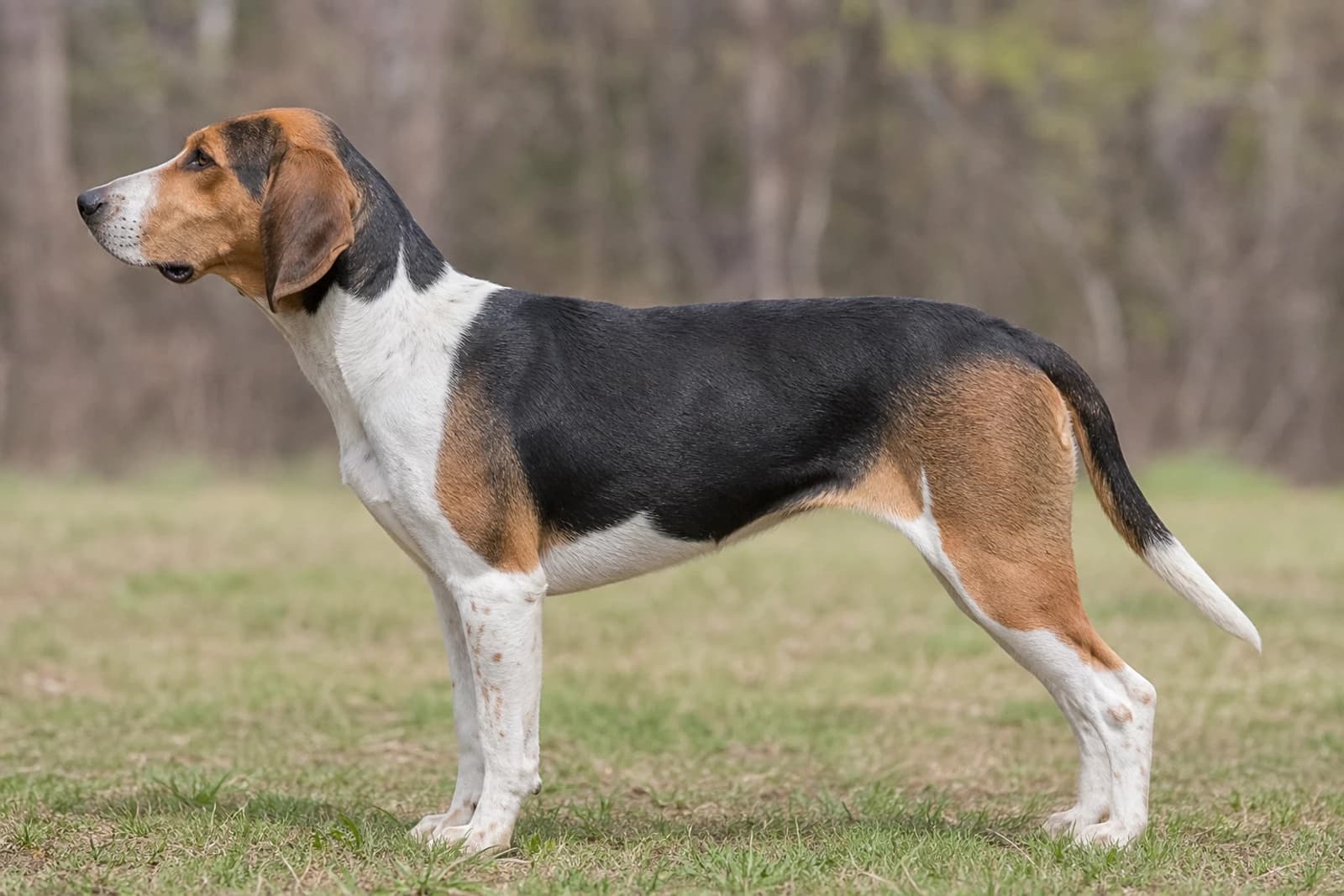
The Treeing Walker Coonhound is a swift, athletic hound standing 20-27 inches tall and weighing 51-71 pounds. Bred for treeing game, they are prized for their speed, endurance, and keen nose. With a friendly, outgoing personality, these dogs are loyal family companions but require an active lifestyle and secure outdoor space. Best for experienced owners who can manage their high energy and independent streak.
At a glance
- Size
- Giant
- Height
- 20–27 in
- Weight
- 51–71 lb
- Life span
- 12–13 years
- Coat colors
- Tricolor (white, black, tan)
- Coat type
- Short, dense
How much does a Treeing Walker Coonhound cost?
Adopt / rescue
$75–$400
Usually includes spay/neuter, first shots, and a microchip.
Buy from a breeder
$700–$2,000
From a reputable, health-testing breeder.
Approximate USD. Prices vary widely by region, breeder, pedigree, age, and coat colour — adopting is the lower-cost and recommended route. Avoid suspiciously cheap “breeders”; they’re often puppy mills.
Estimate the full cost of a Treeing Walker Coonhound →Treeing Walker Coonhound photos
Views
Front, side, rear and top — the full silhouette.Poses
How the breed sits, lies, moves and plays.Puppy to senior
The breed across its whole life.Expressions
The breed’s range of moods.Close-up details
Eyes, ears, nose, paws, tail and coat.Coat colors
The breed’s recognized colors.Click any photo to enlarge. We show the Treeing Walker Coonhound from every angle — three views, poses, life stages, expressions, close-ups, coat and colors.
Appearance & size
A Treeing Walker looks like somebody stretched a Beagle into a lean, long-distance running machine. These are tall, rangy hounds built to cover miles without wasting an ounce of energy. A male at the top end of the standard stands 27 inches at the shoulder and weighs around 70 pounds — not heavy-boned, but all leg, deep chest, and lung power. Females run smaller, 20 to 25 inches and 50 to 65 pounds, but the silhouette stays the same: a smooth, aerodynamic outline with no bulk to slow them down.
The coat is a flat, short, dense jacket that lies close to the body. It's meant to shed water, brush, and mud, not to insulate — these dogs can get chilled in cold weather if they're standing around. The classic color is the tricolor: a black saddle or blanket over the back, rich tan on the legs, face, and under the tail, and crisp white on the chest, feet, and tail tip. You'll also see plenty of bi-color Walkers, usually white with tan points or black with tan. A white tail tip and white feet are common enough that they're almost a trademark, helping hunters spot the dog in low light.
From the front, you notice the straight, clean forelegs set under a deep, moderately wide chest. The shoulders slope well back, so the dog doesn't pound the ground when it gallops. The head is long and slightly domed, with a square-ish, strong muzzle and a nose that's always black and wide open. The eyes are large, dark brown or hazel, and carry a soft, almost pleading expression — a total contrast to the dog's hard-driving work ethic. The ears are a defining feature: set low, hanging in graceful folds that reach at least to the tip of the nose when pulled forward. They frame the face and add to that warm, houndy look.
From the side, you'll see a level topline from the withers to the hip, with just a slight arch over a strong loin. There's a definite tuck-up where the belly cuts cleanly toward the rear, and the tail — set high and carried up like a saber — is never docked. When the dog's moving, that tail flags straight up with a slight curve. The rear view shows the real engine: broad, muscular thighs and well-let-down hocks that drive the dog forward without wasted motion. A Walker stands slightly taller at the hip than at the withers, which gives it that uphill, ready-to-launch stance.
Put short-haired athleticism together with that height range and you get a dog that slips through the house more easily than you'd expect for a 70-pounder, but its body was made for the outdoors. If you're picturing a couch potato, a Walker will spend all day reminding you that those long legs didn't evolve for napping.
History & origin
The Treeing Walker Coonhound didn’t come from a kennel club blueprint — it got carved out of necessity by hunters who wanted a dog that could flat-out run a track, then put a raccoon in a tree and sing until they caught up. Every trait you see in the breed today started with that one job.
The breed’s foundation walks straight back to the English Foxhounds Thomas Walker brought to Virginia in 1742. Those dogs were built for running fox across open country, but in the thick, eastern woodlands of early America, hunters needed something with more heat and grit. Over the next century, the Virginia hounds were crossed with other scent hound imports, and a distinctly American type started taking shape — taller, stringier, faster, with a sharper nose and a booming voice that carried through dense timber.
By the mid-1800s, the real pivot happened in Kentucky. A line of “Walker Foxhounds” already had a reputation for speed and endurance, but they weren’t always reliable tree dogs. That changed when a stolen hound named Tennessee Lead surfaced in the late 1800s. Nobody knows his exact ancestry, but his get displayed an almost obsessive drive to trail and tree game, not just chase it. Breeders like John W. Walker bred Lead’s descendants intensively, selecting for that treeing instinct alongside raw foot speed. The result was a dog that could cover rough ground with a long, efficient stride and then explode into a steady, chopping bawl once the quarry was cornered above ground. The “Treeing Walker” strain had arrived.
Competitive coonhound trials in the early 1900s cemented the breed’s place. Night hunts judged dogs on their ability to strike a trail, track accurately without distraction, and tree the raccoon and stay put. Walkers consistently dominated those events, and their voice — loud, locatable, and insistent — became the gold standard.
The United Kennel Club recognized the Treeing Walker Coonhound as a distinct breed in 1945, acknowledging that its specialized job and type set it apart from the Walker Foxhound. While it remains in the American Kennel Club’s Foundation Stock Service and is not fully AKC-registered, the breed has never relied on show-ring attention for its survival. Today it’s still the most popular coonhound in the nation, owned by weekend hunters and working guides alike. A small but growing number of families also keep them as running partners and house dogs — provided they can handle the volume and the single-minded prey drive.
Temperament & personality
A Treeing Walker Coonhound lives for the chase. He’s a racy, good-natured hound who turns every walk into a scent-seeking mission. Expect a dog who’s equal parts athlete and comedian — bouncy, eager to make you laugh, and absolutely consumed by his nose. This is not a couch potato, and he won’t be satisfied with a couple of slow loops around the block. He needs a solid hour or more of hard running, brisk hikes, or a fenced yard where he can sprint and sniff himself silly. Without enough physical and mental work, that explosive energy gets channeled into epic barking sessions, chewing whatever’s handy, or redecorating your home with urine.
Temperament descriptors like “friendly” and “brave” fit the typical Treeing Walker, but they’re observed tendencies — not a guarantee. Most are outgoing with strangers and affectionate with family, often leaning into you for scratches. Young kids can get knocked over by that full-speed, 70-pound enthusiasm, so supervision matters. Around other dogs, they’re usually sociable pack hounds; around cats or pocket pets, the prey drive kicks in hard. You may never fully train the chase out, so management is everything.
A nose with a dog attached
Your days will be defined by that relentless sniffer. Treeing Walkers find the world through scent and act on it with scant second thought. You’ll see it in territorial marking — a good long sniff, then a deliberate leg lift. That’s scent-based memory at work, so indoor accidents need an enzymatic cleaner to truly erase the cue. A homemade vinegar spray (white and cider vinegar mixed with water) can help neutralize urine odors and discourage re-marking. And when he discovers something dead on the trail, don’t be surprised if he drops a shoulder and rolls. Whether it’s to mask his own scent, share news of a food bonanza, or simply because he likes the stink, it’s a deeply ingrained habit — one that requires a strong “leave it” and a reliable recall.
Reading the hound
This breed wears his mood in his body. A loose, wiggly frame and soft eyes tell you he’s content. A forward lean with a stiff tail flags intense focus (likely on a squirrel). If that posture shifts to a frozen stare and rigid body, back off — it can precede a snap in a cornered or nervous dog. Calming signals like lip licking, a yawn, or turning his head away are the dog’s way of dialing down tension, whether during training or a too-tight hug from a child. Never disturb a Walker while he’s eating. Let him have his meal in peace, and teach kids to do the same to prevent food-guarding.
Household rhythm
He’s a people-oriented hound, not a loner. Left alone for long hours, he can spiral into anxiety-driven barking or destructive chewing. Puppies gnaw to explore and soothe teething gums; adults chew to keep jaws strong and teeth clean. Direct that instinct to hard rubber toys or raw bones. If a specific family member travels, the hound might lose his potty-training groove in less-used rooms — his “house” territory seems tied to the scent of the family, not the walls. Mark the right behavior: the second he squats outdoors, deliver a tasty treat. That positive marker sinks in far deeper than punishment ever will. And when the bay-and-pace starts at the sight of a squirrel on the fence, bring him inside with a cheerful call, not a scolding. He’s not being stubborn; he’s just a dog doing what seven generations of treeing hounds were built to do.
Good with kids, dogs & other pets
The Treeing Walker’s easygoing, non-aggressive temperament makes it a surprisingly steady companion for children. These hounds are patient by nature and rarely quick to snap, which means they often handle ear tugs, clumsy hugs, and the general chaos of a household with young kids without fuss. That said, a 51-to-71-pound dog moving at full Coonhound enthusiasm can accidentally bowl over a toddler, so you’ll need to teach “no jumping” early and always supervise interactions until both dog and child understand the rules.
Pack life is literally in the breed’s DNA. Expect your Walker to want to be in the middle of whatever the family is doing, flopped on the couch next to a kid watching cartoons or trailing someone from room to room. They don’t do well parked in a yard by themselves all day—this need for constant companionship means they thrive in homes where someone is usually around, which lines up perfectly with busy family households.
-
Other dogs: Generally, yes. Treeing Walkers were bred to work and live alongside other hounds, so they tend to be sociable and enjoy canine company. Introduce new dogs on neutral ground and keep initial interactions calm. As with any breed, early and ongoing socialization matters. The critical window runs from about 3 to 16 weeks; during that time, you’ll want your puppy to have repeated positive experiences with a variety of dogs. Without it, an adult Walker may become timid or over-excited around unfamiliar dogs. Even well-socialized adults often prefer familiar dog buddies over day-to-day encounters with strangers.
-
Cats and small pets: Here’s where you hit the brakes. This is a hunting hound with an intense drive to chase and tree anything that runs—squirrels, rabbits, and, yes, the family cat sprinting from the living room to the kitchen. A puppy raised with a cat from 8 weeks old, with careful, positive exposure, can learn to coexist peacefully indoors. Even then, that outdoor squirrel-flipping switch can flip outdoors, so fence-fighting with neighborhood cats is a real possibility. For small caged animals like hamsters or ferrets, the safest bet is keeping the hound entirely separate, because the prey drive often overrides any training. If you’re not willing to manage and separate, a home without small furries is the safer path.
Trainability & intelligence
You’re working with a dog that was bred to bolt ahead, make decisions on the fly, and bay loudly enough for a hunter half a mile away to find him. That intelligence is real and quick—a Treeing Walker Coonhound can learn a new command in a handful of repetitions. The catch is, he’s just as quick to decide the command doesn’t matter if his nose locks onto something juicier.
Positive reinforcement is the only way through. These hounds wilt under harsh corrections, and punishment kills the trust you need for any kind of cooperation. Use tiny, high-value treats, a squeaky toy, or a burst of excited praise the instant he gets it right. Keep sessions brief and unpredictable—three short rounds a day beats one long grind. Once boredom sets in, your Coonhound’s brain clocks out, and you’ll just be watching his nostrils twitch at the window.
Recall is the hard truth here. A Treeing Walker’s scent drive can override months of training in a single breath. Practice it daily on a long line in a variety of environments, but accept that off-leash reliability may never be solid. A 51–71 lb hound on a mission is fast and selectively deaf. Secure fencing is not optional.
Early socialization makes a big difference. Between 3 and 14 weeks, expose him to different people, friendly dogs, city sounds, and weird surfaces like metal grates or wobbly boards. He’s generally good-natured, but under-socialized Coonhounds can become wary of new situations, which often comes out as noise—baying, not backing down. Don’t force greetings; let him approach at his own pace with a treat ready for calm behavior.
A Treeing Walker needs a job for his brain, not just his legs. Scent games, puzzle feeders, and even introductory nose work classes channel that problem-solving mind. Otherwise he’ll invent his own entertainment, and you probably won’t love opening the kitchen cabinets or re-folding the laundry he re-sorted. Build a training relationship on clear, patient communication, and you’ll have a dog who happily picks up cues—yet will always, on some level, consult his own agenda first.
Exercise & energy needs
Plan on at least 60 to 90 minutes of hard, daily exercise — and “hard” means running, not strolling. A Treeing Walker Coonhound was bred to cover miles of rough terrain at a steady lope while working a scent trail, then bay up game in a tree. A couple of 20-minute leash walks won’t touch that deep-bred stamina. Split the day into two solid sessions: a long morning run or off-leash hike, and an evening hike, bike ride, or vigorous game of fetch. Without that outlet, you’ll get a dog who howls, paces, and dismantles your couch.
Mental work matters just as much as the mileage. This is a nose on four legs. Scent games, structured nose work classes, or a simple “find the hidden treat” drill indoors will wear out their brain faster than more running. Puzzle toys help, but nothing satisfies like following a scent trail. If you don’t give the nose a job, the nose will find its own — and that might mean trailing a raccoon across two counties at 3 a.m.
- Good fits: off-leash forest hikes, canicross, running alongside a bike (once joints are mature), flirt pole sessions, barn hunt, and coonhound field trials that simulate treeing game.
- Watch for: A Walker’s enthusiasm can override self-preservation. They’ll run until they drop, so you set the limits on hot days and don’t push a puppy through high-impact pavement pounding before growth plates close.
- Red flag: If your hound starts baying endlessly, chewing fence boards, or getting snappy with housemates, you’ve undershot the exercise quota. Dial up both the physical and scent-work hours.
A tired Walker is a quiet, good-natured housemate. But that tired requires real sweat equity.
Grooming & coat care
A Treeing Walker Coonhound’s coat is about as easy as it gets. The short, hard, single-layered hair lies flat and slick, shedding water and dirt like it was designed to chase raccoons through wet brush—which, of course, it was. Weekly upkeep is minimal, but if you ignore it, you’ll still find needle-sharp hairs woven into every seat cushion.
Grab a bristle brush, a rubber curry mitt, or a hound glove and go over the dog once or twice a week. That’s enough to pull out loose dead hair, distribute skin oils, and leave the coat gleaming. During spring and fall shed cycles, step it up to every other day. There’s no undercoat to blow in giant tufts, but the steady trickle of short hairs will collect fast if you don’t stay ahead of it. A quick session after a run works wonders—outdoor activity jostles the loose stuff free, so you catch it outside instead of on the living room rug.
Bathe only when he’s genuinely ripe. These dogs don’t get greasy quickly, and over-washing strips the natural waterproofing. When mud season hits, a rinse with plain water or a spritz of waterless shampoo between proper baths stretches the time without drying the skin. Always use a gentle dog shampoo, never human products.
Floppy ears are the real grooming attention grabber. The drop ear design traps moisture and limits airflow, so a weekly ear check and cleaning with a vet-approved drying solution prevents infections that sneak up fast. Swipe the outer ear with a cotton ball—never dig into the canal. If you catch a whiff of yeast or see your dog shaking his head more than usual, don’t wait.
Nails need a trim about once a month; if you hear clicking on hardwood, they’re overdue. Brush teeth several times a week with dog-formulated paste. Dental neglect is common in the breed and leads to problems well before old age. Manage those ears and teeth with the same consistency you brush the coat, and you’ll sidestep the stuff that sends Coonhounds to the vet.
Shedding & allergies
The Treeing Walker Coonhound is not a heavy shedder by any stretch, but you’ll still find short, stiff hairs woven into your couch cushions. Their coat is a single layer — smooth, dense, and lying flat — which means there’s no fluffy undercoat to explode twice a year. You get a steady, low-grade sprinkle of hair rather than a seasonal blizzard.
- Shedding level: Moderate year-round. Run a hound glove or rubber curry over them once or twice a week and you’ll pull off loose hair before it ends up on your floor. During spring and fall, the shedding ticks up a notch; a quick daily brush handles it.
- Coat and mess: The hairs are short and can be surprisingly pokey — they like to work their way into fabric. Vacuuming upholstery and car seats becomes a regular chore. On the upside, they don’t mat or tangle, so grooming is a 5-minute job.
- Drool factor: More than a dry-mouthed breed, less than a Bloodhound. Expect slobber after drinking, during hot weather, or when they’ve got their nose locked on a scent. Keeping a drool rag in the kitchen is a practical move.
- Allergies? There’s no such thing as a hypoallergenic hound. This breed produces dander and sheds, so they’re a poor match for someone with dog allergies. The single coat doesn’t reduce allergens enough to matter — you’re still dealing with saliva and skin proteins. If allergies run in your house, spend real time inside a Coonhound’s home before committing, and talk to an allergist.
Diet & nutrition
Keeping a lean, strong hound
Treeing Walker Coonhounds burn serious energy when they’re on a scent, but they’ll happily eat themselves into trouble if you let them. These dogs are highly food-motivated, so free-feeding is a fast track to weight problems. Extra pounds put real stress on the joints of a 51–71 lb dog that loves to leap and pivot — managing weight from the start is non-negotiable.
How much to feed
- Adults: A 60 lb coonhound running hard most days might need 3–3.5 cups of quality dry food daily, split into two meals. That same dog on a lighter week? Cut back to 2.5 cups. Use your hands and eyes: you should easily feel ribs but not see them.
- Puppies: Four evenly spaced meals until 4 months, then three meals until 6 months, then the adult two-meal rhythm. Transition to a new diet gradually — lightly cooked, puréed meat and veggies or a premium large-breed puppy food. Raw chicken wings can come in around 12 weeks, with supervision.
- Seniors: As the pace slows, drop food slowly and watch the scale. Two or three smaller meals often work better than two big ones. There’s no need to slash protein; just adjust total calories.
What to put in the bowl
A Coonhound’s digestion is built for meat. Aim for a mix that lands around 60% high-quality animal protein (raw, cooked, or canned), 20–30% dog-safe fruits and veggies, and the rest from eggs, grains like pearl barley or white rice, or plain yogurt. Puréeing meals can boost nutrient absorption — their jaws only move vertically and lack those starch-busting enzymes we have.
Avoiding the “garbage gut” and pancreatitis
Resist the urge to slip table scraps or holiday leftovers. Rich, fatty foods can trigger a nasty bout of pancreatitis in this breed. If you want to use leftovers, mix them into their regular bowl away from the table to prevent begging.
Slower eaters are healthier eaters. A food puzzle bowl makes them work for it, matching their natural problem-solving drive. It also cuts down on the gulping and bloat risk that can plague deep-chested dogs. For a Coonhound who vacuums meals, it’s a cheap upgrade that pays off every day.
Health & lifespan
A healthy Treeing Walker Coonhound usually lives 12 to 13 years—a solid run for a dog in the 50- to 70-pound range. That lifespan assumes you stay ahead of a few well-known trouble spots and don’t let a chowhound figure turn into a weight problem.
What can go wrong
Like many deep-chested, leggy hounds, this breed can be prone to bloat (gastric dilatation-volvulus). It comes on fast—restlessness, a swollen belly, unproductive retching—and needs an emergency vet immediately. Feeding two smaller meals a day instead of one big one and avoiding heavy exercise right after eating helps lower the risk.
Hip dysplasia shows up in some lines. Responsible breeders screen breeding stock through the OFA or PennHIP, so ask to see those clearances. Floppy, low-set ears trap moisture and need a weekly wipe-out to keep ear infections from taking hold. Eye conditions like progressive retinal atrophy aren’t rampant, but a yearly check by a veterinary ophthalmologist catches trouble early.
The weight-and-worms part nobody should skip
Treeing Walkers are famously food-driven. They’ll run themselves lean in the field, but a pet hound lounging at home packs on pounds fast if the bowl stays full. Use a measuring cup, adjust portions to the dog’s activity level, and keep treats to 10% of daily calories. Even a few extra pounds strain hips and shorten an active life.
Mosquito-borne heartworm is a year-round threat in many regions. A monthly preventive given on time—and continued one month past the last mosquito—is non-negotiable. Rabies vaccination is legally required; there’s no treatment once symptoms appear, so keep that tag current.
Staying sound, season to season
That short, dense coat gives almost no protection against cold. In winter, a well-fitted jacket keeps a Walker from shivering on walks. In summer, skip midday runs—they’ll keep chasing right up to the point of heat exhaustion if you let them. Early morning or late evening exercise works best.
Ear cleaning once a week with a vet-approved drying solution, along with routine dental care and annual wellness exams, keeps the small stuff small. Because this breed tends to be stoic, a drop in energy or appetite might be the first whisper that something’s off—don’t ignore it.
Living environment
Living Environment
A Treeing Walker Coonhound belongs in a house with a large, securely fenced yard — that’s not a preference, it’s a bare minimum. These 51–71 lb. athletes were bred to follow their nose at a dead run, and a flimsy four-foot fence won’t slow them down. Apartment living isn’t really an option; the moment they catch a squirrel’s scent, they’ll let out a ringing bay that travels for blocks and tests every neighbor relationship you’ve got.
The yard is a place to sniff, track, and blow off some steam between outings, but it can’t replace real exercise. You’re looking at a solid 60 minutes of hiking, running, or focused scent work twice a day — not a pair of casual leash walks. This dog was built to tree raccoons all night, and a tired Coonhound is a quiet, non-destructive one. Skip the workout, and expect hole-digging, nonstop pacing, and that booming voice.
Their short, sleek coat handles heat well enough, but they have almost zero protection against bitter cold. When temperatures drop below freezing, keep outdoor sessions short or strap on a dog coat. In summer, stick to morning and evening runs; they’ll keep chasing a trail long past the point of reasonable, and heatstroke is a real risk.
Noise comes with the breed. The classic Treeing Walker bay — part howl, part bugle — is automatic once they lock onto a scent or spot a critter. You won’t silence it, though regular scent games and impulse-control work can redirect some of that drive.
Being left alone for hours is where things often fall apart. These dogs form tight attachments and can tip into destructive separation anxiety when faced with a long workday. Gradual alone-time training from puppyhood, plus a brain and body worn out before you leave, makes a concrete difference. Crate training, frozen puzzle toys, and a view of the yard buy you a couple hours, but this isn’t a breed that thrives as a solo house pet — they need people around, or at least an active job to do.
Who this breed suits
This is a full-throttle hunting hound, not a casual couch buddy. If you want a dog who’s game for miles of running, thinking puzzles, and a whole lot of noise, you’re in the right place. If that sounds like a lot of work — it is, and it’s non-negotiable.
Best fit: active, outdoor-oriented households
- Runners and long-distance hikers. This dog needs a solid hour or more of hard, leash-free running daily — a stroll around the block won’t touch the sides. A securely fenced yard is a must; these hounds follow their nose and will bolt through an invisible fence without a second thought.
- Families with older, dog-savvy kids. Treeing Walkers are generally patient and affectionate with people, but their enthusiasm and 50–70 pounds of muscle can accidentally bowl over a toddler. Kids who understand how to handle a strong, independent dog do well here.
- Singles or couples who work from home or have flexible schedules. This breed bonds hard and can develop serious separation anxiety if left alone all day. You’ll need time for two long exercise sessions plus scent games, hide-and-seek, or training drills to tire out that relentless brain.
- Experienced owners who enjoy a training challenge. Treeing Walkers are clever problem-solvers, but their “what’s in it for me?” attitude means they’ll test your patience. A first-time owner who expects a biddable Labrador will be in for a shock. You need consistency, a sense of humor, and a willingness to manage a dog that’s often smarter than you are at getting what he wants.
Who should think twice
- Apartment dwellers or anyone with noise-sensitive neighbors. The Treeing Walker’s signature bay is loud, long, and carries a block away. It’s not occasional barking; it’s a deep, echoing hound song they’ll use whenever they catch an interesting scent, spot a squirrel, or get bored.
- Couch potatoes and busy families with no time for intense exercise. A bored Walker will redecorate your house, dig up the yard, and sing the song of his people at 2 a.m. This breed doesn’t just “need a walk”; he needs a job. Without one, he becomes destructive.
- Homes with small pets like cats, rabbits, or tiny dogs. A high prey drive is baked in. Some Walkers learn to live with a cat they’re raised with, but a running, squeaking creature triggers a hardwired chase-and-tree instinct. You’ll be managing doors and gates forever.
- Those who want a quiet, off-leash reliable dog. Even with training, the nose wins. Expect to keep this dog on a long line or in a fenced area unless you’re in a safe, enclosed space. Recall is a constant work in progress, and you’ll never 100% override the drive to follow a deer trail.
Seniors or less mobile owners should look elsewhere unless they have help meeting the exercise load. This is a high-octane partner for someone who genuinely wants a dog to run, hike, and hunt alongside — not a laid-back companion.
Cost of ownership
A well-bred Treeing Walker Coonhound puppy from a breeder who screens for hips, eyes, and temperament typically runs between $800 and $1,500. Puppies out of champion hunting lines can push toward $2,000. If you go the rescue route, adoption fees usually land in the $200–$400 range, often including spay/neuter and initial vaccines.
Once the dog is home, the monthly bills settle into a steady rhythm. These are big, lean athletes—most hit 55 to 70 pounds—and they burn through calories. Budget $50–$70 a month for a high-quality kibble that supports joint health and muscle maintenance. Treats and the odd bully stick add another $15–$20.
Grooming is refreshingly cheap. The short, dense coat needs a quick once-over with a hound glove and a bath only when the dog rolls in something foul. A $25 pair of nail clippers and ear-cleaning solution will last months; if you pay a groomer for nails and an ear check, figure $15–$25 every 6 weeks.
Veterinary care is where the real money goes. Annual exams, core shots, heartworm and flea/tick prevention for a dog this size will average $50–$75 per month when spread across the year. Add pet insurance (a reasonable policy starts around $35–$50 monthly), and you're looking at a total ongoing cost between $150 and $250 a month, not counting the occasional emergency visit or the extra bag of food when a growth spurt hits.
Choosing a Treeing Walker Coonhound
You generally have two paths: a responsible breeder who puts working ability and health first, or a rescue that screens for temperament. Treeing Walker Coonhounds are not rare, but they are purpose-bred coon dogs, so the best breeders are usually hunters who run their dogs in night hunts or competitive events. That matters because a dog from proven working lines is far more likely to have the sound body, steady nerves, and problem-solving drive that make a house companion manageable. Avoid anyone who treats these dogs like decorative ornaments or oversized lap warmers. Without a real job preview, the baying, endless nose-driven energy, and escape-artist tendencies will blindside you.
Health clearances to demand
Responsible breeders screen for what the breed actually passes on. Ask for OFA or PennHIP hip evaluations (look for “Excellent,” “Good,” or at least “Fair” on OFA). Request a current eye exam from a veterinary ophthalmologist (not a general vet check), registered through OFA or CERF. Some breeders also run a cardiac exam, though heart disease is less pervasive here than hip dysplasia and progressive retinal atrophy. Because Coonhounds are deep-chested, a candid conversation about bloat (gastric dilatation-volvulus) history in the line tells you more than a checkbox. A breeder who sidesteps that question or acts like it never happens is not worth your time.
Red flags that should make you walk away
Puppies always available, multiple litters on site, and a refusal to let you meet at least the dam (sire may be off-site) top the list. Run from any seller pushing full registration with no questions about your experience or containment plans. Treeing Walkers are loud, relentless trackers—a good breeder wants to know you have a tall fence and don’t expect silence. If you see a puppy listing that hypes rare colors or “giant” size, move on. The breed standard calls for a functional 20–27 inches and 51–71 pounds; extremes for cash are a red flag. Rescues are a real alternative, but only go through a hound-savvy group that evaluates prey drive and howling triggers. A generic shelter may mislabel the dog as “high energy” and gloss over what that means at 3 a.m.
Choosing your puppy
At 7–8 weeks, a sound Treeing Walker puppy should be head-up curious, investigating your shoes, and willing to engage. You don’t want the pup hiding behind the whelping box or the one bullying littermates nonstop—aim for the middle-of-the-road explorer who recovers quickly after a startle. Ask to hear the adults bay. If the sound sets your teeth on edge, picture it echoing through your house at raccoon-o'clock. A breeder who raises pups indoors with household noise and handling has already done your first month of socialization for you. That early exposure is non-negotiable unless you’re prepared to undo baggage with a sighthound-speed adolescent who learns bad habits fast.
Pros & cons
A Treeing Walker Coonhound packs equal parts charm and chaos. Here’s the real deal, good and bad, so you can decide if you’re ready for the ride.
Pros:
- Born social butterfly: They genuinely love people, kids, and other dogs, greeting everyone with a wagging tail—more welcome wagon than guard dog.
- Easy-care coat: The short, dense fur needs a quick weekly brush and occasional bath. Shedding is moderate, not catastrophic.
- Unstoppable joy: Life with a Walker means constant comedic antics and a dog that throws itself wholeheartedly into every game, walk, or nap pile.
- General health: With a 12- to 13-year lifespan and few dramatic hereditary issues (responsible breeders screen hips and eyes), they’re a sturdy breed. Keep floppy ears clean and dry to sidestep infections.
Cons:
- Exercise machine: A 51- to 71-lb hound bred to tree raccoons all night demands 60–90+ minutes of hard exercise daily—running, hiking, or nose work. A leashed stroll isn’t enough, and boredom invites destruction.
- Voice of a foghorn: Their deep, ringing bay is instinctual and frequent. You’ll hear it at every squirrel, leaf, or delivery truck. Close neighbors and thin walls will not approve.
- Nose over everything: Off-leash freedom is a fantasy. Once a scent grabs them, they’re deaf to commands and will follow it for miles, often testing fences with Houdini-like skill. A 6-foot+ secure yard with dig barriers is non-negotiable.
- Stubborn streak: They were bred to work independently ahead of the hunter. Training requires patience, food rewards, and a sense of humor; they’ll weigh your request against what their nose wants.
Similar breeds & alternatives
If the Treeing Walker Coonhound’s borderline-obsessive drive and flat-out speed appeal to you but the intensity gives you pause, a few close relatives tweak the formula in useful ways.
- American Foxhound – The Walker’s direct ancestor, originally bred for fox rather than raccoon. Very similar in build (60–70 lb, 21–25 in) and need for off-leash running, but typically less fixated on treeing and often a little more easygoing in the house. Foxhounds are still loud, pack-oriented hounds, so expect the same musical baying, just with a slightly softer on/off switch.
- Black and Tan Coonhound – Heavier (80–110 lb) and more deliberate. Where the Walker works a hot, fresh scent and flies through the woods, the Black and Tan is a cold-nosed trailer that can follow an hours-old trail with relentless patience. Generally calmer indoors, but you trade the Walker’s whippet-like sprint for a slower, methodical worker that still needs serious daily exercise.
- Redbone Coonhound – Close in size (45–70 lb, 21–27 in) and equally capable on the trail, but often described as a touch more laid-back around the family. The solid red coat is the obvious visual difference. Expect the same strong prey drive and voice; the edge in intensity tends to tilt just a little lower, making some lines more forgiving for active pet homes.
- Bluetick Coonhound – The blue-speckled cousin (45–80 lb) lands between the Walker’s speed and the Black and Tan’s cold-nose persistence. They’re typically a bit more tenacious than a Redbone and might be more vocal at home. Like all coonhounds, an unfenced yard and a non-negotiable off-leash exercise plan are still mandatory.
All of these breeds share the hound hallmarks—a nose that overrides everything, an ear-splitting bay, and a need to run hard. The differences come down to how much speed, how much stamina, and how much indoor calm you’re willing to trade.
Fun facts
- Treeing Walker Coonhounds are descended from English Foxhounds and were developed in the United States.
- They get their name from their hunting style: chasing game until it 'trees' and then barking to alert the hunter.
- Often called 'the racehorse of coonhounds' due to their incredible speed and endurance.
- Their distinctive baying bark can be heard from great distances, making them exceptional trackers.
Frequently asked questions
- Are Treeing Walker Coonhounds good with children?
- They can be affectionate and patient with kids, especially when raised together, but their high energy and strong prey drive mean interactions should be supervised. They tend to be gentle but may accidentally knock over small children during play.
- Do Treeing Walker Coonhounds shed a lot?
- Their short, dense coat sheds moderately year-round, with heavier shedding in spring and fall. Weekly brushing helps manage loose hair, but expect some fur around the house.
- How much exercise does a Treeing Walker Coonhound need?
- This breed requires at least 1–2 hours of vigorous exercise daily, such as long runs, hikes, or scent work. Without enough physical and mental stimulation, they may become restless and develop destructive behaviors.
- Can a Treeing Walker Coonhound live in an apartment?
- Apartment living is challenging because they are vocal, energetic, and need space to roam. Their loud baying can disturb neighbors, and they thrive better in homes with large, securely fenced yards.
- Are Treeing Walker Coonhounds easy to train for first-time owners?
- They are intelligent but also independent and driven by scent, which can make training a bit of a challenge. First-time owners may find their stubborn streak and high energy demanding, so early, consistent training with positive reinforcement is crucial.
- How much grooming do Treeing Walker Coonhounds require?
- Grooming needs are minimal; a weekly brushing, occasional baths, and regular nail trims and ear checks are usually sufficient. Their drop ears should be kept clean and dry to prevent infections.
Tools & calculators for Treeing Walker Coonhound owners
Quick estimates tailored to Treeing Walker Coonhounds — pre-filled with this breed’s size where it matters.
Articles & stories about the Treeing Walker Coonhound
Sources & standards
This profile follows recognized breed standards from the American Kennel Club (AKC) and the Fédération Cynologique Internationale (FCI), along with established veterinary and breed-club guidance. These describe general breed tendencies — every dog is an individual.
Owner stories
Have a Treeing Walker Coonhound? Share your experience — grooming tips, personality quirks, anything goes.