

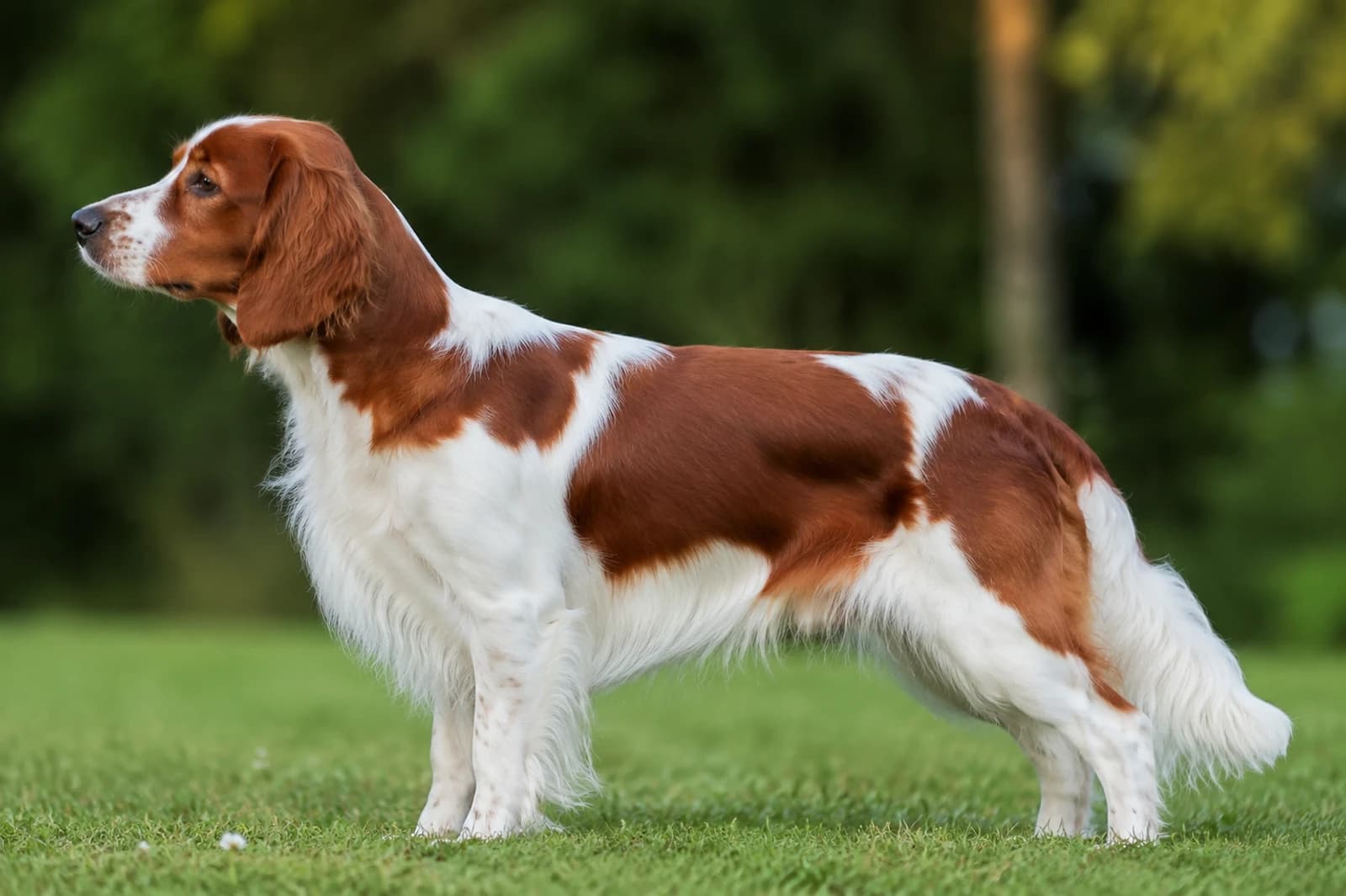
The Welsh Springer Spaniel is a red-and-white sporting dog with a loyal temperament and a strong need for daily activity. It is usually affectionate with family and good with children, but it does best where exercise is part of the routine.
At a glance
- Size
- Medium
- Height
- 17–19 in
- Weight
- 35–55 lb
- Life span
- 12–15 years
- Coat colors
- Red and white
- Coat type
- Medium silky coat
- Group
- Gun
- Origin
- Wales
How much does a Welsh Springer Spaniel cost?
Adopt / rescue
$75–$400
Usually includes spay/neuter, first shots, and a microchip.
Buy from a breeder
$700–$2,000
From a reputable, health-testing breeder.
Approximate USD. Prices vary widely by region, breeder, pedigree, age, and coat colour — adopting is the lower-cost and recommended route. Avoid suspiciously cheap “breeders”; they’re often puppy mills.
Estimate the full cost of a Welsh Springer Spaniel →Welsh Springer Spaniel photos
Views
Front, side, rear and top — the full silhouette.Poses
How the breed sits, lies, moves and plays.Puppy to senior
The breed across its whole life.Expressions
The breed’s range of moods.Close-up details
Eyes, ears, nose, paws, tail and coat.Coat colors
The breed’s recognized colors.Click any photo to enlarge. We show the Welsh Springer Spaniel from every angle — three views, poses, life stages, expressions, close-ups, coat and colors.
Appearance & size
At first glance, a Welshie reads like a classic spaniel was carefully hand-painted in deep autumn tones. The only color you’ll see on a purebred Welsh Springer Spaniel is a rich red and white — never black, liver, or lemon. The red can range from a warm mahogany to a brighter flame, and it usually covers the ears, face, and rump in solid patches, while the white forms a blaze, collar, chest, and leg markings. The coat is flat, dense, and silky to the touch, never curly or wiry. You’ll find soft feathering on the backs of the legs, the chest, and the underside of the tail, giving the dog a tidy but not fussy outline.
Build & size
This is a medium-sized gun dog built for a full day in the field, but scaled to snuggle on the sofa afterward. Males stand 18 to 19 inches at the shoulder; females are slightly smaller at 17 to 18 inches. Weight generally falls between 35 and 55 pounds, with females on the lighter end and working-line males pushing the upper limit when fit. The body is compact and slightly longer than tall — just enough length to allow a fluid, ground-covering stride without looking low-slung. A deep brisket and well-sprung ribs give the heart and lungs plenty of room, while a firm, moderate tuck-up keeps the silhouette athletic.
Head & expression
If you’re used to the blockier muzzle of an English Springer or the rounder dome of a Cocker, the Welshie’s head will strike you as notably refined. The skull is slightly rounded with a clear stop, and the muzzle is roughly square, tapering only subtly from stop to nose. The ears sit at eye level or just below, hugging the cheeks like soft, vine-shaped flaps. But it’s the eyes that really anchor the breed’s trademark soft expression: oval, medium-sized, and dark to medium brown, with a gentle, melting gaze that never looks hard or suspicious. The pigment of the nose, eye rims, and lips is always dark, matching the coat and completing that warm, approachable face.
From the front, side, and rear
Stand in front of a Welshie and you’ll see straight forelegs set well under the body, with moderate bone that’s never dainty or heavy. The shoulders slope back nicely, allowing the neck to blend smoothly into the topline. From the side, the back appears level and firm from withers to croup, with the deep chest reaching to the elbows and the rear angulation matching the front. The traditional docked tail (where legal) continues that line — set low, carried horizontally or slightly elevated when the dog’s moving, but never curled over the back. Watch one from the rear as it trots away, and you’ll notice the hind legs driving squarely, hocks parallel, with no wasted motion. It’s the kind of balanced build that made Welsh springers a favorite among hunters who needed a tireless, close-working dog that could turn on a dime in thick cover, yet still look handsome waiting by the fire.
History & origin
The red-and-white spaniel of Wales has a paper trail that goes back a lot further than most breeds. A 14th-century Welsh legal code, the Dimetian Code, already valued the hunting spaniel highly enough to list it as property worth a chattel payment. Then in 1570, Dr. John Caius published De Canibus Britannicis and described a “Spaniell” that came in “white and reddishe,” setting it apart from other land spaniels — the earliest written distinction that many consider the birth certificate of the Welsh Springer Spaniel as its own type.
What that spaniel did for a living shaped everything about it. Welsh terrain is dense, marshy, and steep, so the breed was selected for a compact body (17–19 inches, 35–55 pounds) that could push through brambles all day and retrieve from cold water without tiring. Farmers, poachers, and country squires alike used the “Welshie” to quarter ground ahead of the gun, flushing woodcock, pheasant, and rabbit from cover too thick for larger dogs. Its rich red-and-white coat gave it decent visibility in the undergrowth, but its silence on the flush was what really mattered to a hunter who didn’t want his birds scattering early.
For centuries the Welsh Springer existed alongside the larger English Springer as a regional variety, but by the 19th century breeders were actively refining the Welsh type. The UK Kennel Club formally separated the two in 1902, and the breed arrived in North America not long after, with the American Kennel Club granting recognition in 1914. Then came the bottleneck. Both World Wars hit the breed hard — by the end of World War II, registered Welsh Springers in the UK had dropped to dangerous levels. A handful of dedicated breeders literally rebuilt the population from a tiny pool, and every Welshie alive today descends from those reconstruction efforts.
That near-miss shows in the numbers. The Welsh Springer Spaniel remains uncommon on both sides of the Atlantic, cherished for the same honest working drive that kept it alive through the centuries.
Temperament & personality
A Welsh Springer Spaniel’s personality starts with togetherness. This is a dog who wants to be part of whatever you’re doing, whether that’s hiking through wet grass or flopping on the couch after a long day. Leave one alone in the backyard for hours, and you won’t get a relaxed dog — you’ll get an anxious barker who’s invented his own job, and none of his choices will make you happy. They’re simply too people-oriented to thrive in isolation.
Inside that compact, 35–55 lb frame is a cheerful engine that rarely idles. Expect a lively, bouncy greeting every time you walk through the door, and a curious nose that will investigate every corner of the house and yard. That nose also leads to a classic spaniel quirk: an absolute talent for finding — and then rolling in — the stinkiest thing available. Biologists have theories about masking scent or advertising a great food source to the pack; your Welshie won’t care about the science. He’ll just wear the smell like a prize.
With their own family, they’re soft, affectionate, and remarkably gentle. They do well with respectful kids, though that leaping joy can knock over a toddler, so supervision matters. With strangers, they’re alert without being sharp — a few warning barks, then a wagging tail once you give the all-clear. This makes them a decent watchdog, not a guard dog.
Training a Welshie means working with a brain that’s both eager and occasionally stubborn. Strong-willed moments crop up, and heavy-handed corrections backfire. You’ll get far more mileage from clear, consistent rules and a pocketful of treats. They read your body language like a book: a relaxed, soft-eyed dog is content; a forward lean with intense staring means he’s locked onto a squirrel. Pay attention to the small signals. A lip lick or a yawn isn’t always tiredness — it’s often a way of saying, “I’m a little unsure here.” Respect those signs, and you’ll keep the partnership easy.
A tired Welshie is the best version of himself. Without at least an hour of real exercise — off-leash running, a vigorous swim, or a nose-led hike — that liveliness turns into restlessness. Meet his needs, though, and you get a calm indoor companion who’s happy to curl up at your feet, storing energy for tomorrow’s adventure.
Good with kids, dogs & other pets
The Welsh Springer Spaniel’s patient, non-aggressive temperament makes him a natural around children—but a 40-pound bundle of enthusiasm can still knock over a wobbly toddler by accident. Supervise until kids are steady on their feet, and teach both sides to play gently. This is a dog who craves companionship. He’ll shadow your kids from the breakfast table to the backyard and park himself at their feet during a movie. That devotion has a flip side: a Welshie doesn’t do well parked in the yard or left alone for an eight‑hour workday. Expect distress behaviors—barking, chewing, digging—if you try to treat him like a part‑time pet.
With other dogs, the breed’s easygoing nature usually translates into friendly, wag‑first greetings. Puppyhood socialization is what locks that in. The critical window closes around 12–16 weeks, and every calm encounter with a new dog, person, or sound during that stretch builds an adult who handles the world with confidence. If you’re adopting an adult Welshie who missed that foundation, introduce resident dogs on neutral ground gradually and read his body language honestly; forced socializing only adds stress.
Cats and small pets need a thoughtful approach. Bred to flush and retrieve game, most Welshies will eye a darting squirrel or a fleeing cat with keen interest. A pup raised alongside a house cat from day one often learns to co‑exist indoors, but that same dog may still chase unfamiliar cats outside. Rabbits, guinea pigs, and other pocket pets should never share unsupervised space—the spaniel’s drive can override training in a flash. Pour your socialization efforts into calm, controlled exposures during the puppy months with whatever species you want him to accept. An adult rescue who missed that early window may simply never be trustworthy around small fluffies, and that’s a reality worth respecting.
Trainability & intelligence
A Welshie learns a little differently than the people-pleasing retrievers some owners picture. He’s smart, and he wants to cooperate, but he won’t work for a drill sergeant. Soft, reward-based training gets the motor running; harsh corrections shut it off fast. That’s not a flaw — it’s just a spaniel who was bred to quarter ground within gun range, using his own initiative while staying constantly in tune with the handler’s voice. You’ll earn reliable obedience by being a steady, fair partner, not a commander.
Expect moderate trainability, not push-button obedience. The breed is absolutely beginner-friendly if you keep sessions upbeat and keep expectations reasonable. They thrive on praise, short games of tug, and a pocketful of tiny treats. Motivation can dip during repetitive drills, so break things up — five minutes of sit-stay, then a retrieve, then another sit-stay. Use the nose. Hiding a toy or a handful of kibble in the grass and asking for a “hunt” command taps right into what his brain was built to do.
Recall is a conversation, not a guarantee. A Welshie wants to stay close, but a flushing bird or a fresh deer track can override the best training for a beat. Start long-line recalls early and reward every check-in with something better than what’s out in the field. Proof the command around distractions while he’s still young, because a full-grown spaniel running a scent line isn’t listening to a half-hearted whistle.
Because the breed tends toward sensitivity, common mistakes hit harder here: jerking the leash, raising your voice, or repeating a command impatiently can make a Welshie freeze or retreat into appeasement behaviors — tail tucked, ears flat, checking out mentally. You’ll see far faster progress by calmly showing him what you do want and paying that choice handsomely. If he flubs a new skill, just reset and try again. He’s not stubborn; he’s just soft and sometimes needs an extra beat to process.
- Socialization runs on a tight clock. Expose the puppy to varied people, kids, city sounds, and friendly dogs consistently between 3 and 14 weeks old. A Welshie who misses that window can become guarded or spooky in new places, and that’s much harder to undo in a dog that already feels emotions deeply. After vaccination, keep up weekly outings to new surfaces and scenarios — storefronts, parking lots, shallow water — but always let him investigate at his own pace.
- Use what he loves. Food helps, but many Welshies light up for a thrown ball or a chance to carry something. Build training around that. A pup who will do five puppy push-ups for a toss of the bumper is giving you his best focus.
- Be boringly consistent. He’s not testing you when he jumps on guests today after being allowed on the couch yesterday. He just needs the same rule every single time, delivered with the same calm energy. Mixed messages from family members are the fastest way to confuse this breed.
House manners usually click by six months if you stick with positive cues and short, frequent potty trips. Crate training goes fine when introduced as a den, not a jail; a blanket over the top and a frozen Kong make it a safe retreat, not a last resort. The real marker of progress isn’t a perfect heel — it’s a dog who keeps glancing back at you to see what’s next, tail wagging, fully bought into the partnership. That’s the Welshie you want, and you get it by refusing to break his trust in the name of a quicker result.
Exercise & energy needs
Count on giving a Welsh Springer Spaniel at least 60 minutes of real exercise every day—and that means two solid 30-minute sessions, not one long walk around the block. Bred to quarter ground and flush game for the gun, these dogs carry a durable work ethic packed into a medium frame. A leashed stroll won't scratch the surface. What works: off-leash running in a safe, fenced area, swimming, vigorous fetch, or hiking on soft trails where they can use their nose and cover ground.
Stick to that two-a-day rhythm. A morning sprint or swim followed by an afternoon field session or training game keeps a Welshie physically tired and mentally settled. If you can only manage one long outing, pair it with a shorter evening burst—10 minutes of focused tug, an interactive puzzle feeder, or a 20-minute hide-and-seek game with a favorite toy.
Mental exercise matters just as much. These spaniels thrive on scent work. Hide a canvas dummy, scatter kibble in the grass, or work on a frozen stuffed Kong. They're naturals for dog sports like agility, rally, flyball, and dock diving—anything that combines running with problem-solving. Short, daily training sessions for obedience or tricks also burn off mental steam and tighten your bond.
Puppies and young adults need careful handling. Repetitive high-impact jumping on concrete or hard floors can stress developing joints, so keep play on grass or sand until growth plates close. Responsible breeders screen for hip and elbow issues, but your own vigilance with low-key, varied exercise early on pays off later.
If a Welshie doesn't get enough outlets, you'll see it. Restlessness, pacing, barking, or chewing the drywall are not signs of a "bad dog"—they're signs of a bored hunting dog with nowhere to put his energy. Swap a walk for a nose-work game on rainy days, and the house stays quiet.
Grooming & coat care
A slicker brush and a metal comb are your everyday tools. The Welshie’s flat, silky double coat hides a dense undercoat that sheds moderately all year — and then dumps it in earnest during spring and fall. Brush two to three times a week to keep the inside of your house from growing a new carpet. During peak shedding season, a quick five-minute session every day makes a real difference.
Brushing and tools
Start with a slicker brush with rounded pins to pull dead undercoat, loose hair, and light debris out of the longer outer coat. Pay extra attention behind the ears, under the front legs, and around the back end where feathering gets thick and mats tend to start. Follow with a greyhound-style metal comb on the leg, belly, and chest feathering to catch any tiny snags before they turn into tight mats. A bristle brush isn’t necessary, but running one over the topcoat after slicker work lays the hair flat and gives it a clean sheen.
Bathing
Don’t over-bathe. Once every six to eight weeks is usually enough — or whenever your Welshie has rolled in something memorable. Use a mild dog shampoo that won’t strip the skin’s natural oils; spaniel skin can get dry and flaky if you scrub too often. Always work out any mats before the bath. Water tightens a tangle into a felted mess that’s a bear to get out later.
Trimming
Trimming stays minimal to keep the natural, un-sculpted look of the breed. Neaten the hair between the paw pads and around the foot outline so mud and snow don’t ball up. Some owners take a little length off the feathering on the back of the legs and belly to reduce debris collection, but heavy scissoring isn’t part of the deal.
Ears, nails, and teeth
Those long, dropped ears are gorgeous — and they’re also a moisture trap. Check ears weekly and wipe them out with a vet-approved cleanser, especially after swimming or a rainy walk. Redness or a yeasty smell means it’s time for the vet. Nails get trimmed every three to four weeks. If you hear clicking on hard floors, you’ve waited too long. Brush teeth several times a week with dog-formulated toothpaste to head off periodontal trouble; small daily habits save big vet bills.
Seasonal coat blowouts
When the weather turns, expect tufts of undercoat you can literally pluck out. A rubber curry brush or a de-shedding rake alongside your slicker will speed up the process and keep your dog comfortable. Many owners do a warm-water bath with a de-shedding shampoo during the peak drop, then blow the coat dry outside or with a dryer to send the loose fluff flying before it lands on the sofa. The payoff: a dog that feels cooler in summer and grows a healthy winter coat without matting.
Shedding & allergies
The Welsh Springer Spaniel sheds more than you might guess from that sleek red-and-white coat. This is a dog that drops hair daily, and twice a year — typically spring and fall — the shedding kicks into overdrive as the undercoat blows out. You'll find fine, silky hair on your floors, furniture, and dark pants. The soft feathering on the legs, chest, belly, ears, and tail is a major contributor; those longer strands float and cling.
- Shedding level: Moderate year-round, heavy during seasonal transitions. Brushing two or three times a week helps, but you'll need a slicker brush and a comb almost daily during a blowout to keep it from piling up.
- Drool factor: Extremely low. A Welshie isn't a slobbery breed, so drool won't be what triggers your allergies.
- Hypoallergenic reality: No dog is truly hypoallergenic, and the Welsh Springer Spaniel is squarely in the "not a good bet for allergy sufferers" category. The dog produces normal amounts of dander and sheds enough hair to spread it around. If you have mild allergies, spending a few hours around adult Welshies before bringing home a puppy can tell you more than any label on a website.
- Managing the mess: A high-velocity dryer after a bath can blow out loose undercoat in one go, saving your vacuum cleaner. Hard floors are easier to keep dog-hair-free than carpet.
The coat itself is relatively easy to maintain — it's flat, silky, and doesn't mat easily with regular brushing — but it will never be a non-shedding coat. If minimal hair around the house is a dealbreaker, you'll be fighting this breed's nature.
Diet & nutrition
A Welsh Springer Spaniel rarely walks away from a meal. That keen appetite makes training a breeze — you’ve got a dog who’ll work for a single piece of kibble — but it also means weight piles on fast if you free-feed or overdo the treats. Keeping your Welshie lean isn’t just about looks; extra pounds stress the joints, and this breed can be prone to hip and elbow problems.
Puppy feeding. Start with four evenly spaced meals a day until about four months old, then drop to three meals until six months. From six months onward, two meals a day works for life. Transition a new puppy to your chosen food slowly over a week to avoid stomach upsets. Look for a high-quality puppy formula and stick to measured portions — rapid growth is hard on developing joints.
Adult portions. Most Welshies settle between 35 and 55 pounds. A moderately active adult typically eats 1¾ to 2½ cups of quality dry food split into morning and evening meals, but the bag is just a starting point. A dog that hunts or runs hard all day needs more fuel; a laid-back companion needs less. Judge by body condition — you want to feel the ribs under a thin layer of flesh, not see a waist disappear into a solid barrel.
Weight watch. Because obesity compounds any underlying joint trouble, check your dog’s shape every few weeks. If the midsection softens, cut back the kibble a smidge and swap high-calorie treats for bits of carrot, green bean, or apple. Puzzle bowls and slow feeders are a double win here: they stretch out mealtime and give a smart dog a quick mental workout.
Senior years. As activity slows, scale back portions before the pounds creep on. Older dogs with worn or missing teeth do better with softened or puréed meals, but they still need good-quality protein — there’s no reason to slash it just because the muzzle turns grey. Monitor weight closely and feed two smaller meals, or even three, if your old-timer seems hungry all day.
What to put in the bowl. Dogs are built for a meat-based diet, not a vegan one. Stick with a well-formulated commercial food or a home-prepared plan crafted with a veterinary nutritionist. If your vet recommends a bland meal for a stomach upset, plain boiled chicken and white rice usually settle things. Cooked pearl barley makes a digestible high-fibre topper if your dog needs more bulk. Prep extra grains and vegetables ahead of time so you have healthy mix-ins ready, and always serve any leftovers in the dog’s own bowl — feeding from the table creates a beggar you’ll have a hard time fixing.
Health & lifespan
A healthy Welsh Springer Spaniel often lives 12 to 15 years, and a lot of that hinges on steady weight management and catching potential issues early. These are medium-sized athletes (35–55 lb) who carry their muscle well, but a little extra weight can quietly stress their joints — particularly because the breed can be prone to hip dysplasia, elbow dysplasia, and arthritis. Responsible breeders routinely screen for those, and you’ll want to keep your vet in the loop about any stiffness, lagging behind on walks, or reluctance to jump.
Skin and eyes are the two other areas that deserve extra attention. Skin disease — including chronic allergies, hot spots, and recurrent yeast infections — shows up often enough that diet, environmental triggers, and grooming matter a lot. You might see a Welshie lick paws obsessively or flare up during certain seasons. On the eye side, inherited disorders like progressive retinal atrophy (PRA) and cataracts are known in the breed, so breeders should have annual eye exams performed by a veterinary ophthalmologist and use only dogs with clear results. A puppy from tested parents takes a big layer of guesswork off the table.
Those floppy spaniel ears can trap moisture, so ear infections are a practical reality if you don’t keep them clean and dry after swimming or rainy walks. Regular checks and a vet-approved cleaning routine help avoid a painful cycle of head shaking and odor.
General preventive care goes a long way. Monthly heartworm prevention during mosquito season (plus a month past the first frost) is non-negotiable, and a rabies vaccine is required by law. Wormers and flea/tick control round out the basics.
Welshies have a thick, water-resistant coat, but that doesn’t make them immune to temperature extremes. They can overheat fast during hard runs in summer heat, so shift exercise to early morning or evening when it’s sticky outside. In bitter cold, limit exposure and watch for signs that paws are uncomfortable.
A mentally engaged, well-socialized Welshie is a healthier dog overall. Isolation and neglect can fuel anxiety-driven behaviors, and chronic stress can worsen skin conditions or suppress immunity. Early positive handling — vet visits, nail trims, ear exams — teaches your dog to tolerate care without fighting, which means you’ll spot small problems before they become big ones. If you notice subtle shifts like a drop in appetite, unexplained weight change, or a sudden lack of interest in the usual romp, get it checked. These dogs won’t always complain loudly, but they’ll tell you plenty if you pay attention.
Living environment
A fenced yard isn’t an absolute must, but it comes close. The Welsh Springer Spaniel was built to scour rough Welsh countryside all day, and a simple walk around the block won’t touch that reservoir of drive. A house with a securely fenced yard makes it much easier to give this dog the 60-plus daily minutes of hard, off-leash running it genuinely needs — ideally split into two sessions, like a vigorous morning bird-chase and an evening romp.
Apartment living isn’t impossible, but you’ll be working for it. You’d need to commit to multiple long outings, daily access to a safe open space, and a plan for rainy days. Without that outlet, the Welshie’s energy curdles into restlessness, leading to pacing, chewing, or barking.
Speaking of noise: they’re not yappy by nature, but they do have a voice. A bored or under-exercised dog will bark — a lot. One that’s well exercised and mentally tired (this breed thrives on scent games, training puzzles, and hunting through brush) is more likely to curl up quietly. Expect some excited barks when someone rings the doorbell; spaniels can be thoughtful alarm systems.
Climate is pretty forgiving. A dense, water-resistant double coat means the Welshie shrugs off cold, damp, and even a cold rain — he’ll happily splash through a creek in November. High heat is the bigger concern. On hot days, limit hard exercise to early morning or late evening and watch for overheating.
The real sticking point is time alone. These dogs form a deep bond with their people and can tip into distress if left for long stretches. Extended absences (a standard 8–10 hour workday with no break) often trigger separation anxiety, complete with howling, destructive chewing, or frantic pacing. If your schedule keeps you away most of the day, this is likely not the right breed. When you must leave, gradual desensitization, interactive feeders, and a tired-out dog are your best tools — but even then, a Welshie belongs in a household where someone is around most of the time.
Who this breed suits
A Welsh Springer Spaniel fits like a glove in a household where someone is around much of the day and outdoor adventure is a regular habit. These are true Velcro dogs — they want to be wherever you are, whether that’s splashing through a marsh or snoozing on your feet after a solid hour of off-leash running.
Active families with kids are a natural match. The Welshie’s weight (35–55 lb) and 17–19-inch frame keep them sturdy but not overpowering, and they’re famously patient, merry playmates. Just watch small children during the zoomies — that wagging body can still knock a toddler off balance. First-time owners can thrive with this breed if they’re ready to make the dog a central part of daily life. Welshies are eager to please and sensitive, so positive training clicks fast, but harsh methods shut them down. Singles and couples who hike, jog, or spend weekends near water will discover a tireless sidekick that outlasts them on the trail and nose-dives into every pond along the way. Active retirees who can provide a steady 60–90 minutes of exercise — a brisk walk plus fetch, scent work, or a swim — will get a devoted shadow, provided they can handle a medium-sized dog that may pull when a rabbit darts past.
The breed’s deep need for human contact makes it a poor fit for some homes. Think twice if any of these describe you:
- You’re gone 8–10 hours a day. A mid-day dog walker alone rarely cuts it. Welshies crave extended companionship and will develop anxious, destructive habits when left adrift.
- Your idea of exercise is a couple of short leash walks. This dog needs genuine running, swimming, or vigorous retrieving most days — a 30-minute stroll won’t touch the sides.
- You hate dog hair on the sofa. Welshies shed moderately year-round and more heavily during seasonal blows.
- You want a guard dog. They’ll announce the doorbell, then greet the stranger with a wagging tail and a retrieved slipper.
- You live in an apartment without a concrete plan for daily off-leash exercise. A fenced yard isn’t mandatory, but a commitment to real daily exertion absolutely is.
Cost of ownership
Bringing home a Welshie isn’t an impulse buy. From a breeder who screens for hip dysplasia, eye anomalies, and thyroid issues, a puppy typically costs $1,500–$2,500. Show-potential pups or those from top working lines can edge past $3,000. Rescue adoption through a breed-specific group usually runs $300–$500.
Once your dog is home, the monthly budget breaks down like this:
- Food: A 35–55 lb spaniel with a strong prey drive needs fuel. Count on $50–$70 a month for high-quality kibble that keeps his coat and joints in shape.
- Grooming: That silky, feathery coat mats without consistent attention. Brush thoroughly two to three times a week and plan a full clip-out every six to eight weeks. A professional session runs $60–$80; if you handle the between-appointment brushing, set aside $40–$60 a month.
- Routine vet and preventatives: Annual exams, vaccinations, heartworm prevention, and flea/tick control average about $50–$70 per month spread across the year.
- Pet insurance: A solid accident-and-illness policy for a medium purebred often lands between $30 and $60 a month. Welsh Springers can be prone to epilepsy and certain eye conditions, so even well-bred dogs benefit from coverage that kicks in before a crisis.
Real-world monthly upkeep—everything above—falls in the $170–$260 range. The first year costs more: puppy shots, spay or neuter, a crate, and replacing whatever gets chewed during teething can easily tack on another $1,000.
Choosing a Welsh Springer Spaniel
Responsible breeder or rescue?
You have two solid paths to a Welshie: a preservation breeder who treats each litter like a project, or a breed-specific rescue. Both can give you a wonderful dog, but they demand different homework.
The Welsh Springer Spaniel Club of America runs a small rescue program. Because the breed isn't common, you may wait months for an adult dog. The upside is you skip puppy chaos and see the dog's real temperament right away — shy, bold, or work-focused — before committing. General spaniel rescues occasionally place Welshies, too.
Breeder puppies mean a waitlist. A good breeder will ask you about your yard, your daily routine, and your plans for exercise. This is a small gene pool, so ethics stay front and center. Expect to pay $1,500–$2,500 and to be screened as thoroughly as the sire and dam.
Health clearances to ask for
Ask to see the actual OFA or PennHIP certificates — never just a vet's note. At minimum, both parents need passing scores on hips, elbows, and a current eye exam (through OFA or CERF). Responsible breeders often go further: a full thyroid panel from an approved lab and a DNA test for cord1 PRA (an inherited eye disease) show they're not cutting corners. If a breeder hesitates to share proof, that's your exit.
Red flags
Walk away from anyone who can't show you where the litter is raised, refuses to let you meet at least one parent on site, or always has multiple litters on the ground. Welsh Springer Spaniels are intensely people-oriented; a puppy raised in a kennel run instead of a home environment can turn out spooky or shut down. Also skip breeders who sell you the "low-energy spaniel" story — this dog needs a solid hour of hard running, swimming, or field work each day. No health testing, no questions from the breeder, and pups being handed over before 8 weeks are all deal-breakers.
Picking your puppy
A sharp breeder has already spent weeks observing the litter and will match puppies to homes based on temperament, not on who called first about the flashy red-and-white coat. You're after a middle pup — curious, confident, but not the tiny tyrant bowling over littermates. The one cowering in the corner may struggle in a busy household. Watch how the puppies interact with people; a Welshie who seeks you out, wags, and then settles for a moment is gold. Expect to bring your puppy home between 8 and 10 weeks of age, with a stack of health paperwork and a contract that includes a return-to-breeder clause. A puppy from parents with verifiable health scores and stable temperaments is your best shot at a happy, sound adult — not the cutest spot pattern.
Pros & cons
A Welsh Springer Spaniel is a devoted, medium-sized partner who thrives on togetherness and withers when left on the sidelines.
Pros
- He’s biddable without being a push-button robot; training feels like a conversation, and he shines in obedience, rally, or working trials when you’re consistent.
- Size stays practical — 35 to 55 pounds and 17 to 19 inches at the shoulder — so he’s easy to load up for a weekend trip and fits into most homes without feeling cramped.
- With his own family, he’s gentle, patient, and unflappable around respectful children; many also coexist peacefully with other dogs once introduced.
- A typical 12- to 15-year lifespan gives you plenty of time to build a steady rhythm together.
- The straight, weather-shedding coat needs brushing twice a week and a tidy-up a couple of times a year; you won’t be living at the groomer’s.
- Rather than a tail-wagging glad-hander, you get a quiet, deepening loyalty — he’s your shadow, not the whole neighborhood’s.
Cons
- This is a high-octane dog in a laid-back wrapper. He needs a full hour of running, swimming, or scent work daily; a leash stroll and he’ll remodel your baseboards.
- Velcro tendencies run strong. Routine 8-to-10-hour absences often trigger separation anxiety, barking, or destruction unless you build alone-time gradually from puppyhood.
- Corrections crush him. Harsh tones or leash jerks undo trust fast; you’ll need to lean on patient, reward-based training, not force.
- Drop ears trap moisture and need weekly cleaning to dodge infections; moderate year-round shedding means a lint roller becomes part of your decor.
- Breed-specific health watchpoints include hip dysplasia, progressive retinal atrophy, and epilepsy — responsible breeders screen for all three, but zero risk doesn’t exist.
- That birdy prey drive makes off-leash reliability in the woods a serious training project; he was built to flush game, not ignore it.
Similar breeds & alternatives
If the Welsh Springer Spaniel’s blend of steady affection and moderate drive appeals to you, but you’re still weighing your options, a few closely related breeds sit on either side of that sweet spot.
-
English Springer Spaniel — This is the Welshie’s closest cousin, and the one most people default to. Show-bred Springers are a bit taller (19–20 inches) and heavier (45–55 pounds), with more coat. The real difference shows up in energy. Even bench-bred ESS lines often carry a stronger spark; field-bred Springers are full-throttle hunters that need an hour-plus of hard running, not just a long walk. Welshies tend to run quieter, with a more settled off-switch indoors. If you want a dog you can take to the park but then have curl up without a project, the Welshie fits. If you want a tireless flushing partner for aggressive upland days, a field-bred Springer makes more sense.
-
English Cocker Spaniel — Noticeably smaller (26–34 pounds, 15–17 inches), the English Cocker brings the same merry spaniel temperament in a package that’s easier to lift and travels lighter. They’re just as people-oriented and solid with kids, but their compact build means less physical presence on a leash and a lower calorie bill. Coat care is similar, though Cocker temperaments can be a shade more sensitive. The Welshie gives you more leg, more substance, and a slightly calmer baseline — but if you want a smaller face-licker who still romps in the woods, the English Cocker is worth a look.
-
Boykin Spaniel — Bred in South Carolina as a swamp dog, the Boykin matches the Welshie’s weight range (25–40 pounds) with a shorter, darker brown coat and an unusually cheerful, eager-to-please personality. Boykins are natural water retrievers with a high tolerance for heat and humidity. Both breeds are affectionate family dogs that need solid daily exercise. The Boykin is rarer than the Welshie in many regions but often easier to find in the Southeast. The Welshie’s longer, feathered red-and-white coat and reserved-then-warm temperament set it apart from the Boykin’s more consistently outgoing, wash-and-wear vibe. So if you’re drawn to the Welshie’s look and balance, a Boykin might appeal if you prefer a slicker coat and a dog that thinks every stranger is a future best friend.
Fun facts
- Welsh Springer Spaniels are always red and white.
- They are distinct from English Springer Spaniels.
- The breed was developed as a flushing spaniel.
Frequently asked questions
- Are Welsh Springer Spaniels good with children?
- Welsh Springer Spaniels tend to be gentle and patient with children, making them excellent family companions. However, their enthusiasm can sometimes be overwhelming for small kids, so supervision and early socialization are recommended. They thrive in homes where they are included in family activities.
- How much exercise does a Welsh Springer Spaniel need?
- As an active gun dog, the Welsh Springer Spaniel requires daily vigorous exercise—typically at least an hour of running, swimming, or play. Without enough physical and mental stimulation, they can become restless or develop unwanted behaviors. They excel in dog sports like agility or flyball.
- Do Welsh Springer Spaniels shed a lot?
- They are moderate shedders, shedding more during seasonal changes, but regular brushing can help keep loose hair under control. Weekly brushing is usually sufficient to maintain their coat and minimize shedding around the home. They are not considered a hypoallergenic breed.
- What grooming requirements does a Welsh Springer Spaniel have?
- Their silky, feathered coat needs brushing about twice a week to prevent mats and remove debris; occasional trimming of the ears and paws may be needed. Regular ear checks are important to avoid infections, especially since drop ears can trap moisture. Bathing is only necessary when they get dirty.
- Can a Welsh Springer Spaniel live in an apartment?
- While they can adapt to apartment living with enough daily exercise, they are energetic dogs that do best in homes with a securely fenced yard. Their tendency to bark at unfamiliar noises might be an issue in close quarters. Apartment dwellers should be committed to providing long walks and playtime.
- Are Welsh Springer Spaniels reserved or shy with strangers?
- This breed is known for being reserved with strangers but generally warms up once properly introduced. Early socialization is key to prevent excessive shyness or timidity. They are loyal and affectionate with their family without being overly demanding.
Tools & calculators for Welsh Springer Spaniel owners
Quick estimates tailored to Welsh Springer Spaniels — pre-filled with this breed’s size where it matters.
Articles & stories about the Welsh Springer Spaniel
Sources & standards
This profile follows recognized breed standards from the American Kennel Club (AKC) and the Fédération Cynologique Internationale (FCI), along with established veterinary and breed-club guidance. These describe general breed tendencies — every dog is an individual.
Owner stories
Have a Welsh Springer Spaniel? Share your experience — grooming tips, personality quirks, anything goes.