


The Australian Shepherd is a smart, energetic herding dog that thrives with active, experienced owners who can provide plenty of mental and physical stimulation. Originally bred to work on ranches, they excel in dog sports and make devoted family companions. They are best suited to homes with a yard, as they need room to run and a job to do to prevent boredom-related behaviors. This breed is affectionate with its family but can be reserved around strangers, requiring early socialization. Not ideal for first-time owners or apartment dwellers.
At a glance
- Size
- Large
- Height
- 18–23 in
- Weight
- 40–65 lb
- Life span
- 10 years
- Coat colors
- Blue Merle, Red Merle, Black, Red
- Coat type
- Medium-length double coat
- Group
- Working
- Origin
- United States
How much does a Australian Shepherd cost?
Adopt / rescue
$100–$450
Usually includes spay/neuter, first shots, and a microchip.
Buy from a breeder
$1,200–$3,000
From a reputable, health-testing breeder.
Approximate USD. Prices vary widely by region, breeder, pedigree, age, and coat colour — adopting is the lower-cost and recommended route. Avoid suspiciously cheap “breeders”; they’re often puppy mills.
Estimate the full cost of a Australian Shepherd →Australian Shepherd photos
Views
Front, side, rear and top — the full silhouette.Poses
How the breed sits, lies, moves and plays.Puppy to senior
The breed across its whole life.Expressions
The breed’s range of moods.Close-up details
Eyes, ears, nose, paws, tail and coat.Coat colors
The breed’s recognized colors.Click any photo to enlarge. We show the Australian Shepherd from every angle — three views, poses, life stages, expressions, close-ups, coat and colors.
Appearance & size
The Australian Shepherd is a large, solid dog without an ounce of clumsiness. Males stand 20 to 23 inches at the shoulder and run 50 to 65 pounds; females are 18 to 21 inches and 40 to 55 pounds. That body is slightly longer than tall — roughly a 10:9 ratio — which gives the dog a low, athletic stretch even when standing still.
Look from the front and you see a clean, balanced head with a moderate stop and a muzzle that tapers just enough to be functional, not snipey. The ears are set high, triangular with a slightly rounded tip, and they break forward or go to the side when the dog is relaxed. It’s the eyes that really grab you: they can be brown, blue, amber, or any marbled mix of those, even split right down the middle in merles. That wide-set, focused stare is pure working intensity.
In profile, the topline stays level from withers to hip, and the chest reaches to the elbow. The front legs are dead straight, parallel, with well-laid-back shoulders that let this dog turn on a dime. The rear is broad and moderate, neither over-angled nor flat, built for long days of low-effort trotting. A natural bobtail or a docked tail shorter than four inches is the breed standard, though full tails do pop up in some lines; the bobtail gene is inherited, and a short, straight tail that barely wags is a quirk of the breed’s merle genetics.
The coat is a weather-ready double layer: medium texture, straight to wavy, with a dense undercoat. You’ll find four main color groups: blue merle, red merle, solid black, and solid red — all may or may not show white markings and copper (tan) points. Merles are marbled swirls of color on a lighter base; white trim on the chest, collar, legs, and face is common, but too much white on the head or body is a fault linked to hearing and vision issues, so responsible breeders watch for that. The head, ears, and front of the legs carry short, smooth hair, while the back of the legs is heavily feathered, and males in particular sport a rough, heavy mane and frill around the neck.
History & origin
Despite the name, the Australian Shepherd is a red-white-and-blue American original, forged in the ranching country of the Western United States. The story starts in the 1800s, when Basque shepherds emigrated from the Pyrenees to Australia, then on to the American West, bringing their tough little herding dogs with them. Americans started calling those dogs “Australian Shepherds” because of that stopover Down Under—and the label stuck.
Once here, the dogs proved themselves on arid, sprawling sheep outfits from California to Colorado. Ranchers didn’t much care about pedigree; they cared about a dog that could work sunup to sundown, read stock from a quarter-mile away, and think for itself when the trail got rough. So they bred the best workers to the best, mixing in other herding types—likely Border Collies, Collies, and local shepherd’s dogs—to build a tireless, versatile ranch hand. The result wasn’t a cookie-cutter breed yet, but a Western working type with a recognizable look: medium-sized, bob-tailed or naturally docked, and often sporting a striking merle coat.
By the mid-20th century, the Aussie’s intelligence and flashy moves caught the eye of rodeo crowds. Roy Rogers’ dog Stub and other performing Aussies helped the breed transition from ranch gate to show ring and backyard. Breeders organized, and the Australian Shepherd Club of America was founded in 1957 to preserve the working dog, not a beauty-pageant version. The AKC didn’t fully recognize the breed until 1993, and even today, a working/bench split exists, with many ranch-bred dogs unregistered.
So a dog that never saw Australia became the emblem of the American cowboy’s right-hand helper—bred for brains, stamina, and the kind of loyalty that keeps a herd together through a High Sierra snowstorm.
Temperament & personality
An Australian Shepherd’s personality runs closer to a working partner than a casual house pet. This is a dog wired to think, anticipate, and act—often before you finish giving a cue. Loyalty runs deep: they tend to pick a favorite person and shadow them room to room, which some owners affectionately call a “Velcro” attachment. That devotion also makes them sharp watchdogs. They’ll announce a stranger at the door with a serious bark, then hold back until they’ve sized up the situation. Early, positive socialization helps that natural reserve stay polite rather than becoming suspicious.
Energy is the headline, but it’s the intensity behind it that catches people off guard. A 40–65 lb dog with a mind this quick needs daily challenges that leave him legitimately tired. Without them, he’ll redirect that drive into his own projects—rearranging couch cushions, unrolling the toilet paper, or “herding” the kids by circling and nudging. Nipping at heels is a bred-in herding move, not malice, and it’s common enough that families with small children should plan on redirecting it from day one.
- Smart and strong-willed. An Aussie reads patterns fast and can out-think a handler who falls into routine. Respectful, consistent training sticks; force or repetitive drilling usually backfires.
- Work-driven, not idle. These dogs have an off switch only if you give them a legitimate reason to use it. A good run, a puzzle toy that actually stumps them, or a training session that demands precision—all count as a deposit into the calm-bank.
- Watchful but not typically aggressive. You’ll see a forward-leaning posture and a hard stare when something is out of place, but with solid breeding and guidance, the look is more about assessment than threat.
- Sensitive to isolation. Left alone too much or too often, many Aussies tip into anxiety-driven barking, chewing, or indoor marking. Boredom and loneliness hit this breed harder than most.
Around their own household, they’re affectionate and often comical—a loose, wiggly body and soft eyes signal a happy dog. They tend to do best in homes where someone is around for a good chunk of the day and where exercise means more than a stroll. If you want a dog who’ll be right at your side whether you’re hiking, training, or just moving laundry, an Australian Shepherd will consider that a pretty fair deal.
Good with kids, dogs & other pets
With kids
An Australian Shepherd’s patient, gentle side is genuine, but it comes with a strong herding drive that doesn’t magically recognize the difference between livestock and a child running across the yard. Circling, staring, and heel-nipping are not playful misbehavior — they’re instinct. Never leave a young child unattended with an excited Aussie who hasn’t been taught an off-switch. Redirect that focus into a job: a ball to chase, a “find it” game, a few minutes of trick training. Teach kids to move calmly and not shriek or bolt, because sudden, high-pitched sounds can flip a shepherd’s arousal switch. These dogs are sensitive, not tough-it-out stoics; harsh voices or chaotic roughhousing can make them anxious or shut down. When everyone plays fair, an Aussie becomes a remarkably careful family dog who reads a toddler’s mood and adjusts accordingly.
With other dogs
How your Australian Shepherd handles other dogs depends almost entirely on what happened during the 3-to-16-week socialization window. Puppies who get steady, positive exposure to friendly, well-calibrated adult dogs usually grow up fluent in canine body language and play well without drama. Miss that critical window, and you can end up with an adult who’s tense, over-reactive, or outright fearful around unfamiliar dogs. If you bring home an older Aussie who’s already uneasy, forcing dog-park greetings or pack walks will backfire — it heightens stress and can trigger a fight. Meet your dog where he is. Many Aussies are perfectly fulfilled with one carefully introduced housemate or as the only dog in the family.
With cats and small pets
The impulse to chase is baked into this breed, so small animals require clear-headed management. A cat who holds its ground and shares the house from puppyhood often earns a workable truce, but an Aussie will still pursue a fleeing fuzzball without thinking. Never leave an Australian Shepherd unsupervised with rabbits, guinea pigs, ferrets, or pocket pets — even a solidly trained dog can slip into predatory mode in a split second. Separate spaces with sturdy barriers, and drill a “leave it” cue until it’s reflexive. That cat may be safe on the couch for years, but a squirrel-like dash through the kitchen is a different proposition entirely.
Socialization counts
You cannot crate this breed in a backyard and expect a well-adjusted dog. Australian Shepherds need to be underfoot, riding along on errands, hearing the blender, meeting the neighbor’s kid, and learning that the world isn’t scary. Start structured exposure before 16 weeks: different faces, calm vaccinated dogs, city noises, carpet, gravel, the vacuum cleaner. Keep it positive and frequent. An Aussie deprived of that early input tends to develop noise phobias, separation anxiety, and wariness of strangers that’s hard to undo later. Even after puppyhood, consistent, gentle practice builds confidence. The adult dog who’s been shown the world reads a crowded park or a visiting grandchild with discernment rather than fear, and won’t unravel the first time life gets loud.
Trainability & intelligence
Australian Shepherds learn faster than most dogs you’ll meet — and if you’re not ready to channel that, they’ll find their own curriculum, usually involving unraveling the couch. They read your body language like a book, which is why reward-based training clicks instantly with them and punishment shuts them down. A treat, a quick game of tug, or just your happy voice often works better than a dozen repetitions.
Start the day your puppy comes home. By 8 to 12 weeks, their sponge-like brain is already making associations, so reward the behaviors you want immediately — a sit before meals, eye contact for attention, four-on-the-floor for greetings. Introduce them gradually to kids, traffic noise, slick floors, and friendly strangers before 16 weeks. This early window, paired with lifelong positive exposures, prevents the wariness that can show up as barking or reserved behavior later.
The catch with a breed this sharp? Boredom. Drill the same sit-stay five times in a row and you’ll watch their eyes glaze over. Keep sessions short, unpredictable, and mentally demanding. Teach a solid recall using a long line in distracting environments — squirrels will test it. Swap a dry routine for hide-and-seek, named-toy retrieval, or backyard agility obstacles. That cooperative streak runs deep, but it relies on trust, not force. Yanking a leash or yelling when a 50-pound Aussie herds a running child only erodes the bond and amps up anxiety.
Be patient with the inevitable “but why?” phase — they’ll test boundaries, and consistency is what turns clever dodging into reliable obedience. End every training moment with something they nail, payoff heavily with real play, and you’ll have a dog who locks onto your next cue before you fully form the word.
Exercise & energy needs
Plan on providing at least 60 to 90 minutes of vigorous, sweat-breaking exercise every day—split into two sessions, not one lazy walk around the block. A quick potty break won’t touch this dog’s energy reserves. Aussies need to run, sprint, and change direction at full speed. Long off-leash hikes, jogging, biking (once joints are mature), or a solid game of fetch in a securely fenced yard all fit the bill. If you don’t have a fenced area, a long line and open park space can work, but a fenced yard turns into your best friend—they need room to really stretch out.
Physical exercise is only half the story. An Australian Shepherd’s brain is just as high-octane as its body. Factor in daily mental workouts: puzzle toys, snuffle mats, hide-and-seek with a favorite squeaky, or 10-minute trick-training sessions. This breed absolutely thrives on dog sports—agility, flyball, herding trials, and dock diving are natural fits that burn both mental and physical fuel. Without that problem-solving outlet, you’ll see a dog that paces, barks at shadows, or takes apart your sofa cushion by cushion.
- Puppies and adolescents (up to about 18 months): Avoid forced running on pavement, repetitive high jumps, or intense stop-and-go games on hard surfaces while growth plates are still closing. Stick to soft footing, moderate hikes, and swimming once they’re safely introduced to water.
- Older dogs or those with joint concerns: Responsible breeders screen for hip and elbow dysplasia, but it’s wise to shift toward low-impact activities like swimming or long sniffy walks when you notice stiffness. A dog with joint vulnerabilities still needs daily movement—just not the pounding of agility A-frames.
- Hot weather: That thick double coat traps heat. Exercise in early morning or late evening, and always bring water. Watch for signs of overheating during summer drills.
Skip the daily workout, and an under-exercised Aussie doesn’t just get bored—it gets destructive and noisy. You’ll see herding behavior directed at kids, cyclists, or the neighborhood squirrels, plus a deep well of barking, digging, or chewing. Hand your dog a real job, even if it’s something as simple as carrying a lightweight backpack on a hike or learning the names of 20 different toys, and you’ll have a settled, focused companion at the end of the day.
Grooming & coat care
An Australian Shepherd’s double coat is a full-time hair factory. You’ll find tufts drifting across the floor year-round, with two big seasonal blowouts in spring and fall when the undercoat launches off the dog in fistfuls. You can’t stop the shedding, but you can contain the mess—and keep the dog comfortable—with steady brushing.
Grab a slicker brush and a metal comb. Work through the medium-length coat 2–3 times a week, getting down to the skin. Pay extra attention behind the ears, under the armpits, and around the fluffy britches on the back legs; those spots mat up fast. When shedding season hits, switch to an undercoat rake or a high-velocity dryer to blast loose fuzz out before it lands on your sofa. A quick daily rake for a week or two can make the difference between a minor flurry and a woolly apocalypse.
Bathing every 2–3 months—or when the dog rolls in something foul—is plenty. Over-washing strips the coat’s natural weather resistance. Use a dog shampoo and rinse thoroughly; leftover soap can cause hot spots, especially in that dense undercoat. Never shave an Aussie. The double coat insulates against heat and cold, and shaving damages the growth cycle, often leaving a patchy, dull mess that grows back wrong.
Nails, ears, and teeth need regular check-ups too. Trim nails every 3–4 weeks so you don’t hear clicking on hard floors. Flip the ear leather weekly to look for redness or waxy buildup, and wipe with a damp cloth—those drop ears can trap moisture. Brush teeth several times a week with dog-safe toothpaste. After a rainy hike or a swim, dry your dog thoroughly, especially the thick coat on the neck and tail, or you’ll get a musty smell and mats that are a nightmare to unpick.
A high-maintenance coat on a high-energy dog means grooming has to become second nature. If the idea of dog hair floating into every corner of your home makes you twitchy, this isn’t your breed.
Shedding & allergies
If you want a dog that barely sheds, an Australian Shepherd is not your breed. These dogs have a dense double coat that protects them from heat, cold, and brush, and it sheds everywhere, all the time. Expect a steady rain of fur year-round, punctuated by two massive seasonal blowouts—usually in spring and fall—when the soft undercoat releases in tufts you can literally pull out by hand.
The outer layer is medium-length, straight to wavy, and water-resistant. Underneath sits a thick, insulating undercoat. Together they produce a surprising volume of hair for a dog that weighs 40–65 pounds. Twice- to three-times-weekly brushing with a slicker brush and an undercoat rake keeps the worst of it off your couch, but during shedding season you’ll need to brush daily and still find tumbleweeds of fluff in the corners.
Drool is a non-issue—Aussies aren’t slobbery. The bigger concern for allergy sufferers is dander, which sticks to all that shed fur and floats through the house. No dog is truly hypoallergenic, and the Australian Shepherd’s heavy shedding makes it a poor fit for anyone with moderate to severe dog allergies. You can run an air purifier, bathe the dog every few weeks, and vacuum relentlessly, but you’ll still be living with a fine layer of hair on everything you own. Know that before you bring one home.
Diet & nutrition
An Australian Shepherd who works cattle all day needs a very different plate than one whose main job is chasing a ball in the backyard. The single most useful thing you can do is measure every meal and pull back the instant you feel ribs start to disappear under a soft layer of fat. These dogs are often food-motivated — a blessing for training, a curse for their waistline. Extra weight stresses joints already prone to hip and elbow issues, and it can shave years off a 10‑year lifespan.
How much to feed by life stage
- Puppies: Four meals a day until 4 months, then three meals until 6 months, then two meals for life. Transition a new pup slowly — start with lightly cooked, puréed meats, fish, fruits, and veggies, or a high-quality large-breed puppy kibble that supports controlled growth. Raw chicken wings can be introduced around 12 weeks under close supervision.
- Adults: Feed according to size, weight, and real exercise — not ideal exercise. A lean 50‑lb adult who runs the trails for an hour daily may need around 1,200–1,400 calories, but that same dog logging 20‑mile workdays can burn double. Split the daily ration into two meals. Use a slow-feeder or puzzle bowl if your Aussie inhales food; it turns mealtime into a brain game and cuts the risk of bloat from gulping air.
- Seniors: As the sprint turns into a stroll, shift to smaller, more frequent meals and watch the scale like a hawk. There’s no solid reason to slash protein, but you do need to taper calories. Purée meals if teeth go missing or mouths get sensitive.
What goes in the bowl Aim for a diet built around meat, with moderate amounts of fruits and veggies, and the occasional egg, grain, or plain yogurt. That can look like quality kibble, a balanced raw or home-cooked plan, or a mix — what matters is that it’s species-appropriate, not a vegetarian experiment. When you cook at home, pearl barley and white rice are easy-to-digest grains for sensitive stomachs; save unsalted veggie-cooking water to use as a broth base.
Weight‑management reality check Aussies can pack on pounds quietly, and a pudgy dog is a future orthopedic patient. Skip the table scraps — serve any leftovers in the dog’s own bowl after you’ve finished eating, never from your plate, or you’ll build a begging habit that’s fiendishly hard to undo. Watch out for rich, fatty foods, especially around holidays; they can trigger pancreatitis in susceptible dogs. Keep treats to less than 10% of daily calories, and adjust meals down on light‑exercise days. If you can see a waist tuck from above and easily feel ribs with flat fingers, you’re in the right zone.
Health & lifespan
An Australian Shepherd’s typical lifespan lands around 10 years, though well-bred dogs kept lean and active often reach 12 or 13. Reaching that number depends on proactive care and knowing where the breed is genetically vulnerable.
Aussies can be prone to a handful of inherited issues that responsible breeders actively screen for. Hip and elbow dysplasia show up in the breed, so reputable breeders have their dogs’ joints evaluated through OFA or PennHIP before breeding. Eye problems are another concern — cataracts, progressive retinal atrophy, and collie eye anomaly all appear in the gene pool. Annual eye exams by a veterinary ophthalmologist and genetic tests (like CEA and PRA screenings) are non‑negotiable for a breeder you can trust. The MDR1 gene mutation (multidrug sensitivity) is also common in herding breeds. A dog carrying two copies can have severe neurological reactions to common drugs like ivermectin, certain pain meds, and some dewormers. A simple cheek swab test tells you your dog’s status — and lets you keep a safe drug list on file with your vet.
- Joint health: Excess weight on a fast‑growing puppy or an aging adult strains hips and elbows. Keep your Aussie lean. You should feel ribs with a light touch, not see them, but never a layer of padding that hides them.
- Epilepsy surfaces in the breed, too. No screening test exists for it, but a breeder who’s upfront about any seizure history in their lines is worth their weight in gold.
- Skin and coat issues can flare from environmental allergens or yeasts. You’ll spot them early with regular brushing — another reason to comb down to the skin every week.
Beyond genetics, routine care adds years. Give a monthly heartworm preventive during mosquito season (and for one month after it ends) and keep rabies vaccines current — that one’s a legal requirement, not a suggestion. Schedule annual wellness exams, bumping up to twice a year once your dog turns seven. Subtle changes in appetite, water intake, or stride are often the first red flags.
Early, positive socialization also matters for health. An Aussie left isolated or under‑exercised tends to develop anxiety‑fueled barking, pacing, or destructiveness, which can snowball into chronic stress. This is a dog built to work alongside you. Daily off‑leash running, herding classes, or advanced trick training don’t just wear them out — they keep their brain and body balanced, and that directly supports a longer, healthier life.
If you’re talking to a breeder, ask to see hip, elbow, and eye clearances for both parents, and a copy of the MDR1 DNA test. That one conversation screens out a huge chunk of preventable heartache.
Living environment
An Australian Shepherd is a full-throttle partner, not a casual house pet. If you live in an apartment or a home without a securely fenced yard, this probably isn’t your breed — unless you’re prepared to treat outdoor exercise like a part-time job. These dogs were built to move livestock all day, and that drive doesn’t switch off indoors.
Yard and space: A house with a large, fenced yard gives them room to sprint and patrol, but a yard alone is never enough. They’ll still need you out there throwing a ball, running them through obstacle courses, or playing frisbee. Without that engagement, a bored Aussie will redecorate your landscaping with crater-sized holes or invent their own loud, repetitive games. Apartment dwellers can theoretically make it work, but it’s a grind — plan on multiple off-leash sessions in a safe area every single day, plus serious indoor mental work.
Exercise reality: Count on at least 60 to 90 minutes of vigorous exercise daily, split into two or three sessions. A leisurely stroll around the block doesn’t touch their energy. Think off-leash running, herding balls, advanced trick training, or uphill hikes. Mix in mental challenges like scent work, puzzle toys, or learning new commands. A tired Aussie isn’t the one who just jogged three miles; it’s the one who had to use their brain and their legs at full speed simultaneously.
Climate tolerance: Their double coat insulates against cold and moderate heat, but they’re not all-weather machines. They often love snow and will happily romp in freezing temperatures. In hot weather, you need to shift exercise to early mornings or evenings, provide shade and water, and watch for overheating. That thick coat also means heavy shedding — twice a year it’s a fur blizzard.
Noise and barking: Aussies notice everything and feel obligated to tell you about it. They bark at the mail carrier, the squirrel, the neighbor’s car door, a leaf that moved suspiciously. You can train an “enough” cue, but the alertness is hardwired. If you have noise-sensitive neighbors or thin walls, expect some friction.
Being left alone: This is the painful part. Australian Shepherds are intensely bonded to their people and can develop severe separation anxiety when left alone for long stretches. A standard 8-to-5 workday with no break is a recipe for destruction, howling, and a deeply stressed dog. If you must be gone, you’ll need a midday dog walker, doggy daycare, or a carefully built desensitization plan from the start. Even then, these dogs do best in homes where someone is around more often than not. Crate training and safe chew items help, but they don’t replace human connection.
Who this breed suits
This is not a casual pet
Australian Shepherds were bred to work all day, and that drive still pulses through them. If you want a dog to join you on long trail runs, earn titles in agility or herding, and be your shadow every waking moment, this might be your breed. If you’re looking for a low-key companion to chill on the couch, move on.
Born to run (and think)
This is a large, 40- to 65-pound athlete that stands 18 to 23 inches tall. A quick walk around the block won’t take the edge off. Expect to provide at least 90 minutes of vigorous exercise every day — running, fetch, off-leash hiking, or structured dog sports. Without it, an Aussie will invent his own job, and that usually means redecorating your home or barking at every leaf that falls.
Best fit for experienced, active owners
- Active singles or couples who want a weekend warrior and a weekday training partner. If you hike, bike, or run daily and genuinely enjoy teaching advanced commands, you’ll thrive together.
- Families with older kids who can participate in training and respect a dog’s space. The breed’s herding instincts can kick in around running, shrieking toddlers — nipping at heels to “gather” them isn’t aggression, but it’s scary for a small child.
- Owners ready to give the dog a real job. No, you don’t need a flock of sheep (though that’s heaven to them). Agility, flyball, competitive obedience, or intense trick training can satisfy that clever, problem-solving mind.
Think twice if...
- You’re a first-time dog owner. The combo of off-the-charts intelligence and physical intensity is a steep learning curve. A bored, untrained Aussie becomes a destructive, neurotic handful fast.
- You’re gone 8+ hours a day. These velcro dogs want to be part of your world, not staring out a window until loneliness turns into barking, digging, or chewing through drywall.
- Your idea of downtime is a full weekend on the sofa. This breed sees idleness as a puzzle to be solved, usually by dismantling something you value.
- You prefer a tidy, hair-free home. The thick double coat sheds heavily year-round and needs brushing at least 2–3 times a week, more during spring and fall blowout.
An Aussie commits you to roughly a decade of intense partnership. If you can match that energy and channel those smarts into real action, you’ll have a fiercely loyal, breathtakingly capable dog. If not, both of you will be miserable.
Cost of ownership
Purchase price
Expect to pay $800 to $2,500 from a responsible breeder. Working-line dogs often fall at the lower end of that range; show-line puppies, especially blue merles with striking markings, can push toward the top. That price should include early socialization, age-appropriate vaccinations, and documented health clearances on both parents — notably OFA hips, elbow, and an eye exam by a boarded ophthalmologist, since the breed is prone to cataracts, progressive retinal atrophy, and hip dysplasia. The MDR1 genetic test is another non-negotiable. Adoption through an Australian Shepherd rescue typically runs $200 to $500, often covering spay/neuter and basic vet work.
Monthly costs
A 40- to 65-pound Aussie eats like the worker she is. Count on $60–$80 a month for decent-quality kibble (roughly 2–3 cups a day depending on activity level). Raw or fresh diets can double that.
- Grooming: The double coat sheds dirt and undercoat year-round and blows heavily twice a year. You’ll brush several times a week to stay ahead of mats. Professional grooming every 6–8 weeks runs $70–$100 per session; averaged out, that’s $40–$60 per month. Add the cost of a good undercoat rake, pin brush, and nail clippers up front.
- Vet & preventatives: Annual exams, core vaccines, heartworm testing, and year-round flea/tick/heartworm prevention typically land at $35–$50 per month. Budget extra for the first year (spay/neuter, puppy shots) and for any breed-related eye or orthopedic surprises later.
- Insurance: Given the breed’s risk for hip dysplasia, epilepsy, and hereditary eye disease, a solid accident-and-illness policy for a young adult Aussie runs $30–$55 a month with a reasonable deductible. Skipping it is a gamble, considering an unplanned cruciate repair can hit $4,000 overnight.
- Training & enrichment: This is a high-drive, problem-solving dog that rots when bored. An initial obedience series often costs $150–$300, and ongoing weekly classes (agility, herding, nose work) run $20–$50 per session. Even if you don’t attend classes, puzzle toys and long-lasting chews easily eat up $30–$50 a month. A bored Aussie will create her own job — usually destroying furniture or your garden — so treat enrichment as a recurring line item, not a luxury.
Choosing a Australian Shepherd
If you’re buying an Australian Shepherd, choose the breeder as carefully as the puppy—and expect to wait. A well-bred Aussie starts with a breeder who can show you real health clearances, not just a vet’s wellness check. The breed averages 10 years, and a handful of inherited problems can shorten that fast.
Health clearances to ask for:
- Hips: OFA or PennHIP evaluation, rated fair or better. Elbows: OFA cleared.
- Eyes: a current CAER exam from a veterinary ophthalmologist (not a quick peek from a general vet). This screens for collie eye anomaly, progressive retinal atrophy, and hereditary cataracts.
- MDR1 genetic test: a cheek swab for the multi-drug sensitivity mutation. Many Aussies carry it; even one copy makes them dangerously reactive to common drugs like ivermectin, Imodium, and certain sedatives. You need the result in writing—clear, carrier, or affected—so you can warn every vet they’ll ever see.
DNA tests for CEA, PRA, and HSF4 cataracts are common too, but don’t let a big list of DNA results distract you from the structural clearances.
Red flags to walk away from:
- No physical certificates to show you, or only “vet-checked” puppies.
- Pups leaving before eight weeks, multiple litters on the ground at once, or a breeder who always has puppies available.
- You can’t meet the mother (in person or by video) in a home setting. A kennel-only setup with no socialisation raises immediate questions.
- Pressure to pick a puppy because of a splashy blue merle coat or wall eyes. Coloring is cosmetic; brain and soundness come first.
- No written contract, no health guarantee, and no enforceable take-back policy if life implodes.
Rescues are another path, and Australian Shepherd rescues often overflow with dogs whose people couldn’t keep up with the breed’s mind and motor. You’ll sacrifice health history, but a good foster-based rescue can tell you how the dog handles kids, cats, and being left alone. Be brutally honest about your daily routine if you go this route.
When you visit a litter, watch for a puppy who trots over to investigate, accepts a gentle restraint, and bounces back after a loud noise. Extreme wallflowers and tiny bullies both spell trouble. Still, lean on the breeder’s matchmaking—someone who raises the litter underfoot, does early neurological stimulation, and maps each pup’s temperament can steer you toward the right fit. A good breeder hands you a folder with health records, a bag of the pup’s current food, and a quiet promise to take the dog back at any age, no questions asked. That backup is worth every minute of your wait.
Pros & cons
-
Pros
- A brain that never quits: Aussies are among the sharpest dogs you’ll meet. They pick up new commands in a handful of repetitions and thrive on puzzle toys, trick training, and any job you give them — from fetching the paper to running an agility course.
- Built for real partnership. Bred to work closely with livestock and ranchers, they bond intensely with their people and read your mood and body language like a book. If you want a shadow who’s genuinely paying attention, this is it.
- Athletic versatility. At 40–65 pounds and 18–23 inches, they’re large enough to be sturdy hiking or running partners but compact enough to load into the car without a crane. They excel in dog sports, herding, dock diving — you name it.
- Natural watchdogs without the nuisance. Their alertness means they’ll notice the delivery truck three streets over, and they’ll let you know — but with early training, they settle into “I’ve reported it, now you handle it” mode instead of endless barking.
- Stunning, low-prep coat (mostly). Those merle patterns and blue eyes turn heads, but the medium-length double coat needs only a thorough brushing a couple times a week. Dirt tends to brush right out once it dries.
-
Cons
- Energy that can backfire. “An hour of fetch” isn’t a cute bonus — it’s the bare minimum. Without a solid hour or more of running, herding, or focused mental work each day, an Aussie will redecorate your house, herd your kids relentlessly, or bark at shadows. Tired Aussie, happy home.
- Sharp mind, sharp teeth. Their intelligence means they’ll find the holes in your routine — literally and figuratively. An understimulated Aussie can become neurotic, destructive, or a nuisance barker. You need to be one step ahead, always.
- The herding instinct doesn’t clock out. They may nip at children’s heels, chase bicycles, or try to gather the neighbor’s cat. This is hardwired; you can manage and redirect it, but it rarely disappears completely.
- Shedding. Twice a year, they “blow” their undercoat, and during that time you’ll knit a second dog out of the fluff in your vacuum. Even the rest of the year, expect a steady dusting of hair on dark pants.
- Potential for separation anxiety. That velcro loyalty has a downside: left alone for long workdays without gradual training, many Aussies panic. They’re doers, not loafers, and isolation can lead to howling, chewing, or escape attempts.
- A shorter average lifespan for a medium-large breed. Around 10 years is typical, and the breed can be prone to epilepsy, hip dysplasia, and certain eye disorders. Responsible breeders screen for these, but you’re signing up for a dog that burns bright and fast.
Similar breeds & alternatives
If you’re drawn to the Australian Shepherd’s quick mind and athletic build, you’re really after a full-contact herding companion with a protective streak. That combination differs in practical ways from several breeds often considered alongside it.
- Border Collie: A lighter, more intense sheepdog specialist (30–55 lb, 18–22 inches). The Aussie is stockier, often carries a bit more protectiveness and a louder voice, and tends to have a more defined off-switch inside the house. A Border Collie can become laser-focused on motion or a single job; the Aussie is more of an all-purpose ranch dog that will circle the kids one minute and alert-bark at the driveway the next.
- Miniature American Shepherd: For those who want the merle coat, bobtail, and herding brain in a smaller package, this breed delivers at 13–18 inches and 20–40 lb. Don’t mistake the size for a dialed-down engine—a Mini American needs just as much daily mental work and running as its larger cousin. It’s the clearest alternative if square footage is tight but your activity level is not.
- Rough Collie: At 50–75 lb and 22–26 inches, this breed is larger but far less demanding. A Rough Collie thrives on a long walk and family time and lacks the Aussie’s near-compulsive work ethic and natural reserve with strangers. If the thought of an hour of hard exercise every day feels like a stretch, the Collie is a gentler entry to the herding group.
Any of these choices means you’re signing up for a dog that needs a job. Scale down the body size with a Mini American Shepherd, and you’ve still got a high-output herder. Scale down the drive by picking a Rough Collie, and you’ll trade some of that electric responsiveness for a cozier household fit. The real alternative to an Aussie isn’t a smaller or calmer lookalike—it’s a commitment to meeting a bright, busy dog halfway every single day.
Fun facts
- Despite the name, the breed was developed in the United States.
- They are often called 'Aussies' and are popular rodeo dogs.
- Aussies are known for their heterochromia (different colored eyes) which is common in merle-coated dogs.
- They are highly versatile and excel in dog sports like agility, obedience, and herding trials.
Frequently asked questions
- Are Australian Shepherds good with children?
- Australian Shepherds can be good with children when properly socialized, as they are loyal and protective. Their high energy and herding instincts may lead them to try to herd small kids, so supervision is recommended.
- Do Australian Shepherds shed a lot?
- Yes, Australian Shepherds are heavy shedders with a thick double coat that blows seasonally. Regular brushing can help manage the fur, but expect to find hair around the home year-round.
- How much exercise does an Australian Shepherd need?
- Australian Shepherds require extensive daily exercise, ideally over an hour of vigorous activity like running, hiking, or advanced training. Without enough mental and physical stimulation, they may become restless or develop unwanted behaviors.
- Are Australian Shepherds suitable for first-time dog owners?
- Due to their high intelligence and energy, Australian Shepherds can be challenging for first-time owners. They need consistent training and plenty of engagement, so experienced handlers often find them easier to manage.
- What is the grooming routine for an Australian Shepherd?
- Australian Shepherds need brushing at least two to three times per week to control shedding and prevent mats, especially behind the ears and in the feathering. During seasonal shedding, more frequent brushing is necessary, and occasional baths keep the coat clean.
- Do Australian Shepherds bark a lot?
- Australian Shepherds tend to be vocal and may bark to alert their owners of strangers or unusual sounds, reflecting their protective nature. With training, you can manage excessive barking, but some level of vocalization is typical.
Tools & calculators for Australian Shepherd owners
Quick estimates tailored to Australian Shepherds — pre-filled with this breed’s size where it matters.
Articles & stories about the Australian Shepherd

Our Husky Was Dragging Us Down the Street. Here's the Method That Fixed It.
Our 50-pound Husky turned walks into drag races—until we ditched the choke chain and tried this. It took time, but now he walks at our pace, not his.
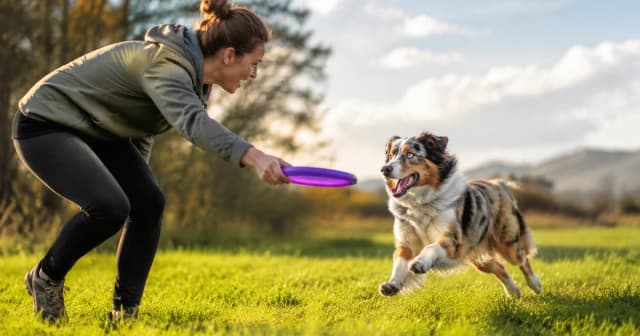
How We Actually Tire Out Our Australian Shepherd (Walks Alone Don't Cut It)
A five-mile run barely scratches the surface for our Australian Shepherd. Here’s how we mix brain games and high-energy play to finally get a tired dog.
Sources & standards
This profile follows recognized breed standards from the American Kennel Club (AKC) and the Fédération Cynologique Internationale (FCI), along with established veterinary and breed-club guidance. These describe general breed tendencies — every dog is an individual.
Owner stories
Have a Australian Shepherd? Share your experience — grooming tips, personality quirks, anything goes.